The Eightfold Path in Asvaghos
・as Saundarananda
Choi, Jin kyoung
〔Abstract〕
In the latter half of the Saundarananda, more precisely from Cantos XII to XVII, Asvaghos・a skillfully depicts the Buddha s detailed expounds on yoga and Nanda s actual practice in the beautiful form of Kavya. This part, therefore, has been considered as one of the most useful sources for understanding the school affiliation of Asvaghos・a, which seems to have been an issue of ongoing
controversy up until now. The purpose of this paper, however, is not about affirming any of the previous assertions, but rather about casting doubts on its textual reliability regarding its doctrinal elements, which naturally leads to skepticism on the long-standing controversy of Asvaghos・a s sectarian identity
itself.
Key words Asvaghos・a, Saundarananda, Eightfold Path, Three Classes of the
path, Sectarian identity
I. Asvaghos
・a s Eightfold Path in the
:on Canto XVI verses 30-33
In middle of Canto XVI of the Saundarananda (SN ), Buddha expounds to Nanda the Eightfold Path as the last constituents of Four Noble Truth :
asyabhyupayo dhigamaya margah・ prajnatrikalpah・ prasamadvikalpah・ / sa bhavanıyo vidhivad budhena sıle sucau tripramukhe sthitena //16.30 //
The method to attain this[cessation of defilements]is the path which consists of threefold Insight (prajna) and twofold Quiescence (prasama). It should be practiced appropriately by the wise who abides in the threefold pure Discipline (sıla).
Correct Verbal and Bodily Behavior (vak/kayakarman), and pure, proper Livelihood (ajıvanaya); these three, which are based on Discipline (sıla), arise in the rules of action in order to control ones behavior.
satyes・u duh・khadis・u dr・・s・tir arya samyag vitarkas ca parakramas ca /
idam・ trayam・ jnanavidhau pravr・ttam・ prajnasrayam・ klesapariks・ayaya //16.32 //
Noble View (dr・・s・ti) on the[four]truths, such as suffering, Correct Reflection (vitar-ka), and Efforts;these three, which are based on Insight (prajna), arise in the rules of wisdom in order to cease defilements.
nyayena satyadhigamaya yukta samyak smr・tih・ samyag atho samadhih・ /
idam・ dvayam・ yogavidhau pravr・ttam・ samasrayam・ cittaparigrahaya //16.33 //
Correct Recollection (smr・ti) connected with proper methods to attain the[four]
truths, and Correct[Meditative]Absorption (samadhi); these two, which are based on Quiescence (sama), arise in the rules of yoga in order to control minds.
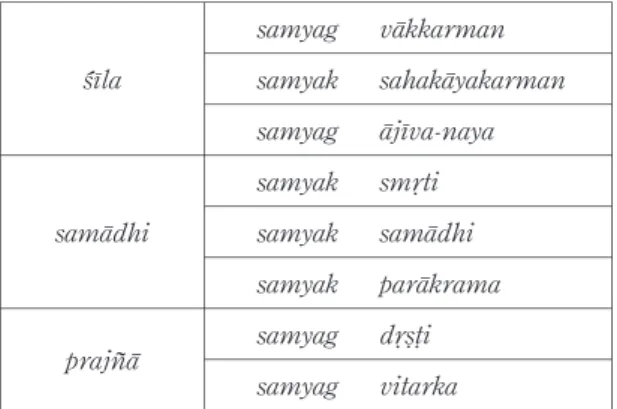
The most unique feature of this style of description is that the Eightfold Path and the Three Classes of the path, i.e., sıla-prajna-samadhi, are interconnected. But in most cases, as far as my limited scope of research indicates, these two systems are described separately(1)
. Table 1 illustrates the classification of the Eightfold Path elements on these verses.
Table 1 Three Class-Eightfold Path model in Johnston s edition of the Saundarananda samyag vakkarman
sıla(16.31) samyak sahakayakarman samyag ajıva-naya samyag drsti prajna(16.32) samyag vitarka
samyak parakrama samyak smrti sama(=samadhi)(16.33)
On this table, unnatural sequence of three classes is noticeable, i.e., sıla-prajna-samadhi which are normally expected to appear in the order of sıla-samadhi-prajna.
Johnston seems to have also paid special attention to these verses and left a long, intuitive note in his standard translations of the text(2)
. First of all, one of the reasons why I call his simple note intuitive is that his suspicion on transposition of verses 32 and 33 has been proven to be correct by a relatively recent identification of Central Asian manuscript fragments by Jens-Uwe Hartmann in 1988(3)
.
Above all, I would like to briefly mention the conditions of two Nepali manuscripts of the Saundarananda with which Johnston produced his standard edition and transla-tions(4). First one is palm leaf manuscript transcribed around 12th century, complete but with many lacunae;the second one is paper manuscript transcribed only in 18th century, also complete and intact but textually much inferior to the first one, and assumed to have derived more or less directly from it. Thus, these are not considered as completely separate versions of the same text. In other words, our current standard text is edited from not much more than a single defective manuscript with many uncertain and prob-ably corrupt passages. This is one of the reasons why there has been so much conten-tion among scholars suggesting different readings of the text.
However, Central Asian fragments, originally published by Heinrich Luders in 1971 but identified only in 1988, are assumed to have been written around 2nd-3rd century, and it covers Canto XVI verses 21c-33a. Richard Salomon notices the numerous diver-gences of these fragments and proves them to be clearly superior by means of thor-ough textual analysis(5)
, which I would not need to specify here. Therefore, these Cen-tral Asian fragments are confirmed to be a part of the older and more original text of the Saundaranada. Fortunately, this superior fragments include the part describing the Eightfold Path and Three Classes. Table 2 displays the differences between two differ-ent editions.
Hartmann s edition of Central Asian Fragments of SN
Johnston s edition of Nepali Manuscripts of SN
XVI. 30
asyabhyupayo dhiga(maya margah prajna kalpah)[p](ra)sama kalpah tau bhavanıyau vidhivad budh[e]na s
[ı]le sucau trppramukhe sthitena
asyabhyupayo dhigamaya margah prajna kalpah prasama kalpah / sa bhavanayo vidhivad budhena
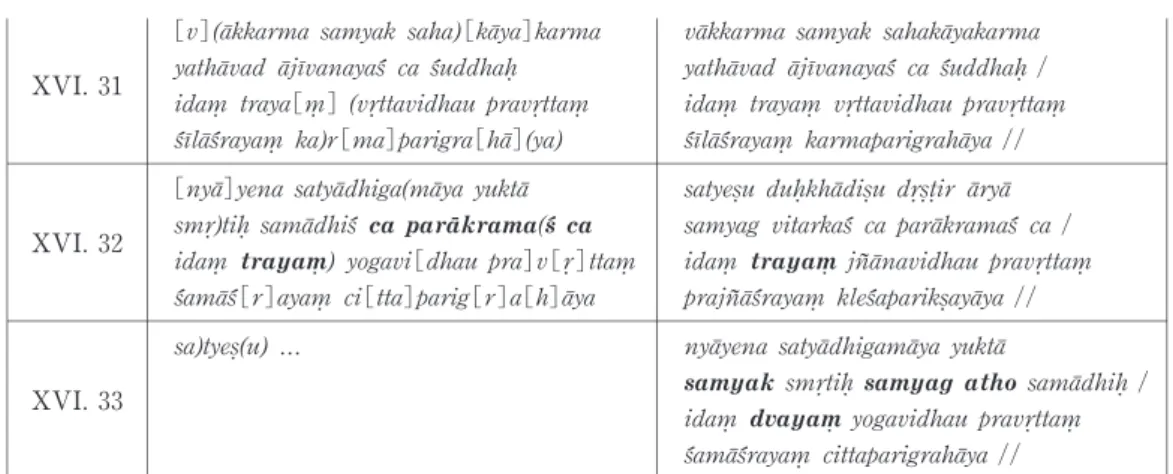
First of all, I would like to pay attention to verses 32 & 33. Although Central Asian fragments ends with the first single word of verse 33, it is enough to confirm that the original order of verses 32 and 33 has been reversed in Nepali manuscript. However, if you take a look more closely, the divergences seem to bear a more complex process of transition of the text. First of all, not only the order of verse 32 & 33 which implies the dislocation of prajna and samadhi classes, but also the position of samyak parakrama (Right Efforts) has changed from samadhi class to prajna class, or rather left in its original position. Plus, the numbers of constituents of samadhi and prajna classes have been carefully re-edited accordingly as you can see in these highlighted parts on verses 32, 33 and 30.
Salomon agrees with Hartmann that the problem is based on a mixing up of verses 31-33. At least in the first stage of transition a simple scribal error or miscopying may have occurred considering the similar endings on these three verses, each of these verses ends with -parigrahaya / -parigrahaya / -pariks・ayaya. Next, Salomon also reason-ably assumes that the rest of the changes indicate the additional and intentional recen-sion of the text at some later period. Salomon s discusrecen-sion ends with his assumption that the text had inevitably been altered to smooth over an initial textual incongruity, and it was conducted possibly probably under the influence of a different doctrinal tradition describing the Eightfold Path(6)
. What I would like to present from now on is the result of my further research regarding a possible different doctrinal background of the last stage of transition of our text.
XVI. 31
[v](akkarma samyak saha)[kaya]karma yathavad ajıvanayas ca suddhah idam traya[m](vrttavidhau pravrttam sılasrayam ka)r[ma]parigra[ha](ya)
vakkarma samyak sahakayakarma yathavad ajıvanayas ca suddhah / idam trayam vrttavidhau pravrttam sılasrayam karmaparigrahaya //
XVI. 32
[nya]yena satyadhiga(maya yukta smr)tih samadhis ( idam ) yogavi[dhau pra]v[r]ttam samas[r]ayam ci[tta]parig[r]a[h]aya
satyesu duhkhadisu drstir arya samyag vitarkas ca parakramas ca / idam jnanavidhau pravrttam prajnasrayam klesapariksayaya //
XVI. 33
sa)tyes(u) ... nyayena satyadhigamaya yukta
smrtih samadhih / idam yogavidhau pravrttam samasrayam cittaparigrahaya //
II. Doctrinal Background of Textual Transition :
Little Skepticism on Controversial Issue of Asvaghos・a s Sectarian Identity
While working on this topic, Johnston s note, again, attracted my attention. Among various references Johnston notes, it is the Cul・avedalla-sutta in Majjhima Nikaya (MN ) that includes the description of classifying the constituents of the Eightfold Path into three classes(7)
. Interestingly, it apparently shows the pattern identical to that of sequence and classification of the Central Asian fragments as illustrated on Table 3 below.
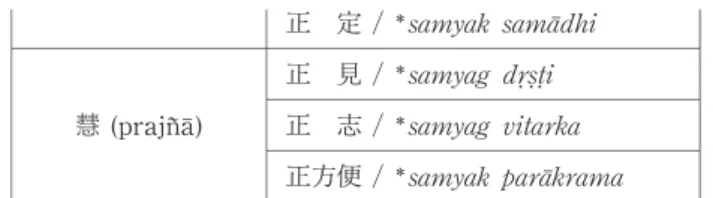
I also checked the equivalent parts in Cul・avedalla-sutta s Chinese equivalent, 法楽比丘尼 経 (TD 1 788-792) as well as the Tibetan transmission of similar Madhyamagama sutra, quoted in Śamathadevas commentary on Abhidharmakosa-bhas・ya (AKBh) titled as Ab-hidharmakos・opayika(8)
. Although it is only extant in Tibetan translations, Śamathadevas commentary is considered tremendously valuable sources as it introduces the entire texts of agama, which have been partly quoted in AKBh. What is more interesting is that both sources present the Three Class-Eightfold Path model as follows (Table 4).
samyag vakkarman sıla samyak sahakayakarman
samyag ajıva-naya samyak smrti samadhi samyak samadhi
samyak parakrama samyag drsti prajna
samyag vitarka
Table 3 Three Class-Eightfold Path model in Central Asian fragments of the Saundarananda
正 語 / samyag vakkarman 戒 (sıla) 正 業 / samyak sahakayakarman
正 命 / samyag ajıva-naya 正 念 / samyak smrti 定 (samadhi)
Table 4 is very much alike with the case of Johnston s edition based on Nepali manu-scripts in Table 1. The only difference is that the order of prajna-samadhi in Table1 is reversed as samadhi-prajna in Table 4, and all the rest of the elements are identically classified. However, If you consider the transitional process which I have mentioned earlier, it is obvious that the latter scriber who attempts to make the intentional re-edition of this part was under the influence of the sources which were close to Chinese Madhyamagama or the similar agama tradition to which Śamathadeva related.
Needless to say, Chinese translations of Madhyamagama are generally assumed to belong to (Mula-)Sarvastivadins, and Śamathadeva is also considered as (Mula-)Sarvas-tivadin. Furthermore, as Johnston s note also introduces, a single phrase on prajna-skandha in Abhidharmakosa-bhas・ya includes the same constituents of the Eightfold Path
as Table1 and 4, which includes the elements Right View, Right Reflection and Right efforts as follows.
samyagdr・・s・tisan・kalpavyayamas ca prajnaskandha uktah・ (AKBh I, 159)
Therefore, the scribe, who worked on Nepali manuscript around 12th century or so, was highly likely under the influence of Sarvastivadin s doctrinal tradition. In other words, as far as dealing with the description on the Eightfold Path, earlier version of the Saundarananda was influenced by non-Sarvastivadin sources which were rather close to Theravada tradition, while the later version of the text was under the influence of Sarvastivadins.
The problem is that scholars who have disputed over Asvaghos・a s school affiliation generally agree on one point that he was Sarvastivadin(9)
. I am not, of course, simply denying the validity of the previous assertions on Asvaghos・a s sectarian identity all of a sudden biased on this tiny fragments describing the Eightfold Path. At the same time, I cannot simply agree with those previous assertions either, as far as regarding the pos-sible non-Sarvastivadin influence on this significant doctrinal statements in the original
正 定 / samyak samadhi 正 見 / samyag drsti (prajna) 正 志 / samyag vitarka
正方 / samyak parakrama
and superior version of the Saundarananda. One should also acknowledge of the fact that all these arguments are merely based on our current standard edition with many corrupted passages. As Salomon relates, judging from this doctrinally significant editori-al recension, one cannot deny the possibility that the complete earlier manuscript of the text would reveal much more cases of doctrinal variants than expected. Therefore, my preliminary conclusion is that it would be rather safe for us to remain vague about Asvaghos・a s Sectarian Identity until we get to have a chance to get to know more about the original text, if that is ever possible.
Notes
(1) Besides the instances in the Culavedalla-sutta and Chinese and Tibetan Madhyamagama discussed below, I have never encountered such a case in any other sources except the one found in Petakopadesa, in which Three Class elements are not directly mentioned [see Mizuno (1997)p. 119ff].
(2) Johnston (1932)pp. 91-92.
(3) Hartmann (1988)pp. 67-68 ;Salomon (1993)p. 238 n. 32. (4) Johnston (1928)vi-x ;Salomon (1993)p. 222.
(5) Salomon (1993)pp. 231-233. (6) Salomon (1993)p. 238.
(7) ya cavuso visakha yo ca yo ca ,
ime dhamma kkhandhe sangahıta;
yo ca ya ca yo ca ,
ime dhamma kkhandhe sangahıta;
ya ca yo ca ,
ime dhamma kkhandhe sangahıtati (MN I, 301) (8) Honjo (1983)p. 98-99 ;p. 106.
(9) Yamabe (1996), Honjo(1987, 1992).
References
Hartmann, Jens-Uwe
1988 Neue Asvaghosa- und Matrceta-Fragmente aus Ostturkistan. Nachrichten der Akademie der Wissenschaften in Gottingen I. Philologisch-Historische Klasse Nr.2 : 53-92.
Honjo, Yoshifumi
の傳へる 大業 別経 と 法施比丘尼経 ), Bukkyobunkakenkyu 28 gou :95-112. 1987 Memyo no naka no kyoryoubusetsu (馬鳴のなかの経量部説), Indogaku Bukkyogaku
Kenkyu 36(1):87-92.
1992 Memyou saku Saundaranannda dai 13 syo, 22-26 (馬鳴作 サウンダラナンダ 第13章、 22-26), Bukkyoronso 37:19-22.
Johnston, E. H.
1928 The Saundarananda of Asvaghosa. London:Oxford University Press.
1932 The Saundarananda or Nanda the Fair: Translated from the Original Sanskrit of Asvaghosa. London:Oxford University Press.
Mizuno, Kogen
1997 Pali Ronjokenkyu, Mizuno Kogen chosakusensyu, vol. 2, Syunjusha. Salomon, Richard
1993 Asvaghosa in Central Asia: Some Comments on the Recensional History of His Works in Light of Recent Manuscript Discoveries. Collection of Essays -Buddhism Across Boundaries: 221-263. Taiwan: Fo Guang Shan Foundation for Buddhist & Culture Education.
Yamabe, Nobuyoshi
1996 On the School Affiliation of An Shigao: Sarvastivada and Yogacara. Unpublished draft read at International Institute for Asian Studies Workshop:The Works of An Shigao, Leiden, December 19, 1996.
(ちぇ じんぎょん 文学研究科仏教学専攻博士後期課程)
(指導: 田 和信 教授) 2009年9月29日受理