BLAST
®
Command Line
Applications User Manual
Last Updated: November 4, 2016
BLAST is a Registered Trademark of the National Library of Medicine
Table of Contents
Contributors... 1
Introduction... 3
Installation... 4
Dependencies... 5
Quick start... 5
User Manual... 7
Functionality offered by BLAST+ applications... 7
BLAST+ features... 7
Configuring BLAST... 12
Input formats to BLAST... 14
Cookbook... 17
Query a BLAST database with a GI, but exclude that GI from the results... 17
Create a masked BLAST database... 17
Search with database masking enabled... 22
Display BLAST search results with custom output format... 23
Use blastdb_aliastool to manage the BLAST databases... 25
Reformat BLAST reports with blast_formatter... 26
Extracting data from BLAST databases with blastdbcmd... 27
Use Windowmasker to filter the query sequence(s) in a BLAST search... 29
Building a BLAST database with local sequences... 30
Limiting a Search with a List of Identifiers... 31
Multiple databases vs. spaces in filenames and paths... 32
Specifying a sequence as the multiple sequence alignment master in psiblast... 32
Ignoring the consensus sequence in the multiple sequence alignment in psiblast... 33
Performing a DELTA-BLAST search... 33
Contributors
Christiam Camacho: [email protected]
homas Madden: [email protected]
Tao Tao: [email protected]
Richa Agarwala: [email protected]
Introduction
Created: June 23, 2008; Updated: May 26, 2016.
Sequence similarity searching is one of the more important bioinformatics activities and oten provides the irst evidence for the function of a newly sequenced gene or piece of sequence. Basic Local Alignment Search Tool (BLAST) is probably the most popular similarity search tool. he National Center for Biotechnology Information (NCBI) irst introduced BLAST in 1989. he NCBI has continued to maintain and update BLAST since the irst version. In 2009, the NCBI introduced a new version of the stand-alone BLAST applications (BLAST+). he BLAST+ applications have a number of
improvements that allow faster searches as well as more lexibility in output formats and in the search input. hese improvements include: splitting of longer queries so as to reduce the memory usage and to take advantage of modern CPU architectures; use of a database index to dramatically speed up the search; the ability to save a “search strategy” that can be used later to start a new search; and greater lexibility in the formatting of tabular results.
he functionality of the BLAST+ applications is organized by search type. As an example, there is a “blastp” application that compares proteins queries to protein databases. he “blastx” application translates a nucleotide query in six frames and searches it against a protein database. his organization is diferent from that of the applications irst released in 1997 (e.g., blastall) that supported all types of searches with one application, but it resembles that of the NCBI BLAST web site. An advantage of this design is that each application has only the options relevant to the searches it performs. Additionally, each application can compare a query to a set of FASTA sequences in a ile, bypassing the need to create a BLAST databases for small and infrequently searched sets. Finally, a “remote” option permits each application to send of a search to the NCBI servers.
his manual has several sections. It provides brief installation instructions, a QuickStart, a section describing BLAST+ features in more depth, a “Cook Book” section on how to perform a number of tasks, as well as three appendices. he irst appendix discusses tools to help with the transition from the older applications (e.g., blastall) to the BLAST+ applications. he second appendix documents exit codes from the BLAST+ applications. he third appendix is a table of BLAST options, the type of input required, and the default values for each application. he fourth appendix lists the scoring parameters that the blastn application supports.
An introduction to BLAST is outside the scope of this manual, more information on this subject can be found on http://blast.ncbi.nlm.nih.gov/Blast.cgi?
CMD=Web&PAGE_TYPE=BlastDocs.
Installation
Installation instructions are available for Windows and LINUX/UNIX. his section provides instructions for a few cases not covered by those entries.
he BLAST+ applications are distributed both as an executable and as source code. For the executable formats we provide installers as well as tarballs; the source code is only provided as a tarball. hese are freely available at tp://tp.ncbi.nlm.nih.gov/blast/ executables/blast+/. Please be sure to use the most recent available version; this will be indicated in the ile name (for instance, in the sections below, version 2.2.18 is listed, but this should be replaced accordingly).
MacOSX
For users without administrator privileges: follow the procedure described in http:// www.ncbi.nlm.nih.gov/books/NBK52640/
For users with administrator privileges and machines MacOSX version 10.5 or higher: Download the ncbi-blast-2.2.18+.dmg installer and double click on it. Double click the newly mounted ncbi-blast-2.2.18+ volume, double click on ncbi-blast-2.2.18+.pkg and follow the instructions in the installer. By default the BLAST+ applications are installed in /usr/local/ncbi/blast, overwriting its previous contents (an uninstaller is provided and it is recommended when upgrading a BLAST+ installation).
RedHat Linux
Download the appropriate *.rpm ile for your platform and either install or upgrade the ncbi-blast+ package as appropriate using the commands:
Install:
rpm -ivh ncbi-blast-2.2.18-1.x86_64.rpm Upgrade:
rpm -Uvh ncbi-blast-2.2.18-1.x86_64.rpm
Note: one must have root privileges to run these commands. If you do not have root privileges, please use the procedure described in http://www.ncbi.nlm.nih.gov/books/ NBK52640/
Source tarball
Use this approach to build the BLAST+ applications yourself. Download the tarball, expand it, change directories to the newly created directory, and type the following commands:
cd c++ ./configure
he compiled executables will be found in c++/ReleaseMT/bin. Please note that this sequence of commands will build the applications with optimizations, with support for multi-threading and it may require the installation of dependencies (see following
section). If a diferent coniguration is desired, please use the conigure.orig script located in the same directory.
Building sources in Windows
Extract the appropriate tarball (e.g.: ncbi-blast-VERSION+-x64-win64-tar.gz) and open the appropriate MSVC solution or project ile (e.g.: c++\compilers\msvc1000_prj\static \build\ncbi_cpp.sln), build the -CONFIGURE- project, click on “Reload” when prompted by the development environment, and then build the -BUILD-ALL- project. he compiled executables will be found in the directory corresponding to the build coniguration
selected (e.g.: c++\compilers\msvc1000_prj\static\bin\debugdll).
Note regarding building the source code
he BLAST source tarballs are a subset of the NCBI C++ toolkit. Information on using and compiling the NCBI C++ toolkit is available at http://www.ncbi.nlm.nih.gov/ toolkit/doc/book. Please send questions about compiling the NCBI C++ toolkit to [email protected]
Dependencies
Starting with BLAST+ 2.5.0, the usage of the –remote option requires the GNUTLS development libraries (http://www.gnutls.org/) to make a secure connection to NCBI. he pre-compiled Linux and MacOS binaries link these statically and the Windows binaries include the required DLLs.
If you are compiling the sources, please be sure your system has the appropriate dependencies installed before building the BLAST+ applications.
Quick start
A BLAST search against a database requires at least a –query and –db option. he command:
blastn –db nt –query nt.fsa –out results.out
will run a search of nt.fsa (a nucleotide sequence in FASTA format) against the nt database, printing results to the ile results.out. If “-out results.out” had been let of, the results would have been printed to stdout (i.e., the screen). he blastn application searches a nucleotide query against a nucleotide database.
To send the search to our servers and databases, add the –remote option:
See more about this option in the section below, BLAST+ remote service.
he BLAST+ applications print documentation when invoked with the –h or –help option. he –h option provides abbreviated help, and the –help lag provides more extensive documentation. For example, use –help to get a list of output options for the – outfmt option.
Create a custom database from a multi-FASTA ile of sequences with this minimal command:
makeblastdb –in mydb.fsa –dbtype nucl –parse_seqids
See the section below, Building a BLAST database with local sequences, for more details.
he BLAST databases are required to run BLAST locally and to support automatic resolution of sequence identiiers. Documentation about these identiiers can be found at
http://www.ncbi.nlm.nih.gov/toolkit/doc/book/ch_demo/#ch_demo.T5. he databases may be retrieved automatically with the update_blastdb.pl PERL script, which is included as part of this distribution. his script will download multiple tar iles for each BLAST database volume if necessary, without having to designate each volume. For example:
./update_blastdb.pl htgs
will download all the relevant HTGs tar iles (htgs.00.tar.gz, …, htgs.N.tar.gz)
he script can also compare your local copy of the database tar ile(s) and only download tar iles if the date stamp has changed relecting a newer version of the database. his will allow the script run on a schedule and only download tar iles when needed.
Documentation for the update_blastdb.pl script can be obtained by running the script without any arguments (perl is required).
RPS-BLAST ready databases are available at tp://tp.ncbi.nih.gov/pub/mmdb/cdd/ he BLAST taxonomy database is required in order to print the scientiic name, common name, blast name, or super kingdom as part of the BLAST report or in a report with blastdbcmd. he BLAST database contains only the taxid (an integer) for each entry, and the taxonomy database allow BLAST to retrieve the scientiic name etc. from a taxid. he BLAST taxonomy database consists of a pair of iles (taxdb.bti and taxdb.btd) that are available as a compressed archive from the NCBI BLAST FTP site (tp://
tp.ncbi.nlm.nih.gov/blast/db/taxdb.tar.gz). he update_blastdb.pl script can be used to download and update this archive; it is recommended that the uncompressed contents of the archive be installed in the same directory where the BLAST databases reside.
Assuming proper ile permissions and that the BLASTDB environment variable contains the path to the installation directory of the BLAST databases, the following commands accomplish that:
# Download the taxdb archive perl update_blastdb.pl taxdb
# Install it in the BLASTDB directory
User Manual
Created: June 23, 2008; Updated: November 4, 2016.
Functionality offered by BLAST+ applications
he functionality ofered by the BLAST+ applications has been organized by program type, as to more closely resemble Web BLAST.
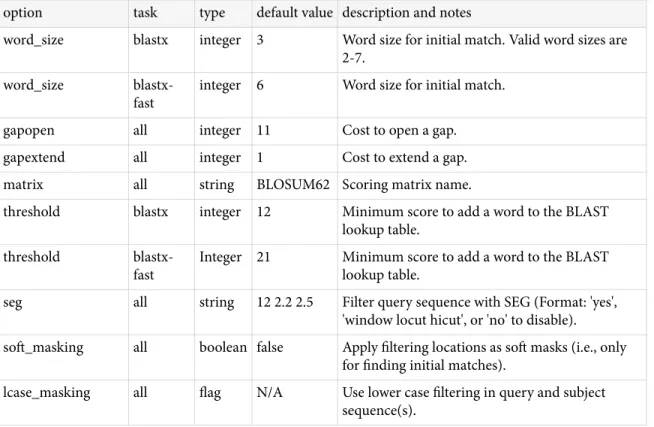
As an example, to run a search of a nucleotide query (translated “on the ly” by BLAST) against a protein database one would use the blastx application. he blastx application will also work in “Blast2Sequences” mode (i.e.: accept FASTA sequences instead of a BLAST database as targets) and can also send BLAST searches over the network to the public NCBI server if desired.
he BLAST+ package ofers three categories of applications: 1.) search tools, 2.) BLAST database tools, and 3.) sequence iltering tools. he blastn, blastp, blastx, tblastx, tblastn, psiblast, rpsblast, and rpstblastn are considered search applications, as they execute a BLAST search, whereas makeblastdb, blastdb_aliastool, makeproiledb, and blastdbcmd are considered BLAST database applications, as they either create or examine BLAST databases.
here is also a new set of sequence iltering applications described in the section Sequence iltering applications and an application to build database indices that greatly speed up megablast in some cases (see section titled Megablast indexed searches).
BLAST+ features
Tasks
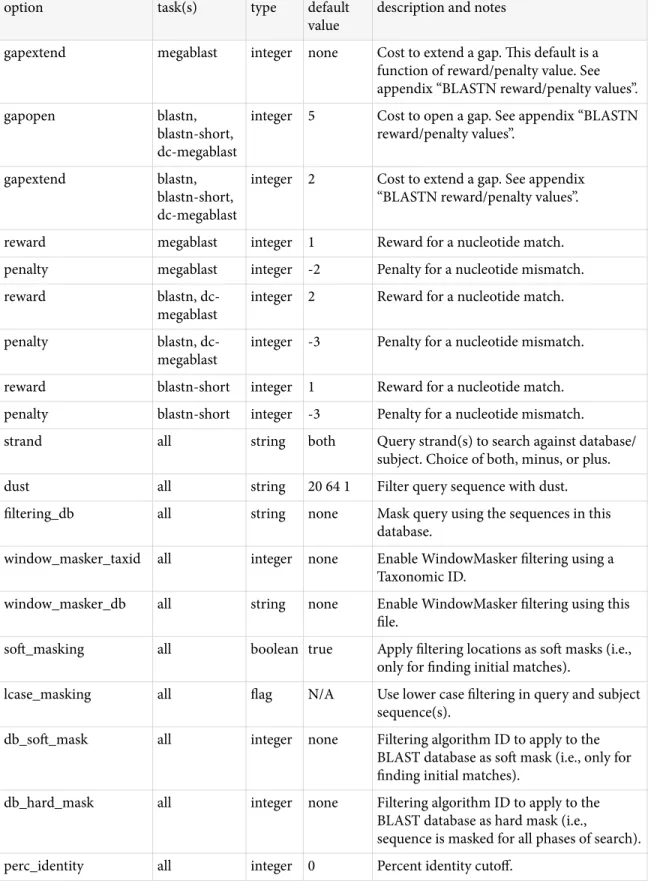
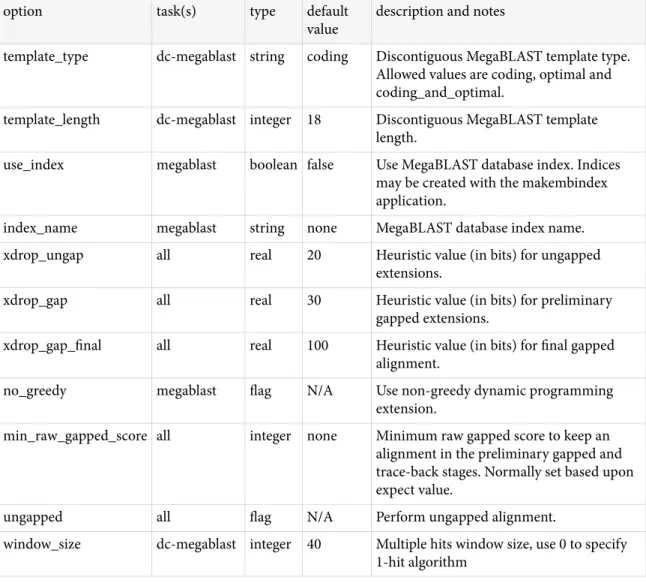
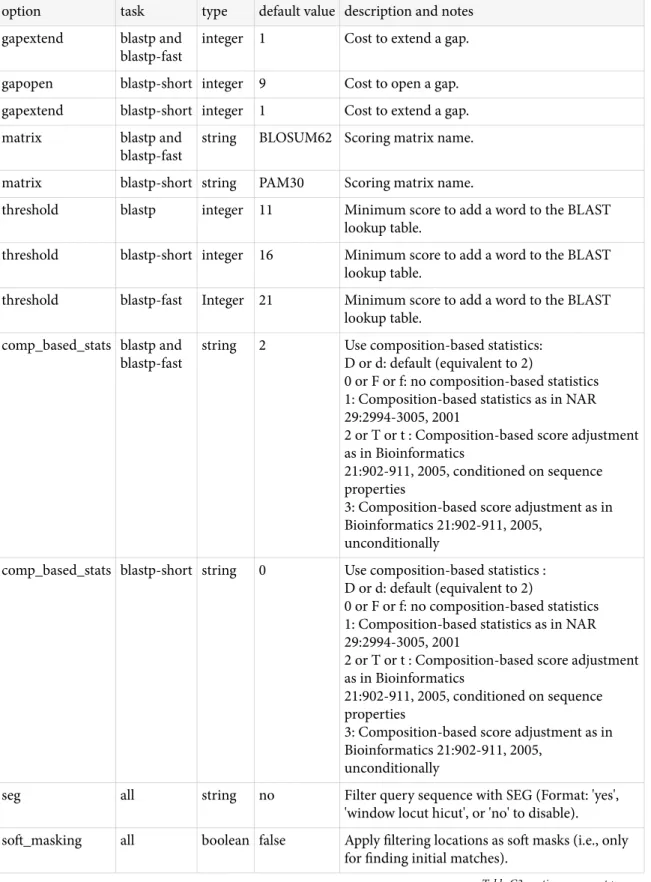
he blastn and blastp applications have a –task option. his option sets the parameters (e.g., word-size or gap values) to typical values for a speciic type of search. For example, the “megablast” task is optimized for intraspecies comparison as it uses a large word-size, whereas “blastn” is better suited for interspecies comparisons with a shorter word-size. hese tasks resemble the “Program Selection” section of the BLAST web pages and do not preclude the user from setting other options to override those speciied by the task. See Appendix "Options for the command-line application" for documentation on parameter values for diferent tasks. he following tasks are currently available:
Program Task Name Description
blastp blastp Traditional BLASTP to compare a protein query to a protein database
blastp-short BLASTP optimized for queries shorter than 30 residues
blastn blastn Traditional BLASTN requiring an exact match of 11
blastn-short BLASTN program optimized for sequences shorter than 50 bases
Table continued from previous page.
megablast Traditional megablast used to ind very similar (e.g., intraspecies or closely related species) sequences
dc-megablast Discontiguous megablast used to ind more distant (e.g., interspecies) sequences
Megablast indexed searches
Indexing provides an alternative way to search for initial matches in nucleotide-nucleotide searches (blastn and megablast) by pre-indexing the N-mer locations in a special data structure, called a database index.
Using an index can improve search times signiicantly under certain conditions. It is most beneicial when the queries are much shorter than the database and works best for queries under 1 Mbases long. he advantage comes from the fact that the whole database does not have to be scanned during the search.
Indices can capture masking information, thereby enabling search against databases masked for repeats, low complexity, etc.
here are, however, limitations to using indexed search in blast:
• Index iles are about four times larger than the blast databases. If an index does not it into computer operating memory, then the advantage of using it is eliminated. • Word size must be set to 16 or more in order to use an indexed search.
• Discontiguous search is not supported.
Reference: Morgulis A, Coulouris G, Raytselis Y, Madden TL, Agarwala R, Schäfer AA. Database Indexing for Production MegaBLAST Searches. Bioinformatics 2008, 24(16): 1757-64. PMID:18567917
BLAST search strategies
BLAST search strategies are iles that encode the inputs necessary to perform a BLAST search. he purpose of these iles is to be able to seamlessly reproduce a BLAST search in various environments (Web BLAST, command line applications, etc).
Exporting search strategies on the Web BLAST
Click on "download" next to the RID/saved strategy in the "Recent Results" or "Saved Strategies" tabs.
Exporting search strategies with BLAST+ applications
Add the -export_search_strategy along with a ile name to the command line options.
Importing search strategies on Web BLAST
Importing search strategies with BLAST+ applications
Add the -import_search_strategy along with a ile name containing the search strategy ile. Note that if provided, the –query, -db, -use_index, and –index_name command line options will override the speciications of the search strategy ile provided (no other command line options will override the contents of the search strategy ile).
Negative GI lists
Search applications support negative GI lists. his feature provides a means to exclude GIs from a BLAST database search. he expect values in the BLAST results are based upon the sequences actually searched and not on the underlying database. For an example, see the cookbook.
Masking in BLAST databases
It is now possible to create BLAST databases that contain iltered sequences (also known as masking information or masks). his iltering information can be used for sot or hard masking of the subject sequences. For instructions on creating masked BLAST databases, please see the cookbook.
Custom output formats for BLAST searches
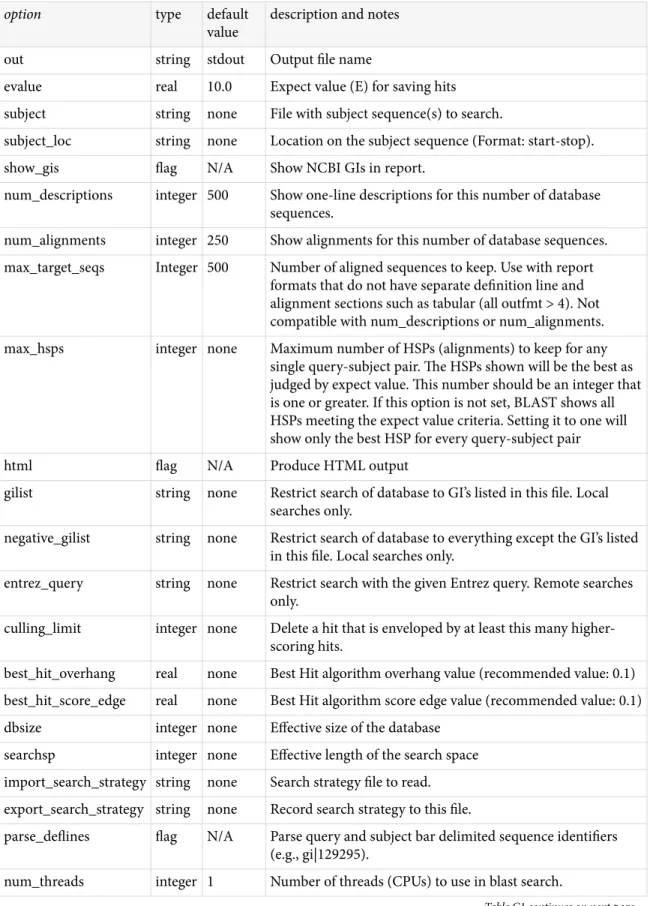
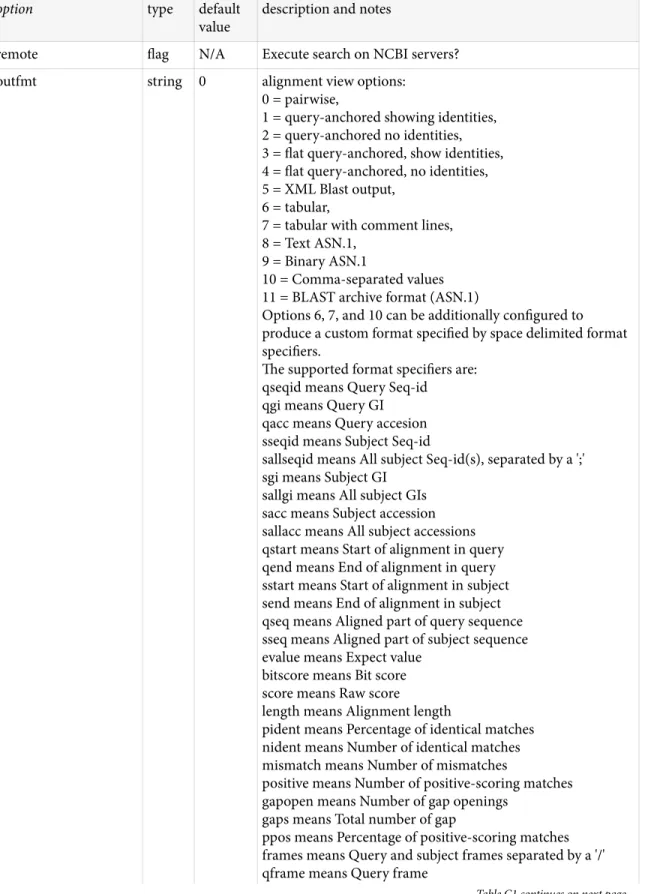
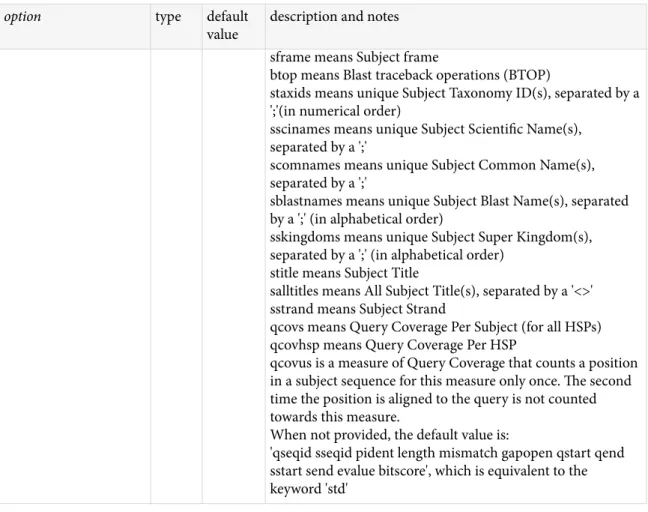
he BLAST+ search command line applications support custom output formats for the tabular and comma-separated value output formats. For more details see “outfmt” in Appendix “Options for the command-line application” as well as the cookbook.
Custom output formats to extract BLAST database data
blastdbcmd supports custom output formats to extract data from BLAST databases via the -outfmt command line option. For more details see the blastdbcmd options in Appendix “Options for the command-line application” as well as the cookbook.
Improved software installation packages
he BLAST+ applications are available via Windows and MacOSX installers as well as RPMs (source and binary) and unix tarballs. For more details about these, refer to the installation section.
Sequence filtering applications
tp.ncbi.nlm.nih.gov/pub/agarwala/windowmasker/README.windowmasker for more information.
Best-Hits filtering algorithm
he Best-Hit iltering algorithm is designed for use in applications that are searching for only the best matches for each query region reporting matches. Its -best_hit_overhang parameter, H, controls when an HSP is considered short enough to be iltered due to presence of another HSP. For each HSP A that is iltered, there exists another HSP B such that the query region of HSP A extends each end of the query region of HSP B by at most H times the length of the query region for B.
Additional requirements that must also be met in order to ilter A on account of B are:
i. evalue(A) >= evalue(B)
ii. score(A)/length(A) < (1.0 – score_edge) * score(B)/length(B)
We consider 0.1 to 0.25 to be an acceptable range for the -best_hit_overhang parameter and 0.05 to 0.25 to be an acceptable range for the -best_hit_score_edge parameter. Increasing the value of the overhang parameter eliminates a higher number of matches, but increases the running time; increasing the score_edge parameter removes smaller number of hits.
Automatic resolution of sequence identifiers
he BLAST+ search applications support automatic resolution of query and subject sequence identiiers speciied as GIs or accessions (see the cookbook section for an example). his feature enables the user to specify one or more sequence identiiers (GIs and/or accessions, one per line) in a ile as the input to the -query and -subject command line options.
Upon encountering this type of input, by default the BLAST+ search applications will try to resolve these sequence identiiers in locally available BLAST databases irst, then in the BLAST databases at NCBI, and inally in Genbank (the latter two data sources require a properly conigured internet connection). hese data sources can be conigured via the DATA_LOADERS coniguration option and the BLAST databases to search can be conigured via the BLASTDB_PROT_DATA_LOADER and
BLASTDB_NUCL_DATA_LOADER coniguration options (see the section on Coniguring BLAST).
BLAST-WindowMasker integration in BLAST+ search applications
In the irst case, the WINDOW_MASKER_PATH coniguration parameter should refer to a directory which contains subdirectories named ater NCBI taxonomy IDs (e.g.: 9606 for human, 10090 for mouse), where the windowmasker unit counts data iles should be placed with the following naming convention: wmasker.obinary (for iles generated with the obinary format) and/or wmasker.oascii (for iles generated with the oascii format). For an example on how to create these iles, please see the Cookbook. Once these
windowmasker iles and the coniguration ile are in place, this feature can be invoked by providing the taxonomy ID to the -window_masker_taxid command line option.
Alternatively, this feature can also be invoked by providing the path to the windowmasker unit counts data ile via the -window_masker_db.
Please see the Cookbook for a usage example of this feature.
DELTA-BLAST: A tool for sensitive protein sequence search
DELTA-BLAST uses RPS-BLAST to search for conserved domains matching to a query, constructs a PSSM from the sequences associated with the matching domains, and searches a sequence database. Its sensitivity is comparable to PSI-BLAST and does not require several iterations of searches against a large sequence database. See the cookbook for more information.
Concatenation of queries
BLAST works more eiciently if it scans the database once for multiple queries. his feature is known as concatenation. It speeds up MegaBLAST searches the most as they spend little time on tasks that consume CPU and most of the time streaming through the database. BLASTN and discontiguous MegaBLAST searches also run faster with
concatenation, though the efect is less pronounced. BLAST+ applies concatenation on all types of searches (e.g., also BLASTP, etc.), and it can be very beneicial if the input is a large number of queries in FASTA format. BLAST+ concatenates queries by grouping them together until a speciic number of letters (or “chunk size”) is reached.
Unfortunately, a constant chunk size for each database scan causes certain problems. For some searches the chunk size is too large, too many letters are searched at once, and the process consumes too much memory. Tests have shown that the number of successful ungapped extensions performed in the preliminary stage is a good predictor of overall memory use during a search. he BLASTN application (starting with the 2.2.28 release) takes advantage of this insight to provide an “adaptive chunk size”. he application starts with a low initial chunk size of 10,000 bases and records how many successful ungapped extensions were performed during search. It adjusts the chunk size on the next database scan with a target of performing two million extensions during the search.
BLAST+ remote service
he BLAST+ applications can also send a search to the servers at the NCBI. In this case, the BLAST+ application is acting as a client and there is no need to install a database or provide more than minimal computing power. he BLAST+ remote service uses the same servers used by the NCBI BLAST website. he BLAST server can return a Request ID (RID) as part of the results, and that RID can be used to reformat the results with the blast_formatter or on the NCBI website. In general, the servers keep the results for an RID for 36 hours. he BLAST+ applications will use the remote service if the –remote lag is added to the command line. he BLAST+ remote service uses a shared resource (the computers at the NCBI), so only one BLAST+ application should run remote searches at a time. An example in the cookbook section demonstrates a remote search.
Configuring BLAST
he BLAST+ search applications can be conigured by means of a coniguration ile or environment variables.
Configuring BLAST via configuration file
his can be accomplished with a coniguration ile named .ncbirc (on Unix-like platforms) or ncbi.ini (on Windows). his is a plain text ile that contains sections and key-value pairs to specify coniguration parameters. Lines starting with a semi-colon are considered comments. he application will search for the ile in the following order and locations:
1. Current working directory (*) 2. User's HOME directory (*)
3. Directory speciied by the NCBI environment variable
4. he standard system directory (“/etc” on Unix-like systems, and given by the environment variable SYSTEMROOT on Windows)
(*) Unless the NCBI_DONT_USE_LOCAL_CONFIG environment variable is deined.
he search for this ile will stop at the irst location where it is found and the
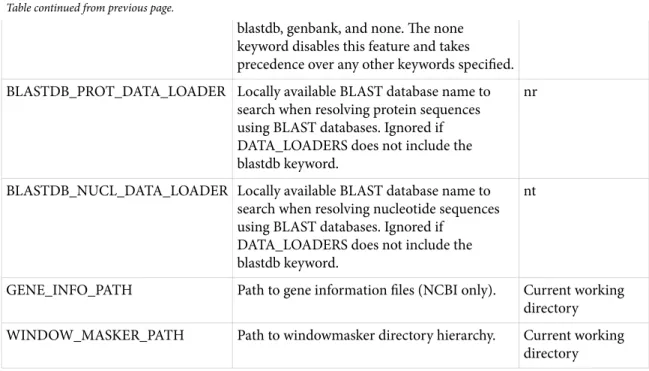
conigurations settings from that ile will be applied. If the coniguration ile is not found or if the NCBI_DONT_USE_NCBIRC environment variable is deined, the default values will apply. he following are the possible coniguration parameters that impact the BLAST + applications:
Coniguration Parameter Speciies Default value
BLASTDB Path to BLAST databases. Current working
directory
DATA_LOADERS Data loaders to use for automatic sequence identiier resolution. his is a comma separated list of the following keywords:
blastdb,genbank
Table continued from previous page.
blastdb, genbank, and none. he none keyword disables this feature and takes precedence over any other keywords speciied.
BLASTDB_PROT_DATA_LOADER Locally available BLAST database name to search when resolving protein sequences using BLAST databases. Ignored if DATA_LOADERS does not include the blastdb keyword.
nr
BLASTDB_NUCL_DATA_LOADER Locally available BLAST database name to search when resolving nucleotide sequences using BLAST databases. Ignored if
DATA_LOADERS does not include the blastdb keyword.
nt
GENE_INFO_PATH Path to gene information iles (NCBI only). Current working directory
WINDOW_MASKER_PATH Path to windowmasker directory hierarchy. Current working directory
he following is an example with comments describing the available parameters for coniguration:
; Start the section for BLAST configuration [BLAST]
; Specifies the path where BLAST databases are installed BLASTDB=/home/guest/blast/db
; Specifies the data sources to use for automatic resolution ; for sequence identifiers
DATA_LOADERS=blastdb
; Specifies the BLAST database to use resolve protein sequences BLASTDB_PROT_DATA_LOADER=custom_protein_database
; Specifies the BLAST database to use resolve protein sequences BLASTDB_NUCL_DATA_LOADER=/home/some_user/my_nucleotide_db
; Windowmasker settings [WINDOW_MASKER]
WINDOW_MASKER_PATH=/home/guest/blast/db/windowmasker ; end of file
Configuring BLAST via environment variables
Please note that the environment variables take precedence over any settings from the NCBI coniguration ile.
Environment Variable Speciies
NCBI Path to NCBI coniguration ile.
NCBI_DONT_USE_NCBIRC If deined, no NCBI coniguration ile will be used.
Table continued from previous page.
NCBI_DONT_USE_LOCAL_CONFIG If deined, no NCBI coniguration ile on the local directory or the user’s HOME directory will be used
BLASTDB Path to BLAST databases.
BLASTMAT Path to scoring matrix iles.
BATCH_SIZE See “Controlling concatenation of queries” and “Memory usage” sections below.
NCBI_CONFIG__BLAST__X Assuming X is any of the coniguration parameters from the previous section, it serves the same purpose.
Controlling concatenation of queries
As described above, BLAST+ works more eiciently if it scans the database once for multiple queries. his feature is knows as concatenation. Unfortunately, for some searches the concatenation values are not optimal, too many queries are searched at once, and the process can consume too much memory. For applications besides BLASTN (which uses an adaptive approach), it is possible to control these values by setting the BATCH_SIZE environment variable. Setting the value too low will degrade performance dramatically, so this environment variable should be used with caution.
Memory usage
he BLAST search programs can exhaust all memory on a machine if the input is too large or if there are too many hits to the BLAST database. If this is the case, please see your operating system documentation to limit the memory used by a program (e.g.: ulimit on Unix-like platforms). Setting the BATCH_SIZE environment variable as described above may help.
Input formats to BLAST
Multiple sequence alignment
he -in_msa psiblast option provides a way to jump start psiblast from a master-slave multiple sequence alignment computed outside psiblast. he multiple sequence alignment must contain the query sequence as one of its sequences, but it need not be the irst
sequence. he multiple sequence alignment must be speciied in a format that is derived from Clustal, but without some headers and trailers (see example below).
sequence identiier followed by some whitespace followed by characters (and gaps) for that sequence in the multiple sequence alignment. In each column, all letters must be in upper case, or all letters must be in lower case.
# Example multiple sequence alignment file align1
---26SPS9_Hs IHAAEEKDWKTAYSYFYEAFEGYdsidspkaitslkymllckimlntpedvqalvsgkla F57B9_Ce LHAADEKDFKTAFSYFYEAFEGYdsvdekvsaltalkymllckvmldlpdevnsllsakl YDL097c_Sc ILHCEDKDYKTAFSYFFESFESYhnltthnsyekacqvlkymllskimlnliddvkniln YMJ5_Ce LYSAEERDYKTSFSYFYEAFEGFasigdkinatsalkymilckimlneteqlagllaake FUS6_ARATH KNYIRTRDYCTTTKHIIHMCMNAilvsiemgqfthvtsyvnkaeqnpetlepmvnaklrc COS41.8_Ci SLDYKLKTYLTIARLYLEDEDPVqaemyinrasllqnetadeqlqihykvcyarvldyrr 644879 KCYSRARDYCTSAKHVINMCLNVikvsvylqnwshvlsyvskaestpeiaeqrgerdsqt YPR108w_Sc IHCLAVRNFKEAAKLLVDSLATFtsieltsyesiatyasvtglftlertdlkskvidspe eif-3p110_Hs SKAMKMGDWKTCHSFIINEKMNGkvw---T23D8.4_Ce SKAMLNGDWKKCQDYIVNDKMNQkvw---YD95_Sp IYLMSIRNFSGAADLLLDCMSTFsstellpyydvvryavisgaisldrvdvktkivdspe KIAA0107_Hs LYCVAIRDFKQAAELFLDTVSTFtsyelmdyktfvtytvyvsmialerpdlrekvikgae F49C12.8_Hs LYRMSVRDFAGAADLFLEAVPTFgsyelmtyenlilytvitttfaldrpdlrtkvircne Int-6_Mm KFQYECGNYSGAAEYLYFFRVLVpatdrnalsslwgklaseilmqnwdaamedltrlket
26SPS9_Hs lryagrqtealkcvaqasknrsladfekaltdy---F57B9_Ce alkyngsdldamkaiaaaaqkrslkdfqvafgsf---YDL097c_Sc akytketyqsrgidamkavaeaynnrslldfntalkqy---YMJ5_Ce ivayqkspriiairsmadafrkrslkdfvkalaeh---FUS6_ARATH asglahlelkkyklaarkfldvnpelgnsyneviapqdiatygglcalasfdrselkqkv COS41.8_Ci kfleaaqrynelsyksaiheteqtkalekalncailapagqqrsrmlatlfkdercqllp 644879 qailtklkcaaglaelaarkykqaakclllasfdhcdfpellspsnvaiygglcalatfd YPR108w_Sc llslisttaalqsissltislyasdyasyfpyllety---eif-3p110_Hs T23D8.4_Ce ---YD95_Sp vlavlpqnesmssleacinslylcdysgffrtladve---KIAA0107_Hs ilevlhslpavrqylfslyecrysvffqslavv---F49C12.8_Hs vqeqltggglngtlipvreylesyydchydrffiqlaale---Int-6_Mm idnnsvssplqslqqrtwlihwslfvffnhpkgrdniidlflyqpqylnaiqtmcphilr
26SPS9_Hs RAELRDDPIISTHLAKLYDNLLEQNLIRVIEPFSRVQIEHISSLIKLSKADVERKLSQMI F57B9_Ce PQELQMDPVVRKHFHSLSERMLEKDLCRIIEPYSFVQIEHVAQQIGIDRSKVEKKLSQMI YDL097c_Sc EKELMGDELTRSHFNALYDTLLESNLCKIIEPFECVEISHISKIIGLDTQQVEGKLSQMI YMJ5_Ce KIELVEDKVVAVHSQNLERNMLEKEISRVIEPYSEIELSYIARVIGMTVPPVERAIARMI FUS6_ARATH KSNLLLDIHLHDHVDTLYDQIRKKALIQYTLPFVSVDLSRMADAFKTSVSGLEKELEALI COS41.8_Ci QLMPHQKAITADGSNILHRAVTEHNLLSASKLYNNIRFTELGALLEIPHQMAEKVASQMI 644879 KDNLLLDMYLAPHVRTLYTQIRNRALIQYFSPYVSADMHRMAAAFNTTVAALEDELTQLI YPR108w_Sc ANVLIPCKYLNRHADFFVREMRRKVYAQLLESYKTLSLKSMASAFGVSVAFLDNDLGKFI eif-3p110_Hs DLFPEADKVRTMLVRKIQEESLRTYLFTYSSVYDSISMETLSDMFELDLPTVHSIISKMI T23D8.4_Ce NLFHNAETVKGMVVRRIQEESLRTYLLTYSTVYATVSLKKLADLFELSKKDVHSIISKMI YD95_Sp VNHLKCDQFLVAHYRYYVREMRRRAYAQLLESYRALSIDSMAASFGVSVDYIDRDLASFI KIAA0107_Hs EQEMKKDWLFAPHYRYYVREMRIHAYSQLLESYRSLTLGYMAEAFGVGVEFIDQELSRFI F49C12.8_Hs SERFKFDRYLSPHFNYYSRGMRHRAYEQFLTPYKTVRIDMMAKDFGVSRAFIDRELHRLI Int-6_Mm ESVLVNDFFLVACLEDFIENARLFIFETFCRIHQCISINMLADKLNMTPEEAERWIVNLI
Cookbook
Created: June 23, 2008; Updated: May 26, 2016.
Query a BLAST database with a GI, but exclude that GI from
the results
Extract a GI from the ecoli database:
$ blastdbcmd -entry all -db ecoli -dbtype nucl -outfmt %g | head -1 | \ tee exclude_me
1786181
Run the restricted database search, which shows there are no self-hits: $ blastn -db ecoli -negative_gilist exclude_me -show_gis -num_alignments 0 \ -query exclude_me | grep `cat exclude_me`
Query= gi|1786181|gb|AE000111.1|AE000111 $
Create a masked BLAST database
Creating a masked BLAST database is a two step process:
a. Generate the masking data using a sequence iltering utility like windowmasker or dustmasker
b. Generate the actual BLAST database using makeblastdb
For both steps, the input ile can be a text ile containing sequences in FASTA format, or an existing BLAST database created using makeblastdb. We will provide examples for both scenarios.
Collect mask information files
For nucleotide sequence data in FASTA iles or BLAST database format, we can generate the mask information iles using windowmasker or dustmasker. Windowmasker masks the over-represented sequence data and it can also mask the low complexity sequence data using the built-in dust algorithm (through the -dust option). To mask low-complexity sequences only, we will need to use dustmasker.
For protein sequence data in FASTA iles or BLAST database format, we need to use segmasker to generate the mask information ile.
he following examples assume that BLAST databases, listed in “Obtaining sample data for this cookbook entry”, are available in the current working directory. Note that you should use the sequence id parsing consistently. In all our examples, we enable this function by including the “-parse_seqids” in the command line arguments.
Create masking information using dustmasker
$ dustmasker -in hs_chr -infmt blastdb -parse_seqids \ -outfmt maskinfo_asn1_bin -out hs_chr_dust.asnb
Here we specify the input is a BLAST database named hs_chr (-in hs_chr -infmt blastdb), enable the sequence id parsing (-parse_seqids), request the mask data in binary asn.1 format (-outfmt maskinfo_asn1_bin), and name the output ile as hs_chr_dust.asnb (-out hs_chr_dust.asnb).
If the input format is the original FASTA ile, hs_chr.fa, we need to change input to -in and -infmt options as follows:
$ dustmasker -in hs_chr.fa -infmt fasta -parse_seqids \ -outfmt maskinfo_asn1_bin -out hs_chr_dust.asnb
Create masking information using windowmasker
To generate the masking information using windowmasker from the BLAST database hs_chr, we irst need to generate a counts ile:
$ windowmasker -in hs_chr -infmt blastdb -mk_counts \ -parse_seqids -out hs_chr_mask.counts –sformat obinary
Here we specify the input BLAST database (-in hs_chr -infmt blastdb), request it to generate the counts (-mk_counts) with sequence id parsing (-parse_seqids), and save the output to a ile named hs_chr_mask.counts (-out hs_chr_mask.counts).
To use the FASTA ile hs_chr.fa to generate the counts, we need to change the input ile name and format:
$ windowmasker -in hs_chr.fa -infmt fasta -mk_counts \ -parse_seqids -out hs_chr_mask.counts –sformat obinary
With the counts ile we can then proceed to create the ile containing the masking information as follows:
$ windowmasker -in hs_chr -infmt blastdb -ustat hs_chr_mask.counts \ -outfmt maskinfo_asn1_bin -parse_seqids -out hs_chr_mask.asnb
Here we need to use the same input in hs_chr -infmt blastdb) and the output of step 1 (-ustat hs_chr_mask.counts). We set the mask ile format to binary asn.1 (-outfmt
maskinfo_asn1_bin), enable the sequence ids parsing (-parse_seqids), and save the masking data to hs_chr_mask.asnb (-out hs_chr_mask.asnb).
To use the FASTA ile hs_chr.fa, we change the input ile name and ile type:
$ windowmasker -in hs_chr.fa -infmt fasta -ustat hs_chr.counts \ -outfmt maskinfo_asn1_bin -parse_seqids -out hs_chr_mask.asnb
Create masking information using segmasker
$ segmasker -in refseq_protein -infmt blastdb -parse_seqids \ -outfmt maskinfo_asn1_bin -out refseq_seg.asnb
Here we specify the refseq_protein BLAST database (-in refseq_protein -infmt blastdb), enable sequence ids parsing (-parse_seqids), request the mask data in binary asn.1 format (-outfmt maskinfo_asn1_bin), and name the out ile as refseq_seg.asnb (-out
refseq_seg.asnb).
If the input format is the FASTA ile, we need to change the command line to specify the input format:
$ segmasker -in refseq_protein.fa -infmt fasta -parse_seqids \ -outfmt maskinfo_asn1_bin -out refseq_seg.asnb
Extract masking information from FASTA sequences with lowercase masking
We can also extract the masking information from a FASTA sequence ile with lowercase masking (generated by various means) using convert2blastmask utility. An example command line follows:
$ convert2blastmask -in hs_chr.mfa -parse_seqids -masking_algorithm repeat \ -masking_options "repeatmasker, default" -outfmt maskinfo_asn1_bin \
-out hs_chr_mfa.asnb
Here the input is hs_chr.mfa (-in hs_chr.mfa), enable parsing of sequence ids, specify the masking algorithm name masking_algorithm repeat) and its parameter
(-masking_options “repeatmasker, default”), and ask for asn.1 output (-outfmt maskinfo_asn1_bin) to be saved in speciied ile (-out hs_chr_mfa.asnb).
Create BLAST database with the masking information
Using the masking information data iles generated in the previous 4 steps, we can create BLAST database with masking information incorporated.
Note: we should use “-parse_seqids” in a consistent manner – either use it in both steps or not use it at all.
Create BLAST database with masking information using an existing BLAST database or FASTA sequence file as input
For example, we can use the following command line to apply the masking information, created above, to the existing BLAST database generated in Obtaining sample data for this cookbook entry:
$ makeblastdb -in hs_chr –input_type blastdb -dbtype nucl -parse_seqids \ -mask_data hs_chr_mask.asnb -out hs_chr -title \
"Human Chromosome, Ref B37.1"
mask_data hs_chr_mask.asnb), and name the output database with the same base name (-out hs_chr) overwriting the existing one.
To use the original FASTA sequence ile (hs_chr.fa) as the input, we need to use “-in hs_chr.fa” to instruct makeblastdb to use that FASTA ile instead.
We can check the “re-created” database to ind out if the masking information was added properly, using blastdbcmd with the following command line:
$ blastdbcmd -db hs_chr -info
his command prints out a summary of the target database:
Database: human chromosomes, Ref B37.1
24 sequences; 3,095,677,412 total bases
Date: Aug 13, 2009 3:02 PM Longest sequence: 249,250,621 bases
Available filtering algorithms applied to database sequences:
Algorithm ID Algorithm name Algorithm options
30 windowmasker
Volumes:
/export/home/tao/blast_test/hs_chr
Extra lines under the “Available iltering algorithms …” describe the masking algorithms available. he “Algorithm ID” ield, 30 in our case, is what we need to use if we want to invoke database sot masking during an actual search through the “-db_sot_mask” parameter.
We can apply additional masking data to an existing BLAST database with one type of masking information already added. For example, we can apply the dust masking generated above to the database generated earlier by using this command line:
$ makeblastdb -in hs_chr –input_type blastdb -dbtype nucl -parse_seqids \ -mask_data hs_chr_dust.asnb -out hs_chr -title "Human Chromosome, Ref B37.1"
Here, we use the existing database as input ile (-in hs_chr), specify its input and molecule type (-input_type blastdb -dbtype nucl), enable parsing of sequence ids (-parse_seqids), provide the dust masking data (-mask_data hs_chr_dust.asnb), naming the database with the same based name (-out hs_chr) overwriting the existing one.
Checking the “re-generated” database with blastdbcmd:
$ blastdbcmd -db hs_chr -info
we can see that both sets of masking information are available:
Database: Human Chromosome, Ref B37.1
24 sequences; 3,095,677,412 total bases
Available filtering algorithms applied to database sequences:
Algorithm ID Algorithm name Algorithm options
11 dust window=64; level=20; linker=1 30 windowmasker
Volumes:
/net/gizmo4/export/home/tao/blast_test/hs_chr
A more straightforward approach to apply multiple sets of masking information in a single makeblastdb run by providing multiple set of masking data iles in a comma delimited list:
$ makeblastdb -in hs_chr –input_type blastdb -dbtype nucl -parse_seqids \ -mask_data hs_chr_dust.asnb, hs_chr_mask.asnb -out hs_chr
Create a protein BLAST database with masking information
We can use the masking data ile generated in “Create masking information using segmasker” to create a protein BLAST database:
$ makeblastdb -in refseq_protein –input_type blastdb -dbtype prot -parse_seqids \ -mask_data refseq_seg.asnb -out refseq_protein -title \
"RefSeq Protein Database"
Using blastdbcmd, we can check the database thus generated:
$ blastdbcmd -db refseq_protein -info
his produces the following summary, which includes the masking information:
Database: RefSeq Protein Database
7,044,477 sequences; 2,469,203,411 total residues
Date: Sep 1, 2009 10:50 AM Longest sequence: 36,805 residues
Available filtering algorithms applied to database sequences:
Algorithm ID Algorithm name Algorithm options 21 seg window=12; locut=2.2; hicut=2.5
Volumes:
/export/home/tao/blast_test/refseq_protein2.00 /export/home/tao/blast_test/refseq_protein2.01 /export/home/tao/blast_test/refseq_protein2.02
Create a nucleotide BLAST database using the masking information extracted from lower case masked FASTA file
We use the following command line:
$ makeblastdb -in hs_chr.mfa -dbtype nucl -parse_seqids \
Here we use the lowercase masked FASTA sequence ile as input (-in hs_chr.mfa), its ile type (-input_type fasta), specify the database as nucleotide (-dbtype nucl), enable parsing of sequence ids (-parse_seqids), provide the masking data (-mask_data hs_chr_mfa.asnb), and name the resulting database as hs_chr_mfa (-out hs_chr_mfa).
Checking the database thus generated using blastdbcmd, we have:
Database: Human chromosomes (mfa)
24 sequences; 3,095,677,412 total bases
Date: Aug 26, 2009 11:41 AM Longest sequence: 249,250,621 bases
Available filtering algorithms applied to database sequences:
Algorithm ID Algorithm name Algorithm options 40 repeat repeatmasker lowercase
Volumes:
/export/home/tao/hs_chr_mfa
he algorithm name and algorithm options are the values we provided in “Extract masking information from FASTA sequences with lowercase masking”.
Obtaining Sample data for this cookbook entry
For input nucleotide sequences, we use the BLAST database generated from a FASTA input ile hs_chr.fa, containing complete human chromosomes from BUILD38, generated by inlating and combining the hs_ref_*.fa.gz iles located at:
ftp.ncbi.nlm.nih.gov/genomes/H_sapiens/Assembled_chromosomes/seq/
We use this command line to create the BLAST database from the input nucleotide sequences:
$ makeblastdb -in hs_chr.fa -dbtype nucl -parse_seqids \ -out hs_chr -title "Human chromosomes, Ref B38"
For input nucleotide sequences with lowercase masking, we use the FASTA ile
hs_chr.mfa, containing the complete human chromosomes from BUILD37.1, generated by inlating and combining the hs_ref_*.mfa.gz iles located in the same tp directory.
For input protein sequences, we use the preformatted refseq_protein database from the NCBI blast/db/ tp directory:
ftp.ncbi.nlm.nih.gov/blast/db/refseq_protein.00.tar.gz ftp.ncbi.nlm.nih.gov/blast/db/refseq_protein.01.tar.gz ftp.ncbi.nlm.nih.gov/blast/db/refseq_protein.02.tar.gz
Search with database masking enabled
known as "hard-masking", and BLAST uses the database mask during all phases of the search. Here, we look at both types of masking.
To enable database masking during a BLAST search, we use the –info parameter of blastdbcmd to discover the masking Algorithm ID. For the database generated in the previous cookbook entry, we can use the following command line to activate the windowmasker sot masking:
$ blastn -query HTT_gene -task megablast -db hs_chr -db_soft_mask 30 \ -outfmt 7 -out HTT_megablast_softmask.out -num_threads 4
Here, we search a nucleotide query, HTT_gene* (-query HTT_gene), with the megablast algorithm (-task megablast) against the database hs_chr (-db hs_chr). We use sot
masking (-db_sot_mask 30), set the result format to tabular output (-outfmt 7), and save the result to a ile named HTT_megablast_sotmask.tab (-out
HTT_megablast_sotmask.tab). We also activated the multi-threaded feature of blastn to speed up the search by using 4 CPUs$ (-num_threads 4).
For the database generated in the previous cookbook entry, we can use the following command line to activate the windowmasker hard masking:
$ blastn -query HTT_gene -task megablast -db hs_chr -db_hard_mask 30 \ -outfmt 7 -out HTT_megablast_hardmask.out -num_threads 4
he options are similar to the ones for sot masking, except that we use –db_hard_mask rather than –db_sot_mask. Additionally, we changed the name of the output ile.
Hard masking is much more aggressive than sot masking. In interspersed or simple repeats, sot masking normally provides the best results. Hard masking may be warranted to remove vector or other contamination from the BLAST results.
*his is a genomic fragment containing the HTT gene from human, including 5 kb up- and down-stream of the transcribed region. It is represented by NG_009378.
$ he number to use under in your run will depend on the number of CPUs your system
has.
In a test run under a 64-bits Linux machine, the search with sot masking took about 1.5 seconds real time, and the search with hard masking took about 2.5 seconds real time. he search without database masking took about 31 minutes.
Display BLAST search results with custom output format
Example of custom output format
he following example shows how to display the results of a BLAST search using a custom output format. he tabular output format with comments is used, but only the query accession, subject accession, evalue, query start, query stop, subject start, and subject stop are requested. For brevity, only the irst 10 lines of output are shown:
$ echo 1786181 | ./blastn -db ecoli -outfmt "7 qacc sacc evalue qstart qend sstart send"
# BLASTN 2.2.18+
# Query: gi|1786181|gb|AE000111.1|AE000111 # Database: ecoli
# Fields: query acc., subject acc., evalue, q. start, q. end, s. start, s. end
# 85 hits found
AE000111 AE000111 0.0 1 10596 1 10596 AE000111 AE000174 8e-30 5565 5671 6928 6821 AE000111 AE000394 1e-27 5587 5671 135 219 AE000111 AE000425 6e-26 5587 5671 8552 8468 AE000111 AE000171 3e-24 5587 5671 2214 2130 $
Trace-back operations (BTOP)
he “Blast trace-back operations” (BTOP) string describes the alignment produced by BLAST. his string is similar to the CIGAR string produced in SAM format, but there are important diferences. BTOP is a more lexible format that lists not only the aligned region but also matches and mismatches. BTOP operations consist of 1.) a number with a count of matching letters, 2.) two letters showing a mismatch (e.g., “AG” means A was replaced by G), or 3.) a dash (“-“) and a letter showing a gap. he box below shows a blastn run irst with BTOP output and then the same run with the BLAST report showing the alignments.
$ blastn -query test_q.fa -subject test_s.fa -dust no -outfmt "6 qseqid sseqid btop" -parse_deflines
query1 q_multi 7AG39 query1 q_multi 7A-39 query1 q_multi 6-G-A41
$ blastn -query test_q.fa -subject test_s.fa -dust no -parse_deflines BLASTN 2.2.24+
Query= query1 Length=47
Subject= Length=142
Query 1 ACGTCCGAGACGCGAGCAGCGAGCAGCAGAGCGACGAGCAGCGACGA 47 ||||||| ||||||||||||||||||||||||||||||||||||||| Sbjct 47 ACGTCCGGGACGCGAGCAGCGAGCAGCAGAGCGACGAGCAGCGACGA 93
Score = 80.5 bits (43), Expect = 3e-21 Identities = 46/47 (97%), Gaps = 1/47 (2%) Strand=Plus/Plus
Query 1 ACGTCCGAGACGCGAGCAGCGAGCAGCAGAGCGACGAGCAGCGACGA 47 ||||||| ||||||||||||||||||||||||||||||||||||||| Sbjct 1 ACGTCCG-GACGCGAGCAGCGAGCAGCAGAGCGACGAGCAGCGACGA 46
Score = 78.7 bits (42), Expect = 1e-20 Identities = 47/49 (95%), Gaps = 2/49 (4%) Strand=Plus/Plus
Query 1 ACGTCC--GAGACGCGAGCAGCGAGCAGCAGAGCGACGAGCAGCGACGA 47 |||||| ||||||||||||||||||||||||||||||||||||||||| Sbjct 94 ACGTCCGAGAGACGCGAGCAGCGAGCAGCAGAGCGACGAGCAGCGACGA 142
Use blastdb_aliastool to manage the BLAST databases
Oten we need to search multiple databases together or wish to search a speciic subset of sequences within an existing database. At the BLAST search level, we can provide multiple database names to the “-db” parameter, or to provide a GI ile specifying the desired subset to the “-gilist” parameter. However for these types of searches, a more convenient way to conduct them is by creating virtual BLAST databases for these. Note: When combining BLAST databases, all the databases must be of the same molecule type. he following examples assume that the two databases as well as the GI ile are in the current working directory.
Aggregate existing BLAST databases
To combine the two nematode nucleotide databases, named “nematode_mrna” and “nematode_genomic", we use the following command line:
$ blastdb_aliastool -dblist "nematode_mrna nematode_genomic" -dbtype nucl \ -out nematode_all -title "Nematode RefSeq mRNA + Genomic"
Create a subset of a BLAST database
$ blastdb_aliastool -db nematode_mrna -gilist c_elegance_mrna.gi -dbtype \ nucl -out c_elegance_mrna -title "C. elegans refseq mRNA entries"
Note: one can also specify multiple databases using the -db parameter of blastdb_aliastool.
Reformat BLAST reports with blast_formatter
It may be helpful to view the same BLAST results in diferent formats. A user may irst parse the tabular format looking for matches meeting a certain criteria, then go back and examine the relevant alignments in the full BLAST report. He may also irst look at pair-wise alignments, then decide to use a query-anchored view. Viewing a BLAST report in diferent formats has been possible on the NCBI BLAST web site since 2000, but has not been possible with stand-alone BLAST runs. he blast_formatter allows this, if the original search produced blast archive format using the –outfmt 11 switch. he query sequence, the BLAST options, the masking information, the name of the database, and the alignment are written out as ASN.1 (a structured format similar to XML). he –
max_target_seqs option should be used to control the number of matches recorded in the alignment. he blast_formatter reads this information and formats a report. he BLAST database used for the original search must be available, or the sequences need to be fetched from the NCBI, assuming the database contains sequences in the public dataset. he box below illustrates the procedure. A blastn run irst produces the BLAST archive format, and the blast_fomatter then reads the ile and produces tabular output.
Blast_formatter will format stand-alone searches performed with an earlier version of a database if both the search and formatting databases are prepared so that fetching by sequence ID is possible. To enable fetching by sequence ID use the –parse_seqids lag when running makeblastdb, or (if available) download preformatted BLAST databases from tp://tp.ncbi.nlm.nih.gov/blast/db/ using update_blastdb.pl (provided as part of the BLAST+ package). Currently the blast archive format and blast_formatter do not work with database free searches (i.e., -subject rather than –db was used for the original search).
$ echo 1786181 | blastn -db ecoli -outfmt 11 -out out.1786181.asn $ blast_formatter -archive out.1786181.asn -outfmt "7 qacc sacc evalue qstart qend sstart send"
# BLASTN 2.2.24+
# Query: gi|1786181|gb|AE000111.1|AE000111 Escherichia coli K-12 MG1655 section 1 of 400
# Database: ecoli
# Fields: query acc., subject acc., evalue, q. start, q. end, s. start, s. end
# 85 hits found
AE000111 AE000376 1e-22 5587 5675 129 42 AE000111 AE000268 1e-22 5587 5671 6174 6090 AE000111 AE000112 1e-22 10539 10596 1 58 AE000111 AE000447 5e-22 5587 5670 681 598 AE000111 AE000344 6e-21 5587 5671 4112 4196 AE000111 AE000490 2e-20 5584 5671 4921 4835 AE000111 AE000280 2e-20 5587 5670 12930 12847
Extracting data from BLAST databases with blastdbcmd
Extract lowercase masked FASTA from a BLAST database with masking
information
If a BLAST database contains masking information, this can be extracted using the blastdbcmd options –db_mask and –mask_sequence as follows:
$ blastdbcmd -info -db mask-data-db Database: Mask data test
10 sequences; 12,609 total residues
Date: Feb 17, 2009 5:10 PM Longest sequence: 1,694 residues
Available filtering algorithms applied to database sequences:
Algorithm ID Algorithm name Algorithm options 20 seg default options used 40 repeat -species Desmodus_rotundus
Volumes:
mask-data-db
$ blastdbcmd -db mask-data-db -mask_sequence_with 20 -entry 71022837
>gi|71022837|ref|XP_761648.1| hypothetical protein UM05501.1 [Ustilago maydis 521] MPPSARHSAHPSHHPHAGGRDLHHAAGGPPPQGGPGMPPGPGNGPMHHPHSSYAQSMPPPPGLPPHAMNGINGPPPSTHG GPPPRMVMADGPGGAGGPPPPPPPHIPRSSSAQSRIMEAaggpagpppagppastspavQklslANEaawvsIGsaaetm EdydralsayeaalrhnpysvpalsaiagvhrtldnfekavdyfqrvlnivpengdTWGSMGHCYLMMDDLQRAYTAYQQ ALYHLPNPKEPKLWYGIGILYDRYGSLEHAEEAFASVVRMDPNYEKANEIYFRLGIIYKQQNKFPASLECFRYILDNPPR PLTEIDIWFQIGHVYEQQKEFNAAKEAYERVLAENPNHAKVLQQLGWLYHLSNAGFNNQERAIQFLTKSLESDPNDAQSW YLLGRAYMAGQNYNKAYEAYQQAVYRDGKNPTFWCSIGVLYYQINQYRDALDAYSRAIRLNPYISEVWFDLGSLYEACNN QISDAIHAYERAADLDPDNPQIQQRLQLLRNAEAKGGELPEAPVPQDVHPTAYANNNGMAPGPPTQIGGGPGPSYPPPLV GPQLAGNGGGRGDLSDRDLPGPGHLGSSHSPPPFRGPPGTDDRGARGPPHGALAPMVGGPGGPEPLGRGGFSHSRGPSPG PPRMDPYGRRLGSPPRRSPPPPLRSDVHDGHGAPPHVHGQGHGQGHGQGHGQGHGQGHGQSHGHSHGGEFRGPPPLAAAG PGGPPPPLDHYGRPMGGPMSEREREMEWEREREREREREQAARGYPASGRITPKNEPGYARSQHGGSNAPSPAFGRPPVY GRDEGRDYYNNSHPGSGPGGPRGGYERGPGAPHAPAPGMRHDERGPPPAPFEHERGPPPPHQAGDLRYDSYSDGRDGPFR GPPPGLGRPTPDWERTRAGEYGPPSLHDGAEGRNAGGSASKSRRGPKAKDELEAAPAPPSPVPSSAGKKGKTTSSRAGSP WSAKGGVAAPGKNGKASTPFGTGVGAPVAAAGVGGGVGSKKGAAISLRPQEDQPDSRPGSPQSRRDASPASSDGSNEPLA ARAPSSRMVDEDYDEGAADALMGLAGAASASSASVATAAPAPVSPVATSDRASSAEKRAESSLGKRPYAEEERAVDEPED SYKRAKSGSAAEIEADATSGGRLNGVSVSAKPEATAAEGTEQPKETRTETPPLAVAQATSPEAINGKAESESAVQPMDVD GREPSKAPSESATAMKDSPSTANPVVAAKASEPSPTAAPPATSMATSEAQPAKADSCEKNNNDEDEREEEEGQIHEDPID APAKRADEDGAK
Extract all human sequences from the nr database
Although one cannot select GIs by taxonomy from a database, a combination of unix command line tools will accomplish this:
$ blastdbcmd -db nr -entry all -outfmt "%g %T" | \ awk ' { if ($2 == 9606) { print $1 } } ' | \
blastdbcmd -db nr -entry_batch - -out human_sequences.txt
he irst blastdbcmd invocation produces 2 entries per sequence (GI and taxonomy ID), the awk command selects from the output of that command those sequences which have a taxonomy ID of 9606 (human) and prints its GIs, and inally the second blastdbcmd invocation uses those GIs to print the sequence data for the human sequences in the nr database.
Custom data extraction and formatting from a BLAST database
he following examples show how to extract selected information from a BLAST database and how to format it:
Extract the accession, sequence length, and masked locations for GI 71022837:
$ blastdbcmd -entry 71022837 -db Test/mask-data-db -outfmt "%a %l %m" XP_761648.1 1292 119-139;140-144;147-152;154-160;161-216;
Extract different sequence ranges from the BLAST databases
he command below will extract two diferent sequences: bases 40-80 in human chromosome Y (GI 13626247) with the masked regions in lowercase characters (notice argument 30, the masking algorithm ID which is available in this BLAST database) and bases 1-10 in the minus strand of human chromosome 20 (GI 14772189).
$ printf "%s %s %s %s\n%s %s %s\n" 13626247 40-80 plus 30 14772189 1-10 minus \
| blastdbcmd db GPIPE/9606/current/all_contig entry_batch
->gi|13626247|ref|NT_025975.2|:40-80 Homo sapiens chromosome Y genomic contig, GRCh37.p10 Primary Assembly
tgcattccattctattctcttctACTGCATACAatttcact
>gi|14772189|ref|NT_025215.4|:c10-1 Homo sapiens chromosome 20 genomic contig, GRCh37.p10 Primary Assembly
GCTCTAGATC $
Display the locations where BLAST will search for BLAST databases
his is accomplished by using the -show_blastdb_search_path option in blastdbcmd:
$ blastdbcmd -show_blastdb_search_path
Display the available BLAST databases at a given directory
his is accomplished by using the -list option in blastdbcmd:
$ blastdbcmd -list repeat -recursive repeat/repeat_3055 Nucleotide
repeat/repeat_31032 Nucleotide repeat/repeat_35128 Nucleotide repeat/repeat_3702 Nucleotide repeat/repeat_40674 Nucleotide repeat/repeat_4530 Nucleotide repeat/repeat_4751 Nucleotide repeat/repeat_6238 Nucleotide repeat/repeat_6239 Nucleotide repeat/repeat_7165 Nucleotide repeat/repeat_7227 Nucleotide repeat/repeat_7719 Nucleotide repeat/repeat_7955 Nucleotide repeat/repeat_9606 Nucleotide repeat/repeat_9989 Nucleotide $
he irst column of the default output is the ile name of the BLAST database (usually provided as the –db argument to other BLAST+ applications), the second column represents the molecule type of the BLAST database. his output is conigurable via the list_outfmt command line option.
Use Windowmasker to filter the query sequence(s) in a BLAST
search
he blastn executable can ilter a query sequence using the windowmasker data iles. his option can be used to mask interspersed repeats that may lead to spurious matches. he windowmasker data iles should be created as discussed in step 1 of “Create masking information using windowmasker” or downloaded from the NCBI FTP site. Follow the instructions in Coniguring BLAST to make sure BLAST will be able to ind the
windowmasker iles in the examples below.
1. Run BLAST search using Windowmasker for sequence filtering based upon taxid
(9606 is the taxid for human).
$ blastn -query input -db database -window_masker_taxid 9606 -out results.txt
2. Run BLAST search using Windowmasker for sequence filtering based upon the windowmasker file name.
Building a BLAST database with local sequences
he makeblastdb application produces BLAST databases from FASTA iles. In the simplest case the FASTA deinition lines are not parsed by makeblastdb and may be completely unstructured. he text in the deinition line will be stored in the BLAST database and displayed in the BLAST report, but it will not be possible to fetch individual sequences using blastdbcmd or to limit the search with the –seqidlist option. Use the –parse_seqids lag when invoking makeblastdb to enable retrieval of sequences based upon sequence identiiers. In this case, each sequence must have a unique identiier, and that identiier must have a speciic format. he identiier should begin right ater the “>” sign on the deinition line, contain no spaces, and follow the formats described in http://
www.ncbi.nlm.nih.gov/toolkit/doc/book/ch_demo/#ch_demo.T5 User supplied
sequences should make use of the local or general identiiers described in the above table. A FASTA ile with general IDs would look like:
$ cat mydb.fsa
>gnl|MYDB|1 this is sequence 1
GAATTCCCGCTACAGGGGGGGCCTGAGGCACTGCAGAAAGTGGGCCTGAGCCTCGAGGATGACGGTGCTGCAGGAACCCG TCCAGGCTGCTATATGGCAAGCACTAAACCACTATGCTTACCGAGATGCGGTTTTCCTCGCAGAACGCCTTTATGCAGAA GTACACTCAGAAGAAGCCTTGTTTTTACTGGCAACCTGTTATTACCGCTCAGGAAAGGCATATAAAGCATATAGACTCTT GAAAGGACACAGTTGTACTACACCGCAATGCAAATACCTGCTTGCAAAATGTTGTGTTGATCTCAGCAAGCTTGCAGAAG GGGAACAAATCTTATCTGGTGGAGTGTTTAATAAGCAGAAAAGCCATGATGATATTGTTACTGAGTTTGGTGATTCAGCT TGCTTTACTCTTTCATTGTTGGGACATGTATATTGCAAGACAGATCGGCTTGCCAAAGGATCAGAATGTTACCAAAAGAG CCTTAGTTTAAATCCTTTCCTCTGGTCTCCCTTTGAATCATTATGTGAAATAGGTGAAAAGCCAGATCCTGACCAAACAT TTAAATTCACATCTTTACAGAACTTTAGCAACTGTCTGCCCAACTCTTGCACAACACAAGTACCTAATCATAGTTTATCT CACAGACAGCCTGAGACAGTTCTTACGGAAACACCCCAGGACACAATTGAATTAAACAGATTGAATTTAGAATCTTCCAA >gnl|MYDB|2 this is sequence 2
GAATTCCCGCTACAGGGGGGGCCTGAGGCACTGCAGAAAGTGGGCCTGAGCCTCGAGGATGACGGTGCTGCAGGAACCCG TCCAGGCTGCTATATGGCAAGCACTAAACCACTATGCTTACCGAGATGCGGTTTTCCTCGCAGAACGCCTTTATGCAGAA GTACACTCAGAAGAAGCCTTGTTTTTACTGGCAACCTGTTATTACCGCTCAGGAAAGGCATATAAAGCATATAGACTCTT GAAAGGACACAGTTGTACTACACCGCAATGCAAATACCTGCTTGCAAAATGTTGTGTTGATCTCAGCAAGCTTGCAGAAG GGGAACAAATCTTATCTGGTGGAGTGTTTAATAAGCAGAAAAGCCATGATGATATTGTTACTGAGTTTGGTGATTCAGCT TGCTTTACTCTTTCATTGTTGGGACATGTATATTGCAAGACAGATCGGCTTGCCAAAGGATCAGAATGTTACCAAAAGAG CCTTAGTTTAAATCCTTTCCTCTGGTCTCCCTTTGAATCATTATGTGAAATAGGTGAAAAGCCAGATCCTGACCAAACAT TTAAATTCACATCTTTACAGAACTTTAGCAACTGTCTGCCCAACTCTTGCACAACACAAGTACCTAATCATAGTTTATCT CACAGACAGCCTGAGACAGTTCTTACGGAAACACCCCAGGACACAATTGAATTAAACAGATTGAATTTAGAATCTTCCAA >gnl|MYDB|3 this is sequence 3
GAATTCCCGCTACAGGGGGGGCCTGAGGCACTGCAGAAAGTGGGCCTGAGCCTCGAGGATGACGGTGCTGCAGGAACCCG TCCAGGCTGCTATATGGCAAGCACTAAACCACTATGCTTACCGAGATGCGGTTTTCCTCGCAGAACGCCTTTATGCAGAA GTACACTCAGAAGAAGCCTTGTTTTTACTGGCAACCTGTTATTACCGCTCAGGAAAGGCATATAAAGCATATAGACTCTT GAAAGGACACAGTTGTACTACACCGCAATGCAAATACCTGCTTGCAAAATGTTGTGTTGATCTCAGCAAGCTTGCAGAAG GGGAACAAATCTTATCTGGTGGAGTGTTTAATAAGCAGAAAAGCCATGATGATATTGTTACTGAGTTTGGTGATTCAGCT TGCTTTACTCTTTCATTGTTGGGACATGTATATTGCAAGACAGATCGGCTTGCCAAAGGATCAGAATGTTACCAAAAGAG CCTTAGTTTAAATCCTTTCCTCTGGTCTCCCTTTGAATCATTATGTGAAATAGGTGAAAAGCCAGATCCTGACCAAACAT TTAAATTCACATCTTTACAGAACTTTAGCAACTGTCTGCCCAACTCTTGCACAACACAAGTACCTAATCATAGTTTATCT$
Makeblastdb can be invoked for this ile as below.
Building a new DB, current time: 01/28/2011 13:39:37 New DB name: mydb.fsa
New DB title: mydb.fsa Sequence type: Nucleotide Keep Linkouts: T
Keep MBits: T
Maximum file size: 1073741824B
Adding sequences from FASTA; added 3 sequences in 0.00206995 seconds. $
he FASTA ile has three entries. All entries are part of the “MYDB” database, with the entries numbers 1, 2, and 3. Makeblastdb will store this information properly and produce an index, so that the sequences can be retrieved by these identiiers. Makeblastdb stores the title portion of the deinition line (e.g., “this is sequence 1”), but will not parse it. If the irst token ater the “>” does not contain a bar (“|”) it will be parsed as a local ID. Use the full identiier string (e.g., “gnl|MYDB|2”) to retrieve sequences with a general ID
he NCBI makes databases that are searchable on the NCBI web site (such as nr, refseq_rna, and swissprot) available on its FTP site. It is better to download the
preformatted databases rather than starting with FASTA. he databases on the FTP site contain taxonomic information for each sequence, include the identiier indices for lookups, and can be up to four times smaller than the FASTA. he original FASTA can be generated from the BLAST database using blastdbcmd.
Limiting a Search with a List of Identifiers
BLAST can now limit a database search by a list of text identiiers, which should be speciied one per line in a text ile. hese identiiers, referencing the sequences to include in BLAST search, should not contain any whitespace and must be resolvable through the BLAST database ID lookup. In some cases this means that the entire bar-delimited format (speciied in http://www.ncbi.nlm.nih.gov/toolkit/doc/book/ch_demo/#ch_demo.T5) must be used. In other cases it is enough to simply specify an accession. For the “general” example from “Building a BLAST database with local sequences” a valid ID would be “gnl| MYDB|2”. On the other hand, if the identiier is “gi|15674171|ref|NP_268346.1”, one of the following string is suicient:
“gi|15674171|ref|NP_268346.1”, “15674171”, “ref|NP_268346”, “NP_268346”, “NP_268346.1”, etc.
When the search is limited by a list of IDs the statistics of the BLAST database are re-calculated to relect the actual number of sequences and residuals/base included in search.
BLAST has been able to limit a search by a list of GI’s for a number of years. It is
Multiple databases vs. spaces in filenames and paths
BLAST has been able to search multiple databases since 1997. he databases can be listed ater the “-db” argument or in an alias ile (see cookbook entries on blastdb_aliastool), separated by spaces. Many operating systems now allow spaces in ilenames and directory paths, so some care is required. Basically, one should always have two sets of quotes for any path containing a space. Blastdbcmd is used as an example below, but the same rules apply to makeblastdb as well as the search programs like blastn or blastp.
To access a BLAST database containing spaces under Microsot Windows it is necessary to use two sets of double-quotes, escaping the innermost quotes with a backslash. For example, Users\joeuser\My Documents\Downloads would be accessed by:
blastdbcmd -db "\"Users\joeuser\My Documents\Downloads\mydb\"" -info
he irst backslash escapes the beginning inner quote, and the backslash following “mydb” escapes the ending inner quote.
A second database can be added to this command by including it within the outer pair of quotes:
blastdbcmd -db "\"Users\joeuser\My Documents\Downloads\mydb\" myotherdb" -info
If the second database had contained a space, it would have been necessary to surround it by quotes escaped by a backslash.
Under UNIX systems (including LINUX and Mac OS X) it is preferable to use a single quote (‘) in place of the escaped double quote:
blastdbcmd -db ‘ "path with spaces/mydb" ’ -info
Multiple databases can also be listed within the single quotes, similar to the procedure described for Microsot Windows.
Specifying a sequence as the multiple sequence alignment
master in psiblast
he -in_msa psiblast option, unlike blastpgp, does not support the speciication of a master sequence via the -query option, so if one wants to specify a sequence (other than the irst one) in the multiple sequence alignment ile to be the master sequence, this has to be speciied via the -msa_master_idx option. For instance, in the example below, the third sequence in the multiple sequence alignment would be used as the master sequence:
Ignoring the consensus sequence in the multiple sequence
alignment in psiblast
Oten a consensus sequence is added to a multiple sequence alignment to be used as the master sequence in a PSI-BLAST search. he consensus sequence provides a good option to display the query-subject alignment in the output and to deine which MSA columns are to be converted to PSSM. At the same time adding the consensus sequence changes the statistical properties of the original alignment. To avoid this, the -ignore_msa_master option can be used:
psiblast -in_msa align1 -db pataa -ignore_msa_master
In this case the master sequence is displayed in the output but ignored when the PSSM scores are calculated.
Performing a DELTA-BLAST search
DELTA-BLAST searches a protein sequence database using a PSSM constructed from conserved domains matching a query. It irst searches the NCBI CDD database to construct the PSSM.
Download the cdd_delta database
Obtain this database from tp://tp.ncbi.nlm.nih.gov/blast/db using the update_blastdb.pl tool (provided as part of the BLAST+ package). Note that the cdd_delta database must be downloaded and installed to the standard BLAST database directory (see Coniguring BLAST) or in the current working directory.
Execute the deltablast search
$ deltablast –query query.fsa –db pataa
Indexed megaBLAST search
he indexed megaBLAST search requires both BLAST databases as well as an index of the words found in the database. he index of words may be produced with makembindex. he example below demonstrates how to produce the index as well as perform an indexed megaBLAST search. his example assumes that the nt.00 BLAST database has been placed in the current directory (before makembindex is run) and that QUERY is a ile containing a nucleotide query. Results will appear in OUTPUT. See tables C2 and C11 for
information on command-line options.
$ makembindex -input nt.00 -iformat blastdb -old_style_index false $ blastn -db ./nt.00 -query QUERY -use_index true –out OUTPUT
the database from the index. his is demonstrated below. he irst command shows how to discover the masking “Algorithm ID” from the BLAST database using blastdbcmd. In this case, the ID is 30. he second command demonstrates how to build an index that excludes the masked regions. Once the index has been built, it can be used as shown above. In the example below, the ref_contig BLAST database had been placed in the directory before makembindex was run.
$ blastdbcmd -db ref_contig -info Database: ref_contig
364 sequences; 2,938,626,560 total bases
Date: Oct 7, 2011 10:34 AM Longest sequence: 115,591,997 bases
Available filtering algorithms applied to database sequences:
Algorithm ID Algorithm name Algorithm options 30 windowmasker default options used
$ makembindex -input ref_contig -iformat blastdb -old_style_index false -db_mask 30 creating /export/home/madden/INDEX_TEMP/ref_contig.00.idx...done
creating /export/home/madden/INDEX_TEMP/ref_contig.01.idx...done
creating /export/home/madden/INDEX_TEMP/ref_contig.02.idx...removed (empty)
BLAST+ remote service
he BLAST+ applications can perform a search on the NCBI servers if invoked with the “–remote” lag. All other command-line options are the same as for a stand-alone search.
he box below shows an example BLAST+ remote search using the blastn application. First, blastn searches the query against the nt database and produces a standard BLAST report. he query ile (nt.u00001) contains the sequence for accession u00001 as FASTA. Second, the UNIX grep utility is used to ind the RID for the search. Note that the RID can simply be found near the top of the BLAST report. hird, the RID is then used with blast_formatter to print out the results as a tabular report. Finally, the results are
formatted as XML. he RID is only printed as an example and is no longer valid.
$ blastn –db nt –query nt.u00001 –out test.out -remote $ grep RID test.out
RID: X3R7GAUS014
$blast_formatter –rid X3R7GAUS014 –out test.tab –outfmt 7