九州大学学術情報リポジトリ
Kyushu University Institutional Repository
中国の穀物価格政策に対する経済学的分析 : グロー バル化の観点から
曹, 正偉
https://doi.org/10.15017/1398432
出版情報:Kyushu University, 2013, 博士(農学), 課程博士 バージョン:
権利関係:Fulltext available.
Economic Analysis on
Chinese Grain Prices from the Perspective of Globalization
Zhengwei CAO
2013
Economic Analysis on
Chinese Grain Prices from the Perspective of Globalization
A DISSERTATION BY
Zhengwei CAO
Submitted to the
Graduate School of Bioresource and Bioenvironmental Sciences Kyushu University
In partial fulfillment of the requirements for the degree of DOCTOR OF PHILOSOPHY
Department of Agricultural and Resource Economics Laboratory of Agricultural Policy
September 2013
Economic Analysis on
Chinese Grain Prices from the Perspective of Globalization
Supervised by
Shoichi ITO Professor Hiroshi ISODA Associate Professor
Hisamitsu SAITO Assistant Professor
Laboratory of Food and Agricultural Policy, Department of Agricultural and Resource Economics,
Graduate school of Bioresource and Bioenvironmental Sciences, Kyushu University, Fukuoka, Japan
September 2013
ABSTRACT
China has been motivated to find a way to face the grain price globalization during the recent years. China holds the greatest number of population in the world, and it will be a difficult challenge for the government in the country to feed its population, by not only the traditional grain for food, but also the increasing demand for eggs, milk and meats, all of which will bring increasing demand for feed grains. In addition, the co- relationship between grains for food/feeding and for bio-energy provides big challenges on the rapid growth Chinese economies.
The results of this entire study indicate that China's grain price reform has gone through a long process of exploration. On the other hand, we must consider that the government decisions have a lagged effect on the grain prices.
Also indicated was that investors such as middlemen and speculators showed risk aversion in wheat and corn before China’s joining WTO. After China joined the WTO, however, they have been risk avert for wheat and indica rice, risk appreciate for soybean. After the agricultural promotion policy introduced in 2004, investors are risk avert for staple food such as wheat, japonica rice and indica rice. During the global high grain prices in 2008, soybeans, corn and japonica rice showed risk avert effects.
While indica rice showed risk avert to middlemen and speculators in the recent era, corn showed risk appreciate, which may bring a challenge for corn in the next few years.
In addition, the effective but costly grains policy measures in China in 2008 cut off the relationship between the domestic and the international market, and stabilized the
domestic prices. Stabilization index for wheat in China is the largest, followed by japonica rice, indica rice, and corn, with soybeans located at the lowest.
Wheat prices in China have been keeping gradually increasing since 2007. Corn wholesale prices and soybean wholesale prices in China have been higher than US price during the recent years. However, the US corn price had surpassed the China’s corn price during the international price spike in 2008. Soybean prices in China shifted in the same direction as the US soybeans prices. Yet the China soybean prices remained above the world market price.
Our result of ADF test for grain prices in China and the US indicated that co- integrations might exist between the same grain prices. The results of VECM models also indicated existence of causality among all grains at 1% significance level.
Volatility for the US soybean prices may have caused the Chinese soybean prices to fluctuate. In impulse response functions, Chinese grain prices response immediately to their own standard deviation innovations and the impacts from the international markets are more significant for soybeans. Prices of US soybean and corn show significant effect to their own innovations.
Based on the results of this research, we recommend that Chinese government should take some policy measures to face the new challenges for grain globalization.
Firstly, China will have to introduce some new the pricing systems to replace the old pricing mechanism. Secondly, China can forecast the grain price fluctuations and take effective policy measures. It is necessary to reduce the speculators hoarding of large numbers of grains, which may lead to insufficient domestic grain supply. Thirdly, the Chinese government should help the farmers increase production in the future by increasing the financial and technical supports. In long run, the Chinese government
needs to prepare to face the higher prices. Finally, it is imperative for the Chinese government to focus on CBOT agricultural futures markets and find out immediately any new symptoms of the CBOT prices so that any negative influence to the Chinese markets can be harnessed.
ACKNOWLEDGEMENT
I would like to take this great opportunity to express my deepest thanks and greatest respects to my supervisors, Professor Shoichi Ito, Associate Professor, Dr.
Hiroshi Isoda, and Assistant Professor, Dr. Hisamitsu Saito for their help on both my study and life during my two years stay in Fukuoka, Japan. They have taught me much knowledge on economic studies and provided extremely valuable comments to my research. This dissertation is a fruit that has been composed based on the
During study with these three professors, I feel lucky to have a chance to improve myself in academic researches. Of course, there are so many professional people who contribute to this research. My supervisor, Professor Shoichi Ito, helped me to form healthy life and the attitudes towards academic studies, and I enjoy stay with him to study. I admire him as a great expert in agricultural economics fields, with always enthusiasm to his study work. Dr. Hiroshi Isoda always lends me his collection of books and teaches me the method to study. Dr. Hisamitsu Saito gives me a lot of suggestions on how to study English, and he also provides me many pieces of advice to improve both my paper and the thesis. All of experience studied from these three professors, I believe, will encourage me to organize my future studies and life.
In addition, I gratefully acknowledge the financial support of the Ministry of Education, Culture, Sports, Science and Technology of Japan(MEXT), and the program of international courses also provides me a valuable opportunity to get into a five year
international course in Kyushu University, where I have known many foreign classmates and friends.
I would like to thank full-bodied study environment in the Laboratory of Agricultural Policy in Kyushu University. Weekly seminar offers me a good chance to give speeches on my topic, study from other students’ fields and communicate with each other. I would thank to all of my kindly fellows in our laboratory, their strong supports give me more confidence to finish my thesis.
Last but not least, I would like to express my special thanks to my beloved parents and for their endless love and encouragements. My wife, Alice Chen has been always supporting me and offering me confidence to face all of difficulties abroad.
There are so many people who helped me grow at this stage, and this dissertation includes all of their efforts and encouragements. I would like to share my best wishes to them. I wish I could mention each one of those people sparing a chapter in this dissertation. Instead of acknowledge a limited numbers of people, I would like to keep all of their names deep inside my heart for the rest of my life, and I would like to make much more efforts during my further studies and life.
Fukuoka, Japan, 2013
TABLE OF CONTENTS
ABSTRACT ... I ACKNOWLEDGEMENT... IV TABLE OF CONTENTS ... VI LIST OF TABLES ...VIII LIST OF FIGURES... IX CHAPTER 1
INTRODUCTION ... 1
1.1 Background ... 1
1.2 Purpose of the study ... 3
1.3 Justification of research ... 4
1.4 Structure of the study ... 5
CHAPTER 2 OVERVIEW OF CHINESE GRAIN PRICES AND THE RELATED POLICIES ... 8
2.1 Background and literature review ... 8
2.2 Evolution of Chinese grain prices(1978-2013) ... 12
2.3 Chinese grain price policies (1949-2013) ... 18
2.4 Summary of the Chinese grain prices and its related policies ... 28
CHAPTER 3 ANALYSIS OF PRICE FLUCTUATION IN RECENT CHINESE GRAIN MARKETS ... 30
3.1 Background and literature review ... 30
3.2 Methodology and data ... 35
3.3 Results and discussion ... 37
3.4 Conclusions ... 46
CHAPTER 4 EVALUATION OF GRAIN PRICE STABILIZATION POLICIES IN CHINA: HOW DID CHINA CONTROL THE DOMESTIC GRAIN PRICES IN 2008 ... 48
4.1 Background and existing reports ... 48
4.2 Methodology and data ... 60
4.3 Results ... 63
4.4 Conclusions and policy implications ... 88
4.4.1 Summary of analysis ... 88
4.4.2 Conclusions... 89
4.4.3 Policy implications ... 94
CHAPTER 5 CHINESE AND U.S. PRICE DIFFERERCES AND CHINESE INTERNATIONAL TRADE DURING 2008 AND 2009 ... 96
5.1 Grains’ price differences between the Chinese and the US markets ... 96
5.2 Chinese grain trade and domestic production and consumption ... 100
5.3 International trade for grains in major trade countries during the food crisis ... 108
5.2.1 Rice trade in recent era ... 109
5.2.2 Wheat trade in recent era ... 116
5.2.3 Corn trade in recent era ... 121
5.2.4 Soybeans trade in recent era ... 128
5.4 Summary of this chapter ... 132
CHAPTER 6 GRAIN PRICES TRANSMISSION FROM INTERNATIONAL MARKETS TO CHINESE DOMESTIC MARKETS ... 135
6.1 Background and literature review ... 135
6.2 Materials and methods ... 143
6.3 Results of the research ... 149
6.4 Discussion ... 158
CHAPTER 7 CONCLUSIONS AND POLICY IMPLICATIONS ... 160
7.1 Summary of analysis ... 160
7.2 Policy implications ... 162
7.3 Suggestions for further study ... 163
REFERENCES ... 164
APPENDIX ... 172
LIST OF TABLES
Table 2.3.1 Time table for grain price policies in China ... 19
Table 3.3.1 Results of ARCH-LM test on Chinese grain price volatilities ... 38
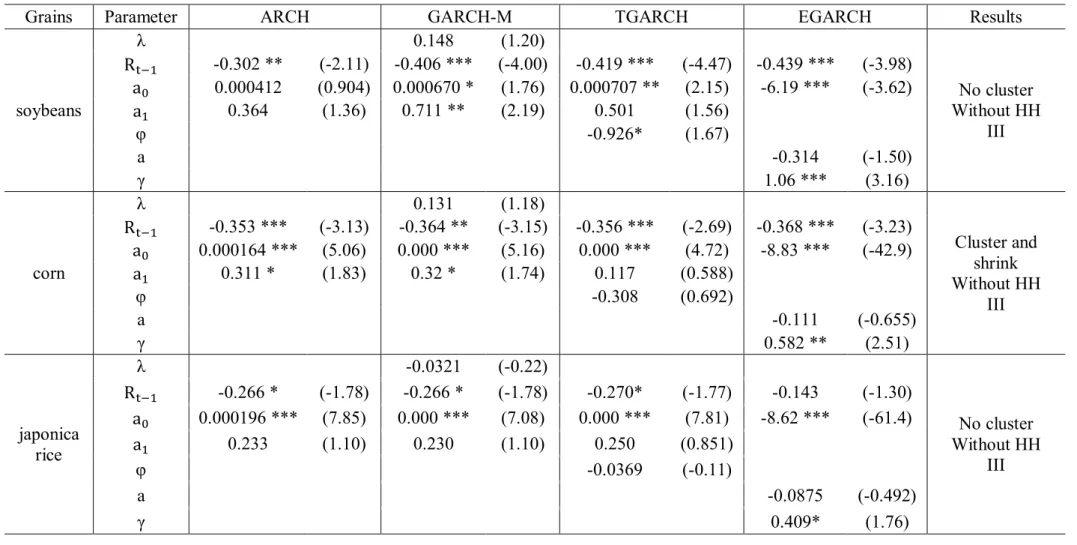
Table 3.3.2 Results of ARCH-type models before China joined WTO ... 40
Table 3.3.3 Results of ARCH-type models after China joined WTO ... 42
Table 3.3.4 Results of ARCH-type models after 2004... 43
Table 3.3.5 Results of ARCH-type models during high world prices ... 44
Table 3.3.6 Results of ARCH-type models in the recent era ... 45
Table 3.3.7 Comparison with previous study ... 46
Table 4.2.1 Explanation for data resources used in this study ... 60
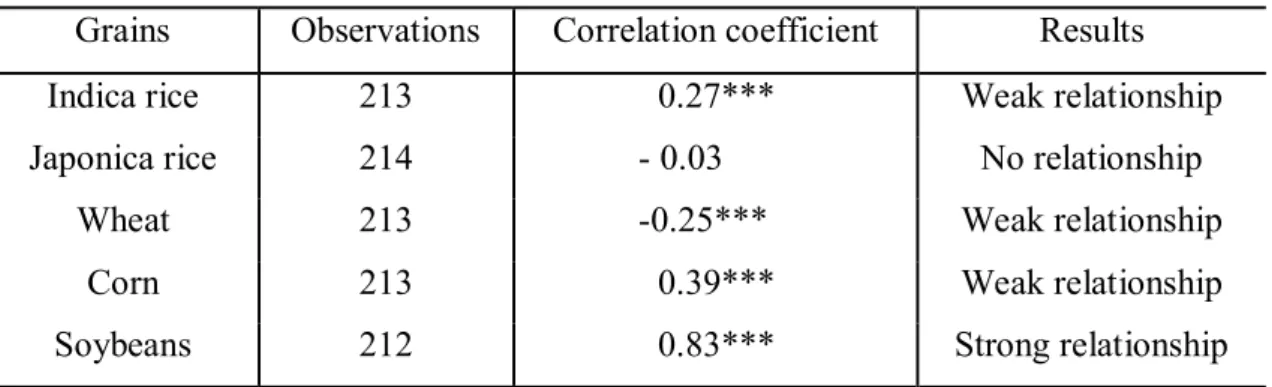
Table 4.3.1 Correlation coefficient of grains prices between two markets ... 63
Table 4.3.1 Grain policies in China during the skyrocketing world prices in 2008 ... 66
Table 4.3.2 Temporary storage volumes for milled rice in China in 2008... 74
Table 4.3.3 Domestic supply and demand for paddy in China (Million tons) ... 75
Table 4.3.4 Minimum procurement prices for paddy in China (US dollar/ton) ... 78
Table 4.3.5 Rice export tariff adjustments in China in 2008 (US dollar/ton) ... 80
Table 4.3.6 Indices for standard deviation for P for grains in China and the US ... 87
Table 4.3.7 Stabilization Inde (SI) for various grains in China ... 88
Table 6.1.1 Increase rates of Chinese wholesale grain prices (%) ... 137
Table 6.2.1 Description of data and source in this study... 145
Table 6.3.1 Result of ADF test for weekly grain prices in China and the US ... 150
Table 6.3.2 Johansen co-integration test for the Chinese and the US grain prices ... 151
Table 6.3.3 Long-run cointergrationships between the Chinese and US prices ... 152
Table 6.3.4 Result s of VECM models of the Chinese and US grain prices ... 153
Table 6.3.5 Result s of Granger Causality test of soybeans prices ... 155
Appendix Table 7.3.1 Chinese grain polices and its policy purpose (1949-1952) ... 172
Appendix Table 7.3.2 Chinese grain polices and its policy purpose (1953-1957) ... 173
Appendix Table 7.3.3 Chinese grain polices and its policy purpose (1978-1984) ... 176
Appendix Table 7.3.4 Chinese grain polices and its policy purpose (1985-1992) ... 178
Appendix Table 7.3.5 Chinese grain polices and its policy purpose (1993-1995) ... 179
Appendix Table 7.3.6 Chinese grain polices and its policy purpose (1996-2000) ... 180
Appendix Table 7.3.7 Chinese grain polices and its policy purpose (2001-2003) ... 181
Appendix Table 7.3.8 Chinese grain polices and its policy purpose (2004-2008) ... 182
Appendix Table 7.3.9 Chinese grain polices and its policy purpose (2009-2013) ... 183
LIST OF FIGURES
Fig. 2.2.1 Indices for real grain price in China from 1978 to 2013 ... 13
Fig. 3.1.1 Weekly wholesale grain prices in China ... 34
Fig. 4.1.1 Weekly grain prices in China and the US markets ... 52
Fig. 4.3.1 Nominal Rate of Assistance (NRA) for Chinese grains ... 65
Fig. 4.3.1 Diagram of price stabilization in 2008 in China ... 67
Fig. 4.3.2 Area harvested and yield for rice in China ... 69
Fig. 4.3.3 Rice production in China since 1985 ... 70
Fig. 4.3.4 Rice consumption in China since 1985 ... 71
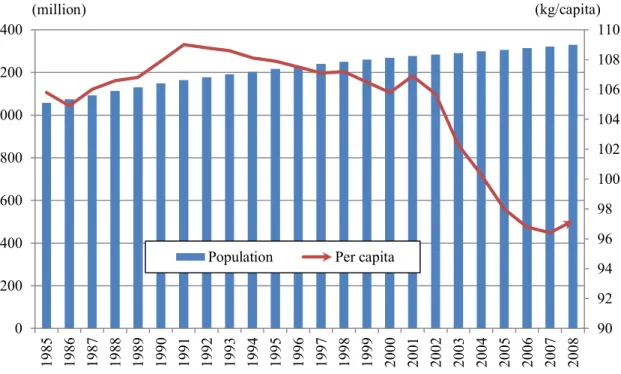
Fig. 4.3.5 Population and per capita rice consumption in China since 1985 ... 72
Fig. 4.3.6 Stock to use ratio and self-sufficiency for rice in China... 73
Fig. 4.3.7 Freight subsidy on northeast rice (Jan. 23, 2008 - Jun. 30. 2008) ... 77
Fig. 4.3.8 Freight subsidy on northeast rice (Nov. 1, 2008 - Apr. 30, 2009) ... 77
Fig. 4.3.9 Monthly rice export volumes in China in recent years ... 81
Fig. 4.3.10 Export volumes for state-owned enterprise in recent years ... 82
Fig. 4.3.11 Export volumes for foreign-funded enterprise in recent years ... 83
Fig. 4.3.12 Export volumes for collectively-owned enterprise in recent years ... 83
Fig. 4.3.13 Export volumes for private-run enterprise in recent years ... 84
Fig. 4.3.14 Monthly rice export value in China in recent years... 85
Fig. 4.3.15 Monthly rice export prices in China and US ... 86
Fig. 5.1.1 Weekly price movements of rice in China and the US ... 97
Fig. 5.1.2 Weekly price movements of wheat in China and the US ... 98
Fig. 5.1.3 Weekly price movements of corn in China and the US... 99
Fig. 5.1.4 Weekly price movements of soybeans in China and the US ... 100
Fig. 5.3.1 Total world trade volume of rice ... 109
Fig. 5.3.2 Total rice export volume in Thailand ... 113
Fig. 5.3.3 Total rice export volume in Vietnam ... 114
Fig. 5.3.4 Total rice export volume in the United States ... 115
Fig. 5.3.5 Total world trade volumes of wheat ... 116
Fig. 5.3.6 Total wheat export volume in China ... 121
Fig. 5.3.7 Total world trade volumes of corn ... 122
Fig. 5.3.8 Total corn import volume in China ... 124
Fig. 5.3.9 Total corn export volume in the United States ... 125
Fig. 5.3.10 Total corn export volume in Argentina ... 126
Fig. 5.3.11 Total corn export volume in Brazil... 127
Fig. 5.3.12 Total world trade volumes of soybeans ... 128
Fig. 5.3.13 Total soybeans production and import volume in China ... 129
Fig. 5.3.14 Total soybeans production and export volume in the United States ... 130
Fig. 5.3.15 Total soybeans production and export volume in Argentina ... 131
Fig. 5.3.16 Total soybeans production and export volume in Brazil ... 132
Fig. 6.1.1 Weekly grain prices in China and the US markets ... 136
Fig. 6.1.2 Trade share of Chinese grains after China joined WTO ... 138
Fig. 6.3.1 Response of prices of soybeans and corn to one S. D. innovations ... 156
Fig. 6.3.2 Response of prices of milled rice and wheat to one S. D. innovations ... 157
Appendix Fig. 7.3.1 Development of Chinese grain production (1964-2013) ... 185
Appendix Fig. 7.3.2 Development of Chinese grain harvest area (1964-2013) ... 186
Appendix Fig. 7.3.3 Development of Chinese grain yield (1964-2013) ... 187
Appendix Fig. 7.3.4 Development of Chinese grain comsumption (1964-2013) ... 188
Appendix Fig. 7.3.5 Grain supply gap in China (1964-2013) ... 189
Appendix Fig. 7.3.6 Development of Chinese grain exports (1964-2013) ... 190
Appendix Fig. 7.3.7 Development of Chinese grain imports (1964-2013) ... 191
Appendix Fig. 7.3.8 Chinese grain Stocks-to-use ratio (1964-2013)... 192
Appendix Fig. 7.3.9 Per capical grain consumption and population (1964-2013) ... 193
CHAPTER 1 INTRODUCTION
1.1 Background
China has to find a way to face the coming grain globalization in the recently years.
China has the greatest numbers of population in the world, and it will be a difficult challenge for China to feed its population, by not only the traditional grain for food, but also the increasing demands for eggs, milk and meat, all of which will bring increasing demand for feeding from grains. In addition, the co-relationship between grains and energy also provide big challenges also to the rapid growing Chinese economics.
China's grain price reform has gone through a long process of exploration. Every grain price reform decision is considered comprehensively and carefully with the overall state economy, the food situation, grain farmers and urban consumers, and many other factors. Different historical periods of grain price policy have played positive roles to achieve the desired objectives on the protection of the grain market supply and stabilize prices, improve people's livelihood.
Weekly Chinese wholesale grain prices showed a steady increase in the recent era, during which price fluctuations existed for individual grains. More particularly, frequent grain price fluctuation has an impact on the behaviors of both feed-companies and middlemen, thus these market participants pay attention to the wholesale grain prices and decide to add or release their stocks. In addition, government can implement effective market price stabilization policies to avoid risks, based on the characteristics of grain prices volatilities.
In 2008, global prices of agricultural products skyrocketing increased and reached a record, although the increasing levels of price were various among different agricultural commodities, including milled rice, wheat, corn and soybeans. However, main grain prices’ increase in China was rather moderate as compared to the US market. That was because that China government had taken a series of measures and policies to ensure grain supply and price stability, such as financial subsidy to farmers, minimum rice procurement prices for northeast China’s rice, minimum grain purchasing price plan, temporary grain storage plan, and trade policy. Those policies have reacted positively to domestic trade, safeguard farmer's profits and ensure stable grain production. China had successfully deal with the challenges of international food security, and its domestic grain prices remained relatively stable, which had made contribution to the development of national economy.
In addition, after joining WTO, Chinese agricultural commodities linked with the international markets to a certain extent. Therefore, fluctuations of international grain prices started influencing Chinese domestic grain markets, which indicated that the volatility of international grain prices brought new challenges to Chinese grains' price stabilization. Fluctuations of the two grain markets are also simultaneously, which suggest that there is consistency between the domestic grain prices in China and the US future grain prices. The reason for this was due to the CBOT prices played a decisive role in announcing price information, by which Chinese domestic grain prices were influenced, such as soybean prices in China had fluctuated in a rather similar style as the US soybean prices.
In sum, Chinese grain prices will meet great challenges in the near future because of the grain globalization. Chinese government should improve grain market order,
increase its domestic farmer’s income, and get ready for the growing integration with the world grain prices.
1.2 Purpose of the study
The overall objective of this research is to study the Chinese grain prices in the coming grain globalization in the recently years. In specific, this study will discuss the following five aspects:
We will calculate the real grain price indices in China, by taking the grain procurement prices indices from 1978 to 2000, and the grain producers’ price indices from 2001 to 2013. In addition, varieties of grains covered wheat, paddy, corn and soybeans in this study and their price indices were also calculated in the same way.
We will employ ARCH family models to study grain price volatility in China, which includes the models for ARCH, ARCH-M, TARCH and EGARCH for price volatility. Indica rice, japonica rice, wheat, corn and soybeans in China were selected.
This study also attempts to analyze the price stabilization of rice, wheat, corn and soybeans in China during the high grain prices in 2008. This study attempt to find out to what extent the domestic grains’ price correlated with the international market. We will calculate the correlation coefficients of the prices of japonica rice, indica rice, wheat, corn and soybeans between the China’s and the US markets in recent era, and a comparison to the result will show the relationships between the two markets. Secondly, we aim to study the situation for other major grain trade counties to investigate how China stabilized its domestic grain prices at that time, as the movements of Chinese domestic prices of main grains quite differed from that of the world prices.
In addition, this study also explore whether the international grain prices have an impact on Chinese grain prices in recent years, using the latest weekly time series data and econometric analysis, to verify the causality of the domestic and international grain prices and check whether long-run equilibrium or short-run equilibrium relationship between the Chinese and international grain prices exist or not.
Based on the analyses, this study will provide some policy recommendations for China to face the coming grain globalization.
1.3 Justification of research
Chinese grain price must get prepared to face the coming grain globalization. This study mainly aims to evaluate the Chinese grain price system and provide some useful policy implications to this issue.
Many researchers have studied about the Chinese grain price. However, there are still some area not mentioned, which will be studied in our research. First of all, previous studies have showed an approximately trend for Chinese grain prices.
However, there was less convincing evidence to support their descriptions. This study calculated the real grain price indices to reflect the development of Chinese grain prices, especially after China implemented the reform and open up policies in 1978. This will provide the development of Chinese grain policies and grain prices.
Secondly, there are some researchers on Chinese grain price fluctuation. However, there are only few qualitative analysis used on Chinese grain markets. Also, most of the researchers used monthly or annual data in price fluctuation, among which there are no studies using more detailed grain prices, such as the weekly grain prices. Besides, scholars have not made comparisons on the grain price fluctuation within the different
periods in China, such as before and after joining WTO, before and after the world grain prices hiked, and so on.
Thirdly, majority of those studies related to Chinese grain stabilization policies were analyzed and concluded mainly based on the graphical and descriptive analyses.
Studies with empirical analyses were quite limited. This study attempts to analyze a series of grain policy measures in China in 2007 and 2008, and take trade policy as an example, which represented the most efficient policy in the study periods to stable the domestic grain prices, and we are going to evaluate that to what extent the domestic grains’ price correlated with the international market, and explain how China controlled its domestic grain prices in 2008.
Fourthly, we will systematically analyze the prices and trade situation of rice, wheat, corn and soybeans in the world in recent era, especially in 2008. This study will employ some graphics and tables to show grain prices movements and the trade volumes of rice, wheat, corn and soybeans in China and other major trade countries in recent years.
Finally, previous studies on grain prices transmission from international markets to Chinese domestic markets are quite limited. This study will use the latest weekly time series data and econometric analysis to verify the causality of the domestic and international grain prices.
1.4 Structure of the study
This study is organized into seven chapters respectively. The first chapter introduces some backgrounds, addressing that the Chinese grain prices have to face the coming grain globalization. And China must get prepared to challenge the “grain-
energy” correlation with its economic development. Its related grain policies indicate that China needs both macro direction and marketization to maintain a national high grain self-sufficiency to feed the greatest population. At the same time, increasing the benefits for the poor people, including the poor farmers and the poor consumers, will be a great answer that more than economical area. However, to subsidize the grain producers in the recent years is a reprehensive policy measure to show China’s desire not only on encouraging its domestic grain supply, but also keeps increasing farmers income. This also the requirement for China to accept or follow the world grain markets in the future.
The other chapters mainly discussed the following topics. We shall briefly study the overview of Chinese grain historical prices and the related policies, by which we attempt to analyze about the development and experience of the government’s intention for the specific grain price policies in different period.
An analysis of price fluctuation in recent Chinese domestic grain markets will be arranged as the third chapter, in which we want to employ econometric models to study grain price volatilities. We will discuss in chapter four about how china controlled it’s the domestic grain prices in 2008, during which China carried out some specific grain price stabilization policies to cut down the relationship between Chinese domestic grain markets and the world markets.
In addition, a further introduction to Chinese and US’ price differences follows in chapter five, where we will report also about Chinese international trade during the food crisis and grain trades among the main importers and exports for rice, wheat, corn and soybeans. We will also discuss about the supply and demand in grains in China.
Chapter six will particularly focus on the grain prices transmission from international
markets to Chinese domestic markets from the perspective of grain globalization, in which we want to declare about the present communication between Chinese grain and the CBOT grain markets. Based on our analysis, conclusions and several policy implications based on the study results are finally addressed.
CHAPTER 2
OVERVIEW OF CHINESE GRAIN PRICES AND THE RELATED POLICIES
2.1 Background and literature review
At the beginning of the Chinese government was founded in 1949, grain supply had to face many challenges, and the grain prices fluctuation was quite serious. The reason was because that many people stored their grains to search for the benefits. In order to stabilize the grain prices and support the national finance economic, the government decided to enhance the impact of the state-owned commerce department, together with the a relative loose free purchasing polices. As a result, the stated-owned grain polices not only helped to control the grain prices well, but also support greatly to the government finance income, which played a positive effect to the development of the Chinese national economic.
However, grain policies changed in 1953 when the whole society in China started enhancing its economic development. The grain crisis in 1953 offered an important opportunity to promulgate a policy for unified purchase and sale of grain. Grain policies in China turned to facing monopoly for procurement and market in order to meet the demand of the economic construction and people’s daily consumption. During this period, the Chinese government carried out the planned unified national purchasing and supply. Grain farmer sold their surplus commodities to the government, but the procurement volumes, supply volumes, procurement prices and supply prices must be determined or approved by the central government.
After that, the Chinese government increased the grain procurement prices by 3.1%, 2.6%, 25.3% and 1.5% in 1958, 1960, 1961 and 1965, respectively, among which China faced natural serious disaster in 1960s. However, the national grain sale prices did not change until 1963 and 1965, after which the grain procurement prices increased again by 17.1% in 1966, and the soybean procurement prices raised by 9% and 23.4% in 1971 and 1978. Procurement prices for stable grains such as paddy and wheat did not change in 12 years, and the government aimed to support its industry development and guaranteed the consumer’s daily life by taking into the price subsides to the consumers.
Scholars have divided commonly the Chinese grain prices by some specific years, during which important agricultural polices had great impact on the grain prices in China. Wei (2009) divided from 1949 to 2006 into 6 periods, such as free market price with significant disadvantages (1949 - 1952), unified purchase and sale prices with government pricing (1949 - 1984), dual grain pricing system that expanded the range of market regulation (1985 - 1989), released the market grain prices (1990 - 1993), grain market mechanism was improved (1994 - 2000), and market-oriented grain price (2001 - 2006). He found that the market-oriented reform in China has brought a series of relevant problems and challenges, but China's grain market mechanism trend is formed significantly in the recent years, which not only makes China's grain supply and demand stable, but also helps to implement food security strategies and to reduce the risk from the international food crisis.
Guo (2009) analyzed the significant fluctuations since 1949. He studied the correlations between the policy adjustments and fluctuations for grain prices in 7 periods, including 1949 – 1976, 1977 – 1984, 1985 – 1990, 1991 – 1996, 1997 – 2002, 2003 – 2005, and 2006 – 2009. Guo pointed out that grain not only with the same
properties as ordinary commodities that can circulate in the market, but also belonged to important resource that related to the national and social stability. The author evaluated Chinese grain historical prices in different policy backgrounds, and he suggested that Chinese grain prices should connect with the world grain market in the future, and financial supports to farmers need to be increased. He also recommended that a price warning system was needed in Chinese grain markets, which should be based on the effective local wholesale markets and the future grain prices.
Kang (2010) described the evolution of Chinese grain prices into 8 periods since 1949. She regarded the first period from 1949 to 1952 is conducive to the recovery of the national economy, during which the free trade together with the state-owned enterprises were the leading procurement and sale. The second stage that Kang considered started from 1953 to 1978, during which the unified procurement and sale prices by the Chinese government tried to meet the domestic demand. The third stage was from 1979 to 1984 and China increased the unified procurement prices. After that, China canceled the unified procurement for grains from 1985 to 1992. The fifth stage lasted 3 years since 1993, during which unified procurement and sale prices were completely terminated. Grain protective prices were set during 1996 to 2000 to protect the farmers’ benefits in order to avoid the surplus grains reducing market prices. The seventh stage in Kang’s study suggested that China improved the grain protective prices in both main sale areas and mail production areas. The last stage that begun from 2004 suggested that minimum procurement grain prices, temporary grain storage plan and the grain subsidy policies could encourage farmers.
Leng, et al (2003) reviewed grain price policies since China started the reform and opening up policy, which suggested a transformation from a planned way to a market-
oriented process. She also tried to find some problems for the current grain price policies. They divided the period from 1979 to 2003 into 4 stages, based on several grain polices. In the first stage, a basically unified purchase policy and an increased the purchase price were defined from 1979 to 1984. The second stage from 1985 to 1990 was regarded that the Chinese government cancelled the unified purchase prices but retained the unified selling prices for grains. The third stage from 1991 to 1997 reported that the unified selling prices were removed in this period. China started exploring the market system for grain prices in the fourth stage from 1998 to 2003.
Deng, et al. (2009) argued that agricultural price policy in the different stages reflected national plans, food production and market demands situations. They thought that from 1979 to 1984, the Chinese government adjusted prices of agricultural products, open up fair trade and introduced market mechanisms. China abolished grain’s unified purchase prices, but kept the unified selling prices in phase two (1985 – 1991). After that, prices of agricultural reformed and China started to introduce comprehensive market mechanisms from 1992 to 1997, during which the unified selling prices were abolished. During the fourth stage since 1998, market price mechanism for agricultural products circulation system gradually formed under the government’s macro adjustments. They pointed out that there were some problems in Chinese agricultural market, such as insufficient production, low profit, reduction of cultivated area, low competitiveness of agricultural products, and so on. In addition, they suggested that, China can prove the policy goals to make a long-term agricultural policy and should promote new rural construction of socialism.
Previous studies have showed an approximately trend for Chinese grain prices.
However, there was less convincing evidence to support their descriptions. Therefore,
we calculated the real grain price indices to reflect the development of Chinese grain prices, especially after China implemented the reform and open up policies in 1978. In addition, we shall also summarize Chinese grain price policies systematically in this study.
2.2 Evolution of Chinese grain prices(1978-2013)
We calculated the real grain price indices in China, by taking the grain procurement prices indices from 1978 to 2000, and the grain producers’ price indices from 2001 to 2013 (Fig 2.2.1). Grain price indices are deflated by Chinese anural CPI to compute the real grain prices indices, by which we tried to describe the real fluctuation in the grain prices.
In addition, varieties of grains covered wheat, paddy, corn and soybeans in this study and their price indices were also calculated in the same way. We set the base year as 100 in 1978. Grain price indices in 2013 were calculated by each necessary published average value in the first quarter, including the producers’ monthly grain price indices monthly CPI.
As a result, we divided our data into 7 periods according to both our calculated results and Chinese prices revolution policies since 1978, from which China started its reform and opening-up policy. We concluded that Chinese historical grain prices fluctuated due to the specific policies, and the real grain prices increased significantly in the recent years.
Fig. 2.2.1 Indices for real grain price in China from 1978 to 2013
Source: China Statistical Yearbook (1979 - 2012)
Note: 1. Base year: 1978=100; 2. Grain procurement prices indices (1978 - 2000), and grain producers’ price indices (2001 - 2013); 3. Grain price indices in 2013 are calculated by the average value from January to April; 4. Calendar year based (January - December).
Indices, 1978=100
P1 P2 P3 P4 P5 P6 P7
Grain price globalization
Period 1: During 1978 and 1984, the Chinese grain procurement prices increased by 66.14%
In 1978, China carried out reform and opening up policies, and household- responsibility system was successfully introduced in 1981 to the Chinese farmers so as to increase their grain production. There was an about 20% increase in the grain procurement prices in 1979, followed by a significant 54.01% increase in the soybeans procurement prices in 1981 because that the Chinese government wanted to promote the soybeans production to meet the increasing consumption.
As a result, the domestic soybean production increased by 17.44%, which showed an effective impact to help the soybean farmers to promote their production. In this period, procurement prices for wheat, paddy, corn and soybeans increased by 43.50%, 37.57%, 41.45% and 107.65%, respectively. However, the Chinese government also had to spend huge amount of subsidies to the consumers due to the planned stabilized grain sale prices, which was less than the government procurement grain prices.
Period 2: During 1985 and 1992, China replaced the national procurement with the contract procurement.
The Chinese government abolished the national grain procurement policies since 1985. Instead, the government decided to make contract with the grain farmers with a procurement prices. This policy encouraged the farmers to sell their surplus grains to the market, which reduced significantly the government burden to buy all of the produced grains or to subsidize the consumers, then to reduce the situation that the purchasing prices exceeded the selling prices. In this period, the procurement grain prices maintained until they dropped by 12.50% since 1989, among which prices reduced by 20.42%, 10.26%, 14.90% and 4.19% for wheat, paddy, corn, and soybeans respectively. In addition, China also increased the selling prices in 1991 and 1992 in this period.
In order to reduce the gap between the procurement grain prices and its selling prices, the government implemented a series of policy measures, such as improved the
bargain systems in the contract, increased the procurement prices and the government selling prices, developed the grain wholesale markets, and also combined the grain procurement contract with the supplied fertilizer, diesel and the front money. This important grain price policy not only ensured that the government to master a certain number of grains to supply the needs of the market and the necessary reserves, but also helped to guide the grain producers in accordance with the needs of the market quantity, variety and quality of production. More importantly, this policy helped the government to reduce the heavy load for subsidize the farmers and the consumers.
The invisible hand started to play an important role in the grain market, and the increasing market regulation was conducive to adjust the agricultural structure and promote the development of rural grain markets.
Period 3: During 1993 and 1995, China introduced the market regulation into the grain markets.
Chinese grain prices started to fluctuate gradually with its domestic markets since 1993 when the government carried out some important policies, including asked the farmers to sell their grains freely to the markets, removed the national edible oil procurement policy and the supply on edible oil rations. As a result, farmers begun to sell their grains actively to the market, and the grain producers’ prices increased by 30.11%, among which wheat prices, paddy prices and corn prices significantly increased by 39.38%, 27.99%, and 46.67% during this period.
However, the soybean prices dropped by 10.82% because of the less benefits expected by the farmers. Meanwhile, the Chinese government also implemented the protective procurement pricing system and the grain risk fund to protect the farmers expected economic returns.
Period 4: During 1996 and 2000, oversupply pulled the grain prices to drop, thus China adjusted the area that adopted the protective procurement prices
As the grain farmers begun to arrange their cultivation activities and expected to get more benefit, grain production started to increase sharply since early 1990s.
Anural ending stocks-to-use ratio in China suggested that oversupply pulled the grain prices to fall down in period 4, due to which grain price dropped by 32.12% from 1996 to 2000. Among that, producers’ prices of wheat, paddy, corn and soybeans reduced by 38.58%, 30.54%, 26.23% and 26.89%, respectively.
At that time, the Chinese government set the protective procurement prices to improve the grain quality. For example, China reduced the protective procurement prices of inferior wheat in Northeast and South China and the poor-quality early indica paddy in South China in 1999, and removed their protective procurement prices in 2000.
Period 5: During 2001 and 2003, China released the protective prices in the main sales area.
China joined the World Trade Organization (WTO), and became one of its 143 members on December 11, 2001. The government decided to improve the grain markets to face the opportunities and challenges from the world grain markets.
Chinese grain price index moved relatively stable during these three years, and dropped by 2.38%. Among that, price indices for wheat and soybean increased by 0.65% and 18.81%. But the price indices for paddy and corn fell down by 3.27% and 4.66%. Chinese soybean prices increased sharply was mainly due to that China started importing a great volume soybean, so the soybean prices begun correlating with the world market.
In addition, selling prices for grains in the main sales area was opened to the market prices in eight big cities in China, such as in Beijing, Shanghai, Tianjin, Zhejiang, Jiangsu, Fujian, Guangdong and Hainan provinces. Meanwhile, the grain procurement prices in the main grain production area was also decided by their local market in Anhui, Hunan, Hubei, Inner Mongolia and Xinjiang, which were five of the
main grain production areas in China. Meanwhile, the local government started being responsible for manage their provincial local market.
Period 6: During 2004 and 2008, China supported the agricultural development, and opened up both of the grain procurement and sale prices
The Chinese government encouraged the diversity of the grain market participants under the national macro-control and promoted the farmers benefits since 2004. China introduced a directly subsidy police to farmers, a minimum procurement grain price policy, and a temporary storage plan since 2004. All of these polices mobilized the enthusiasm of farmers to produce grains and helped to increase grain farmers’ income, thus stabilized national food security and improved the grain price formation mechanism in China. Especially, the grain prices in the world market spiked during 2007 and 2008. However, the Chinese grain prices showed relatively stable during this period, but the government had to give up the opportunities for exporting grains for benefits due to the purpose of feeding its largest population and maintain its food security.
The real grain prices index from 2004 to 2008 increased slightly, with a 4.03%
growth rate. Among that, real prices of paddy, corn and soybeans increased by 1.53%, 8.63% and 23.22%, respectively. However, the real prices indices for Chinese wheat dropped by 3.52% during this period. However, a objectively evaluation to the Chinese grain market was that its domestic grain markets started more and more to get influenced by the world grain market. For example, the bio-ethanol was becoming popular at that time, and grain prices were connected with the energy use, which was required by a huge world market. On the other hand, the future prices which contained the speculating activities also had begun making a decidable guidance to the local grain markets. So the Chinese domestic grain prices not only had to face the upward pressure from the world market, but also must consider about its domestic farmers’ benefits.
Period 7: During 2009 and 2013, China enhanced supports to farmers’ benefits.
In the recent years, China raised the level of minimum grain procurement prices and continued to increase the temporary storage volume. Meanwhile, the government also subsided to the grain farmers, the grain processors and the feed companies.
As a result, the producer prices index increased continuously. According to our estimation, real grain price index in China increased by 44.49% from 2009 to 2013, among which price indices for stable grains such as wheat and paddy increased by 55.77% and 72.89%, respectively. In addition, price indices for corn and soybeans also rose by 48.33% and 26.53% respectively.
2.3 Chinese grain price policies (1949-2013)
In this part, we will describe historically the main grain price policies from 1949 through 2013. We collected the Chinese government documents that influenced the domestic grain prices. We divided our total period into 9 parts and the entire lists of documents were shown in Appendix.
Table 2.3.1 indicates a time table for grain price policies in China. We shall analyze characteristics of Chinese grain price policies, growth the rates of the price movements, back ground for each policy and our evaluations in 9 periods from 1949 to 2013.
1949-1952
The early days of China faced serious inflation, and it’s the economy was in recovery period. Free trade occupied the grain market, and the private grain-based business was the main factor in the grain trade. During that time, an obvious contradiction between food supply and demand came out, and some unscrupulous traders took the opportunity to hoard grains, which drove up grain prices and led serious grain price volatilities.
Table 2.3.1 Time table for grain price policies in China
Period Characteristics of Chinese grain price policies P change (%) Background Evaluation 1949-
1952
Support state-owned grain enterprises;
strengthen market management, formulate grain prices via free market.
- Short of grains, some unscrupulous traders' hoarding drove up grain prices.
Safeguarded grain price stabilization, but the monopolized grain enterprises
exacerbated inequality.
1953- 1978
National purchase and sale, with prices are decided by the government. Non private grain
dealers. G (57.5)
Production was hard to meet the demand, leading a shortage for more than 4 billion kg.
Controlled private grain merchant. But the highly centralized management also constrained grain production.
1978- 1984
Increase grain retail prices. Implemented multi-channel management. Market
mechanism started in prices in grain market.
G(66.1); W(43.5);
P(37.6);C(41.5);
S(107.7)
Low grain production at the
beginning of reform and opening up since 1978.
Purchase and sale prices still occupy a dominant position. There were still difficulties on selling and storing grains.
1985- 1992
Change monopolized grain purchase to contract ordering, and allowed free purchase and sale to surplus grains.
G(-12.5); W(- 20.4); P(-10.3);C(-
14.9); S(7.6)
Nationwide farmers' to sell grains due to the grain oversupply,
State mandatory pricing system was broken, market-oriented reforms performed. It added financial burden.
1993- 1995
Abolish the monopolized grain sale policy.
Improve farmers' enthusiasm for growing grain. Increased ordering and sales prices.
G(30.1); W(39.4);
P(28.0);C(46.7);
S(-10.8)
Panic buying grains in 1993 because of the serious nationwide
fluctuations in grain prices.
Cancellation in 1993 failed because of inflation. High order prices in 1994 and brought financial burden for inventory.
1996- 2000
Implement protective grain prices. Separate responsibilities for government and
enterprises. Improve grain price mechanism.
G(-32.1); W(- 38.6); P(-30.5);C(-
26.2); S(-26.9)
Oversupply forced grain prices to continue slumping.
Over grain production pulled down the grain prices.
2001- 2003
Accelerate market-oriented reform for grains.
Allow private grain enterprises to enter the market for grains’ acquisition.
G(-2.4); W(0.7);
P(-3.3);C(-4.7);
S(18.8)
Protective prices did not be
completely carried out. Grain markets and the real market price were officially formed.
2004- 2008
Liberalize grain market. Implement grain subsidies and reformed rural taxes. Ensure the domestic price stabilization.
G(4.3); W(-3.5);
P(1.5);C(8.6);
S(23.2)
Floods led a production cut in 2003.
Tight global supply influenced the pricing system.
As gradually integrated into the WTO system, global grain market intensified.
China reduced this effect.
2009-
2013 Increase grain purchase and sale prices.
Ensure supply. Protect farmers' benefits.
G(44.5); W(55.8);
P(72.9);C(48.3);
S(26.5)
Demand for grains was increasing.
China wanted to improve the farmers' income.
Farmers' income and production increased. But the influence from the global competition is coming.
Source: China Statistical Yearbook, China Agricultural Statistics Yearbook, China Development and Reform Commission, Ministry of Agriculture of China.
The Chinese government supported state-owned grain enterprises, strengthened market management, and formulated grain prices via the free market. As a result, China safeguarded the food markets and grain price stability. But the problems came that state-owned grain enterprises relied on monopolized government support and help, exacerbated the other channels and the main channel between the purchase and sale of other ingredients, then increased the interests of inequality.
1953-1978
In this period, grain production was difficult to meet the demand, and there had been a shortage of grain supplies for more than four billion kilograms. So Chinese government implemented a series of grain price polices such as national purchase and sale policy, grain prices are decided by the government and non-private grain dealers operated freely.
A national purchase and sale policy indicated that China planned to acquainted and sell grain by the government throughout the country. Provisions of grain production, acquisition, storage, processing and marketing were entirely operated by the state regulation, and the grain prices were also formulated by the State. Rural households were required to leave enough food rations, seeds, feed and pay the agricultural tax, then the government would acquire substantially all of their surplus grain. On the other hand, China asked urban residents and farmers to carry out purchase and sale, and non-food private grain dealers were allowed to operate freely.
As a result, Chinese real grain price indices in this period increased by 57%.
The national purchase and sale policy combated the private grain merchants manipulating the grain market, stabilized prices and promote the development of food production, food security, but grain prices were highly centralized management constraints to the development of grain production.
1978-1984
China introduced reform and opening up policy in 1978, but grain production was quite low at the beginning of the reform. In order to meet the domestic demand, China increased grain retail prices, implemented multi-channel management and market mechanism started in prices in grain market.
During this period, China increased grain retail prices through the restoration of grain fair trade, and the implementation of multi-channel management. China also adjusted by increasing grain imports to make up for the domestic grain varieties and national food shortage. Household-responsibility system was successfully introduced and sales price increased by 20% over the share price increased by 80%. As a result, Chinese grain prices increased by 66.1%, and a 43.5%, 37.6%, 41.5% and 107.7%
increase to wheat, paddy, corn and soybeans, respectively.
Though those police measures, purchase and sale prices were still occupied a dominant position, the grain distribution was still not active enough, and there had been a difficult and in selling grains and grain storage.
1985-1992
China's total grain output of about 9,000 billion kilograms in 1990, which met
growth. During the middle of 1980s, urban consumers purchase food tickets, so their demand was inelastic, then to lead a grain oversupply. Finally, there has been a nationwide problem for farmers to sell their grains.
Under this pressure, China changed monopolized grain purchase to contract ordering, and allowed free purchase and sale to surplus grains. Procurement price and bargain purchase price of the "dual track" mechanism. Contract the ordered food, national pressed proportional valuation into the original purchase price of the acquisition. It also provides that if the market price is lower than the share price of national unity, a national procurement all by purchasing peasants unified purchase all the grains. More substantial increased in the purchase price since 1991 and the state grain monopoly purchase and cancel further removed on the basis of grain marketing in the price, quantity ordered to put the implementation of grain prices. Grain prices increased by 50% in 1992 procurement price increased by 20%, while sales prices of the city further increased by 50%, basically realized the purchase and sale of the same price, while the consumer price subsidies complemented changes. The state-owned grain enterprises cancelled the corresponding price subsidies, fiscal subsidies only operating expenses. Grain procurement achieved the same price, based on price liberalization, liberalization of the pilot operation and success. At the end of 1993, more than 95% of China liberalized grain prices, completed the pricing and market pricing from a planned coexistence of "dual track" to market regulation monorail system changes, grain supply and consumption were completely, and the market regulation that mechanism determined by was basically formed.
In this period, Chinese grain prices decreased by 12.5%, and a 20.4%, 10.3%, and 14.9% drop to wheat, paddy and corn, respectively. But the prices for soybeans increased by 7.6%.
We regarded that grain price polices in this period that after China changed into the contract ordering, the actual price level decreased, and the rapid decline of food production, prices rebounded quickly. State mandatory pricing situation was broken and the scope of market regulation got further expanded. Market-oriented reforms in grain prices increased obviously. By the end of 1992, most areas of the country outside the county adopted a procurement liberalization reforms. Grains had been greatly restored, the role of market allocation of food resources significantly enhanced.
But the purchasing and selling prices and increased the number of two inverted the burden on the state, which was not conducive to the development of market mechanisms.
1993-1995
Panic buying grains in 1993 because of the serious nationwide fluctuations in grain prices. 1994 State developed a "stable grain size, stabilize grain production, stabilize grain inventory to ensure national food balance and the total amount of regional balance. In response to grain production, China improved farmers' enthusiasm for growing grain twice. In 1994, a dramatically increased in grain ordering and sales prices, and in October 1994 China established the China agricultural Development Bank funds for grain acquisition management. China also proposed a grain provincial governor responsibility system in 1995, and the
sales take full responsibility, which become central to solve China's grain total balance and regional balance taken a crucial reform measures.
By those grain price policies, Chinese grain prices increased by 30.1%, and a 39.4%, 28.0%, and 46.7% to wheat, paddy and corn, respectively. But the prices for soybeans decreased by 10.8%.
As southern rice production caused large fluctuations in grain prices nationwide in 1993, a large number of migrant workers in cities, greatly increases the urban demand for agricultural products. In addition, China conducted the devaluation of the RMB exchange reform in in 1994, and 57% are of foreign trade and the southern provinces to domestic purchase, so there was panic buying of grain in autumn 1993.
Chinese grain price polices had a limited effect in stabilized grain prices.
1996-2000
Because of the continuous China's grain production in this period, grain surplus in the form of grain market oversupply made grain prices continued to slumping.
Therefore, China started to implemented protective grain prices formulated grain price protection and separated responsibilities for government and enterprises. China also improved grain price mechanism and deepened the grain circulation system.
Grain prices resumed track system for heat, corn and other grain for national implementation of prices formulated grain price protection. From 1995 to 1997, China adopted a national purchasing peasants' surplus grain at protective prices as the core of macro-control measures. In addition, China has implemented separating, reserves and operating separately central and local responsibilities separate financial
accounts. Grain price mechanism as the basic principle in order to further deepened the grain circulation system.
As a result, Chinese grain prices decreased by 32.1%, and a 38.6%, 30.5%, 26.2%
and 26.9% to wheat, paddy, corn and soybeans, respectively. Those grain price polices led an over grain production and pulled down the grain prices in this period.
2001-2003
In this period, some local areas places did not completely us the protective prices to open purchase surplus grain for farmers, and some varieties of grain had selling difficulties. Grain provincial governor responsibility system was not fully implemented and some areas of the grain risk fund could not be filled. In addition, the reform of state-owned grain enterprises lagged and national grain size, structure and management methods were not fully adapted to the needs of national macro- control.
Because of this back ground, China accelerated market-oriented reform for grains and allowed private grain enterprises to enter the market for grains’ acquisition.
China started to protected areas and the governor in charge to strengthen regulation reform policy. It was significantly to accelerate the pace of market-oriented reform of grains. To play the regional advantages of agricultural resources, China fully liberalized of the market sales areas and gradually opened up the main producing areas of the acquisition market, the central decision in Zhejiang, Beijing, Shanghai, Tianjin, Jiangsu, Guangdong, Fujian and Hainan eight main grain sales areas released grain market. The state allows private grain enterprises owned grain enterprises to
During this period, real Chinese grain producer prices decreased by 2.4%, and a 3.3% and 4.7% for paddy and corn, respectively. But the prices for wheat and soybeans increased by 0.7% and 18.8%, due to China joined WTO and the globalization started to become a factor to influence the Chinese domestic grain prices.
Those grain prices in China established a new type of relationship between food production and marketing. Grain market system construction from a single subject to multiple subjects started. What’s more, grain markets and the real market price were officially formed.
2004-2008
Grain production cut by the end of 2003, and the market became fluctuated.
China suffered from natural disasters in main grain producing areas resulting in a substantial cut in food production. In addition, the industrial concept influenced agricultural market since 2006. Tight global supply and demand of agricultural products brought economic concepts deep into the grain pricing system. China's economy has maintained rapid growth, demand for grains in consumer increased.
Therefore, China carried out a series of grain polices to stabilize its domestic grain prices. The state grain purchase and sale of fully liberalized market in 2004, and the comprehensive buying and selling grain market was also introduced. In addition, China took grain direct subsidies, reformed rural taxes and provinces and cities to implement a minimum purchase price policy. Since 2006, grain prices fluctuate significantly, but the state controlled of industrial use of grain to and increased the volume and grain-market imports.
By implementing those grain policies, China real Chinese grain producer prices increased by 4.3%, and a 1.5%, 8.6% and 23.2% increase for paddy and corn, and soybeans, respectively. But the prices for wheat decreased by 3.5%, because of great production.
Grain price polices in this period led farmers to grow grain increase, although China's grain output increased year by year. But as the agricultural market gradually integrated into the WTO system, the impact of the global agricultural market intensified. With the purchase and sale released, the state had entered a market-based phase of the market price. In order to meet new socialist countryside construction and protect the interests of farmers, China reduced the globalization effects in grains.
2009-2013
As demand for grains increasing in recent years and the unexpected global food insecurity, China aimed to improve the farmers' income and to increase the domestic grain production. Therefore, China increased grain purchase and sale prices and ensure the effective supply of grain. Many polices aimed to protect farmers' benefits and increase their income.
According to our estimation, real grain producer prices in China increased greatly by 45.5%, and a 55.8%, 72.9%, 48.3% and 26.5% increase for wheat, paddy, corn and soybeans, respectively.
By those policy measures, farmers' income increased and they were encouraged to increase their production. But the influence from the global competition is coming, China faces great challenge from the grain globalization at present.
2.4 Summary of the Chinese grain prices and its related policies
Reviewing the historical evolution of food to support policy, we can conclude that China's grain price reform has gone through a long process of exploration. Every grain price reform are considered when the overall state economy, the food situation, grain farmers and urban consumers, and many other factors make comprehensive decisions carefully. Different historical periods of grain price policy has played a positive role to achieve the desired objectives on the protection of the grain market supply and stabilize prices, improve people's livelihood.
Different periods of grain price policies smooth convergence to achieve from the strict grain supply management and price controls to the use of economic, legal and other means to regulate the grain market changes, initially established price supports, subsidies support and industry support such as the combination of grain prices policy system.
On the other hand, we must consider that the government decisions have a lagged effect on the grain policies. Chinese food pricing mechanism is a mandatory change of institutional change, the government's choice of pricing mechanism has a dominant position. In general, the first government chose pricing mechanism can better achieve the appropriate food policy objectives. However, with the macro-economic environment, food supply capacity and other factors change, the existing pricing mechanism gradually adapt to the new situation, the requirements of food policy objectives, the performance of the system costs, system efficiency. To a certain critical point, the government will have to adjust the pricing mechanism, with a new pricing mechanism to replace the old pricing mechanism, in order to better achieve
However, China has to find a way on facing the coming grain globalization in the recently years. China has the greatest number of population in the world, and it will be a difficult challenge for China to feed its population, by not only the traditional grain for food, but also the increasing demand for eggs, milk and meat, all of which will bring increasing demand for feeding from grains. In addition, the co-relationship between grains and energy provide big challenges also on the rapid grow in Chinese economics.
CHAPTER 3
ANALYSIS OF PRICE FLUCTUATION IN RECENT CHINESE GRAIN MARKETS
3.1 Background and literature review
Weekly Chinese wholesale grain prices showed a steady increase in the recent era, during which price fluctuations existed for individual grains (Fig 3.1.1). It is important and practical for agricultural producers, feed-companies and investors to understand the characteristics of grain price volatility. Farmers can sell their commodities on their expected prices, and grain price fluctuations also influence their cultivation activities. More particularly, frequent grain price fluctuation has an impact on the behaviors of both feed-companies and middlemen, thus these market participants pay attention to the wholesale grain prices and decide to add or release their stocks. In addition, government can implement effective market price stabilization policies to avoid risks, based on the characteristics of grain prices volatilities.
Researchers studied the characteristics of fluctuations in Chinese grain prices by using a variety of methods. For example, Luo, et al. (2010) found that there was no significant heteroscedasticity effect on prices of indica rice, japonica rice and soybeans, but wheat and corn showed significant clustering and high-risk high-return characteristics.
Feng (2008) showed that grain price volatility had clustering effects and obvious