Example 1.3: As an example, consider the following func- tion:
f (x) =
⎧⎪⎪⎪⎨⎪⎪⎪⎩
1, for 0 < x < 1, 0, otherwise.
Clearly, since f (x) ≥ 0 for −∞ < x < ∞ and
∞−∞
f (x) dx
=
10
f (x) dx = [x]
10= 1, the above function can be a proba- bility density function.
In fact, it is called a uniform distribution.
59
Example 1.4: As another example, consider the following function:
f (x) = 1
√ 2 π e
−12x2, for −∞ < x < ∞ .
Clearly, we have f (x) ≥ 0 for all x.
We check whether
∞−∞
f (x) dx = 1.
First of all, we define I as I =
∞−∞
f (x) dx.
To show I = 1, we may prove I
2= 1 because of f (x) > 0 for all x, which is shown as follows:
60
I
2=
∞−∞
f (x) dx
2=
∞−∞
f (x) dx
∞
−∞
f (y) dy
=
∞−∞
√ 1
2π exp(− 1 2 x
2) dx
∞
−∞
√ 1
2π exp(− 1 2 y
2) dy
= 1 2 π
∞
−∞
∞
−∞
exp
− 1
2 (x
2+ y
2) dx dy
= 1 2 π
2π 0
∞
0
exp( − 1
2 r
2)r dr d θ
= 1 2π
2π 0
∞
0
exp( − s) ds d θ = 1
2π 2 π [ − exp( − s)]
∞0= 1 .
61
ʻ Review ʼ Integration by Substitution (ஔ
ੵ):
Univariate (1 ม) Case: For a function of x, f (x), we perform integration by substitution, using x = ψ(y).
Then, it is easy to obtain the following formula:
f (x) dx =
ψ
(y) f ( ψ (y)) dy ,
which formula is called the integration by substitution.
62
Proof:
Let F(x) be the integration of f (x), i.e., F(x) =
x
−∞
f (t) dt , which implies that F
(x) = f (x).
Differentiating F(x) = F(ψ(y)) with respect to y, we have:
f (x) ≡ dF(ψ(y))
dy = dF(x) dx
d x
dy = f (x)ψ
(y) = f (ψ(y))ψ
(y).
Bivariate (2 ม) Case: For f (x , y), define x = ψ
1(u , v) and y = ψ
2(u , v).
f (x , y) dx dy = J f ( ψ
1(u , v) , ψ
2(u , v)) du dv , where J is called the Jacobian (ϠίϏΞϯ), which repre- sents the following determinant (ߦྻࣜ):
J =
∂ x
∂ u
∂ x
∂ v
∂ y
∂ u
∂ y
∂ v
= ∂ x
∂ u
∂ y
∂ v − ∂ x
∂ v
∂ y
∂ u .
ʻ End of Review ʼ
ʻ Go back to the Integration ʼ
In the fifth equality, integration by substitution (ஔੵ) is used.
The polar coordinate transformation (ۃ࠲ඪม) is used as x = r cos θ and y = r sin θ .
Note that 0 ≤ r < +∞ and 0 ≤ θ < 2π.
The Jacobian is given by:
J =
∂ x
∂r
∂ x
∂ y ∂θ
∂ r
∂ y
∂θ
=
cos θ − r sin θ sin θ r cos θ
= r . 65
In the inner integration of the sixth equality, again, inte- gration by substitution is utilized, where transformation is s = 1
2 r
2.
Thus, we obtain the result I
2= 1 and accordingly we have I = 1 because of f (x) ≥ 0.
Therefore, f (x) = e
−12x2/ √
2π is also taken as a probability density function.
Actually, this density function is called the standard normal probability density function (ඪ४ਖ਼ن).
66
Distribution Function: The distribution function (
ؔ) or the cumulative distribution function (ྦྷੵؔ
), denoted by F(x), is defined as:
P(X ≤ x) = F(x), which represents the probability less than x.
67
The properties of the distribution function F(x) are given by:
F(x
1) ≤ F(x
2), for x
1< x
2, — > nondecreasing function P(a < X ≤ b) = F(b) − F(a) , for a < b ,
F(−∞) = 0, F(+∞) = 1.
The difference between the discrete and continuous random variables is given by:
68
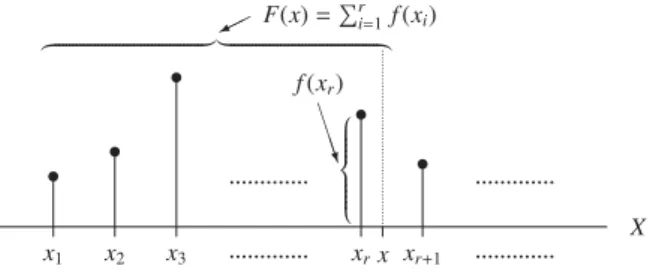
1. Discrete random variable (Figure 1):
• F(x) =
ri=1
f (x
i) =
ri=1
p
i,
where r denotes the integer which satisfies x
r≤ x <
x
r+1.
• F(x
i) − F(x
i− ) = f (x
i) = p
i,
where is a small positive number less than x
i− x
i−1.
2. Continuous random variable (Figure 2):
• F(x) =
x−∞
f (t) dt,
• F
(x) = f (x).
f (x) and F(x) are displayed in Figure 1 for a discrete random
variable and Figure 2 for a continuous random variable.
Figure 1: Probability Function f (x) and Distribution Func- tion F(x)— Discrete Case
X
x1 x2 x3 ... xrx xr+1 ...
• •
•
•
... • ...
⎧⎪⎪⎪⎪⎪⎨
⎪⎪⎪⎪⎪
⎩ BBBN f(xr)
F(x)=r
i=1f(xi)
Note thatris the integer which satisfiesxr≤x<xr+1.
71
Figure 2: Density Function f (x) and Distribution Function F(x) — Continuous Case
x
X f(x)
@@R F(x)=x
−∞f(t)dt
....
. . . .. . . . . .. .
. .
. .
. .
. .
. .
. .
. .
. .
. .
. .
. .
. .
. .
. .
. .
. .
. .
. .
. .
. .
. .
. .
. .
. .
. .
. .
. .
. .
. .
. .
. .
. .
. .
. .
. .
. .
. .
. .
. .
. .
. .
. .
. .
. .
. .
. .
. .
. .
. .
. .
. .
. .
. .
. .
. .
. .
. .
. .
. .
. .
. .
. .
. .
. .
. .
. .
. .
. .
. .
. .
. .
. .
. .
. .
. .
. .
. .
. .
. .
. .
. .
. .
. .
. .
. .
. .
. .
. .
. .
. .
. .
. .
. .
. .
. .
. .
. .
. .
. .
. .
. .
. .
. .
. .
. .
. .
. .
. .
. .
. .
. .
. .
. .
. .
. .
. .
. .
. .
. .
. .
. .
. .
. .
. .
. .
. .
. .
. .
. .
. .
. .
. .
. .
. .
. .
. .
. .
. .
. .
. .
. .
. .
. .
. .
. .
. .
. .
. .
. .
. .
. .
. .
. .
. .
. .
. .
. .
. .
. .
. .
. .
. .
. .
. .
. .
. .
. .
. .
. .
. .
. .
. .
. .
. .
. .
. .
. .
. .
. .
. .
. .
. .
. .
. .
. .
. .
. .
. .
. .
. .
. .
. .
. .
. .
. .
. .
. .
. .
. .
. .
. .
. .
. .
. .
. .
. .
. .
. .
. .
. .
. .
. .
. .
. .
. .
. .
. .
. .
. .
. .
. .
. .
. .
. .
. .
. .
. .
. .
. .
. .
. .
. .
. .
. .
. .
. .
. .
. .
. .
. .
. .
. .
. .
. .
. .
. .
. .
. .
. .
. .
. .
. .
. .
. .
. .
. .
. .
. .
. .
. .
. .
. .
. .
. .
. .
. .
. .
. .
. .
. .
. .
. .
. .
. .
. .
. .
. .
. .
. .
. .
. .
. .
. .
. .
. .
. .
. .
. .
. .
. .
. .
. .
. .
. .
. .
. .
. .
. .
. .
. .
. .
. .
. .
. .
. .
. .
. .
. .
. .
. .
. .
. .
. ....
....
....
....
. ....
..
....
....
....
....
. ....
....
... ....
....
....
....
....
....
..
....
....
....
....
....
....
....
....
..
....
....
....
....
....
.
....
....
....
....
....
...
....
....
....
....
....
....
..
....
....
....
....
....
....
....
.
....
....
....
....
....
....
....
...
....
....
....
....
....
....
....
....
..
....
....
....
....
....
....
....
....
....
.
....
....
....
....
....
....
....
....
....
....
....
....
....
....
....
....
....
....
....
....
...
....
....
....
....
....
....
....
....
....
....
....
..
....
....
....
....
....
....
....
....
....
....
....
....
....
....
....
....
....
....
....
....
....
....
....
....
...
....
....
....
....
....
....
....
....
....
....
....
....
....
.
....
....
....
....
....
....
....
....
....
....
....
....
....
...
....
....
....
....
....
....
....
....
....
....
....
....
....
....
....
....
....
....
....
....
....
....
....
....
....
....
....
....
..
....
....
....
....
....
....
....
....
....
....
....
....
....
....
...
....
....
....
....
....
....
....
....
....
....
....
....
....
....
...
....
....
....
....
....
....
....
....
....
....
....
....
....
....
...
....
....
....
....
....
....
....
....
....
....
....
....
....
....
...
....
....
....
....
....
....
....
....
....
....
....
....
....
....
...
....
....
....
....
....
....
....
....
....
....
....
....
....
....
..
....
....
....
....
....
....
....
....
....
....
....
....
....
....
....
....
....
....
....
....
....
....
....
....
....
....
....
...
....
....
....
....
....
....
....
....
....
....
....
....
....
.
....
....
....
....
....
....
....
....
....
....
....
....
...
....
....
....
....
....
....
....
....
....
....
....
....
....
....
....
....
....
....
....
....
....
....
....
..
....
....
....
....
....
....
....
....
....
....
...
....
....
....
....
....
....
....
....
....
....
....
....
....
....
....
....
....
....
....
.
72
2.2 Multivariate Random Variable (ଟมྔ֬
ม) and Distribution
We consider two random variables X and Y in this section. It is easy to extend to more than two random variables.
Discrete Random Variables: Suppose that discrete ran- dom variables X and Y take x
1, x
2, · · · and y
1, y
2, · · ·, respec- tively. The probability which event {ω; X(ω) = x
iand Y (ω) =
73
y
j} occurs is given by:
P(X = x
i, Y = y
j) = f
xy(x
i, y
j) ,
where f
xy(x
i, y
j) represents the joint probability function (݁߹֬ؔ) of X and Y. In order for f
xy(x
i, y
j) to be a joint probability function, f
xy(x
i, y
j) has to satisfies the fol- lowing properties:
f
xy(x
i, y
j) ≥ 0 , i , j = 1 , 2 , · · ·
i
j
f
xy(x
i, y
j) = 1.
74
Define f
x(x
i) and f
y(y
j) as:
f
x(x
i) =
j
f
xy(x
i, y
j), i = 1, 2, · · · , f
y(y
j) =
i
f
xy(x
i, y
j), j = 1, 2, · · · .
Then, f
x(x
i) and f
y(y
j) are called the marginal probability functions (पล֬ؔ) of X and Y.
f
x(x
i) and f
y(y
j) also have the properties of the probability functions, i.e.,
≥ = ≥ =
Continuous Random Variables: Consider two continu- ous random variables X and Y. For a domain D, the prob- ability which event {ω; (X(ω), Y (ω)) ∈ D } occurs is given by:
P((X , Y) ∈ D) =
D
f
xy(x , y) dx dy ,
where f
xy(x , y) is called the joint probability density func-
tion (݁߹֬ີؔ) of X and Y or the joint density
function of X and Y.
f
xy(x , y) has to satisfy the following properties:
f
xy(x, y) ≥ 0,
∞−∞
∞
−∞
f
xy(x , y) dx dy = 1.
Define f
x(x) and f
y(y) as:
f
x(x) =
∞−∞
f
xy(x , y) dy , for all x and y, f
y(y) =
∞
−∞
f
xy(x , y) dx ,
where f
x(x) and f
y(y) are called the marginal probability 77
density functions (पล֬ີؔ) of X and Y or the marginal density functions (पลີؔ) of X and Y.
For example, consider the event {ω ; a < X( ω ) < b , c <
Y( ω ) < d } , which is a specific case of the domain D. Then, the probability that we have the event {ω ; a < X( ω ) < b , c <
Y(ω) < d} is written as:
P(a < X < b, c < Y < d) =
ba
d
c
f
xy(x, y) dx dy.
78
The mixture of discrete and continuous RVs is also possible.
For example, let X be a discrete RV and Y be a continuous RV. X takes x
1, x
2, · · ·. The probability which both X takes x
iand Y takes real numbers within the interval I is given by:
P(X = x
i, Y ∈ I) =
I
f
xy(x
i, y) dy . Then, we have the following properties:
f
xy(x
i, y) ≥ 0 , for all y and i = 1 , 2 , · · · ,
i
∞
−∞
f
xy(x
i, y) dy = 1.
79
The marginal probability function of X is given by:
f
x(x
i) =
∞−∞
f
xy(x
i, y) dy,
for i = 1, 2, · · ·. The marginal probability density function of Y is:
f
y(y) =
i
f
xy(x
i, y) .
80
2.3 Conditional Distribution
Discrete Random Variable: The conditional probability function (݅֬ؔ) of X given Y = y
jis represented as:
P(X = x
i| Y = y
j) = f
x|y(x
i| y
j) = f
xy(x
i, y
j)
f
y(y
j) = f
xy(x
i, y
j)
i
f
xy(x
i, y
j) . The second equality indicates the definition of the condi- tional probability.
The features of the conditional probability function f
x|y(x
i| y
j) are:
f
x|y(x
i| y
j) ≥ 0 , i = 1 , 2 , · · · ,
i
f
x|y(x
i|y
j) = 1, for any j.
Continuous Random Variable: The conditional proba- bility density function (݅֬ີؔ) of X given Y = y (or the conditional density function (݅ີؔ
) of X given Y = y) is:
f
x|y(x|y) = f
xy(x, y)
f
y(y) = f
xy(x, y)
∞−∞
f
xy(x, y) dx .
83
The properties of the conditional probability density function f
x|y(x | y) are given by:
f
x|y(x | y) ≥ 0 ,
∞−∞