Introduction
Tuberculosis (TB) is an infectious disease that re-ceives attention globally. This disease is the top killer and produces the highest burden in many countries [1]. The World Health Organization reported that almost 5,000 people die of TB every day, 98% of whom live in developing countries, especially in the productive age [2]. As Indonesia has the second-highest burden of TB after India, Multi Drug-Resistant Tuberculosis (MDR-TB), Tuberculosis-Human Immunodeficiency Virus HIV), Tuberculosis-Diabetes Mellitus (TB-DM), and TB in children have become the focus of TB control there [3]. In 2017, 425,089 cases of TB were reported in Indonesia. This number was higher than the previous year, 2016 (360,565) [3]. Most of the cases of TB in Indonesia occur in poor urban areas with a high population density [4].
The government of Indonesia developed a strategic plan to end TB in the period of 2016-2020. One strat-egy is to control the risk factors of TB [5], so monitor-ing the risk factors in society is essential to inform the policymakers for the development of the prevention program. Updating the TB risk factors will support the United Nations Sustainable Development Goals (SDGs) point 3, provide good health, and promote well-being [6]. The target of the SDGs is to reduce the TB mortality by 90% by 2030 [1], with milestones in 2020 and 2025 [7]. A previous review explored the potential risk factors for TB and categorized them into an environmental factor and host characteristics. The host characteristics include age, gender, immune status, malnutrition, alcohol consumption and smok-ing behaviour, diabetes, and occupation, while the en-vironmental factors are population density and poor ventilation. Beyond that, the duration of proximity of [Original]
Risk Factors for Tuberculosis in an Urban Setting in Indonesia: A
Case-control Study in Umbulharjo I, Yogyakarta
Sulistyawati Sulistyawati* and Andika Wisnu Ramadhan
Faculty of Public Health, Universitas Ahmad Dahlan, Yogyakarta, Indonesia
Abstract : The rate of incidence of Tuberculosis (TB) in Indonesia is the ninth highest in the world. Poor
environ-mental conditions, mainly related to air circulation and improper behaviour, were recognized as the risk factors in this country. A case-control study of 69 participants was conducted in the Umbulharjo I Public Health Centre of Yogyakarta during January-August 2019. Data collection was conducted using a tested questionnaire. Analysis was performed using Chi-square and Logistic regression. Three variables were identified as potential risk factors for TB: family history of TB, smoking behaviour, and ventilation condition. The results of the logistic regression test revealed that people who smoke have the greatest risk of TB infection. Health promotion needs to be enforced to educate both patients and their family to prevent the transmission of TB.
Keywords : Tuberculosis, risk factor, ventilation, smoking, Indonesia.
(Received May 18, 2020, accepted January 13, 2021)
*Corresponding Author: Sulistyawati Sulistyawati, Faculty of Public Health, Universitas Ahmad Dahlan, Yogyakarta, Indonesia, FKM UAD, 3rd
Cam-pus of UAD. Jl Prof Dr Soepomo, Janturan, Umbulharjo, Yogyakarta, Indonesia. Tel: +62 8170402693, Fax: (0274) 564604, E-mail: sulistyawati. [email protected]
contact influences exposure to TB [8]. Urban settings, such as in Yogyakarta City, are the most frequently mentioned risk factors of possible infection of TB. According to Indonesia s basic health research (2019), the number of TB cases in Yogyakarta prov-ince is categorized as low compared to the 34 other provinces [9]. There were 3,776 TB cases in Yogya-karta province in 2018. West Java province had the highest number of TB cases, with more than 90,000. The province with the fewest TB cases was West Pap-ua, with 1,421 cases [10]. Yogyakarta province con-sists of five districts, and Yogyakarta City, which has been struggling with TB since about a decade ago, had the highest number of TB cases during 2013-2018. Figure 1 shows a comparison of the incidence rates of TB among the administrative levels in Yogyakarta province. It indicates that Yogyakarta City had the highest incidence rate in the district during three years of observation, even compared with the provincial rate [11]. Meanwhile, the TB cure rate in 2019 in the City of Yogyakarta was only 84%, which was lower than the set target of 90%. This means that TB in Yogya-karta City requires more attention in prevention ef-forts, including monitoring risk factors on an ongoing basis because of the high number of cases.
Recognizing and monitoring risk factors is essential to prevent the occurrence of the disease as well as for outbreak preparedness. Monitoring behavioural risk factors is used to measure TB infection in the popu-lation to consider prevention and control strategies. Several studies in the last decade have observed the risk factors of TB in Indonesia. One previous study mentioned that pulmonary TB is significantly
associ-ated with gender, Diabetes Mellitus history, and con-tact history with TB patients [12]. A study in Kendal District, Central Java, found residential density, room temperature, indoor humidity, floor type, sputum placement, cough and sneeze habit as potential risk factors [13]. The two studies revealed that individual behaviour and the home environment are still potential risk factors for TB in Indonesia. Accordingly, to sup-port the national TB plan in Indonesia and the SDGs 3, it is essential to investigate the current potential risk factors for getting TB in both individual behaviour and the home environment. With this background in mind, the present research investigated the risk factors for TB from the home environment and behaviour using a case-control design in Umbulharjo of Yogyakarta, Indonesia.
Materials and Methods
Study design and sample
A case-control study with a 1:2 ratio between cases and controls, respectively, was conducted in Umbul-harjo I Public Health Centre, Warungboto sub-district part of the City of Yogyakarta during September 2019. We used secondary data, which was the TB register in the Umbulharjo I Primary Health Centre (PHC). The case population was entirely TB patients who had taken medication during January-August 2019 in the Umbulharjo I Primary Health Centre (40 patients). The control population was all the citizens living in the Umbulharjo I PHC area who had been diagnosed as TB negative (58 patients). A sample calculation was conducted through Open Source Epidemiologic Statistics for Public Health (Bill and Melinda Gates Foundation, Seattle, USA) [14], by considering a 95% confidence level, 80% of power, and Odds Ratio (OR = 5,618) referred to in previous research [15]. Accord-ingly, this study involved 23 cases and 46 controls. Cases and controls were matched in sex and age. The inclusion criteria for the cases were TB patients who had been diagnosed with pulmonary tuberculosis by a doctor through clinical examination and strength-ened by a laboratory test. These patients had taken medication during January-August 2019, were aged 17-65 years old, were able to participate, and had re-sided in Umbulharjo for at least one year. The
exclu-Figure 1. Comparison of TB incidence rates between district and province levels during 2016-2018. TB: Tu-berculosis Yogyakarta Province Sleman Gunungkidul Kulonprogo Bantul Yogyakarta City 0 2018 2017 2016 50 100 150 200 250
sion criteria for the cases were death of patient, ces-sation of medication, having multiple drug-resistant TB, and extensively drug-resistant TB. The inclusion criteria for the controls were people who had resided in Umbulharjo for at least one year, being able to par-ticipate, and having had a TB test. The exclusion cri-teria for the controls were age below 17 years old and residing outside of Umbulharjo.
Among the 40 cases, 32 met the inclusion criteria. Among the 58 controls, 55 fit the inclusion criteria. Both for cases and controls, we systematically selected the participants starting from the newest cases until the number of samples was fulfilled.
Research instrument
We used two instruments: a questionnaire and a field measurements form. A structured questionnaire was used to collect the data from the participants. This questionnaire, which was adapted from previous research [16], was divided into 2 parts. Part 1 asked about respondent information and risk factors, such as name, address, age, education, status of residence, duration of residence, status of house renovation, and history of any family members of having TB. For education, we categorized as low when a respondent s highest level was graduation from junior high school. High education was when a respondent attended senior high school or upper education. Part 2 asked about behaviour: smoking and the duration. People who re-ported consuming at least one cigarette per day during a year were categorized as smokers. A non-smoker was a person who had not smoked for a minimum of one year. Lastly, the field measurement form was used to measure the house ventilation and bedroom ventilation by using a rolling meter. We categorized as adequate when they had ventilation of at least 10% compared to the total floor space [17-19]. The same ventilation requirement for residences has been used in Malaysia [20].
Data collection
Door to door visits were conducted to collect the data based on the sample list from the PHC. All of the respondents agreed to participate on the first visit. Activities were separated into two steps: interview and measurement. The interview was done face to face
in Bahasa, Indonesia. For illiterate respondents, the questionnaire was read and filled in by the researcher (second author) based on their information. Informed consent was obtained before the interview.
Statistical analysis
Univariate analysis was used to calculate the distri-bution frequency. The risk factor was calculated using a chi-squares test by assessing the odds ratio and last conducted logistic regression with significance level P ≤ 0.05. The multivariate model was adjusted for sex, age and education. The calculation was executed in SPSS version 24.0 (IBM Corp., Armonk, NY, USA). Ethical consideration
The study was approved by the Ethical review board of Universitas Ahmad Dahlan, Yogyakarta, Indonesia (ethical approval code: 011907068).
Results
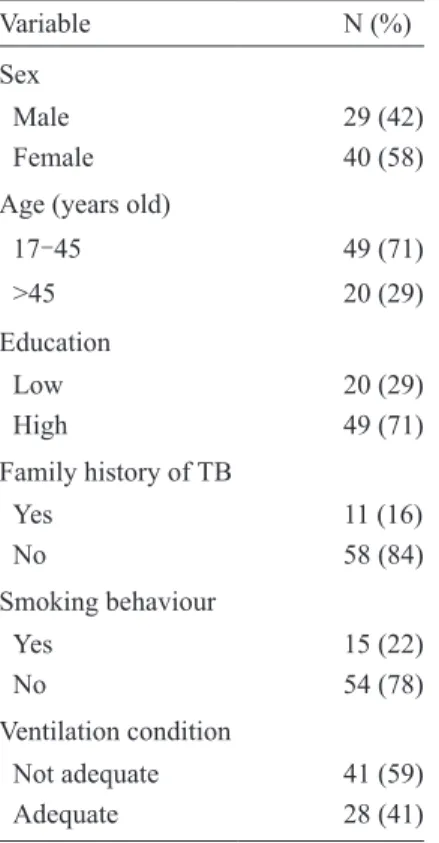
A total of 69 respondents participated in this study, divided into 23 cases and 46 controls. The majority of the respondents were female and aged 17-45 years old or in the production phase. More than 70% of the respondents attended high school, meaning that they had not graduated from senior high school or attended university. Most of the respondents stated they did not have a family member with TB. Seventy-eight percent of respondents did not smoke. The majority of the re-spondents lived in houses that did not have adequate ventilation (Table 1).
In this study, the potential risk factors of TB we tested for were sex, age, education, history of family members with TB, smoking behaviour, and ventila-tion. Among them, three variables had a significant association with TB incidence at the P ≤ 0.05 level: the history of family members having TB, smoking behaviour, and ventilation condition (Table 2). Hav-ing a family member who experienced TB increased the odds of someone getting TB infection by 4.59 times (OR = 4.59). People who smoked one cigarette per day during one year increased the odds of getting TB infection by 4.28 (OR = 4.28) times compared to those who did not. We found that people who lived in a house with poor ventilation conditions had 3.60
(OR = 3.60) times higher odds of getting TB infec-tion compared to people who had adequate ventilainfec-tion conditions.
In the multivariate analysis (Table 3), it was found that people who smoked were 7.89 (OR = 7.89) times more likely to be infected by TB than those who did not smoke. Anyone who lived in poor ventilation con-dition was 6.69 (OR = 6.69) times more likely to get TB infection. Lastly, those with a family history of TB were 5.18 (OR = 5.18) times more likely to be infected by TB than those without a TB family history.
Discussion
Tuberculosis has received serious attention from the health authorities due to its contagiousness and high mortality rate. Monitoring TB s potential risk factors is essential for prevention purposes, especially in areas where TB becomes endemic or has a high incidence of cases. Individual, environmental, and behaviour vari-ables are the main influences on the spread of TB in several regions of the world, including in Umbulharjo, an urban area in Yogyakarta.
Our research found that having a family member who experienced TB increased the risk (5.18 times) of someone getting TB infection. TB is transmitted di-rectly to people by droplets from people infected with Mycobacterium tuberculosis [21, 22]. The micropar-ticles are easily spread through the aerosol system. Thus, when a family member is positive for TB, it means an increased risk of other family members liv-ing in the same house gettliv-ing TB because of the inten-sive interaction between them. The situation will be worse when they don t have sufficient air circulation in
Table 2. Bivariate analysis of TB incidence versus the potential risk factors
Variable TB P-Value OR (95% CI)
Case N (%) Control N (%)
Sex 0.66 1.42 (0.51-3.91)
Male 11 (48) 18 (39)
Female 12 (52) 28 (61)
Age (years old) 0.92 1.24 (0.40-3.18)
17-45 17 (74) 32 (70) > 45 6 (26) 14 (30) Education 1.00 1.11 (0.37-3.32) Low 7 (30) 13 (28) High 16 (70) 33 (72) Family history of TB 0.03 4.59 (1.18-17.84) Yes 7 (30) 4 (9) No 16 (70) 42 (91) Smoking behaviour 0.03 4.28 (1.29-14.21) Yes 9 (39) 6 (13) No 14 (61) 40 (87) Ventilation condition 0.04 3.60 (1.14-11.33) Not adequate 18 (39) 23 (50) Adequate 5 (61) 23 (50)
n = 69, OR: odds ratio, 95% CI: confidence interval, TB: Tuberculosis
Table 3. Multiple Logistic regression of risk factors for getting TB
Variable Adjusted OR* 95% CI P-value
Family history of TB 5.18 1.14-23.39 0.03 Smoking behaviour 7.89 1.77-35.22 0.00 Ventilation condition 6.69 1.55-28.81 0.01 n = 69, OR: odds ratio, 95% CI: confidence interval, TB: Tuber-culosis, *adjusted for sex, age and education
Table 1. Socio demographic char-acteristics of the participants
Variable N (%)
Sex
Male 29 (42)
Female 40 (58)
Age (years old)
17-45 49 (71) >45 20 (29) Education Low 20 (29) High 49 (71) Family history of TB Yes 11 (16) No 58 (84) Smoking behaviour Yes 15 (22) No 54 (78) Ventilation condition Not adequate 41 (59) Adequate 28 (41)
their house. This finding was confirmed by research in other countries such as Ethiopia and India [23, 24]. Smoking is a risk factor for the development of chronic obstructive pulmonary disease, lung cancer, and other respiratory diseases, especially TB [25], as has been proven by other research [26-28]. In our study, too, we found that smoking is a potential risk factor for TB. People who smoked one cigarette per day for one year had 7.89 times higher odds of getting TB infection than those who did not. Indeed, smoking is a big problem that coincides with the high popula-tion and the growth of the cigarette industry in Indo-nesia. In 2002, 60% of adult males and 4% of females were smokers [29]. Smokers are found not only in the adult population but also among the youth. In 2018, 20% of youth aged 13-15 years old were smokers, which was relatively high and could harm Indonesia in the future, related to the disease burden [30]. Accord-ingly, providing early education in health care and in school by using proper health promotion is essential. It can be face-to-face counselling, phone interaction, printed or electronic media, or internet sources [31]. We found that people who live in a house with poor ventilation conditions had 6.69 times higher odds of getting TB infection compared to people who have ad-equate ventilation conditions. It is well known that TB bacilli can survive in the air before being inhaled by a new host. Accordingly, the ventilation condition deter-mines the transmission of TB in indoor environments related to free air circulation [32, 33]. In our research area, an urban setting, some of the residents built hous-es without a proper plan, rhous-esulting in the houshous-es be-ing huddled together with poor air circulation. Even if they have ventilation, they acquire insufficient fresh air inside their home. A similar situation was discov-ered in other parts of Indonesia [34, 35]. Seen from our results, there are bad circumstances where a house or settlement is already set up, making it difficult when they have to renovate their house to have better venti-lation. A possible solution is to increase the penetra-tion of the sunlight through the roof, since vitamin D is proven to improve immunity to TB [36, 37]. It is also important to have collaboration among government di-visions such as health, infrastructure, and population to build proper new residences in the future.
This study has some limitations, such as the small
sample, but we did our research in an urban area where there is a high incidence of TB. Accordingly, our sam-ple may represent a bigger picture of TB in Yogyakarta and Indonesia.
Conclusions
In conclusion, we identified smoking behaviour as a possible risk factor for getting TB infection. The other risk factors are ventilation conditions and family history of TB. Therefore, it is important to improve knowledge, both formal and non-formal, targeting all segments of the population, to update the understand-ing of potential risk factors in society.
Acknowledgement
We would like to thank the TB programmer in Um-bulharjo I PHC of Yogyakarta (Ibu MF. Rini W) for her assistance during the course of our research. We also wish to thank all the participants who contributed to this study.
Conflict of Interest
The author declares there is no conflict of interest. Funding
This research did not receive any external funding. References
1 . WHO (2015): The End TB Strategy. World Heal. Organ. WHO, Geneva 16 pp https://apps.who.int/iris/ handle/10665/331326 (accessed February 18, 2021) 2 . WHO (2005): Tuverculosis control: surveillance,
plan-ning, financing. In: WHO report 2005. WHO, Gene-va, 247 pp https://apps.who.int/iris/bitstream/handle/ 10665/144569/9241562919_eng.pdf (accessed Febru-ary 18, 2021)
3 . Ministry of Health Republic of Indonesia (2011): Health Profile of Indonesia. https://www.kemkes.go.id/ index.php?lg=LN02 (accessed January 20, 2020) (In Indonesia)
Drug-Resistant TB in Indonesia: A Human Face. https://medium.com/undp-in-asia-and-the-pacific/ defeating-drug-resistant-tb-in-indonesia-a-human-face-9d0ac70ee143 (accessed November 20, 2019) 5 . Ministry of Health Republic of Indonesia (2018):
Indo-nesia National TB Program Current status of integrated community based TB service delivery and the Global Fund work plan to find missing TB cases. https://www. who.int/tb/features_archive/indonesia_11apr18. pdf?ua=1 (accessed February 19, 2021)
6 . The United Nations. Health (2019): United Nations Sus-tainable Development. Available from: https://www. un.org/sustainabledevelopment/health/ (accessed No-vember 20, 2019)
7 . WHO (2019): Global Tuberculosis Report. https://www. who.int/publications/i/item/global-tuberculosis-report-2019 (accessed February 19, 2021)
8 . Narasimhan P, Wood J, MacIntyre CR & Mathai D (2013): Risk factors for tuberculosis. Pulm Med (2013) 828939
9 . The Ministry of Health of Indonesia(2019): Main Re-sults RISKESDAS 2018 (In Indonesian). http://kesmas. kemkes.go.id/assets/upload/dir_519d41d8cd98f00/ files/Hasil-riskesdas-2018_1274.pdf (accessed Febru-ary 19, 2021)
10 . Ministry of Health of Republic of Inddonesia (2018): Data and information on Indonesia s Health profile 2018. https://www.kemkes.go.id/article/view/19041500003/ data-dan-informasi-profil-kesehatan-indonesia-2018. html (accessed February 19, 2021)
11 . Yogyakarta Provincial Health Office (2019): Profile of Provincial Health Office of Yogyakarta. https://keseha tan.jogjakota.go.id/uploads/profil2019data2018.pdf (accessed February 19, 2021)
12 . Padang IA & Sudaryo MK (2019): A cross-secsional study: Analysis risk factors against pulmonary TB AFB positive in Indonesia. Indian Journal of Public Health Research and Development 10(2): 398-403
13 . Wulandari AA, Nurjazuli & Adi MS (2015): Risk fac-tor and potential of transmission of tuberculosis in Kendal district, central Java. J Kesehat Lingkung In-dones 14(1): 7-13 (In InIn-donesia)
14 . Bill and Melinda Gates Foundation (2020): Open Source Epidemiologic Statistics for Public Health. https:www. openepi.com/SampleSize/SSCC.htm (accessed March 10, 2021)
15 . Fitriani E (2013): Riskfactors related to the event of lung tuberculosis. Public Heal 2(1): 1-7 (In Indonesia) 16 . Ayunah Y (2008): The relationship between factors of
the quality of the physical environment of the home and the incidence of positive BTA Lung TB in the Cilandak District, South Jakarta in 2008. Thesis, Faculty of Pub-lic Health, University of Indonesia (In Indonesia) 17 . Kurniawati E & Sulistyorini L (2018): Analysis of the
physical quality of the house with the presence of my-cobacterium tuberculosis in the air. Indones J Public Heal 13(1): 13-24 (In Indonesia)
18 . MInister of Health, Republic of Indonesia (2011): In-donesian Minister of Health Regulation No 1077/ Menkes/PER/2011. https://pkmgading.files.wordpress. com/2011/10/permenkes-pedoman-penyehatan-udara-dalam-ruang-rumah.pdf (accessed February 19, 2021) (In Indonesia)
19 . Indriyani N, Istiqomah N & Anwar MC (2016): Re-lationship of humidity level of a households with the event of lung tuberculosis in the Tulis district region, Batang district. Unnes J Public Heal 5(3): 214 20 . Nedhal AT, Sharifah FSF & Adel A (2016):
Relation-ship between window-to-floor area ratio and single-point daylight factor in varied residential rooms in Ma-laysia. Indian J Sci Technol 9(33): 1-8
21 . Shiloh MU (2016): Mechanisms of mycobacterial transmission: how does Mycobacterium tuberculosis enter and escape from the human host. Futur Micro-biol 11(12): 1503-1506
22 . Mandal A (2019): Tuberculosis Transmission. News Med. Life Sci. https://www.news-medical.net/health/ Tuberculosis-Transmission.aspx (accessed November 19, 2019)
23 . Shimeles E, Enquselassie F, Aseffa A et al (2019): Risk factors for tuberculosis: A case-control study in Addis Ababa, Ethiopia. PLoS One 14(4): e0214235
24 . Andrews R., Devadatta S, Fox W, Radhakrishna D, Ramakrishnan C & Velu S (1960): Prevalence of tu-berculosis among close family contacts of tuberculous patients in South India, and influence of segregation of the patient on early attack rate. Bull World Health Organ 23(4-5): 463-510
25 . Malin AS & McAdam KP (1995): Escalating threat from tuberculosis: the third epidemic. Thorax 50 (Sup-pl): 1S37-42
Association between tuberculosis and smoking. Int J High Risk Behav Addict 1(2): 71-74
27 . den Boon S, van Lill SW, Borgdorff MW et al (2005): Association between smoking and tuberculosis infec-tion: a population survey in a high tuberculosis inci-dence area. Thorax 60(7): 555-557
28 . Borekci S, Duman B, Mazican N et al (2013): The re-lationship between smoking habit and tuberculosis in patients under anti-TNF-α treatment. European Respi-ratory Journal 42(Suppl 57): p 4676
29 . Aditama TY (2002): Smoking problem in Indonesia. Medical Journal of Indonesia 11(1): 56-65
30 . Southeast Asia Tobacco Control Alliance (2018): In-donesia: Protecting Indonesian Youth From Tobacco. https://seatca.org/indonesia-protecting-indonesian-youth-from-tobacco/ (accessed November 20, 2019) 31 . Harvey J, Chadi N & Canadian Paediatric Society
AHC (2016): Preventing smoking in children and ado-lescents: Recommendations for practice and policy. Paediatr Child Health 21(4): 209-221
32 . Turner RD, Chiu C, Churchyard GJ et al (2017): Tu-berculosis Infectiousness and Host Susceptibility. J
Infect Dis 216(suppl 6): S636-S643
33 . Nagaraja SB, Satyanarayana S & Bansal AK (2018): Can ventilation oust tuberculosis bacilli? Dare to plug the unpluggable. Public Health Action 8(1): 28 34 . Rahayu SR, Katsuyama H, Demura M et al (2015):
Factors associated with tuberculosis cases in Semarang District, Indonesia: case-control study performed in the area where case detection rate was extremely low. En-viron Health Prev Med 20(4): 253-261
35 . Sinaga FR, Heriyani F & Khatimah H (2016): Rela-tionship between house ventilation conditions and lung disease in the Kelayan Timur Health Center. Berk Ke-dokt 12(2): 279-288
36 . Koh GC, Hawthorne G, Turner AM, Kunst H & Dedicoat M (2013): Tuberculosis incidence correlates with sunshine: an ecological 28-year time series study. PLoS One 8(3): e57752
37 . Wells WA (2006): Curing TB with sunlight. Journal of Cell Biology 172(7): 958a-958