A Clinical Study of Twelve Cases of
Decompression Illness in Kagoshima Prefecture
During the Past Two Years, December,
1991-December, 1993
著者
ARIKAWA Kazuhiro, NOGUCHI Harushi, MASUDA
Tsugitoshi, KUBO Kaori, HIRAKAWA Wataru,
NOMAGUCHI Satoshi
journal or
publication title
南太平洋海域調査研究報告=Occasional papers
volume
25
page range
31-36
URL
http://hdl.handle.net/10232/16801
Decompression Sickness in Divers
A CLINICAL STUDY OF TWELVE CASES
OF DECOMPRESSION ILLNESS IN KAGOSHIMA PREFECTURE
DURING THE PAST TWO YEARS, DECEMBER, 1991-DECEMBER, 1993
Kazuhiro ARIKAWA, Harushi NOGUCHI, Tsugitoshi MASUDA,
Kaori KUBO, Wataru HlRAKAWA and Satoshi NOMAGUCHIAbstract
Twelve cases of decompression illness during the past two years were studied. Among
these, one death was encountered. Half of the twelve cases were Type I (Bends), characterized
by localized pain around the joints. The other half were the more severe Type II, which in
cludes spinal cord injuries, pulmonary disturbances (Chokes), cerebral disturbances, arterial
gas embolism, and vestibular staggerings. Two of the severest cases, one of which was fatal, were reported with the common risk factor of obesity. The fatal case, in which the patient died shortly after recompression therapy, was related to reperfusion injury. Diving after a long interval of diving inactivity was also found to be a probable risk factor of decompres
sion illness.
Key Words : Decompression illness, Bends, Chokes, Spinal cord injury, Obesity, Diving after a long interval, Reperfusion Injury, HBO therapy
Introduction
Twelve cases of decompression illness have appeared in our institution during the past two years. All the patients were male with a mean age of 42.5 years, ranging from 29 to 51 years of age. Of the twelve cases, 10 were professional divers and the other two were sports
divers. All used a self contained underwater breathing apparatus (SCUBA). Six of the cases were categorized as "Bends" (Type I); four were "Spinal cord injuries" and 2 were "Chokes"
(Type II). The severest Type II case died soon after recompression therapy probably of
reperfusion injury. The other eleven cases recovered without serious complications after
treatment with hyperbaric oxygen (HBO) therapy. Seven cases occurred near the islands in
the southern ocean of Kagoshima Prefecture, Japan. After being injured, four were trans ported by helicopter to our hospital. Monthly numbers of patients with decompression illness are shown in Figure 1. Four cases of decompression illness occurred at the end of December, and three of four were severe cases. These three severe cases had occurred after a long period of diving inactivity. The purpose of these dives was to gather fish and/or shellfish for the New Year celebration dishes. This paper presents the details of two Type II cases, one which was fatal, and the other which was a severe spinal cord injury.
No. of Cases
5
K. Arikawa et al.4
3
2
1
Type I
Type II
Jan. Feb. Mar.Apr.MayJun. Jul.Aug.Sep.Oct.Nov.Dec.
* deathFig. 1
Case Reports Case 1.
The patient lived in Tanegashima Island, located 100 km south of Kagoshima City. He was a 43 year-old professional diver and usually dived about 20 days per month during sum mer. His last dive during the summer was on August, 1992. On December 30, 1992, he went diving at 11:00 a.m. for collecting ear shells. He started to dive and his diving depth was
about 15 meters, but because of the cold water temperature and the strong tide, he surfaced
rapidly without sufficient decompression time. Shortly after the surfacing, he vomited at first, then complained of upper and lower limb paralysis and could not speak. On admission to the neighborhood hospital on Tanegashima island, his blood pressure measured below 50 mmHg. He was treated with cathecholamine and had a fluid transfusion, and then trans
ported to our hospital by helicopter, five hours after the incident.
On admission to our hospital, his blood pressure measured 80 mmHg. He was a little
confused, but was able to state his own name and birth date. The motion of his limbs was
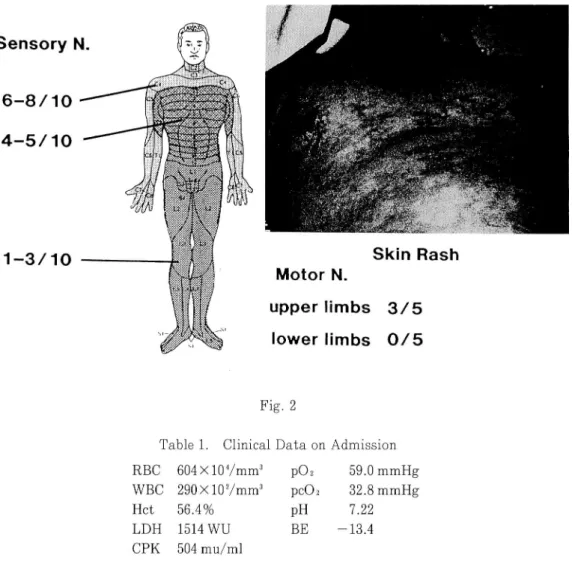
disturbed completely in the lower, and incompletely in the upper (Fig. 2). Numbness had
extended to the cervical level and he complained of severe pain in his left shoulder. He was heavy-set, weighing 90 kg, and standing 175 cm tall. His skin color was deeply cyanotic. A
skin rash was visible on his breast and upper abdomen. The laboratory data (Table 1) re
vealed hemoconcentration, hypoxemia despite oxygen inhalation, high levels of lactate
dehydronase (LDH) and creatine phosphokinase (CPK). His urine color was dark red with an extremely high level of myoglobin (18,600 ng/ml). The patient was given a transfusion of
the Past Two Years, December 1991-December 1993
Sensory N
1-3/10 Motor N. upper limbs 3/5 lower limbs 0 / 5 Fig. 2Table 1. Clinical Data on Admission
RBC 604 X 107mm3 p02 59.0 mmHg WBC 290XlOVmm3 pcCh 32.8 mmHg
Hct 56.4% PH 7.22 LDH 1514 WU BE -13.4
CPK 504 mu/ml
corrected with sodium bicarbonate. The patient's blood pressure recovered to 110 mmHg 30 minutes after admission. Then he was carried into the multiplace chamber, and treated by HBO therapy according to Table Standards (Table VI : 2.8ATA; 4 hours 47 minutes). We could not find any signs of improvement, which is usually seen in patients of Type II decom pression illness during the chamber treatment. One hour after the HBO therapy, he suddenly collapsed and his blood pressure fell to 50 mmHg. The increase of the cathecholamine dose was temporally effective. However he passed away 7.5 hours after the recompression ther apy, resisting various aggressive supports. An autopsy was not permitted by the family
because of the upcoming New Year's ceremony.
Case 2.
A 47 year-old man, who also lived in Tanegashima Island, was attacked by decompres sion illness after his third dive on August 24, 1992. He was a guide diver for visitors. As the weather was worsening, he decided to quit diving and surfaced with the crew from a depth of 25 meters around 3 o'clock in the afternoon. Paralysis of his lower limbs developed 10 min utes after surfacing and he dived to a depth of 10 meters for recompression. His paralysis
34 K. Arikawa et al
disappeared and he surfaced again slowly. He then complained of paralysis and numbness again, and was carried to the local hospital. Neither a helicopter nor a regular high speed boat was available because of stormy weather. The patient was sent to Kagoshima by steamer the next morning and arrived in our hospital about 23 hours after the accident.
The severity of his decompression illness on admission, is shown in Figure 3. His lower limbs were completely paralyzed and his upper limbs incompletely paralyzed. Numbness reached to the upper breast. He was also heavy, weighing 74 kg, and measured at 168 cm in height. He was conscious to clearly explain the details of the accident, and we could not find any reason that would cause the occurrence of his disease. He had a history of Type I decom pression illness at the age of 43, and since then he had surfaced according to the Dive Table
Standards.
He was treated by HBO therapy according to Table Standards (Table VI). Within 30
minutes of the first treatment, the paralysis and numbness improved markedly, but not sufficiently. Paresis was resolved almost completely following the second HBO therapy. The
numbness, on the other hand, remained and bladder and rectal disturbances continued for
several days. From the third day of hospitalization, we changed the therapy program to OHP
2 (2.5ATA; 1.5 hours) with an intravenous infusion of Lipo PGE1 to treat his spinal cord
injury. The patient improved day by day, being able to walk on the 10th, urinate and defecate by himself on the 14 th hospitalized day. He was discharged on September 30, 37 days after being admitted. He left with a slight temperature numbness in the external part of his right leg, after receiving a total of 37 HBO therapy sessions. He is doing well now.
47/M (Spinal Cord)
1 - 2 / 1 0 Fig. 3 0101-2391 Motor N.upper limbs 2/5
lower limbs 0/5
the Past Two Years, December 1991-December 1993 Discussion
Decompression illness iscaused mainly by nitrogen bubble formation in the body because
of the rapid reduction ofenvironmental pressure. It is known that approximately one liter of
nitrogen is dissolved in the body, a half in the body fluid and another half in the fat. Further
more, nitrogen is five times more soluble in the fat than in water (JAIN, 1990). These facts
suggest obesity increases the risk of decompression illness and in fact McCallum and Petrie
(1984) stated that divers who are more than 20% in excess of ideal weight should be prohib
ited from diving. Our two severest cases of decompression illness reported above were also
fat, and suggest that divers should try to maintain an ideal weight.
Of the 12 cases in this study, seven occurred in the southern islands and four of them
were transported by helicopter. We asked pilots to fly at the lowest height possible, at least
below a height of 100 meters above sea level, because of low pressure in high places, decom
pression illness may be worsened. Lipmann and Bugg (1992) also have recommended that
divers should not take an airplane within 24 hours after their last dive.
Of interest, four cases developed the attacks at the end of December. These four cases
were the first trials in winter season and three of them were the more severe Type II. It is
said that the bubble formation during decompression is suppressed by repeating dives (Per
sonal Communication with Mano, Y. M. D.). This suggests that divers should exercise
greater care if the intervals between dives are greater than 2 weeks.
Despite the fact that the first case reported in this paper, arrived at our hospital within
5 hours after the attack, and died, the importance of immediate recompression therapy must
be emphasized for treatment of decompression illness. This patient had fallen into shock
shortly after being stricken and revealed almost all the signs and symptoms of decompres
sion illness on admission. Furthermore, laboratory data and myoglobinuria suggested exten
sive tissue damage due to ischemia. Abrupt redissolution of bubbles might have caused blood
reperfusions in the ischemic tissues. Reperfusion injury, considered to be mainly due to the
harmful effect of oxygen-free radicals, results in lethal effect at times, and is the suspected
cause of death in this case.
The second patient was transported 23 hours after being stricken and received same
treatment as the first case. His laboratory data was within the normal range and, he re
sponded markedly to HBO therapy. However, he needed 37 treatments of HBO therapy. The
results of our two cases suggest that ischemic tissue damage exists is a more damaging fac
tor than the interval between onset of symptoms and recompression therapy. However, we do
not intend to emphasize that early treatment is less important. In our 12 cases of decompres
sion illness, similarly severe spinal cord injury cases that had been treated within shorter
intervals after onset recovered completely after receiving only two to three HBO therapies.
Conclusion
The experiences of twelve cases of decompression illness over the past two years were
studied. The two most severe cases were reported and some risk factors of decompression
illness were elucidated.
References
K. Arikawa et al.
Tronto.
Lippmann, J. and Bugg, S. 1992. The Diving Emergency Handbook, Japanese ed., Kaibundo
Publishing Co., Tokyo.