Waste management and public-private partnership-integrating waste
pickers’ cooperative in India
Yukiko Hashimoto
*Neha Sathe
**Abstract
This article intends to analyse the effectiveness of public and private partnership in dealing with waste management
in urban India. It examines effectiveness of the model with integrating waste pickers’ cooperative into public to
improve the social issue and the living standard of the waste pickers based on the survey conducted among the
cooperative members. It tries to evaluate the organisation’s efficiency such as social impact, management ability,
and innovativeness. Finally, we try to identify factors to be a successful waste management model based on the
evaluation results and case study. It concludes that the Solid Waste Collection and Handling Cooperative
(SWaCH), a doorstep waste collection cooperative resulted from the union’s joint effort with
Pune Municipal Corporation (PMC) reformed not only solid waste management and service
delivery across Pune, but it also improved the lives, incomes and working conditions of the waste‐
pickers themselves, addressing the issues of both poverty and public sanitations.
Key words :waste pickers’ cooperatives, public-private partnership
Background
Waste is a major health hazard that undermines people’s right to a safe life. All forms of waste — municipal, bio-medical, e-waste, or industrial, if not treated and disposed carefully are a threat to the health of people as well
as the environment. Anaerobic degradation of waste at landfill sites produces methane — a greenhouse gas that is 20 times more harmful than carbon dioxide. Filth and garbage on streets facilitate spread of diseases like malaria, plague; making a significant dent on a country’s prospects of achieving the Millennium Development Goals (MDG). With
* 吉備国際大学外国語学部 〒716-8508 岡山県高梁市伊賀町8
Kibi International University
8, Iga-machi Takahashi, Okayama, Japan(716-8508)
** Karve Institute of Social Service, School of Social Work, Industrial Social Work, Hillside Karve Nagar Pune, India.
吉備国際大学研究紀要 (人文・社会科学系) 第25号,103−111,2015
waste generation rates set to more than double over the next twenty years in low and middle income countries, the costs of managing the waste is also expected to witness a steep rise, with cost increases being most severe in low income countries (more than 5-fold increases) followed by middle income countries (more than 4-fold increases)1).
Municipal Solid Waste Management (MSW) in
India
In India, the responsibility of waste management lies with Urban Local Bodies (ULBs) due to the public and local nature of the service. Since MSW is inextricably linked to urbanization and economic development, the nature and constitution of MSW in India differs greatly, when compared to MSW in other high-income countries. The composition of MSW at generation sources and collection points in India is observed to mainly consist of a large organic fraction (40–60%), ash and fine earth (30–40%), paper (3–6%) and plastic, glass and metals (each less than 1%)2).
In India, segregation and storage of MSW at source is lacking and the decomposable and non-decomposable wastes are often disposed off at a common communal dustbin/disposal centre. The collection efficiencies are also seen to be poor, at around 70% in most Indian cities and continue to be predominantly manual in nature. Transfer stations are rarely used and the same vehicle that collects refuse from the individual communal bins is also responsible for taking it to the processing or the disposal site. Collection and transportation activities constitute approximately 80–95% of the total budget of MSW; hence, it forms a key component in determining the economics of the entire MSW Management system. On the contrary, disposal and treatment of waste is an underinvested area and open, uncontrolled and poorly managed landfills are a common feature across most Indian cities and town. Now local
government bodies (ULBs) responsible for this issue are changing the policy to shift the responsibility to private sectors or waste pickers’ cooperatives3)4).
Waste management and waste pickers’
cooperatives in Pune, Maharashtra
Thousands of tons of garbage are segregated across the country every day with re-usable material finding its way to scrap markets. Work done by rag pickers is productive in economic and environmental terms.
In the past, all the waste was placed in bins on the roadside and the municipal trucks would regularly come to empty them and take the waste to the dump. KKPKP5)6) (Kagad
Kach Patra Kashtakari Panchayat), a rag pickers union working in Pune is promoting the separation of waste at household level: families separate their waste into biodegradable and non-biodegradable and rag pickers go from house to house to collect it and then sell what can be sold. What cannot be reused is sent to the dump, and the biodegradable waste is composted at source. This practice is working only in one ward of Pune. In rest of the city, the practice of disposal of un-segregated solid waste by households into roadside public bins and collection by municipal trucks is in practice; being segregated by rag pickers on dump site and bio-degradable waste in converted into manure by private company as described earlier. The Municipal Solid Waste (MSW) Rules 2000 require municipalities to extend themselves to primary collection of garbage (door to door) instead of the earlier practice of secondary collection from the common collection points (containers) on the street. The rules themselves are explicit in offering a range of choices that the municipalities can adopt for this purpose. The Maharashtra government also requires that this work should be given to organizations of waste-pickers on a priority basis. This offers the space for the
integration of organized waste-pickers into the system of doorstep collection so that they are guaranteed access to scrap, their conditions of work improve, and they are able to work with dignity7).
However, for all the good intentions, the implementation remains far from sight in Maharashtra. On the contrary the MSW Rules are forcing municipalities to clean up the city with an emphasis on improved appearances rather than job protection, improved recycling, or diverting waste from landfills. Required compliance with the Rules is promoting them towards privatization of this work. There was no attempt to integrate waste-pickers as labourers/service providers either by the contractors or the NGOs taking up the work of collection before. They often found unemployed youth for this work; this was displacing the already extremely poor waste-pickers from the only livelihood they knew. Moreover, in the contract system of garbage collection, there was no segregation of garbage at the collection point. It was done after the mixed garbage was processed leading to losses in resource recovery. This was another reason why the waste pickers should be deployed on these trucks as the collection happened. This required rag-pickers to register and organise themselves to push for their inclusion into any system of door-to-door collection that the municipality decided upon8).
In Pune, the waste pickers collect waste from households in two teams and use carts to transport waste. They usually follow the same route and this way, many of their clients know them by name. Clients pay for waste collection services from *SWaCH or waste pickers’ organization dealing with door to door collection and it is up to each team to figure out an agreeable profit sharing arrangement amongst themselves. When the *KKPKP was introduced, members fought for the implementation of an I-card
identification system for waste pickers.
Recycling
There are currently no facilities to sort recyclable materials in Pune so recycling shelters and several sorting screens were set up around Pune in March 2011.The municipalities in Pune and Pimpri Chinchwad have provided sorting spaces but they fall short of the required number of sorting spaces. Recycling shelters were introduced after residents’ concerns about waste pickers sorting waste on the side of the road and after concerns about having a sheltered area to sort dry waste. After the waste is sorted, the recyclable materials are taken to the scrap shops and sold. KKPKP owns 2-3 scrap shops. Collectively, waste pickers in Pune and Pimpri (including non-SWaCH members) collect and sort through 144 tons of waste per year and the scrap trade contributes 185 million rupees to the local economy per year (Chikarmane, Narayan, 2010) 9).
Pune Municipal Corporation (PMC) (2014) revealed that only 50% of the biogas plants set up in the city with an aim to decentralize garbage processing system are functioning. According to Suresh Jagtap, head of PMC's solid waste management department biogas plants help decentralization of garbage processing. According to PMC, on the other hand, the city's garbage problem seems to be getting out of hand. Poor response to trash segregation, a non-effective refuse management process, elected members who have set up a parallel disposal system to please voters, citizens' opposition to biogas plants and villagers blocking new landfills have collectively led to Pune's garbage disposal system getting entangled in confusion10). According to Certain NGOs like
Vatavaranin Delhi, CEE (Centre for Environmental Education) in Bangalore and SNDT (Srimati Nathibai Damodar Thackersey) Women’s University in Pune have highlighted the cause of the rag pickers and have taken initiatives to improve their lot.
※ Regarding the above 2 s, Please refer the details in the ※ later section.
Public-Private Partnerships in Solid Waste
Management
During the last two decades, high-income countries have taken up recycling as an integral part of their waste (and resource) management systems, and have invested heavily in both physical infrastructures and communication strategies to improve their processing and disposal capabilities. This has proven to be an efficient alternative to expensive landfills, incineration and other treatment and disposal options. Despite the increasing focus on MSW management by state and central governments, providing affordable and sustainable waste management services is among the largest municipal challenges in India. The presence of a large informal sector that remains un-integrated into the formal waste management system coupled by inadequate mechanization owing to the poor financial health of the ULBs has made the management and delivery of a well-structured MSW system a herculean task. In order to overcome the technical and financial deficiencies associated with the current system, state and local governments in India are increasingly resorting to the use of private contractors for collection, transportation and disposal and private capital to supplement the mechanization/improvisation process. In fact, private participation in the provision of MSW services is not new to India and several corporation/municipalities have employed private contractors for secondary transportation from the communal bins or collection points to the disposal sites since 1985. However, the services provided for by the private sector then were contractual in nature and were confined to one or two segments of the MSW value chain. In recent times, the engagement of private sector participation has increased from short-term-contracts to long-term partnerships. Close to 31 long-term Build-Operate-Transfer concessions have been awarded to the private sector till March, 2011 to manage solid waste in the country11).
However, despite the rising popularity of Public-Private Partnerships (PPPs) in the management and delivery of MSW services, the institutional setting, governance and regulatory structures and market linkages (for recyclables/compost) are at a nascent stage, making the successful implementation of PPPs a challenging task. This is further complicated by the presence of a large informal sector (mainly consisting of rag pickers) that pre-dominantly remains outside the PPP framework. Thus the evolution of the MSW sector in India and the potential role that PPPs could play, given the local institutional and market dynamics, demands closer attention12).
Various forms of engagement among the ULBs, private sector and community have been observed at different places in the country. Broadly, four kinds of engagement by ULBs can be observed in the management of MSW in India. Firstly, there are ULBs that manage the wastes on their own. Cities like Jabalpur, Bokaro and Tiruchirapalli, among others, fall into this category. It might be the case that these cities engage private contractors for some services like street sweeping but they collect, transport and dispose waste themselves.
Secondly, there are cities like Hyderabad and Rajkot which have partnered with the private sector for processing of waste. In Rajkot, the collection and transportation of waste is managed by the local municipal corporation. In Hyderabad, the local authority initially entered into concession agreements with three private sector companies for only processing of waste. Lately, a separate contract was awarded to a private concessionaire for collection & transportation of waste for the entire city and processing of the remaining waste.
Thirdly, municipal corporations of Chennai, Namakkal and Trivandrum, among others, have engaged SHGs and NGOs for (decentralized) management of waste. There are also cases such as the Guwahati Municipal Corporation, where
ULB partners with both the private sector and the community of informal waste workers to design and implement an integrated (centralized) solid waste management model.
Lastly, in some cities, the local community has come forward to manage the waste in their own areas or nearby vicinities. In such cases, the ULBs give permission to SHGs or NGOs to undertake waste management activities. In other cases, the ULBs actively supports community participation in management of wastes by providing financial support to the community based on the area served or quantity of waste managed.
KKPKP and SWaCH Pune
*KKPKP: a membership-based trade union
In 1993, waste pickers and itinerant waste buyers in Pune and Pimpri Chinchwad came together to form KKPKP, a membership-based trade union.
The union aimed to establish and assert waste pickers’ contribution to the environment, their status as workers and their crucial role in the Solid Waste Management of the city. Today, KKPKP has 9000 plus members, 80 per cent of whom are women from socially backward and marginalised castes. Each member pays an annual fee to the organization and an equal amount towards their life insurance cover. Members are given I-cards that are endorsed by the PMC, and can avail of other benefits like interest-free loans and educational support for their children.
*SWaCH: wholly-owned workers’ cooperative
In 2000, the new MSW laws and rules were passed, which required segregation of waste, door to door waste collection, and waste processing instead of dumping (MSW rules 2000). There was also a push towards reducing containers on the street and making the city ‘container-free’, in the name of more sanitary conditions and cleanliness.
KKPKP seized this opportunity to improve the working conditions of waste pickers. In 2005, KKPKP launched a pilot programme in collaboration with the PMC, where waste pickers were integrated in door-to-door waste collection (DTDC) work. This paved the way for the formal institution, SWaCH, a wholly-owned workers’ cooperative as a Pro-poor Public Private Partnership to undertake such work. The SWaCH DTDC model was based on recovery of user fees from service users and provision of infrastructure and management support from the municipality which was also to play an enabling role.
SWaCH becoming operational : The pilot scheme implemented in collaboration with the Department of Adult Education, SNDT Women’s University, was operational in 2006/2008 and enabled 1500 waste pickers to become service providers for the door-to-door collection of waste from 1,25,000 households in Pune city13)
This considerably improved their conditions of work and upgraded their livelihoods, effectively bridging the gap between households and the municipal waste collection service. The initiative brought together two interests – the waste pickers’ interest in upgrading their livelihood and the municipality’s interest in sustainable SWM.
In 2008, the doorstep collection work got institutionalised under the aegis of SWaCH which was specifically registered for this purpose. With time, SWaCH diversified into verticals as well as extended its service delivery to another city.
Today, apart from SWaCH PMC, there is also SWaCH Plus. SWaCH Plus includes all the livelihood upgradation and income enhancement activities with respect to waste management, that go beyond door to door collection, such as V-Collect events where citizens can dispose of their unused household items/clothes; composting; e-waste collecting and disposing through the correct channels; making and selling ST Dispo bags; awareness raising events, etc. SWaCH
model is getting recognized as effective and expanding due to their performance of solving the waste problems and improving waste pickers’ working conditions.
Survey:
Questionnaire and focus group discussion
SWaCH has been working for decades in various areas of Pune, employing the people mostly from the Schedule Caste, to collect the wastes and garbage within the city. We conducted a survey to evaluate SWaCH as an effective model and identify keys to success. The main objectives of the survey are as follows;
1. To analyze if SWaCH has been contributed to improve social issue (waste management problem),
2. To identify what needs to be improved,
3. To know any recommendations for further operations. Place: SWaCH headquarter, Pune, Time: Dec. 10th 2014 to Dec.28th 2014 Methodology: Social ventures LLC. Licensed under a creative commons attributions Share for questionnaire and FGD
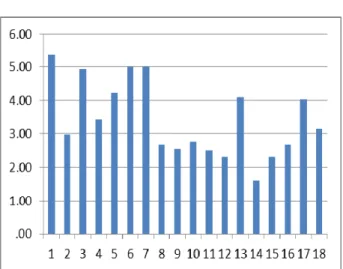
Figure 1 average of evaluation
Evaluation Range1~5
S.N Organisation and Social Success Criteria
1 Mission fit with public
2 Project fit with public
3 Contribution to solution social Issues
4 Perception of external Stakeholder
5 Efficient use of local capital/capacity
6 Fit with client Needs- need of society
7 Fit local needs priority
8 Public communication 9 Organisation/ leadership 10 Networking 11 Management Ability 12 Market potential 13 Profitability 14 Innovativeness 15 Expansions possibility 16 Supporters/ Mentors
17 Shared value creation
18 Secret of success/ How to survive
Table 1 evaluation tool for Social Enterprise :Source: 2002 Social ventures LLC. Licensed under a creative commons attributions Share –a like 3.0
Findings:
As you can see from the figure 1, 1. Mission fit with public, 3. Contribution to solve social Issues, 6. Fit with client Needs-need of society, and 7. Fit local needs priority are rated high(average≒5) by the members.These variables are in the category of social and community aspect. On the contrary, 11. Management Ability, 12.Market potential, and 14. Innovativeness are rated low (average=2 and less). These variables are in the category of management aspect. It can be said the members evaluated SWaCH project high in contributing social and community issues but low in management for their sustainability.FGD – Focus Group discussion
The respondents of this survey were 30, and they all have been working for not less than 3 years with SWaCH. They cater to the Baner area specifically. Some of them drive the tempo, while some collect the garbage from societies, and some have the garbage trolley that moves house to house. There were more women than men who carry out this work (female: 22, Male: 8). What was observed was that there is a need for SWaCH to expand their services to various other areas of Pune, as they have been catering to particular areas since years. A need for expansion was felt.
Though the mission is fit with public but the influence among the societies is not satisfactory. Some of the housing societies are cooperative and supportive for the mission of the organisation as this is need of society.
Project is fit with public and no competition as this waste collection job is for specific community ( Backward class community)
Contribution to solution social issues is strongly linked and important mentioned by the members. The SWaCH project is fit with client needs and need of society and it is strongly linked and important. The members have mentioned that the waste management has high market potential which has no real boundaries.
The waste management is not required much investment but some kind of investment is required significantly. The members demanded:
1. SWaCH should invest more in supplying the gloves, chapples, mouth cover, raincoats to the workers at regular intervals, as it was observed that it’s giving on yearly basis only. The trolley given to them for collecting garbage is not of a very good quality, due to which it gets spoilt a lot of times, and the workers have to repair it with their own money.
2. The Rag pickers don’t get space where they can segregate the waste and the society members are
creating problem to them.
3. The repairing of the trolleys is also maintained by the rag pickers and it is difficult for them maintained 4. The occupational hazards is more and their health
check-up is requirement to maintain them fit.
5. Children’s education is more important and which is missing, the members are not in position to give education to their children as they don’t have much income from this.
6. Baner area, has only one supervisor, and that creates a problem most of the times for the workers, as they are unable to contact him properly, and he doesn’t reciprocates well and this leads to clashes between the supervisor and workers.
The societies to which SWaCH caters to have been informed prior only, that they have to segregate the dry and wet waste and keep it outside their house, and the workers will come and collect it at a particular time of the day. Some materials which can be sold off, are sold off to a shop, while other wastes are disposed off.
It was observed that the workers have their family members doing the same work. This can zero down to the conclusion that the entire family are garbage pickers.
SWaCH deducts 5% from each worker’s salary, every month. Along with these deductions, they deduct 300 rupees as a part of the bachat gat. When the workers fight back for the deducted money, the SWaCH people tell them various things like, either leave the job, or this deducted money will be given after few months, however the money is never returned, they also say that this money is deducted for buying the gloves and boots for the workers, however, these are given once a year, so why is the money deducted every month. The workers were unaware on their part so as to why the money is cut from their salaries every month which is not even repaid back to them.
they could earn some more money.
Secret of success and survival is required significant capital investment and this is important for the SWaCH as movement to spread its work in the world.
Challenges:
・Scaling up
It was also found that not all residents are happy to pay user fees. Many of them still subscribe to the idea that they pay taxes so funding services such as waste collection should be the responsibility of the government. The number of users willing to pay a fee generally hits a plateau and from then on it becomes more difficult to convince the rest of customers to pay for the service.
・Social Security
Social protection benefits for SWaCH workers is an area that needs further exploration. Schemes for a package consisting of life and medical insurance and death and disability benefits and old age pension will have to be prepared and financed from the municipal budget.
・Decentralising garbage processing
The processing of garbage at some plants, garbage vehicles entering the plants was stopped by the villagers. The PMC has asked the states for space to set up new garbage processing plants. But it will take at least 18months to be operational. New processing plants should be operational urgently and innovative processing methods are required for plastic garbage which is getting increased rapidly in the city.
Conclusion
KKPKP and SWaCH exemplify that waste pickers can successfully defend their right to livelihoods and that they can also be architects of a better future for themselves and society. SWaCH came into existence on the effort of the years of organizational work and credibility achieved by KKPKP, which brought to the development of the cooperative an insider’s knowledge of the realities of solid waste management. In a similar way, KKPKP led the process of countering privatization in Pune. It proposed and pushed for an alternative that incorporated larger issues and processes that were consistent with its vision of operationally, financially and environmentally sustainable waste management that required the participation of workers and other residents. A recent unique effort initiated by SWaCH brought recyclable materials traders, the PMC and SWaCH together on a common platform to deliberate on waste management and recycling. The broad themes were issue of receipts to waste pickers; recording of quantities of materials traded and therefore diverted from landfills; annual bonuses to informal sellers; and not employing/ buying from child workers. KKPKP has asked for land to be reserved for recyclable materials markets and decentralized material recovery facilities in the development plan. There are much more difficult issues ahead to be solved, but SWaCH and other motivated and empowered workers surely will be able to fight back those issues with their dedications.
SWaCH is about transformation, transforming systems, transforming perceptions and transforming lives.
Reference:
1) India has the highest incidence of TB in the world accounting for 20% of the total cases and the incidence of malaria being 1.51%. Source: MDG -Status of India Report 2010, MOSPI, GOI.
2) Durga Surekha and Deepa Siddharth Donde(2014), SUSTAINABLE ENVIRONMENT MANAGEMENT THROUGH ENVIRONMENTAL EDUCATION WITH RESPECT TO A CASE STUDY OF GARBAGE CONCERN WELFARE SOCIETY, VSRDIJBMR,Vol. IV (IV) April 2014 / 108
3) Public Private Partnerships in Municipal Solid Waste Management,Potential and Strategies Sustainable Urban Solid Waste Management- a case study of Pune,Vaishali Anagal, 2014.
4) Pune Municipal Corporation (2014), “Biogas plants hardly a help in clearing garbage” , available at : http://timesofindia.indiatimes.com/city/pune/Biogas-plantshardly-a-help-in
clearinggarbage/articleshow/30365428.cms Dec.3rd accessed
5) Towards social inclusion and protection of informal waste pickers and recyclers Best practices#91 / 10KKPKP and SWaCH, Pune India 2014
6) Kagad Kach Patra Kashtakari Panchayat (KKPKP) website. 2012. Available at www.wastepickerscollective.org Dec.1st 2014 accessed.
7) Ahmed, Dr. S. I. 2011. Kagad Kach Patra Kashtkari Panchayat Health Insurance Scheme Casestudy. Centre for Insurance and Risk Management for the ILO. Available at:
http://www.ifmr.co.in/wpcontent/uploads/2011/03/CIRM_Kagadkachpatrakashtkaripanchayat.pdf (accessed May 9 2014).
8) A key trend in collection of MSW that is unique to low to middle income countries like India is the presence of a large informal sector that plays an active role in collection. The rag pickers work day and night to collect the recyclable materials from the streets, bins and disposal sites for their livelihood, thereby significantly reducing the role of the Government in recovering secondary materials form the waste.
9) Chikarmane, P., M. Deshpande, and L. Narayan. 2001. Report on Scrap Collectors, Scrap Traders and Recycling Enterprises in Pune. Geneva: ILO-UNDP.
10) Wainwright, Hilary, 2012. Transformative Resistance: The Role of Labour and Trade Unions in Alternatives to Privatisation, ed. McDonald David and Ruiters,
11) Purnima Chikarmane 2012 WEIGO Policy Brief Urban Policy No.8 1-12, Integrating waste pickers into Municipal Solid Waste Management in Pune.
12) Varanasi Municipal Corporation (2014), “Solid wastemanagement system a failure in Varanasi”, available at: http://timesofindia.indiatimes.com/city/varanasi/Solidwaste-management-system-a-failure-in-Varanasi-saysreport/arti cleshow/29980955.cms
13) SWaCH. 2011. OHS Report. Internal document. SWaCH/ Pimpri Chinchwad Municipal Corporation (PCMC). April - November 2011. Injury Data. Internal document. (http://articles.timesofindia.indiatimes.com) Nov. 2014 accessed.