Title
[依頼総説]血液悪性疾患と脂質代謝異常 −低 HDL-C 血症
合併の検討−
Author(s)
小宮, 一郎; 平良, 伸一郎; 友寄, 毅昭; 池間, 朋己; 益崎, 裕
章
Citation
琉球医学会誌 = Ryukyu Medical Journal, 30(1-4): 13-19
Issue Date
2011
URL
http://hdl.handle.net/20.500.12001/10201
血液悪性疾患と脂質代謝異常
一低HDL-C血症合併の検討一
小宮一郎1),平良伸一郎2),友寄毅昭2),池間朋己2),益崎裕章2)
1)琉球大学医学部附属病院地域医療システム学講座2)同大学院医学研究科内分泌代謝・血液・惨原病内科学講座(第二内科)
Dyslipidemia
in hematological
malignancies
: analysis
of
hypo-HDL
cholesterolemia
Ichiro Komiya°, Shin-ichiro Taira2), Takeaki Tomoyose2), Tomomi Ikema2) and Hiroaki Masuzaki2)
nEndowed Departments by Okinawa Prefecture Community Healthcare System 'Graduate School of Medicine, University of the Ryukyus Internal Medicine, Endocrinology,
Diabetes and Metabolism, Hematology, Rheumatology
ABSTRACT
Low concentrations of high-density lipoprotein cholesterol (HDL-C) or low-density lipoprotein cholesterol (LDL-C) were reported in patients with hematological malignan-cies and other malignant tumors. Increased cytokines might induce the uptake of LDL-C and HDL-LDL-C, and decrease plasma lecithin-cholesterol acyltransferase (LCAT) activity and lipoprotein lipase (LPL) activity, resulting in low serum cholesterol and high serum TG levels. Compared our patients with malignant lymphoma (ML) and adult T-cell leukemia-lymphoma (ATLL) with normal controls, low HDL-C (less than 40 mg/dL) was observed in 60.3% of patients and in 6.2% of controls, and low LDL-C (less than 80mg /dL) was observed in 20.5% of patients and in 9.1% of controls. Lower HDL-C levels were associated with a poorer clinical outcome. Cytokine-induced low HDL-C indicated the disease activity and the prognosis in patients with hematological malig-nancies. Ryukyu Med. J., 30(1-4)13-19, 2011
Key words: Hematological malignancies, HDL-C, LDL-C, cytokines
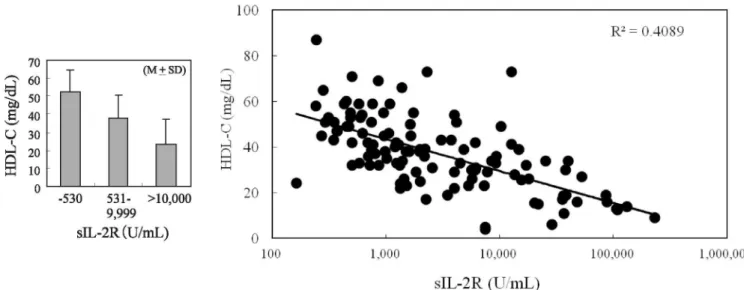
緒 言 脂質代謝異常症が悪性リンパ腫などの血液悪性疾患の 患者に伴うことは,以前から報告され1),低LDL−C血 症,高TG血症および低HDL−C血症が認められる2). さらにこれらの異常は治療により回復するとされてい る3).今回,悪性リンパ腫および成人で細胞性白血病 リンパ腫などの血液悪性疾患の患者の脂質代謝異常につ いて,我々のデータを中心に考察した. 悪性腫瘍に伴う脂質代謝異常 白血病や悪性リンパ腫患者では脂質代謝異常が惹起さ れ1,2),急性リンパ性白血病に伴う低HDL−C血症,低 LDL−C血症は原疾患の予後判定マーカーになることが 報告されている4).Tablelに低コレステロール血症の 原因病態を挙げた.白血病や癌などが低コレステロール 血症の原因として挙げられているが,系統的な検討はほ とんどされていない. 2002年1月から2007年12月の6年間に琉球大学医学 部附属病院第二内科に入院した血液悪性疾患患者のうち, 新規診断された悪性リンパ腫(ML)81名(ポジキン病 HDll名,非ポジキン悪性リンパ腫瘍NHL70名),成 人T細胞性白血病リンパ腫(ATLL)58名,急性骨髄性 白血病(AML)11名の計150名の患者を検討し,怪・ 年齢をマッチさせた検診患者433名を正常対象とした. 食欲低下や嘔吐・嘔気症状のある患者は除外し,重症肝 障害,ネフローゼ症候群,骨髄移植後の患者ならびに血
14 血液悪性疾患における低HDL−C血症
Table 1 Causes of hypocholestrolemia 原発性 ①産生低下 無(低)βリボ蛋白血症 Anderson病 Apo A−I欠損症 ②異化元進 アポ蛋白B異常症 Tangier病 続発怪 ①産生低下 慢性肝炎・肝硬変 慢性膵炎 吸収不良症候群 クローン病 悪性腫瘍 アジソン病 ②異化元進 甲状腺機能元進症 白血病・悪性リンパ腫 慢性(急性)炎症・感染症 悪性腫瘍 活脂質に影響を及ぼす薬剤(スタチン,フイブラート, EPA,副腎ステロイド,エゼチミブ,ニコチン酸,βブ ロッカー,女性ホルモン,サイクロスポリン)を内服し ている患者は除外した.Table2にそれぞれの血液疾患 における患者背景を示した.データには示さないが体重 やBMIは両群間で差がなかった. Fig.1は疾患別のHDL−C,LDL−CならびにTGの 検査値を示した.血液悪性疾患では,対照群に比して明 らかな低HDL−C,低LDL−Cならびに高TG血症を呈 した.さらに,低HDL−C血症(HDL−C40mg/dL 未満)や低LDL−C血症(LDL−C80mg/dL未満)の 割合は,それぞれ60.3%,20.5%と対照群(9.1%)に 比し高く,逆にLDL−C140mg/dL以上の割合は対照 群よりも低かった(Fig.2). ここまで解析してきた症例の中でAMLは症例数も 少なく,白血球数や貧血の程度も他の疾患群と異なるた め,以下の解析からは除外して考察した.Table3には MLとATLL患者の治療内容を示した.放射線療法は ごく一部の症例に適用された.ATLLの患者では化学 療法ではなく骨髄移植を選択した症例がML患者に比 して有意に多かった.MLとATLLにおける血清脂質 の分布をFig.3に示した.対照群に比してML患者と ATLL患者ではHDL−Cは明らかに左にシフトして分 布し,LDL−Cも同様であった.TG分布は右にシフト していた. 治療後の脂質データのある寛解中の36症例を最大7 年間追跡した結果をFig.4に示した.各期間の平均症 例は5∼19症例で、すべての症例で寛解後の脂質検査 を実施していないが,HDL−C,LDL−Cは明らかに上昇 していた.図には呈示していないが,寛解中の36症例 以外の一時寛解や寛解に至らない症例においても,治療 介入によりHDL−CとLDL−Cは上昇した. Fig.5はKaplan−Meier法で分析したMLとATLL 患者の生存率であるが,従来から報告されている予後決 定因子であるLDHやPPFs(potential prognostic factors)など以上に,HDL−Cも明らかな予後決定因 子であった.
Table 2 Clinical data of patients with hematological malignancies
No. Men/Women Age (years old)
ML(悪性リンパ腫) HD(ポジキン病) NHL(非ポジキンリンパ腫) ATLL(成人T細胞性白血病リンパ腫) 58 AML(急性骨髄性白血病) 11 43/38 5/6 38/32 32/26 4/7 53+18(16−87) 32+19(16−74) 57+16(16−87) 54+11(27−74) 46+21(22−83)
All cases HD NHL ATLL AML Controls All cases HD NHL ATLL AML Controls Fig. 1 Concentrations of serum HDL-C, LDL-C and TG in patients with hematological malignancies.
低LDL−C血症の原因
込み増加は悪性細胞の増殖や機能維持に必要で,その結 果,低LDL−C血症が惹起される5).HMG−CoA LDL受容体活性元進を介したコレステロールの取り reductaseの元進が白血病細胞では惹起されるが,それ LowHDL−C 0 0 0 0 0 0 ′ 0 5 . 寸 3 ﹁ − 1 ︵ 求 ︶ む u O 罫 巴 h 5 0 4 5 4 0 3 5 , - , 3 0 § . 2 5 5 1 2 0 I 1 5 § * 1 0 LowLDL−CAllcases HD NHL ATLL AML ControIs Allcases HD NHL ATLL AML ControIs
Low HDL-C; less than 40 mg/dL, high TG; more than 150 mg/dL
Low LDL-C; lessthan 80 mg/dL, high LDL-C; more than 140 mg/dL 70
All cases HD NHL ATLL AML Controls
Fig. 2 Frequencies of dyslipedemia in patients with hematological malignancies.
50-99 100-149 150-199 200-249 250-TG concentrati on (lng/dL)
LDL-C
120 100 80 60 40 20 0 140 120 100 80 (50 40 20 0 0-49 50-74 75-99 100-124125-149150-174175-199 200-LDL-C concentration (mg/dL)Fig. 3 Distributions of HDL-C, LDL-C and TG concentrations in patients with ML and ATLL.
10-1 9 20-29 30-39 40-49 50-59 60-69
16 血液悪性疾患における低HDL−C血症 でも細胞内コレステロールは低下しており,細胞外から のコレステロールの取込が必要である6). 動脈硬化巣に集積した活性Tリンパ球からのIFNγ は,スカベンジャー受容体経由のコレステロール取り込 みを元進する7).腫瘍細胞では,TNFαとIL−1βが LDL受容体のmRNA発現を惹起する8).骨髄障害患 者へのM−CSF投与は血清コレステロールの低下を惹起 した9).コレステロール取り込み増加が腫瘍細胞自体や サイトカインを介した他の組織で惹起されて,血清 LDL−Cの低下がもたらされると考えられる. 低HDL−C血症と高TG血症の原因 HDL取り込みの増加が悪性腫瘍細胞で惹起されるこ とが示唆されている10).悪性腫瘍に伴うサイトカイン (TNFαなど)の増加が脂肪細胞でのLPL(lipopro− teinlipase)活性の低下をもたらし11),さらにLCAT (lecithin−Cholesterol acyltransferase)活性低下を介 してHDL−Cの低下とTGの増加をもたらして12),低 HDL−C血症と高TG血症を誘発する.またサイトカイ ンはhormone sensitivelipase(HSL)活性の元進を 惹起し,脂肪分解を元進させ高TG血症をもたらす13).
Table 3 Therapeutic choices to patients with ML and ATLL
化学療法 移植* 放射線 なし
HD (ポジキン病)
NHL (非ポジキンリンパ腫) Diffuse Large B Cell Folhcular Angioimmunoblastic NK/T Cell Burkitt その他 ATLL (成人丁細胞性白血病リンパ腫) 急性 リンパ腫 慢性 くすぶり 9 (81.8%) 49 (70.0%) 2 (18.2%) 19 (27.1%) 2 (2.9%) 24 8 10 2 4 2 1 4 5 5 3 32 (55.2%) 23 (39.7%) 14 18 10 3 8 2 移植: autoPBSCT/alloPBSCT/BMT/CBT
HDL-C
U 60 50 40 30u
s
LDL-C
0 0.5 1 ユ 3 5 7 n U n U O 八 日 . ヽ L O ’ l J つ → 一 つ 一 O 150 100Years
Fig. 4 Lipid profile of 36 patients under the remission.
TG
0 0.5 1 2 3 5 7Years
1 1 1 3 (5.1%) 1 1 1TNFαの増加が悪性腫瘍では報告されており14),こ れに随伴するsIL−2R(solubleinterleukin−2recep− tor)の増加がこれを裏付けている15).自験例において, sIL−2Rの値に従いMLとATLL患者を3群に分ける と,HDL−CはsIL−2R値の最大群では最小群の約50% 70 IS , § 40 U 30 Q 20 H io であり(Fig.6,1eft),血清HDL−Cは血清sIL−2Rと 逆相関を示した(Fig.6,right).図には示さないが, LDL−Cは血清sIL−2Rとの相関は示さなかった. 血球貪食症候群(HPS)においては,サイトカイン とsIL−2Rが著明に増加する16).HPSでの脂質代謝異常 I 0.60 53 > 0.40 O 50 100 Months
PPFs, potential prognostic factors (high LDH/low albumin/high BUN)
S 0.60
O 0.40
Fig. 5 Overall survival rate in patients with ML and ATLL (Kaplan-Meier).
・530 531・ >10,000
I
o
9、999 SIL2R(U血L) 0 1 ,000 10,000 1 00,000 1 ,000,000 SIL-2R (U/mL)18 血液悪性疾患における低HDL-C血症 は診断基準の一つにも含まれている. HPSでの高TG 血症はTNFαなどによる血奨LPL活性の低下や肝怪 リパーゼ活性の低下に由来する17)サイトカインが増加 するクローン病においても,低HDL-C血症と低 LDL-C血症を合併し,これはTNFαやIFNγによる LCAT活性抑制に由来するとされる18)サイトカインの 産生増加はSR-Blの発現増加を介してHDLの細胞内 uptakeを元進し19)さらにNFkBを介してABCAl あるいはSREBP2などの活性低下をもたらし,細胞か らのHDL effluxが低下し20)これらの結果として低 HDL-C血症が惹起されるものと考えられる. 我々の検討では, SIL-2RとTGとは全く相関しなかっ たことから, TGの増加には他の機序の関与も考えられ る.同様にLDL-CにおいてもsIL-2Rと有意な差が見 られなかった事の説明としては, LDL-Cの方が食事な どの生活習慣の影響をより受けやすい為ではないかと推 定される. SIL-2RやTNFαの高値症例ほど予後が不 良であるとされており;), HDL-Cの減少が原疾患予後 の間接的なマーカーとなりうる.自験例でも,低 HDL-C血症の出現頻度は比較的予後良好なHDで 45.5%なのに比し,予後不良なATLLでは75.9%であっ た事もこれを裏付けている. 才}*>・')に 固形癌のみならず,血液悪性疾患に伴う脂質代謝異常 は古くから指摘されていながら,その実態は現在まで詳 細に検討されていなかった.スタチン製剤のシンパスタ チンは白血病細胞にアポトーシスを惹起する21)一方, スタチン投与中の脂質異常症の患者においては,悪性リ ンパ腫の発生が少ないとされる22)さらに米国における NHLの疫学的研究にて,高HDL-C血症を伴う住民の 方がNHLの発症が少なかったと報告されている23)血 液悪性疾患に伴う低HDL-C血症は,原疾患の病勢把握, 治療判定,治療薬選択,さらには疾患予防などに関わる 極めて重要な事象であり,今後さらなる解析が必要となっ てきている. 文 献
1 ) Spiegel R.J., Schaefer E.J., Magrath I.T. and
Edwards B.K∴ Plasma hpid alterations in
leu-kemia and lymphoma. Am. J. Med. 72:
775-782, 1982.
2 ) Budd D. and Ginsberg H∴ Hypocholesterolemia
and acute myelogeneous leukemia. Association between disease activity and plasma low-density hpoprotem cholesterol concentrations. Cancer 58: 1361-1365. 1986.
3) Ghalaut V.S., Pahwa M.B., Sunita and
Ghalau P.S∴ Alteration in hpid profile in
pa-tients of chronic myeloid leukemia before and after chemotherapy. Clin. Chim. Acta. 366: 239-342, 2006.
4) Baroni S., Scribano D., Zuppi C, Pagano L.,
Leone G. and Giardma B∴ Prognostic
rele-vance of hpoprotem cholesterol levels in acute lymphocytic and nonlymphocytic leukemia. Acta. Haemato.1 96: 24-28, 1996.
5) Ho Y.K., Smith G., Brown M.S. and Goldstein
J.L∴ Low-density lipoprotein (LDL) receptor
activity in human myelogenous leukemia cells. Blood 52: 1099-1113, 1978.
6) Tatidis L., Masquelier M. and Vitols S∴
Ele-vated uptake of low density hpoprotem by drug resistant human leukemic cell lines. Biochem. Pharmacol. 63: 2169-2180, 2002.
7) Geng Y.J. and Hansson G.K∴ Interferon-gamma inhibits scavenger receptor expression and foam cell formation in human monocyte-derived macrophages. J. Clin. Invest. 89: 1322-1330, 1992.
8) Stopeck A.T., Nicholson A.C. and Mancini
F.P∴ Cytokme regulation of low density
hpo-protein receptor gene transcription in HepG2 cells. J. Biol. Chem. 268: 17489-17494, 1993.
9) Motoyoshi K. and Takaku F∴ Serum
choles-terol-lowermg activity of human monocyte colony-stimulating factor. Lancet I: 326-327, 1989.
10) Goncalves R.P., Rodrigues D.G. and Marahao
R.C∴ Uptake of high density hpoprotem
(HDL) esters by human acute leukemia cells. Leuk. Res. 29: 955-959, 2005.
ll) Levy E., Delvin E., Peretti N. and Seidman E∴
Combined effects of EFA deficiency and tumor necrosis factor-alpha on circulating lipoprotein in rats. Lipids 38: 595-602, 2003.
12) Ettinger W.H., Miller L.D., Albers J.J., Smith
T.K. and Parks J.S∴ Lipopolysaccharide and tumor necrosis factor cause a fall in plasma concentration of lecithin-cholesterol acyltransferase in cynomolgus monkey. J. Lipid Res. 31: 1099-1107, 1990.
13) Tisdale M.J∴ Cancer cachexia. Langenbecks
Arch. Surg. 389: 299-305, 2004.
14) Potapnev M.P., Petyovka N.V., Belevtsev
M.V., Savitskiy V.P. and Miqal N.V∴ Plasma
level of tumor necrosis factor-alpha (TNF-alpha) correlates with leukocytosis and
biological features of leukemic cells, but not treatment response of children with acute
lymphoblastic leukemia. Leuk. Lymphoma 44: 1077-1079, 2003.
15) Kalmanti M., Karamolengou K., Dimitriou H., Tosca A., Vlachonikolis I., Peraki M., Georqoulias V. and Kalmantis T.: Serum lev-els of tumor necrosis factor and soluble
interleukin 2 receptor as markers of disease activity and prognosis in childhood leukemia and lymphoma. Int. J. Hematol. 57: 147-152, 1993.
16) Fujiwara F., Hibi S. and Imashuku S.: Hypercytokinemia in hemophagocytic syn-drome. Am. J. Pediatr. Hematol. Oncol. 15: 92-98, 1993.
17) Henter J.I., Carlson L.A., Soder 0., Nilsson-Ehle P. and Elinder G.: Lipoprotein alterations and plasma lipoprotein lipase reduction in fa-milial hemopahgocytic lymphohistiocytosis. Acta. Paediatr. Scand. 80: 675-681, 1991. 18) Field F.J., Watt K. and Mathur S.N.:
TNF-alpha decreases ABCA1 expression and at-tenuates HI cholesterol efflux in the human
intestinal cell line Caco-2. J. lipid Res. 51: 1407-1415, 2010.
19) Trigatti B.L., Rigotti A. and Braun A.: Cellu-lar and physiological roles of SR-BI, a lipo-protein receptor which mediates selective lipid
uptake. Biochim. Biophys. Acta. 1529: 276-286,
2000.
20) Horie T., Ono K., Horiguchi M., Nishi Nakamura T., Nagao K., Kinoshita Kuwabara Y., Marusawa H., Iwanaga Hasegawa K., Yokode M., Kimura T.
H., M., Y.,
and Kita T.: MicroRNA-33 encoded by an intron of sterol regulatory element-binding protein 2 (Srebp2) regulates HDL in vivo. Proc. Natl. Acad. Sci. USA 107: 17321-17326, 2010.
21) Podhorecka M., Halicka D., Klimek P., Kowal M., Chocholska S. and Dmoszynska A.: Simvastatin and purine analogs have a synergic effect on apoptosis of chronic lymphocytic leukemia cells. Ann. Hematol. 89: 1115-1124, 2011.
22) Fortuny J., de Sanjose S., Becker N., Maynadie M., Cocco P.L., Staines A., Foretova L., Vomanen M., Brennan P., Nieters A., Alvaro T. and Boffetta P.: Statin use and risk of lymphoid neoplasms: results from the Euro-pean Case-Control Study EPILYMPH. Cancer Epidemiol. Biomarkers Prev. 15: 921-925, 2006. 23) Lim U., Gayles T., Katki H.A.,
Stolzenberg-Solomon R., Weinstein S.J., Pietnen P., Tay-lor P.R., Virtamo J. and Albanes D.: Serum high-density lipoprotein cholesterol and risk on non-Hodgkin lymphoma. Cancer Res. 67: 5569-74, 2007.