Approximately Efficient Solutions for
Vector
optimization
Problems*
弘前大学理学部 田中 $\ovalbox{\tt\small REJECT}$ (TAMAKI TANAKA)\dagger
Abstract. The aim ofthis paperis to present anapproach toapproximating solutions
in vector optimization problems with arbitrary ordering cones. This paper presents a
study ofapproximately efficient points of a given set with respect to a convex cone in
an ordered Banach space. Existence results for such approximate points are obtained.
Moreover, the domination property relatedto them is observed, and then it is proved
that each element of a given set is approximated by the sum of a point in a convex
cone inducing the ordering and a point in a finite set consisting of such approximate
points of the set.
Key Words. Vector optimization, multiobjective programming, approximation,
ap-proximately efficient solutions,$\epsilon$-solutions,efficient points, domination property.
1.
IntroductionIn vector optimization field, theoretical existence results have been studied to conditions which ensure the existence of minimal and$/or$ maximal points (i.e., efficient points) with
respect to thepartial ordering induced by a convex cone in a topologicalvector space. Many
papers [1, 2, 3, 5, 6, 8, 9, 13, 16, 21] give us some interesting answers.
Furthermore, many researches related to $\epsilon$-optimal solutions has been made in various
areas of applied mathematics, optimization, and mathematical economics as well as vector optimization. The concept of such solutions is considered as a perturbation by $\epsilon>0$ or a
satisfactory compromise with a given prescribed error $\epsilon>0$. This optimal criterion is called
an $\epsilon$-optimal criterion. Recently, Loridan [11] extended the $\epsilon$-optimal criteria to multiple
criteria for multiobjective optimization problems in finite dimensional spaces. Thus, the following questions come to us.
First, what are vector-version’s concepts with correspondence to the notions of an infi-mum and a supreinfi-mum in$R$ ? In general, we can define the infimum and supremum of agiven
subset in an ordered set, but these notions do not harmonize with the notion of an efficient point in a multiple criteria problem. Because their points of a bounded subset in a general ordered set may be far from the set, while those of a bounded subset in $R$ is ncar the set.
Secondly, what is an approximate solution, or $\epsilon$-optimal solution, in a vector optimization
*AMS 1991 Subject Classffications. $90C29$
.
This work was based on research 06740139supported by Grant-in-Aidfor Scientffic Research (Grant-in-Aidfor Encouragement of Young
Scientists) from the Ministry ofEducation, Scienceand Culture of Japan.
$\uparrow E$-mail address: tmakaQsi.
hirosaki-u.ac.jp. The author is very grateful to Professor Y.Ohtsubo
of Kyushu Institute of Technology for this opportunity ofgiving$a$talk about this work.
problem ? In $R$, approximation solutions are made with satisfaction at conditions that they
are near the infimum or supremum ofa givensubset. Thirdly, is it possible that we construct a sequence of approximate solutions such that it tends to a point with correspondence to an
infimal point or a supremum of a given set ? In $R$, we can construct a sequence which tends
to an infimal point (or a supremum) of a given set.
The aim of this paper is to present an approach to approximation of solutions of vector
optimization problems in partially ordered Banach spaces. In particular, we introduce a
notion of an 6-approximately efficient solution of agiven set. The concept of approximation herein is different than that studied by Loridan[ll], and has the advantage that it excludes
certain pathological points. In addition, under certain conditions, givenany prescribed error
$\epsilon>0$,the set ofefficient points (ifitexists) as wellas the set of infimal points is approximated
by a finite set of lower $\epsilon$-approximately efficient points.
This paper is organized as follows. In Section 2, we give the preliminary terminology and define minimal points, infimal points, and approximately efficient solutions of a set in an
ordered Banach space, and prove existence results for such solutions. In Section 3, we show
that under certain conditions, the set of strict infimal points of a given set is approximated by afinite set of approximately efficient solutions. In Section 4, we consider some connections between efficient points and separation.
2.
Efficient Points and Approximately Efficient PointsThe definition of approximate solutions is meaningful in anyordered topological vectorspace
$X$ where the vector ordering $\leq c$ is defined by a convexcone $C$. For ease of presentation, we
shall assume throughout the paper that $X$ is a Banach space.
Let $X$ be an ordered real Banach space, where the norm is denoted by $\Vert\cdot\Vert$, with the
vector ordering $\leq c$ induced by a convex cone $C$, that is, for $x,$$y\in X,$ $x\leq cy$ if$y-x\in C$.
For ease of presentation in this section, the convex cone $C$ is assumed to be pointed, i.e.,
$C\cap(-C)=\{0\}$, and then the ordering is antisymmetric and $C\ni O$. Moreover, $C$ is assumed
to be acute, that is, cl$C\cap(-c1C)=\{0\}$, and hence $C$is pointed. Hence, clC induces another
antisymmetric vector ordering $\leq c1c$ stronger than $\leq c$ in $X$. With respect to each of the
orderings $\leq c$ and $\leq c1c$
’ we define minimal points and infimal points of a subset $A$ of $X$.
An element $x_{0}$ of a subset $A$ of $X$ is said to be a C-minimal point of $A$ (or an efficient
point of $A$ with respect to $C$) if $\{x\in A|x\leq cx_{0}, x\neq x_{0}\}=\emptyset$, which is equivalent to
$A\cap(x_{0}-C)=\{x_{0}\}$. Also, we say that an element $x_{0}$ of the closure of a subset $A$ of $X$
is a C-infimal point (resp., strictly C-infimal point) of $A$ if $\{x\in c1A|x\leq c^{x_{0},x}\neq x_{0}\}=\emptyset$
$($resp., $\{x\in$ cl$A|x\leq c1c^{x_{0},x}\neq x_{0}\}=\emptyset)$, which is equivalent to clA $\cap(x_{0}-C)=\{x_{0}\}$
(resp., clA $\cap(x_{0}$ –clC) $=\{x_{0}\}$). That is, a C-infimal point and strictly C-infimal point
of $A$ are an efficient point of clA with respect to $C$ and that of clA with respect to clC,
respectively. It is remarked that infimal points of $A$ are near $A$. We denote the set of all
C-minimal (resp., C-infimal, strictly C-infimal) points of $A$ by $MinA$ $($resp., $InfA,$ $Inf_{s}A)$.
Then, it shouldberemarkedthat $Inf_{i;}A\subset InfA={\rm Min}(c1A)$, andhence that $InfA=MinA$
whenever $A$ is closed.
Let $X^{*}$ denote the topological dual space of $X$. We denote the nonnegative polar
cone and the positive polar cone by $C^{*}$ $:=\{x^{*}\in X^{*}|\{x^{*}, x\rangle\geq 0,\forall x\in C\}$ and $C^{*+};=$
$\{x^{*}\in X^{*}|\langle x^{*}, x\rangle>0,\forall x\in C\backslash \{0\}\}$ , respectively.
Throughout the paper, the axiom of choice is assumed without being mentioned in each instance, and also the ball centered at $x$ with radius $r$ is denoted by $B_{r}(x)$. $Morc()r^{r}er$, the
symbol
int
$C$ denotes the topological interior of $C$. Also, the symbol $A\backslash B$ is the set of all $x$ in $A$ which are not in $B$.
Now, we introduce a concept of approximately efficient solutions.
Definition 2.1. Let $A$ be a nonempty subset of $X$ and $\epsilon>0$. A point $x\in X$ is
said to be a lower 6-approximately efficient point of $A$ with respect to $C$ if $x\in A$ and
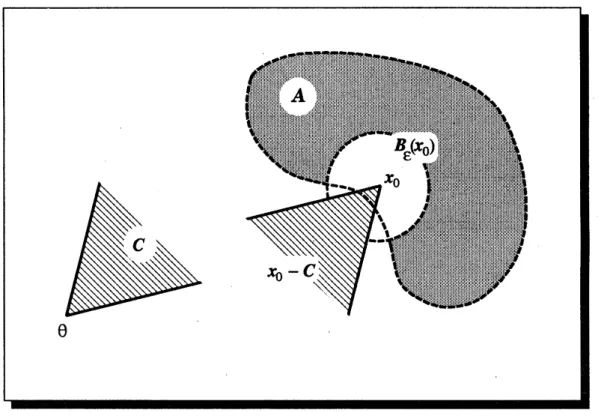
$(x-C)\cap(A\backslash B_{6}(x))=\emptyset$, as illustrated in Figure 2.1. We denote the set of all lower
$\epsilon$-approximately efficient points of$A$ with respect to $C$ by $prox\min_{C}(A|\epsilon)$
.
Figure 2.1: Illustration of a lower $\epsilon$-approximately efficient point
For a sufficiently large $\epsilon$, the lower $\epsilon$-approximately efficient points are near infimal
points of a given set, and we can choose a sequence of lower $\epsilon$-approximately efficient points
tending to an infimal point of the set. This fact is demonstrated in the following propositions. Proposition 2.1. Let $A$ be a nonempty subset
of
$X$ and $\epsilon_{1},\epsilon_{2}>0$.If
$\epsilon_{1}<\epsilon_{22}$ then$prox\min_{C}(A|\epsilon_{1})\subset prox\min_{C}(A|\epsilon_{2})$.
Proposition 2.2. Let $A$ be a nonempty subset
of
$X_{f}$ then$prox\min_{C}(A|\epsilon)\supset MinA,$$\forall\epsilon>0$, (2.1)
$\bigcap_{\epsilon>0}prox\min_{C}(A|\epsilon)=MinA$, (2.2)
$\cap prox\min_{C}$$(c1A |\epsilon)=InfA$. (2.3)
Since the sets $MinA$ and $InfA$ are possibly empty, we observe the behavior of sets of
lower $\epsilon$-approximately efficient points. In the remainder, the set $A\cap(x-C)$ is called the C-section of $A$ at $x$.
Definition 2.2. Let $A$ be a nonempty subset of $X$. We say that $A$ has a compact
clC-section of clA, if
$tbd_{C}A:=$
{
$x\in X|$ cl$A\cap(x$ –clC) is nonempty andcompact}
$\neq\emptyset$.Lemma 2.1. Let $A$ be a nonempty subset
of
$X$ and $x_{0}\in Inf_{s}$A.If
there are $r>0$and $yo\in tbd_{C}A$ such $tha$オ
$A\cap B_{r}(x_{0})\subset.y_{0}$–clC, (2.4)
オんen there exists $x\in A\cap B_{r}(x_{0})$ such that $A\cap(x-C)\subset B_{r}(x_{0})$.
Proof. Supposethat forany $x\in A\cap B_{r}(x_{0}),$ $A\cap(x-C)\backslash B_{r}(x_{0})\neq\emptyset$. Since$x_{0}\in Inf_{s}A$
(and hence $x_{0}\in$ cl$A$), $A\cap B_{s}(x_{0})\neq\emptyset$ for all $s>0$. By the axiom of choice, choose a vector
$x(s)\in A\cap B_{s}(x_{0})$ for each $s\in(0, r]$. Then, the net $\{x(s)\}$ converges to $x_{0}$. By the axiom
of choice again, choose a vector $z(s)\in A\cap(x(s)-C)\backslash B_{r}(x_{0})$ for each $x(s)$. Thus, we get the net $\{z(s)\}$.
Since
$A\cap B_{r}(x_{0})\subset y_{0}$ –clC, we have$\bigcup_{0<s\leq r}$A $\cap$ (x$($
棚 唄$\ovalbox{\tt\small REJECT} - c1C)$,
and the latter set is compact. Then there is a subnet $\{z(s(k))\}$ which converges to some vector $z_{0}\in c1A\cap$ $(y_{0} - c1C)$. Since $x(s(k))-z(s(k))\in C$ and $z(s(k))\not\in B_{r}(x_{0})$ for each $k$,
we have $x_{0}-z_{0}\in$ cl$C$ and $x_{0}\neq z_{0}$
.
This is a contradiction to $x_{0}\in Inf_{s}A$. This completesthe proof.
1
Theorem 2.1. Let $A$ be a nonempty subset
of
$X$ and $x_{0}\in Inf_{s}$A. I アオゐere are $r>0$and $y0\in tbd_{C}$A sa擁sfying condition (24) then
for
each $\epsilon_{f}0<6\leq r,$ there exists a lower$(2\epsilon)$
-approximateiy
efficienオ pointof
$A$ (approximating$x_{0}$).Proof. By the assumption, we have $A\cap B_{6}(x_{0})\subset y_{0}$ –clC for each 6, $0<\epsilon\leq r$.
By Lemma 2.1, there exists $x(\epsilon)\in A\cap B_{6}(x_{0})$ such that $A\cap(x(\epsilon)- clC)\subset B_{6}(x_{0})$. Since
$B_{\mathcal{E}}(x_{0})\subset B_{2\epsilon}(x(\epsilon))$, we have $(x(\epsilon)- clC)\cap(A\backslash B_{2\epsilon}(x(\epsilon)))=\emptyset$, which shows that $x(\epsilon)$ is a
lower $(2\epsilon)$-approximately efficient point of$A$. Moreover, the net $\{x(\epsilon)\}$ converges to $x_{0}$ (and
so we say that $x(\epsilon)$ approximates $x_{0}$).
I
Proposition2.2 and Theorem 2.1 show thatgiven anyprescribed accuracy$\epsilon>0$, thereis
acorresponding subset $prox\min_{c}(A|\epsilon)$ of$A$which approximates the set $(Inf_{s}A)\cup(MinA)$.
It means that we can construct a sequence of lower $\epsilon$-approximately efficient points tending
to a given infimal point of the set.
Remark 2.1. In Theorem 2.1, the set $A$ is assumed neither to be C-bounded in the
sense of downward-directed[19] (that is, there exists a point $a\in X$ such that $A\subset a+C$) nor tobe Luc’s $C$-bounded[14] (that is, thereis some$\epsilon>0$ suchthat $A\subset B_{6}(O)+C$) includes an
example which satisfies the assumption of Theorem 2.1 in spite of satisfying neither notions
In Corollary 2.1 we give sufficient conditions for Eq.(2.4); and hence, for the existence of lower$\epsilon$-approximatelyefficient points. Condition (i) ofthe corollary is the conditiongiven
in Loridan[11].
Definition 2.3. A subset $A$ of $X$ is said to be strongly C-compact if the set $(x-$
$c1C)\cap A$ is empty or compact for each $x\in X$ (not $A$).
Corollary 2.1. Let $A$ be a nonempty subset
of
$X$ and $x_{0}\in Inf_{s}$A.If
either(i) clA is C-compact and $(x_{0}+intC)\cap A\neq\emptyset$, or
(ii) clA is strongly C-compact and int$C\neq\emptyset$,
オんen
for
each $\epsilon>0$, there exisオ$s$ a lower $\epsilon$-approximatelyefficient
poinオof
$A$ (approximating$x_{0})$.
Proof. (i) Since clA is C-compact, $A\subset tbd_{C}A$. Since $(x_{0}+$ int$C)\cap A\neq\emptyset$, there
exists $y_{0}\in A$ such that $x_{0}\in y_{0}$–int$C$, and hence there is $r>0$ such that $B_{r}(x_{0})\subset y_{0}-C$.
This implies that $y_{0}\in$ tbd$c^{A}$ and $r>0$ satisfy the condition (2.4). By Theorem 2.1 and
Proposition 2.1, we have the conclusion.
(ii) Since int$C\neq\emptyset$, let $z\in$ int$C$ and $y_{0}:=x_{0}+z$. Then $x_{0}\in y_{0}-$int$C$. Since $x_{0}\in c1A$
and clA is strongly C-compact, we have $y_{0}\in$ tbd$cA$. In the same way of the proof of (i),
we have the conclusion.
I
Remark 2.2. Clearly, any strongly C-compact set is also a C-compact set. However, the converse is not always true. Moreover, there is no connection between conditions (i) and (ii) of the above corollary.
Corollary 2.2. Let $\dim X<\infty_{f}$ int$C\neq\emptyset_{f}$ and $A$ be a nonempty subset
of
X.If
there exisオ$s\lambda\in C^{*+}suc$ん $tha$オ
$\inf_{\in}\langle\lambda,$$a\rangle>-\infty$,
オんen
for
each $\epsilon>0,$ $prox\min_{C}(A|\epsilon)\neq\emptyset$.Proof. Let us define the following closed half-space
$H^{(\lambda,c)}:=\{x\in X|\langle\lambda, x\rangle\geq c\}$
,
where$c$ $:= \inf_{a\in A}\langle\lambda,$$a\rangle$. For each $x\in X$, $(x-clC)\cap H^{(\lambda,c)}$is either emptyoraclosed bounded
set, and hence a compact set. Then, the half-spaceis strongly C-compact and cl$A\subset H^{(\lambda,c)}$.
3.
Domination
PropertyIn this section, we observe a domination property for lower $\epsilon$-approximately efficient points.
Wesaythat aset $A$is dominated by a set $B$with respect to anordering cone $C$if$A\subset B+C$. Also, we say that the domination property[13, 14] holds for $A$ if$A\subset MinA+C$.
Lemma 3.1. For any $\epsilon>0$ and $A\subset X,$ $A+c1C\subset(A+B_{\mathcal{E}}(O))+C$.
Theorem 3.1. We assume $t$ん at $A\subset X$
satisfies
the following domination property:$c1A\subset Inf_{s}A+c1C$. (3.1)
If
オん$ere$ are $r>0$ and $yo\in tbd_{C}A$ such that$A\cap(Inf_{s}A+B_{r}(0))\subset y_{0}$ –clC, (3.2)
オんen
for
each $\epsilon,$ $0<\epsilon\leq r,$ $t$ん$eree$厩$sts$ a subset $P(\epsilon)$of
$prox\min_{C}(A|\epsilon)suc$ん that $A$ isdominated by $P(\epsilon)+B_{\epsilon}(O)$, that $is_{f}$
$A\subset(P(\epsilon)+B_{\mathcal{E}}(O))+C$. (3.3)
Mooeover,
if
$Inf_{s}A$ is compact, the set $P(\epsilon)$ is afinite
set.Proof. By the assumption and Lemma 3.1, we have
$A\subset$ cl$A\subset Inf_{s}A+$ cl$C\subset Inf_{s}A+B_{\epsilon/2}(0)+C$. (3.4)
By Theorem 2.1, there exists a subset $P(\epsilon)$ of $prox\acute{\min}_{C}(A|\epsilon/2)$ such that $Inf_{s}A\subset$
$P(\epsilon)+B_{\epsilon/2}(0)$. Hence, by Proposition 2.1, we get $P( \epsilon)\subset prox\min_{C}(A|6)$, and thus Eq.(3.3). Furthermore, if$Inf_{s}A$ is compact, there is a finite subset $A(\epsilon)$ of$Inf_{s}A$ such that
$Inf_{s}A\subset A(\epsilon)+B_{\mathcal{E}/4}(0)$.
By replacing $\epsilon/2$ in (3.4) by $\epsilon/4$, we have
$A\subset A(\epsilon)+B\epsilon/2(0)+C$.
In the same way, there exists a finite subset $P(\epsilon)$ of $prox\min_{C}(A|\epsilon/2)$ such that $A(\epsilon)\subset$
$P(\epsilon)+B_{\mathcal{E}/2}(0)$. This completes the proof.
I
Corollary 3.1. Let $A$ be a subset
of
X.If
clA is $s$オrongly C-compact and int$C\neq\emptyset$,オんen ア$or$ each $\epsilon>0$, there exists a subset $P(\epsilon)0$ア $prox\min_{C}(A|\epsilon)$ satisfying $Eq.(3.3)$.
$Mooeover_{f}$
if
$Inf_{s}A$ is compact, オん$e$ set $P(\epsilon)$ is afinite
set.Proof. By Luc[14], it follows that Eq.(3.1) holds. By Corollary 2.1 and Theorem 3.1,
we have the conclusion.
1
Corollary 3.2. Let $\dim X<\infty$,
int
$C\neq\emptyset$, and $A$ a nonempty subsetof
X.If
thereexists $\lambda\in C^{*+}suc$ん that
$\inf_{\in}\langle\lambda,$$a\rangle>-\infty$,
then
for
$eac$ん $\epsilon>0$, there exists a subset $P(\epsilon)$of
$prox\min_{C}(A|\epsilon)$ sa 翻 sfying $Eq.(3.3)$.Moreover,
if
$Inf_{s}A$ is compact, the set $P(\epsilon)$ is afinite
set.Proof. In the proof of Corollary 2.2, we verify that clA is a strongly C-compact set
in $X$, and hence we have the conclusion by the above corollary.
1
Theorem 3.1 and its corollaries show that under some conditions, each element of a
given subset $A$ of $X$ can be approximated by the sum of a point of $C$ and a point in a finite
4.
Efficient Points and SeparationGiven
a convex set $A\subset R^{n}$ and an efficient point (C-minimal point) $x_{0}$ of $A$, there existsa hyperplane that separates $A$ and $x_{0}-C$, and hence there exists a nonzero vector $p$ such
that $\langle p,$$x_{0}\rangle\leq\langle p,$$y\rangle$ for all $y\in A$. In non-convex case, we can consider a similar situation
([4, 18]); given a set $A\subset R^{n}$ and an efficient point (C-minimal point) $x_{0}$ of $A$, there exists
a nonzero vector $q\in$ int$C$ such that $z_{x0,q}(x_{0})\leq z_{x0,q}(y)$ for all $y\in A$, where
$z_{a,q}(y)$ $:= \inf\{t\in R|y\in a- clC+tq\}$ (4.1)
with parameters $a\in X$ and $q\in$ int$C$. Thus lower 6-approximately efficient points of $A$ can
be also calculated via scalarization.
5.
ConclusionsWe have proposed an approximate optimal criterion for approximate multiple criteria de-cision makings, and introduced a harmonious concept (an infimal point), corresponding to an infimum, with the notion of an efficient point. Then, we have defined an approximate solution (a lower $\epsilon$-approximately efficient point), being near infimal points of a given set.
The approach is based on the concept of approximate solutions of efficient points, but
it is different from that of Loridan[ll]. The approach taken has the following advantages:
(i) the approximate solutions exclude certain pathological points;
(ii) the approximate solutions are near infimal points of a given set;
(iii) for each infimal point, there is a sequence of approximate solutions converging to the
point;
(iv) under certain conditions, the set of efficient points (if it exists) as well as the set of infimal points is approximated by a finite set of approximate solutions corresponding to a given prescribed error $\epsilon>0$.
References
[1] H. P. Benson, On a Domination Property
for
Vector Maximization witん respect to Cones,J. Optim. Theory. Appl. 39 (1983) 125-132.
[2] J. M. Borwein, On tんe Existence
of
ParetoEfficient
Points, Math. Oper. Res. 8 (1983)64-73.
[3] H. W. Corley, An Existence Resulオ
for
Maximizations with respcct to Cones, J.Op-tim. Theory. Appl. 31 (1980) 277-281.
[4] C. Gerth and P. Weidner, Nonc.onvex Separation Tんeorems and Some Applications in Vector optimiza伽n, J Optim Theory. Appl 67 (1990)297-320.
[5] R. Hartley, On Cone-Efficiency, Cone-Convexity, and Cone-Compactness, SIAM J. Appl. Math. 34 (1978) 211-222.
[6] M. I. Henig, Existence and Cんaracterization 0 ア$Effici\dot{e}n$オ Decisions wiオん respect to Cones,
[7] J.-B. Hiriart-Urruty, $\epsilon$-Sub碗がerential Calculus, 43-92, in Convex Analysis and Opti-mization. Research Notes in Mathematics Series 57, ed. J.-P. Aubin and R. B. Vinter (Pitman, Boston, 1982).
[8] J. Jahn, Existence Tんeorems in Vector optimization, J. Optim. Theory. Appl. 50 (1986)
397-406.
[9] A. sterna-Karwat, On Existence oア cone-Maximal Points in Real
Topoiogical
LinearSpaces, Israel. J. Math. 54 (1986) 33-41.
[10] P. Loridan, Necessary Conditions
for
6-Optimality, Math. Programming Study 19 (1982) 140-152.[11] P. Loridan, $\epsilon$-Solutions in Vector Minimization Problems, J. Optim. Theory. Appl. 43
(1984)
265-276.
[12] P. Loridan and J. Morgan, Penalty Functions in $\epsilon$-Programming and $\epsilon$-Minimax
Prob-lems, Math. Programming 26 (1983) 213-231.
[13] D. T. Luc, An Existence Theorem in Vector optimization, Math. Oper.
Res.
14 (1989)693-699.
[14] D. T. Luc, Theory 0 ノレector optimization, Lecture Notes in Economics and Mathemat-ical Systems, 319, (Springer-Verlag, Berlin, 1989).
[15] K. Tanaka and K. Yokoyama, On $\epsilon$-Equilibrium Point in a Noncooperative n-Person
Game, J. Math. Anal. Appl. 160 (1991) 413-423.
[16] T. Tanaka, On Cone-Extreme Points in $R^{n}$, Sci. Rep. Niigata Univ. 23 (1987) 13-24.
[17] T. Tanaka, A New Approacんオ0 Approximation
of
Solutions in Vector optimizationProblems, Proceeding of APORS’94(Fukuoka, Japan, July, 1994).
[18]
C.
Tammer, Stability Resultsfor
ApproximatelyEfficient
Solutions,OR
Spektrum 16 (1994)47-52.
[19] T.Tanino and Y. Sawaragi, Conjugate Maps and Duality in Multiobjective optimization, J. Optim. Theory. Appl. 31 (1980)
473-499.
[20] K. Yokoyama, 6-Optimaliオy Criteria
for
Convex Programming Problems via PenaltyFunctions, Math. Programming 56 (1992)
233-243.
[21] P. L. Yu, Cone Convexity, Cone Extreme Points, and Nondominated Solutions in De-cision Problems wiオん Multiobjectives, J. Optim. Theory. Appl. 14 (1974) 3]9-377.