
Kronecker Approximation Theorem employing Mathematica (Study of Mathematical Software and Its Effective Use for Mathematics Education)
6
0
0
全文
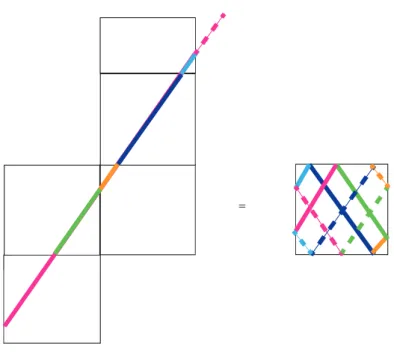
(2) 34. 図 1: 球跡が周期的. 稠密 (dense) の定義を含めて書. \langle. \Leftrightarrow. 傾き有理数. と,以下のように2次元版を記述することができる.. Theorem 2 (Kronecker: 2次元版) 1, \vartheta, \varphi が \mathb {Q} 上で一次独立 \Leftrightarrow\forall\varepsilon>0, \forall(\alpha_{1}, \alpha_{2})\in \mathbb{R}^{2}(0\leq\alpha_{1}<1, 0\leq\alpha_{2}<1) に対してヨ n\in \mathbb{Z} が存在して. \{begin{ar y}{l |\alph_{1}-(n\varthea)|<\varepsilon, |\alph_{2}-(n\varphi)|<\varepsilon. \end{ar y} 注意. \Leftarrow. は対偶を示せば良いので,簡単である.. 連分数,数の幾何学,一様分布論,フーリエ解析,線形代数学など多様な証明が知ら. れている.平面の場合は幾何学的に理解されやすい [1] [2] [4] [6]. 以下 [5] [7] にある証明を紹介する.. \Leftarrow. 0<\vartheta, \varphi<1 と仮定してよい. さて集合 (P_{n}). は簡単なので \mathb {Z}. \Rightarrow. のみ証明する.. 上一次独立と \mathb {Q} 上一次独立は同値である.. :=\{P_{n}\in \mathbb{R}^{2}|P_{n}=((n\vartheta), (n\varphi)), n\in \mathbb{N}\} が単位正方形で稠密であることを. 示す.点 P_{n} について考えると以下のことがわかる..
(3) 35 (1) どの瑞も一致しない. n\neq m に対して窺, P_{m} が一致するならば (n\vartheta)=(m\vartheta) となるので を満たす. l\in \mathbb{Z}. n\vartheta-m\vartheta=l. が存在する.. \vartheta=\frac{l}{n-m}\in \mathbb{Q} となるが. \vartheta. は1と一次独立なので \vartheta\not\in \mathbb{Q} となり矛盾する.. (2) どの瑞も単位正方形の辺上にない. 1, \vartheta,. \varphi. は. \mathb {Z}. 上一次独立より n\vartheta, n\varphi\not\in \mathbb{Z} . 従って (n\vartheta), (n\varphi)\neq 0 となるので瑞は. 単位正方形の辺上にはない.. (3) 有向線分 P_{n}P_{n+r}(n, r\in \mathbb{N}) を考える.任意の点瑞に対し,有向線分 P_{m}Q が P_{n}P_{n+r} に等し \langle なるように Q をとると,点 Q は点 P_{m+r} と一致する.. 有向線分 P_{n}P_{n+r} の成分は ((n+r)\vartheta)-(n\vartheta), ((n+r)\varphi)-(n\varphi) ) であり,有向線分 P_{m}Q の成分は Q の座標を (q_{1}, q_{2})(0\leq q_{1}, q_{2}\leq 1) とするとき (q_{1}-(m\vartheta), q_{2}-(m\varphi)) となる.従って x 成分を考えると q_{1}-(m\vartheta) = ((n+T)\vartheta)-(n\vartheta)\Leftrightarrow q_{1}-((m+T)\vartheta) = [(m+r)\vartheta]-[m\vartheta]-[(n+T)\vartheta]+ [n\vartheta]. (m+r)\vartheta\not\in \mathbb{Z} より 0<((m+r)\vartheta)<1 となること,及び [(m+T)\vartheta]-[m\vartheta]-[(n+T)\vartheta]+[n\vartheta]\in \mathbb{Z} から q_{1}-((m+r)\vartheta)=0 となる.従って q_{1}=((m+r)\vartheta) . y. 成分についても同様に q_{2}=((m+r)\varphi) .. 以上から Q=(((m+r)\vartheta), ((m+r)\varphi))=P_{m+r} が従う.. (4) 有向線分 P_{m}Q が途中で正方形の辺に交わる場合,正方形の対辺の対応する点から 同じ方向に続けて点 Q をとることにする.. (5) (1) より (P_{n}) の点は全て異なる.点列 \{P_{n}\} を考える. \{P_{n}\} の点は全て単位正方形 の内部に存在しているので \{P_{n}\} は収束する部分列をもつ.その収束部分列を \{P_{n}'\} とお \langle.. 任意の正数 \epsilon に対して,ある N\in \mathbb{N} が存在して, n, m\geq N ならば, が成立.従って有向線分 P_{m}'P_{n}' の長さは \epsilon より短い. ここで. m=N. と固定する.. |P_{n}'-P_{m}'|<\epsilon. n=N+T\geq N を満たす有向線分 P_{N}'P_{n}' の長さは. \epsilon. よ. り短い.従ってこの有向線分 P_{N}'P_{n}'=P_{N}'P_{N+r}' の終点は集合 (P_{n}) 内に存在する.. (6) 次に,任意の P_{n}\in 集合. P_{n}. に対しても同様の結論が成立することを示す.すなわち,任意の. (P_{n}) と任意の正数 \epsilon に対して P_{n}P_{n+r} の長さが \epsilon より小さい P_{n+r} が存在 するが,その理由は P_{N}'P_{N+r}' と同じ有向線分 P_{n}P_{n+r} の存在が (3) で保証されてい るからである..
(4) 36 (6) から,と. \langle. に君を始点とするような有向線分 P_{1}P_{1+r} で長さが \epsilon より小さいものが存. 在するので \epsilon<\min\{\vartheta, \varphi, 1-\vartheta, 1-\varphi\} と取れば,君から出る君 P_{1+r} は単位正方形の辺 上を通らず,単位正方形の辺にぶつからない.. (ア) 平行ではない2つの有向線分で長さ. <\epsilon. となるものが存在する場合は (3), (4) か. ら君を始点として P_{1} を始点とした有向線分の2つの終点を基に格子を作ることができ る.単位正方形の任意の点 \epsilon. P. はある格子点 P_{k} から. \epsilon. より小さい距離にある.従って. P. の. 近傍に少なくとも疏は含まれていることになり,主張が成り立つ. (イ ) (ア) ではない場合,つまり有向線分で長さ <\epsilon となるものが全て平行ならば. P_{1} から出る有向線分で長さ. 字. r,. s. <\epsilon. となるものは一直線上.この直線には任意に大きい添え. をもつ点耳,瓦が存在することになるが, P_{1}, P_{r} , 几は一直線上にあるので. 0=|\begin{ar y}{l \varthea \varphi 1 (r\vathea)(r\vaphi) 1 (s\varthea)(s\varphi) 1 \end{ar y}|=\begin{ar y}{l \varthea \varphi 1 r\vathea-[r\vathea] r\vaphi-[r\vaphi] 1 s\varthea-[s\varthea] s\varphi-[s\varphi] 1 \end{ar y}|. 従って. \vartheta. \varphi. 1. [\tau\vartheta] [s\vartheta]. [r\varphi] [s\varphi]. T-1. =0.. s-1. この行列式を展開すると \vartheta. |\begin{ar y}{l [r\varphi] r -1 {[}s\varphi] s -1 \end{ar y}| |\begin{ar y}{l [r\varthea] r -1 {[}s\varthea] s -1 \end{ar y}| +|\begin{ar y}{l [r\varthea] [r\varphi] {[}s\varthea] [s\varphi] \end{ar y}|. となる.しかし1, \vartheta,. -\varphi. \varphi. =0. は一次独立なので. [r\varphi] [s\varphi]. r-1 s-1. =0.. すなわち. \frac{[s\varphi]}{s-1}=\frac{[r\varphi]}{r-1} である.任意に大きい. s. に対して瓦が存在するから. sarrow\infty. とするとき. \lim_{sar ow\infty}\frac{[s\varphi]}{s-1}=\lim_{sar ow\infty}\frac{s\varphi-(s \varphi)}{s-1}=sar ow\infty 1\dot{ \imath} m(\frac{s\varphi}{s-1}- \frac{(s\varphi)}{s-1})=\varphi となる.従って. \varphi=\lim_{sar ow\infty}\frac{[s\varphi]}{s-1}=\frac{[r\varphi]}{r-1} が得られる.しかしならが,仮定より \varphi は無理数であるので (イ) は矛盾. 以上から (ア) のみ起こりうる.従って定理が成立.口.
(5) 37 3. 入射光線の傾きが無理数のときの球跡図 本稿の目的は,球跡の図示から入射光線の傾きの数論的性質を予想することであった.. ここで各無理数に対してMathematica で描いた球跡を紹介する.Kronecker の定理で3 次元に相当する場合も図示してみよう.以下4つのケースを考える.. (2A) 2次元の場合:入射光線の傾き = \frac{5}{8}\in \mathbb{Q}\Rightar ow 球跡は周期的.. (3B) 3次元の場合: \vartheta \Rightarrow. = \frac{1}{\sqrt{3} \not\in \mathbb{Q},. 球跡は3次元でも稠密.. \varphi=\log 2\not\in \mathbb{Q} かつ. = \frac{\log2}{\sqrt{3} \not\in\mathb {Q}. 以下の図をご覧下さい.赤い点がビリヤード球である.特に (3A) が面白い.. 図2:. 2A. の図. 図3:. 2B. の図. 図4:. 3A. の図. 図5:. 3B. の図. 著者の願望はリーマンゼータ関数の値の無理数性,及び超幾何級数で突然に値が有理 数になる場合を発見することにこれらの図を用いることである.夢は尽きない..
(6) 38 参考文献 [1] H. Bohr, Again the Kronecker Theorem, Jornal London Math. Soc., Vol.9, (1934), 5‐6.. [2] H. Bohr and R. J. Jessen, One More Proof of Kronecker’s Theorem, Journal London Math. Soc., Vol.7, (1932), 274‐275. [3] J. W. S. Cassels, An Introduction to Diophantine approximation, 1957, Cambridge Tracts in Math., Vol.45, Cambridge University Press.. [4] T. Estermann, A Proof of Kronecker’s Theorem by Induction, Journal London Math. Soc., Vol.8, (1933), 18‐20. [5] G. H. Hardy and E. M. Wright, An Introduction to the Theory of Numbers, Fifth Edition, 1979, Oxford University Press.. [6] F. Lettenmeyer, Neuer Beweis des allgemeinen Kroneckerschen Approximation‐ ssatzes, Proc. London Math. Soc. (2), 21, (1923), 306‐314. [7] I. Niven, Diophantine Approximations : Interscience Tract in Pure and Applied Mathematics : Vol.14, 1963, Interscience, New York.. [8] I. Niven, H. S. Zuckerman and H. L. Montgomery, An Introduction to the Theory of Numbers, Willey, 5th edition, 1991.. Noriko Hirata‐Kohno (平田典子) , Department of Mathematics; Coııege of Science & Technoıogy. Yukiko Ishii (石井夕紀子) , Yuta Kurimoto (栗本裕太) , Shohei Shimawaki (島脇章平) ,. &Yusuke Washio (鷲尾勇介) , Buzan‐joshi High Schooı; Nihon University. Nihon University Kanda, Chiyoda, Tokyo. Department of Mathematics;. Nakadai 3‐15, Itabashi, Tokyo 174‐0064, Japan.. 101‐8308, Japan. Kiyomitsu Suzuki (鈴木潔光) ,. [email protected] nihon‐u. ac jp. Department of Physics,. Coılege of Science & Technoıogy Nihon University Kanda, Chiyoda, Tokyo 101‐8308, Japan.
(7)
図
関連したドキュメント
We point out that in the case when the nonlocal operators from equation (1.3) are replaced by the corresponding differential operators (Laplacian and p-Laplacian) the resulting
We give a new sufficient condition in order that the curvature determines the metric: generically, if two Riemannian manifolds have the same ”surjective” (1,3)-curvature tensor
For example, a maximal embedded collection of tori in an irreducible manifold is complete as each of the component manifolds is indecomposable (any additional surface would have to
A generalization of Theorem 12.4.1 in [20] to the generalized eigenvalue problem for (A, M ) provides an upper bound for the approximation error of the smallest Ritz value in K k (x
In [9], it was shown that under diffusive scaling, the random set of coalescing random walk paths with one walker starting from every point on the space-time lattice Z × Z converges
The Artin braid group B n has been extended to the singular braid monoid SB n by Birman [5] and Baez [1] in order to study Vassiliev invariants.. The strings of a singular braid
The proof relies on some variational arguments based on a Z 2 -symmetric version for even functionals of the mountain pass theorem, the Ekeland’s variational principle and some
We also discuss applications of these bounds to the central limit theorem, simple random sampling, Poisson- Charlier approximation and geometric approximation using
