2011 年 10 月 12 日受付.Received October 12,2011
1 Department of Applied Aquabiology, National Fisheries University
2 Graduate of Department of Applied Aquabiology, National Fisheries University (the then Department of Aquaculture, Shimonoseki University of Fisheries)
† Corresponding author: [email protected]
Introduction
Lake Ono, a reservoir in Yamaguchi Prefecture, with a surface area of 25 km2 and a maximum depth of 39 m, appeared in 1950 by construction of the Koto River Dam. A pelagic planktivorous cyprinid Gnathopogon caerulescens (Sauvage) was transplanted from Lake Biwa to Lake Ono for propagation purpose in 19531). Today’s Gnathopogon fish in Lake Ono, however, are morphologically and genetically intermediate between G. caerulescens and a brooklet-dwelling omnivorous G. elongatus (Temminck & Schlegel), which strongly suggest that the Lake Ono population is a hybrid swarm2) between the two species3). Gnathopogon elongatus and G. caerulescens exhibit different homozygote genotypes on a protein-coding locus Prot-3*, aa
and bb respectively, with limited exceptions3). The Lake Ono population, on the other hand, has homozygote and heterozygote genotypes, namely aa, ab and bb. Morphological comparison among the three genotypes of Gnathopogon from Lake Ono has yet to be made. In the present study, the Lake Ono fish were classified first according to the genotypes of the locus Prot-3* by the electrophoresis method, following which their morphology was compared in order to confirm whether or not the morphological difference exists among the genotypes.
Materials and Methods
Fish CollectionTwo hundred Gnathopogon fish were collected from Lake
本論文
Journal of National Fisheries University 60 145-150(2012)
Abstract : Population of Gnathopogon (Cypriniformes, Cyprinidae) from a dammed reservoir
Lake Ono in Yamaguchi Prefecture is estimated to be a hybrid swarm between
brooklet-dwelling G. elongatus and pelagic planktivorous G. caerulescens of Lake Biwa. Alleles on
a protein-coding locus Prot-3
*are nearly exclusively fixed to
*a and
*b in G. elongatus and
G. caerulescens respectively. Gnathopogon from Lake Ono, on the other hand, has both of
homozygote and heterozygote genotypes of the alleles in its population, namely aa, ab and
bb. Morphological comparison revealed that there are no differences in relative lengths and
meristic counts among three genotypes of Gnathopogon from Lake Ono, which supports the
hybrid swarm theory.
Key words : Gnathopogon, Cyprinidae, Lake Ono, hybrid swarm, morphology
山口県小野湖産コイ科魚類モロコ
Gnathopogon の筋肉タンパク質
遺伝子型によって分けられる
3 型間に形態的差異はあるか
酒井治己
1†,米花正三
2Are Three Protein Genotypes of a Cyprinid Gnathopogon from Lake Ono
Morphologically Different from Each Other?
Ono near the Ono Limnological Laboratory (Figs. 1 and 2) with a small fish trap in September 1989 and frozen immediately after collection for electrophoretic analysis and morphological observation.
Electrophoresis
Small pieces of muscle were cut off from the frozen samples for electrophoresis, and the remaining bodies were fixed in a formalin solution for morphological observation.
In order to classify the protein genotypes of the Lake Ono fish, general protein electrophoregram was investigated by means of standard horizontal starch gel electrophoresis3, 4) and the three genotypes on the protein-coding locus Prot-3* were discriminated (Fig. 3, Table 1).
Fig. 1. Map showing the sampling location; Ono
Limnological Laboratory by Lake Ono, Koto River, Yamaguchi Prefecture, Japan.
Fig. 3. Electrophoregram of general proteins for eight individuals
of Gnathopogon from Lake Ono, exhibiting three genotypes, aa, ab and bb, in Prot-3*
Morphology of Gnathopogon from Lake Ono
147
Morphological ObservationSeven relative lengths in % of standard length, three relative lengths in % of head length, and six meristic counts were measured (see Table 2 for measured characteristics), all of which are significantly different between G. caerulescens and G. elongatus3). Barbel length that is characteristically different between G. caerulescens and G. elongatus3) was not able to measure due to fragility of barbels of the frozen samples. Methods for measuring and counting followed Nakamura5). The number of vertebrae was counted with soft X-ray projection, the Weberian apparatus being counted to be four.
Differences among the three genotypes in mean values of 17 characters including standard length were tested by ANOVA (Analysis of Variance). To make an overall morphological comparison, a principal component analysis of 17 characters in log-standardized values was carried out.
Results
The number of individuals of each genotype is shown in Table 1, exhibiting no significant departure from the Hardy-Weinberg expectation (chi-square test, p>0.3). Allelic frequencies of alleles *a and *b on the locus Prot-3* were 0.715 and 0.285 respectively. Standard lengths and all the characteristics of the three genotypes exhibited almost no significant difference (ANOVA, p>0.1 – 0.9, Table 2).
Difference G. caerulescence G. elongatus
aa ab bb ANOVA, p<0.05 N = 91 N = 64
Standard length in mm (SL) 34.9 - 65.0 39.4 - 67.5 38.0 - 55.0 insignificant 60.1 - 93.1 22.1 - 68.8 In % of SL
Head length (HL) 28.3 (1.1) 28.2 (1.1) 28.3 (1.1) insignificant 25.4 (1.1) 30.3 (1.4) Body depth 22.5 (1.5) 22.8 (1.9) 22.3 (1.6) insignificant 19.4 (1.4) 24.6 (1.3) Caudal depth 11.4 (0.8) 11.3 (0.5) 11.3 (0.5) insignificant 9.3 (0.3) 12.2 (0.7) Pectoral fin length 17.7 (1.0) 17.9 (1.0) 17.8 (1.1) insignificant 15.7 (0.9) 17.3 (1.6) Pelvic fin lenrth 15.6 (0.9) 15.7 (0.8) 15.8 (1.0) insignificant 13.7 (0.7) 15.2 (1.3) Dorsal fin length 21.7 (1.2) 22.0 (1.0) 21.8 (1.1) insignificant 18.4 (1.0) 21.8 (1.5) Anal fin length 15.1 (1.0) 15.3 (0.9) 15.3 (1.0) insignificant 11.8 (0.9) 16.3 (1.2) In % of HL
Snout length 25.7 (1.7) 26.0 (1.6) 25.8 (1.2) insignificant 26.6 (2.0) 27.3 (2.8) Eye diameter 27.0 (1.3) 27.0 (1.5) 27.4 (1.4) insignificant 19.6 (1.7) 20.3 (1.6) Interorbital width 30.2 (1.9) 30.3 (1.9) 29.7 (2.0) insignificant 28.5 (2.3) 33.5 (3.2) Lateral line scales 36.6 (0.8) 36.6 (0.8) 36.3 (0.8) insignificant 39.8 (1.3) 35.5 (1.3) Predorsal scales 13.5 (0.8) 13.6 (0.8) 13.4 (0.6) insignificant 14.7 (0.8) 12.8 (0.8) Upper transverse scales 5.2 (0.4) 5.3 (0.4) 5.3 (0.5) insignificant 6.1 (0.3) 5.1 (0.3) Lower transverse scales 4.2 (0.4) 4.2 (0.4) 4.3 (0.4) insignificant 4.9 (0.4) 4.0 (0)
Vertebrae 36.3 (0.6) 36.3 (0.6) 36.1 (0.8) insignificant 39.2 (1.6) 36.0 (0.9)
Gill rakers 9.8 (0.9) 9.7 (1.0) 9.8 (1.2) insignificant 16.8 (1.3) 8.4 (1.0)
Genotype
Table 2. Standard lengths, mean relative lengths and counts with standard deviation in parentheses in three genotypes on general protein locus
Prot-3* of Gnathopogon fish from Lake Ono with comparative data of G. caerulescence and G. elongatus appeared in Sakai et al. (2011)
Table 1. Genotype aa ab bb l a t o T Chi-square value Probability Number of individuals 1.698 p > 0.3
Number of individuals of three genotypes on general protein locus Prot-3* of Gnathopogon fish from Lake Ono, and the result of chi-square test
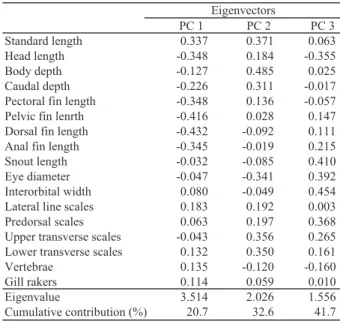
Table 3. PC 1 PC 2 PC 3 Standard length 0.337 0.371 0.063 Head length -0.348 0.184 -0.355 Body depth -0.127 0.485 0.025 Caudal depth -0.226 0.311 -0.017
Pectoral fin length -0.348 0.136 -0.057
Pelvic fin lenrth -0.416 0.028 0.147
Dorsal fin length -0.432 -0.092 0.111
Anal fin length -0.345 -0.019 0.215
Snout length -0.032 -0.085 0.410
Eye diameter -0.047 -0.341 0.392
Interorbital width 0.080 -0.049 0.454
Lateral line scales 0.183 0.192 0.003
Predorsal scales 0.063 0.197 0.368
Upper transverse scales -0.043 0.356 0.265 Lower transverse scales 0.132 0.350 0.161 0 6 1 . 0 -0 2 1 . 0 -5 3 1 . 0 e a r b e tr e V Gill rakers 0.114 0.059 0.010 Eigenvalue 3.514 2.026 1.556 Cumulative contribution (%) 20.7 32.6 41.7 Eigenvectors
Eigenvectors, eigenvalues and their cumulative contribution for PC 1, PC 2 and PC 3 in standard length, relative lengths and counts
Eigenvectors, eigenvalues and their cumulative contribution to principal components (PC 1, PC 2, and PC 3) in 17 characteristics are indicated in Tables 3. Among the characters whose absolute eigenvector value were more than 0.4 were pelvic fin length and dorsal fin length in PC 1, body depth in PC 2, and snout length and interorbital width in PC 3, which indicates their comparatively large contribution to the variation of respective principal component scores.
Mean principal component scores of the three genotypes were not different in all the three components (PC 1, PC 2, and PC 3)
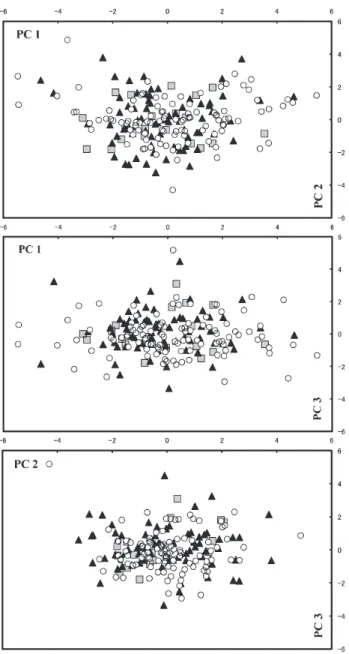
Fig. 4. Scattered diagrams of principal component scores PC
1 – PC 2, PC 1 – PC 3, and PC 2 – PC 3 based on 17 characters including standard length of three genotypes, aa (open circles), ab (closed triangles) and bb (gray squares) of Gnathopogon from Lake Ono.
(ANOVA, p>0.1 – 0.8). Individuals of the three genotypes were scattered widely on three PC planes, namely PC 1 – PC 2, PC 1 – PC 3, and PC 2 – PC 3, overlapping largely with each other (Fig. 4).
Discussion
The population genetic data of the protein-coding locus Prot-3* has reconfirmed that the Lake Ono population of Gnathopogon is a Mendelian population, having both of respective alleles peculiar to G. caerulescens and G. elongatus3). Individuals of Gnathopogon from Lake Ono were clearly divided into three Prot-3* genotypes, aa, ab and bb. Relative lengths and meristic counts, however, were not different among these genotypes. The overall morphological comparison made no difference among these genotypes in any planes of three principal components, either.
As a result, the Lake Ono population of Gnathopogon has been confirmed again as a hybrid swarm2) between introduced G. caerulescens and G. elongatus3), with the any genotypes of the population crossing freely and exhibiting no morphological difference from each other.
One of other big issues concerned would be to monitor whether or not the Lake Ono population of Gnathopogon fish continues to be a stable hybrid swarm hereafter.
Acknowledgment
We are indebted to the staff of the Ono Limnological Laboratory for their cooperation in collecting materials and to K. Sakai for English correction.
References
1 ) Fujioka Y: Fishes of the Koto River. Bull Fac Ed Yamaguchi Univ, 10, 97-107 (1960) (in Japanese)
2 ) Mayr E: Animal Species and Evolution. Belknap Press of Harvard University Press, Cambridge, Massachusetts (1963) 3 ) Sakai H, Nakashima N, Uno T, Yonehana M, Kitagawa
S, Kuwahara M: A pelagic Cyprinid of Lake Biwa Gnathopogon caerulescens and a Brooklet-Dwelling Relative G. elongatus Formed a Hybrid Swarm in a Dammed Reservoir Lake Ono. J Nat Fish Univ, 60, 43-50 (2011)
4 ) Hillis DM, Moritz C (eds): Molecular Systematics. Sinauer, Sunderland (1990)
5 ) Nakamura M: Cyprinid Fishes of Japan. Res Inst Nat Res, Tokyo (1969) (in Japanese)
山口県の小野湖(厚東川ダム湖)に生息するコイ科魚類のモロコGnathopogon 集団は,西日本の小 川に生息するタモロコG. elongatus と琵琶湖から移植された沖合性でプランクトン食性のホンモロコ G. caerulescens との雑種群と考えられている。筋肉タンパクをコードする遺伝子座 Prot-3*において, タモロコは対立遺伝子*a に,ホンモロコは*b にほぼ固定されているが,小野湖産のモロコ集団の遺 伝子型には,それらのホモ接合体aa および bb のほかにヘテロ接合体 ab が存在することが分かって いる。このたび,小野湖産モロコ集団の各遺伝子型間で形態学的比較を行ったところ,計測形質にも 係数形質にも差異がなく,本集団が両種の雑種群であることを裏付けた。