J3
Series to J4 Series Handbook
Existing manufacturing assets are completely utilizable.
SAFETY INSTRUCTIONS
Please read the instructions carefully before using the equipment.
To ensure correct usage of the equipment, make sure to read through this Replacement Manual, the
Instruction Manual, the Installation Guide, and the Appended Documents carefully before attempting to install,
operate, maintain, or inspect the equipment. Do not use the equipment until you have a full knowledge of the
equipment, safety information and instructions.
In this Replacement Manual, the safety instruction levels are classified under "WARNING" and "CAUTION".
WARNING
Indicates that incorrect handling may cause hazardous conditions,
resulting in death or severe injury.
CAUTION
Indicates that incorrect handling may cause hazardous conditions,
resulting in medium or slight injury to personnel or may cause physical
damage.
Note that the
CAUTION level may lead to a serious consequence according to conditions.
Please follow the instructions of both levels because they are important to personnel safety.
What must not be done and what must be done are indicated by the following diagrammatic symbols.
Indicates prohibition (what must not be done). For example, "No Fire" is indicated by
.
Indicates obligation (what must be done). For example, grounding is indicated by
.
In this Replacement Manual, instructions of a lower level than the above, such as those that do not cause
physical damage or instructions for other functions, are classified under "POINT".
1. To prevent electric shock, note the following
WARNING
Before wiring or inspection, turn off the power and wait for 15 minutes or more until the charge lamp turns
off. Then, confirm that the voltage between P+ and N- is safe with a voltage tester and others. Otherwise,
an electric shock may occur. In addition, when confirming whether the charge lamp is off or not, always
confirm it from the front of the servo amplifier.
Ground the servo amplifier and servo motor securely.
Any person who is involved in wiring and inspection should be fully competent to do the work.
Do not attempt to wire the servo amplifier and servo motor until they have been installed. Doing so may
cause an electric shock.
Do not operate switches with wet hands. Otherwise, it may cause an electric shock.
The cables should not be damaged, stressed, loaded, or pinched. Otherwise, it may cause an electric
shock.
During power-on or operation, do not open the front cover of the servo amplifier. Otherwise, it may cause
an electric shock.
Do not operate the servo amplifier with the front cover removed. High-voltage terminals and charging area
are exposed and you may get an electric shock.
Except for wiring and periodic inspection, do not remove the front cover of the servo amplifier even if the
power is off. The servo amplifier is charged and you may get an electric shock.
To prevent electric shock, always connect the protective earth (PE) terminal (
marked) of the servo
amplifier to the protective earth (PE) of the cabinet.
To avoid an electric shock, insulate the connections of the power supply terminals.
2. To prevent fire, note the following
CAUTION
Install the servo amplifier, servo motor, and regenerative resistor on incombustible material. Installing
them directly or close to combustibles will lead to a fire.
Always connect a magnetic contactor between the main circuit power supply and the converter unit and
L1/L2/L3 of the servo amplifier in order to configure a power supply shut-off on the side of the servo
amplifier's power supply. If a magnetic contactor is not connected, continuous flow of a large current may
cause smoke and fire when the converter unit or the servo amplifier (drive unit) malfunctions.
When using the regenerative resistor, switch power off with the alarm signal. Not doing so may cause
smoke and fire when a regenerative transistor malfunctions or the like may overheat the regenerative
resistor.
Provide adequate protection to prevent screws and other conductive matter, oil and other combustible
matter from entering the servo amplifier and servo motor.
3. Injury prevention
CAUTION
Only the voltage specified in the Instruction Manual should be applied to each terminal. Otherwise, a
burst, damage, etc. may occur.
The cables must be connected to the correct terminals. Otherwise, a burst, damage, etc. may occur.
Ensure that the polarity (+/-) is correct. Otherwise, a burst, damage, etc. may occur.
The servo amplifier heat sink, regenerative resistor, servo motor, etc. may be hot while power is on or for
some time after power-off. Take safety measures, e.g. provide covers, to avoid accidentally touching the
parts (cables, etc.) by hand.
4. Additional instructions
The following instructions should also be fully noted. Incorrect handling may cause a malfunction, injury,
electric shock, fire, etc.
(1) Transportation/installation
CAUTION
Transport the products correctly according to their mass.
Stacking in excess of the specified number of product packages is not allowed.
Do not hold the front cover, cable and connector when transporting the servo amplifier. Otherwise, it may
drop.
Install the servo amplifier and the servo motor in a load-bearing place in accordance with the Instruction
Manual.
Do not get on or put heavy load on the equipment.
The equipment must be installed in the specified direction.
Secure the prescribed distance between the servo amplifier and the inner surface of the cabinet or other
devices.
Do not install or operate the servo amplifier and servo motor which have been damaged or have anyparts
missing.
Do not block the intake and exhaust areas of the servo amplifier. Otherwise, it may cause a malfunction.
Do not drop or strike the servo amplifier and servo motor. Isolate them from all impact loads.
Do not drop or apply heavy impact on the servo amplifiers and the servo motors. Otherwise, injury,
malfunction, etc. may occur.
Do not strike the connector. Otherwise, a connection failure, malfunction, etc. may occur.
When you keep or use the equipment, please fulfill the following environment.
Item Environment
Ambient temperature
Operation 0 °C to 55 °C (non-freezing) Storage -20 °C to 65 °C (non-freezing) Ambient
humidity
Operation
5 %RH to 90 %RH (non-condensing) Storage
Ambience Indoors (no direct sunlight) and free from corrosive gas, flammable gas, oil mist, dust, and dirt Altitude The altitude varies depending on the model. (Check each servo amplifier instruction manual.) Vibration resistance 5.9 m/s2or less at 10 to 55 Hz (directions of X, Y, Z axes)
Contact your local sales if the product has been stored for an extended period of time.
When handling the servo amplifier, be careful about the edged parts such as corners of the servo
amplifier.
CAUTION
When fumigants that contain halogen materials, such as fluorine, chlorine, bromine, and iodine, are used
for disinfecting and protecting wooden packaging from insects, they cause a malfunction when entering
our products. Please take necessary precautions to ensure that remaining materials from fumigant do not
enter our products, or treat packaging with methods other than fumigation, such as heat treatment.
Additionally, disinfect and protect wood from insects before packing the products.
To prevent a fire or injury from occurring in case of an earthquake or other natural disasters, securely
install, mount, and wire the servo motor in accordance with Servo Amplifier Instruction Manual
(2) Wiring
CAUTION
Wire the equipment correctly and securely. Otherwise, the servo motor may operate unexpectedly.
Make sure to connect the cables and connectors by using the fixing screws and the locking mechanism.
Otherwise, the cables and connectors may be disconnected during operation.
Do not install a power capacitor, surge killer, or radio noise filter (optional FR-BIF(-H)) on the output side
of the servo amplifier.
Because installation of these items may cause the servo motor to malfunction, connect the wires to the
correct phase terminals (U/V/W) of the servo amplifier and servo motor power supply.
Directly connect the servo amplifier power output (U/V/W) to the servo motor power input (U/V/W). Do not
let a magnetic contactor, etc. intervene. Otherwise, it may cause a malfunction.
The connection diagrams in this instruction manual are shown for sink interfaces, unless stated otherwise.
The surge absorbing diode installed to the DC relay for control output should be fitted in the specified
direction. Otherwise, the emergency stop and other protective circuits may not operate.
When the cable is not tightened enough to the terminal block, the cable or terminal block may generate
heat because of the poor contact. Be sure to tighten the cable with specified torque.
To avoid a malfunction, do not connect the U, V, W, and CN2 phase terminals of the servo amplifier to the
servo motor of an incorrect axis.
Configure a circuit to turn off EM2 or EM1 when the main circuit power is turned off to prevent an
unexpected restart of the servo amplifier.
To prevent malfunction, avoid bundling power lines (input/output) and signal cables together or running
them in parallel to each other. Separate the power lines from the signal cables.
RA RA
Servo amplifier Servo amplifier
DOCOM
Control output signal
DOCOM
Control output signal
24VDC 24VDC
For sink output interface
For source output interface U
M V
W
U
V
W
U
M V
W
U
V
W
(3) Trial run/adjustment
CAUTION
When executing a test run, follow the notice and procedures in this instruction manual. Otherwise, it may
cause a malfunction, damage to the machine, or personal injury.
Before operation, check the parameter settings. Improper settings may cause some machines to operate
unexpectedly.
Never perform extreme adjustment or changes to the parameters; otherwise, the operation may become
unstable.
Keep away from moving parts in a servo-on state.
(4) Usage
CAUTION
Provide an external emergency stop circuit to ensure that operation can be stopped and power switched
off immediately.
For equipment in which the moving part of the machine may collide against the load side, install a limit
switch or stopper to the end of the moving part. The machine may be damaged due to a collision.
Do not disassemble, repair, or modify the product.
Disassembled, repaired, and/or modified products are not covered under warranty.
Before resetting an alarm, make sure that the run signal of the servo amplifier is off in order to prevent a
sudden restart. Otherwise, it may cause an accident.
The effect of electromagnetic interference must be reduced by using a noise filter or by other means.
Electromagnetic interference may be given to the electronic equipment used near the servo amplifier.
Burning or disassembling a servo amplifier may generate toxic gases. Do not burn or break it.
Use the servo amplifier with the specified servo motor.
Correctly wire options and peripheral equipment, etc. in the correct combination. Otherwise, it may cause
an electric shock, fire, or injury.
The electromagnetic brake on the servo motor is designed to hold the motor shaft and should not be used
for ordinary braking.
For such reasons as incorrect wiring, service life, and mechanical structure (e.g. where a ball screw and
the servo motor are coupled via a timing belt), the electromagnetic brake may not hold the motor shaft. To
ensure safety, install a stopper on the machine side.
If the dynamic brake is activated at power-off, alarm occurrence, etc., do not rotate the servo motor by an
external force. Otherwise, it may cause a fire.
(5) Corrective actions
CAUTION
CAUTION
Configure an electromagnetic brake circuit so that it is activated also by an external emergency stop switch.
When any alarm has occurred, eliminate its cause, ensure safety, and deactivate the alarm before
restarting operation.
If the molded-case circuit breaker or fuse is activated, be sure to remove the cause and secure safety
before switching the power on. If necessary, replace the servo amplifier and recheck the wiring.
Otherwise, it may cause smoke, fire, or an electric shock.
Provide an adequate protection to prevent unexpected restart after an instantaneous power failure.
To prevent an electric shock, injury, or fire from occurring after an earthquake or other natural disasters,
ensure safety by checking conditions, such as the installation, mounting, wiring, and equipment before
switching the power on.
(6) Maintenance, inspection and parts replacement
CAUTION
Make sure that the emergency stop circuit operates properly such that an operation can be stopped
immediately and a power is shut off by the emergency stop switch.
It is recommended that the servo amplifier be replaced every 10 years when it is used in general
environment.
When using a servo amplifier whose power has not been turned on for a long time, contact your local
sales office.
(7) General precautions
To illustrate details, the equipment in the diagrams of this Replacement Manual may have been drawn
without covers and safety guards. When the equipment is operated, the covers and safety guards must be
installed as specified. Operation must be performed in accordance with Instruction Manual.
B U
Contacts must be opened with the ALM (malfunction) off or the MBR (electromagnetic brake interlock) off.
Servo motor
Contacts must be opened with the EMG stop switch.
Electromagnetic brake
RA
Disposal of Waste
When disposing of this product, the following two laws are applicable, and it is necessary to consider each
law. In addition, because the following laws are effective only in Japan, local laws have priority outside Japan
(overseas). We ask that the local laws be displayed on the final products or that a notice be issued as
necessary.
1. Requirements of the Act on the Promotion of Effective Utilization of Resources
(Commonly known as: the Law for Promotion of Effective Utilization of Resources
Promotion Law)
(1) Please recycle this product whenever possible when it becomes unnecessary.
(2) It is recommended that this product be divided as necessary and sold to appropriate purchasers, as
recycled resources are usually divided into iron, electrical parts, and so on, which are then sold to
scrap processors.
2. Requirements
of
the Act on Waste Disposal & Cleaning (Commonly known as: The
Waste Disposal Treatment Cleaning Act)
(1) It is recommended to decrease waste through the sale of recyclables or through any other means as
shown in the preceding Paragraph 1.
(2) In case the unnecessary products cannot be sold and require disposal, such item falls under
Industrial waste in the above act.
(3) It is required that industrial waste be properly dealt with, including manifest management, by commissioning the
disposal to an industrial waste disposal contractor licensed under the act.
(4) Please dispose of batteries (primary batteries) used in servo amplifiers according to local regulations.
Measures against servo amplifier harmonics
This servo amplifier applies to "Harmonics control guidelines for customers receiving high voltage or special
high voltage power" (published by current Ministry of Economy, Trade and Industry). Consumers subject to
this guideline must check if a harmonic suppression measure is necessary, and measures must be enforced
when the limit level is exceeded.
EEP-ROM life
The number of write times to the EEP-ROM, which stores parameter settings, etc., is limited to 100,000. If the
total number of the following operations exceeds 100,000, the servo amplifier may malfunction when the
EEP-ROM reaches the end of its useful life.
Write to the EEP-ROM due to parameter setting changes
Write to the EEP-ROM due to device changes
STO function of the servo amplifier
Dealing with overseas standards
See the following relevant manuals concerning dealing with overseas standards.
«About the manual»
This Replacement Manual and the following Instruction Manuals are necessary when using this servo for
the first time. Ensure to prepare them to use the servo safely.
Relevant manuals
Manual name Manual number
MELSERVO-J4 Series Instructions and Cautions for Safe Use of AC Servos (Packed with the servo amplifier)
IB(NA)0300175
MELSERVO-J4 Servo Amplifier Instruction Manual (Troubleshooting Edition) SH(NA)030109 MELSERVO Servo Motor Instruction Manual (Vol. 3) (Note 1) SH(NA)030113 MELSERVO Linear Servo Motor Instruction Manual (Note 2) SH(NA)030110 MELSERVO Direct Drive Motor Instruction Manual (Note 3) SH(NA)030112 MELSERVO Linear Encoder Instruction Manual (Note 2, 4) SH(NA)030111
EMC Installation Guidelines IB(NA)67310
Note 1. It is necessary for using a rotary servo motor. 2. It is necessary for using a linear servo motor. 3. It is necessary for using a direct drive motor. 4. It is necessary for using a fully closed loop system.
«Cables used for wiring»
The wiring cables mentioned in this Replacement Manual are selected based on an ambient temperature
of 40°C.
«U.S. customary units»
U.S. customary units are not shown in this manual. Convert the values if necessary according to the
following table.
Quantity SI (metric) unit U.S. customary unit
Mass 1 [kg] 2.2046 [lb]
Length 1 [mm] 0.03937 [inch]
Torque 1 [N•m] 141.6 [oz•inch]
Moment of inertia 1 [(× 10-4 kg•m2)] 5.4675 [oz•inch2] Load (thrust load/axial load) 1 [N] 0.2248 [lbf]
1. SUMMARY OF MR-J3/MR-J3W REPLACEMENT ... 1- 2
2. MAJOR REPLACEMENT TARGET MODEL ... 1- 2
2.1 Servo Amplifier Replacement Target Model ... 1- 2
2.2 Servo Motor Replacement Target Model ... 1- 2
3. FLOW OF REPLACEMENT ... 1- 3
3.1 Summary ... 1- 3
3.1.1 Flow of Review on Replacement ... 1- 3
3.1.2 Configuration diagram ... 1- 4
3.1.3 Changes from MR-J3 series to MR-J4 series ... 1- 5
3.1.4 Changes from MR-J3W series to MR-J4 series ... 1- 7
3.2 Review
on
replacement ... 1- 9
3.2.1 Checking the system prior to replacement ... 1- 9
3.2.2 Determination of base replacement model ... 1- 9
3.2.3 Attachment compatibility check ... 1-13
3.2.4 Detailed review on replacement model ... 1-13
3.2.5 Peripheral equipment check ... 1-13
3.2.6 Startup procedure check... 1-13
4. RELATED MATERIALS ... 1-13
4.1 Catalog ... 1-13
4.2 Instruction Manual ... 1-13
4.3 Replacement Tool for Replacing MR-J3 with MR-J4 ... 1-14
4.4 MITSUBISHI
ELECTRIC
FA Global Website ... 1-14
Part 2: Review on Replacement of MR-J3-_A_ with MR-J4-_A_
2- 1 to 2-64
1. SUMMARY ... 2- 2
2. CASE STUDY ON REPLACEMENT OF MR-J3-_A_ ... 2- 2
2.1 Review on Replacement Method ... 2- 2
2.2 Replacement Method ... 2- 2
3. DIFFERENCES BETWEEN MR-J3-_A_ AND MR-J4-_A_ ... 2- 4
3.1 Function
Comparison Table ... 2- 4
3.2 Comparison of Standard Connection Diagrams ... 2- 6
3.3 List of Corresponding Connectors and Terminal Blocks ... 2- 8
3.4 Comparison of Peripheral Equipment ... 2-13
3.5 Comparison of Parameters ... 2-14
3.5.1 Setting requisite parameters upon replacement ... 2-14
3.5.2 Parameter comparison list ... 2-16
3.5.3 Comparison of parameter details ... 2-20
3.6 Important
Points for Replacement ... 2-63
Part 3: Review on Replacement of MR-J3-_B_ with MR-J4-_B_
3- 1 to 3-50
3.5 Comparison of Peripheral Equipment ... 3-12
3.6 Comparison of Parameters ... 3-13
3.6.1 Setting requisite parameters upon replacement ... 3-14
3.6.2 Parameter comparison list ... 3-15
3.6.3 Comparison of parameter details ... 3-18
4. APPLICATION OF FUNCTIONS ... 3-49
Part 4: Replacement of MR-J3W-_B with MR-J4W2-_B
4- 1 to 4-42
1. SUMMARY... 4- 2
2. CASE STUDY ON REPLACEMENT OF MR-J3W-_B ... 4- 2
2.1 Review on Replacement Method ... 4- 2
2.2 Servo
Amplifier
Replacement Model ... 4- 2
2.3 Replacement Method ... 4- 3
3. DIFFERENCES BETWEEN MR-J3W-_B AND MR-J4W2-_B ... 4- 6
3.1 Function
Comparison Table ... 4- 6
3.2 Configuration
including auxiliary equipment ... 4- 7
3.3 Comparison
of Networks ... 4- 9
3.4 Comparison of Standard Connection Diagrams ... 4- 9
3.5 List of Corresponding Connectors and Terminal Blocks ... 4-10
3.6 Main
circuit
terminal block ... 4-12
3.7 MR-J3W-_B => MR-J4W2-_B Comparison Table of Servo Amplifier Dimensions/Installation
Differences ... 4-13
3.7.1 MR-J3W-_B => MR-J4W2-_B Comparison Table of Servo Amplifier Dimensions/
Installation Differences ... 4-13
3.7.2 Comparison dimensions ... 4-13
3.8 Comparison of Peripheral Equipment ... 4-13
3.9 Comparison of Parameters ... 4-14
3.9.1 Setting requisite parameters upon replacement ... 4-15
3.9.2 Parameter comparison list ... 4-16
3.9.3 Comparison of parameter details ... 4-20
4. APPLICATION OF FUNCTIONS ... 4-42
Part 5: Common Reference Material
5- 1 to 5-176
2.1.2 General-Purpose Interface/SSCNET III Interface 400 V class (22 kW or less) ... 5-30
2.2 Parameter
conversion ... 5-34
2.2.1 Operation procedure of parameter conversion ... 5-34
2.2.2 MR-J3-_A_ parameter diversion procedure ... 5-35
2.2.3 Parameter reading from the servo amplifier MR- J3-_A_ ... 5-36
2.2.4 Converting the parameters of MR-J3-_A_ and writing them to the MR-J4-_A_
servo amplifier ... 5-38
2.2.5 Conversion rules (MR-J3-_A_ => MR-J4-_A_) ... 5-41
2.2.6 Parameters that need to be checked after parameter conversion ... 5-45
2.3 MR-J3-_B_ and MR-J3W-_B Parameter Diversion Procedure ... 5-46
2.3.1 Changing QD75MH to QD77MS/LD77MS ... 5-47
2.3.2 Changing Q17nHCPU/Q17nDCPU/Q170MCPU to Q17nDSCPU/Q170MSCPU(-S1) ... 5-49
2.3.3 Conversion rules (MR-J3-_B_ and MR-J3W-_B => MR-J4-_B_ and MR-J4W2-_B) ... 5-51
2.3.4 Parameters that need to be checked after parameter conversion ... 5-54
3. COMMON POINTS TO NOTE ... 5-56
3.1 Method for checking the software version ... 5-56
3.1.1 Checking with MR Configurator2 (SW1DNC-MRC2-E) ... 5-56
4. COMMUNICATION FUNCTION (MITSUBISHI GENERAL-PURPOSE AC SERVO
5.1 MR-J3 series motors which are available with MR-J4-_A_ and MR-J4-_B_ ... 5-97
6. APPLICATION OF FUNCTIONS ... 5-100
6.1 J3
compatibility mode ... 5-100
6.1.1 J3 Outline of J3 compatibility mode ... 5-100
6.1.2 Operation modes supported by J3 compatibility mode ... 5-100
6.1.3 J3 compatibility mode supported function list ... 5-101
6.1.4 How to switch J4 mode/J3 compatibility mode ... 5-103
6.1.5 How to use the J3 compatibility mode ... 5-104
6.1.6 Cautions for switching J4 mode/J3 compatibility mode ... 5-105
6.1.7 Cautions for the J3 compatibility mode ... 5-105
6.1.8 Change of specifications of "J3 compatibility mode" switching process ... 5-106
6.1.9 Extension function ... 5-109
6.2 Master-slave
operation function ... 5-166
6.3 Scale
measurement function ... 5-170
6.3.1 Functions and configuration ... 5-170
6.3.2 Scale measurement encoder ... 5-172
6.3.3 How to use scale measurement function... 5-175
Part 6: Review on Replacement of Motor
6- 1 to 6-62
1. SERVO MOTOR REPLACEMENT ... 6- 2
1.1 Servo Motor Substitute Model and Compatibility ... 6- 2
2. COMPARISON OF SERVO MOTOR SPECIFICATIONS ... 6-12
2.1 Comparison of Servo Motor Mounting Dimensions ... 6-12
2.2 Detailed Comparison of Servo Motor Mounting Dimensions ... 6-17
2.3 Comparison of Mounting Dimensions for Geared Servo Motors (For high precision
applications: HC-RP_G5
→
HG-SR_G5) ... 6-18
2.4 Comparison of Actual Reduction Ratios for Geared Servo Motors ... 6-20
2.5 Comparison of Moment of Inertia ... 6-21
2.6 Comparison of Servo Motor Connector Specifications ... 6-32
2.7 Comparison of Servo Motor Torque Characteristics ... 6-53
Part 7: Review on Replacement of Optional Peripheral Equipment
7- 1 to 7-68
4.1.3 MR-J3W series power supply wire size ... 7-19
4.1.4 MR-J4W2-_B servo amplifier, power supply wire size ... 7-20
4.2 Selection
Example
of Crimp Terminals ... 7-21
4.2.1 MR-J3 series crimp terminal ... 7-21
4.2.2 MR-J4 series crimp terminal ... 7-22
4.3 Selection of Molded-Case Circuit Breaker, Fuse, and Magnetic Contactor (Example) ... 7-23
4.3.1 MR-J3 series, molded-case circuit breakers, fuses, and magnetic contactors ... 7-23
4.3.2 MR-J4 series, molded-case circuit breakers, fuses, and magnetic contactors
Part 1
Summary of
MR-J3/MR-J3W
This document describes the review items for replacing MR-J3/MR-J3W with MR-J4. Some equipment may require
review on items not described in this document. Please review those items after viewing the Instruction Manual and
the catalogs.
Part 1: Summary of MR-J3/MR-J3W Replacement
1. SUMMARY OF MR-J3/MR-J3W REPLACEMENT
In this document, the flow when replacing a system using the MELSERVO "MR-J3" with the "MR-J4 series"
is explained.
After deciding the replacement strategy (batch update or partial update of the servo amplifier, servo motor,
and controller), please proceed with replacement by referring to the corresponding parts of this manual and
the manual for each model.
2. MAJOR REPLACEMENT TARGET MODEL
2.1 Servo Amplifier Replacement Target Model
Series Servo amplifier model Series Servo amplifier Model
MR-J3 series
MR-J3-_A_
→
MR-J4 series
MR-J4-_A_
MR-J3-_B_ MR-J4-_B_
MR-J3W series MR-J3W-_B MR-J4W2-_B
2.2 Servo Motor Replacement Target Model
Servo motor model Servo motor model
Small capacity
Low inertia HF-KP_
→
HG-KR_
Ultra-low inertia
HF-MP_ HG-MR_
HF-MP_ (with reducer) HG-KR_ (with reducer)
Medium capacity
medium
inertia HF-SP_ HG-SR_
Low inertia
HC-LP_
HG-JR_ HF-JP_
Ultra-low inertia
HC-RP_ HG-RR_
HC-RP_ (with reducer) HG-SR_ (with reducer)
Flat HC-UP_ HG-UR_
Large
capacity Low inertia HA-LP_
HG-SR_
HG-JR_
3. FLOW OF REPLACEMENT
3.1 Summary
This section describes the flow of replacement when replacing a system using the MR-J3 series/MR-J3W
series with a system using the MR-J4 series.
3.1.1 Flow of Review on Replacement
Checking the system prior to replacement Check the components of the system prior to replacement.
: See "3.2.1 Checking the system prior to replacement" in this document.
Determination of base replacement model Determine the base replacement model for the servo amplifier/servo motor model used for the system prior to replacement.
: See "3.2.2 Determination of base replacement model" in this document.
Detailed specifications/
functions difference check Determine the base replacement model and check the impact according to the "specification/function" of the replacement model. : Check "Part 5
:
Common Reference Material" in this document.Attachment compatibility check Check the compatibility and the attachment differences in the "Attachment compatibility" items in the list of base replacement models.
: Check "Part 5: Common Reference Material, 2. SERVO AMPLIFIER DIMENSIONS /INSTALLATION DIFFERENCES", and "Part 6: Replacement of Motor" in this document.
(When replacing the MR-J3W series with the MR-J4 series, also check "Part 4: Review on Replacement of MR-J3W-_B with MR-J4W2-_B".)
Detailed review on replacement model Determine the replacement strategy and perform detailed designing. : Check "Part 2: Review on Replacement of MR-J3-_A_ with MR-J4-_A_",
"Part 3: Review on Replacement of MR-J3-_B_ with MR-J4-_B_" "Part 4: Review on Replacement of MR-J3W-_B with MR-J4W2-_B" "Part 6: Review on Replacement of Motor"
in this document.
Peripheral equipment check Check the peripheral equipment that comes with the replacement.
: Check "Part 7: Review on Replacement of Optional Peripheral Equipment" in this document.
Startup procedure check Check the startup procedure.
3.1.2 Configuration diagram
The following displays the review items when replacing MR-J3 series with MR-J4 series using MR-J3-100A
or less as an example case.
Note. "MR Configurator2" can also be used for MR-J3 series/MR-J3W series. Power supply
Line noise filter (FR-BSF01)
R S T
Magnetic contactor (MC) No-fuse breaker (NFB) or fuse
CN5
CN3
Regenerative option
P C
L11
L21 Power factor
improving DC reactor (FR-BEL)
Analog monitor
CN1
CN2
CN4
Junction terminal block
CN6
P1
P2
Servo amplifier
Servo motor L1
L2 L3
Setup software (SETUP221E) (Note)
Personal computer
Battery MR-J3BAT
U V W
3.1.3 Changes from MR-J3 series to MR-J4 series
POINT
The following table summarizes the changes from MR-J3 series to MR-J4 series.
For details, refer to the reference document/items.
Changes Check items Impact Reference
document/items Servo
amplifier
Connector Connector shape, pin arrangement, signal abbreviation, and location are different.
Part 2, Section 3.3 Part 3, Section 3.4 Part 5, Section 1.2.2 Terminal block Terminal block shape, location, and method of drawing out
wires are different. Part 5, Section 1.2.1 P3, P4 terminals MR-J4 servo amplifier has P3 and P4 in the upstream of
the inrush current suppression circuit. Note that the locations of the P1 and P terminals of J3-11K_ to MR-J3-22K_ are different.
Part 5, Section 1.2.1
Z-phase There is no difference caused by the replacement from the
MR-J3 servo amplifier to the MR-J4 servo amplifier. Part 5, Section 1.2.7 Parameter General-purpose interface is upward compatible, but the
parameter needs to be changed. The parameter converter function of MR Configurator2 can transfer the parameter setting for MR-J3 to the setting for MR-J4. For SSCNET III interface, the MR-J3 compatibility mode is available with the MR-J4 series and the parameter does not need to be changed.
Part 2, Section 3.5 Part 3, Section 3.6 Part 5, Section 2.2 Part 5, Section 2.3
Dimensions MR-J3 and MR-J4 have compatibility in mounting. Note that the positions (clearances) of mounting screws for the 5 kW (200 V), 3.5 kW (400 V), 11 kW, and 15 kW have been changed to reduce the size of external dimensions.
Part 5, Chapter 2
Dynamic brake coasting distance
The servo motor has a different dynamic brake coasting
distance. Part 5, Section 1.2.3
Forced stop deceleration For MR-J4, in the shipping status, the servo motor decelerates to stop during a forced stop or when an alarm has occurred. The stop method for MR-J4 is different from the method of when an emergency stop or a forced stop of MR-J3 is enabled.
Part 5, Section 1.2.4 MR-J4-_A_Servo Amplifier Instruction
Manual MR-J4-_B_Servo Amplifier Instruction
Manual Initializing time The time it takes to reach servo-on from power-on is
different. Part 5, Section 1.2.6
Options and peripheral equipment
Molded-case circuit breaker Fuse
Those for J3 may not be usable. Select those for
MR-J4. Part 7, Section 4.3
Magnetic contactor Those for J3 may not be usable. Select those for
MR-J4. Part 7, Section 4.3
Power factor improving AC reactor
Those for MR-J3 may not be usable. FR-HAL is recommended.
Part 7, Section 7.2 Part 7, Section 7.5 Part 7, Section 7.6 Power factor improving DC
reactor
Those for MR-J3 may not be usable. FR-HEL is recommended.
Part 7, Section 7.1 Part 7, Section 7.3 Part 7, Section 7.4 Regenerative option Some regenerative options cannot be used for MR-J4. Part 7, Chapter 1 Setup software (SETUP221E) Setup software (SETUP221E) cannot be used for MR-J4.
Use MR Configurator2.
"MR Configurator2" can also be used for MR-J4 series and MR-J3 series.
Part 7, Chapter 8
Battery Use MR-BAT6V1SET for MR-J4. Part 7, Chapter 5 Encoder cable For MR-J4-22K_, the encoder cable needs to be changed
with the following. MR-ENECBL _ M-H-MTH
Part 5, Section 1.2.2 Part 7, Chapter 3
Wire An HIV wire is recommended for MR-J4. Part 7, Chapter 4 Dynamic brakes Some dynamic brakes cannot be used for MR-J4. Part 7, Chapter 2 EMC filter There is no change in recommended products. Part 7, Chapter 6 Panel through attachment MR-J3ACN cannot be used for 11K_(4) or
Changes Check items Impact Reference document/items
Servo motor Mounting compatibility Some models have no mounting compatibility. Part 6, Section 1.1 Dimensions The total length may differ depending on models. Part 6, Section 2.1 Part 6, Section 2.2 Part 6, Section 2.3 Reducer The actual reduction ratio of HF-KP and HF-MP series G1
types may differ from that of HG-KR series G1 types depending on models.
Part 6, Section 2.3 Part 6, Section 2.4
Moment of inertia The moment of inertia of the HF-_P/HC-_P/HA-_P motor may differ from that of the HG motor depending on models. (Note 2)
Part 6, Section 2.5
Load to motor inertia ratio The range of the load to motor inertia ratio for the servo motor may differ between the HF-_P/HC-_P/HA-_P motor and the HG motor depending on models.
Part 6, Section 2.5
Connector The power connector, encoder connector, and electromagnetic brake connector may differ from one another in shape.
Part 6, Section 2.6
Torque characteristics The torque characteristics of the HF-_P/HC-_P/HA-_P
motor may differ from those of the HG motor. Part 6, Section 2.7 Rated speed/maximum speed The Rated speed/maximum speed of the
HF-_P/HC-_P/HA-_P motor may differ from those of the HG motor.
Servo Motor Instruction Manual
(Vol. 3) Thermal sensor (Note 1) For JR 1000 r/min series of 15 kW or more and
HG-JR 1500 r/min series of 22 kW or more, the thermal sensor is replaced with a thermistor. For HG-JR 1000 r/min series of 12 kW or less and HG-JR 1500 r/min series of 15 kW or less, the thermal sensor is removed.
Servo Motor Instruction Manual (Vol. 3)
Encoder resolution The encoder resolution differs as follows. HF-_P/HC-_P/HA-_P motor: 18bit ABS HG motor: 22 bit ABS
Servo Motor Instruction Manual (Vol. 3)
Controller (SSCNET III interface only)
MR-J4-_B_ servo amplifiers have two operation modes. "J4 mode" is for using all functions with full performance and "J3 compatibility mode" is compatible with MR-J3-_B_ series for using the amplifiers as the conventional series.
When you connect an amplifier with SSCNET III/H communication for the first controller communication with the factory setting, the operation mode will be fixed to "J4 mode". For SSCNET III communication, the operation mode will be fixed to "J3 compatibility mode".
Note 1. For HG-JR 1000 r/min series of 15 kW or more and HG-JR 1500 r/min series of 22 kW or more, the thermal sensor is replaced with a thermistor. For HG-JR 1000 r/min series of 12 kW or less and HG-JR 1500 r/min series of 15 kW or less, the thermal sensor is removed. A new encoder cable laying is required because the motor thermal wiring differs.
3.1.4 Changes from MR-J3W series to MR-J4 series
POINT
The following table summarizes the changes from MR-J3W series to MR-J4
series. For details, refer to the reference document/items.
Changes Check items Impact Reference
document/items Servo
amplifier
Connector Connector shape, pin arrangement, signal abbreviation, and location are different.
Part 4, Section 3.6 Part 5, Section 1.2.2 Parameter For SSCNETIII interface, the MR-J3 compatibility mode is
available with the MR-J4 series and parameters do not need to be changed.
Part 4, Section 3.9
Dimensions MR-J3W-22B/-44B ⇒ MR-J4W2-22B/-44B
: The dimensions are the same. The number of mounting screws is different.
MR-J3W-77B/-1010B ⇒ MR-J4W2-77B/-1010B : Note that the positions (clearances) and the number of
mounting screws have been changed to reduce the size of external dimensions.
Part 4, Section 3.7
Dynamic brake coasting distance
The servo motor has a different dynamic brake coasting
distance. Part 5, Section 1.2.3
Forced stop deceleration For MR-J4, in the shipping status, the servo motor decelerates to stop during a forced stop or when an alarm has occurred. The stop method for MR-J4 is different from the method of when an emergency stop or a forced stop of MR-J3W is enabled.
Part 5, Section 1.2.4 MR-J4W2-_B_ Servo Amplifier Instruction Manual
Initializing time The time it takes to reach servo-on from power-on is
different. Part 5, Section 1.2.6
Options and peripheral equipment
Molded-case circuit breaker Fuse
Those for MR-J3W may not be usable. Select those for
MR-J4. Part 7, Section 4.3
Magnetic contactor Those for MR-J3W may not be usable. Select those for
MR-J4. Part 7, Section 4.3
Power factor improving AC reactor
Those for MR-J3W may not be usable. FR-HAL is recommended.
Part 7, Section 7.2 Part 7, Section 7.5 Regenerative option Some regenerative options cannot be used for MR-J4. Part 7, Chapter 1 Setup software (SETUP221E) Setup software (SETUP221E) cannot be used for MR-J4.
Use MR Configurator2.
"MR Configurator2" can also be used for MR-J4 series and MR-J3W series.
Part 7, Chapter 8
Battery Use MR-BT6VCASE, MR-BAT6V1 for MR-J4. Part 7, Chapter 5 Encoder cable MR-J3W cables can be used as they are. Part 5, Section 1.2.2
Changes Check items Impact Reference document/items
Servo motor Mounting compatibility Some models have no mounting compatibility. Part 6, Section 1.1 Dimensions The total length may differ depending on models. Part 6, Section 2.1 Part 6, Section 2.2 Part 6, Section 2.3 Reducer The actual reduction ratio of HF-KP and HF-MP series G1
types may differ from that of HG-KR series G1 types depending on models.
Part 6, Section 2.3 Part 6, Section 2.4
Moment of inertia The moment of inertia of the HF-_P/HC-_P/HA-_P motor may differ from that of the HG motor depending on models. (Note 1)
Part 6, Section 2.5
Load to motor inertia ratio The range of the load to motor inertia ratio for the servo motor may differ between the HF-_P/HC-_P motor and the HG motor depending on models.
Part 6, Section 2.5
Connector The power connector, encoder connector, and electromagnetic brake connector may differ from one another in shape.
Part 6, Section 2.6
Torque characteristics The torque characteristics of the HF-_P/HC-_P motor may
differ from those of the HG motor. Part 6, Section 2.7 Rated speed/maximum speed The Rated speed/maximum speed of the HF-_P/HC-_P
motor may differ from those of the HG motor.
Servo Motor Instruction Manual
(Vol. 3) Encoder resolution The encoder resolution differs as follows.
HF-_P/HC-_P motor: 18bit ABS HG motor: 22 bit ABS
Servo Motor Instruction Manual
(Vol. 3)
Controller (SSCNET III interface only)
MR-J4W2-_B servo amplifiers have two operation modes. "J4 mode" is for using all functions with full performance and "J3 compatibility mode" is compatible with MR-J3W-_B series for using the amplifiers as the conventional series. When you connect an amplifier with SSCNET III/H communication for the first controller communication with the factory setting, the operation mode will be fixed to "J4 mode". For SSCNET III communication, the operation mode will be fixed to "J3 compatibility mode".
3.2 Review on replacement
3.2.1 Checking the system prior to replacement
Check the components of the system prior to replacement.
Category Controller model Amplifier model "Reference items" in this document Remarks
Positioning module
QD75P(D)
MR-J3_A_
1) MR-J3 series
"Part 2: Review on Replacement of MR-J3-_A_ with MR-J4-_A_"
Positioning control A1SD75P(D)
Controller from another company
Controller from
another company MR-J3_A_
No controller
connected No controller MR-J3-_A_
Speed control Torque control
SSCNET III
Positioning module QD75MH
MR-J3-_B_
MR-J3W-_B
1) MR-J3 series"Part 3: Review on Replacement of MR-J3-_B_ with MR-J4-_B_" 2) MR-J3W series
"Part 4: Review on Replacement of MR-J3W-_B with MR-J4W2-_B"
Positioning control SSCNET III
Motion controller
Q17_HCPU
MR-J3-_B_ MR-J3W-_B
Q170MCPUQ17_DCPU
3.2.2 Determination of base replacement model
(1) Models for replacement between MR-J3 series and MR-J4 series
Shown below are the base replacement models with the assumption that both the servo amplifier and
servo motor will be replaced as a set.
(a) General-purpose interface (200 V class)
Model Replacement model (example)
Attachment compatibility (: Compatible)
Check items
MR-J3-10A MR-J4-10A
See "Part 5: Common Reference Material".
MR-J3-20A MR-J4-20A
MR-J3-40A MR-J4-40A
MR-J3-60A MR-J4-60A
MR-J3-70A MR-J4-70A
MR-J3-100A MR-J4-100A
MR-J3-200A(N)(-RT) MR-J4-200A
MR-J3-350A MR-J4-350A
MR-J3-500A MR-J4-500A (Note 1)
MR-J3-700A MR-J4-700A
MR-J3-11KA
MR-J4-11KA (Note 1)
MR-J3-11KA-LR
MR-J3-15KA
MR-J4-15KA (Note 1)
MR-J3-15KA-LR
MR-J3-22KA MR-J4-22KA
(b) SSCNET III interface (200 V class)
Model Replacement model (example)
Attachment compatibility (: Compatible)
Check items
MR-J3-10B MR-J4-10B
See "Part 5: Common Reference Material".
MR-J3-20B MR-J4-20B
MR-J3-40B MR-J4-40B
MR-J3-60B MR-J4-60B
MR-J3-70B MR-J4-70B
MR-J3-100B MR-J4-100B
MR-J3-200B(N)(-RT) MR-J4-200B
MR-J3-350B MR-J4-350B
MR-J3-500B MR-J4-500B (Note 1)
MR-J3-700B MR-J4-700B
MR-J3-11KB
MR-J4-11KB (Note 1)
MR-J3-11KB-LR
MR-J3-15KB
MR-J4-15KB (Note 1)
MR-J3-15KB-LR
MR-J3-22KB MR-J4-22KB
Note 1.Refer to Comparison of servo amplifier dimensions (Part 5 Common Reference Material) for dimensions of mounting holes.
(c) General-purpose interface (400 V class)
Model Replacement model (example)
Attachment compatibility (: Compatible)
Check items
MR-J3-60A4 MR-J4-60A4
See "Part 5: Common Reference Material".
MR-J3-100A4 MR-J4-100A4
MR-J3-200A4 MR-J4-200A4
MR-J3-350A4 MR-J4-350A4 (Note 1)
MR-J3-500A4 MR-J4-500A4
MR-J3-700A4 MR-J4-700A4
MR-J3-11KA4
MR-J4-11KA4 (Note 1)
MR-J3-11KA4-LR
MR-J3-15KA4
MR-J4-15KA4 (Note 1)
MR-J3-15KA4-LR
MR-J3-22KA4 MR-J4-22KA4
(d) SSCNET III interface (400 V class)
Model Replacement model (example)
Attachment compatibility (: Compatible)
Check items
MR-J3-60B4 MR-J4-60B4
See "Part 5: Common Reference Material".
MR-J3-100B4 MR-J4-100B4
MR-J3-200B4 MR-J4-200B4
MR-J3-350B4 MR-J4-350B4 (Note 1)
MR-J3-500B4 MR-J4-500B4
MR-J3-700B4 MR-J4-700B4
MR-J3-11KB4
MR-J4-11KB4 (Note 1)
MR-J3-11KB4-LR
MR-J3-15KB4
MR-J4-15KB4 (Note 1)
MR-J3-15KB4-LR
MR-J3-22KB4 MR-J4-22KB4
Note 1.Refer to Comparison of servo amplifier dimensions (Part 5 Common Reference Material) for dimensions of mounting holes.
(e) General-purpose interface (100 V class)
Model Replacement model (example)
Attachment compatibility (: Compatible)
Check items
MR-J3-10A1 MR-J4-10A1
See "Part 5: Common Reference Material".
MR-J3-20A1 MR-J4-20A1
MR-J3-40A1 MR-J4-40A1
(f) SSCNET III interface (100 V class)
Model Replacement model (example)
Attachment compatibility (: Compatible)
Check items
MR-J3-10B1 MR-J4-10B1
See "Part 5: Common Reference Material".
MR-J3-20B1 MR-J4-20B1
MR-J3-40B1 MR-J4-40B1
(2) Models for replacement between MR-J3W series and MR-J4 series
Shown below are the base replacement models with the assumption that both the servo amplifier and
servo motor will be replaced as a set.
(a) SSCNET III interface (200 V class)
Model Replacement model (example)
Attachment compatibility (: Compatible)
Check items
MR-J3W-22B MR-J4W2-22B (Note 1)
See "Part 4: Review on Replacement of MR-J3W-_B with MR-J4W2-_B"
MR-J3W-44B MR-J4W2-44B (Note 1)
MR-J3W-77B MR-J4W2-77B (Note 2)
MR-J3W-1010B MR-J4W2-1010B (Note 2)
Note 1. The dimensions are the same. The number of mounting screws is different.
(3) Servo amplifier and servo motor combination for the MR-J4 series
For a review on the replacement of an existing motor with a new one, see "Part 6: Review on
Replacement of Motor".
(a) 100 V/200 V class
Servo amplifier Rotary servo motor
HG-KR HG-MR HG-SR HG-UR HG-RR HG-JR
MR-J4-10_(1) 053 13
053 13
MR-J4-20_(1) 23 23
MR-J4-40_(1) 43 43
MR-J4-60_ 51
52 53
MR-J4-70_ 73 73 72 73
MR-J4-100_ 81
102 103
MR-J4-200_ 121, 201
152, 202 152
103 153
153 203
MR-J4-350_ 301
352 202 203 353
MR-J4-500_ 421
502
352 502
353
503 503
MR-J4-700_ 702 703
MR-J4-11K_ 903
11K1M
MR-J4-15K_ 15K1M
MR-J4-22K_ 22K1M
MR-J4W2-22B
053 13 23
053 13 23
MR-J4W2-44B
053 13 23 43
053 13 23 43
MR-J4W2-77B 43 73
43 73
51
52 72
53 73
MR-J4W2-1010B 43 73
43 73
51 81 52 102
72 53 (Note)
73 103
Note. The combination increases the rated torque and the maximum torque.
(b) 400 V class
Servo amplifier Rotary servo motor
HG-SR HG-JR
MR-J4-60_4 524 534
MR-J4-100_4 1024 734, 1034
MR-J4-200_4 1524, 2024 1534, 2034
MR-J4-350_4 3524 3534
MR-J4-500_4 5024 5034
MR-J4-700_4 7024 7034
MR-J4-11K_4 9034, 11K1M4
3.2.3 Attachment compatibility check
Check "Part 5: Common Reference Material" and "Part 6: Review on Replacement of Motor".
3.2.4 Detailed review on replacement model
Check "Part 2: Review on Replacement of MR-J3-_A_ with MR-J4-_A_", "Part 3: Review on Replacement of
MR-J3-_B_ with MR-J4-_B_" and "Part 4: Review on Replacement of MR-J3W-_B with MR-J4W2-_B".
3.2.5 Peripheral equipment check
See "Part 7: Review on Replacement of Optional Peripheral Equipment" in this document.
3.2.6 Startup procedure check
See "Part 8: Startup Procedure Manual" in this document.
4. RELATED MATERIALS
4.1 Catalog
(1) Mitsubishi Electric General-Purpose AC Servo MELSERVO-J4
(2) Motion Controller Q17nDSCPU/Q170MSCPU
4.2 Instruction Manual
(1) MELSERVO-J4 Series MR-J4-_A(-RJ)/MR-J4-_A4(-RJ)/MR-J4-_A1(-RJ) Servo Amplifier Instruction
Manual
(2) MELSERVO-J4 Series MR-J4-_B(-RJ)/MR-J4-_B4(-RJ)/MR-J4-_B1(-RJ) Servo Amplifier Instruction
Manual
(3) MELSERVO-J4 Series MR-J4W2-_B/MR-J4W3-_B/MR-J4W2-0303B6 Servo Amplifier Instruction
Manual
(4) HG-MR/HG-KR/HG-SR/HG-JR/HG-RR/HG-UR/HG-AK Servo Motor Instruction Manual (Vol.3)
4.3 Replacement Tool for Replacing MR-J3 with MR-J4
This tool is a reference for replacing the in-use MR-J3 series with the MR-J4 series.
The replacement tool is available on the Mitsubishi Electric FA site.
When an in-use rotary servo motor or servo amplifier is selected, a corresponding MR-J4 series product can
be selected.
Note 1. Use the results as just a reference. Refer to catalogs or instruction manuals. For details, contact your local sales office. 2. MR-J3W series is not compatible.
4.4 MITSUBISHI ELECTRIC FA Global Website
http://www.mitsubishielectric.com/fa/
Servo motor series model, servo amplifier model, regenerative option, encoder motor power supply, and electromagnetic brake selection
Selection result configuration, servo motor
Part 2
Review on Replacement of
Part 2: Review on Replacement of MR-J3-_A_ with MR-J4-_A_
1. SUMMARY
This section describes the changes to be made when a system using MR-J3-_A_ is replaced with a system
using MR-J4-_A_.
2. CASE STUDY ON REPLACEMENT OF MR-J3-_A_
2.1 Review on Replacement Method
POINT
An HG motor cannot be driven by MR-J3-_A_. When a servo motor is replaced
with an HG motor, servo amplifier also needs to be replaced with MR-J4-_A_
simultaneously.
2.2 Replacement Method
(1) Simultaneous replacement with MR-J4-_A_ and an HG motor
The currently used connectors or cables need to be replaced. The parameters of the existing system
can be transferred with the parameter converter function of MR Configurator2. (See "Part 5: Common
Reference Material".)
Note Separate repair means replacement.
[Existing system]
MR-J4-_A_
HG motor Pulse train command Controller
[System after simultaneous replacement]
MR-J3-_A_
Pulse train command Controller
HF-_P/HC-_P /HA-_P motor
YES MR-J3-_A_
Pulse train command Controller
NO HF-_P/HC-_P/HA-_P
motor
(2) Separate repair of a servo amplifier is available. (Note) For the available servo motors, refer to the following. (See Section 2.2 (2).)
Amplifier and motor Simultaneous replacement?
(2) Separate repair of servo amplifiers and servo motors
POINT
An HG motor cannot be driven by MR-J3-_A_. When a servo motor is replaced
with an HG motor, servo amplifier also needs to be replaced with MR-J4-_A_
simultaneously.
When an "HC-_P motor" shown below is used, "simultaneous replacement with
MR-J4-_A_ and an HG motor" is recommended. When an HG motor is adopted,
the capacity of the servo amplifier needs to be changed. (Consider replacement,
referring to "torque characteristics" described in "Part 6: Replacement of
Motor".)
The low inertia "HG-JR motor" is recommended for the replacement of "HC-LP
motor".
To use a servo motor other than the motors listed in following table, check the
compatibility with the equipment because the motor inertia, etc. is different.
Existing device models Replacement models for simultaneous replacement (example)
Servo motor Servo amplifier Servo motor Servo amplifier
HC-RP103(B)G5 1/_ MR-J3-200A(N)(-RT) HG-SR102(B)G5 1/_ MR-J4-100A
HC-RP203(B)G5 1/_ MR-J3-350A HG-SR202(B)G5 1/_ MR-J4-200A
HC-RP353(B)G5 1/_ MR-J3-500A HG-SR352(B)G5 1/_ MR-J4-350A
HC-RP103(B)G7 1/_ MR-J3-200A(N)(-RT) HG-SR102(B)G7 1/_ MR-J4-100A
HC-RP203(B)G7 1/_ MR-J3-350A HG-SR202(B)G7 1/_ MR-J4-200A
HC-RP353(B)G7 1/_ MR-J3-500A HG-SR352(B)G7 1/_ MR-J4-350A
HC-LP52(B) MR-J3-60A HG-JR73(B) MR-J4-70A
HC-LP102(B) MR-J3-100A HG-JR153(B) MR-J4-200A
HC-LP152(B) MR-J3-200A(N)(-RT) HG-JR353(B) MR-J4-350A
Replacement of servo amplifier
Replacement of servo motor
Replacing the system allows the J3 series servo motors to drive in MR-J4-_A_. Check "Part 5 Common Reference Material" for target motors.
The HG motor cannot be driven by MR-J3-_A_. When a servo motor is replaced with an HG motor, servo amplifier also needs to be replaced with MR-J4-_A_ simultaneously.
HF-_P/HC-_P /HA-_P motor
MR-J4-_A_
MR-J3-_A_ MR-J3-_A_
Pulse train command Controller
MR-J4-_A_
MR-J3-_A_ MR-J3-_A_
HG motor HF-_P/HC-_P /
HA-_P motor
HF-_P/HC-_P / HA-_P motor Pulse train
3. DIFFERENCES BETWEEN MR-J3-_A_ AND MR-J4-_A_
3.1 Function Comparison Table
<Comparison of 200 V Class>
Item MR-J3-_A_ MR-J4-_A_
1 Capacity range 0.1 kW to 22 kW/200 V 0.1 kW to 22 kW/200 V
2 Internal regenerative resistor Built-in (0.2 kW to 7 kW) External (11kW to 22 kW)
Built-in (0.2 kW to 7 kW) External (11kW to 22 kW)
3 Dynamic brake Built-in (0.1kW to 7kW) External (11kW to 22 kW)
Built-in (0.1 kW to 7 kW) External (11kW to 22 kW)
Coasting distance may differ. (Note 1)
4 Control circuit power 1-phase 200 V AC to 230 V AC 1-phase 200 V AC to 240 V AC
5 Main circuit power
1-phase
200 V AC to 230 V AC (0.1 kW to 0.75 kW) 3-phase
200 V AC to 230 V AC (0.1 kW to 22 kW)
1-phase
200 V AC to 240 V AC (0.1 kW to 2 kW) 3-phase
200 V AC to 240 V AC (0.1 kW to 22 kW) 6 24 V DC power External supply required External supply required
7 Auto Tuning Real-time auto tuning: 32 steps Advanced gain search
Real-time auto tuning: 40 steps One-touch tuning
8 Control mode
General-Purpose Interface
Position control mode (pulse command) Speed control mode (analog command) Torque control mode (analog command)
General-Purpose Interface
Position control mode (pulse command) Speed control mode (analog command) Torque control mode (analog command)
9 Maximum input pulses
Differential pulse: 1 Mpulse/s Open-collector pulse: 200 kpulses/s Command pulse: Sink
Differential pulse: 4 Mpulses/s Open-collector pulse: 200 kpulses/s Command pulse: Sink
10 The number of DIO points (excluding EM1)
General-Purpose Interface DI: 9 points, DO: 6 points
General-Purpose Interface DI: 9 points, DO: 6 points
11 Encoder pulse output A/B/Z-phase pulse (differential line driver) Z-phase pulse (open collector)
A/B/Z-phase pulse (differential line driver) Z-phase pulse (open collector)
12 DIO interface input/output: sink/source input/output: sink/source
13 Analog input/output
General-Purpose Interface (Input) 2ch
10-bit torque, 14-bit speed or equivalent (Output) 10-bit or equivalent × 2ch
General-Purpose Interface (Input) 2ch
10-bit torque, 14-bit speed or equivalent (Output) 10-bit or equivalent × 2ch
14 Number of internal speed
commands 7 points 7 points
15 Parameter setting method
Setup software (SETUP221E) MR Configurator2
Push button
MR Configurator2 Push button
16 Setup software communication
function USB USB
17 Servo motor (Encoder resolution)
HF-_P series (18-bit ABS) HA-_P series (18-bit ABS)
HG series (22-bit ABS)
18 Motor maximum torque
HF-KP 350% HG-KR350%
HF-MP 300% HG-MR 300%
HF-SP 300% HG-SR 300%
HF-JP 300% HG-JR 300%
HA-LP 250% HG-JR 300%
19 Button 4 buttons 4 buttons
20 LED display 7-segment 5-digit 7-segment 5-digit
21 Advanced vibration
suppression control Provided Provided (II 3 inertia vibration suppression)
22 Adaptive filter II Provided Provided
23 Notch filter Provided (2 pcs) Provided (5 pcs)
24 Tough drive Unprovided Provided
25 Drive recorder Unprovided Provided
26 Forced stop EM1 (DB stop) EM1 (DB stop)/EM2 (deceleration to a stop)
Note Functions with difference are shown with shading.
<Comparison of 400 V Class>
Item MR-J3-_A_ MR-J4-_A_
1 Capacity range 0.6 kW to 22 kW/400 V 0.6 to 22 kW/400 V
2 Internal regenerative resistor Built-in (0.6 kW to 7 kW) External (11kW to 22 kW)
Built-in (0.6 kW to 7 kW) External (11kW to 22 kW)
3 Dynamic brake Built-in (0.6 kW to 7 kW) External (11kW to 22 kW)
Built-in (0.6 kW to 7 kW) External (11kW to 22 kW)
Coasting distance may differ. (Note 1)
4 Control circuit power 1-phase 380 V AC to 480 V AC 1-phase 380 V AC to 480 V AC 5 Main circuit power 3-phase 380 V AC to 480 V AC 3-phase 380 V AC to 480 V AC 6 24 V DC power External supply required External supply required
7 Auto Tuning Real-time auto tuning: 32 steps Advanced gain search
Real-time auto tuning: 40 steps One-touch tuning
8 Control mode
General-Purpose Interface
Position control mode (pulse command) Speed control mode (analog command) Torque control mode (analog command)
General-Purpose Interface
Position control mode (pulse command) Speed control mode (analog command) Torque control mode (analog command)
9 Maximum input pulses Differential pulse: 1 Mpulse/s Command pulse: Sink
Differential pulse: 4 Mpulses/s Command pulse: Sink
10 The number of DIO points (excluding EM1)
General-Purpose Interface DI: 9 points, DO: 6 points
General-Purpose Interface DI: 9 points, DO: 6 points
11 Encoder pulse output A/B/Z-phase pulse (differential line driver) A/B/Z-phase pulse (differential line driver) 12 DIO interface input/output: sink/source input/output: sink/source
13 Analog input/output
General-Purpose Interface (Input) 2ch
10-bit torque, 14-bit speed or equivalent (Output) 10-bit or equivalent × 2ch
General-Purpose Interface (Input) 2ch
10-bit torque, 14-bit speed or equivalent (Output) 10-bit or equivalent × 2ch
14 Number of internal speed
commands 7 points 7 points
15 Parameter setting method
Setup software (SETUP221E) MR Configurator2
Push button
MR Configurator2 Push button
16 Setup software
communication function USB USB
17 Servo motor (Encoder resolution)
HF-_P series (18-bit ABS) HA-_P series (18-bit ABS)
HG series (22-bit ABS)
18 Motor maximum torque
HF-SP 300% HG-SR 300%
HF-JP 300% HG-JR 300%
HA-LP 250% HG-JR 300%
19 Button 4 buttons 4 buttons
20 LED display 7-segment 5-digit 7-segment 5-digit
21 Advanced vibration
suppression control Provided Provided (II 3 inertia vibration suppression)
22 Adaptive filter II Provided Provided
23 Notch filter Provided (2 pcs) Provided (5 pcs)
24 Tough drive Unprovided Provided
25 Drive recorder Unprovided Provided
26 Forced stop EM1 (DB stop) EM1 (DB stop)/ EM2 (deceleration to a stop)
Note Functions with difference are shown with shading.
3.2 Comparison of Standard Connection Diagrams
(1) Position control mode
MR-J3-_A_ MR-J4-_A_
Example of connection to QD75D Example of connection to QD75D
Plate
Plate Servo amplifier
2 m or less
3 MO1
1 LG
2 MO2
CN6
DC ± 10 V DC ± 10 V
Analog monitor 1
Analog monitor 2 Malfunction
Zero speed detection Limiting torque
Encoder A-phase pulse (differential line driver)
47 DOCOM 48 ALM 23 ZSP 25 TLC 24 INP 4 LA 5 LAR 6 LB 7 LBR 34 LG 33 OP SD 10 m or less
2 m or less
Encoder B-phase pulse (differential line driver)
Control common
Encoder Z-phase pulse (open collector) CN1
LG
DICOM
10 m or less 41 20 46 49 10 11 35 9 3 36 CLEARCOM 12 15 16 14 13 11 CLEAR RDYCOM READY PULSE F+ PULSE F-PG0 PG0 COM PULSE R+ PULSE R- 18
10 17 9 DOCOM CR RD PP PG NP NG LZ LZR 8 CN1 Positioning module RD75D/LD75D/QD75D 24 V DC
24 V DC
In-position Control common SD RA1 RA2 RA3 RA4 Plate 2 m or less 10 m or less
Upper limit setting
42 15 19 17 18 43 44 21 1 27 SD EM2 SON RES PC TL LSP LSN DICOM P15R TLA LG 28 CN1
24 V DC
Forced stop 2 Servo-on Reset Proportion control
External torque limit selection Forward rotation stroke end Reverse rotation stroke end + USB cable (option) MR Configurator2 CN5 CN8 Analog torque limit
+10 V/maximum torque
Personal computer
Short-circuit connector
(Packed with the servo amplifier) Main circuit power supply
(2)
Speed control mode
MR-J3-_A_ MR-J4-_A_
Main circuit power supply
CN8
Short-circuit connector
(Packed with the servo amplifier)
Analog speed command ±10 V/rated speed
CN1
CN1
Plate Servo amplifier
CN6
2 m or less
3 MO1 1 LG 2 MO2 47 DOCOM 48 ALM 23 ZSP 25 TLC 24 SA 49 RD ( 4 LA 5 LAR 6 LB 7 LBR 34 LG 33 OP SD
2 m or less (
8 LZ
9 LZR
21
DICOM
10 m or less
2 1
2 m or less
Upper limit setting 28
27
Plate Upper limit setting
VC SD TLA LG P15R + USB cable (option) CN5
Analog torque limit +10 V/maximum torque
MR Configurator2 Personal computer
24 V DC
24 V DC
RA1 RA2 RA3 RA4 RA5 42 15 19 17 18 43 44 20 41 16 EM2 SON RES ST1 ST2 LSP LSN DICOM SP1 SP2 Reverse rotation stroke end
Forced stop 2 Servo-on Reset Speed selection 1
Forward rotation start
Speed selection 2
Reverse rotation start Forward rotation stroke end
DC ± 10 V DC ± 10 V
Analog monitor 1
Analog monitor 2 Encoder A-phase pulse (differential line driver)
Encoder B-phase pulse (differential line driver) Control common
Encoder Z-phase pulse (open collector)
Encoder Z-phase pulse (differential line driver) Malfunction Zero speed detection Limiting torque Speed reached Ready
10 m or less
46 DOCOM 3 1 2 CN6 Plate MO1 LG MO2 SD
2 m max.
Analog monitor 1
Analog monitor 2 USB cable (option) Setup software (SETUP221E) Personal computer Upper limit setting Emergency stop Servo-on Reset Speedselection1 Speedselection2
Forward rotation stroke end Reverse rotation stroke end
Analog speed command ±10 V/rated speed
Upper limit setting Analog torque limit + 10 V/max. torque Forwardrotationstart Reverserotationstart
Encoder A-phase pulse (differential line driver) Encoder B-phase pulse (differential line driver) Control common
Encoder Z-phase pulse (open collector)
Encoder Z-phase pulse (differential line driver) Trouble
Zero speed detection
Limiting torque Ready Speed reached Servo amplifier 21 DICOM 48 ALM 23 ZSP 25 TLC 24 SA CN1 49 RD 4 LA 5 LAR 6 LB 7 LBR 34 LG 33 OP 1 P15R SD 10 m max.
2 mmax.
8 L 9 LZR CN 2 4 DICOM DOCOM 2 1
2 m max. 28 2 VC SD TLA LG P15R CN 24 V DC
RA1
RA2
RA3
RA4
RA5
10m max. 4 1 1 1 1 4 4 4 4 1 EMG SON RE ST1 ST2 LSP LSN DOCOM SP1 SP2 Plate Plate Servoamplifier Plate Plate 3 1 2 CN6 Trouble Zero speed detection Limiting torque
Encoder A-phase pulse (differential line driver)
21 DICOM 48 ALM 23 ZSP 25 TLC 24 INP 4 LA 5 LAR 6 LB 7 LBR 34 LG 33 OP 1 P15R SD
10 m max.
2 m max.
Encoder B-phase pulse (differential line driver) Control common Encoder Z-phase pulse (open collector)
CN1
LG
DICOM
10 m max.
41 20 46 49 10 11 35 9 3 36 CLEARCOM 12 15 16 14 13 11 CLEAR RDYCOM READY PULSE F+ PULSE F-PG0 PG0 COM PULSE R+ PULSE R- 18
10 17 9 DOCOM CR RD PP PG NP NG LZ LZR 8 CN1 QD75D Positioning module
24 V DC
In-position Control common SD RA1 RA2 RA3 RA4 Plate
2 m max. 10mmax.
Upper limit setting
42 15 19 17 18 43 44 47 1 27 SD EMG SON RES PC TL LSP LSN DOCOM P15R TLA LG 28 CN1 Emergency stop Servo-on Reset Proportion control External torque limit selection Forward rotation stroke end Reverse rotation stroke end
USB cable (option) Setup software
(SETUP221E)
CN5
Analog torque limit +10 V/max. torque Personal computer Plate MO1 LG MO2 SD
2 m max.
(3) Torque control mode
MR-J3-_A_ MR-J4-_A_
24 V DC
24 V DC
Servo amplifier
CN6
2 m or less
3 MO1
1 LG
2 MO2
DC ± 10 V DC ± 10 V
Analog monitor 1
Analog monitor 2 9
Malfunction
Zero speed detection Limiting speed
Encoder A-phase pulse (differential line driver)
48 ALM 23 ZSP 25 VLC 4 LA 5 LAR 6 LB 7 LBR 34 LG 33 OP SD 10 m or less
2 m or less
Encoder B-phase pulse (differential line driver) Control common
Encoder Z-phase pulse (open collector) CN1
49 RD Ready
Encoder Z-phase pulse (differential line driver)
8 LZ LZR CN1 20 47 DICOM 21 DICOM DOCOM Personal computer + USB cable (option) CN5 27 1
2 m or less
Upper limit setting 28
2
Plate Upper limit setting
TC
SD VLA LG P15R Analog torque command
±8 V/maximum torque
Analog speed limit 0 to ±10 V/rated speed
MR Configurator2
Plate 10 m or less
42 15 19 17 18 46
Forced stop 2 Servo-on Reset
Forward rotation selection Reverse rotation selection
41 16 Speed selection 2
EM2 SON RES RS1 RS2 DOCOM SP1 SP2 Speed selection 1
RA1 RA2
RA3
RA4
Short-circuit connector
(Packed with the servo amplifier)
CN8
Main circuit power supply
3 1 2 CN6 Plate MO1 LG MO2 SD
2 m max.
Analog monitor 1
Analog monitor 2 Encoder A-phase pulse (differential line driver) Encoder B-phase pulse (differential line driver) Control common
Encoder Z-phase pulse (open collector)
Encoder Z-phase pulse (differential line driver) Trouble
Zero speed detection
Ready Limiting speed
USB cable (option) Upper limit setting Emergency stop Servo-on Reset Speed selection 1 Speed selection 2
Analog torque command ±8 V/max. torque
Upper limit setting Analog speed limit 0 to ±10 V/rated speed
Forward rotation selection Reverse rotation selection
24 V DC
Servo amplifier 9 21 DICOM 48 ALM 23 ZSP 25 VLC 4 LA 5 LAR 6 LB 7 LBR 34 LG 33 OP 1 P15R SD 10m max. 2m max. CN1 49 RD 8 L LZR CN1 20 46 DICOM DOCOM Personal computer CN5 27 1
2 m max. 28 2 Plate TC SD VLA LG P15R Setup software (SETUP221E) Plate 10 m max.

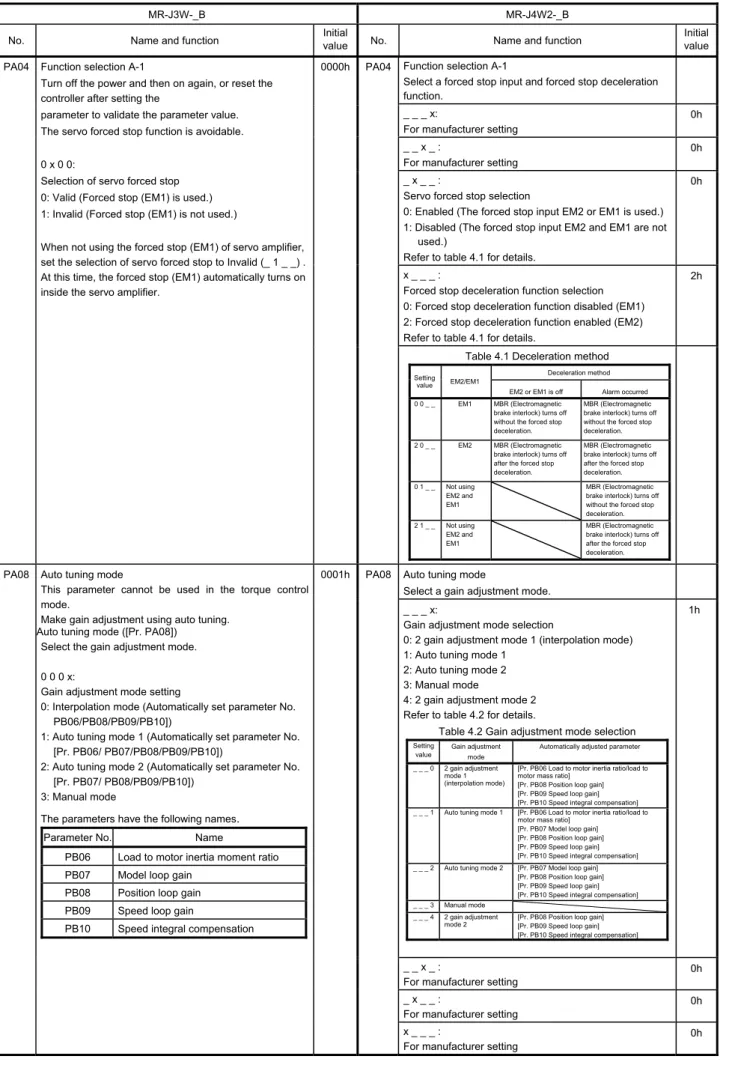
![Table 2.4 [Pr. PA19] setting value and reading/writing range](https://thumb-ap.123doks.com/thumbv2/123deta/6687882.207653/58.892.81.812.123.1179/table-pr-pa-setting-value-reading-writing-range.webp)
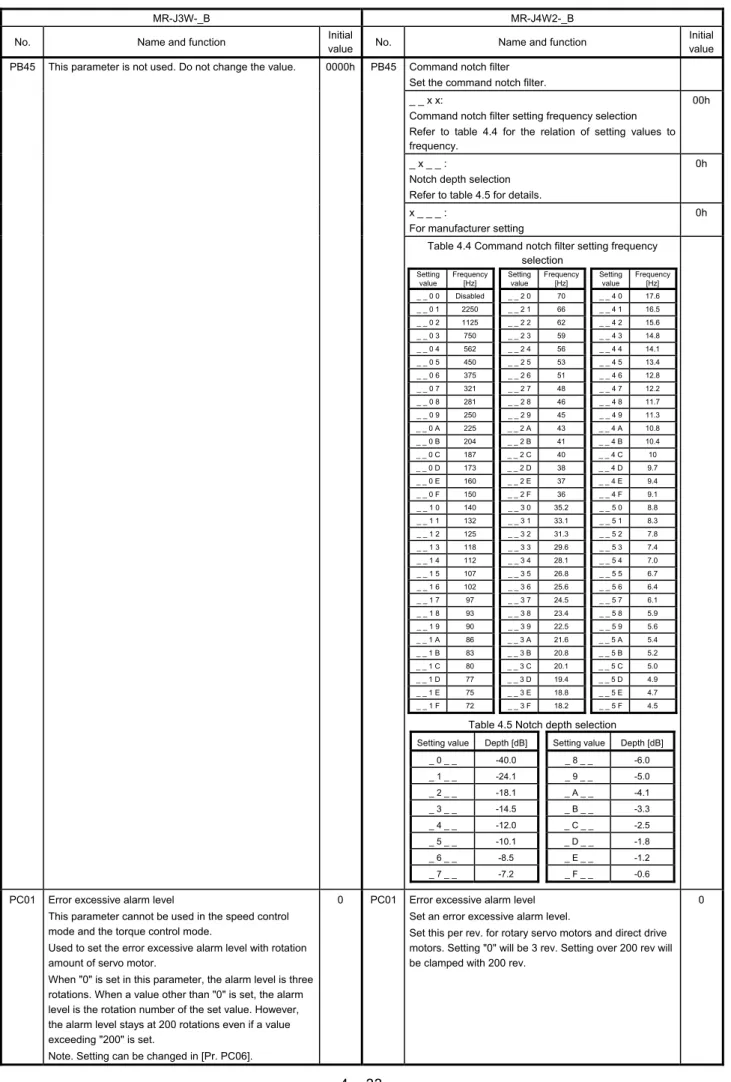
![Table 3.3 Command notch filter setting frequency selection Setting value Frequency [Hz] Setting value Frequency [Hz] Setting value Frequency [Hz] _ _ 0 0 Disabled _ _ 2 0 70 _ _ 4 0 17.6 _ _ 0 1 2250 _ _ 2 1 66 _ _ 4 1 16.5 _ _ 0 2 112](https://thumb-ap.123doks.com/thumbv2/123deta/6687882.207653/128.892.88.810.124.1097/frequency-selection-setting-frequency-frequency-setting-frequency-disabled.webp)