Consortium Standards and
Patent Pooling
Reiko Aoki
Hitotsubashi University
Overview
•
Lessons from Standard Consortiums
–
Free Riding
–
Bargaining Failure
•
Patent Pools and Innovation
–
Upstream and downstream
–
Upstream = technology in the patent pools
Evidence from Standard
Consortiums
•
Members leaving
–
Rambus left JEDEC and now suing members
•
Patent owner does not join the pool,licenses
independently and charges “high” royalty
–
Forgent sues firms over JPEG patents
•
DVD consortium split into 3 patent pools
•
3G platform
–
5 standards
Why is a Pool Not Stable?
•
Welfare is greater when there is one single
patent pool
–
Competition authorities supportive
•
Source of instability
–
Free riding by non-members
–
Bargaining failure due to heterogeneous
Example
•
Demand for license depends on total
royalty payment (licensing fee)
•
Higher royalty means fewer demand for
licenses
•
Q = 60 – r
•
Q is number of licenses demanded
•
r is total royalty payment
–
If all patentees in one pool , then r is pool’s rate
There are three firms, A, B and C
•
Single licensor
–
All three firms form a pool
•
Independent licensing
–
There are three licensor
•
Firm C is an outsider
–
Only firms A and B form a pool
Each licensor (pool or firm) sets
royalty to maximize own revenue
•
If there are 3 licensors
–
Firm A charges r
A
–
Total royalty payment is r
A
+r
B
+ r
C
–
Firm A’s revenue (60 - r
A
- r
B
- r
C
) x r
A
•
If there is one licensor (pool)
–
Pool charges r
–
Total royalty payment is r
Incentives
•
Raising royalty reduces number of
licenses
•
A’s revenue hurt by B and C’s royalty rate
–
Better to have fewer rivals
•
A does not take into account reduction of
B and C’s revenue
Optimal Royalty and Revenue
Regime
No. of
Licensors
Each
Licensor
Royalty
Total
Royalty
Each
Licensor
Revenue
One Patent
Pool
1
30
30
30X30=
900
Firm C is
Outsider
2
20
20 x 2=
40
20X20=
400
Independent
Licensing
3
15
15 x 3=
45
Optimal Royalty and Revenue
Regime
No. of
Licensors
Each
Licensor
Royalty
Total
Royalty
Each
Licensor
Revenue
One Patent
Pool
1
30
30
30X30=
900
Firm C is
Outsider
2
20
20 x 2=
40
20X20=
400
Independent
Licensing
3
15
15 x 3=
45
Each Firm’s Revenue
Regime
Each
Licensor
Revenue
Each Firm Revenue
One Patent
Pool
900 900/3 =
300 > 225
Firm C is
Outsider
400
400/2 = 200 pool member
400 outsider > 300
Independent
Each Firm’s Revenue
Regime
Each
Licensor
Revenue
Each Firm Revenue
One Patent
Pool
900 900/3 =
300
> 225
Firm C is
Outsider
400
400/2 = 200 pool member
400 outsider
>
300
Independent
Free Riding
•
C is better off being an outsider than being
a member of a pool
•
Incentive to free ride
–
Good to have all other firms in a single pool
–
Better not to join
•
Agree to a pool in principle and not join
•
Leave the pool after formation
Possible Solutions
•
400 + 200 + 200 < 900
•
Pool members are better off having firm C
join the pool
–
Pay 400 to firm C
Bargaining Failure
•
Forgent and Rambus are not
manufacturers
•
Research only firms (R-firms) and
vertically integrated (V-firms) have
different incentive
–
V-firms both conduct research and
manufacture
Different Profit and Incentives
•
R-firm
–
Profit ( ) is only licensing revenue
•
V-firm
–
Profit ( )
= Licensing revenue + manufacturing profit
–
Manufacturing profit decreasing in royalty rate
–
Wants royalty lower than R-firm
R
V
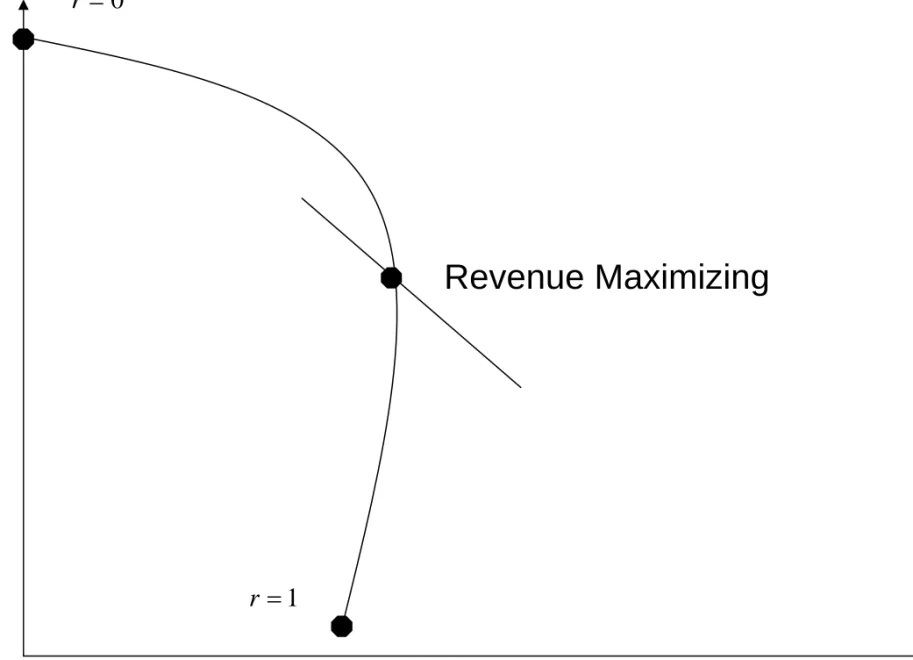
Patent Pool Licensing Frontier
•
Plot of V-firm and R-firm profits with
different patent pool royalty rates (r)
•
Pool revenue distributed according to
number of patents (in this example equal
number of patents)
V
R
Revenue Maximizing
0
r
1
r
Possible Profit Allocations
•
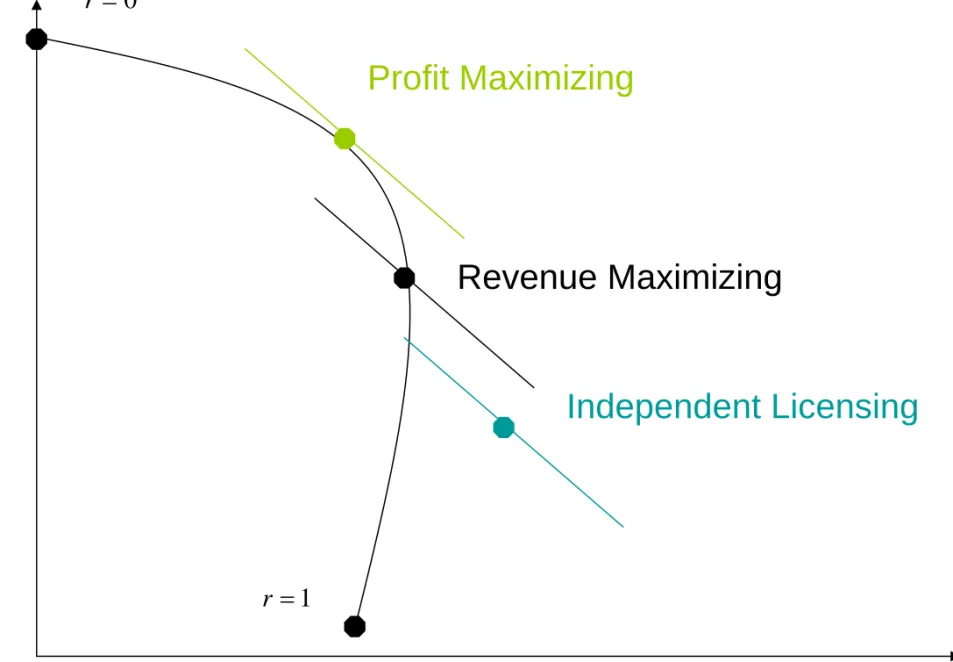
Revenue Maximizing Point = pool
revenue maximized
•
Profit Maximizing Point
= total firm profits
maximized (r lower than Revenue Max)
•
Independent Licensing Point
= Firms
V
R
Revenue Maximizing
Independent Licensing
Profit Maximizing
0
r
1
r
Bargaining Failure
•
Independent Licensing is outside the
frontier
•
Not achievable by current pool revenue
sharing rule
•
Pool revenue sharing rule must
incorporate Independent Licensing into
account
Possible Solutions
•
Total profit is larger with Revenue
Maximizing than Independent Licensing
•
R-firm must be guaranteed at least
Independent Licensing profit
–
Bargaining than per patent distribution rule
•
Total profit is larger even larger with Profit
Maximizing
Nash Bargaining Solution
•
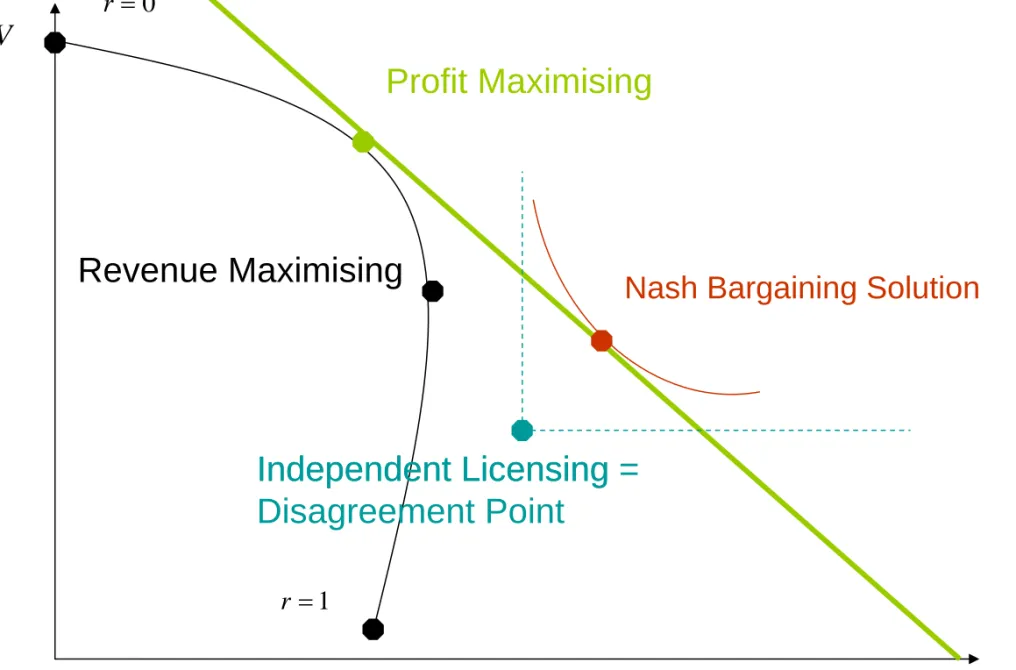
Profit maximizing line is bargaining frontier
–
Best possible profits by firms cooperating
–
Best achievable only by forming a pool
•
Disagreement point (threat point) is
Independent Licensing
•
Nash Bargaining Solution splits the
surplus from cooperating (difference
V
R
Independent Licensing
Profit Maximising
0
r
1
r
Figure 2: Nash Bargaining Solution
Nash Bargaining Solution
Revenue Maximising
Conclusion
•
Patent pool is appealing in theory
•
Problems in implementation (also
theoretically sound !)
–
Free riding
•
Incentive to not join or leave the pool
•
Wants everyone else to form a pool
–
Bargaining failure
Patent Pools and Innovation
◮ Problem:
◮ Downstream innovation or product development may
require licensing multiple upstream technologies with multiple owners⇒high transaction costs and ‘tragedy of the anticommons’.
◮ Example: Standard implementing patents, Genetic
diagnostic tests
◮ Possible solutions:
Patent Pools and Innovation
◮ Problem:
◮ Downstream innovation or product development may
require licensing multiple upstream technologies with multiple owners⇒high transaction costs and ‘tragedy of the anticommons’.
◮ Example: Standard implementing patents, Genetic
diagnostic tests
◮ Possible solutions:
◮ Patent Pools ◮ Cross-licensing ◮ Compulsory licensing ◮ Research exemptions
Focus
◮ Examine effects of PP onupstreamincentives to innovate
◮ PP of complementary intellectual property
◮ Standard implementing patent pools ◮ DNA microarrays
◮ Specifically, we examine how PPs effect
◮ Ex-post (after upstream innovation) licensing ◮ Ex-ante incentives to invest in upstream research.
◮ Compare different PP licensing revenue (royalty) distribution rules.
Focus
◮ Examine effects of PP onupstreamincentives to innovate ◮ PP of complementary intellectual property
◮ Standard implementing patent pools ◮ DNA microarrays
◮ Specifically, we examine how PPs effect
◮ Ex-post (after upstream innovation) licensing ◮ Ex-ante incentives to invest in upstream research.
◮ Compare different PP licensing revenue (royalty) distribution rules.
Focus
◮ Examine effects of PP onupstreamincentives to innovate ◮ PP of complementary intellectual property
◮ Standard implementing patent pools ◮ DNA microarrays
◮ Specifically, we examine how PPs effect
◮ Ex-post (after upstream innovation) licensing ◮ Ex-ante incentives to invest in upstream research.
◮ Compare different PP licensing revenue (royalty) distribution rules.
Focus
◮ Examine effects of PP onupstreamincentives to innovate ◮ PP of complementary intellectual property
◮ Standard implementing patent pools ◮ DNA microarrays
◮ Specifically, we examine how PPs effect
◮ Ex-post (after upstream innovation) licensing ◮ Ex-ante incentives to invest in upstream research.
◮ Compare different PP licensing revenue (royalty)
distribution rules.
Analysis - Factors to Consider
◮ Licensing by the PP must be optimalex-post(after
upstream innovation) given the ex-post outcome of innovation (market structure)
◮ Maximize joint profit
◮ Induce IP owners to rationally join
◮ R&D incentive determined byex-ante expected profit
◮ Ex-ante expected profitdepends onex-post profitandR&D technology(probability distribution over outcomes)
◮ Ex-post optimal royalty distribution rule may not provide
right incentives ex-ante
◮ Expected profit depends onnumber of firmsinvesting
(ex-ante market structure)
◮ Firms differ: Some firms arecompetitors(substitute
Analysis - Factors to Consider
◮ Licensing by the PP must be optimalex-post(after
upstream innovation) given the ex-post outcome of innovation (market structure)
◮ Maximize joint profit
◮ Induce IP owners to rationally join
◮ R&D incentive determined byex-ante expected profit
◮ Ex-ante expected profitdepends onex-post profitandR&D technology(probability distribution over outcomes)
◮ Ex-post optimal royalty distribution rule may not provide
right incentives ex-ante
◮ Expected profit depends onnumber of firmsinvesting
(ex-ante market structure)
Analysis - Factors to Consider
◮ Licensing by the PP must be optimalex-post(after
upstream innovation) given the ex-post outcome of innovation (market structure)
◮ Maximize joint profit
◮ Induce IP owners to rationally join
◮ R&D incentive determined byex-ante expected profit ◮ Ex-ante expected profitdepends onex-post profitandR&D
technology(probability distribution over outcomes)
◮ Ex-post optimal royalty distribution rule may not provide
right incentives ex-ante
◮ Expected profit depends onnumber of firmsinvesting
(ex-ante market structure)
◮ Firms differ: Some firms arecompetitors(substitute
Main Conclusions
◮ In general, PPsstimulate upstream R&D investment
◮ But PPs mayhurtthe incentive of an inventor withunique
ability (ex-ante monopoly, firms ex-ante asymmetric)
◮ PP dilutes rent
◮ And incentives to invest may be socially excessive
◮ PP that distributes licensing revenueunequallyamong its
members isless likelyto lead to welfareloss
◮ Unequal distribution helps form PP
◮ Even if inventors are symmetric ex-ante, ex-post
asymmetries may emerge
Main Conclusions
◮ In general, PPsstimulate upstream R&D investment
◮ But PPs mayhurtthe incentive of an inventor withunique
ability (ex-ante monopoly, firms ex-ante asymmetric)
◮ PP dilutes rent
◮ And incentives to invest may be socially excessive
◮ PP that distributes licensing revenueunequallyamong its
members isless likelyto lead to welfareloss
◮ Unequal distribution helps form PP
◮ Even if inventors are symmetric ex-ante, ex-post
asymmetries may emerge
◮ Firm’s profit ranking over different PP rules differsex-ante or ex-postandby firm(monopolist or not)⇒likely to lead todisagreementover PP rules and formation
◮ Implication: Determination ofPP rules(revenue
Main Conclusions
◮ In general, PPsstimulate upstream R&D investment
◮ But PPs mayhurtthe incentive of an inventor withunique
ability (ex-ante monopoly, firms ex-ante asymmetric)
◮ PP dilutes rent
◮ And incentives to invest may be socially excessive
◮ PP that distributes licensing revenueunequallyamong its
members isless likelyto lead to welfareloss
◮ Unequal distribution helps form PP
◮ Even if inventors are symmetric ex-ante, ex-post
asymmetries may emerge
◮ Firm’s profit ranking over different PP rules differsex-ante
Main Conclusions
◮ In general, PPsstimulate upstream R&D investment
◮ But PPs mayhurtthe incentive of an inventor withunique
ability (ex-ante monopoly, firms ex-ante asymmetric)
◮ PP dilutes rent
◮ And incentives to invest may be socially excessive
◮ PP that distributes licensing revenueunequallyamong its
members isless likelyto lead to welfareloss
◮ Unequal distribution helps form PP
◮ Even if inventors are symmetric ex-ante, ex-post
asymmetries may emerge
◮ Firm’s profit ranking over different PP rules differsex-ante
or ex-postandby firm(monopolist or not)⇒likely to lead todisagreementover PP rules and formation
◮ Implication: Determination ofPP rules(revenue
Framework
◮ Newdownstream productneeds two complementary
upstream innovations: A and B.
◮ Large number of competitiveupstream research firms:
◮ Each has capacity for one research‘project’at costc ◮ Specialized in development of A or B
◮ Revenues only from licensing
◮ Eachfirmeither independently succeeds or fails
(probabilistic) .
◮ All successful projects (= patent) of a single component
result in perfect substitutes.
◮ PP
Framework
◮ Newdownstream productneeds two complementary
upstream innovations: A and B.
◮ Large number of competitiveupstream research firms:
◮ Each has capacity for one research‘project’at costc ◮ Specialized in development of A or B
◮ Revenues only from licensing
◮ Eachfirmeither independently succeeds or fails
(probabilistic) .
◮ All successful projects (= patent) of a single component
result in perfect substitutes.
◮ PP
◮ Licenses on behalf of successful inventors who choose to
join.
◮ Objective is to maximize joint royalty revenues of its
Framework
◮ Newdownstream productneeds two complementary
upstream innovations: A and B.
◮ Large number of competitiveupstream research firms:
◮ Each has capacity for one research‘project’at costc ◮ Specialized in development of A or B
◮ Revenues only from licensing
◮ Eachfirmeither independently succeeds or fails
(probabilistic) .
◮ All successful projects (= patent) of a single component
result in perfect substitutes.
◮ PP
Timing
◮ Innovation and licensing takes place in four stages:
I. Theantitrust ruleis set and announced: Is the PP allowed to jointly license substitute innovations or not?
II. The PP sets and announces aroyalty redistribution rule
consistent with the anti-trust rule.
III. Each research firmdecides to invest or not to investin an R&D project and those that invest invent a component with given probability.
Timing
◮ Innovation and licensing takes place in four stages:
I. Theantitrust ruleis set and announced: Is the PP allowed to jointly license substitute innovations or not?
II. The PP sets and announces aroyalty redistribution rule
consistent with the anti-trust rule.
III. Each research firmdecides to invest or not to investin an R&D project and those that invest invent a component with given probability.
Timing
◮ Innovation and licensing takes place in four stages:
I. Theantitrust ruleis set and announced: Is the PP allowed to jointly license substitute innovations or not?
II. The PP sets and announces aroyalty redistribution rule consistent with the anti-trust rule.
III. Each research firmdecides to invest or not to investin an R&D project and those that invest invent a component with given probability.
Timing
◮ Innovation and licensing takes place in four stages:
I. Theantitrust ruleis set and announced: Is the PP allowed to jointly license substitute innovations or not?
II. The PP sets and announces aroyalty redistribution rule consistent with the anti-trust rule.
III. Each research firmdecides to invest or not to investin an R&D project and those that invest invent a component with given probability.
Timing
◮ Innovation and licensing takes place in four stages:
I. Theantitrust ruleis set and announced: Is the PP allowed to jointly license substitute innovations or not?
II. The PP sets and announces aroyalty redistribution rule consistent with the anti-trust rule.
III. Each research firmdecides to invest or not to investin an R&D project and those that invest invent a component with given probability.
Assumptions
◮ Tragedy of Anticommons:
πM ≥2πDandW0≥WM ≥WD.
◮ πM andWM: Monopoly licensing profit and welfare. ◮ πDandWD: Duopoly licensing profit and welfare. ◮ W
0: Welfare when both components are licensed at zero
price
◮ P(k,N):Probabilitythatk substitute versions of a
component are invented whenN projects are undertaken
for that component (probability ofk success fromNtrials):
N
X
k=0
P(k,N) =1andlimN→∞P(k,N) =0.
Assumptions
◮ Tragedy of Anticommons:
πM ≥2πDandW0≥WM ≥WD.
◮ πM andWM: Monopoly licensing profit and welfare. ◮ πDandWD: Duopoly licensing profit and welfare. ◮ W
0: Welfare when both components are licensed at zero
price
◮ P(k,N):Probabilitythatk substitute versions of a
component are invented whenN projects are undertaken
for that component (probability ofk success fromNtrials):
N
Licensing Revenue and Antitrust Rules
◮ (π=total PP licensing revenues)
◮ Joint licensing of substitutes isnotallowed:
◮ Strict Antitrust Rule: PP randomly chooses at most one
member of each component to license; royalties are shared equally between the chosen.
◮ Joint licensing of substitutes by the PP is allowed:
◮ Equal:Withnmembers, each receivesπ/n.
◮ Unequal: If one component has a single inventor and the
other component hasn≥2 substitute inventors, the single
inventor receiveszπand the others receive(1−z)π/nwith
z ∈[0,1]. Otherwise, equal shares.
Ex-post Outcomes and PP Membership
◮ Possible ex-post outcomes: nA andnB(number of successful inventors of A and B) :
Cases\Successful firms nA nB
Case MM 1 1
Case MC: 1 ( 2 or more) 2 or more (1)
Case CC: 2 or more 2 or more
◮ Who will join the PP ex-post?
◮ Competitive component inventors (cases MC & CC) join
any kind of PP.
◮ Competition among perfect substitutes drives royalties down
to zero⇒joining is a weakly dominant strategy for them.
◮ Case MM:Both inventors join any kind of PP. ◮ Avoid tragedy of anticommons .
◮ Case MC: Monopoly inventor joins a strict PP. (Assumption)
Monopoly inventor doesnot joinan equal PP butdoes join
Ex-post Outcomes and PP Membership
◮ Possible ex-post outcomes: nA andnB(number of successful inventors of A and B) :
Cases\Successful firms nA nB
Case MM 1 1
Case MC: 1 ( 2 or more) 2 or more (1)
Case CC: 2 or more 2 or more
◮ Who will join the PP ex-post?
◮ Competitive component inventors (cases MC & CC) join
any kind of PP.
◮ Competition among perfect substitutes drives royalties down
to zero⇒joining is a weakly dominant strategy for them.
Ex-post Outcomes and PP Membership
◮ Possible ex-post outcomes: nA andnB(number of successful inventors of A and B) :
Cases\Successful firms nA nB
Case MM 1 1
Case MC: 1 ( 2 or more) 2 or more (1)
Case CC: 2 or more 2 or more
◮ Who will join the PP ex-post?
◮ Competitive component inventors (cases MC & CC) join
any kind of PP.
◮ Competition among perfect substitutes drives royalties down
to zero⇒joining is a weakly dominant strategy for them.
◮ Case MM:Both inventors join any kind of PP. ◮ Avoid tragedy of anticommons .
◮ Case MC: Monopoly inventor joins a strict PP.(Assumption)
Monopoly inventor doesnot joinan equal PP butdoes join
Ex-post Outcomes and PP Membership
◮ Possible ex-post outcomes: nA andnB(number of successful inventors of A and B) :
Cases\Successful firms nA nB
Case MM 1 1
Case MC: 1 ( 2 or more) 2 or more (1)
Case CC: 2 or more 2 or more
◮ Who will join the PP ex-post?
◮ Competitive component inventors (cases MC & CC) join
any kind of PP.
◮ Competition among perfect substitutes drives royalties down
to zero⇒joining is a weakly dominant strategy for them.
Ex-post Profits
◮ Ex-post equilibrium payoffs of successful inventors
(Gains,Lossesrelative to no PP):
PP Type\Profit πMM πMCM π C
MC(n) πCC(nA,nB)
None πD πM 0 0
Equal πM/2 πD πD/n πM/(nA+nB)
Unequal πM/2 zπM (1−z)πM/n πM/(nA+nB)
Strict πM/2 πM/2 1nπM/2 n1
iπM/2;
Ex-post Welfare
◮ Ex-post equilibrium welfare:
(Gains,Losses)
PP Type\Welfare WMM WMC WCC
None WD WM W0
Equal WM WD WM
Unequal WM WM WM
Strict WM WM WM
◮ Ex-ante only probability of outcomes (MM,MC, orCC)
R&D Technology
◮ Probability that a given research firm becomes a
successful inventor depends on the number of firms that invest.
Upstream Innovation
◮ Ex-ante expected profit depends on ex-post profit and
distribution of outcomes
◮ We consider two different upstream market structures.
◮ Market 1: There areN ≥2 firms that can invest in A and N ≥2 firmsthat can invest in B.
◮ Potential ex-ante competition for both components. ◮ Symmetric
◮ Market 2: There isonly one firmthat invests in A.N ≥2 firmscan invest in B.
◮ Ex-ante monopoly for innovation of component A.
Competitive for component B.
Upstream Innovation
◮ Ex-ante expected profit depends on ex-post profit and
distribution of outcomes
◮ We consider two different upstream market structures. ◮ Market 1: There areN ≥2 firms that can invest in A and
N ≥2 firmsthat can invest in B.
◮ Potential ex-ante competition for both components. ◮ Symmetric
◮ Market 2: There isonly one firmthat invests in A.N ≥2
firmscan invest in B.
◮ Ex-ante monopoly for innovation of component A.
Market 1 Upstream Innovation
◮ Market 1:Nprojects are undertaken for each component ◮ Ex-ante competitive, symmetric
◮ Ex-ante expected profit and welfare:
π(N) = 1
NP(1,N)
2
πMM
+N1P(1,N)
N
X
k=2
P(k,N)hπMMC+nπC
MC(k)
i
+
N
X
m=2
N
X
k=2
m
NP(m,N)P(k,N)πCC(m,k)−c
W (N) = P(1,N)2WMM+2P(1,N)
N
X
k=2
P(k,N)WMC
+ N X m 2 N X k 2
Market 1 Result: Ex-ante Expected Profit and Welfare
(Given
N
)
◮ Ex-ante, theexpected profit gains always outweigh any
losses:
◮ πUC(N) =πSC(N)≥πEC(N)≥πNC(N)for allN ≥1.
◮ PP increases incentive to invest in upstream R&D.
◮ Welfare
◮ WhenNis large, case CC likely andW
0achieved. ◮ WhenNis small, case MM likely and PP beneficial.
◮ Expected welfare withno PPis highest whenNis large but lowest whenN is small:
(i) WUC
(N) =WSC
(N)≥WEC
(N)≥WNC
(N)for smallN,
(ii) WNC
(N)≥WUC
(N) =WSC
(N)≥WEC
Market 1 Result: Ex-ante Expected Profit and Welfare
(Given
N
)
◮ Ex-ante, theexpected profit gains always outweigh any
losses:
◮ πUC(N) =πSC(N)≥πEC(N)≥πNC(N)for allN ≥1.
◮ PP increases incentive to invest in upstream R&D. ◮ Welfare
◮ WhenNis large, case CC likely andW
0achieved.
◮ WhenNis small, case MM likely and PP beneficial.
◮ Expected welfare withno PPis highest whenNis large
but lowest whenN is small:
(i) WUC
(N) =WSC
(N)≥WEC
(N)≥WNC
(N)for smallN,
(ii) WNC
(N)≥WUC
(N) =WSC
(N)≥WEC
(N)for largeN. ◮ Unequal or strict PP always outperforms equal: Unequal or strict
Market 1 Result: Ex-ante Expected Profit and Welfare
(Given
N
)
◮ Ex-ante, theexpected profit gains always outweigh any
losses:
◮ πUC(N) =πSC(N)≥πEC(N)≥πNC(N)for allN ≥1.
◮ PP increases incentive to invest in upstream R&D. ◮ Welfare
◮ WhenNis large, case CC likely andW
0achieved.
◮ WhenNis small, case MM likely and PP beneficial.
◮ Expected welfare withno PPis highest whenNis large
but lowest whenN is small:
(i) WUC
(N) =WSC
(N)≥WEC
(N)≥WNC
(N)for smallN,
(ii) WNC
(N)≥WUC
(N) =WSC
(N)≥WEC
Simulation with Binomial Upstream R&D Technology
(Determination of
N
)
◮ Linear demand for licenses:Q=100−ρgives parameter
values:
Parameter πM πD W0 WM WD
Value 1004 1009 50 752 2509
◮ AssumeP(k,N)is binomial;σis success prob. of each
project.
◮ Other parameters:z,c (market 1),cA andcB(market 2).
◮ Given parameter values, use numerical search to find
equilibrium value ofNunder each PP type.
◮ Equilibrium condition: HighestNwhereπ(N)≥0 and
Simulation with Binomial Upstream R&D Technology
(Determination of
N
)
◮ Linear demand for licenses:Q=100−ρgives parameter
values:
Parameter πM πD W0 WM WD
Value 1004 1009 50 752 2509
◮ AssumeP(k,N)is binomial;σis success prob. of each
project.
◮ Other parameters:z,c (market 1),cA andcB(market 2). ◮ Given parameter values, use numerical search to find
equilibrium value ofNunder each PP type.
Market 1 Ex-ante Profit & Welfare and Equilibrium
Investment by Simulation
◮ Simulation forc =2.5 andσ =0.7 (symmetry makes value
ofz irrelevant):
◮ PP stimulates investment but may reduce welfare.
◮ Equilibrium investment may increase too much once R&D
Market 2 of Upstream Innovation
◮ Market 2: Firm A has theunique abilityto develop
component A ; Development of component B is as before
◮ Asymmetric firms, Firm A is a monopolist ◮ Case CC is no longer possible.
◮ Firm profits whenNprojects undertaken for component B:
πA(N) =P(1,N)πMM+ N
X
k=2
P(k,N)πMMC−cA
πB(N) = 1
NP(1,N)πMM +
N
X n
NP(k,N)π
C
Market 2 of Upstream Innovation
◮ Market 2: Firm A has theunique abilityto develop
component A ; Development of component B is as before
◮ Asymmetric firms, Firm A is a monopolist ◮ Case CC is no longer possible.
◮ Firm profits whenNprojects undertaken for component B:
πA(N) =P(1,N)πMM+ N
X
k=2
P(k,N)πMMC−cA
πB(N) =
1
NP(1,N)πMM +
N
X
k=2 n
NP(k,N)π
C
Market 2 Results: Ex-ante Expected Profits and
Welfare (Given
N
)
◮ Firm A prefers
◮ No PPwhenNis large ◮ Unequal PP whenNis small.
◮ Component B firm , for any givenN,
◮ Always better off under either an equal or unequal PP
compared to no PP.
◮ Such a firm is better off under an unequal PP compared to
an equal PP ifz ≤1−πD/πM.
◮ Welfare: Unequal or strict PP best for allN. Equal PP
Market 2 Results: Ex-ante Expected Profits and
Welfare (Given
N
)
◮ Firm A prefers
◮ No PPwhenNis large ◮ Unequal PP whenNis small.
◮ Component B firm , for any givenN,
◮ Always better off under either an equal or unequal PP
compared to no PP.
◮ Such a firm is better off under an unequal PP compared to
an equal PP ifz ≤1−πD/πM.
◮ Welfare: Unequal or strict PP best for allN. Equal PP
Market 2 Upstream R&D Incentives
◮ PP’s effect depends on firm(ex-ante market structure)
◮ Increasethe incentives ofcompetitiveresearch firms to
invest, but
◮ Mayreducethe incentive ofmonopolist(unique ability).
◮ PP’s effect differ by firm andby ex-ante and ex-post.
◮ Ex-post, firm A prefers ahigh value ofzunder an unequal
PP, but this reduces the payoff of component B firms.
◮ Ex-ante, firm A may want to choose alower value ofzto
give incentive to B firms to invest.
Market 2 Upstream R&D Incentives
◮ PP’s effect depends on firm(ex-ante market structure)
◮ Increasethe incentives ofcompetitiveresearch firms to
invest, but
◮ Mayreducethe incentive ofmonopolist(unique ability).
◮ PP’s effect differ by firm andby ex-ante and ex-post.
◮ Ex-post, firm A prefers ahigh value ofzunder an unequal
PP, but this reduces the payoff of component B firms.
◮ Ex-ante, firm A may want to choose alower value ofzto
give incentive to B firms to invest.
◮ Or,ex-ante, firm A may prefernot to have a strict anti-trust
Market 2: Ex-ante Profit & Welfare and Equilibrium
Investment
◮ Single simulation of market 2, forcA=8,cB =1.3,σ =0.5
Interaction between Technology and Distribution Rule
by Simulation
◮ Effect of changingz in an unequal PP on equilibrium
expected profits of firm A and expected welfare:
◮ Level ofz affects equilibrium investment level of
component B firms.
Conclusion
◮ PP can generate both ex-post and ex-antegains and
lossesto welfare and profits of research firms.
◮ PP generallystimulate investmentin upstream R&D except
possibly by inventors who have unique abilities.
◮ Unequal PPredistribution is less likely to lead to welfare
losses but not always.
◮ Likely conflict between existing and potential inventors
regarding PP support.
◮ PP design and royalty distribution rule needs to reflect
Conclusion
◮ PP can generate both ex-post and ex-antegains and
lossesto welfare and profits of research firms.
◮ PP generallystimulate investmentin upstream R&D except
possibly by inventors who have unique abilities.
◮ Unequal PPredistribution is less likely to lead to welfare
losses but not always.
◮ Likely conflict between existing and potential inventors
regarding PP support.
◮ PP design and royalty distribution rule needs to reflect