Automatic Labeling of Semantic Roles
Daniel Gildea
University of California, Berkeley, and International Computer Science Institute
Daniel Jurafsky Department of Linguistics University of Colorado, Boulder
Abstract
We present a system for identify-ing the semantic relationships, or se-mantic roles, filled by constituents of a sentence within a semantic frame. Various lexical and syntactic fea-tures are derived from parse trees and used to derive statistical clas-sifiers from hand-annotated training data.
1 Introduction
Identifying thesemantic rolesfilled by con-stituents of a sentence can provide a level of shallow semantic analysis useful in solving a number of natural language processing tasks. Semantic roles represent the participants in an action or relationship captured by a se-mantic frame. For example, the frame for one sense of the verb “crash” includes the roles
Agent,Vehicleand To-Location.
This shallow semantic level of interpreta-tion can be used for many purposes. Cur-rent information extraction systems often use domain-specific frame-and-slot templates to extract facts about, for example, financial news or interesting political events. A shal-low semantic level of representation is a more domain-independent, robust level of represen-tation. Identifying these roles, for example, could allow a system to determine that in the sentence “The first one crashed” the sub-ject is the vehicle, but in the sentence “The first one crashed it” the subject is the agent, which would help in information extraction in this domain. Another application is in word-sense disambiguation, where the roles
associ-ated with a word can be cues to its sense. For example, Lapata and Brew (1999) and others have shown that the different syntactic sub-catgorization frames of a verb like “serve” can be used to help disambiguate a particular in-stance of the word “serve”. Adding seman-tic role subcategorization information to this syntactic information could extend this idea to use richer semantic knowledge. Semantic roles could also act as an important inter-mediate representation in statistical machine translation or automatic text summarization and in the emerging field of Text Data Mining (TDM) (Hearst, 1999). Finally, incorporat-ing semantic roles into probabilistic models of language should yield more accurate parsers and better language models for speech recog-nition.
paper we report on our current system, as well as a number of preliminary experiments on extensions to the system.
2 Semantic Roles
Historically, two types of semantic roles have been studied: abstract roles such as Agent
and Patient, and roles specific to individual
verbs such as Eater and Eaten for “eat”.
The FrameNet project proposes roles at an in-termediate level, that of the semantic frame. Frames are defined as schematic representa-tions of situarepresenta-tions involving various partici-pants, props, and other conceptual roles (Fill-more, 1976). For example, the frame “conver-sation”, shown in Figure 1, is invoked by the semantically related verbs “argue”, “banter”, “debate”, “converse”, and “gossip” as well as the nouns “argument”, “dispute”, “discus-sion” and “tiff”. The roles defined for this frame, and shared by all its lexical entries, include Protagonist1 and Protagonist2
or simplyProtagonistsfor the participants
in the conversation, as well as Medium, and
Topic. Example sentences are shown in
Ta-ble 1. Defining semantic roles at the frame level avoids some of the difficulties of at-tempting to find a small set of universal, ab-stract thematic roles, or case roles such as
Agent, Patient, etc (as in, among many
others, (Fillmore, 1968) (Jackendoff, 1972)). Abstract thematic roles can be thought of as being frame elements defined in abstract frames such as “action” and “motion” which are at the top of in inheritance hierarchy of semantic frames (Fillmore and Baker, 2000).
The preliminary version of the FrameNet corpus used for our experiments contained 67 frames from 12 general semantic domains cho-sen for annotation. Examples of domains (see Figure 1) include “motion”, “cognition” and “communication”. Within these frames, ex-amples of a total of 1462 distinct lexical pred-icates, ortarget words, were annotated: 927 verbs, 339 nouns, and 175 adjectives. There are a total of 49,013 annotated sentences, and 99,232 annotated frame elements (which do not include the target words themselves).
3 Related Work
Assignment of semantic roles is an impor-tant part of language understanding, and has been attacked by many computational sys-tems. Traditional parsing and understand-ing systems, includunderstand-ing implementations of unification-based grammars such as HPSG (Pollard and Sag, 1994), rely on hand-developed grammars which must anticipate each way in which semantic roles may be real-ized syntactically. Writing such grammars is time-consuming, and typically such systems have limited coverage.
Data-driven techniques have recently been applied to template-based semantic interpre-tation in limited domains by “shallow” sys-tems that avoid complex feature structures, and often perform only shallow syntactic analysis. For example, in the context of the Air Traveler Information System (ATIS) for spoken dialogue, Miller et al. (1996) com-puted the probability that a constituent such as “Atlanta” filled a semantic slot such as
Destination in a semantic frame for air
travel. In a data-driven approach to infor-mation extraction, Riloff (1993) builds a dic-tionary of patterns for filling slots in a spe-cific domain such as terrorist attacks, and Riloff and Schmelzenbach (1998) extend this technique to automatically derive entire case frames for words in the domain. These last systems make use of a limited amount of hand labor to accept or reject automatically gen-erated hypotheses. They show promise for a more sophisticated approach to generalize beyond the relatively small number of frames considered in the tasks. More recently, a do-main independent system has been trained on general function tags such as Manner and
Temporalby Blaheta and Charniak (2000).
4 Methodology
confer−v
debate−v converse−v
gossip−v dispute−n discussion−n
tiff−n
Conversation
Frame:
Protagonist−1 Protagonist−2 Protagonists Topic Medium Frame Elements:
talk−v
Domain:
Communication
Domain:Cognition
Frame: Questioning
Topic Medium Frame Elements: Speaker Addressee Message
Frame:
Topic Medium Frame Elements: Speaker Addressee Message
Statement
Frame:
Frame Elements:
Judgment
Judge Evaluee Reason Role
dispute−n
blame−v fault−n
admire−v
admiration−n disapprove−v blame−n
appreciate−v
Frame:
Frame Elements:
Categorization
Cognizer Item Category Criterion
Figure 1: Sample domains and frames from the FrameNet lexicon.
Frame Element Example (in italics) with target verb Example (in italics) with target noun Protagonist 1 Kim arguedwith Pat Kimhad an argumentwith Pat Protagonist 2 Kim arguedwith Pat Kim had an argumentwith Pat Protagonists Kim and Patargued Kim and Pat had anargument
Topic Kim and Pat arguedabout politics Kim and Pat had anargument about politics Medium Kim and Pat arguedin French Kim and pat had an argumentin French
Table 1: Examples of semantic roles, or frame elements, for target words “argue” and “argu-ment” from the “conversation” frame
labels roles using human-annotated bound-aries, returning to the question of automat-ically identifying the boundaries in Section 5.3.
4.1 Features Used in Assigning Semantic Roles
The system is a statistical one, based on train-ing a classifier on a labeled traintrain-ing set, and testing on an unlabeled test set. The sys-tem is trained by first using the Collins parser (Collins, 1997) to parse the 36,995 train-ing sentences, matchtrain-ing annotated frame el-ements to parse constituents, and extracting various features from the string of words and the parse tree. During testing, the parser is run on the test sentences and the same fea-tures extracted. Probabilities for each possi-ble semantic role r are then computed from the features. The probability computation will be described in the next section; the fea-tures include:
Phrase Type: This feature indicates the syntactic type of the phrase expressing the semantic roles: examples include
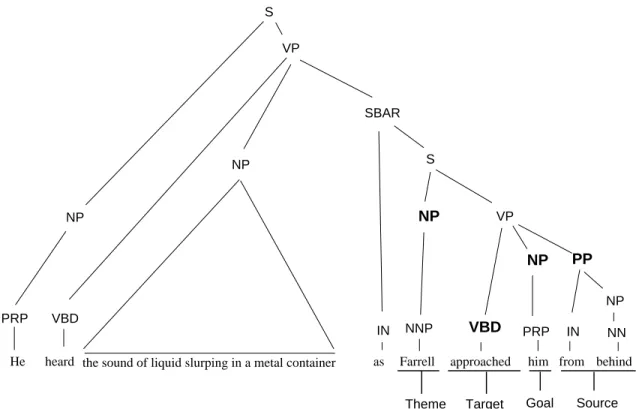
noun phrase (NP), verb phrase (VP), and clause (S). Phrase types were derived au-tomatically from parse trees generated by the parser, as shown in Figure 2. The parse constituent spanning each set of words annotated as a frame element was found, and the constituent’s nonterminal label was taken as the phrase type. As an example of how this feature is useful, in communication frames, the Speaker
is likely appear a a noun phrase, Topic
as a prepositional phrase or noun phrase,
andMediumas a prepostional phrase, as
in: “We talked about the proposal over the phone.” When no parse constituent was found with boundaries matching those of a frame element during testing, the largest constituent beginning at the frame element’s left boundary and lying entirely within the element was used to calculate the features.
S
NP
PRP
VP
VBD
NP
SBAR
IN S
NNP
VP
VBD
NP PP
PRP IN
NP
NN
Goal Source Theme Target
NP
He heard the sound of liquid slurping in a metal container as Farrell approached him from behind
Figure 2: A sample sentence with parser output (above) and FrameNet annotation (below). Parse constituents corresponding to frame elements are highlighted.
for example as a subject or object of a verb. As with phrase type, this feature was read from parse trees returned by the parser. After experimentation with various versions of this feature, we re-stricted it to apply only to NPs, as it was found to have little effect on other phrase types. Each NP’s nearest S or VP ances-tor was found in the parse tree; NPs with an S ancestor were given the grammati-cal functionsubjectand those with a VP ancestor were labeledobject. In general, agenthood is closely correlated with sub-jecthood. For example, in the sentence “He drove the car over the cliff”, the first NP is more likely to fill the Agent role
than the second or third.
Position: This feature simply indicates whether the constituent to be labeled oc-curs before or after the predicate defin-ing the semantic frame. We expected this feature to be highly correlated with grammatical function, since subjects will generally appear before a verb, and
objects after. Moreover, this feature may overcome the shortcomings of read-ing grammatical function from a con-stituent’s ancestors in the parse tree, as well as errors in the parser output.
Voice: The distinction between active and passive verbs plays an important role in the connection between semantic role and grammatical function, since direct objects of active verbs correspond to sub-jects of passive verbs. From the parser output, verbs were classified as active or passive by building a set of 10 passive-identifying patterns. Each of the pat-terns requires both a passive auxiliary (some form of “to be” or “to get”) and a past participle.
a head word as an integral part of the parsing model, we were able to read the head words of the constituents from the parser output. For example, in a commu-nication frame, noun phrases headed by “Bill”, “brother”, or “he” are more likely to be the Speaker, while those headed
by “proposal”, “story”, or “question” are more likely to be theTopic.
For our experiments, we divided the FrameNet corpus as follows: one-tenth of the annotated sentences for each target word were reserved as a test set, and another one-tenth were set aside as a tuning set for developing our system. A few target words with fewer than ten examples were removed from the cor-pus. In our corpus, the average number of sentences per target word is only 34, and the number of sentences per frame is 732 — both relatively small amounts of data on which to train frame element classifiers.
Although we expect our features to inter-act in various ways, the data are too sparse to calculate probabilities directly on the full set of features. For this reason, we built our classifier by combining probabilities from dis-tributions conditioned on a variety of combi-nations of features.
An important caveat in using the FrameNet database is that sentences are not chosen for annotation at random, and therefore are not necessarily statistically representative of the corpus as a whole. Rather, examples are cho-sen to illustrate typical usage patterns for each word. We intend to remedy this in fu-ture versions of this work by bootstrapping our statistics using unannotated text.
Table 2 shows the probability distributions used in the final version of the system. Cov-erageindicates the percentage of the test data for which the conditioning event had been seen in training data. Accuracyis the propor-tion of covered test data for which the correct role is predicted, and Performance, simply the product of coverage and accuracy, is the overall percentage of test data for which the correct role is predicted. Accuracy is some-what similar to the familiar metric of pre-cision in that it is calculated over cases for
which a decision is made, and performance is similar torecallin that it is calculated over all true frame elements. However, unlike a tradi-tional precision/recall trade-off, these results have no threshold to adjust, and the task is a multi-way classification rather than a binary decision. The distributions calculated were simply the empirical distributions from the training data. That is, occurrences of each role and each set of conditioning events were counted in a table, and probabilities calcu-lated by dividing the counts for each role by the total number of observations for each con-ditioning event. For example, the distribution P(r|pt, t) was calculated sas follows:
P(r|pt, t) = #(r, pt, t) #(pt, t)
Some sample probabilities calculated from the training are shown in Table 3.
5 Results
Results for different methods of combining the probability distributions described in the previous section are shown in Table 4. The linear interpolation method simply averages the probabilities given by each of the distri-butions in Table 2:
P(r|constituent) = λ1P(r|t) + λ2P(r|pt, t) + λ3P(r|pt, gf, t) + λ4P(r|pt, position, voice) + λ5P(r|pt, position, voice, t) + λ6P(r|h) + λ7P(r|h, t) +λ8P(r|h, pt, t)
wherePiλi = 1. The geometric mean,
ex-pressed in the log domain, is similar: P(r|constituent) = 1
Zexp{λ1logP(r|t) +
λ2logP(r|pt, t) + λ3logP(r|pt, gf, t) + λ4logP(r|pt, position, voice) + λ5logP(r|pt, position, voice, t) + λ6logP(r|h) + λ7logP(r|h, t) + λ8logP(r|h, pt, t)}
whereZ is a normalizing constant ensuring that PrP(r|constituent) = 1.
Distribution Coverage Accuracy Performance
P(r|t) 100% 40.9% 40.9%
P(r|pt, t) 92.5 60.1 55.6 P(r|pt, gf, t) 92.0 66.6 61.3 P(r|pt, position, voice) 98.8 57.1 56.4 P(r|pt, position, voice, t) 90.8 70.1 63.7
P(r|h) 80.3 73.6 59.1
P(r|h, t) 56.0 86.6 48.5
P(r|h, pt, t) 50.1 87.4 43.8
Table 2: Distributions Calculated for Semantic Role Identification: r indicates semantic role, pt phrase type,gf grammatical function,h head word, andttarget word, or predicate.
P(r|pt, gf, t) Count in training data P(r =Agt|pt=NP, gf =Subj, t=abduct) =.46 6
P(r =Thm|pt=NP, gf =Subj, t=abduct) =.54 7
P(r =Thm|pt=NP, gf =Obj, t=abduct) = 1 9
P(r =Agt|pt=PP, t=abduct) =.33 1
P(r =Thm|pt=PP, t=abduct) =.33 1
P(r =CoThm|pt=PP, t=abduct) =.33 1
P(r =Manr|pt=ADVP, t=abduct) = 1 1
Table 3: Sample probabilities forP(r|pt, gf, t) calculated from training data for the verbabduct. The variable gf is only defined for noun phrases. The roles defined for theremovingframe in themotiondomain are: Agent,Theme,CoTheme(“... had been abducted with him”) and
Manner.
Other schemes for choosing values of λ, in-cluding giving more weight to distributions for which more training data was available, were found to have relatively little effect. We attribute this to the fact that the evaluation depends only the the ranking of the probabil-ities rather than their exact values.
P(r | h, t) P(r | pt, t)
P(r | pt, position, voice) P(r | pt, position, voice, t) P(r | pt, gf, t)
P(r | t) P(r | h)
P(r | h, pt, t)
Figure 3: Lattice organization of the distri-butions from Table 2, with more specific dis-tributions towards the top.
In the “backoff” combination method, a lattice was constructed over the distributions in Table 2 from more specific conditioning
events to less specific, as shown in Figure 3. The less specific distributions were used only when no data was present for any more specific distribution. As before, probabilities were combined with both linear interpolation and a geometric mean.
Combining Method Correct Linear Interpolation 79.5%
Geometric Mean 79.6
Backoff, linear interpolation 80.4 Backoff, geometric mean 79.6 Baseline: Most common role 40.9
Table 4: Results on Development Set, 8148 observations
Linear
Backoff Baseline Development Set 80.4% 40.9%
Test Set 76.9 40.6%
Table 5: Results on Test Set, using backoff linear interpolation system. The test set con-sists of 7900 observations.
5.
5.1 Discussion
It is interesting to note that looking at a con-stituent’s position relative to the target word along with active/passive information per-formed as well as reading grammatical func-tion off the parse tree. A system using gram-matical function, along with the head word, phrase type, and target word, but no passive information, scored 79.2%. A similar system using position rather than grammatical func-tion scored 78.8% — nearly identical perfor-mance. However, using head word, phrase type, and target word without either position or grammatical function yielded only 76.3%, indicating that while the two features accom-plish a similar goal, it is important to include some measure of the constituent’s syntactic relationship to the target word. Our final sys-tem incorporated both features, giving a fur-ther, though not significant, improvement. As a guideline for interpreting these results, with 8176 observations, the threshold for statisti-cal signifance withp < .05 is a 1.0% absolute difference in performance.
Use of the active/passive feature made a further improvement: our system using po-sition but no grammatical function or pas-sive information scored 78.8%; adding paspas-sive information brought performance to 80.5%. Roughly 5% of the examples were identified as passive uses.
Head words proved to be very accurate in-dicators of a constituent’s semantic role when data was available for a given head word, confirming the importance of lexicalization shown in various other tasks. While the dis-tribution P(r|h, t) can only be evaluated for 56.0% of the data, of those cases it gets 86.7%
correct, without use of any of the syntactic features.
5.2 Lexical Clustering
In order to address the sparse coverage of lex-ical head word statistics, an experiment was carried out using an automatic clustering of head words of the type described in (Lin, 1998). A soft clustering of nouns was per-formed by applying the co-occurrence model of (Hofmann and Puzicha, 1998) to a large corpus of observed direct object relationships between verbs and nouns. The clustering was computed from an automatically parsed ver-sion of the British National Corpus, using the parser of (Carroll and Rooth, 1998). The ex-periment was performed using only frame el-ements with a noun as head word. This al-lowed a smoothed estimate of P(r|h, nt, t) to be computed as PcP(r|c, nt, t)P(c|h),
sum-ming over the automatically derived clustersc to which a nominal head wordhmight belong. This allows the use of head word statistics even when the headword hhas not been seen in conjunction was the target word t in the training data. While the unclustered nominal head word feature is correct for 87.6% of cases where data for P(r|h, nt, t) is available, such data was available for only 43.7% of nominal head words. The clustered head word alone correctly classified 79.7% of the cases where the head word was in the vocabulary used for clustering; 97.9% of instances of nominal head words were in the vocabulary. Adding clustering statistics for NP constituents into the full system increased overall performance from 80.4% to 81.2%.
5.3 Automatic Identification of Frame Element Boundaries
and the frame as inputs, whereas a full lan-guage understanding system would also iden-tify which frames come into play in a sen-tence — essentially the task of word sense disambiguation. The main feature used was the path from the target word through the parse tree to the constituent in question, rep-resented as a string of parse tree nonterminals linked by symbols indicating upward or down-ward movement through the tree, as shown in Figure 4.
S
NP VP
NP
He
ate
some target
word frame
element pancakes PRP
DT NN
VBD
Figure 4: In this example, thepathfrom the frame element “He” to the target word “ate” can be represented as NP↑ S↓VP↓ V, with
↑ indicating upward movement in the parse tree and ↓downward movement.
The other features used were the iden-tity of the target word and the ideniden-tity of the constituent’s head word. The probabil-ity distributions calculated from the train-ing data were P(f e|path), P(f e|path, t), and P(f e|h, t), wheref eindicates an event where the parse constituent in question is a frame el-ement, path the path through the parse tree from the target word to the parse constituent, t the identity of the target word, and h the head word of the parse constituent. By vary-ing the probability threshold at which a deci-sion is made, one can plot a precideci-sion/recall curve as shown in Figure 5. P(f e|path, t) performs relatively poorly due to fragmenta-tion of the training data (recall only about 30 sentences are available for each target word). While the lexical statistic P(f e|h, t) alone is not useful as a classifier, using it in linear in-terpolation with the path statistics improves results. Note that this method can only iden-tify frame elements that have a correspond-ing constituent in the automatically
gener-ated parse tree. For this reason, it is inter-esting to calculate how many true frame el-ements overlap with the results of the sys-tem, relaxing the criterion that the bound-aries must match exactly. Results for partial matching are shown in Table 6.
When the automatically identified con-stituents were fed through the role labeling system described above, 79.6% of the con-stituents which had been correctly identified in the first stage were assigned the correct role in the second, roughly equivalent to the per-formance when assigning roles to constituents identified by hand.
0 0.1 0.2 0.3 0.4 0.5 0.6 0.7 0.8 0.9 1
0 0.1 0.2 0.3 0.4 0.5 0.6 0.7 0.8 0.9 1
recall
precision
P(fe|path) P(fe|path, t) .75*P(fe | path)+.25*P(fe | h, t)
Figure 5: Precison/Recall plot for various methods of identifying frame elements. Recall is calculated over only frame elements with matching parse constituents.
6 Conclusion
Type of Overlap Identified Constituents Number
Exactly Matching Boundaries 66% 5421
Identified constituent entirely within true frame element 8 663 True frame element entirely within identified constituent 7 599
Partial overlap 0 26
No match to true frame element 13 972
Table 6: Results on Identifying Frame Elements (FEs), including partial matches. Results obtained usingP(f e|path) with threshold at .5. A total of 7681 constituents were identified as FEs, 8167 FEs were present in hand annotations, of which matching parse constituents were present for 7053 (86%).
taken alone, the specific method of combina-tion used was less important.
We plan to continue this work by integrat-ing semantic role identification with parsintegrat-ing, by bootstrapping the system on larger, and more representative, amounts of data, and by attempting to generalize from the set of pred-icates chosen by FrameNet for annotation to general text.
References
Collin F. Baker, Charles J. Fillmore, and John B. Lowe. 1998. The berkeley framenet project. InProceedings of the COLING-ACL, Montreal, Canada.
Dan Blaheta and Eugene Charniak. 2000. As-signing function tags to parsed text. In Pro-ceedings of the 1st Annual Meeting of the North American Chapter of the ACL (NAACL), Seat-tle, Washington.
Glenn Carroll and Mats Rooth. 1998. Va-lence induction with a head-lexicalized pcfg. In
Proceedings of the 3rd Conference on Empir-ical Methods in Natural Language Processing (EMNLP 3), Granada, Spain.
Michael Collins. 1997. Three generative, lexi-calised models for statistical parsing. In Pro-ceedings of the 35th Annual Meeting of the ACL.
Charles J. Fillmore and Collin F. Baker. 2000. Framenet: Frame semantics meets the corpus. InLinguistic Society of America, January.
Charles Fillmore. 1968. The case for case. In Bach and Harms, editors, Universals in Lin-guistic Theory, pages 1–88. Holt, Rinehart, and Winston, New York.
Charles J. Fillmore. 1976. Frame semantics and the nature of language. In Annals of the New York Academy of Sciences: Conference on the Origin and Development of Language and Speech, volume 280, pages 20–32.
Marti Hearst. 1999. Untangling text data mining. In Proceedings of the 37rd Annual Meeting of the ACL.
Thomas Hofmann and Jan Puzicha. 1998. Sta-tistical models for co-occurrence data. Memo, Massachussetts Institute of Technology Artifi-cial Intelligence Laboratory, February.
Ray Jackendoff. 1972. Semantic Interpretation in Generative Grammar. MIT Press, Cambridge, Massachusetts.
Maria Lapata and Chris Brew. 1999. Using subcategorization to resolve verb class ambigu-ity. In Joint SIGDAT Conference on Empiri-cal Methods in NLP and Very Large Corpora, Maryland.
Dekang Lin. 1998. Automatic retrieval and clus-tering of similar words. In Proceedings of the COLING-ACL, Montreal, Canada.
Scott Miller, David Stallard, Robert Bobrow, and Richard Schwartz. 1996. A fully statistical approach to natural language interfaces. In
Proceedings of the 34th Annual Meeting of the ACL.
Carl Pollard and Ivan A. Sag. 1994. Head-Driven Phrase Structure Grammar. University of Chicago Press, Chicago.
Ellen Riloff and Mark Schmelzenbach. 1998. An empirical approach to conceptual case frame ac-quisition. InProceedings of the Sixth Workshop on Very Large Corpora.