Achieving High Data Utility K-
Anonymization Using Similarity-Based
Clustering Model
MOHAMMAD RASOOL SARRAFI AGHDAM
DOCTOR OF
PHILOSOPHY
Department of Informatics,
School of Multidisciplinary Sciences,
SOKENDAI
(The Graduate University for Advanced Studies)
2016 (School Year)
March 2017
ii
iii
A dissertation submitted to
Department of Informatics,
School of Multidisciplinary Sciences,
SOKENDAI (The Graduate University for Advanced Studies),
in partial fulfillment of the requirements for
the degree of Doctor of Philosophy
Advisory Committee:
Advisor Prof. Noboru Sonehara
National Institute of Informatics (NII), SOKENDAI
Sub-advisor Prof. Isao Echizen
National Institute of Informatics (NII), SOKENDAI
Committee Members
Prof. Kento Aida
National Institute of Informatics (NII), SOKENDAI
Prof. Akihisa Kodate
Tsuda College
Prof. Shigeki Yamada
National Institute of Informatics (NII)
(Alphabet order of last name except advisor and sub-advisor)
iv
Table of Contents
Table of Contents ... iv
List of Figures ... vii
List of Tables ... ix
List of Equations ... xi
Acknowledgments ... 1
Abstract ... 3
Thesis Overview ... 6
1. Chapter 1: Introduction ... 11
1.1. Summary of Chapter ... 11
1.2. Introduction to Data Mining and Privacy Issues ... 11
1.3. Privacy Preserving Data Mining (PPDM) ... 13
1.4. Motivation ... 14
1.5. Privacy Concerns in Data Publishing ... 15
1.6. K-anonymity Model as The General Solution ... 17
1.7. Data Privacy and Data Utility Basic Definition ... 19
1.8. Challenges in K-anonymity Model ... 19
1.9. Main Objectives ... 22
1.10. Contributions ... 23
v
1.11. Organization of Thesis ... 24
2. Chapter 2: Background Study and Related Works ... 26
2.1. Summary of Chapter ... 26
2.2. Data Types and Classification ... 27
2.3. Common Anonymization Techniques ... 30
2.4. K-anonymity Model through Generalization and Suppression ... 32
2.5. Related Works ... 36
2.6. Information Loss and Data Utility Metrics ... 50
3. Chapter 3: Similarity Based Clustering Model for K-anonymity ... 55
3.1. Summary of Chapter ... 55
3.2. Proposed Similarity-Based Clustering Model for K-Anonymization ... 56
3.3. Clustering Approach in K-anonymization ... 57
3.3.1. Clustering ... 57
3.3.2. Clustering in K-anonymity ... 59
3.4. Similarity Measurement in Categorical Attributes ... 62
3.5. Distance Measurement ... 66
3.6. Similarity-Based Clustering (SBC) Model ... 68
3.7. Extension of Similarity-Based Clustering (SBC) Model for Multiple Categorical Attributes ... 69
3.8. Limitations of Similarity-Based Clustering (SBC) Model ... 71
3.9. Proposed Similarity-Based Clustering (SBC) Algorithm ... 72
vi
4. Chapter 4: Empirical Evaluation ... 75
4.1. Summary of Chapter ... 75
4.2. Experimental Evaluation ... 75
4.3. Simulation Result on Adult Dataset ... 77
4.4. Simulation Result on N. Corporation ISP Dataset ... 81
4.5. Analysis on Simulation Results ... 85
5. Chapter 5: Conclusion ... 89
5.1. Summary of Main Results ... 89
5.2. Applications and Future Works ... 92
6. Related Publications ... 95
7. Appendix ... 98
7.1. Adult Dataset Configuration File for ToolBox ... 98
7.2. N. Corporation ISP Dataset Configuration File for ToolBox ... 102
7.3. Example of Hierarchical Taxonomy (N. Corporation ISP Dataset Location Attribute) ... 106
8. Bibliography... 108
vii
List of Figures
Figure 1-1: Common Attributes between Medical Dataset and Voter Registration List Linking Datasets to Re-Identify [3] ... 15
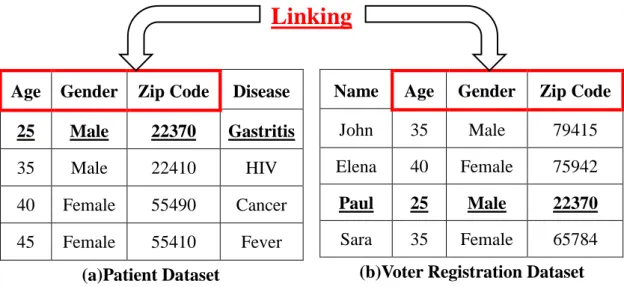
Figure 1-2: Sample of Linking Attack between the Released Dataset (a) and External Dataset (b) through shared attributes between two datasets ... 17
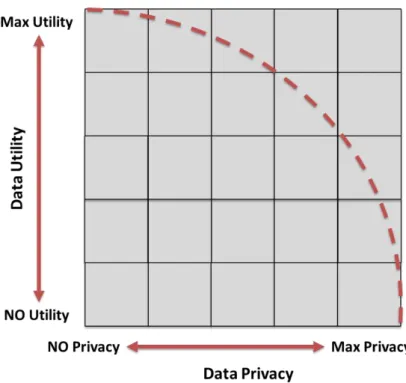
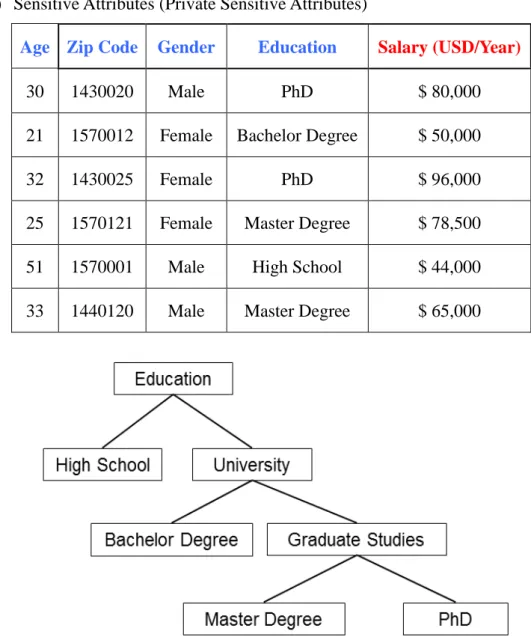
Figure 1-3: Tradeoff Relation between Data Privacy and Data Utility ... 20 Figure 2-1: Sample of a Dataset with Numerical and Categorical Attributes along with Education Attribute Hierarchical Taxonomy ... 29
Figure 2-2: Common Anonymization Techniques ... 31 Figure 2-3: Gender (Sex) Attribute Generalization Hierarchy ... 33 Figure 2-4: Generalization Hierarchies for Gender, Race, Date of Birth and Zip Code Attributes ... 39
Figure 2-5: Quasi-Identifier Attributes Generalization Hierarchy ... 44 Figure 2-6: Multi-attribute Generalization of <Date of Birth, Gender> ... 45 Figure 2-7: Spatial Representation of Age and Zip Code Attributes in Original Patient Dataset ... 47
Figure 2-8: Spatial Representation with Single and Multi-dimensional Allowable Cuts ... 48 Figure 2-9: 2-Anonymous Dataset Using Mondrian ... 49 Figure 2-10: Original Patient Dataset and its Corresponding 3-Anonymous Dataset 53 Figure 3-1:2-Dimensional Representation of Dataset Clustered with Constrain of k=3 ... 57
viii
Figure 3-2: Good versus Bad Clustering ... 60 Figure 3-3: Education Attribute and Its Generalization Tree ... 61 Figure 3-4: Categorical Attributes in Dataset T ... 63 Figure 3-5: Similarity Calculation based on Contingency Table Shown in Table 3-1 66 Figure 3-6: Pseudo code for Similarity-Based Clustering Algorithm ... 73 Figure 4-1: Frequency Distribution of Adult Dataset ... 78 Figure 4-2: Information Loss and Data Utility Comparison between Mondrian, Datafly, Incognito and SBCA on Adult Dataset ... 80
Figure 4-3: Frequency Distribution of N. Corporation ISP Dataset ... 83 Figure 4-4: Information Loss and Data Utility Comparison between Mondrian, Datafly, Incognito and SBCA on N. Corporation ISP Dataset ... 84
ix
List of Tables
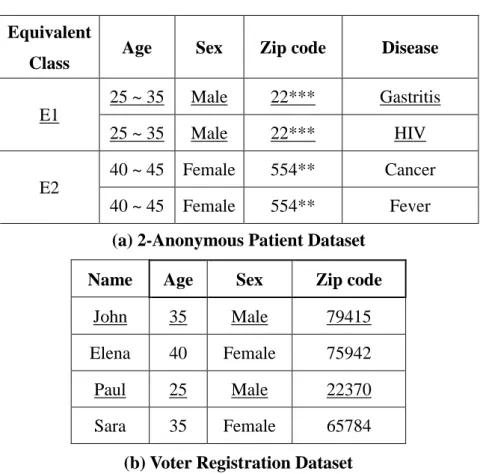
Table 1-1: The Effect of K-anonymity Model... 18
Table 2-1: Sample of Collected Microdata ... 28
Table 2-2: Original Dataset with Its 2-dimensional Representation ... 34
Table 2-3: Global Recoding Generalization of Original Dataset Shown in Table 2-2 34 Table 2-4: Multidimensional Recoding Generalization of Original Dataset Shown in Table 2-2 ... 35
Table 2-5: Local Recoding Generalization of Original Dataset Shown in Table 2-2 .. 36
Table 2-6: Original Dataset from Hospital ... 37
Table 2-7: Constructed Frequency List of Original Dataset ... 40
Table 2-8: Constructed Frequency List of Original Dataset ... 41
Table 2-9: 2-anonymous Dataset Using Datafly ... 42
Table 2-10: Original Patient Dataset ... 43
Table 2-11: 2-Anonymous Patient Dataset Using Incognito ... 46
Table 2-12: Original Patient Dataset ... 46
Table 2-13: Normalized Certainty Penalty (NCP) Calculation for Each Tuple with Respect to Each Attribute ... 54
Table 3-1: Contingency Table of Dataset T Shown in Figure 3-4 ... 64
Table 3-2: Contingency Table (1) of Dataset T and the Total Number of ... 64
Table 3-3: Contingency Table (2) of Dataset T if Total Number of Male is less then k value k = 10 ... 65
Table 3-4: Contingency Table for More than Two Categorical Attributes ... 70
Table 4-1: Anonymized-data Analysis On k = 2 In Adult and ISP Datasets ... 86
x
Table 4-2: Anonymized-data Analysis On k = 50 and 100 In Adult and ISP Datasets ... ... 87
xi
List of Equations
Equation 2-1: DM Metric Information Loss for Generalization and Suppression ... 51
Equation 2-2: ILoss Metric ... 51
Equation 2-3: Normalized Certainty Penalty Information Loss Numerical Attributes ... 51
Equation 2-4: Normalized Certainty Penalty Information Loss Categorical Attributes ... 52
Equation 2-5: Data Utility ... 54
Equation 3-1: Probability of Observation for Each Value in Attribute N ... 65
Equation 3-2: Distance between Values Numerical Attributes ... 68
Equation 3-3: Total Distance between Tuples ... 68
xii
1
Acknowledgments
I owe my deepest gratitude to my supervisor Professor Noboru Sonehara, for welcoming me in his laboratory and facilitating me with opportunity to work in a unique research and educational environment with elite researchers during my years in National Institute of Informatics (NII). I will always be grateful for all his constructive advices he taught me to continue and succeed in my research. Also I am thankful for the precious time he dedicated to me during my studies at The Graduate University for Advanced Studies (Sokendai) for discussions regarding my research future and correcting my articles to be acceptable for submissions at international conferences and journals. Professor Noboru Sonehara also introduced me to respectful researchers and business owners, with whom I had the opportunity to discuss, cooperate and work on successful projects and learn the value of research and innovation in society.
I also would like to thank all the members of my PhD committee, Professor Isao Echizen, Professor Kento Aida, Professor Shigeki Yamada at Sokendai and Professor Akihisa Kodate at Tsuda College, for their constructive comments and invaluable advice during my intermediate presentations. I am indebted to them for investing and dedicating time and effort for discussions and suggestions to guide me through my PhD.
I owe special thanks to Professor Kenzo Takahashi who has introduced me to Professor Noboru Sonehara. He has been particularly helpful and always encouraged me to continue my studies at higher level.
Moreover, I would like to thank all my lab mates for sharing their experiences and reporting their feedback on my work. Also I would like to thank all the staff in the
2
International Affairs and Education Support Team at The Graduate University for Advanced Studies (Sokendai) for their assistance, which made my life comfortable.
Last but not least, I would like to thank my family, my father Saeid, my mother Afkham and my brother Ali, who have been always supporting me emotionally and financially so I could continue and proceed with my education up to this PhD degree. Certainly none, and I mean NONE, of this work would exist without their love and support.
3
Abstract
Nowadays, in the communication, smart devices, social networks and Big Data era, privacy has become one of the main concerns of all socially active individuals. Mainly because of advanced information processing, storage capacity, data mining technologies and the necessity of information sharing in social life. There are lots of government agencies, organizations and service providers that collect and store huge amount of information containing personal information of individuals as their common procedure. The collected micro-data which is a combination of categorical and numerical attributes, contains identifying attributes (e.g., Date of Birth, Sex and Zip code) and private sensitive attributes (e.g., Salary, Credit Card Records and Disease). Sharing the collected micro- data for research and education purposes would be very helpful for researchers and data miners to investigate the correlation between different attributes and get some useful outcomes. However, individual's privacy is one of the main concerns in data publishing especially when releasing datasets involving human subjects contain private sensitive information. Even though information such as name and social security number are discarded in the shared dataset re-identification of individuals is still very much possible due to the existence of other identifying attributes. Therefore to protect the privacy of individuals, a model that is widely used for privacy preservation in publishing micro-data, k-anonymity model was proposed by Samarati and Sweeney. It suggests “For every record in a released dataset there should be at least k-1 other records identical to it along the quasi- identifier attributes”. K-anonymity from clustering aspect is defined as “clustering with constrain of minimum k tuples in each group”.
4
K-anonymity protects the privacy of individuals by modifying the values of identifying attributes through generalization and suppression. Through this modification some information loss occurs. Information loss in k-anonymity model is an unfortunate and inevitable consequence. This information loss reduces the utility of anonymized-data and makes the anonymized-data to be less accurate and accordingly less useful for further analysis. In addition, there is a trade-off relationship between the privacy and data utility. Due to this trade-off, performing anonymization with maximum privacy and attaining maximum data utility is not possible. Moreover, the problem of optimal k-anonymization and computational complexity of finding an optimal solution for the k-anonymity problem has been proven to be NP-hard. Furthermore, real world and census datasets contain both numerical and categorical type data. As a matter of fact most of the QID attributes in micro-data are assume to be categorical. The combination of numerical and categorical attributes makes anonymization process rather complicated and very often results in an inefficient anonymization with very high information loss. Most of the previous approaches and techniques to achieve k-anonymity suffer from huge information loss and very low data utility. Also most of the approaches are mainly designed for continuous numerical attributes and in case of considering categorical attributes, they depend on hierarchical taxonomies or require some additional information, which more often than not, are not defined or available in real life applications.
Therefore, in order to maximize the utility of anonymized-data in real life applications in this work a new approach is proposed. The proposed model is called Similarity-Based Clustering (SBC) Anonymization. It is based on clustering and local recoding anonymization method. SBC model concentrates on clustering the original dataset containing both numerical and categorical attributes efficiently based on given k value so after anonymization the information loss kept as minimum as possible. SBC model
5
suggests a new similarity measurement and distance calculation based on the measured similarity for categorical attributes so the total distance between tuples can be calculated for clustering. This approach does not depend on hierarchical taxonomies regarding categorical attributes. Based on the proposed model a bottom-up greedy algorithm for k- anonymization is proposed and evaluated on two different real datasets. Our extensive study on information loss and data utility show that the proposed algorithm based on SBC model in comparison with existing well-known algorithms offers data utility above 80% and reduces the information loss to less than 20% within the wide range of various k values.
Keywords: Privacy Preserving Data Mining, Anonymization, Privacy and Algorithm
6
Thesis Overview
At present, in the communication, smart devices (smartphones, tablets, Google glass), social networks and Big Data era, privacy has become one of the main concerns of all socially active individuals. Mainly because of advanced information processing, storage capacity, data mining technologies and the necessity of information sharing in social life. Also, there are lots of government agencies, organizations and service providers in real and cyber world (hospitals, universities, banks, social network and etc.) that collect and store huge amount of information containing personal information of individuals as their common procedure. The collected data at individual level is called micro-data. The attributes in micro-data, which is a combination of categorical (e.g., Gender, Nationality) and numerical (e.g., Age) attributes, can be divided into two main categories. The attributes which are used to identify an individual, called quasi-identifier (QID) attributes (e.g., Date of Birth, Sex and Zip code) and the attributes which are not normally shared with public or strangers, called private sensitive attributes (e.g., Salary, Credit Card Records and Disease). Information sharing and data publishing has a long history in information technology and due to the regulations, mutual benefits or for some other reasons such as business, marketing, research and education purposes there is always a demand for sharing the collected information among various parties. Publishing or sharing the collected micro-data for research and education purposes would be very helpful for researchers and data miners to investigate the correlation between different attributes and get some useful outcomes. For instance, the relation between a particular disease and
7
location or Sex could be very helpful to prevent and possibly find a cure for that specific disease.
However, individual's privacy is one of the main concerns in data publishing especially when releasing datasets involving human subjects contain private sensitive information such as financial information or medical history. Even though information such as name and other identifiers (such as driver license number and social security number) are discarded in the shared dataset (anonymous shared dataset) identifying information about specific individuals is still very much possible since a particular record can often be uniquely identified from the combination of other QID attributes. There are lots of data and information available on Internet, which is accessible to everyone, and the QID attributes of the released dataset could be linked with the QID attributes in the external datasets. This linking, which technically known as “linking attack”, could lead to re- identifying individuals uniquely and consequently lead to releasing the sensitive information which were not meant to be released by individuals.
Therefore given the thread of re-identification in our growing digital society, guaranteeing privacy of individuals while providing accurate and high utility data for data mining and knowledge discovery has become rather difficult issue. Therefore in order to protect the privacy of individuals, a model that is widely used for privacy preservation in publishing micro-data, k-anonymity model was proposed. Samarati and Sweeney proposed K-anonymity in 2002 which suggests “For every record in a released dataset there should be at least k-1 other records identical to it along the quasi-identifier attributes”. Generally k-anonymity can be also defined from clustering point of view. Clustering is the process of arranging similar records in groups so that the records belonging to the same cluster have high similarity, while records belonging to different clusters have high
8
dissimilarity. K-anonymity from clustering aspect is defined as “clustering with constrain of minimum k tuples in each group”.
The K value in k-anonymity model is the minimum number of data records with identical QID attributes in k-anonymous dataset. K value basically is the anonymization degree representing the level of desired privacy. Obviously by having larger k value the privacy protection is higher and having low k value (k=2) is providing minimum privacy for the dataset. K-anonymity protects the privacy of individuals by modifying the values of QID attributes through generalization and suppression so that each record in the released dataset is indistinguishable from at least k-1 other records within the same dataset. Therefore the linking confidence between the k-anonymous released dataset and the external dataset will reduce by 1/k ratio. Thus it can be concluded that the privacy of individuals is protected to some extent.
By modifying QID attributes using generalizing or suppression in original dataset to form k-anonymous dataset some information loss occurs. Information loss in k-anonymity model is an unfortunate and inevitable consequence. This information loss reduces the utility of anonymized-data and makes the anonymized-data to be less accurate and accordingly less useful for data mining, knowledge discovery and research purposes.
In addition, there is a trade-off relationship between the privacy level and the quality of anonymized-data. Choosing larger k value means providing higher privacy and consequently obtaining less utility k-anonymous dataset. Due to this trade-off, performing anonymization with maximum privacy and attaining maximum utility for anonymized- data is not possible. Moreover the problem of optimal k-anonymization and computational complexity of finding an optimal solution for the k-anonymity problem has been proven to be NP-hard.
9
Furthermore, real world and census datasets contain both numerical and categorical type data. As a matter of fact most of the QID attributes in micro-data are assume to be categorical with no hierarchical taxonomies. The combination of numerical and categorical attributes makes anonymization process rather complicated and very often results in an inefficient anonymization with very high information loss. Most of the previous approaches and techniques to achieve k-anonymity suffer from huge information loss and very low data utility (anonymized-data). Also most of the approaches are mainly designed for continuous numerical attributes and in case of considering categorical attributes, they depend on hierarchical taxonomies or require some additional information, which more often than not, are not defined or available in real life applications.
Therefore, in order to maximize the utility of anonymized-data in real life applications (datasets containing both numerical and categorical attributes with NO hierarchical taxonomies), in this work a new approach is proposed. The proposed model is called Similarity-Based Clustering (SBC) Anonymization. It is based on clustering and local recoding anonymization method. As it was mentioned earlier k-anonymity is actually clustering with constrain of minimum k tuples in each group, thus SBC model concentrates on clustering the original dataset containing both numerical and categorical attributes efficiently based on given k value so after anonymization the information loss kept as minimum as possible. The key point to reduce the information loss is to retain the records in a cluster (equivalent class) as similar to each other as possible. Therefore when all the records in the same cluster are modified through anonymization process to have identical QID values, the anonymized-data will be less distorted. However, clustering the datasets containing both numerical and categorical attributes is quite challenging mainly due to the presence of categorical attributes. Therefore in SBC model a new similarity measurement function and distance calculation based on the measured similarity for categorical
10
attributes is introduced so the total distance between tuples (data records) with numerical and categorical attributes can be calculated for clustering. This approach does not depend on hierarchical taxonomies regarding categorical attributes. Based on the proposed model a bottom-up greedy algorithm for k-anonymization is suggested. In order to evaluate our Similarity-Based Clustering model the proposed algorithm is simulated on two different real datasets with around 5000 data records of individuals (Adult dataset and N. Corporation ISP Dataset). Our extensive study on information loss and data utility show that the proposed algorithm based on SBC model in comparison with existing well-known algorithms offers much higher data utility and reduces the information loss significantly within the wide range of various k values.
11
1. Chapter 1: Introduction
1.1. Summary of Chapter
In this chapter an introduction of main topics which are going to be discussed in this work has been given. Regarding privacy of individuals, Act on Protection of Personal Information (APPI) is introduced. The privacy issues and concerns in data mining applications, data publishing and data sharing are explained and elaborated in details.
Privacy Preserving Data Mining (PPDM) concept is introduced. In addition the relevant reasons of why such a concept is necessary is explained as well. K-anonymity model as a general solution to protect privacy of individuals is introduced and the current challenges in this model is indicated and elaborated.
Finally the motivation and objectives on this work is stated and explained in details. The organization of this thesis is also explained briefly at the end of this chapter.
1.2. Introduction to Data Mining and Privacy Issues
Data mining is relatively new and interdisciplinary field of computer science and it is regarded as the process of discovering new and insightful patterns from large datasets [1] [2] [52] . In recent years by growing the amount of data in databases, cyber world (e.g., social network, online shopping, online banking and advertising) data mining has become a significant technology for getting and extracting useful and handy information from huge quantities of data [1] [2] [5] [52] .
12
Although data mining is still at the early stage of growth and development, it has been using in various fields such as science, engineering, education, healthcare [53] , medicine, genetics, bioinformatics and business [1] [5] [52] .
Even though the goal of most data mining approaches is to develop generalized knowledge rather than identify information about specific individuals, but the existence of comprehensive and accurate datasets brings up privacy issues regardless of their intended use. An example of such datasets and privacy issues will be discussed later in this chapter.
Nowadays in our digitalized social life, individuals leave lots of electronical trails through their daily activities such as using electronic cards to use public transportation, credit cards for shopping and booking hotels, using different applications and services on their smart devices or even emails for communication [5] .
Based on Act on Protection of Personal Information (APPI) Personal information should be collected with the consent and permission of the individuals who actually are providing the information and they are in fact the data subjects [54] . The data collectors (e.g., credit card companies, hospitals and service providers) should provide some assurance that the individual privacy will be protected based on Act on Protection of Personal Information (APPI).
However, in real life the data collectors use the collected data for some secondary purposes which means using the collected data in any other ways or for any other purposes that the data were collected initially. Moreover it is also very common practice that data collectors sell the collected data to other organizations and entities which utilize the purchased data for their own purposes. These kind of personal information utilizations increases the privacy concerns of individuals [5] .
Therefore it can be concluded that data mining and data privacy are in disagreement with each other and in fact by having more accurate and complete data the data mining
13
results will become better [45] . In order to exercise data mining while protecting the privacy of individuals, Privacy-Preserving Data Mining (PPDM) was proposed [1] [5] [31] [32] [41] [42] [43] .
1.3. Privacy Preserving Data Mining (PPDM)
It has been proven that data mining is so crucial and beneficial for organizations, yet high public concerns regarding individual privacy has actually made the implementation of privacy preserving data mining techniques to become a demand at the moment. A privacy preserving data mining provides individual privacy while allowing extraction of useful knowledge from data. In another word, privacy preserving data mining techniques allow researcher and data miner to extract the useful information while protecting the privacy of individuals [5] [31] [32] [41] [42] .
There are various different methods, techniques and models that is employed to enable privacy preserving data mining. One particular way of such techniques modifies the collected dataset before it is released to protect individual records from being re-identified. When a dataset has been modified and then released an intruder or third party user cannot be very sure and certain about the correctness of re-identification even by having additional knowledge. This way of privacy preserving data mining techniques relies on the fact that the datasets which are used for data mining purposes do not necessarily need to contain 100% accurate data. In the context of data mining it is very important to maintain the patterns in the dataset. Additionally, maintenance of statistical parameters such as means, variances and covariance of attributes is important in the context of statistical databases [1-7].
There are two main factors that a useful privacy preserving technique requires to satisfy, one is high data quality and the other one is high privacy and security. Therefore, we need to evaluate the data quality and the degree of privacy of a modified dataset. The
14
information loss or data quality of a modified dataset can be evaluated through a few quality indicators such as extent to which the original patterns are preserved, and maintenance of statistical parameters. There is no single agreed upon definition of privacy. Therefore, measuring privacy and security is a challenging task [1-7].
1.4. Motivation
As it was mentioned earlier nowadays data mining is widely used in most of organizations and they are extremely dependent on data mining in their daily routine activities. During the whole process of data mining, from collection of data to discovery of knowledge, these data, which usually contain private sensitive individual information, such as medical background and detailed financial information, often shared and get exposed to several parties including data collectors, data owners, data users and finally researcher and data miners. Disclosure of such sensitive information among various parties raises privacy concerns and also can cause a breach of individual privacy [1-7]. For instance, the detailed credit card record of an individual can expose the private life style with sufficient precision. Private sensitive information can also be disclosed by linking multiple databases and accessing web log data. A malicious data miner can learn sensitive attribute values such as income and disease type of a certain individual, through re- identification of the record from an exposed dataset [1-7].
Simply removing the names and other identifiers (such as social security number, driver license number and passport number) does not guarantee the confidentiality of individual records. Because of particular individual record can often be uniquely identified from the combination of other attributes in datasets [3] .
An example on combination of attributes, which are shared between two different datasets, is shown in Figure 1-1. In Medical dataset there are plenty of sensitive information about individuals from the date and time of doctor visits to medication, disease
15
and insurance coverage data. On the other hand in voter list dataset there are information about the political party, name and address.
Figure 1-1: Common Attributes between Medical Dataset and Voter Registration List Linking Datasets to Re-Identify [3]
These two datasets are linked together using three attributes, which are in common between them. Attributes are {Gender, Date of Birth and Zip Code}. Therefore it is not really difficult for a malicious data miner or an intruder to re-identify a record from a dataset if sufficient additional knowledge about an individual is provided [3] [4] [5] [6] .
1.5. Privacy Concerns in Data Publishing
In real world, there are lots of government agencies and organizations such as hospitals that collect and store huge amount of information containing personal information of individuals. The individual level collected data, which is called micro-data, contains quasi- identifier attributes and private sensitive attributes. Quasi-identifier attributes such as Age, Zip code and Gender are type of attributes, which are used to identify an individual. On the other hand private sensitive attributes, for example Disease name, are type of attributes, which are not shared with public or strangers by individuals. Information sharing and data publishing has a long history in information technology and due to the regulations, mutual
16
benefits or for some other reasons such as research and education purposes there is a demand for sharing the collected information among various parties [35] [48] [49] [50] . Publishing or sharing the collected micro-data by the hospital for research and education purposes would be very helpful and interesting for researchers and data miners to investigate the correlation between different attributes such as the relation between a certain disease and gender, the relation between the area of living and certain type of disease and so on. However, publishing the collected data containing private sensitive information would bring up some privacy concerns. Even though the identifying information such as name and social security number (ID number) are discarded before releasing the data, disclosing the private sensitive information of individuals and re- identifying them uniquely is still very much possible due to the existence of quasi- identifier attributes in the released dataset [3] [30] [48] [49] [50] .
Based on the previous research and study on US population in [4] , disclosing one’s gender, Zip code and full date of birth allows for unique identification of 63% of the US population. This study clearly shows the high possibility of re-identification, the importance of quasi-identifier attributes in data sharing and eventually the main reason of privacy concerns in data publishing.
The common quasi-identifier attributes between the released dataset and other existing datasets like Voter Registration dataset, which are accessible to everyone through Internet, can be used to establish a link by matching records from the released dataset to other records in the Voter Registration dataset, which have the same values. This established link between these two datasets could result in identifying the individuals uniquely and disclosure of their private sensitive information. Technically this is known as “linking attack” [3] [33] [48] [49] [50] .
17
Linking
(a)Patient Dataset
Age Gender Zip Code Disease 25 Male 22370 Gastritis
35 Male 22410 HIV
40 Female 55490 Cancer
45 Female 55410 Fever
(b)Voter Registration Dataset Name Age Gender Zip Code
John 35 Male 79415
Elena 40 Female 75942
Paul 25 Male 22370
Sara 35 Female 65784
Figure 1-2: Sample of Linking Attack between the Released Dataset (a) and External Dataset (b) through shared attributes between two datasets
A sample of linking attack between the Patient Dataset released by a hospital and Voter Registration Dataset as an external dataset is shown in Figure 1-2. In this linking attack, the privacy of Paul is violated because his disease is disclosed and we know Paul has Gastritis [48] [49] [50] .
1.6. K-anonymity Model as The General Solution
In order to protect the privacy of individuals against the possible re-identification through linking attacks explained in previous section, k-anonymity model was proposed by Samarati and Sweeney as an approach towards privacy preserving data mining [1] [4] [6] . K-anonymity definition stated as follows:
K-anonymity suggests “For every record in a released dataset there should be at least k-1 other records identical to it along the quasi-identifier attributes”.
K-anonymity model is widely used for privacy preservation in data publishing and information sharing. A method of k-anonymization suggests to modify the values of quasi- identifier attributes through generalization so that each record in the dataset is indistinguishable from at least k-1 other records within the same dataset [34] [68] .
18
By applying this method on the released dataset, the linking confidence between the released dataset and the external dataset will reduce by ⁄ ratio, which means the � privacy of individuals is protected to some extent. Clearly by having larger k value the privacy protection is higher. The effect of applying k-anonymity model on the Patient dataset in Figure 1-2 is illustrated in Table 1-1.
Table 1-1: The Effect of K-anonymity Model Equivalent
Class Age Sex Zip code Disease
E1
25 ~ 35 Male 22*** Gastritis
25 ~ 35 Male 22*** HIV
E2
40 ~ 45 Female 554** Cancer
40 ~ 45 Female 554** Fever
(a) 2-Anonymous Patient Dataset
Name Age Sex Zip code
John 35 Male 79415
Elena 40 Female 75942
Paul 25 Male 22370
Sara 35 Female 65784
(b) Voter Registration Dataset
As it is shown in Table 1-1, having the Patient Dataset anonymized with privacy degree of k=2, the linking confidence between 2-Anonymous Patient Dataset and Voter Registration Dataset is reduced by the ration of ⁄ . Therefore the exact identification of Paul as an individual and his specific disease is not simply possible. It can be concluded that the linking confidence is reduced the ration of ⁄ and the privacy of individuals is somewhat protected. At the same time it is realized that the values are distorted and the
19
anonymized data is less accurate than original dataset. This matter, data privacy and data utility is discussed in the next subsection [48] [49] [50] .
1.7. Data Privacy and Data Utility Basic Definition
In anonymization there are two terms, which will be used a lot in this thesis, the first one is data privacy. Privacy itself is very difficult to be defined, as privacy meaning is actually different from person to person. The second term is data utility, which actually defines the usefulness of data and its originality. Considering the Patient Dataset in the previous section it can be said that the original dataset has 100% utility and 0% privacy. On the other hand 2-anonymous dataset has privacy to some extent (more than 0%) but the utility of dataset decreased due to the anonymization (less than 100%) [44] .
Considering the original dataset T which contains the information on each individual in n attributes {A1... An} the main terminologies are defined as below.
Quasi-Identifier attributes: set of attributes in dataset T that can potentially join with external datasets to reveal private information of individuals. For example Age, Gender and Zip Code attributes in Figure 1-2 are quasi- identifiers, which can establish a link between Patient dataset and Voter Registration dataset.
Equivalent class: An equivalent class E of dataset T is a set of all tuples in T containing identical values with respect to QID attributes. For instant T1 (tuple 1) and T2 (tuple 2) in Table 1-1 form an equivalent class (E1) with respect to attributes Age, Gender and Zip Code.
K-anonymity: A dataset T is said to be k- anonymous with respect to the QID attributes if the size of every equivalent class is greater or equal to pre-defined k value.
1.8. Challenges in K-anonymity Model
There are several different methods for anonymizing a dataset which will be mentioned in chapter two. However regarding k-anonymity model there are two main methods which
20
are very well used, Generalization and Suppression on quasi-identifier attributes (QIDs) [1] [3] [6] .
Generally K-anonymity is achieved through 1) Generalization and 2) Suppression methods. The generalization method itself can be further subcategorized as follows.
1. Global Recoding 2. Local Recoding
The Generalization method essentially is modifying the value of the data record into more generalized form and suppression is basically removing the data record from the published dataset [1] [3] [6] [16] [17] [22] .
By generalizing the original data record to the generalized form in k-anonymous dataset or suppressing the original data record, some information loss occurs. Information loss in k-anonymity model is an unfortunate and inevitable consequence. This information loss reduces the utility of anonymized-data and makes the anonymized-data to be less accurate and accordingly less useful for data mining and research purposes.
Figure 1-3: Tradeoff Relation between Data Privacy and Data Utility
21
Therefore one of the main challenges in k-anonymization is to minimize the information loss while the privacy of individuals is protected, so high utility anonymized- data can be obtained.
Privacy protection level in k-anonymity could be measured by “k” value. As it was mentioned in section 1.6, minimum value for “k” value is k=2. If k=1 it means the dataset is original dataset and it is not anonymized. Regarding maximum “k” value, it depends on number of records in dataset. If k is equal to number of records in dataset (k >= n/2 and k
<= n) that means there is only one group and all values across all quasi-identifiers are identical to each other. The data publisher usually chooses the anonymization degree or the k value in k-anonymity model based on the desired level of privacy.
In addition, as shown in Figure 1-3, there is a tradeoff relationship between the privacy level and the quality of anonymized-data and due to this tradeoff, performing anonymization with maximum privacy and attaining maximum utility for anonymized- data is not possible [55] .
Furthermore on challenges in k-anonymization, real world and census datasets contain both numerical and categorical type data. As a matter of fact according to Leon Willenborg and Ton de Waal, one of the author of Elements of Statistical Disclosure Control, most of the quasi-identifier attributes in micro-data are assumed to be categorical (nominal) [23] , which by itself does not have hierarchical taxonomy or generalization hierarchy. Therefore it can be concluded that categorical attributes play a very important role in actual real life datasets.
The combination of numerical and categorical attributes in dataset makes anonymization process rather complicated and very often results in an inefficient anonymization with very high information loss and low data utility. Most of the previous approaches and techniques to achieve k-anonymity, which will be reviewed carefully in
22
the next chapter, suffer from huge information loss and very low data utility (quality of anonymized-data). Also most of the approaches are mainly designed for continuous numerical attributes and in case of considering categorical attributes, they depend on hierarchical taxonomies or require some additional information, which are mostly not defined or available in real life applications [20] [48] [49] [50] .
Moreover, the optimal anonymization and optimal selection of k value is shown to be NP hard problem [7] [8] [9] . Therefore, one of the possible approaches to solve high information loss problem in k-anonymization could be through heuristic algorithms [10] [11] [12] [71] .
1.9. Main Objectives
In the previous sections the importance of privacy protection of individuals in data publishing and information sharing was pointed out. Also privacy concerns due to the linking attack were explained and elaborated with an example. In order to protect the privacy of individual a model, which is widely used and called k-anonymity, was introduced. Furthermore the challenges in k-anonymity model were elaborated from our point of view.
Therefore, the main objectives of this research can be summarized and stated as here under:
I. To study and understand the concept of Privacy Preserving Data Mining (PPDM) and k-anonymity model as the widely used model for privacy preservation in data publishing and information sharing.
II. To investigate and study the current challenges in k-anonymization and possible solution methods.
III. To propose and define clustering approach in k-anonymity model.
23
IV. To propose a new model based on clustering which implements k- anonymity and at the same time minimizes the information loss and maximizes the utility of anonymized data.
V. To evaluate the proposed model using real dataset in practice.
1.10. Contributions
In this work the privacy issues in data publishing and information sharing is studied. K- anonymity model as a general solution to overcome the privacy violation of individuals issue in data publishing and data sharing is introduced. Particularly the current challenges in k-anonymization were identified and studied in depth are stated as follows.
1) Huge information loss issue in k-anonymization due to generalization and suppression as an unfortunate and inevitable consequence
2) Tradeoff relationship between data privacy and data utility
3) Real life datasets most likely consist of a combination of numerical and categorical attributes.
Some of the main information quality metrics in this field are studied. Most importantly, main previous works and existing well-known models and algorithms, which are implementing k-anonymization, are reviewed in detail.
By considering the drawbacks of the previous works and current challenges in k- anonymity model, a new model, which is based on clustering, to achieve k-anonymity with high data utility is proposed. In the proposed model k-anonymity is defined and viewed from clustering point of view. Since datasets containing numerical and categorical attributes is the core and heart of this work attention, a new similarity and distance measurement between the variables in categorical attributes for clustering purposes, which will be employed in anonymization, is introduced.
24
Also a bottom-up greedy algorithm is introduced based on the proposed clustering model and finally the proposed model and algorithm is evaluated regarding the information loss and data utility. The results are compared with other existing well-known algorithms which proves the proposed model increases the utility of anonymized data and reduces the information loss.
1.11. Organization of Thesis
This thesis consists of 8 chapters in total. In chapter 1 of this thesis, data mining and its relation to privacy of individuals is explained. The benefits of data mining and the privacy concerns which data mining and data sharing can cause is elaborated and explained in details. Privacy preserving data mining and its benefits are introduced. Also the technical term “Linking Attack” is introduced and explained with an example which shows exactly how one’s privacy could get violated. K-anonymity model as a general solution and its effect is introduced. Moreover the current challenges in k-anonymization are explained. Also motivation, objectives and contributions of this work are clearly stated in this chapter. Chapter 2 of this thesis is more focused on related works and background study. In this chapter, we have defined the terms related to anonymization. Different data and attribute types are explained. As a background study, various anonymization and disclosure protection techniques are mentioned. K-anonymity model and related techniques are fully explained and elaborated. We have also reviewed Mondrian, Datafly and Incognito, which are the main models implementing k-anonymity, and explained them in details with example. Their drawbacks are also mentioned in this chapter. At the end some of the data quality metrics and information loss measurements are introduced. In this work for measuring information loss Normalized Certainty Penalty (NCP) methods has been chosen.
In chapter 3, we introduce our model, which is called Similarity-Based Clustering model. The basics of clustering, clustering in k-anonymization and how it is employed in
25
anonymization to reduce information loss and increase data utility is explained. The proposed model clusters the dataset based on measured similarity over all quasi identifier attributes. The similarity is measured based on calculated distances over categorical and numerical attributes. Particularly distances over categorical attributes is defined based on the context and observation probability of values in each categorical attribute. Based on the Similarity-Based Clustering model a bottom-up heuristic algorithm is presented.
Chapter 4 is dedicated to empirical evaluation and results. The proposed model which was explained in chapter 3 is simulated on two different real datasets. The proposed model and other well-known algorithms were compared to each other with respect to information loss and data utility.
Finally in chapter 5 this work is concluded and the future works is discussed. Chapter 6 is on main publications of the author and chapters 7 and 8 are appendix and reference materials which have been used to write this thesis.
26
2. Chapter 2: Background Study and Related
Works
2.1. Summary of Chapter
This chapter is dedicated to literature review and background study. At first an introduction is given regarding different types of data and its classifications. Particularly the difference between numerical and categorical attributes is elaborated.
Attributes classification from anonymization point of view is also explained with an example. It is stated that from this point of view the attributes are mainly categorized in 2 groups. First category is called identifying attributes and second type is private sensitive attributes.
Moreover, different anonymization techniques are explained. Then k-anonymity model and its implementation through generalization and suppression is explained. After the fundamental definitions, very well-known algorithms which implement k-anonymity model are explained with examples and results are analyzed. The drawbacks on each model is also discussed briefly in this section.
Finally, the main two terms, data utility and information loss in k-anonymity model is discussed. Data utility and basically calculation and measurement of information loss and the quality of anonymization in addition to data utility after anonymization is very crucial. Different calculation and measurement methods are explained in the last section. At the end, the information loss measurement and data utility which is used in this work is explained in details with an example.
27
2.2. Data Types and Classification
Typically variables and attributes in real datasets contain different type of data. In this section an overview of various attributes and data types is presented. Two of the most common type of data can be classified as follows [23] [52] .
1) Numerical data (continuous) 2) Categorical data (nominal)
Boolean data are a special case of categorical data, which can take only two possible values, 0 or 1 (true or false). Gender attribute could be a very good example of Boolean data type. Because an individual can be either “Male” or “Female”.
Numerical data are formed by continuous digits, which basically means numbers represents them and different kind of math and calculations can be performed on them. For example the Age attribute is a numerical variable that takes numbers. Income, Profit and Turnover are other example of numeric attributes [23] [52] .
However categorical values lack natural ordering in them. For example, an attribute
“Education” can have values such as “High School”, “Bachelor Degree”, “Master Degree”, and “PhD Degree”. There is no straightforward way of ordering these values. In addition mathematical operation could not be performed on this type of attributes.
The collected data at individual level is called microdata. Microdata is a series of data records in which each data record containing information on an individual [23] [52] . Microdata also can be defined as individual level data which consists of a series of records and each record contains information on an individual as a person, or a firm or an institution. Microdata in their simplest form maybe represented as a single data matrix where the rows correspond to the units and the columns to the variables and attributes. An example of individual level data, microdata, is shown in Table 2-1 as follows.
28
Real datasets are combination of numerical and categorical attributes. At the same time, the datasets are not perfect. Meaning that there could be unknown values for different attributes. For instance in the data shown in Table 2-1 the sex of the individual with ID number “322” is not known. Same applies for Marital Status for ID number “324”.
Table 2-1: Sample of Collected Microdata
ID Age Sex Marital Status Education Income
321 45 Male Married Bachelor Degree 100,000
322 65 -?- Divorced Bachelor Degree 65,000
323 57 Female Married Master Degree 50,000
324 41 Male -?- Master Degree 120,000
325 34 Male Not Married PhD Degree 100,000
The fundamental difference between categorical and numerical attributes forces the privacy protection techniques to take different approaches. This topic will be discussed deeper in chapter 3 when the proposed model is presented.
In categorical attributes, sometimes it is possible to define a tree-like structure that defines the relation between various values in that categorical attributes. The tree-like structure is called hierarchical structure. The importance of such structure is when applying anonymization. It is also important to note that the hierarchical structure for categorical attributes do not always exist. More often than not the hierarchical taxonomies are not defined for all categorical attributes in a dataset [23] .
A sample of the dataset including categorical and numerical attributes along with a sample of hierarchical taxonomy of categorical attribute (e.g., Education) is shown in the Figure 2-1.
29
As it was briefly explained in the first chapter, looking at attribute and variable types from another aspect, which is privacy and disclosure risk perspective, the attributes could be divided into two types as follows.
1) Identifying Attributes (Quasi-identifier Attributes) 2) Sensitive Attributes (Private Sensitive Attributes)
Age Zip Code Gender Education Salary (USD/Year)
30 1430020 Male PhD $ 80,000
21 1570012 Female Bachelor Degree $ 50,000
32 1430025 Female PhD $ 96,000
25 1570121 Female Master Degree $ 78,500
51 1570001 Male High School $ 44,000
33 1440120 Male Master Degree $ 65,000
Figure 2-1: Sample of a Dataset with Numerical and Categorical Attributes along with Education Attribute Hierarchical Taxonomy
First type of attributes is called identifying attributes. This type of variables are used to identify an individual (quasi-identifier attributes). For instance Gender, Date of Birth, Zip Code, address and Phone Number which are very common attributes and probably in any
30
registration form for a survey or service subscription this information are necessary and required.
The second type of attributes is called sensitive attributes. The private sensitive attributes are type of information such as personal income, credit card history or medical background and disease which are not usually shared with public or strangers. Obviously there can be some situations, which are exception, such as when a disaster strikes or when ones disease is very rare therefore the information are shared with various parties for further investigation or assistance.
In anonymization models, having a combination of numerical and categorical attributes in the real datasets bring up some difficulties in order to have an efficient anonymization process. Mainly because the numerical data are the type of data that the arithmetic operations are defined for them however regarding the categorical attributes the arithmetic operations are not defined and they are not applicable in the same way.
In fact most of the identifying data and microdata are assumed to be categorical. Therefore as the datasets in real life are consist of both types of data then having a model which can operate efficiently for both types of data is necessary and going to be very useful in real life applications [23] .
2.3. Common Anonymization Techniques
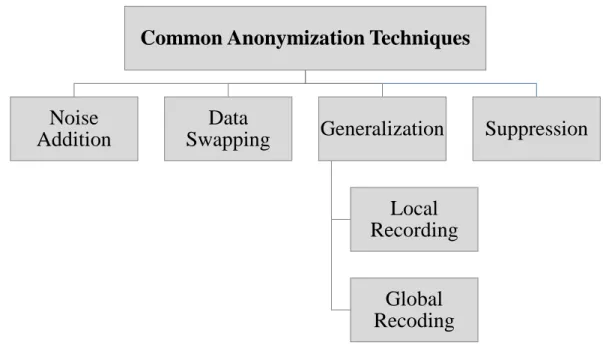
Generally in anonymization in order to protect privacy of individuals in microdata there are several methods which all anonymize the data though data modification [43] [23] . Privacy preserving techniques can be classified based on the protection methods used by them. The classification is shown in Figure 2-2 and explained briefly with an example in this section. Noise addition usually adds a random number (random number and noise are same) to numerical attributes. This random number is generally drawn from a normal distribution with zero mean and a small standard deviation. Noise is added in a controlled
31
way so as to maintain means, variances and co-variances of the attributes of a data set. However, noise addition to categorical attributes is not as straightforward as the noise addition to numerical attributes, due to the absence of natural ordering in categorical values [5] [23] [56] [57] [58] .
Figure 2-2: Common Anonymization Techniques
Data swapping interchanges the attribute values among different records. Similar attribute values are interchanged with higher probability. All original values are kept within the dataset and just the positions are swapped. Data swapping is often explained as a special case of noise addition. The reason is because swapping two numerical values can be seen as the addition of a number (the difference between the values) to the smaller value, and subtraction of the same number from the larger value. Therefore, data swapping results in the addition of noise having zero mean. Similar explanation can be given for swapping categorical values [5] [23] [56] [57] [58] .
Generalization refers to both combining a few attribute values into one, or grouping a few records together and replacing them with a group representative for numerical and categorical attributes. Regarding categorical attributes depending on the generalization
Common Anonymization Techniques
Noise
Addition
Data
Swapping Generalization
Local
Recording
Global
Recoding
Suppression
32
type, which will be explained in details in later section, generalization hierarchy is necessary (e.g., generalization hierarchy for Education attribute shown in Figure 2-1) [22] [23] [48] [49] [50] [66] .
Finally, Suppression means replacing an attribute value in one or more records by a missing value. Many such techniques for different scenarios have already been proposed [1] [3] [4] . It is unlikely to have a single privacy preserving technique that outperforms all other existing techniques in all aspects. Each technique has its strength and weakness. Hence, a comprehensive evaluation of a privacy preserving technique is crucial. It is important to determine the evaluation criteria and related benchmarks.
2.4. K-anonymity Model through Generalization and
Suppression
K-anonymity model was defined in Chapter 1 and explained briefly. In this section the details on k-anonymity model will be elaborated. Specifically the type of anonymization methods, which are utilized in k-anonymity model, will be explained in details with the help of some examples.
Technically from our point of view the operation in k-anonymity model can be divided into two different steps. The first operation is to cluster the data records into groups with a minimum group size of k. This will be explained more in details in the third chapter when k-anonymity is defined from clustering point of view. Afterwards, the second operation is the process of anonymization using anonymization methods mentioned earlier and shown in Figure 2-2.
The two main methods which are utilized in k-anonymity to anonymize the quasi- identifier attributes are as follows [1] [3] [43] .
1) Generalization 2) Suppression
33
Both methods are technically recoding the values of quasi-identifier attributes in original dataset. Suppression can be defined as specific type of recoding in which the values of data record in original dataset is recoded to null values [3] [4] [16] [17] .
In generalization the original values of quasi-identifier attributes are replaced by intervals for numerical attributes. Regarding categorical attributes if generalization hierarchy (taxonomy tree) is provided the original values are replaced by the more general value according to the provided generalization taxonomy. If generalization taxonomies for categorical attributes are not defined the original values are replaced by set of distinct values.
For instance in attribute {Age}, the value 23 could be replaced by [20~25] and for attribute {Gender} with its corresponding generalization hierarchy shown in Figure 2-3, [“Male”] could be replaced by [“Person”].
Figure 2-3: Gender (Sex) Attribute Generalization Hierarchy
The generalization method in anonymization can be further divided into three different types as follows.
1) Global recoding generalization
2) Multidimensional recoding generalization 3) Local recoding generalization
The differences between these three types will be explained using proper examples. In global recoding generalization, the dataset is generalized at the domain level. There are
Person
Male Female
Gen eraliza tio n
34
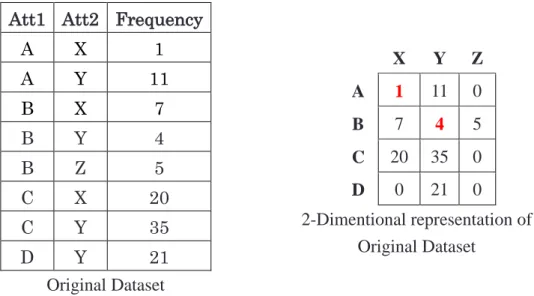
many works, which are based on global recoding generalization such as [3] [13] [14] [17] [19] [35] . In global recoding generalization if a lower level domain needs to be generalized to the higher domain, all the values in the lower level domain are generalized to the higher domain. An example of original dataset with the total of 104 data records with 2 attributes (Att1 and Att2) and its 2-dimentional representation is shown in Table 2-2.
Table 2-2: Original Dataset with Its 2-dimensional Representation Att1 Att2 Frequency
A X 1
A Y 11
B X 7
B Y 4
B Z 5
C X 20
C Y 35
D Y 21
Original Dataset
X Y Z A 1 11 0
B 7 4 5
C 20 35 0
D 0 21 0 2-Dimentional representation of
Original Dataset
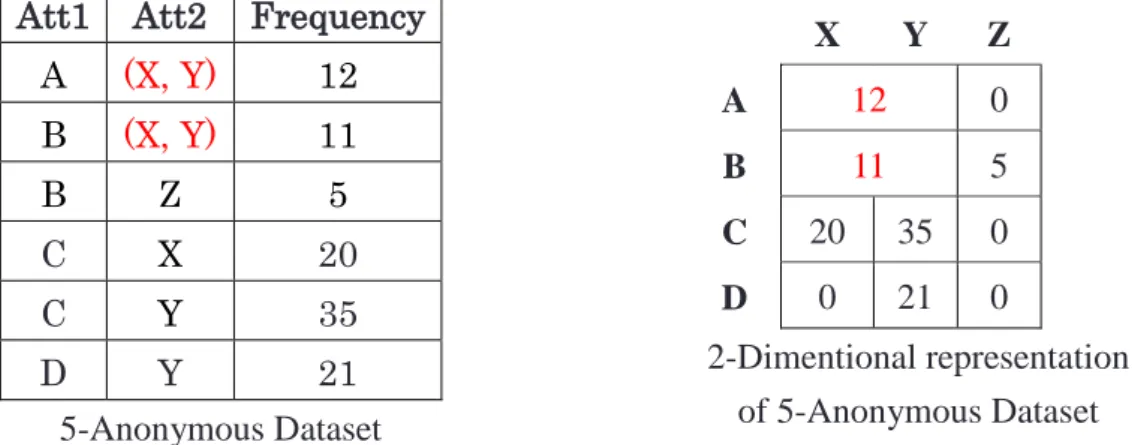
If the dataset which is shown in Table 2-2 is anonymized through global recoding with k=5 as the k-anonymity condition, all the data records with value “X” and value “Y” will be replaced by a generalized value as “(X, Y)”. Because k value condition is k=5 and data records with values (A, X) and (B, Y) do not satisfy the k value condition. The result of anonymization through global recoding is illustrated in Table 2-3.
Table 2-3: Global Recoding Generalization of Original Dataset Shown in Table 2-2 Att1 Att2 Frequency
A (X, Y) 12
B (X, Y) 11
B Z 5
C (X, Y) 55
D (X, Y) 21
5-Anonymous Dataset
(X, Y) Z A 12 0
B 11 5
C 55 0
D 21 0
2-Dimentional representation of 5-Anonymous Dataset
35
This particular effect is called over generalization, which will cause more information loss and reduces the anonymized data utility. Over generalization will be investigated in chapter 4 where the proposed model is discussed and compared with other well-known models which implement k-anonymity.
One of the global generalization methods is Incognito [15] . Incognito produces minimal full domain generalizations with an optional tuple suppression threshold. This model will be reviewed with an example in the next session.
In multidimensional and local recoding generalization, the generalization is taking place at cell levels [8] [9] [11] [12] . They do not cause overgeneralization or reduce the effect of over generalization, which lead to more flexible generalization and have the potential of less information loss.
Table 2-4: Multidimensional Recoding Generalization of Original Dataset Shown in Table 2-2
As it is shown in Table 2-4 the unnecessary generalization regarding data records with value of (C, X) or (D, Y) is not taking place in multidimensional generalization as both Att1 and Att2 dimensions are considered for anonymization. One of the best performing algorithms is Mondrian heuristic algorithm [18] . It studies the single dimension partitioning and suggests an efficient partitioning method for multidimensional recoding anonymization. Mondrian algorithm and its model on multidimensional generalization will be explained in detailed in the next section.
Att1 Att2 Frequency
A (X, Y) 12
B (X, Y) 11
B Z 5
C X 20
C Y 35
D Y 21
5-Anonymous Dataset
X Y Z A 12 0
B 11 5
C 20 35 0
D 0 21 0
2-Dimentional representation of 5-Anonymous Dataset
36
Table 2-5: Local Recoding Generalization of Original Dataset Shown in Table 2-2
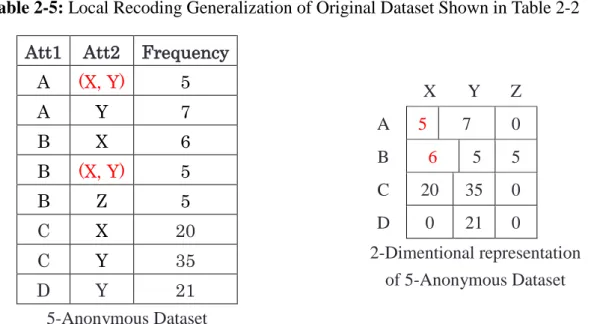
Eventually, Table 2-5 is representing the generalization through Local recoding generalization. As it is shown only the necessary data records, which do not satisfy the k value condition, will be generalized. In local recoding generalization, attributes are generalized at the cell level. Therefore over generalization does not take place. In local recoding the numerical attributes are generalized into intervals from minimum to maximum (e.g., [20~25]) and categorical attributes are generalized into set of distinct values (e.g., {Malaysia, Japan, China}) or in case generalization hierarchy is defined a single value that represents such a set (e.g., Asia).
The work “Utility-Based Anonymization Using Local Recoding” [20] is based on utility anonymization through local recoding. It introduces the new quality metric for both numerical and categorical attributes. However regarding the categorical data it assumes that the hierarchical structure for each categorical attribute is defined and provided. In most of the real life applications the hierarchical structures often do not exist which makes this approach not so practical.
In our proposed model we consider local recoding generalization, as it is more flexible and efficient with the possibility of lower information loss.
2.5. Related Works
Att1 Att2 Frequency
A (X, Y) 5
A Y 7
B X 6
B (X, Y) 5
B Z 5
C X 20
C Y 35
D Y 21
5-Anonymous Dataset
X Y Z
A 5 7 0
B 6 5 5
C 20 35 0
D 0 21 0
2-Dimentional representation of 5-Anonymous Dataset