Ogata, H. et al. (Eds.) (2015). Proceedings of the 23rd International Conference on Computers in Education. China: Asia-Pacific Society for Computers in Education
A Proposal of e-Book Based
Seamless Learning System
Mahiro Kiyotaa, Kousuke Mourib & Hiroaki Ogatac
a,b,c Faculty of Arts and Science and the Graduate School of Information Science and Electrical Engineering, University of Kyushu, Japan
*{mkiyota.kyushuuniv, mourikousuke, hiroaki.ogata}@gmail.com
Abstract: Seamless learning is an approach in which learners can create relationships between their formal and informal learning. To support seamless learning, some seamless learning systems have been proposed. However, conventional systems are mainly based on the relationships and contexts for learners, such as location and time, while their teaching materials are not mentioned in detail. Because most of learners use some textbooks when they learn both inside and outside of the class, textbooks have an important part to support seamless learning. This paper describes a seamless learning system that based on the learners’ textbooks (teaching materials) and creates relationships between their formal and informal learning. Through this system, improvement of the learning environment using a wider range of information is expected.
Keywords: mobile learning, ubiquitous learning, seamless learning, e-Book
1. Introduction
With the mobile and wireless technology advances, a new learning environment called “seamless learning” has been gaining many researchers’ attention. Wong et al. (2011) identified ten salient features of seamless learning, (1) Encompassing formal and informal learning, (2) Encompassing personalized and social learning, (3) Across time, (4) Across locations, (5) Ubiquitous knowledge access, (6) Encompassing physical and digital worlds, (7) Combined use of multiple device types, (8) Seamless switching between multiple learning tasks, (9) Knowledge synthesis, (10) Encompassing multiple pedagogical or learning activity models.
For example, Uosaki et al. (2010) proposed a seamless learning system called the SMALL System (Seamless Mobile-Assisted Language Learning Support System). Using SMALL, learners can create relationships between what they have learned from their e-textbook inside the class and what they have learned outside the class. For example, when a learner learns the word “credit” at the bank, SMALL provides e-textbook information — such as the book’s name, chapter and page — to the learner. Meanwhile, Wong et al. (2014) proposed ubiquitous learning system, MyCloud, allows learners to record what they have learned from the e-textbook.
However, while these systems consider learners’ contexts — such as learners’ location and time
— , they do not consider learners’ actions to e-book — such as opening/closing books, changing the rate of magnification, changing colors and writing in the e-book (e.g., labels)— . As an example of usage of these information, if many learners open same page again and again, publishers can be noticed that the page may be unreadable. Thus, with these information, improvement of the learning environment is highly expected. For learners’ information as described above, an e-book-based ubiquitous learning system that can obtain learners’ information is required.
Therefore, this paper proposes a seamless learning system with EPUB (Electronic PUBlication; one of the e-book formats). EPUB does not specify hardware; therefore, it is available on various mobile terminals including general smartphones, and it is easy to obtain information, such as location, acceleration and rotation of the terminal via sensors while learners read the books. Thus, EPUB enables the inspection of learners’ actions and obtains much information of not only what learners have learned, but also each learner’s state and actions in detail. Therefore, improvement of the learning environment via wider range of information is expected when using this system.
2. Previous works
2.1 SCROLLOgata et al. (2010) proposed a ubiquitous learning system called SCROLL (System for Capturing and Reusing Of Learning Log), which supports learners to record, organize, recall, and evaluate Ubiquitous Learning Logs (ULLs). Using SCROLL, learners can log their experiences with information — such as photos, videos, location, QR-code, RFID tag — and sensor data, and they can also receive personalized quizzes about what they have learned. Learners can also navigate and be aware of their past logs.
Figure 1. SCROLL’s quiz function
Figure 1 shows the user interface of SCROLL’s quiz system. As shown in Figure 1, SCROLL has 3 kinds of quizzes – “yes/no” quiz (Figure 1 - a), “four-choice of images” quiz (Figure 1 - b), and
“four-choice of texts” quiz (Figure 1 - c). Learners can receive these quizzes based on their contexts; for example, when a learner learns the word “ice cream” at a restaurant, the word “ice cream” is recorded in SCROLL with some contextual information, such as the learner’s location, restaurant. When the learner visits the restaurant again, SCROLL gives a quiz about chopsticks to the learner to help them recall ice cream. Thus, SCROLL can support learning based on the context. Since SCROLL runs even on mobile phones, learners can access the SCROLL system wherever they are.
2.2 SCROLL problems and proposed solutions
SCROLL presents quizzes about what learners have learned and lets learners recall these. SCROLL’s quizzes are based on what the learner learned and what someone who have a relationships with the learner learned. Thus, SCROLL’s quiz function is originally implemented for knowledge sharing between each learner. Li et al. (2013) proposed a context-aware ubiquitous learning system to provide quizzes in accordance with learners’ contexts in an informal setting. Therefore, the current SCROLL provides quizzes based on not only each learner’s relationships, but also their contexts — such as location, and time — .
However, because SCROLL does not mention learners’ classroom teaching materials, SCROLL is still insufficient in relating what was learned inside and outside of the classroom. For the better seamless learning environment, the system needs to let learners create relationships between the formal learning — such as the class content — and informal learning — such as actual experiences — by mentioning not only learners’ contexts, but also their teaching materials.
In the proposed system, when learners actually experience or learn something out of class and they open a page about it on EPUB later, learners can relate the actual experience and knowledge from EPUB via a quiz. Similarly, learners can obtain e-book information through the proposed system when they experience or learn something outside of class.
3. Seamless learning system based on e-Book
We propose seamless learning system with EPUB consists of the EPUB reader and SCROLL.
Figure 2. System design
Figure 2 shows the system design of the proposed system. Learners use the EPUB reader in class, and they learn with SCROLL outside the class. Learners’ actions — such as opening a book, zooming, and page turning — are recorded into SCROLL’s server. The proposed system would provide quizzes or e-book information through SCROLL when learners complete specific actions, such as opening a page that the word the learner has learned outside the class is written, or the learner records something s/he has learned in class. Logs are analyzed and fed back to learners. In addition, publishers (teachers in most of cases) can receive learners’ action to e-Book (to be exact, result of analysis) to improve their publications.
Figure3. User Interface
Figure 3 shows the user interface of EPUB viewer. Learners choose a textbook (Figure 3-a), and read it (Figure 3-b). In Figure 3-b, learners can do not only page turning, but also highlighting, bookmarking, and writing in e-Book. This system is available on both PCs and mobile phones. Figure 3 shows an example of UI on PCs.
4. Logs
4.1 Contents of Logs
Modern tablet PCs equip many types of sensors, such as GPS, acceleration sensor, gyroscope, etc. Therefore, various kind of information can be collected while learners are reading their textbooks. Tamura (2014) proposed data items which to be collected with use of Digital Textbooks, (1) Subject, (2) Date & Time, (3) Place and (4) Object. Object can be divided into (1) Class, (2) Page of e-textbook or reference, (3) Highlight / underline, (4) Note (annotation), (5) Link, (6) Quiz, (7) Assignment, (8) Feedback, (9) Message, (10) Group, (11) Shared whiteboard and (12) Shared file. In addition, Tamura also mentioned following data items which have some issues, (13) Face expression of a learner, (14) Attitude of a learner, (15) Voice of a learner and environmental sound, (16) Acceleration data, (17) Digital compass data and (18) Gyroscope data, (19) Temperature of learner’s body and environment, (20) Humidity of environment, (21) Body sweat of a learner, (22) Heart race of a learner, (23) Blood pressure of a learner, (24) Eye-tracking data of a learner and (25) Brain waves of a learner.
Tamura mentioned it is not clear that second half of objects (13 - 25) are useful to
identify learner’s status or not. In addition, second half of objects have issues, such as risk of
privacy violation. Therefore, in this paper, the system deals Subject, Data& Time, Place and
some of first half of stated objects (1 - 12). However, information of location is sometimes
unavailable on PCs. Therefore, location is not recorded when it is not gettable.
4.2 State of Logs
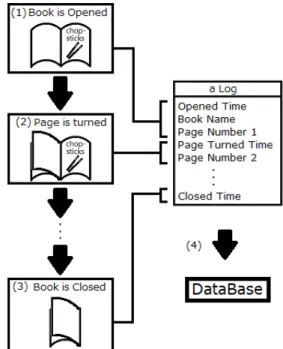
Histories of learners’ actions to EPUB are temporally recorded in a log, and would be sent to SCROLL’s database when all necessary data are written. Specifically, the recorded information are not only about EPUB or what the learner has learned from EPUB, but also the learners’ actions, such as page turning, book opening/closing, highlighting, and so on. This information is recorded in a log when learners undertake some specific actions, such as opening/closing EPUB, zooming-in, zooming-out, and turning pages.
Figure 3. Relation of a learner’s actions and a log (example) Figure 3 shows an example of a log recording.
In Figure 3:
(1) The time the book is opened, book name, and page number are recorded in a log when a learner first opens an e-book (on the EPUB reader).
(2) The time the page was turned and the page number are recorded in the log when the learner turns a page.
(3) Finally, the time the book was closed is recorded in the log when the learner closes the book. (4) After the closed time is recorded, the log is sent to the database.
4.3 Log usage
This system records not only what learners have learned from EPUB, but also some other information
— such as the order of opening and closing pages, learners’ actions (e.g., zooming in or zooming out, changing of font color or background color, writing in the EPUB, and highlighting of a specific sentence) in detail.
Logs have some usages. For example, (1) logs are fed back to learners as quizzes (described above), (2) e-books are improvable using the logs of learners’ actions (via analyzing the logs).
5. Conclusions and future work
This paper proposes a seamless learning system with EPUB. This system runs on both PCs and mobile phones. Learners’ record their learning from EPUB in class and their experiences outside of class through this system. Then, the system allows learners to relate what they have learned in class and what they have experienced outside of class by providing quizzes or book information.
In future work, this seamless learning system needs to be evaluated regarding its efficacy and usability through learners’ actual use. In addition, the verification of the effectiveness of this system will help improve e-books and the system itself is expected to improve through an analysis of the logs recorded within the system. Also, we will consider analyzing various methods such as social network analysis and visualization of graph theory (Mouri et al., 2014; 2015).
Acknowledgments
This part of the research was supported by Grants-in-Aid for Scientific Research (No.25282059, No.26560122, No.25540091, and No.26350319) from the Ministry of Education, Culture, Sports, Science and Technology (MEXT), Japan. The research results were partly achieved by “Research and Development on Fundamental and Utilization Technologies for Social Big Data” (178A03), Commissioned Research by the National Institute of Information and Communications Technology (NICT), Japan.
References
Wong, L.-H, Looi, C.-K.: What seams do we remove in mobile-assisted seamless learning? A critical review of the literature. Comput. Educ. 57, 2364-2381 (2011)
Uosaki, N., Li, M. Hou, B., Ogata, H., & Yano, Y. (2010). Supporting an English Course Using Handhelds in a Seamless Learning Environment. Workshop Proc. Of the 18th International Conference on Computers in Education (ICCE2010), 185-192, Putrajaya, Malaysia
Wong, L.-H, Chai, CS, King, R., Zhang, X., & Aw, GP (2014). Unpacking the Researcher-Teacher Co-Design Process of a Seamless Language Learning Environment with the TPACK Framework. 22nd International Conference on Computers in Education (ICCE2014), 886-895, Nara, Japan
Ogata, H., Li, M., Bin, H., Uosaki, N., Moushir, M. E.-B., &Yano, Y. (2010). SCROLL: Supporting to Share and Reuse Ubiquitous Learning Log in the Context of Language Learning. Research and Practice in Technology Enhanced Learning, 6(2), 69-82.
Li, M., Ogata, H., Hou, B., Uosaki, N., & Mouri, K., (2013). Context-aware and Personalization Method in Ubiquitous Learning Log System. Educational Technology & Society, 16(3), 362-373
Mouri, K., Ogata, H., Uosaki, N., Ubiquitous learning analytics in the context of real-world language learning, Proceedings of LAK15, 378-382, (2015)
Mouri, K., Ogata, H., Uosaki, N., Liu, S., Visualization for Analyzing Ubiquitous Learning Logs,
Proceedings of the 22nd International Conference on Computers in Education (ICCE 2014), pp.461-470, Nara, Japan, (2014)
Tamura, Y.:Learning Analytics Data Items on Digital Textbooks. 22nd International Conference on Computers in Education (ICCE2014) Workshop Proceedings, 277-285, Nara, Japan(2014)