with kernel methods
Hiroshi Yamashita
DOCTOR OF PHILOSOPHY
Department of Statistical Science
School of Multidisciplinary Sciences
The Graduate University for Advanced Studies
2014
Abstract
Small molecules that have the ability to alter the biological response of a cell or disease state are of significant interest as drug candidates. One approach to the design of such molecules using kernel methods is through a map of molecules to a feature space induced by a kernel, where the predictions of the molecular properties are made in a linear manner. The forward mapping helps guide the synthesis of new molecules. Another more direct approach is to solve the so-called pre-image problem, i.e., to reconstruct a corresponding molecule (aka pre-image) from its feature space representation. The inverse mapping is of central impor- tance for the design of new molecules with desired properties. In this thesis, we address two problems in drug design: (I) the forward problem of predicting molecular properties, where we propose a new graph kernel that induces a feature space amenable to the prediction of molecular properties, and (II) the inverse problem of designing new molecules that possess properties required for drug candidates, where we develop a population-based Monte Carlo method to solve the pre-image problem for the molecules. Our respective contributions to these problems are summarized as:
(I) Forward problem of predicting molecular properties
The measurement of molecular similarity is an essential part of predicting molecular prop- erties. Graph kernels provide good similarity measures between molecules. A conventional graph kernel is based on counting common subgraphs of a specific type in molecular graphs. This approach suffers from two primary limitations: (i) only exact subgraph matching is
considered in the counting operation, and (ii) most of the subgraphs will be less relevant to a given task. In order to address these limitations, we propose a new graph kernel as an ex- tension of the subtree kernel initially proposed by Ramon and Gärtner (2003). The proposed kernel tolerates an inexact match between subgraphs by allowing matching between atoms with similar local environments. In addition, the proposed kernel provides a method to as- sign an importance weight to each subgraph according to the relevance to the task, which is predetermined by a statistical test. These extensions lead to promising improvements in classification and regression tasks for predicting a wide range of pharmaceutical properties from the chemical structure of molecules.
(II) Inverse problem of designing new molecules
The de novo design of new molecules that yield desired properties has the potential to sub- stantially reduce both the time and cost involved in drug development. Recent developments in graph kernels have enabled us to apply well-established machine learning techniques to molecular data which are internally represented as graphs. However, in order to allow for the design that generates new molecules as a result, it is necessary to solve the pre-image problem for molecules. Unlike the traditional method proposed in Bakır et al. (2004), which is formulated as a nonlinear combinatorial optimization problem, we express the pre-image problem as a sampling problem for molecular graphs. Here, we are not only interested in optimal molecules, but also in near-optimal molecules which are often considered to be good candidates for further chemical synthesis. Therefore, we develop a population-based Monte Carlo method for sampling structurally diversified molecules near the pre-images, which possess good drug-likeness. The key to an efficient sampling method is to use the update of a population by evolutionary operators for the structural alteration of molecules. Furthermore, to penalize non-drug-like molecules, we use the knowledge of drug-likeness commonly considered by medicinal chemists. The effectiveness of the proposed method is
iii
illustrated through experiments to find corresponding molecules from given image points in a feature space induced by a graph kernel.
Many thanks go to my thesis supervisor, Ryo Yoshida, and sub-supervisor, Tomoyuki Higuchi, for introducing me to the world of machine learning. Ryo has helped me in innumerable ways. I am also very grateful to the members of the Research and Development Center for Data Assimilation.
It goes without saying that my thesis referees, Yoshihiro Yamanishi, Tomoyuki Higuchi, Yukito Iba, Kenji Fukumizu, and Ryo Yoshida have reviewed this thesis and given me valu- able comments to improve upon its content.
Of course, fruitful research is only possible in a friendly and pleasant working envi- ronment. Takashi Washio and Yukito Iba—thanks for our scientific discussions. Okimasa Okada and Tetsu Isomura—thanks for all our discussions. Though I could easily continue this list of colleagues, I wish to thank Masataka Kuroda and Takanori Ohgaru who work in the chemoinformatics group at Mitsubishi Tanabe Pharma Corporation.
Contents
Contents v
1 Introduction 1
1.1 Background . . . 1
1.1.1 Forward Problem of Predicting Molecular Properties . . . 3
1.1.2 Inverse Problem of Designing New Molecules . . . 6
1.2 Outline of the Thesis . . . 8
2 Kernel Methods for Molecules 10 2.1 Kernel Methods . . . 10
2.2 Representing Chemical Structures . . . 13
2.3 Graph Kernels . . . 15
2.3.1 Convolution Kernels . . . 15
2.3.2 Random Walk Kernels . . . 17
2.3.3 Subtree Kernels . . . 18
2.3.4 Other Graph Kernels . . . 20
3 Atom Environment Kernels for the Forward Problem 22 3.1 Basic Idea . . . 22
3.2 Inexact Match Extension . . . 23
3.3 Importance Weight Extension . . . 25
3.4 Relation to Previous Research . . . 28
3.5 Atom Environment Labels . . . 29
3.5.1 Continuous Labels . . . 29
3.5.2 Discrete Labels . . . 30
3.6 Kernel Computation . . . 31
3.6.1 Recursive Algorithm . . . 31
3.6.2 Complexity . . . 32
3.7 Experiments . . . 32
3.7.1 Experimental Settings . . . 33
3.7.2 Data Sets . . . 36
3.7.3 Results and Discussion . . . 37
3.8 Concluding Remarks . . . 47
4 Fragment Assembly Monte Carlo Methods for the Inverse Problem 49 4.1 Basic Idea . . . 49
4.2 Evolutionary Movements in Chemical Space . . . 53
4.3 Preparation of Molecular Fragments . . . 57
4.4 Regularization of Molecules . . . 58
4.5 Experiments . . . 59
4.5.1 Experimental Settings . . . 59
4.5.2 Results and Discussion . . . 61
4.6 Concluding Remarks . . . 65
5 Conclusions 67
Appendix A Derivation of the Recursive Formula 70
List of Figures 73
Contents vii
List of Tables 78
Symbols 82
References 83
List of Publications 92
Introduction
1.1 Background
A primary goal in drug development is to identify new molecules that possess suitable prop- erties required for drug candidates. It is estimated3–5 that there are in excess of 1060 or- ganic molecules below 500 Da of possible interest for drug development. A comprehensive synthesis of molecules is not feasible strategy due to this vast chemical space. Therefore, computer-aided molecular design (CAMD) has the potential to substantially reduce both the time and cost involved in the trial-and-error experiments of drug development. The use of quantitative structure–activity relationships, known as QSARs,6,7is a promising approach to CAMD. The first step in this approach is to build a forward QSAR model for predicting biological activities or molecular properties from the structural information of a molecule. A forward QSAR can be established using many different model equations (e.g., multi- ple linear regression, partial least squares, support vector regression, etc.). Once a model is built, we next invert the QSAR, i.e., now searching for molecules of interest under the model. This is referred to as the inverse problem.
The most commonly used solution to the inverse problem is virtual screening. In this ap- proach, molecules in a database are evaluated using a forward QSAR to identify molecules
1.1 Background 2
O N
N N
N N O
O N O
S
G
G
∗φ φ(G)
Input space G Feature space F
forward mapping
inverse mapping
φ
−1Ψ =
Ni=1
α
iφ(G
i)
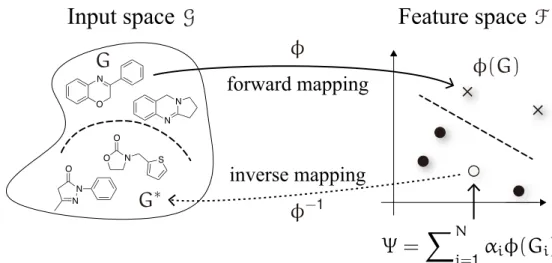
Figure 1.1 Illustration of the pre-image problem in kernel methods. An image pointΨ in the feature space F is mapped back to the input space G.
possessing desired properties. However, virtual screening can only identify molecules present in the database, i.e., it cannot suggest new structural molecules that yield better properties than known molecules. De novo design solves this problem by building molecules from scratch so as to optimize a scoring function. While the scoring is based on a QSAR model, other factors such as drug-likeness and synthetic accessibility can be used as well. Methods for designing new molecules include graphical enumeration8–10 and stochastic optimiza- tion11–16 in the context of inverse QSAR. The exhaustive enumeration of chemical struc- tures with given constraints is often computationally demanding. In addition, at present, this approach can generate only treelike (acyclic) molecular graphs. A stochastic approach such as simulated annealing, genetic algorithms, or tabu search solves a nonlinear combinatorial optimization problem for chemical structures, where one may be interested in only optimal solutions of the problem.
Kernel methods17–20provide a principle framework for solving the forward and inverse problems in CAMD. The recent development of graph kernel functions21 has made it pos- sible to apply kernel methods to various machine learning tasks in chemical informatics,22 where graphs are used to describe the chemical structure of the molecules.23Once a suitable kernel functionk on a set G of molecular graphs is defined, the kernel approach to molecules
works successfully for well-established machine learning methods (e.g., support vector ma- chine, logistic regression, K-means clustering, etc.). The basic idea behind the kernel ap- proach is to implicitly map molecular graphs in the input space G into the high dimensional feature space F via a possible nonlinear map ϕ : G→ F such that for every G, G′∈ G it holds that k(G, G′) =⟨ϕ(G), ϕ(G′)⟩ where ⟨·, ·⟩ denotes the inner product. The forward mapping ϕ is of primary importance in predicting the molecular properties.24–26 We next invert the forward mappingϕ, i.e., the inverse mapping ϕ−1 from the feature space F back to the input space G. This is known as the pre-image problem. The pre-image problem is of central importance for the design of new molecules with desired properties.2,27Many graph kernels21 for solving the forward problem exist, yet solutions2,28to the inverse problem are relatively limited due to its ill-posed nature; it is non-convex, nonlinear, and combinatorial. We describe kernel methods to address the forward and inverse problems in detail below.
1.1.1 Forward Problem of Predicting Molecular Properties
The definition of an appropriate similarity function between molecules is of crucial impor- tance for many applications in chemical informatics. Common applications include QSAR model construction to predict biological activities from structural information of molecules. The quantitative structure-activity relationship models rely on the similarity property princi- ple,29which states that structurally similar molecules tend to have similar properties. There- fore, the QSAR model, derived using an appropriate similarity function, will help guide the synthesis of new molecules.
Graphs are often used as a natural mathematical abstraction to describe the chemical structure of molecules.23 A molecule is translated to a labeled graph (or molecular graph), in which vertices correspond to atoms and edges correspond to covalent bonds between the atoms. The vertices are labeled with element types (e.g., carbon, oxygen, etc.) while the edges are labeled with bond types (e.g., single, double, etc.). Measurement of the similarity
1.1 Background 4
between the molecular graphs requires a method by which to transform any molecular graph G to a feature vector ϕ(G). Classically, molecular graphs are transformed into molecular descriptors,30which can be thought of as numerical representations that are encoded so as to capture the relevant aspects of structural information of molecules. A unique dictionary30 of molecular descriptors lists more than 3, 300 descriptors. Popular choices for them in- clude extended-connectivity fingerprints31 (ECFPs). The similarity between the molecular descriptors is then measured by a similarity metric, e.g., the Tanimoto coefficient.32To date, the molecular descriptors are widely applied due to their computational efficiency. However, such a transformationϕ may cause some loss of structural information of molecules due to the limited dimensional feature space of the molecular descriptors.
Alternatively, molecular graphs can be compared directly in a potentially high or infinite dimensional feature space without the need to perform the explicit transformation,ϕ. This is possible when using a positive definite kernel19,20k on a set G of molecular graphs. The symmetric functionk : G× G → R is said to be a positive definite kernel on G if and only if
∑
i,j∈{1,...,n}cicjk(Gi,Gj) ⩾ 0 for all n∈ N, G1, . . . ,Gn∈ G, and c1, . . . ,cn∈ R. For such k, it is known that a mapϕ : G→ F into a reproducing kernel Hilbert space (RKHS) F exists, such that k(G, G′) = ⟨ϕ(G), ϕ(G′)⟩ for all G, G′ ∈ G. We suppose that the feature map ϕ(G) = k(·, G) ∈ F of a kernel function k is of substantially the same class as the feature vector of a molecular descriptor. A difference is whether the feature space is defined explic- itly or implicitly. The convolution kernel33 provides a framework to construct a wide class of kernel functions for structured objects such as molecular graphs, where each object is implicitly decomposed into a set of subgraphs, and the kernel between the objects is defined as the sum of kernel values among the subgraphs. Following this framework, various graph kernels have been proposed in the literature, see Vishwanathan et al..21These graph kernels differ with respect to the choice of the subgraph types used to represent the structured ob- jects, such as walks,24,34 shortest paths,35 cycles,36 and trees.1,26Mahé et al.37 introduced
two extensions to remove tottering walks and to increase the number of different atom la- bels using the Morgan algorithm. Ralaivola et al. introduced three normalized variants38 (Tanimoto, MinMax, and Hybrid) of the non-tottering walk kernels. Subsequently, the ef- ficient computation schemes for the random walk kernel39 and the subtree kernel40 were developed.
The above graph kernels all have two primary limitations. First, these graph kernels rely on exact subgraph matching where a successful match between subgraphs requires strict correspondence in terms of structure and vertex/edge labels. This means that if two subgraphs differ by only a single atom label, then the two subgraphs are considered to be completely different. The requirement for an exact match may reduce the expressivity of the resulting graph kernels. In an effort to address this problem, the elastic tree kernel41 has been proposed for labeled ordered trees, which allows matching between vertices with different labels. Other similarity measures for inexact matching of subgraphs have been introduced in the optimal assignment kernel.42 Second, when the number of distinct sub- graphs is significantly large, the numerous irrelevant subgraphs for a given task overwhelm the contributions of the relatively few relevant subgraphs. This problem, which is known as the curse of dimensionality, adversely affects the generalization ability of the prediction models built on graph kernels.43 Possible solutions to this problem include decreasing the contribution of larger subgraphs,44using prior knowledge to select relevant subgraphs,45–47 and increasing the specificity of matching between subgraphs based on consideration of neighborhood information.42,48
To tackle the above limitations, we propose a new graph kernel, called the atom envi- ronment (AE) kernel, as an extension of the subtree kernel initially proposed by Ramon and Gärtner.1The AE kernel regards atoms as vertices labeled with information about the local atom environment. The atom environment labels are derived using an extension49 of the Burden approach50,51 and a variant31 of the Morgan algorithm.52 The AE kernel tol-
1.1 Background 6
erates an inexact match between subgraphs by allowing matching between atoms having similar local environments. In addition, the AE kernel provides a method for assigning an importance weight to each subgraph according to the overall statistical significance of the constituent atoms for a given task.
1.1.2 Inverse Problem of Designing New Molecules
In this section we consider the inverse problem of reconstructing a corresponding molecular graph from its feature space representation induced by a graph kernel. This is known as the pre-image problem.
Letk be a kernel function on a set G of molecular graphs. The kernel k induces an RKHS F, called the feature space, and a map ϕ : G→ F such that k(G, G′) =⟨ϕ(G), ϕ(G′)⟩ for allG, G′∈ G. Given an image point Ψ in F as an expansion in terms of known molecules {G1, . . . ,GN}⊆ G, i.e., Ψ = ∑Ni=1αiϕ(Gi), the pre-image problem amounts to finding a corresponding molecular graph G∗∈ G such that Ψ = ϕ(G∗). However, the map ϕ is not
CnH2n+2
R R
R R
R R
R R
R R R R
R R
Cl
OH
OH
F OCH3
OCH3 F F
OH
N HN
NH2
O H
HH2N OH O O
HO
N N
N
H H
H
R ∈{150 functional groups}
# substitutions 14
atom ∈ {C, O, N, S}
# atoms 30
799
1029
1060
n 13
# molecules examples
constraints for molecular generation
(estimated number) Table 1.1 The Number of Molecules with Given Structural Constraints.
surjective in general. In this case, it is natural to find an approximate pre-image G∗ such that
G∗= arg min
G
∥Ψ − ϕ(G)∥2. (1.1)
This is a hard combinatorial optimization problem since there are at least 1060 possible organic molecules3–5(see Table 1.1). A general learning-based framework for finding pre- images is reported in ref 27.
Methods to solve the pre-image problem for molecules include combinatorial enumer- ation28 and stochastic optimization.2Fujiwara et al.28 proposed an enumeration algorithm for treelike chemical structures with given path frequencies using the branch-and-bound method. Enumeration of chemical structures with given constraints is often computation- ally prohibitive.28 In addition, at present, this approach can generate only treelike (acyclic) chemical structures. Bakır et al.2 proposed a stochastic optimization algorithm for finding a corresponding chemical structure from a given image point in F induced by the random walk kernel.24 The stochastic optimization approach suffers from local minimum trapping, requiring restarts with a new initial guess, and therefore may miss potentially important molecules. Moreover, this approach delivers only local optimal solutions (molecules) of the problem.
In CAMD, medicinal chemists are not only interested in optimal solutions, but also in their neighboring suboptimal solutions. This means that molecules near the optimal solu- tions are often considered as good candidates for further chemical synthesis since the desir- ability (e.g., potency, stability, synthesizability, drug-likeness, etc.) of the optimal solutions is usually insufficient. Therefore, the pre-image problem can be expressed as the problem of generating molecular graphs from a target distribution. This is different from the optimiza- tion problem (eq 1.1) where only local optimal solutions are of interest. The formulation of the sampling problem begins by defining a target distribution on the molecular graphs as a
1.2 Outline of the Thesis 8
Boltzmann distribution at temperaturet
G∗∼ π(G)∝ exp{−(||Ψ − ϕ(G)||2+ ηR(G))/t},
whereR(G) is a regularization function to penalize non-drug-like molecules and η controls the strength of the regularization. In Chapter 4, we will draw molecular graphs fromπ(G) using a population-based Monte Carlo method.53–55
1.2 Outline of the Thesis
This thesis is organized into three remaining chapters, followed by a conclusion.
Chapter 2 discusses graph kernels for molecules that can be naturally represented using a graph. First, a short introduction to kernel methods is given, followed by the neces- sary notation regarding graphs and trees required for the graph kernel definitions. Finally, state–of–the–art graph kernels for molecules are presented.
Chapter 3 proposes a new graph kernel to address the forward problem as an extension of the subtree kernel initially proposed by Ramon and Gärtner.1 First, the basic idea for extending the subtree kernel is given. Then, two extensions, called the inexact match ex- tension and the importance weight extension, are introduced. The differences in relation to previous research are then discussed. Atom labels with information regarding the lo- cal atom environment are derived. The computation of the proposed kernel is presented thereafter. Finally, application to classification and regression tasks for predicting various pharmaceutical properties from the structure of molecules is described.
Chapter 4 develops a population-based Monte Carlo method for sampling structurally diversified molecules with good drug-likeness. First, the basic idea for the development of the sampling method is given. Then, evolutionary operators (i.e., mutation, crossover, and exchange) for the structural alteration of molecules are introduced. Next, a molecu-
lar fragment database required for the mutation operation is prepared. In order to penalize non-drug-like molecules, existing knowledge of drug-likeness commonly used by medici- nal chemists is introduced. Finally, the effectiveness of the proposed sampling method is demonstrated by pre-image reconstruction experiments.
Chapter 2
Kernel Methods for Molecules
This chapter describes the extension of kernel methods to handle structured data such as chemical structures through the convolution kernels proposed by Haussler.33We begin with a brief introduction of kernel methods, followed by a description of graph representations of chemical structures, and a review of existing graph kernels.
2.1 Kernel Methods
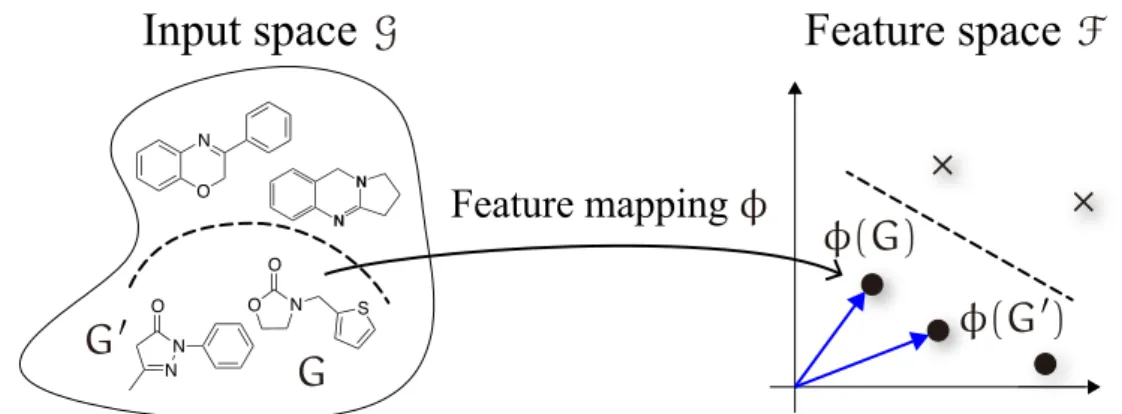
Traditionally, machine learning algorithms (e.g., support vector machine, logistic regres- sion, K-means clustering, etc.) have been well developed for the linear case. However, real-world problems often require nonlinear algorithms to detect the complex patterns that allow for the successful prediction of properties of interest. The use of a positive definite kernel19,20 allows the extension of linear algorithms to nonlinear algorithms (Figure 2.1). The symmetric functionk : G×G → R on the domain G is said to be a positive definite kernel if and only if∑i,j∈{1,...,n}cicjk(Gi,Gj) ⩾ 0 for all n∈ N, G1, . . . ,Gn∈ G, and c1, . . . ,cn∈ R. For suchk, it is known that a map ϕ : G→ F into a (usually high-dimensional) feature space F exists, such that k(G, G′) =⟨ϕ(G), ϕ(G′)⟩ for all G, G′∈ G. In F, the complex patterns can be found as linear relations. Here, substituting k(G, G′) for⟨ϕ(G), ϕ(G′)⟩ is crucial for implicitly mapping the input data into F without ever knowingϕ(·). Any linear machine
Input space G Feature space F
O N
N N
O O N
O
S N
N
G
φ(G)
φ(G )
G
φ
Feature mapping
Figure 2.1 The idea of kernel methods. This approach maps the training data in the in- put space G into a high-dimensional feature space F via the feature map ϕ : G→ F, and applies linear machine learning algorithms such as SVM, which depend on the in- ner product ⟨ϕ(G), ϕ(G′)⟩ between data points ϕ(G) and ϕ(G′). Using the kernel trick k(G, G) =⟨ϕ(G), ϕ(G′)⟩, it is possible to apply them without explicitly mapping ϕ.
learning algorithm formulated as an inner product in F can be turned into a nonlinear one by the kernel substitution, k(G, G′) =⟨ϕ(G), ϕ(G′)⟩. This approach is called the kernel trick. Next we review the nonlinear extension of support vector machines (SVMs) using the kernel trick.
Let us consider a typical binary classification task in chemical informatics as illustrated in Figure 2.1. The goal is to construct a discriminant function to predict whether a new input molecule is effective against a disease. Here, any molecule G in the set G of all molecules can be transformed into a feature vectorϕ(G)∈ Rp containing molecular prop- erties (e.g., molecular weight, molecular hydrophobicity, polar surface area, etc.). Suppose we are given the training data set D = {(ϕ(Gi), yi)∈ X × Y}ni=1where X is the nonempty set ofp-dimensional feature vectors and Y∈ {+1, −1} is the set of class labels whose value takes either the presence (+1) or absence (−1) of efficacy against the disease. Assume that D is separable, i.e., there exists a discriminant function f : G→ Y,
f(G) = sgn(⟨w, ϕ(G)⟩ + b), (2.1)
where the weight vector w∈ Rp and the shift coefficient b∈ R are parameters. SVM
2.1 Kernel Methods 12
determines the hyperplane, which separates the two classes with the largest margin, by solving the constrained optimization problem
minimize
w,b
1 2||w||
2subject toyi(⟨w, ϕ(Gi)⟩ + b) ⩾ 1 for all i = 1, . . . , n. (2.2)
Note that ||w||−1f(Gi) is the distance from the point ϕ(Gi) to the hyperplane H(w, b) := {ϕ(G)|⟨w, ϕ(G)⟩ + b = 0}. The condition yi(⟨w, ϕ(Gi)⟩ + b) ⩾ 1 ensures that the margin distance is at least 2||w||−1. Consequently, minimizing ||w|| subject to the constraints max- imizes the margin of separation. To address this problem one can solve it in dual space, as follows. The Lagrange function of eq 2.2 is given by
L(w, b, α) =1 2∥w∥
2−
∑n i=1
αi(yi(⟨w, ϕ(Gi)⟩ + b) − 1), (2.3)
whereαi⩾0 is a Lagrange multiplier. L has to be minimized with respect to w and b and maximized with respect toαi. At the saddle point, the derivatives ofL with respect to the variables w andb must be equal to zero,
∂
∂bL(w, b, α) = 0 and ∂
∂wL(w, b, α) = 0,
which leads to
∑n i=1
αiyi= 0 (2.4)
and
w =
∑n i=1
αiyiϕ(Gi). (2.5)
Substituting eq 2.4 and eq 2.5 into the Lagrangian eq 2.3, we obtain the so-called dual
optimization problem
maximize
α∈Rn
W(α) =
∑n i=1
αi−1 2
∑n i,j=1
αiαjyiyj⟨ϕ(Gi), ϕ(Gj)⟩
subject toαi⩾0 for alli = 1, . . . , n and
∑n i=1
αiyi= 0.
Using eq 2.5, the decision function (eq 2.1) can be written as
f(G) = sgn(
∑n i=1
yiαi⟨ϕ(G), ϕ(Gi)⟩
| {z }
k(G,Gi)
+ b). (2.6)
Equation 2.6 can be expressed in terms of the kernel k using the kernel trick k(G, Gi) =
⟨ϕ(G), ϕ(Gi)⟩. The kernel trick allows us to handle the feature vectors ϕ(G) in the very high-dimensional feature space with no need to perform the explicit transformation,ϕ. To deal with structured data such as chemical structures, many graph kernels have been devel- oped, as described in Section 2.3. For further information on kernel-based machine learning please see the literature.17–20
2.2 Representing Chemical Structures
Let us represent the chemical structure of a molecule by a labeled directed graph,G = (V, E), as shown in Figure 2.2. The graph G is described by a set of vertices V = {vi}ni=1 of size n = |V| representing the atoms in the molecule and a set of edges E = {(u, v)} ⊆ V × V representing the covalent bonds. Let ΣV,ΣE be the sets of vertex labels and edge labels, respectively. In the case of labeled graphs, there is also a set of labelsΣ = ΣV∪ ΣE with a
labeling functionℓ : V∪ E → Σ that maps vertices and edges to corresponding element types and bond types, respectively. For directed graphs, each edge (u, v) is oriented and is a pair of the initial vertex u and the terminal vertex v. It is assumed that for every edge (u, v)
2.2 Representing Chemical Structures 14
N
N
O
(a) Chemical structure (b) Molecular graph
v1
v2 v3
v4
v5 v6 v7
v8 v9 v10
v11 v12
v13
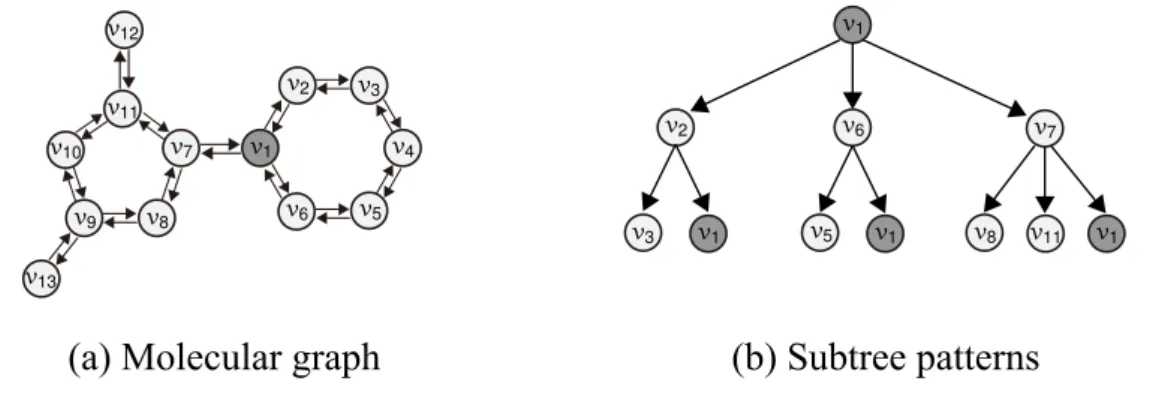
Figure 2.2 A chemical structure (left) can be modeled as a labeled directed graph (right).
belonging to E in G, the corresponding opposite edge (v, u) also belongs to E, i.e., G is symmetric. Such symmetric directed graphs can be viewed as undirected graphs. Note that VG and EGwill be used to refer to the vertex and edge sets, respectively, of a specific graph G. We also define a function describing the outgoing neighbors (children) of a vertex v as N(v) = {u|(v, u)∈ E}.
A rooted treeT = (VT, ET) is a directed acyclic graph with a single designated root, in which the edges have a natural orientation away from the root. The size |T | of the tree T is the number of vertices in T , i.e. |T | = |VT|. The height h of the tree T is the length of the longest path from the root to any other vertex. Note that a vertex inG may appear several times in the tree-pattern, but sibling vertices in the tree-pattern must correspond to distinct vertices inG (see Figure 2.3).
v1
v2 v3
v4
v5
v6
v7
v8
v9
v10
v11
v12
v13
(b) Subtree patterns (a) Molecular graph
v2
v3 v1 v5 v1 v8 v11 v1 v6
v1
v7
Figure 2.3 A molecular graph (left) and subtree patterns up to the heighth = 2 rooted at the nodev1(right). Note that the vertexv1appears at a height of 2 again.
2.3 Graph Kernels
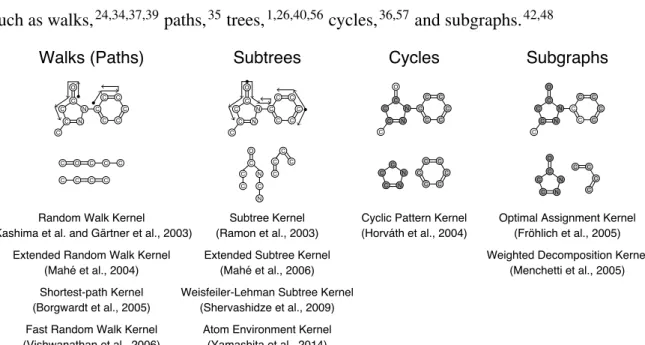
The traditional application of machine learning with the kernel method only considers data represented in a single row of a table. However, there are many potential machine learning applications, where this is not the natural representation. For example, such applications include the classification of molecules internally represented as graphs. The best known framework to construct kernels for structured data is the convolution kernel proposed by Haussler.33 Following this framework, various graph kernels have been proposed over the last decade (see Figure 2.4) and applied successfully to various machine learning tasks in chemical informatics, including the establishment of QSARs. These graph kernels differ with respect to the choice of the subgraph types used to represent the structured objects, such as walks,24,34,37,39paths,35trees,1,26,40,56cycles,36,57and subgraphs.42,48
C O C C C
C C C C
N O
C N
C C
C
C C
C
C C C
Walks (Paths)
Random Walk Kernel (Kashima et al. and Gärtner et al., 2003)
Extended Random Walk Kernel (Mahé et al., 2004)
Fast Random Walk Kernel (Vishwanathan et al., 2006)
N O
C N
C C
C
C C
C
C C C
N O
N C
C
C C C
C C
Subgraphs
Optimal Assignment Kernel (Fröhlich et al., 2005) Weighted Decomposition Kernel
(Menchetti et al., 2005)
N O
C N
C C
C
C C
C
C C C
C C
C
C C C N
N C
C
C
Cycles
Cyclic Pattern Kernel (Horváth et al., 2004)
N O
C N
C C
C
C C
C
C C C
C C C C O
N C C
N C C
Subtrees
Subtree Kernel (Ramon et al., 2003)
Atom Environment Kernel (Yamashita et al., 2014) Weisfeiler-Lehman Subtree Kernel
(Shervashidze et al., 2009) Extended Subtree Kernel
(Mahé et al., 2006) Shortest-path Kernel
(Borgwardt et al., 2005)
Figure 2.4 The research efforts on graph kernels over the last decade.
2.3.1 Convolution Kernels
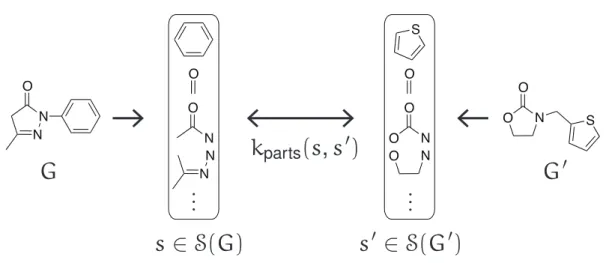
The basic idea of the convolution kernels33is that each structured object is decomposed into a set of parts, and the kernel between the objects is defined as the sum of the kernel values
2.3 Graph Kernels 16
G G
s ∈ S(G) s ∈ S(G )
k
parts(s, s )
N N O
O N O
S
...
O
N O
N N
S
O
O N O
O N
...
Figure 2.5 A schematic concept of the convolution kernel between the molecular graphsG andG′.
among the parts (see Figure 2.5).
Let G, G′ ∈ G be the molecular graphs and let S(G), S(G′) be sets of parts extracted fromG, G′. Given an extraction rule, we can define the sets S(G) and S(G′) of parts. The convolution kernel ofG and G′is then defined as
kconv(G, G′) = ∑
s∈S(G)
∑
s′∈S(G′)
w(s)w(s′)kparts(s, s′), (2.7)
where the function w(s) returns a weight for the part s and kparts(s, s′) is the kernel func- tion between two parts s and s′. Equation 2.7 is guaranteed to be a valid kernel if kparts
is a positive definite kernel. It should be noted that the weight function is not defined in the original definition.33 The convolution kernel is very general and can be used for many different structured objects (e.g., amino acid sequences, chemical structures, metabolic net- works, etc.). To construct a convolution kernel for specific structured objects, we have to design the extraction rule of parts and the kernel function on the parts.
We next describe two established graph kernels: random walk kernels and subtree ker- nels.
2.3.2 Random Walk Kernels
The idea of the random walk (RW) kernel24,34 is to randomly walk on two graphs and compare the label sequences resulting.
Consider a random walk on a graphG, which starts at vertex x1∈ VGwith initial prob- ability ps, goes from xi−1 to xi with transition probability pt, and ends with probability pq. The random walk can be represented as a sequence of the vertices traversed of lengthl, x = (x1,x2, . . . ,xl). The vertex sequence x in G has probability
p(x|G) = ps(x1)(
∏l i=2
pt(xi|xi−1)
)
pq(xl).
Let us define a label sequence by another alternating sequence of vertex labels and edge labels
h = (h1,h2, . . . ,h2l−1)∈ (ΣVΣE)l−1ΣV.
We then obtain the label sequence associated with x
hx= (ℓ(x1)ℓ(x1,x2), ℓ(x2), . . . , ℓ(xl−1)ℓ(xl−1,xl), ℓ(xl)).
The probability of the label sequence h is the sum of probabilities of all vertex sequences that generate h
p(h|G) =∑
x
I(h ∼= hx)·
( ps(x1)
∏l i=2
pt(xi|xi−1)pq(xl)),
whereI(h ∼= hx) is the indicator function that returns 1 if h and hxare equal and 0 otherwise. Next, we define a kernel kz between two label sequences h and h′. Suppose we are given two valid kernels kv between vertex labels andke between edge labels. The kernel
2.3 Graph Kernels 18
for the label sequences of equal length is given by the product of the label kernels
kz(h, h′) = kv(h1,h1′)
∏l−1 i=1
ke(h2i,h2i′)kv(h2i+1,h2i+1′).
For the label sequences h and h′ of different lengths, kz(h, h′) = 0. Finally, the random walk kernel is given by the expectation ofkzover all possible h and h′
kRW(G, G′) =∑
h
∑
h′
kz(h, h′)p(h|G)p(h′|G′).
This kernel is positive definite for validkvandke.
The RW kernel exploits an infinite dimensional feature space, spanned by random walks, on molecular graphs. In consequence, the RW kernel gives an alternative to explicit vector representations of molecules (molecular descriptors). However, Gärtner et al.34 indicated the limited expressiveness of the RW kernel based on linear features. To alleviate this limi- tation, Gärtner et al.34 proposed subtree kernels, as described in the next section.
2.3.3 Subtree Kernels
In this section we describe the subtree (ST) kernel initially proposed by Ramon and Gärtner1 and later extended by Mahé and Vert.26Following Mahé and Vert,26we start by describing the concept of tree-patterns in a graph. LetG = (VG, EG) be a graph, and let T = (VT, ET) with VT = (w1, . . . ,w|T |) be a rooted tree with a designated root w1. A |T |-tuple of ver- tices (v1, . . . ,v|T |) ∈ V|T |G is said to be a tree-pattern of G with respect to T , denoted by
(v1, . . . ,v|T |) = pattern(T ), if and only if
∀i ∈ {1, . . . , |T |}, ℓ(vi) = ℓ(wi),
∀(wi,wj)∈ ET, (vi,vj)∈ EG∧ ℓ((vi,vj)) = ℓ((wi,wj)),
∀(wi,wj), (wi,wk)∈ ET, j̸= k ⇔ vj̸= vk.
(2.8)
With the set of all possible tree-patterns ofG = (VG, EG) with VG= (v1, . . . ,v|VG|) arranged inT ,
PT(G) = {(va1, . . . ,va|T |)|(a1, . . . ,a|T |)∈ {1, . . . , |VG|}|T |∧(va1, . . . ,va|T |) = pattern(T )}, (2.9) the ST kernel of graphsG and G′is given by
kST,h(G, G′) = ∑
T∈Th
µ(T ) ∑
p∈PT(G)
∑
p′∈PT(G′)
I(p ∼=p′). (2.10)
A set Th of all trees up to heighth is considered. We assume that Thincludes the elements of isolated vertices. For each tree T ∈ Th, the sets of tree-patterns PT(G) and PT(G′) in- clude all tree-patterns occurring inG and G′, which can be arranged in a given treeT . Each tree-pattern pair (p, p′)∈ PT(G)× PT(G′) is compared by the indicator function I(p ∼=p′) that determines their isomorphism to be one ifp and p′are isomorphic, and zero otherwise. In this case,I(p ∼=p′) always returns one because both PT(G) and PT(G′) include isomor- phic tree-patterns. Therefore, the ST kernel counts the weighted number of co-occurrences of tree-patterns inG and G′. Each tree-pattern with respect toT has a weight µ(T ) depend- ing on the tree structure. A typical weight is a function of the tree size |T |, for example, µ(T ) = λ2|T |, and assigns smaller weights to larger tree-patterns, whereλ is a nonnegative weight factor that is less than one. Alternative weights have been defined as functions of the structural complexity of the tree.26
2.3 Graph Kernels 20
2.3.4 Other Graph Kernels
There have been various graph kernels proposed in the literature (see Vishwanathan et al.21). In this section, we discuss several important kernels in chemical informatics.
Walk-based kernels, one of the first graph kernels, have been independently proposed by Kashima et al.24 and Gärtner et al..34 Unfortunately, random walks on a graph include tottering between two neighboring vertices, which is otherwise known as an immediate re- visiting of a vertex. Such tottering walks are likely to be uninformative. Mahé et al.37 introduced the second-order Markov model to filter tottering walks. Path-based graph ker- nels35 have been proposed to invalidate the effects of tottering. Another extension37 is to increase the number of different vertex labels using the Morgan index. In the label en- richment, contextual structural information around each vertex is embedded into the vertex label. Subsequently, Vishwanathan et al.39 employed fast methods for solving Sylvester equations as well as conjugate gradient and fixed point iteration methods to speed up walk based kernels.
Ramon and Gärtner1 defined kernels through the comparison of subtrees instead of walks on the graphs. This alleviates the limited expressiveness of linear features generated by random walks. The subtree kernel was later refined by Mahé and Vert.26 Subsequently, the Weisfeiler-Lehman (WL) subtree kernel40 was developed to provide an efficient ker- nel computation. The WL subtree kernel scales up to large labeled graphs. It uses the Weisfeiler-Lehman isomorphism test, which consists of iterative multiset-label determina- tion, label compression, and relabeling steps.
Horváth et al.36,57 proposed cyclic pattern (CP) kernels, which are based on the idea of mapping graphs to the sets of cyclic patterns and tree patterns, which are compared with the intersection kernel. Menchetti et al.48 proposed weighted decomposition kernels based on comparing local neighborhoods of vertices. The optimal assignment (OA) kernel,42 another graph kernel comparing local neighborhoods, arises from finding the best match
between substructures of graphs. However, the OA kernel is not positive semidefinite in general.58 Vishwanathan et al.21 suggested a possible remedy to this problem based on an approximation of the tropical semiring.
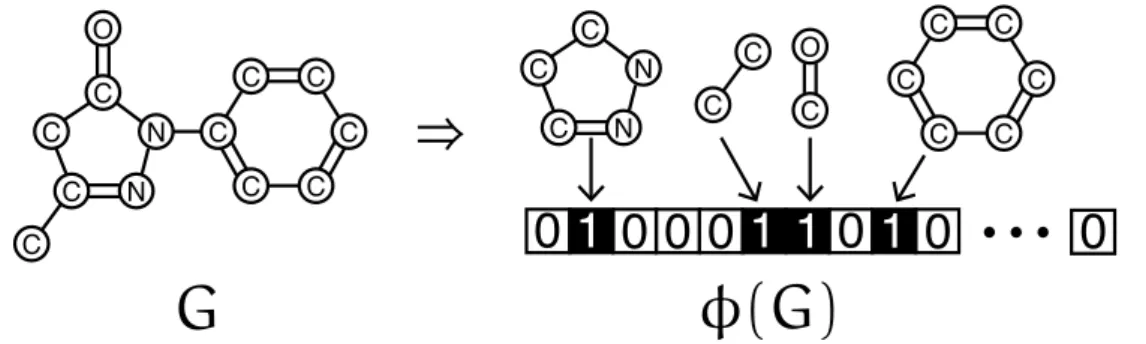
Other kernels, motivated by applications in chemical informatics, include fingerprint kernels38,59 where a molecular graph G is represented by a vector ϕ(G) indexed by a set of molecular fragments as illustrated in Figure 2.6, i.e., sequences of atom types and bond types up to a given length. The fingerprint kernels are normalized by three variations of the Tanimoto kernel designed by analogy with the Tanimoto coefficient.
N O
C N
C C
C
C
C C
C C
C
・・・
0 1 0 0 0 1 1 0 1 0
O C
C C
C
C C
C C
C N
N C
C
⇒
C0
G φ(G)
Figure 2.6 Given a molecule graphG, the traditional fingerprint is defined as a binary vector ϕ(G) such that it indicates the presence or absence of predefined particular substructures in G.
Chapter 3
Atom Environment Kernels for
the Forward Problem
3.1 Basic Idea
In this section we introduce two extensions to the ST kernel. The first extension, referred to as the inexact match extension, relaxes the requirement for exact tree-pattern matching by allowing matching between atoms with similar local environments, and the second ex- tension, referred to as the importance weight extension, introduces a tree weight function to adjust the contribution of each tree-pattern according to the overall statistical significance of the constituent atoms for a given task. For the inexact match extension, we alter the defi- nition of tree-patterns by omitting the first condition for the exact atom label matching from eq 2.8 as
∀(wi,wj)∈ ET, (vi,vj)∈ EG∧ ℓ((vi,vj)) = ℓ((wi,wj)),
∀(wi,wj), (wi,wk)∈ ET, j̸= k ⇔ vj̸= vk.
This alters the definition of the set PT(G) in eq 2.9. Suppose we are given a tree-level kernel ktree(p, p′) to measure the similarity between tree-patterns p and p′. The AE kernel is then
given by the weighted sum of ktree(p, p′) over all possible pairs of tree-patterns induced fromG and G′
kAE,h(G, G′) = ∑
T∈Th
∑
p∈PT(G)
∑
p′∈PT(G′)
w(p)w(p′)ktree(p, p′), (3.1)
where Th is a set of trees up to heighth, and w(p) is a weight associated with the tree- pattern p. In the following section we provide the constructions of the tree-level kernel ktree(p, p′) and the tree weight function w(p).
3.2 Inexact Match Extension
Consider a specific form of the tree-level kernelktree(p, p′) between tree-patterns p and p′
ktree(p, p′) = ∏
(v,v′)∈A(p,p′)
katom(er(v), er(v′)).
The atom-level kernelkatom(er(v), er(v′)) measures the soft similarity between atoms v and v′through the atom environment labels er(v) and er(v′). The atom environment label er(v) captures the local environment of each atomv in the molecular graph. As will be shown in section 3.5.1, er(v)∈ Rd (d = 2 in the present study) is derived from the modified Burden matrix49 of a neighboring substructure of a topological radiusr centered at atom v. The tree-level kernelktree(p, p′) measures the similarity of p and p′as the product of the atom- level kernels over a set A(p, p′) = {(p[i], p′[i])}|p|i=1 of the aligned atom pairs ofp and p′, wherep[i] is the ith element of a tuple p.
We construct a compactly supported (CS) kernel forkatomby multiplying the Gaussian kernel with a width parameterγ by a Wendland function60
katom(er(v), er(v′)) = ψd,c( ∥er(v) − er(v
′)∥
θ
)
exp(−γ∥er(v) − er(v′)∥2). (3.2)
3.2 Inexact Match Extension 24
Gaussian 1.0
0.8
0.6
0.4
0.2
0
8 6
4 2
0
θ
1.0
0.8
0.6
0.4
0.2
0
8 6
4 2
0
Gaussian
(b) (a)
ψ(4)2,0×Gaussian ψ(4)2,1×Gaussian ψ(4)2,2×Gaussian
ψ(2)2,1×Gaussian ψ(4)2,1×Gaussian ψ(6)2,1×Gaussian
er(v) − er(v ) er(v) − er(v )
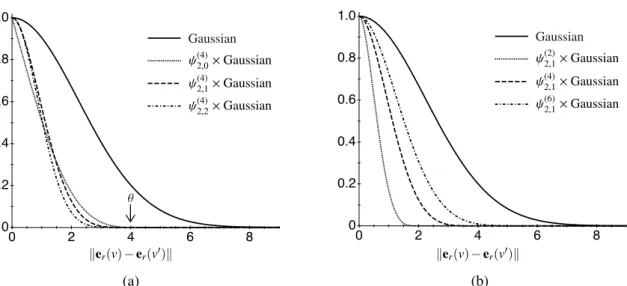
Figure 3.1 Plots of the Gaussian kernel with a width parameter of γ = 0.1 (solid line) and the CS kernelsψ(θ)2,c× Gaussian with respect to (a) the smoothing parameter c and (b) the cut-off distanceθ.
This construction has been proposed in a general machine learning context to yield a sparse Gram matrix without destroying the positive definiteness of any RBF kernel.61 The Wend- land functions ψd,c are defined for the dimension d of input variables and the smoothing parameter c, and tend to zero when the L2 distance ||er(v) − er(v′)|| is beyond a cut-off distance θ. With this construction, katom can smoothly decay to zero at θ without losing positive definiteness.62
More specifically, the Wendland functions are defined as
ψd,c(z) = Icψ⌊d/2⌋+c+1(z), c = 0, 1, 2, . . . ,
with the truncated polynomial
ψs(z) = (1 − z)s+=
(1 − z)s, 0 ⩽z < 1,
0, z ⩾ 1,
and the integral operator
I[f](z) =
∫∞
z
xf(x)dx, z ⩾ 0,
where⌊·⌋ denotes the largest integer less than or equal to the argument, and Icindicates the I-operator that is applied c times and transforms the function ψs to a smoother function. These functions are positive definite on Rd ford ⩽ 2s − 1. We can compute the functions ψd,cford = 2 and c = 0, 1, 2 directly by the explicit form63
ψ2,0(z) = (1 − z)2+,
ψ2,1(z) = (1 − z)4+(4z + 1),
ψ2,2(z) = (1 − z)6+(1 + 6z +353z2).
In Figure 3.1 the Gaussian kernel and the modified kernels with compact support using the Wendland functions ford = 2 with varying c and θ are shown. Since c is irrelevant to the sparsity ofψd,c as shown in Figure 3.1, we fixc = 0 in this thesis.
The compact support property ofkatomeliminates the redundant matches between atoms that have intrinsically different local environments. This will ensure the detection of pairs of chemically meaningful tree-patterns in two molecular graphs.
3.3 Importance Weight Extension
Another important consideration is to determine the weight w(p) of a tree-pattern p. We assign an importance weight to each tree-pattern according to the overall statistical signifi- cance of the constituent atoms for a given classification or regression task.
In the case of a classification task, the chi-square (χ2) statistic is used to measure the statistical significance of the atoms. Each atomv is characterized by another atom environ- ment labelar(v)∈ Z. As described later herein, ar(v) encodes information on a neighboring
3.3 Importance Weight Extension 26
Table 3.1 Two-way Contingency Table of Atom Environment Labela and Class Label ca
c ¬c ∑row
a A B A + B
¬a C D C + D
∑column A + C B + D N
aThe rows symbolize the presence and absence of the atom environment labela and the columns are the class labels (positive classc and negative class¬c).
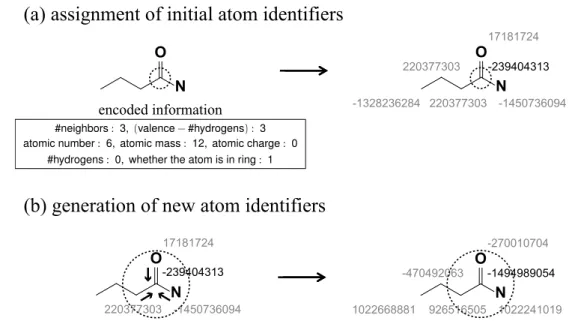
substructure of a topological radiusr centered at atom v using a Morgan type algorithm.31 Using a two-way contingency table (Table 3.1), where the rows signify the presence and ab- sence of the atom environment labelar(v) = a and the columns are the class labels (positive class c and negative class¬c), the association of a with the class labels can be evaluated with theχ2statistic
χ2(a) = N(AD − BC)
2
(A + C)(A + B)(B + D)(C + D),
whereA is the number of samples in which a and c co-occur, B is the number of samples in whicha occurs without c, C is the number of samples in which c occurs without a, D is the number of samples in which neitherc nor a occurs, and N is the total number of (training) samples. The value ofχ2(a) indicates the importance of atoms that have atom environment labela for the task of interest. Thus, the χ2statistic allows the identification of atoms with the ability to distinguish between two class labels. The weight of tree-patternp is then given by
w(p) =∏
v∈p
w(aˆ r(v))
with
w(aˆ r(v)) =
λα, ifχ2(ar(v)) ⩾ τ, λβ, otherwise,
, 0< λβ⩽λα< 1, (3.3)
whereτ is a χ2 threshold. Onceτ is given, the significant atoms satisfying χ2(ar(v)) ⩾ τ are determined and have weightλα, and the other atoms have a relatively small weightλβ. The importance weightw(p) is expressed as the convolution of weight ˆw(ar(v)) over the constituent atoms. The binarized atomic weights allows for easy visualization of significant atoms in a specific molecule, as seen in later.
In the case of a regression task, Welch’st-test is used to assess the statistical significance of each atom with atom environment label a. Given two groups 1 and 2 of observations from molecules with and without a, the association of a with the task can be assessed by thet-statistic
t(a) = | ¯y1− ¯y2|
(var(y1)/n1+ var(y2)/n2
)1/2,
where ¯yi, var(yi), and ni are the sample mean, sample variance, and sample size in the group i. Using t(a) instead of χ2(a) in eq 3.3, the tree weights for regression can be determined in the same manner as above.
For each tree-patternp, we denote the number of atoms found to be significant and less significant asnα(p) and nβ(p), respectively. The AE kernel then becomes
kAE,h(G, G′) = ∑
T∈Th
∑
p∈PT(G)
∑
p′∈PT(G′)
λnαα(p)+nα(p′)λnββ(p)+nβ(p′)
∏
(v,v′)∈A(p,p′)
katom(er(v), er(v′)).
(3.4)
The atom-level kernels preserving positive definiteness are closed under tensor product and non-negative linear combinations.64 The AE kernel is therefore positive definite.
In the case of unsupervised learning tasks, including cluster analysis and principal com- ponents analysis, the AE kernel could be applied by using prior knowledge on the impor- tance of the atoms. In the case where a given pharmacophore set (e.g., hydrogen-bond acceptor and donor, hydrophobic, etc.) is used, if an atom plays the pharmacophore role, the atom is given a higher weightλα. Alternatively, subject to a uniform weightλα= λβin