Enhancements of the offline improvement in human motor skill
Sho Sugawara
DOCTOR OF PHILOSOPHY
Department of Physiological Sciences
School of Life Science,
The Graduated University for Advanced Studies
Table of Contents
1. Summary ‥‥‥‥‥‥‥‥‥‥‥‥‥‥‥‥‥‥‥‥‥‥‥‥‥‥ 1
2. Introduction ‥‥‥‥‥‥‥‥‥‥‥‥‥‥‥‥‥‥‥‥‥‥‥‥‥‥ 5
3. Study1: Sleep in children facilitates the offline improvement in motor skill ‥ 8
3.1 Introduction ‥‥‥‥‥‥‥‥‥‥‥‥‥‥‥‥‥‥‥‥‥‥‥ 8
3.2 Methods & Materials ‥‥‥‥‥‥‥‥‥‥‥‥‥‥‥‥‥‥‥‥ 11
3.3 Results ‥‥‥‥‥‥‥‥‥‥‥‥‥‥‥‥‥‥‥‥‥‥‥‥‥ 15
3.4 Discussion ‥‥‥‥‥‥‥‥‥‥‥‥‥‥‥‥‥‥‥‥‥‥‥‥ 18
4. Study 2: Social rewards enhance the offline improvement in motor skill ‥‥ 22
3.1 Introduction ‥‥‥‥‥‥‥‥‥‥‥‥‥‥‥‥‥‥‥‥‥‥‥ 22
3.2 Methods & Materials ‥‥‥‥‥‥‥‥‥‥‥‥‥‥‥‥‥‥‥‥ 24
3.3 Results ‥‥‥‥‥‥‥‥‥‥‥‥‥‥‥‥‥‥‥‥‥‥‥‥‥ 33
3.4 Discussion ‥‥‥‥‥‥‥‥‥‥‥‥‥‥‥‥‥‥‥‥‥‥‥‥ 38
5. Conclusion ‥‥‥‥‥‥‥‥‥‥‥‥‥‥‥‥‥‥‥‥‥‥‥‥‥‥ 43
6. Acknowledgement ‥‥‥‥‥‥‥‥‥‥‥‥‥‥‥‥‥‥‥‥‥‥‥ 46
7. References ‥‥‥‥‥‥‥‥‥‥‥‥‥‥‥‥‥‥‥‥‥‥‥‥‥‥ 48
8. Tables ‥‥‥‥‥‥‥‥‥‥‥‥‥‥‥‥‥‥‥‥‥‥‥‥‥‥‥‥ 61
9. Figures ‥‥‥‥‥‥‥‥‥‥‥‥‥‥‥‥‥‥‥‥‥‥‥‥‥‥‥‥ 65
Summary
People acquire a lot of motor skills in life, and acquired skills are frequently
used in everyday. Many people probably hope to learn the skills as fast and easy as
possible. Motor skills are initially acquired across the training, and then are
sophisticated over time. The term of consolidation is described as the process that
converts newly acquired fragile memory into more robust and stable forms (Robertson
et al., 2004). Consolidation has a critical role in long-term skill retention (Karni et al.,
1995; Brashers-Krug et al., 1996). Specifically, for procedural skill, offline
improvement refers to the skill improvements that occur between practice sessions
without physical practices, and is thought to be a form of skill consolidation (Walker et
al., 2002, 2003; Fishcer et al., 2002). Therefore, the goal of current project was to
clarify the enhancement factors for the offline performance improvements in human
motor skill. To accomplish this goal, I focused sleep and social rewards as potential
enhancing factors, and conducted two independent behavioral studies to determine the
effect of these factors in offline skill improvements.
First, sleep is necessary for certain skill consolidation in adults (Walker,
2005; Stickgold, 2005; Diekelmann & Born, 2010). On the other hand, it remains
debatable whether skill consolidation benefits from sleep in children as well as in adults
(Fisher et al., 2007; Wilhelm et al., 2009). In Study 1, I focused on the offline
improvement, which is one type of skill consolidation and has been known to depend on
the sleep in adults. Here, I investigated whether in children, sleep duration after motor
training was correlated with the rate of offline improvement. On first day, 9 (n = 14)
and 11 years-old children (n = 10) trained a sequential finger tapping skill (Walker et al.,
2002, 2003). Their parents observed and recorded their children’s sleep duration after
this training. On the next day, to assess the rate of offline improvement, all children
performed a surprise retest session for previously trained sequence. My present data
indicated that in both 9 and 11 years-old children, skill performance significantly
improved at first retest session relative to that at the end of training on previous day (p
< .0001), confirming that offline performance improvement took place, and the rate of
this improvement was significantly correlated with the sleep duration during the night
after the training (β = 0.60, p < .01). Consequently, I conclude that in children as well as
adults, sleep is associated with a type of skill consolidation.
Second, praise, a social reward, is thought to boost motor skill learning by
increasing motivation, which leads to increased practice (Catano, 1975; Henderlong &
Lepper, 2002). However, the effect of praise on consolidation is unknown. In Study 2, I
tested the hypothesis that praise following motor training directly facilitates skill
consolidation. Forty-eight healthy participants were trained on a sequential
finger-tapping task. Immediately after training, participants were divided into three
groups according to whether they received praise for their own training performance
(Self group, n = 17), praise for another participant’s performance (Other group, n = 15),
or no praise (No-praise group, n = 16). Participants who received praise for their own
performance showed a significantly higher rate of offline improvement (19.95 ± 1.85%)
relative to other participants (Other: 13.14 ± 1.82%, p < .05; No-praise: 13.14 ± 1.82%,
p < .05) when performing a surprise recall test of the learned sequence. On the other
hand, the average performance of the novel sequence and randomly-ordered tapping did
not differ between the three experimental groups (ps > 0.60). These results are the first
to indicate that praise-related improvements in motor skill memory are not due to a
feedback-incentive mechanism, but instead involve direct effects on the offline
consolidation process.
In conclusion, I found two important factors that benefit the skill consolidation. In
Study 1, post-training sleep durations were positively correlated to the rate of offline
performance improvement in children, suggesting that sleep is the important in children
as well as in adults. In Study 2, I found that social rewards directly enhance skill
consolidation in humans, suggesting that they have a novel functional effect on the
human motor memory system.The current general conclusion is that praise for skill
performance and subsequent nocturnal sleep could enhance the rate of offline skill
consolidation in at least one type of motor skill such as sequential finger-tapping.These
present findings might contribute to develop protocols to improve motor skills in
educational and rehabilitative contexts.
Introduction
In real life, people use a lot of skills including writing, typing, sports, and
musical instruments. Most people might hope to mastery a lot of skills as fast and easy
as possible. Motor skill memory is first encoded online in a fragile form during practice
and then converted into a stable form by offline consolidation, which is the behavioral
stage critical for successful skill formation (Karni et al., 1995; Brashers-Krug et al.,
1996). Here, I focused on two potential contributing factors to enhance the offline
consolidation in human motor skill.
One factor is sleep after the skill acquisition. In healthy adults, there are the
mounting evidences showing that post-training sleep benefits the certain type of skill
consolidation such as sequential finger-tapping movements (Walker et al., 2002; Fischer
et al., 2002; Debas et al., 2010) and visual discrimination (Karni et al., 1994; Stickgold
et al., 2000). Moreover, the degree of skill consolidation is associated with the total
sleep duration (Stickgold et al., 2000) and the specific sleep architectures such as
non-REM 2 sleep (Walker et al., 2002; Nishida & Walker, 2007) and sleep spindles
(Nishida & Walker, 2007; Morin et al., 2008; Barakat et al., 2011). On the other hand,
despite children train a lot of skill in everyday and have longer sleep durations relative
to adults (Largo et al., 2001), there is no evidence to indicate the effect of sleep for the
skill consolidation in children. Previous behavioral evidences showed that over 9-year
old children exhibited the significant offline performance improvements at 24-hour after
skill training (Dorfberger et al., 2007, 2009). Therefore, in present project, I
investigated the hypothesis whether longer sleep durations facilitate the degree of
offline performance improvements, which is a type of skill consolidation, in elementary
school children or not.
Another factor is praise for own skill performance.In real-life skill acquisition,
people generally believe that praise for good performance results in further skill
improvements. Behavioral evidence indicates that social rewards such as praise
accelerate performance during training, possibly via an information feedback-incentive
mechanism (Adamas, 1972; Catano, 1975). However, the effects of praise on skill
consolidation are not known. The process of skill consolidation is based on plastic
changes in the cortico-striatal loop (Doyon et al., 2003; Penhune et al., 2002; Debas et
al., 2010), which relies on enhanced dopamine transmission (Calabresi et al., 2007). A
recent human neuroimaging study demonstrated that praise activates reward-related
areas of the brain, specifically the ventral striatum (Izuma et al., 2008), which is mainly
involved in dopamine transmission (Zald et al., 2004). These data led me to hypothesize
that praise influences the skill consolidation process directly, as opposed to indirectly
through motivating further practice.
The goal of current project was to clarify the potential factors enhancing the
offline skill consolidation. Thus, I performed two independent behavioral studies to
investigate above-mentioned hypotheses. In Study 1, I investigated whether
post-training sleep durations were positively correlated with the degree of offline
improvements in 9 and 11 year-old children. In Study 2, I determined the effect of
praise for own skill performance in the offline skill consolidation. Accomplishment of
present goal might contribute to develop the novel educational and rehabilitational
programs, as well as to further understanding the skill consolidation process.
Study 1
Sleep in children facilitates the offline improvement in motor skill
3.1 Introduction
Newly acquired skills become more robust, stable states over time
(consolidation; Karni et al., 1993, 1995; Brashers-Krug, 1996; Robertson et al., 2004).
Offline improvement refers to the skill improvements that occur between practice
sessions without physical practices, and is thought to be a form of skill consolidation. It
is well known that sleep has a most benefit to the offline improvement in skill
consolidation in healthy adult human (Stickgold et al., 2000; Walker et al., 2002, 2003;
Fischer et al., 2002). Moreover, the rate of offline improvement is positively correlated
with the total duration of sleep (Stickgold et al., 2000) or with the percentage of specific
sleep stage, specifically non-rapid eye movement sleep stage 2 (NREM stage 2; Walker
et al., 2002; Nishida & Walker, 2007).
As well as adults, previous studies have shown that children exhibit robust
offline improvement in motor sequential learning (Dorfberger et al., 2007, 2009).
However, there are several evidences indicating that offline improvement in children
did not required for the sleep, suggesting that children’s ability for skill consolidation
was different with the adults’ one (Fischer et al., 2007; Prehn-Kristensen et al., 2009;
Wilhelm et al., 2008). On the other hands, these studies had differences in response to
the adapted task and children’s ages. Therefore, the purpose of this study was to
examine the relationship between sleep and skill consolidation with explicit
considerations of children’s age and motor-training task. Specifically, the present study
firstly investigated the hypothesis that sleep duration after motor sequential training was
positively correlated with the rate of offline improvement in 9 and 11 year-old children
that exhibited robust offline improvement (Dorfberger et al., 2009, 2012), using the
sequential finger-tapping task repeatedly reported sleep-dependent offline improvement
in adults (Walker et al., 2002, 2003; Fischer et al., 2002).
To complete this purpose, 9 and 11 year-old children participated in this study
for two consecutive days. All children were trained in the modified version of
sequential finger-tapping task on day 1 (LRN1; Walker et al., 2002, 2003). After 24-h
retention interval including sleep, all children performed the retest of the trained
sequence on day 1 (LRN2). Their sleep duration was observed with their parents. In
present study, the offline improvement was defined by the percent improvements from
LRN1 to LRN2. Here, based on the previous findings in healthy adult study (Karni &
Sagi, 2003; Stickgold et al., 2000; Walker et al., 2002, 2003; Fischer et al., 2002), we
hypothesized as following: (1) more than 9 year-old children exhibited the significant
improvement after 24-h intervals including sleep (Stickgold et al., 2000; Walker et al.,
2002; Fischer et al., 2002); (2) the rate of offline improvement was positively correlated
with the sleep duration during the night after motor training (Stickgold et al., 2000;
Walker et al., 2002).
2.2 Materials and Methods
Participants
Twenty-five children (14 male and 11 females, mean [M] ± standard
deviation [SD] = 9.48 ± 1.16 years) participated in this study. According to Edinburgh’s
Laterality Quatient (LQ), one female was excluded from analyses (LQ = -1.00). Thus,
data from 24 right-handed children (14 male and 10 females; M ± SD = 9.42 ± 1.14
years; Edinburgh’s LQ, M ± SD = 0.89 ± 0.23) were used for analysis. Participants
came to the laboratory on two subsequent days (9 year-old, n = 14; 11 year-old, n = 10).
None of participants had a history of neurological, psychiatric, or sleep disorders. The
experiment approved by the institutional ethics committee, and informed parental
consent was obtained.
Experimental procedure
All participants trained on a modified version of sequential finger-tapping
task on day 1. The original version of sequential finger tapping task required
participants to press four numeric keys on a standard computer keyboard repeatedly
with the fingers of their non-dominant (left) hand as quickly and as accurately as
possible for 30-s periods (for details, see Walker et al., 2002, 2003). Given that
finger-tapping speed depends on age (Largo et al., 2001), here, the modified version of
this task required children to press three keys with the three fingers: index, middle, and
ring finger. A white asterisk appeared on a computer monitor at one of three possible
positions within an equally spaced horizontal array. Each of the three positions
corresponded to one of the three buttons on a numeric keyboard. The stimuli were
presented repeatedly for 30 s in the sequence used in the task. On day 1, participants
trained on sequence A (LRN1; “3-1-2-1-3”). After the training, all participants received
visual feedback about their training performance (for example, their learning curve). On
the following day, all participants performed a retest of the trained sequence (LRN2).
Finger tapping performance was evaluated by the number of correctly tapped
sequences per 30-s trial. The offline improvement following a night of sleep was
defined as the percent increase in mean performance from the last three trials during
training (LRN1) on day 1 compared with the first three retest trials (LRN2) on day 2
(Walker et al., 2002; Nishida & Walker, 2007; Debas et al., 2009). Training on day 1
consisted of twelve 30-s trials with 30-s rest periods between trials, whereas the retest
on day 2 consisted of five trials with the same rest interval.
Sleep duration and additional ratings
To examine the effect of sleep duration on the offline improvements in motor
skill, participants’ parents were asked to observe and report the time that their children
went to bed on the nights before and after training, and the time that they woke up on
the training and retest mornings (Stickgold et al., 2000).
It was possible that participants’ subjective states during training or retest
might influence their performance. Thus, at the end of the training and retest periods, all
participants completed questionnaires about their subjective ratings of alertness (1 = not
at all, 10 = very drowsy), concentration (1 = not at all, 10 = very concentrated), and
fatigue (1 = high level of fatigue, 10 = no fatigue) during training and retest using a
ten-point scale.
Data analysis
Statistical analyses were based on the general linear model using analyses of
variance (ANOVAs) for independent and repeated measures. Then, the rate of offline
improvement was compared between two age groups using unpaired t-tests (two-tailed).
To evaluate the effect of sleep on skill consolidation, multiple regression analyses on
the rate of offline improvement as dependent variable and age, sleep durations during
night after training (hour), and time intervals from wake-up to perform the retest (hour)
as independent variables were conducted, respectively. All analyses were performed in
SPSS 19.0. For all analyses, the significance level was p < 0.05.
2.3 Results
Performance changes between days and after new learning
Present data indicated that skill performance significantly improved during
24-hours retention intervals without physical practice, confirming that offline
improvement took place (Robertson et al., 2004; Walker et al., 2005). We conducted the
Group (between factor; 9 vs 11 year-old)×Session (within factor; LRN1 vs LRN2)
ANOVA. In results, there was a significant main effect of Group, indicating that 11
years children exhibited the greater overall performance relative to 9 years children
(ANOVA, F1,22 = 5.47, p < 0.05; Fig. 1A). Main effect of Session was also significant,
confirming that mean performance across the initial three trials at retest was greater than
that across the last three trials at training (enhancement; F1,22 = 56.12, p < 0.001).
Indeed, planed group-separated ANOVA indicated that 9 and 11 year-old children
exerted higher retest performance than at the end of training, respectively (9 year-old,
ANOVA, F1,13 = 21.93, p < 0.001; 11 year-old, F1,9 = 40.98, p < 0.001; Fig. 1B). There
was no significant interaction (F1,22 = 0.86, p = 0.36), and planed group comparisons
showed that the rate of offline improvement did not significant differ between two-age
groups (unpaired two-tailed t-test, t22 = -0.18, p = 0.86).
The relationship between the rate of gains and sleep durations
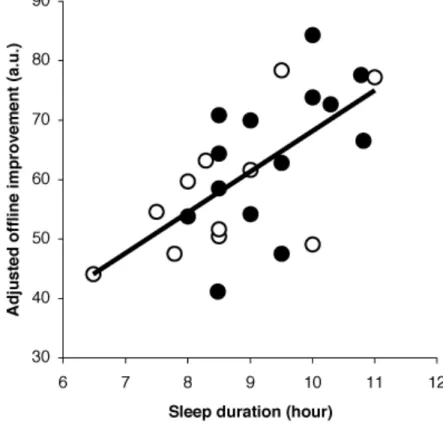
Our present data showed that the total sleep duration after skill training was
significantly correlated with the rate of offline improvement. Multiple regression
analyses were conducted on the rate of offline improvement as dependent variable and
age, sleep durations during night after training (hour), and time intervals from wake-up
to perform the retest (hour) as independent variables. As a result, sleep duration during
night after training had a significant positive effect for the rate of offline improvement
(regression analysis, β = 0.60, p < .01 ; Fig. 2), but not age (β = 0.27, p = 0.18) or time
intervals since wake-up (β = 0.24, p = 0.23).
Additional subjective ratings: fatigue, concentration, and sleepiness
Additional subjective ratings (that is, sleepiness, concentration, and fatigue)
did not significantly differ between two age groups and days, and influenced the rate of
offline improvement. We compared subjective rating scores between groups and days
using Group (between factor; 9 vs 11 year-old)×Day (within factor; day 1 vs day 2)
ANOVA. There were no main effects for all rating scores (ANOVA, ps ≥ 0.52).
However, Group×Day interaction for concentration rating was a marginal significant
(F1,22 = 3.41, p = 0.08) but not for sleepiness or fatigue ratings (ANOVA, ps ≥ 0.42). To
evaluate the effects of sleep durations under consideration of difference of concentration,
the difference of concentration between days was added into multiple regression
analyses as independent variable. Nevertheless, there was certain positive effect of sleep
durations on the rate of offline improvement (regression analysis, β = 0.61, p < 0.01).
2.4 Discussions
9 and 11 year-old children showed the significant offline performance
improvement across the night after motor training. These results are consistent with
previous studies (Dorfberg et al., 2007, 2009), indicating that children have a capability
of the skill consolidation without physical training. Although the overall performance
was significantly greater in the 11 year-old children than that in the 9 year-old children,
the rate of offline improvement did not differ between both age groups. Linear
regression analyses shown that the degree of offline improvement was positively
correlated with the sleep duration across the night after the training. Taken together,
these results suggest that in children sleep is related with a type of skill consolidation.
Most studies have demonstrated that offline skill improvement process
depends on sleep (Walker et al., 2002, 2003; Fischer et al., 2002; Nishida & Walker,
2007; Debas et al., 2010; Doyon et al., 2009; Backhaus et al., 2006). Here, we firstly
showed that sleep duration after skill training was positively correlated with the degree
of offline improvement in children. Present observations consist with previous adult
human study (Stickgold et al., 2000). Using the visual discrimination task, Stickgold
and his colleagues has shown that the performance improvements between practice
sessions was positively correlated with the total sleep durations during the night
between practices, suggesting that sleep is necessary for the skill consolidation.
Previous sleep-wake studies in children have shown that declarative memory
in children benefit from sleep but skill consolidation does not (Fischer et al., 2007;
Prehn-Kristensen et al., 2009; Wilhelm et al., 2008). Present results are inconsistent
with these studies, suggesting that sleep is related to the skill consolidation in children.
Although we could not absolutely explain this inconsistency, present study differs with
previous studies in respect of at least task and age. Fischer et al. (2007) and
Prehn-Kristensen et al. (2009) used to the implicit motor learning task. Because the
benefit of sleep on the implicit motor training has been controversial (Robertson et al.,
2004; Nemeth et al., 2010), this difference might contribute to the discrepancy between
our results and previous studies. Alternatively, Age differences might be another
contributing factor in this discrepancy. Wilhelm et al. (2009) used to the sequential
finger-tapping task, in which was used present study and the benefit of sleep is
repeatedly demonstrated. However, their children were the 6 to 8 year-old, whereas
children in this study were the 9 to 11 year-old. We speculate that participant’s age
results in the different results in respect with the effect of sleep in skill consolidation.
Previous review literatures have suggested that sleep has an important role only in the
hippocampus-dependent memory (Deikelmann et al., 2009, 2010). Also, hippocampus
is involved in the explicit motor learning such as a sequential finger-tapping task
(Thomas et al., 2004; Schendan et al., 2003). Because hippocampal function seems to
be rapidly growing up between 8 and 10 year-old (Townsend et al., 2010), the age of
children might be a critical factor contributing to the benefit of sleep in the skill
consolidation. Future study should be designed to examine the benefit of sleep on
procedural skill consolidation across different age groups.
In present study, sleep duration after motor skill training was observed and
recorded by participants’ parents and was not directly measured across the sleep periods.
A previous adult study based on the subjective report has showed that total sleep
duration was significantly correlated with the offline improvements of perceptual skill
performance (Stickgold et al., 2000). Therefore, we believe that the sleep duration
measurement used in this study could allow us to investigate the correlation between
sleep duration and the degree of offline improvements at least to some extent in a
reliable way. Recent adult human studies have reported that the rate of offline
improvements during sleep is correlated with the specific sleep architectures such as a
non-rapid eye movement sleep 2 or sleep spindles rather than with total sleep duration
(Walker et al., 2002, 2003; Tucker et al., 2009; Barakat et al., 2011). These evidences
encourage the future children studies to elucidate the relationship between the specific
sleep architectures during sleep after skill training and the rate of skill enhancement
using more direct measurement such as polysomnography.
In summary, present results firstly show that sleep duration after skill leaning
is positively correlated with the offline skill consolidation in children. Therefore, sleep
seems to be a critical role in skill consolidation in children as well as adults. Given that
children train a lot of skill in everyday, understanding the ability of motor skill learning
in children might contribute not only their school performance but also to develop the
educational and welfare programs.
Study 2
Social rewards enhance the offline improvement in motor skill
4.1 Introduction
Praise is the positive evaluation of another’s products, performance, or
attributes, where the evaluator presumes the validity of the standards on which the
evaluation is based (Kanouse et al., 1981). Praise can boost self-efficacy (Bandura,
1977, 1997) enhance feelings of competence and autonomy (Deci & Ryan, 1983), create
positive feelings (Blumendeld et al., 1982), strengthen the association between
responses and their positive outcomes (O’Leary & O’Leary, 1977), and provide
incentives for task engagement (Madsen et al., 1977). In motor skill learning, for
example, praise is hypothesized to provide feedback about the level of participant
competence (Catano, 1975), which serves as an incentive to enhance practice efforts
(Steers & Porter, 1974). Thus, praise accelerates motor skill performance by enhancing
motivation (Catano, 1975; Adam, 1972; Henderlong & Lepper, 2002). This is
reasonable because motor skills are initially acquired by repeatedly performing an
action during practice. However, learning a motor skill continues to evolve once
practice ends (Karni et al., 1995; Brashers-Krug et al., 1996; Muellbacher et al., 2002)
through consolidation, which is essential for skill formation and long-term retention
(McGaugh, 2000; Walker & Stickgold, 2004; Robertson et al., 2004). There have been
no investigations into the effects of praise on skill consolidation. Here, we hypothesize
that praise influences the skill consolidation process directly, as opposed to indirectly
through motivating further practice.
In the present study we tested this hypothesis through a behavioral experiment
designed to manipulate both the timing of the praise given and the participants’
expectation of a future test. First, to examine the effects of praise on offline rather than
online performance improvements during training, participants were praised only after
training was completed. Second, after a 24-h retention interval, all participants
performed a ‘‘surprise’’ retest of the trained sequence. This minimized the possibility
that the participants either physically or mentally practiced the trained sequence prior to
the retest. These special considerations allowed us to investigate the direct benefits of
praise on skill consolidation.
4.2 Materials and Methods
Participants. Written informed consent was obtained from all participants before
participation in the experiment and the study conducted according to the Declaration of
Helsinki. If participant was a minor (i.e., 18 or 19 year-old), two different experimenters
ensured their ability to make decision and obtained their written informed consent to the
participation of this experiment, which were approved by the internal review board of
Research Center for Advanced Science and Technology, The University of
Tokyo. Fifty-eight healthy volunteers (39 male and 19 females, mean [M] ± standard
deviation [SD] = 22.6 ± 4.67 years) participated in this study. None of the participants
had a history of neurological, psychiatric, or sleep disorders, and none had had previous
training in playing the piano. Based on interviews after the experiments, five
participants were excluded from the analyses because they physically or mentally
practiced the trained motor sequence after the end of training on day 1. Another five
participants were excluded because they noticed or suspected that the evaluation movies
that they watched were predetermined. Thus, data from 48 participants (35 males and 13
females; M ± SD = 22.8 ± 5.17 years) were used for analysis (Self group, n = 17; Other
group, n = 15; No-praise group, n = 16).
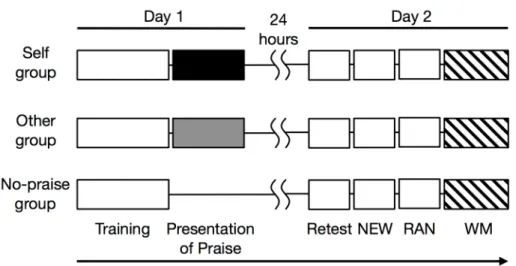
Experimental Procedure. Participants came to the laboratory on two subsequent days.
All participants trained on a sequential finger-tapping task (Karni et al., 1995; Debas et
al., 2010; Walker et al., 2002, 2003; Fischer et al., 2002; Korman et al., 2007; Manoach
et al., 2004) on day 1. The participants were told that evaluators in another room were
monitoring their performance through a web camera above the computer monitor, and
would comment on their performance after training. However, in reality, their
performance was not monitored. After training, all participants received visual feedback
about their performance (for example, their learning curve). The participants were then
divided into three groups to systematically manipulate the praise that they experienced:
1) participants who watched a movie in which evaluators praised their training
performance (Self group); 2) participants who watched the same movie as the Self
group, but who were told that it reflected the evaluation of another participant’s
performance (Other group); and 3) participants who did not watch the movie and who
received no praise (No-praise group).
Unbeknownst to the participants, the contents of the movie were
predetermined and prerecorded, with actors and actresses portraying the evaluators. At
the end of the experiment on day 1, participants were told that they would perform a
different task on the next day. On the following day, however, all participants
performed a “surprise” retest of the trained sequence; this was intended to minimize the
possibility that the participants either physically or mentally practiced the trained
sequence prior to the retest, or that those in the Self group, in particular, were more
motivated to perform the tasks on day 2. We then examined the effect of the
manipulation of praise on the retest performance of the trained sequence.
After the retest, the participants also performed a non-trained sequence, a
randomly-ordered tapping task and completed a working memory task. These additional
tasks were included to investigate whether the effects of praise were specific to the
offline improvement in the trained sequence or induced a more general feeling of
happiness that increased motivation to perform well on day 2. If praise enhanced
general motivation in the Self group, performance on all additional tasks on day 2
should be better in the Self group than in the Other and No-praise groups.
Sequential Finger Tapping Task. The sequential finger tapping task required
participants to press four numeric keys on a standard computer keyboard repeatedly
with the fingers of their non-dominant (left) hand as quickly and as accurately as
possible for 30-s periods (for details, see Walker et al., 2002, 2003). On day 1, one-half
of the participants trained on sequence A (“4-1-3-2-4”), whereas the others trained on
sequence B (“2-3-1-4-2”). Training on day 1 consisted of 12 30-s trials with 30-s rest
periods between trials, whereas the retest on day 2 consisted of five trials with the same
rest interval.
Finger tapping performance was evaluated by the number of correctly tapped
sequences per 30-s trial. The offline performance improvement following a night of
sleep was defined as the percent increase in mean performance from the last three trials
during training on day 1 compared with the first three retest trials on day 2 (Debas et al.,
2010; Walker et al., 2002; Fischer et al., 2002; Korman et al., 2007; Manoach et al.,
2004).
On day 2, participants also performed the sequence that they had not received
training on during day 1 (that is, a participant who trained on sequence A on day 1
performed sequence B on day 2), and the randomly-ordered tapping task, in which
stimuli were presented in a random order. Both tasks consisted of five 30-s trials with a
30-s rest period between trials. Performance for the non-trained sequence (NEW) and
the randomly-ordered (RAN) tapping was calculated based on the mean number of
correctly tapped sequences (NEW) or correctly pressed buttons (RAN) during the five
trials.
Manipulation of Praise. After the training on day 1, participants in the Self and Other
groups watched a movie in which evaluators praised the training performance. We
adopted a movie instead of live praise because predetermined movie can totally control
out the variability of evaluators’ comments and non-verbal information such as facial
expression and intonation. Participants in the Self group were told that the movie
represented the evaluation of their own performance during training. The movie
consisted of three components: one introduction clip, 12 evaluation clips, and happiness
ratings for each clip. In the introduction clip, a man greeted the participant by name to
make the evaluation appear more believable and meaningful. Each movie clip was
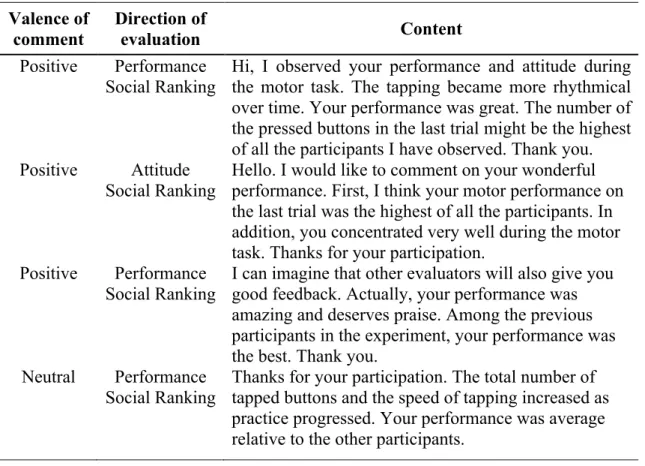
pre-recorded using six actors and six actresses. Ten movie clips contained positive
feedback, and two neutral movie clips were included to maintain the attention of
participants by making the evaluation less predictable.
In the evaluation movies, praise was directed at the participant’s training
performance, their attitude during training, or their social ranking relative to other
participants (see Table 1 for examples of evaluators’ comments used in this
experiment). To rule out the possibility that simply watching the movie might influence
the offline improvement in motor skill, we included the Other group, in which
participants watched the same movie clips but were told that they represented the
evaluation of another participant’s training performance. In the introduction clip seen by
the Other group, a man used another participant’s name. In both the Self and Other
groups, regardless of the target of praise, the participants were asked to rate how happy
they felt upon watching each movie clip using a seven-point scale (1 = very unhappy, 4
= neutral, and 7 = very happy; the responses for one participant were not collected due
to technical difficulties). The order of the evaluation clips was fixed across participants.
After the experiment on day 2, the participants were interviewed to determine
whether they had any doubts about the evaluation movies they watched. After this, all
participants were fully debriefed.
Working Memory Task. A subset of the participants (n = 35) performed an object
working memory task on day 2. A previous study indicated that performance on
working memory tasks is highly sensitive to a participant’s motivational state (Taylor et
al., 2004). In the delayed-matching working memory task, participants were asked to
remember three irregular polygons, and were then required to decide while whether a
probe stimulus matched any of the three target stimuli (for details, see Taylor et al.,
2004). The task was presented in a total of 84 trials.
Alertness, Concentration, and Fatigue During Training and Retest. As it was possible
that the subjective state of the participants during training and retest might influence
their performance, they completed questionnaires to rate their level of alertness
(Stanford Sleepiness Scale rating, Hoddes et al., 1973, translated into Japanese),
concentration (1 = not at all, 7 = very concentrated), and fatigue (1 = high level of
fatigue, 7 = no fatigue, Hummel et al., 2005) using a seven-point scale at the end of the
training and retest periods.
Sleep Duration and Quality the Nights Before and After Training. Because sleep
plays an important role in the offline improvement of motor skills (Walker & Stickgold,
2004; Walker et al., 2002, 2003; Fishcer et al., 2002; Debas et al., 2010), sleep duration
the night after training was measured by subjective reports and actimetry. Participants
were also asked to report the time that they went to bed both the night before and after
training, and the time that they woke up on the training and retest mornings. In addition,
to confirm the validity of the subjective sleep-duration reports, the physical activity of a
subset of participants (n = 26, due to the limited number of available actimetry sensors)
was measured from the end of training to the retest time using a standard actimetry
sensor. There was a significant correlation between the duration of sleep reported by the
participant and that measured by actimetry (Pearson’s correlation, r26 = 0.81, p <
0.0001), confirming that the duration of sleep calculated from the subjective reports was
reliable. We defined sleep quality as the percentage of true sleep epochs relative to the
total sleep intervals automatically determined by AW2 software (Ambulatory
Monitoring, Inc., New York).
Statistical Analysis. Statistical analyses were based on a general linear model using
analyses of variance (ANOVAs) for independent or repeated measures. Dunnett’s test
(two-tailed; compared with the Self group) was adopted for multiple-planned
comparisons (Dunnett, 1955; Hsu, 1996), based on the hypothesis that the offline
improvement in motor skill in the Self group was significantly greater than in the Other
and No-praise groups. Analysis of happiness ratings was performed using unpaired
t-tests (two-tailed). All analyses were performed using SPSS 19.0 software and the level
of significance was p < 0.05.
4.3 Results
Performance of the trained sequence. Forty-eight right-handed participants came to
the laboratory on two subsequent days (Fig. 3). All participants were trained on a
sequential finger-tapping task, for which offline improvement (a form of consolidation)
has been described elsewhere (Walker & Stickgold, 2004; Robertson et al., 2004;
Walker et al., 2002, 2003; Fishcer et al., 2002; Debas et al., 2010). Performance was
defined as the number of correctly tapped sequences per 30-s trial. Immediately after
training, in order to manipulate praise as an independent variable, participants were
divided into three groups (Fig. 4): in the “Self group” (n = 17), participants watched a
movie in which the evaluators praised their own performance; in the “Other group” (n =
15), participants watched the same movie as the Self group, but were told that it
represented the evaluation of another participant’s performance; and in the “No-praise
group” (n = 16), participants neither watched the movie nor received praise. Participant
happiness after watching the clips was subjectively assessed using a seven-point scale
(1 = very unhappy, 4 = neutral, 7 = very happy) and the ratings were significantly
higher (happier) than 4 (the midpoint) in the Self group (black bar; one-sample t-test, t16
= 12.11, p < 0.0001) and the Other group (gray bar; one-sample t-test, t12 = 4.58, p <
0.001). To control out the positive word effect (Hamann & Mao, 2002), we directly
compared the happiness rate of both Self and Other groups. We were interested in the
effect of the direction of the positive evaluation because when the positive evaluation is
directed to “Self”, it should be perceived as praise, whereas it should not be when the
positive evaluation is directed to “Other”. Indeed, participants in the Self group rated
the movies as significantly more pleasant than those in the Other group (unpaired t-test,
t29 = 2.50, p < 0.05), indicating the successful manipulation of praise in present study.
An analysis of variance (ANOVA) showed that performance at the end of
training on day 1 did not significantly differ between the groups (F2,45 = 0.02, p = 0.98;
Fig. 5A). In all groups, performance significantly improved between the end of training
on day 1 and the retest on day 2 (F1,45 = 267.36, p < 0.0001), confirming the offline
improvement on the trained sequence (16, 17, 24–26). The rate of offline improvement
differed significantly between the three groups (F2,45 = 3.53, p < 0.05). Improvement
was significantly greater in the Self group (19.95 ± 1.85%; Fig. 5B) than in the Other
group (14.37 ± 1.33%, Dunnett’s test, p < 0.05) and the No-praise group (13.14 ±
1.82%, p < 0.05), indicating that praise enhanced skill consolidation.
Because several evidences showed that sex of the participants influence the
consolidation and recall of different types of memory (Zorawski et al., 2006; Genzei et
al., 2012; Felmingham et al., 2012), it is possible that sex of participants interacted with
the effect of praise in the offline performance improvements. Therefore, we conducted
an additional ANOVA with Group (Self vs Other vs No-praise) and Sex (Male vs
Female) as independent variables in the offline improvement. No significant main effect
of Sex (F1,42 = .05, p = .94) or interaction between Group and Gender (F2,42 = .62, p
= .52) was observed, while the effect of praise was significant (F2,42 = 4.90, p < .05).
Although present study was not designed to investigate the effect of sex differences,
these results indicate that the effect of praise contributed to the offline improvements in
motor skill independently of participants’ sex.
In present study, we excluded a total of ten participants from the
above-mentioned analyses because they suspected the movie (n = 5) or additionally
practiced after the end of practice (n = 5). To evaluate the trend in the performance
improvement of these excluded participants, we conducted an additional analysis of
offline improvement rates in extra-experimental rehearsal group and suspicion group in
comparison with that in the inclusion group (n = 48). According post-hoc test, relative
to the average offline improvement rate of included participants (15.94±1.06%), that in
extra-experimental rehearsal group was significantly higher (25.66±2.97%, p < .05,
ANOVA with Dunnett’s test) while that in participants who suspected for the movie did
not significantly differ (16.96±2.55%, p = .94). These data suggest that
extra-experimental rehearsal enhance the skill performance through additional exercise,
and that suspicion for the movie per se did not influence the praise-related enhancement
effect in skill consolidation.
Performance on control tasks. An alternative explanation for the Self group’s
improvement was an increase in general motivation due to praise. To investigate this,
the participants were asked to perform a non-trained sequence, a randomly-ordered
tapping task, and a working memory task on day 2. There were no significant group
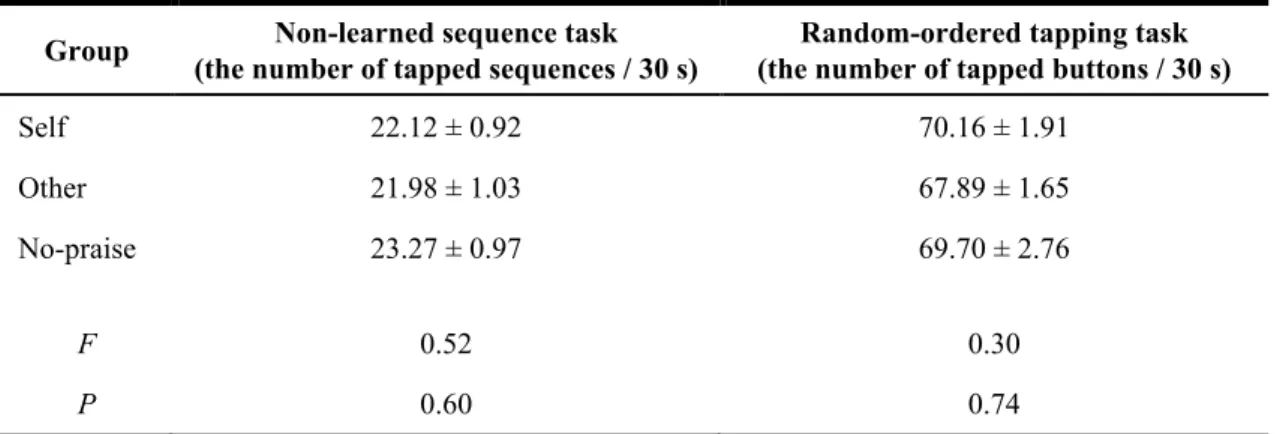
differences in performance on either the non-trained sequence (Self, 22.12±0.92; Other,
21.98±1.03; No-praise, 23.27±0.97 sequences per trial; ANOVA: F2,45 = 0.52, p = 0.60,
Table 2) or the randomly-ordered tapping task (Self, 70.16±1.91; Other, 67.89±1.65;
No-praise, 69.70±2.76 buttons per trial; F2,45 = 0.30, p = 0.74).
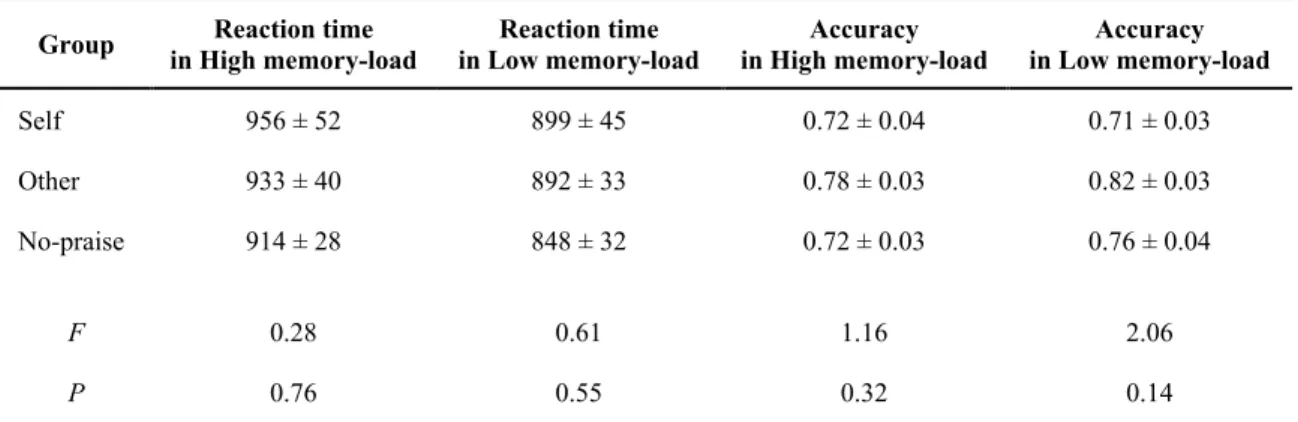
For the working memory task, there were no significant differences between
the three groups in either reaction time (Self, 922±47 ms; Other, 912±35 ms; No-praise,
877±25 ms; F2,33 = 0.47, p = 0.63, Table 3) or accuracy (the number of correct
responses relative to all responses) (Self, 0.71±0.03; Other, 0.80±0.03; No-praise,
0.74±0.03; F2,33 = 1.77, p = 0.19).
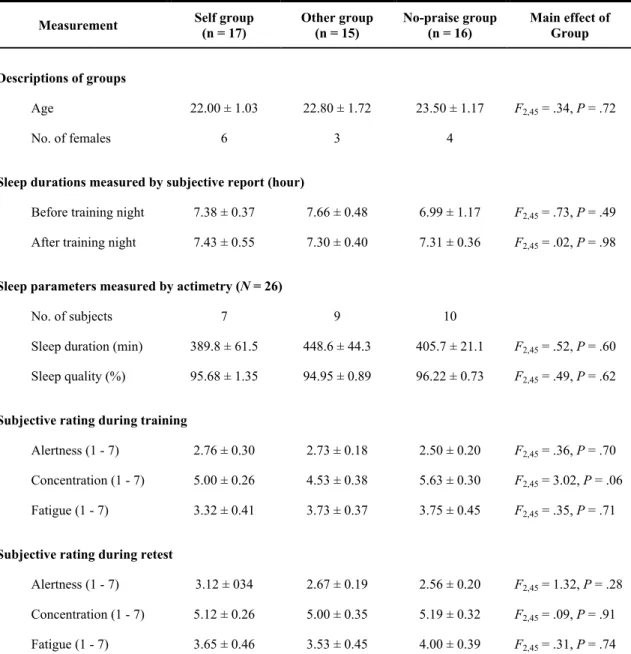
Sleep duration and quality during the night after training. Neither sleep duration
(measured by subjective reports) nor actimetry measures differed between the groups
(Subjective report, F2,45 = 0.02, p = 0.98; Actimetry, F2,45 = 0.52, p = 0.60, Table 4).
There were also no significant differences between the three groups in sleep quality, as
calculated from physical activity during the night after training (Actimetry, F2,45 = 0.49,
p = 0.62).
Alertness, concentration, and fatigue during training and retest. Finally, there were
no significant differences between the three groups for any of subjective ratings
(sleepiness, concentration, and fatigue, ANOVA, p values ≥ 0.06, Table 4), indicating
that the differences in offline improvement between the groups were not caused by
differences in subjective states during training or retest periods.
4.4 Discussions
The purpose of this study was to investigate whether praise following motor
training enhances skill consolidation. All groups showed offline skill improvements
between the end of training and the retest 24 h later, confirming the results of previous
studies (Robertson et al., 2004; Walker et al., 2002; Fischer et al., 2002). Furthermore,
our data indicated that praise following motor training enhances consolidation of the
learned sequence since the rate of offline improvement was significantly greater in the
Self group than in the Other or No-praise groups. As the evaluation video clips viewed
by the Self and Other groups were identical except for the instructions indicating to
whom the praise was directed, it is unlikely that any physical components in the video
clips induced the observed group differences. In addition, other potential factors such as
alertness, concentration, fatigue, and quality and duration of sleep did not differ
between the groups, so cannot explain the improved consolidation in the Self group.
An alternative explanation of the present result is that praise induces a positive
mood or increases the motivation to perform the motor task (Blumenfeld et al., 1982;
Catano, 1975; Henderlong & Lepper, 2002), resulting in the greater improvement in
performance from day 1 to day 2 performance. If this were the case, however, it would
be expected that the uneven performance between the three groups would occur not
only for the trained sequence but also on the other tasks. However, the present results
showed no significant group differences in these tasks, suggesting that the effects of
praise following training were specific to the trained sequence rather than a more
general effect on experimental task performance.
Praise is regarded as a reward (Izuma et al., 2008), because praise has two
essential components of reward, that is, hedonic and motivational (Schultz, 2000).
Praise can induce a feeling of happiness (hedonic component), and also promotes
motivation (motivational component, Catano, 1975; Adams, 1972; Henderlong &
Lepper, 2002). A recent human neuroimaging study demonstrated that praise activates
reward-related areas of the brain, specifically the ventral striatum (Izuma et al., 2008).
Rewards are associated with increased dopaminergic activity in the midbrain and
striatum, in which dopamine-dependent long-term potentiation (Hosp et al., 2011;
Marinelli et al., 2009; Willuhn & Steiner, 2009) has an important role in memory
consolidation. The cortico-striatal system plays a critical role in the automatization of
the type of motor sequence learning used in the present study (Debas et al., 2010;
Doyon et al., 2003; Penhune & Doyon, 2002). Synaptic plasticity represented by
long-term potentiation at cortico-striatal synapses strongly depends on the activation of
dopamine circuits (Calabresi et al., 2007). As the ventral striatum is the part of the
reward system driven by dopamine (Zald et al., 2004), rewards are expected to affect
motor skill consolidation. Taken together, present findings suggest that praise functions
as “social reward” that induces the dopamine transmission in the striatum, resulting in
an enhancement of the motor skill consolidation.
Sleep is another possible contributing factor. There is mounting evidence that
sleep is necessary for the offline improvement in the sequential finger-tapping task used
in the present investigation (Walker & Stickgold, 2004; Robertson et al., 2004; Debas et
al., 2010; Walker et al., 2002, 2003; Fishcer et al., 2002). Although this study was not
designed to determine whether sleep is necessary for the praise-related enhancement of
skill consolidation, it is reasonable to expect that this enhancement selectively occurs
during sleep. Consolidation of a new motor sequence during sleep appears to rely on the
covert re-activation of the brain regions that were initially involved in learning the
motor skill (Maquet et al., 2000). Recent human neuroimaging studies have shown that
several brain areas that were activated during the execution of a memory task are
significantly re-activated during sleep (Maquet et al., 2000; Rasch et al., 2007;
Diekelmann et al., 2011), and that such re-activation facilitates memory consolidation
(Maquet et al., 2000; Rasch et al., 2007). Furthermore, a previous animal study revealed
that sleep-dependent re-activation of firing patterns in the ventral striatum took place
after reward-related learning (Pennartz et al., 2004). In line with these findings, it is
conceivable that the cortico-striatal loop that is modified by praise after the training is
then re-activated during sleep, which in turn contributes to the praise-related
enhancement of offline, overnight consolidation. This working hypothesis will be the
focus of future experimental investigations.
In summary, the present study demonstrated that social rewards directly enhance
skill consolidation in humans, and suggests that they have a novel functional effect on
the human motor memory system. Further understanding of the effects of social rewards
on skill consolidation could help to develop protocols to improve motor skills in
educational and rehabilitative contexts.
Conclusion
The goal of current project is to determine the contributing factors enhancing
the offline skill consolidation in human motor skill. As mentioned above, I had two
hypotheses as following: i) longer sleep durations after skill training benefit the offline
skill consolidation in children as well as in adults, ii) praise for own performance
enhances the offline performance improvement. To test these hypotheses, I performed
two independent behavioral studies. In Study 1, the results showed that in children,
post-training sleep durations were positively correlated with the rate of offline
improvement, which is a type of skill consolidation, even under controlling out
participants’ age and time intervals after wake-up. This finding suggests that sleep
benefits the offline skill consolidation in children as well as adults. In Study 2,
participants who received praise from evaluators exhibited significantly higher offline
improvement relative to them in the other groups, while performances in non-trained
tasks did not differ across experimental groups. These results suggest that social
rewards directly enhance the offline skill consolidation in a certain motor skill. Taken
together, sleep and praise might contribute to enhance a form of consolidation in human
motor skill.
To date, it is a major challenge to identify the neuronal mechanisms mediating
sleep-dependent skill consolidation in human (see for review, Walker, 2005;
Diekelmann & Born, 2010). Moreover, it is totally unknown why praise enhance such
sleep-dependent skill consolidation. According to previous human and animal evidences,
neuronal reactivation, which is that the similar activities that occur during training take
place in post-training sleep, seems to be a critical role in sleep-dependent consolidation
(Wilson & McNaughton, 1994; Rasch et al., 2007; Antony et al., 2012). Therefore,
future investigations should determine whether the praised skill representation is mainly
reactivated during subsequent sleep relative to non-praised representations.
Simultaneously recording of neuroimaging and electroencephalography during sleep
following praise will shed light on this issue.
Although there are enormous evidences investigating some types of motor
skills including finger-tapping (Karni et al., 1995; Walker et al., 2002; Fischer et al.,
2002) and motor adaptation (Brashers-Krug et al., 1996; Albouy et al., 2012), it is still
unclear whether the other important motor skill is consolidated over type. To expand the
scope of praise-related enhancement for motor skill consolidation, future studies should
examine whether praise facilitate the offline consolidation in another type of motor skill.
Specifically, speech production is most important skill because speech necessary for our
life. However, there are no explicit evidences demonstrating that human speech is
consolidated over time or during sleep, while bird songs were stabilized and
sophisticated during sleep (Deregnaucourt et al., 2005; Shank & Margoliash, 2012).
Therefore, this issue is an appealing target for the praise-related enhancement.
Finally, present findings showed that sleep benefits human skill consolidation
even in children, and that praise is a helpful tool to enhance such sleep-dependent skill
consolidation. Although future investigations should determine the scope of such
enhancement and explore the underlying mechanisms, these findings might contribute
to develop novel approach in educational and rehabilitational contexts.
Acknowledgement
First of all, I am deeply grateful to Prof. Norihiro Sadato whose enormous
support and meticulous comments were invaluable for my present project. Also, I am
deeply indebted to Dr. Satoshi Tanaka for helping to make present studies possible and
providing insightful comments. Special thanks also go to Dr. Shuntaro Okazaki for
helping to make stimuli and analysis my data in both studies. Also, I would like to thank
my colleagues in Division of Cerebral Integration at NIPS. Their meticulous comments
and gently supports to an enormous help to me.
For Study 1, I would like to express my gratitude to Prof. Tatsuya Koeda,
who is professor in Department of Regional Education at Torrori University, for
providing a chance to perform the experiment in elementary-school children. Special
Thanks also go to Dr. Daisuke Tanaka, Dr. Ayumi Seki, and Dr. Hitoshi Uchiyama for
helping to make this study possible. For Study 2, my deepest appreciation goes to Prof.
Katsumi Watanabe, who is associate professor in Research Center of Advanced Science
and Technology (RCAST) at The University of Tokyo. He gives a chance to conduct
experiment for a lot of participants and insightful suggestions. Special thanks also go to
the other people in Watanabe laboratory for helping to make the study possible.
Finally, I am deeply indebted to Michiyo Kusaka whose moral support and sweet attention were irreplaceable for me. Moreover, I would also like to express my gratitude to my parents for their financially support and warm encouragements. Without these supports, I could not follow my dream that become a scientific researcher and accomplish the course of my study.
References
Adam EE (1972) An analysis of changes in performance quality with operant
conditioning procedures. Journal of Applied Psychology 56:480–486.
Albouy G, Vandewalle G, Sterpenich V, Rauchs G, Desseilles M, Balteau E, Degueldre
C, Phillips C, Luxen A, Maquet P (2012) Sleep stabilizes visuomotor adaptation
memory: an functional magnetic resonance imaging study. Journal of sleep
research.
Antony JW, Gobel EW, O’Hare JK, Reber PJ, Paller K a (2012) Cued memory
reactivation during sleep influences skill learning. Nature neuroscience
15:1114–1116.
Backhaus J, Junghanns K (2006) Daytime naps improve procedural motor memory.
Sleep medicine 7:508–512.
Bandura A (1977) Self-efficacy: Toward a unifying theory of behavioral change.
Psychological review 84:191–215.
Bandura A (1997) Self-efficacy: The exercise of control. New York: Freeman.
Barakat M, Doyon J, Debas K, Vandewalle G, Morin A, Poirier G, Martin N, Lafortune
M, Karni A, Ungerleider LG, Benali H, Carrier J (2011) Fast and slow spindle
involvement in the consolidation of a new motor sequence. Behavioural brain
research 217:117–121.
Blumenfeld PC, Pintrich PR, Meece J, Wessels K (1982) The formation and role of self
perceptions of ability in elementary classrooms. The Elementary School Journal
82:401–420.
Brashers-Krug T, Shadmehr R, Bizzi E (1996) Consolidation in human motor memory.
Nature 382:252–255.
Calabresi P, Picconi B, Tozzi A, Di Filippo M (2007) Dopamine-mediated regulation of
corticostriatal synaptic plasticity. Trends in neurosciences 30:211–219.
Catano VM (1975) Relation of improved performance through verbal praise to source
of praise. Perceptual and Motor Skills 41:71–74.
Debas K, Carrier J, Orban P, Barakat M, Lungu O, Vandewalle G, Hadj Tahar A, Bellec
P, Karni A, Ungerleider LG, Benali H, Doyon J (2010) Brain plasticity related to
the consolidation of motor sequence learning and motor adaptation. Proceedings of
the National Academy of Sciences of the United States of America
107:17839–17844.
Deci EL, Ryan RM (1985) Intrinsic motivation and self-determination in human
behavior. New York: Plenum Press.
Derégnaucourt S, Mitra PP, Fehér O, Pytte C, Tchernichovski O (2005) How sleep
affects the developmental learning of bird song. Nature 433:710–716.
Diekelmann S, Born J (2010) The memory function of sleep. Nature reviews
Neuroscience 11:114–126.
Diekelmann S, Büchel C, Born J, Rasch B (2011) Labile or stable: opposing
consequences for memory when reactivated during waking and sleep. Nature
Neuroscience 14:381–386.
Diekelmann S, Wilhelm I, Born J (2009) The whats and whens of sleep-dependent
memory consolidation. Sleep Medicine Reviews 13:309–321.
Dorfberger S, Adi-Japha E, Karni A (2007) Reduced susceptibility to interference in the
consolidation of motor memory before adolescence. PloS one 2:e240.
Dorfberger S, Adi-Japha E, Karni A (2009) Sex differences in motor performance and
motor learning in children and adolescents: an increasing male advantage in motor
learning and consolidation phase gains. Behavioural brain research 198:165–171.
Doyon J, Korman M, Morin A, Dostie V, Hadj Tahar A, Benali H, Karni A,
Ungerleider LG, Carrier J (2009) Contribution of night and day sleep vs. simple
passage of time to the consolidation of motor sequence and visuomotor adaptation
learning. Experimental Brain Research 195:15–26.
Doyon J, Penhune V, Ungerleider LG (2003) Distinct contribution of the cortico-striatal
and cortico-cerebellar systems to motor skill learning. Neuropsychologia
41:252–262.
Dunnett CW (1955) A multiple comparison procedure for comparing several treatments
with a control. Journal of the American Statistical Association 50:1096–1121.
Felmingham KL, Tran TP, Fong WC, Bryant R a (2012) Sex differences in emotional
memory consolidation: the effect of stress-induced salivary alpha-amylase and
cortisol. Biological psychology 89:539–544.
Fischer S, Hallschmid M, Elsner AL, Born J (2002) Sleep forms memory for finger
skills. Proceedings of the National Academy of Sciences of the United States of
America 99:11987–11991.
Fischer S, Wilhelm I, Born J (2007) Developmental differences in sleep’s role for
implicit off-line learning: comparing children with adults. Journal of cognitive
neuroscience 19:214–227.
Genzel L, Kiefer T, Renner L, Wehrle R, Kluge M, Grözinger M, Steiger A, Dresler M
(2012) Sex and modulatory menstrual cycle effects on sleep related memory
consolidation. Psychoneuroendocrinology 37:987–998.
Hamann S, Mao H (2002) Positive and negative emotional verbal stimuli elicit activity
in the left amygdala. Neuroreport 13:15–19.
Henderlong J, Lepper MR (2002) The Effects of Praise on Children’s Intrinsic
Motivation: A Review and Synthesis. Psychological bulletin 128:774–795.
Hoddes E, Zarcone V, Smythe H, Phillips R, Dement W. (1973) Quantification of
Sleepiness: A New Approach. Psychophysiology 10:431–436.
Hosp J a., Pekanovic a., Rioult-Pedotti MS, Luft a. R (2011) Dopaminergic Projections
from Midbrain to Primary Motor Cortex Mediate Motor Skill Learning. Journal of
Neuroscience 31:2481–2487.
Hsu JC (1996) Multiple Comparison: Theory and Methods. New York: Chapman &
Hall.
Hummel F, Celnik P, Giraux P, Floel A, Wu W-H, Gerloff C, Cohen LG (2005) Effects
of non-invasive cortical stimulation on skilled motor function in chronic stroke.
Brain : a journal of neurology 128:490–499.
Izuma K, Saito DN, Sadato N (2008) Processing of Social and Monetary Rewards in the
Human Striatum. Neuron 58:284–294.
Kanouse DE, Gumpert P, Canavan-Gumpert D (1981) The semantics of praise. In: New
directions in attribution research (Harvey JH, Ickes W, Kidd RF, eds), pp 97–115.
Hillsdale, NJ: Eribaum.
Karni A, Meyer G, Jezzard P, Adams MM, Turner R, Ungerleider LG (1995)
Functional MRI evidence for adult motor cortex plasticity during motor skill
learning. Nature 377:155–158.