Effects of Finite Orbit Width
on Neoclassical Transport
in High-Temperature Helical Plasmas
Seikichi Matsuoka
DOCTOR OF PHILOSOPHY
Department of Fusion Science
School of Physical Science
The Graduate University for Advanced Studies
March, 2011
Abstract
Improving confinement of the particle and energy transport is an important task to realize a nuclear fusion reactor in toroidal magnetic devices and a great effort has been devoted theoretically and experimentally to achieve this aim. Neoclassical (NC) transport theory has been studied in detail, since it describes a diffusive transport phenomenon caused by particle collisional interactions in a torus configuration, and thus, determines a irreducible minimum transport level depending on the magnetic geometry. In helical/stellarator devices which have the three-dimensional magnetic structure, neoclassical transport has a character of increasing with Ta7/2 in low colli- sionality regime, where Ta is the temperature of species a = e, i. In addition to this, the radial electric field (Er), which in general reduce both neoclassical and anomalous transport, is determined by the ambipolar condition of neoclassical particle transport in helical devices.
The plasmas of Ti> 5 keV are successfully obtained in the recent LHD experiments. Neoclassical transport analyses are performed for such plasmas. We confirm that when Ti increases, the NC transport flux is reduced by two orders of magnitude compared to that without Er due to the existence of the ambipolar radial electric field. The parameter survey calculations on Ti and ne are also carried out to consider the NC transport flux dependence on the plasma parameter. With these calculations, it is shown that NC ion thermal diffusivity is reduced to small level as that of electron even for plasmas with the fusion reactor relevant parameter if Te ≃ Ti is numerically retained. It is found that the radial electric field in high Ti plasmas with high Te has a significant impact on the reduction of the NC transport. This fact provides us the opportunity to reconsider the NC transport more rigorously in high Te plasmas.
Neoclassical transport in an asymmetric magnetic field has been estimated and cal- culated by using numerical simulations based on local assumptions, which neglect the particle drift, or the deviation from a certain magnetic surface. Although it has been pointed out that the finite orbit width effect for ions plays an important role in neoclas-
i
sical transport theory in recent studies, it has been considered that such conventional local assumptions have been valid for electrons. This is because the deviation from the magnetic surface on which the electron is located initially has been considered to be small enough. On the other hand, very high Te plasmas exceeding Te ≃ 20 keV
at the plasma core region followed by electron internal transport barrier formation of the steep Te gradient have been achieved in recent experiments in LHD. These plas- mas are called Core Electron-Root Confinement, CERC, since they are accompanied by the formation of the strong positive radial electric field, or the electron root. The high electron temperature makes helically-trapped electrons drift away from the initial magnetic surface. As a result, local assumptions of the neoclassical transport may be broken even for electrons in CERC plasmas.
This effect of electron drift, however, has not been considered seriously so far and it is quite unclear whether the local treatment is valid or not. In this thesis, the electron finite orbit width effect on neoclassical transport is investigated in detail by using non- local δf Monte Carlo simulation code, FORTEC-3D, which is newly extended to apply to electrons in this work. It is found that the electron finite drift makes qualitative difference between the local treatment and the non-local treatment in neoclassical transport calculations.
This thesis is organized as follows. First, we performed NC transport analysis based on the local treatment for high Tiplasmas. With these calculations, the electron-root Er
is obtained in high Tiplasmas numerically considering Teis high at the same time. This suggests that the non-local electron drift plays an important role in the Er formation. Second, FORTEC-3D, which solves the drift kinetic equation without the local assumptions is newly extended to apply to electrons including electron-ion collisions. Precise benchmark calculations are carried out with DCOM/NNW and GSRAKE code, which are both widely used local neoclassical transport simulation codes. By numerical calculations, it is found that the electron ∇B and curvature drifts change the particle and energy flux due to the particle poloidal precession and collisionless detrapping process in high Te and the low collisionality regime, while results in low Te and high collisionality regime reproduce the similar transport dependence on Er obtained by DCOM/NNW and GSRAKE. The changes of NC transport in the low collisionality regime appear as the reduction of the peak value and/or shift of peak position in flux dependence on the radial electric field. Non-local effect is confirmed by fully taking the particle drift and its orbit into account in neoclassical transport calculations by FORTEC-3D.
ii
Third, the extended FORTEC-3D for electrons is applied to a CERC plasma ob- tained in the LHD experiment. Such non-local electron transport analysis for the LHD experimental discharge is performed for the first time in this study. The radial electric field is analyzed in two ways: (1) the electron particle flux is calculated by FORTEC-3D with the fixed radial electric field for given plasma profiles and the steady state radial electric field is determined so as to satisfy the ambipolar condition of the electron parti- cle flux obtained by FORTEC-3D and the ion particle flux by DCOM/NNW. (2) Time evolution of the radial electric field is followed as an initial value problem with given plasma profiles using ion-particle-flux-radial-electric-field table made by DCOM/NNW. The ambipolar radial electric field is obtained as its steady state solution. This sep- arate procedure for electron and ion is adopted in order to reduce the calculational burden since simultaneously calculating the NC transport for both species waste too much computational resources. It is shown that the resultant Er differs from that ob- tained by DCOM/NNW in the core region, while it agrees with ion-root Er evaluated by DCOM/NNW in the edge region.
In this study, the importance of the electron finite orbit width effect in determining the neoclassical transport flux and its influence on the radial electric formation in high temperature helical plasmas is investigated by directly the the drift kinetic equation including the finite orbit width effect of electrons. With this approach, we provide a sufficient and reasonable basis on how the electron drift affects the neoclassical trans- port and the resultant radial electric field. This enables one to analyze the neoclassical transport property with a desirable accuracy, and thus, leads ones to obtain more de- tailed physical insight to the plasma physics involving the transport and the radial electric field.
iii
Acknowledgement
First of all, I would like to thank Dr. Masayuki Yokoyama, who gave me an opportunity to study plasma physics, with his helpful support throughout my doctor course. Fruitful discussions with him has led me to this work. He has given me freedom to my work and encouraged me all the time.
I also would like to acknowledge Dr. Shinsuke Satake for his valuable suggestion of this study. He has always guided me in many aspects in this work. I have received much inspiration and kind support from him. He is also acknowledged for providing me a numerical code, FORTEC-3D, for the basis of this thesis.
I express my gratitude for Prof. Hideo Sugama to help me understand plasma physics including neoclassical transport theory. A seminar on collisional transport with him has helped me establish a firm foundation for the physical view on the neoclassical transport in plasmas. I also thank Dr. Ryutaro Kanno for his useful discussions and beneficial comments on my work. He has constantly encouraged me during the whole period of my Ph.D course.
I am grateful to Mr. Hisamichi Funaba for his help to analyze the LHD experimental data. The LHD experiment Group is acknowledged for allowing me to use experimental data obtained in the LHD experiments. I wish to thank Dr. Osamu Yamagishi for having the valuable seminar about drift wave turbulence. Dr. Arimitsu Wakasa and Dr. Sadayoshi Murakami in Kyoto Univ. are also acknowledged for providing the numerical results by DCOM/NNW. I thank Prof. Atsushi Fukuyama in Kyoto Univ. for his continuous support to my work. Dr. Gakushi Kawamura, Dr. Akinobu Matsuyama, Dr. Masanori Nunami, Dr. Ryuichi Ishizaki, Dr. Katsuji Ichiguchi, Dr. Ryousuke Seki, Prof. Katsumi Ida, and Dr. Hiromi Takahashi are also acknowledged for their friendliness and advice which gives me a lot of suggestions for my thesis. I also would like to thank Dr. C. D. Beidler for providing me GSRAKE code. Motoki Nakata (Ph.D. candidate), Kunihiro Ogawa (Ph.D. candidate), Kinya Saito, and Akiyoshi Murakami who encourage me all the time in my student time are also acknowledged.
v
At last, I express my sincere thanks to my parents, family and friends for their kind encouragement and support that help me to complete my work.
vi
“All’s well, that ends well”
– William Shakespeare, All’s Well that Ends Well
vii
Contents
Abstract i
Acknowledgement v
1 Introduction 1
1.1 Background . . . 1
1.2 Motivation . . . 3
1.3 Overview of this thesis . . . 4
2 Drift Kinetic Equation and Neoclassical Transport 7 2.1 Drift kinetic equation . . . 7
2.2 Local and non-local approach in neoclassical transport theory . . . 8
2.2.1 Finite orbit width effect . . . 9
2.2.2 Local treatment . . . 12
2.3 Analytical calculation of neoclassical transport . . . 13
2.3.1 Guiding center orbit . . . 14
2.3.2 Neoclassical transport in helical devices . . . 15
3 Local Neoclassical Transport Analysis 19 3.1 Introduction . . . 19
3.2 General solution of the ripple-averaged drift kinetic equation (GSRAKE) 22 3.3 Neoclassical transport analysis of high Ti plasmas in LHD . . . 23
3.4 Numerical results of parameter survey calculations . . . 26
3.5 Summary and discussion . . . 30
4 Numerical Solution of Drift Kinetic Equation 33 4.1 Introduction . . . 33
4.2 Basic formalism in FORTEC-3D code . . . 35
ix
4.2.1 δf Monte-Carlo method . . . 35
4.2.2 Collision operator for unlike-particles . . . 39
4.3 Comparison between FORTEC-3D and other numerical codes . . . 40
4.4 FORTEC-3D results in moderate collisionality regime . . . 42
4.4.1 Calculation conditions . . . 42
4.4.2 Magnetic mode number dependence . . . 44
4.4.3 Comparison among FORTEC-3D and local transport codes . . . 47
4.5 FORTEC-3D results in low collisionality regime . . . 50
4.5.1 Two approaches for lowering collisionality . . . 50
4.5.2 Comparison among FORTEC-3D and local neoclassical trans- port codes . . . 54
4.6 Summary and discussion . . . 56
5 Application of FORTEC-3D to Experimental Analysis 61 5.1 Introduction . . . 61
5.2 Ambipolar condition . . . 62
5.3 Radial electric field analysis by FORTEC-3D . . . 64
5.3.1 Steady state ambipolar condition . . . 65
5.3.2 Time evolution of the radial electric field . . . 67
5.3.3 Time dependent Er analysis for a non-CERC plasma . . . 77
5.4 Summary and discussion . . . 80
5.4.1 Radial electric field diffusion . . . 80
5.4.2 Maxwell’s construction . . . 81
5.4.3 Summary . . . 83
6 Conclusions 85
A Calculation of the Second Adiabatic Invariant 91
List of Publication 101
List of Presentation 103
x
Chapter 1
Introduction
1.1 Background
Improving the plasma confinement in toroidal magnetic confinement devices is one of the key issue to realize fusion energy, and a great effort theoretically and experimentally has been devoted to achieve this aim. The plasma density, temperature, the confine- ment time, etc. have been increased year by year in many experiments. It is of great importance to study the plasma transport to explore the favorable character/state of the plasma confinement to improve such the plasma parameters.
In plasma confinement devices, rotational transformation of magnetic field is re- quired. This rotational transformation is made of the superposition of the poloidal magnetic field with toroidal (axisymmetric) magnetic field. In tokamaks [1], while the toroidal magnetic field is induced by the external current, the plasma current (the current inside the plasma) is necessary to introduce the poloidal magnetic field and thus the rotational transformation. The plasma current sometimes leads to disrup- tive phenomena which poses various problems in the plasma stability. On the other hand, in helical and stellarator devices [2], magnetic field, which essentially have the three-dimensional structure, is formed by external coils and thus no plasma current is required to make the rotational transformation, therefore they have advantage in disruption free. This is the favorable character of helical devices considering feasibility of the fusion energy since reactors in the future should be able to operate in the steady state for a long time without a disruptive phenomena induced by any instabilities. The Large Helical Device (LHD) [3] in National Institute for Fusion Science (NIFS) is the largest Helical confinement device based on the Helical concept.
1
2
Theoretically, transport phenomena in toroidal magnetic field are usually referred to as classical [4], neoclassical (NC) [5–8] and anomalous transport [9]. Neoclassical transport is caused by collisional processes of charged particles in toroidal magnetic field, thus, it becomes an irreducible minimum for toroidal magnetic confinement de- vices, while classical one is simply caused by collisions in the straight magnetic field. Anomalous one refers to the turbulent transport. It mainly arises from two kinds of the turbulence existing in plasmas: one is a microscopic turbulence caused by short wave length fluctuations of the density, potential, etc. [10], which is described by the gyrokinetic theory [11,12], and another is the MHD turbulence [13] which is caused by the MHD, or macroscopic, instabilities disturbing the magnetic field structure.
Although an experimental observation of the radial diffusion usually exceeds the neoclassical transport estimation [14, 15], neoclassical transport theory have attracted much attention since many phenomena in plasma transport such as parallel flow/current [16–18] and the radial electric field [19] are well accounted for by the neoclassical trans- port theory. In addition to this, the neoclassical diffusion increases in proportion to 1/νa, or Ta7/2 in helical plasmas [20, 21], where νa and Ta denote the collision frequency and the temperature of species a. It is also noted that, the radial electric field, Er, which plays an important role in reducing both the neoclassical and anomalous parti- cle/energy flux through its shear [22] and the E × B drift [23, 24], is determined by the ambipolar condition of the neoclassical particle flux [19, 25, 26].
Neoclassical transport theory is often considered to be well established, however, there exists a large gap between theory and experimental fact. For example, a tran- sitional behavior of Er, which appears following the formation of internal transport barrier in the plasma temperature [15], is one of the remaining problems to be solved. Also the accurate evaluation of the bootstrap current is the most important part to the steady state operation in tokamak plasmas [27, 28]. The flow distribution in plasmas should be determined with taking the neoclassical viscosity into account [29]. Such flow distribution is of importance since the flow relates to the stability [17] and the resultant plasma performance.
Among topics above mentioned, we focus on the radial electric field property and neoclassical transport in this thesis. Since Er in the plasma plays an important role in the formation of the transport barrier in helical plasmas and H-mode in tokamaks [30–32], which are examples of the improved confinement, the evaluation of the radial electric field and understanding its behavior are the key issue in the plasma transport study. Especially in helical devices, Er is determined by the ambipolar condition of
1.2. MOTIVATION 3
neoclassical particle flux and neoclassical particle flux is influenced by Er through the E× B drift which reduces neoclassical transport in many cases. Thus determining the neoclassical transport and radial electric field self-consistently and evaluate the reduction of the neoclassical transport still remain an important part in the plasma transport in helical devices.
1.2 Motivation
To analyze the ambipolar in the high temperature plasmas, we carry out neoclassical calculations based on the conventional method to high Tiplasmas obtained in the LHD experiments, which is discussed in more detail in Chapter 3. It aims to investigate more favorable way to improve the plasma performance in LHD. There, we perform parameter survey calculations on Te, Ti, and ne. As a result, high Te, namely Te ≃ Ti, is preferable in order to realize the electron-root (large positive) radial electric field which makes ,in general, the transport smaller than the ion-root (weak negative) one [33, 34]. This fact that high Te plays an important role to accomplish the improved con- finement even in high Ti plasmas leads us to draw an attention to high Te plasmas in LHD experiments called core electron-root confinement (CERC) [15, 23, 35, 36]. The characteristics of typical CERC plasmas are as follows. High Te with the steep Te gra- dient called electron internal transport barrier (eITB) are observed in the plasma core region. It is accompanied by the transitional behavior of Er from the ion-root to the electron-root radial electric field at a radial position of the formation of the transport barrier [15, 37], which results in the large shear of Er there. It is worth considering whether the conventional neoclassical transport theory is applicable for high Teplasmas such as CERC. This is described in detail below in this section. It is noted that the transition of Er itself is an interesting topic since it seems to offer a chance to clarify a bifurcation phenomenon which exists not only in plasma physics but also in the wide range of physics. Although the formation of eITB and its relation to Er shear have been investigated theoretically and numerically from the point of view of the plasma turbulence [38, 39], an accurate evaluation of the radial electric field from neoclassical transport theory still needs to be done to investigate the physical mechanisms of the Er transition.
To understand this, it is necessary to reconsider the conventional neoclassical trans- port analyses especially for electrons because of high Teand its steep gradient in CERC plasmas. So far, conventional neoclassical transport calculations are based on the local
4
assumptions which regards the radial deviation of particles from the particular mag- netic surface as small enough compared to the scale length [40–43], that is, ∆r/L ≪ 1, where ∆r denotes the typical radial orbit size of a particle, and L is the typical scale length in the radial direction such as the density gradient, the temperature gradient, the minor radius. It is noted that in the helical magnetic field there are several types of particles due to the three dimensional magnetic field geometry, e.g. helically-trapped particles, superbanana particles, passing particles, etc. [2, 44] This local assumption enables ones to estimate the neoclassical diffusion of particles and heat from the local plasma parameters since plasma particles are assumed not to drift radially so that the collisional processes are not also influenced by the parameters in radially different mag- netic surfaces. In remainder of this thesis, we call this treatment local, or conventional neoclassical theory.
In recent years, many authors have made great efforts to evaluate the neoclassical transport including ion finite orbit width (FOW) neglected in the local neoclassical theory [45–48]. It is called non-local, or global treatment of the neoclassical transport theory since it involves the effect of the particle radial drift. Since ion banana width is much larger than that of electron by √mi/me, electron finite orbit width effect has been neglected so far even in these works. In other words, it is considered that electrons finite radial drift would not take effect on the transport properties in contrast to ion. However, this may be invalid in high Te plasmas in helical devices for two reasons below: (1) the radial deviation of helically-trapped electrons, ∆h increases in proportion to Te/νei ∝ Te5/2[44], thus regarding ∆h as small enough may be violated in CERC plasmas (2) the steep gradient of Teindicates the small LT, so that ∆h/LT≪ 1
may not be applicable, where LT denotes the scale length of the temperature gradient. Therefore, neoclassical transport simulations including the electron finite orbit width effect is required for the rigorous evaluation of the electron neoclassical transport and the ambipolar Er in high Te plasmas and it is also required to investigate whether the electron FOW affect neoclassical transport simulations.
1.3 Overview of this thesis
In neoclassical transport theory, many calculations based on conventional or local as- sumptions have been performed as mentioned in the previous section, and those calcu- lations have offered theoretical basis on experiments which aims to improve the plasma confinement and obtain high Ti and high Te plasmas. It is found that high Te has a
1.3. OVERVIEW OF THIS THESIS 5
favorable character to realize the improved confinement for high Tiplasmas by electron- root Er in LHD. As noted before, however, the local neoclassical treatment can become inappropriate in high Teplasmas, and numerical simulations including the effect of the rigorous particle orbit are required to evaluate the neoclassical particle and energy flux and to investigate physical mechanisms dominated by the neoclassical transport.
The purpose of this thesis is to present the adequate basis for the effect of the electron orbit on the neoclassical transport and the resulting Er utilizing direct nu- merical calculations based on the first principle of drift kinetic equation. The effect of the electron finite orbit width on the neoclassical transport in helical devices is also investigated. This enables us to investigate the Er behavior in more detail and con- tributes to the understandings of the transport property in helical systems. For this purpose, we extend FORTEC-3D code [45] to be applicable to the electron neoclassical transport. FORTEC-3D code solves drift kinetic equation based on δf Monte-Carlo method [49, 50] with less approximations than conventional neoclassical calculation codes. The feature of FORTEC-3D is as follows. Electron orbits for many marker par- ticles are followed including their exact drift in arbitrary magnetic field in FORTEC- 3D. The ambipolar radial electric field can be also self-consistently obtained with the electron neoclassical transport as the solution of an initial value problem with the combination of the ion particle flux data base obtained by other numerical results.
The remainder of this thesis is organized as follows. Drift kinetic equation, which is the basis of NC transport theory for both local and non-local treatment, is described in detail in Chapter 2. Particle orbit in helical devices and the difference between local and non-local approach is also discussed in this chapter. In Chapter 3, high Tiplasmas in LHD are analyzed by GSRAKE code [51, 52], which solves the ripple-averaged drift kinetic equation. It is noted that the non-local term in GSRAKE is turned off in calcu- lations of this theis, thus it can be said that GSRAKE is based on the local assumption. The Neoclassical ambipolar Er comes to have electron root when Te is increased ar- tificially as Te ≃ Ti and improved confinement results from the transport suppression by electron-root Er. These results lead us to investigate the effect of electron drift which increases in high Te plasmas. In Chapter 4, we extend FORTEC-3D to apply the electron transport. δf Monte-Carlo method, which is used as the numerical scheme to solve drift kinetic equation in FORTEC-3D code is also described in this chapter. Benchmark calculations among the extended FORTEC-3D for electrons, GSRAKE, and DCOM/NNW [42, 43] are carried out. It is noted that DCOM/NNW solves drift kinetic equation by δf Monte-Carlo method using mono-energy particles based on the
6
local assumptions. The results of FORTEC-3D calculation for low temperature case, which is the case that the electron FOW effect less affects the electron neoclassical transport because of the small orbit size, show a good agreement with both GSRAKE and DCOM/NNW, that is, a similar curve of Er dependence for electron particle flux as those by GSRAKE and DCOM/NNW are properly reproduced for this case. On the other hand, for low collisional plasmas, qualitative difference between local and non- local treatment arises. It is shown with detailed discussion that this results from the electron radial drift and its finite orbit width effect. Chapter 5 is devoted to the appli- cation of new FORTEC-3D for electrons to analyze Er for LHD experimental plasmas. It includes the analyses of both steady state Er and time-dependent one. In Chapter 6, concluding remarks and the future direction of this work are presented. Summary is followed in this chapter.
Chapter 2
Drift Kinetic Equation and
Neoclassical Transport
2.1 Drift kinetic equation
Neoclassical transport theory has been established based on drift kinetic equation [5,8, 53]. It involves the averaging procedure over fast gyro motion of plasma particles and removes gyro-angle dependence from a particle distribution function fa(r, v, t), where r and v denotes a-th particle’s position and velocity, respectively. The kinetic equation is usually written using the guiding-center variables (R, E, µ, θ) instead of the phase space coordinates of a real particle (r, v) as
∂fa
∂t + ˙R· ∇fa+ ˙E
∂fa
∂E + ˙µ
∂fa
∂µ + ˙θ
∂fa
∂θ = Ca(fa), (2.1) where Ca(fa) ≡
∑
bCab(fa, fb) denotes a collision operator for faand fa = fa(R, E, µ, θ, t) is the distribution function represented in the guiding-center coordinates. It is noted that µ denotes the magnetic moment, µ ≡ mav⊥2/2B, the term proportional to ˙θ de- scribes the gyro motion of particles and E is the energy defined as
E ≡ mav
2
2 + ZaeΦ. (2.2)
To remove the gyro-angle dependence from the kinetic equation, the small param- eter δ ≡ ρa/L ≪ 1 is introduced, where L denotes the scale length characterizing the plasma and the thermal gyroradius ρa and gyrofrequency Ωa defined as
ρa ≡
vth,a
Ωa
= mavth,a
eaB (2.3)
Ωa ≡ emaB
a
(2.4)
7
8
CHAPTER 2. DRIFT KINETIC EQUATION AND NEOCLASSICAL
TRANSPORT
are used. Eq. (2.1) is averaged over gyro-angle and only the terms concerning the guiding-center variables only remain. As a result, the drift kinetic equation is thus derived as follows,
∂ ¯fa
∂t + vgc· ∇ ¯fa + ˙E
∂ ¯fa
∂E = Ca(fa), (2.5)
where we assumes the magnetic moment is conserved, or ˙µ = 0 and the overbar refers to the gyro-angle average. vgc is the guiding center drift velocity given by
vgc = bvk+ vd
= bvk+ vE+ v∇B + vcurv
= bvk+ E× B B2 +
v⊥2 2Ωa
b× ∇ln B + v
2 k
Ωa
b× κ, (2.6)
where the third and the forth terms on the right-hand side in Eq. (2.6) correspond to the ∇B and the curvature drift velocities, respectively with the curvature κ defined as
κ≡ b · ∇b. (2.7)
Eq. (2.5) is the so-called drift kinetic equation and an alternative form of Eq. (2.5) is obtained by using the kinetic energy K ≡ ma2v2 instead of the energy E for the later use as
∂f
∂t + vgc· ∇f + ˙K
∂f
∂K = C(f ), (2.8)
where we have omitted the overbar and subscript a for simplicity.
2.2 Local and non-local approach in neoclassical
transport theory
The neoclassical transport coefficients are calculated from the steady-state solution of the drift kinetic equation (2.8). The guiding-center coordinates used in Eq. (2.8) is usually written in Boozer coordinates (Ψ, θ, ζ) [54] since the strength of the magnetic field is only required for the drift equation of motion for each particles, where Ψ denotes the label magnetic surface (usually the toroidal magnetic flux in asymmetric toroidal plasmas such as LHD), θ the poloidal angle, and ζ the toroidal angle, respectively. This choice of Boozer coordinates enables one to easily solve the drift kinetic equation. In Boozer coordinates, the magnetic field is written as,
B= ∇Ψ × θ + ι∇ζ × Ψ. (2.9)
2.2. LOCAL AND NON-LOCAL APPROACH IN NEOCLASSICAL
TRANSPORT THEORY 9
To solve the equation, the distribution function f is assumed to be described as the linear combination of a local Maxwellian part and the remainder, f = fM+ δf , where
fM= n(Ψ)
( m
2πT (Ψ) )3/2
exp (
− mv
2
2T (Ψ) )
. (2.10)
We assume that the plasma density and the temperature depend only on the magnetic surface Ψ, that is, n = n(Ψ) and T = T (Ψ). For simplicity we consider that the plasma has no mean flow velocity V = 0. Substituting above expression of the distribution function into Eq. (2.8), one can obtain the following equation to the leading order as
bvk· ∇fM = C(fM). (2.11)
It is immediately found that the Maxwellian distribution function fMis the solution of the leading order equation of Eq. (2.11). Then to the first order of O(δ), one obtains
∂δf
∂t + bvk· ∇δf + ˙K
∂δf
∂K = vd· ∇fM+ ˙K
∂fM
∂K + C(δf ). (2.12) Solving the equation (2.12) to obtain δf , and then calculating the neoclassical particle and energy flux as
Γ(Ψ) ≡ h
∫
vδf d3v, i (2.13)
Q(Ψ) ≡ h
∫ mv2
2 vδf d
3i (2.14)
is the main concern in neoclassical transport theory, where h·i denotes the flux surface average defined as
hAi ≡
∫
dθdζ√gBA/
∫
dθdζ√gB. (2.15)
In the definition above we use the Jacobian of Boozer coordinates, √gB.
2.2.1 Finite orbit width effect
Solving Eq. (2.12) analytically for an arbitrary three-dimensional magnetic field is difficult task. Therefore, δf and resultant neoclassical transport are usually calculated numerically especially for helical/stellarator devices. To implement calculations, δf Monte-Carlo method [49,50] has been widely used as an efficient tool. δf Monte-Carlo method of evaluating the transport coefficients such as the diffusion coefficient and the thermal diffusivity needs to solve the particle drift motion. Before We discuss the formalism of δf Monte-Carlo method in detail in Chapter 4, the drift equation of
10
CHAPTER 2. DRIFT KINETIC EQUATION AND NEOCLASSICAL
TRANSPORT
motion for particles in Boozer coordinates [55–58] is described in the present subsection. Also in this subsection, we discuss the finite orbit width of particles, which is the main concern in this thesis.
We first introduce the guiding-center Hamiltonian as follows; H(θ, ζ, pθ, pζ, t) = mv
2 k
2 + µB + eaΦ(Ψ), (2.16)
where, the electrostatic potential depending only on the magnetic surface is assumed. In the guiding-center Hamiltonian representation above, pθand pζ denote the canonical momenta conjugate to θ and ζ, represented as
pθ = mIvk
B + eΨ (2.17)
pζ = = mgvk
B + eχ. (2.18)
Here, χ = χ(Ψ) denotes the poloidal magnetic flux and g(Ψ) = Bζ and I(Ψ) = Bθ
correspond to the poloidal and the toroidal current, respectively. Using the guiding- center Hamiltonian (2.16), one can obtain following Hamilton’s canonical equations for the guiding-center drift motion:
˙θ = ∂H
∂pθ
(2.19)
˙ζ = ∂H
∂pζ (2.20)
˙
pθ = −
∂H
∂θ (2.21)
˙
pζ = −
∂H
∂ζ . (2.22)
Here, the phase-space coordinates are chosen as (Ψ, θ, ζ, ρk, µ) to obtain the drift equa- tion of motion according to the description in the literature. Noted that ρk is defined as ρk ≡
mvk
eB . The drift equation of motion in the guiding-center coordinates (Ψ, θ, ζ, ρk, µ) is thus derived as
Ψ =˙ δ γ
( I∂B
∂ζ − g
∂B
∂θ )
, (2.23)
˙θ = [δ∂B
∂Ψ + e dφ dΨ
] ∂Ψ
∂pθ
+ e
2B2
m ρk
∂ρk
∂pθ
, (2.24)
˙ζ = [δ∂B
∂Ψ + e dφ dΨ
] ∂Ψ
∂pζ
+ e
2B2
m ρk
∂ρk
∂pζ
, (2.25)
˙
ρk = −
δ γ
[( ρk
dg dΨ − ι
) ∂B
∂θ − (
ρk
dI dΨ + 1
) ∂B
∂ζ ]
, (2.26)
˙µ = 0, (2.27)
2.2. LOCAL AND NON-LOCAL APPROACH IN NEOCLASSICAL
TRANSPORT THEORY 11
where
γ ≡ −eI (
ρkdg dΨ − ι
) + eg
( ρkdI
dΨ+ 1 )
(2.28)
δ ≡ µ + e
2ρ2 k
m B (2.29)
have been used. It is noted that δ in this subsection must be distinguished from that used as the small parameter in the preceding description. The derivatives of Ψ and ρk
with respect to the canonical momenta pθ and pζ are derived from the transformation from (θ, ζ, pθ, pζ) to (Ψ, θ, ζ, ρk)
∂Ψ
∂pθ
= g
γ, (2.30)
∂ρk
∂pθ = − 1 γ
( ρk
dg dΨ− ι
)
, (2.31)
∂Ψ
∂pζ = −
I
γ, (2.32)
∂ρk
∂pζ = 1 γ
( ρk
dI dΨ+ 1
)
. (2.33)
The equation for the kinetic energy K = e22mB2ρ2k+ µB is then obtained as, K =˙ e
2B2
m ρkρ˙k+ e2B
m ρ
2
kB ˙B + ˙µB
= e
2B2
m ρkρ˙k+ (
µ + e
2B
m ρk )
B˙
= e
2B2
m ρkρ˙k+ δ( ˙R· ∇
)B. (2.34)
Thus, the following equation is immediately obtained using Eq. (2.23) - (2.26) as
K = −e˙ dΨdφΨ.˙ (2.35)
As described in chapter 1, finite orbit width effects are caused by the deviation of the guiding center from a magnetic flux surface Ψ due to the drift motion. The effects are represented as ˙Ψ in the equations of drift motion derived above. Also noted that in the equation of the kinetic energy ˙K involves the finite orbit width effect since it includes the term ˙Ψ. This is clearly understood from the fact that Eq. (2.35) can be rewritten as
K = ev˙ d· Er. (2.36)
Later in this thesis, we calculate the electron neoclassical transport with the finite orbit width effects according to the drift equations of motion shown in this section.
12
CHAPTER 2. DRIFT KINETIC EQUATION AND NEOCLASSICAL
TRANSPORT
2.2.2 Local treatment
Neoclassical transport has been conventionally calculated assuming that the finite orbit width effect is negligibly small compared to the typical scale length of the plasma. This local, or conventional neoclassical transport theory has been recognized as the standard procedure for calculating the neoclassical diffusion coefficients.
In the local neoclassical theory, the drift motion of the guiding-center of particles is solely located at a single magnetic surface, that is, the second order term,
Ψ˙ ∂δf
∂Ψ (2.37)
is neglected, but
Ψ˙ ∂fM
∂Ψ (2.38)
is kept since it involves the term of order O(δ). As a result,
K ≃ 0.˙ (2.39)
is also assumed in the local neoclassical theory. The local treatment has several ad- vantages in the practical numerical calculation of neoclassical diffusion coefficients to reduce the computational resources. It can regard the particle kinetic energy as a nu- merical parameter since it does not change due to the local assumptions during the calculations.
For example, DCOM/NNW code [42, 43] adopts such local assumptions above. DCOM/NNW calculates the neoclassical diffusion coefficients based on δf Monte-Carlo method. In DCOM/NNW, test particles have the fixed energy and are assumed to localized at their initial magnetic surfaces. Then the diffusion coefficients at each local magnetic surface are evaluated as a function of the kinetic energy used in the calculation. Then, the energy dependent coefficients which are obtained in this way are integrated over the kinetic energy as
Dj =
∫
D(K)Kjexp(−K
T )dK (2.40)
to evaluate the neoclassical diffusion coefficients corresponding to the thermal forces such as ∇n, ∇T , etc.. It is noted that D(K) denotes the energy dependent diffusion coefficient and Dj is the neoclassical diffusion coefficient for j = 1, 2, 3. If we use only the pitch-angle collision operator as the collision term of drift kinetic equation, there remains only three phase-space variables, namely, (θ, ζ, ξ ≡ vvk) instead of the full five-dimensional phase-space of the drift kinetic equation.
2.3. ANALYTICAL CALCULATION OF NEOCLASSICAL
TRANSPORT 13
GSRAKE [51, 52] is another numerical code of the local neoclassical transport. GSRAKE is based on the ripple-averaged drift kinetic equation and it directly solves the equation. Non-local terms arising from the particle curvature and ∇B drifts are retained in the ripple-averaged drift kinetic equation in GSRAKE. However, since such terms are turned off in calculations in this thesis, GSRAKE is referred to as a local neoclassical transport code here. More detailed discussion on the ripple-averaged drift kinetic equation and GSRAKE is presented in Chapter 3.
The local assumptions discussed above are valid when the particle does not deviate largely from the initial surface. When E × B drift velocity dominates over other drift velocities such as ∇B and the curvature drifts, this assumption is usually satisfied since vd ≃ vE×Band vE×Bis almost in the poloidal direction in many devices. However, it is often broken in both axisymmetric and asymmetric plasmas due to the particles which experience the large drift, such as potato particles in tokamaks, and helically-trapped particles in helical/stellarator devices. These particles have been considered to be important when calculating neoclassical transport and much efforts have been made to include FOW effect in neoclassical transport calculation in recent years [45–48]. While the finite orbit width effects have been treated exclusively for ion species, those for electron species must be paid attention in asymmetric magnetic field because of the helically-trapped electrons in high Te plasmas as pointed out in Chapter 1.
2.3 Analytical calculation of neoclassical transport
The guiding center orbits in magnetic confinement devices are in general classified into either trapped or untrapped (passing) particles depending on the pitch angle of each particle [59]. The neoclassical transport strongly depends on the guiding center orbits [20], thus it is important to understand the orbits, or the drift motion of the guiding center, in plasmas. The radial electric field also makes influence on the neoclassical transport in helical plasmas. In this section, we briefly review analytical calculations of neoclassical transport in helical plasmas especially in low-collisional regime since we are mainly interested in the neoclassical transport in high temperature plasmas. It enables ones to understand the relation between the neoclassical transport and the particle orbit through the collision frequency, the radial electric field, the poloidal rotation, etc.
14
CHAPTER 2. DRIFT KINETIC EQUATION AND NEOCLASSICAL
TRANSPORT
2.3.1 Guiding center orbit
Plasma particles are basically classified into two classes of particles, namely, trapped and passing particles. In axisymmetric tokamaks trapped ones are known as the banana particles located on the outboard side in the poloidal cross section except at the core region where other trapped states such as potato appear [60]. It is noted that in axisymmetric tokamaks the magnetic field B becomes stronger on the inboard side than in the outboard side due to the toroidicity. This is understood as the magnetic field in axisymmetric tokamaks can be written as B/B0 = 1−ǫtcos θ, where B0denotes some reference strength of the magnetic field and ǫt is the toroidicity, respectively. The banana particles are trapped, or reflected at a certain point where a particle with a given kinetic energy K and magnetic moment µ cannot enter a inboard side since the magnetic field is so strong that µB > K and thus vk2 = 2(K − µB)/m < 0. Therefore, if K and µ of the particle satisfy the relation of µBmax < K, it moves freely along the field line and is the passing particle. In contrast, if µBmax> K, the particle is referred to as trapped, or banana particle.
In helical devices, the situation is more complex since the magnetic field strength depends not only on the poloidal angle but also the toroidal angle due to the helicity. The magnetic field strength in helical devices can be written as follows,
B
B0 = 1 − ǫ
tcos θ − ǫhcos(lθ − Nζ) (2.41)
in the simplest form, where l and N are the number of the pole and helical pitch, respectively, and ǫh denotes the helicity. Thus, it can be said that the magnetic field in helical devices is composed of the superposition of the helicity, or the helical ripple in addition to the toroidal field component as shown in Fig.2.1.
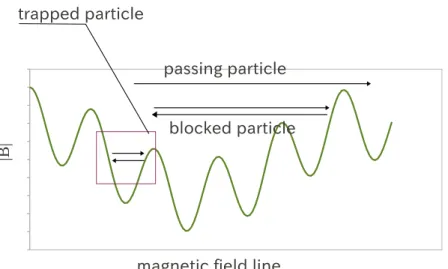
In Fig.2.1, typical particles in helical magnetic field are schematically described. The passing particle can travel without trapped any magnetic field along the field line. The trapped particles and are further classified into two different types of particles, that is, blocked one and (helically) trapped one. The former one can pass through one or more helical ripple but are trapped by the magnetic field well of toroidicity. On the other hand, the latter particle is trapped by the single helical ripple, so that they are called helically-, or ripple-trapped particles hereafter.
2.3. ANALYTICAL CALCULATION OF NEOCLASSICAL
TRANSPORT 15
Figure 2.1: Schematic view of typical particles which exist in the helical magnetic field.
2.3.2 Neoclassical transport in helical devices
Neoclassical transport depends on the collision frequency of a plasma since particles change their orbits due to collisions. Here we concentrate on the neoclassical transport in the 1/ν regime since our main concern is the high temperature and the low collisional plasma in the helical magnetic field. In 1/ν regime we are interested in the helically- trapped particle mainly contribute to the collisional diffusion due to its large radial drift. Passing particles have less significant impact on the transport process.
To study the neoclassical transport in the helical magnetic field, the bounce-averaged drift kinetic equation has been widely used [20,61–63]. The drift kinetic equation (2.5) can be further simplified by integrating over the fast motion along the field line. This is valid when the magnetic field line moves mainly in the toroidal direction within one helical period due to the small rotational transform, that is, N/ι ≫ l, where ι denotes the rotational transform of the magnetic field. The (toroidal) bounce average is defined as,
hXib ≡ τ1
ζ
I dζ
˙ζ X, (2.42)
for passing particles, and,
hXib ≡ τ1
ζ
∫ 2π/M 0
dζ
˙ζ X, (2.43)
for trapped particles, where X is an arbitrary function and τζ denotes the toroidal bounce time for helically-trapped particles and the transit time to pass a single helical ripple for passing ones. One can omit the toroidal-angle variable from the drift kinetic
16
CHAPTER 2. DRIFT KINETIC EQUATION AND NEOCLASSICAL
TRANSPORT
equation with the bounce-averaging procedure, thus the bounce-averaged drift kinetic equation only retains the particle motion in the poloidal and the radial direction in the real space.
The first order bounce-averaged drift kinetic equation is given as follows.
˙θ∂f1
∂θ + ˙r
∂fM
∂r = C(f1), (2.44)
where we use the (r, θ, ζ, E, µ) coordinates instead of (Ψ, θ, ζ, K, µ) used in Sec. 2.1. It is noted that the collision term in this equation is also bounce-averaged. The bounce- averaged drift velocities of the particles are written as,
˙r = rωtsin θ (2.45)
˙θ = ωtcos θ + ωh+ ωE (2.46)
where
ωt = ǫt
µB0
eBr2 (2.47)
ωh = ∂ǫh
∂r µB0
eBr
( 2E(k) K(k) − 1
)
(2.48) ωE = −
Er
Br, (2.49)
are used. It is noted that Er denotes the radial electric field, K(k) and E(k) are the complete elliptic integral of the first and the second kind, respectively, and k is the so-called pitch angle parameter defined as,
k2 ≡ E − eΦ − µB0(1 + ǫtcos θ − ǫh) 2µB0ǫh
. (2.50)
These drift velocities are formally obtained by considering the second adiabatic invari- ance, J, and more detailed description is presented in Appendix A. The term denoted by ωt represents the motion arising from the toroidicity, and ωh from the helicity, and ωE from the radial electric field, respectively. In many helical devices, the ωt term is negligible due to the smallness of the smallness of the toroidicity compared to the helicity. The poloidal rotation, ˙θ vanishes when the term of ωh and ωE is balanced, namely, ωh = ωE This is called the poloidal resonance [64]. The neoclassical transport increases since helically-trapped particles, which cause the large neoclassical diffusion due to their large radial drift, remain trapped for a long time when it occurs.
Our main concern is to solve the equation (2.44) for helically-trapped particles in the 1/ν regime. If the poloidal rotation is mainly caused by the helicity, we can assume
2.3. ANALYTICAL CALCULATION OF NEOCLASSICAL
TRANSPORT 17
that ˙θ ≃ ωh. This corresponds to the situation that no radial electric field exists and the toroidicity is smaller than the helicity. In the 1/ν regime, the effective collision frequency is estimated as νeff ≃ ν/ǫh. In this case, we can reduce the bounce-averaged drift kinetic equation (2.44) to,
ωh
∂f1
∂θ + rωtsin θ
∂fM
∂r = −νefff1. (2.51)
Writing f1 = f+cos θ + f−sin θ, one obtains, ωhf−+ νefff+ = 0
−ωhf++ νefff− = −rωt∂f∂rM. The solution is
f−= −
νeff
νeff2 + ωh2rωt
∂fM
∂r . (2.52)
Thus, the particle flux is
hnVri = h
∫
˙rf1d3vi
= −12
∫ νeff
νeff2 + ωh2(rωt)
2∂fM
∂r d
3v. (2.53)
If the effective collision frequency is νeff > ωh, ωh is neglected in Eq. (2.53). Then, the diffusion coefficient in the 1/ν regime becomes
Dh ≃
ǫ3/2h ǫ2t ν
( T eBr
)2
. (2.54)
It is noted that we use d3v = 2πdv⊥dvk and the parallel velocity for helically-trapped particles is estimated as vk ≃ √ǫhv⊥. It is clearly seen that the diffusion coefficient is in proportion to T7/2.
Chapter 3
Local Neoclassical Transport
Analysis
3.1 Introduction
The ion transport is one of the the central issues in the plasma transport study since the ion particle and temperature need to be confined for a long time to realize the fusion reactor. The analysis of the ion heat transport in LHD has been recently ini- tiated by using the available measured ion temperature profile [65]. It is considered that the anomalous transport due to the plasma turbulence exceeds the neoclassical one in both tokamak and helical devices. However, the quantitative evaluation of the ion neoclassical transport for experimental plasmas is still important since the neo- classical transport determines the minimum transport in toroidal devices. It is also emphasized that the neoclassical transport increases in the high temperature (low col- lisional) plasma due to the increase in the transport of helically-trapped particles in helical devices known as the ripple transport (see e.g., [20]).
Determining the radial profile of the radial electric field is one of the principal tasks in the plasma transport study. It has been considered that both the anomalous and neoclassical transport are reduced by the radial electric field through the shear, direc- tion, and the strength of the radial electric field. In axisymmetric devices, the particle flux is so called intrinsic ambipolar, and the radial electric field cannot be determined by the neoclassical transport flux. Fortunately, in helical plasmas, the radial electric field is determined by the ambipolar condition of the neoclassical transport [26]. The neoclassical particle flux of electrons and ions, which are both dependent on the ra-
19
20 CHAPTER 3. LOCAL NEOCLASSICAL TRANSPORT ANALYSIS
dial electric field, are balanced in the steady state, that is, Γe(ρ, Er) = Γi(ρ, Er) are achieved, where where Γe and Γi are electron and ion particle fluxes, respectively and ρ and Er are the radial position and the radial electric field.
The ambipolar electric field is called the electron root when it has the positive value, while it is called the ion root when the negative value [15,66]. The electron-root Er comes to have the larger |Er| than the ion-root one in many cases, and it results in the larger E × B drift in the plasma. As a result, the electron-root Er generally reduces the neoclassical transport much more than the ion-root one since the E × B drift suppresses the radial diffusion of particles. The ambipolar radial electric field can have multiple roots in the steady state for the solution of the ambipolar condition. In that case, it is necessary to solve the time evolution of the radial electric field with the neoclassical transport to determine whether the electron-root or the ion-root is realized. We provide the procedure to solve the time evolution of the radial electric field and indeed calculate the resultant ambipolar Er later in Chapter 5 for such case. In this chapter, however, we only evaluate the steady-state neoclassical transport, thus it is beyond the scope to determine the realizable ambipolar electric field.
In Chapter 2, we have briefly described the neoclassical transport analytically. For the practical evaluation of the neoclassical transport for helical plasmas, a numerical calculation is required due to the complexity of the magnetic field configuration. In this chapter, numerical calculations based on the local assumptions are carried out by using GSRAKE code [51,52]. The local assumptions are conventionally adopted as the basis of the neoclassical transport analysis in the wide range of the plasma transport study. The finite orbit width effect, which is neglected in the neoclassical transport calculations in GSRAKE, is discussed later in Chapter 4 and 5 in detail.
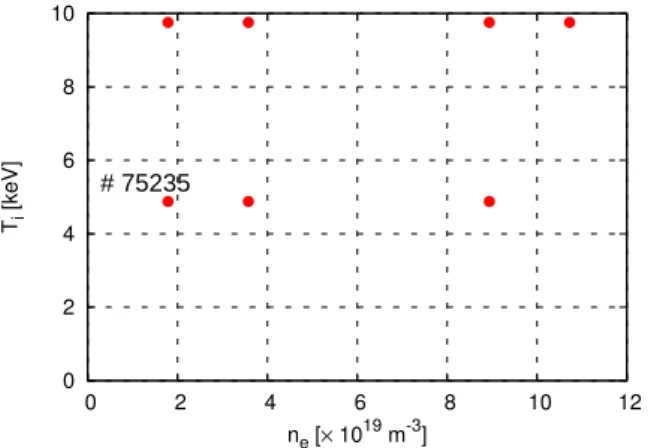
High ion temperature plasmas have been successfully demonstrated in the recent LHD experiments [65]. The power increase of the perpendicular neutral beam injections has mainly contributed to make this realize. The ion temperature have exceeded 5 keV at ne > 1 ×10¹⁹ m−3 and also achieved 3 keV at ne > 3 × 10¹⁹ m−3 (see Fig. 3.1). It is noted that the observed plasma parameters shown in this figure are based on experimental results in FY2006. The neoclassical transport analyses have been conducted for these high-Ti plasmas. Systematic parameter survey calculations are carried out with numerically varying Ti, Te, and ne based on a particular discharge to investigate the parameter dependence of the neoclassical ion diffusivity in the reactor- relevant plasma parameter.
In Section 3.2, the feature of GSRAKE code is briefly described. GSRAKE is
3.1. INTRODUCTION 21
Figure 3.1: The ion and electron temperature with the electron density at the center of the plasma. Those are observed in the high ion temperature experiments in LHD in FY2006.
based on the ripple averaged drift kinetic equation and it has the advantage that it can evaluate the neoclassical transport diffusivity with less computational resources. In Section 3.3, neoclassical transport analyses for the high-Tidischarge obtained in the LHD experiments are shown. Numerical results of the parameter survey calculations are described in Sec. 3.4. It aims to examine the neoclassical transport of the plasma in the reactor-relevant regime. It is shown that the neoclassical ion thermal diffusivity is reduced with the existence of the ambipolar Er even for the reactor-relevant parameters such as ne ≃ 1 × 10²⁰ m−3 and Ti ≃ Te ≃ 10 keV. Finally, summary of this chapter is given in Sec. 3.5. The effect of the high electron temperature, which leads us to reconsider the electron finite orbit width effect on the neoclassical transport calculation in helical plasmas, is also discussed.
22 CHAPTER 3. LOCAL NEOCLASSICAL TRANSPORT ANALYSIS
3.2 General solution of the ripple-averaged drift ki-
netic equation (GSRAKE)
Ripple averaged drift kinetic equation and its numerical solver, GSRAKE is widely used to calculate the neoclassical transport in helical devices so far. In GSRAKE code, it divides the distribution function into three portions of particles; locally-trapped, locally reflected but not trapped, and locally-passing ones. The average of drift kinetic equation is performed over the magnetic ripple in ripple-averaged drift kinetic equation. It enables ones to avoid the problem which arises in the bounce-averaged drift kinetic equation due to the non-localized (locally reflected but not trapped) particles since the bounce average is performed over the bounce motion of particles which are trapped in a single magnetic ripple.
In ripple-averaged drift kinetic equation, the characteristic time to average the drift kinetic equation is chosen as that which is required to traverse the a single (local) magnetic ripple instead of the bounce time of particles. Thus, the interaction between localized and non-localized particles can be described since the time is determined whether or not particles actually bounce off the ripple. In this section, we briefly review the feature of GSRAKE code.
GSRAKE calculated the neoclassical transport based on local assumptions. The radial drift of the plasma particle is neglected in the local assumptions since it is small enough compared to the plasma scale size, that is, ∆r/L ≡ δ ≪ 1 is assumed, where
∆r is the typical radial orbit size of the particle and L is the plasma scale size of the temperature, the density, the minor radius, etc. The word, local, comes from the fact that the plasma particles are located in a single magnetic surface in the transport time scale of ∂/∂t ≃ δ2ν, where ν denotes the collision frequency. It is noted that ∇B and the curvature drifts are included in original GSRAKE, however, the terms are turned off in the practical applications in this thesis. Thus, it can be said that only E ×B drift is considered in GSRAKE. This is consistent with the local assumptions neglecting the radial drift which is mainly caused by ∇B and the curvature drift.
GSRAKE has features as follows. Since it is based on the ripple-averaged drift kinetic equation which does not require any assumptions for the collision frequency, is can obtain a solution through the entire collisionality regime. It has the great advantage of requiring less computational resources to obtain the neoclassical transport diffusivity for both ions and electrons in helical plasmas than those directly solving drift kinetic
3.3. NEOCLASSICAL TRANSPORT ANALYSIS OF HIGH TI
PLASMAS IN LHD 23
equation with the full particle orbit. It is noted that only the pitch angle collisions are considered and the energy scattering term is neglected in GSRAKE. The detailed discussion on the difference between local neoclassical transport calculation codes such as GSRAKE and that including the finite orbit width effect is presented in Chapter 4.
3.3 Neoclassical transport analysis of high T
iplas-
mas in LHD
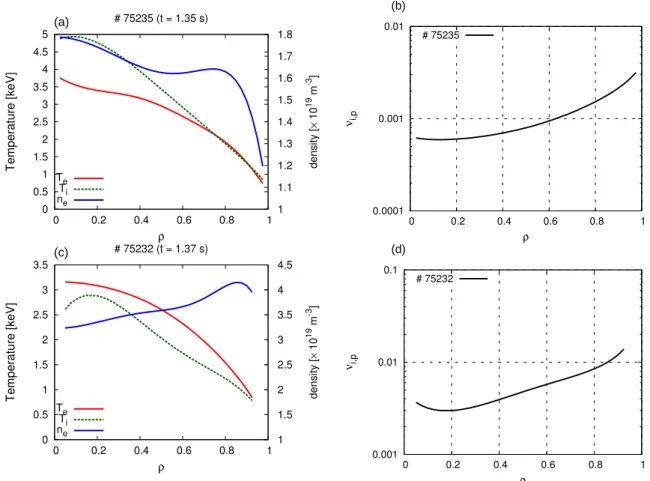
GSRAKE is applied to high-Ti plasmas obtained in LHD experiments. GSRAKE code can calculate the neoclassical particle and energy flux for ions and electrons, and the ambipolar Er from a given Ti, Te, and ne profiles and the LHD magnetic field configurations. The discharges of # 75235 at t = 1.35 s and # 75232 at t = 1.37 s are chosen for the analysis from the high-Ti experiments. The ion temperature of # 75235 is about 4.8 keV with ne ≃ 1.8 × 10¹⁹ m−3 at the core, and that of # 75232 is about 3 keV at ne ≃ 3.2 × 10¹⁹ m−3 (see Fig. 3.1). It is noted that the ion temperature of
# 75232 is comparable to the electron one, while the ion temperature of # 75235 is much higher than the electron one.
The heating scenario for the discharge of # 75235 is shown in Fig. 3.2 (a). The low-energy (≃ 40 keV) perpendicular neutral beam (NBI4A and B) has been injected along with the ion cyclotron range of frequency (ICRF) from t = 0.5 s (just after the electron cyclotron heating (ECH) turned-off), with the superposition of the high- energy (≃ 180 keV) tangential NBI (NBI1-3) from t = 1.1 s. The NBI4 of LHD consists of 4 ion sources with the two-independently-operatable power supplies (4A and 4B). This flexibility is utilized to modulate one of power supplies (in this case, 4B) to modulate the injection to obtain the background signals for the measurement of the ion temperature. The maximum value of Ti has been observed at t = 1.35 s as shown in Fig. 3.2 (b), where the all four NBIs are injected. It is noted that although the NBI3-pulse unintentionally became off at t = 1.3 s, the heating effect can be considered to last until t = 1.35 s by considering the slowing-down time of injected particles. The electron temperature and density of # 75235 at t = 1.35 s are also shown in Fig. 3.2 (b) with the ion temperature. The ion temperature, the electron temperature, and the electron density are measured by charge exchange recombination spectroscopy (cxs), Thomson scattering system and FIR interferometer, respectively.
The plasma parameter used in GSRAKE calculations are shown in Fig. 3.3. In Fig.
24 CHAPTER 3. LOCAL NEOCLASSICAL TRANSPORT ANALYSIS
Figure 3.2: (a)The heating scenario of the discharge of # 75235 in the LHD experi- ment. (b) Measured plasma parameters of # 75235 at t = 1.35 s are shown. In this experiment, Ti, Teand neare measured by charge exchange recombination spectroscopy (cxs), Thomson scattering system and FIR interferometer, respectively.
3.3 (b) and (d), the ion-ion collisionality normalized by the value at the plateau-banana boundary, νi,p ≡ νi/[ǫ3/2t (vi,th/qR)] is shown, where νidenotes the ion-ion collisionality, vi,th is the ion thermal velocity, ǫt, q, and R are the toroidicity, the safety factor, and the major radius, respectively. It can be seen in these figures that both discharges are in the low collisionality or 1/ν regime in which the neoclassical transport increases in proportion to ν−1 without the radial electric field due to the helically-trapped particles. The neoclassical transport is calculated by GSRAKE and numerical results for the discharge of # 75235 and # 75232 are shown in Figs. 3.4 (a) and (b), respectively. In these figures, the particle flux of the ion and the electron at ρ = 0.2 are shown as the function of the radial electric field. It is shown that the ion particle flux steeply increases around Er = 0. The increase is caused by the poloidal resonance [64] where