
Development of novel amphiphilic polymer-supported
palladium complexes and their application to C-X
bond-forming cross-coupling reactions in water
Yoshinori Hirai
March, 2015
Table of Contents
General Introduction ... 1
Chapter I: Development of novel amphiphilic polymer-supported phosphine ligands [] ... 18
Chapter II: Heterogeneous Aromatic Amination of Aryl Halides with Arylamines in Water with PS-PEG Resin-Supported Palladium complexes [] ... 33
Chapter III: Application of an amphiphilic PS-PEG resin-supported transition metal catalyst to synthesize optoelectronical materials [] ... 66
Chapter IV: C-S Bond-Forming Cross Coupling in Water with an Amphiphilic Resin-supported Palladium Complex [] ... 79
Chapter V: C-P Coupling Reaction by using an Amphiphilic Resin-supported Palladium Complex [] ... 92
Conclusion ... 116
Acknowledgment ... 119
1
General Introduction
Palladium-catalyzed cross-coupling reactions are indispensable tool in industrial field as well as academic field.[ 1 , 2 ] The C-N cross-coupling reactions represented by Buchwald-Hartwig reaction are relatively latest in the long history of the palladium-catalyzed cross-coupling reactions.
Scheme 1. Migita’s work
Migita found out the C-N bond-forming cross coupling reaction of aryl bromide and tributyltin diethylamide in the presence of bis(tri-o-tolylphosphine)palladium(II) dichloride in 1983 (Scheme 1).[3] This hetero cross-coupling is remarkable, considering its relationship to Stille C-C bond-forming cross coupling reactions, however, the knowledge about the mechanism of this reaction has been limited. Buchwald[4] and Hartwig[5] discovered the mechanism of the palladium-catalyzed C-N bond-forming cross-coupling reactions from the discovery of Migita 10 years later. Buchwald combined the known transamination reaction between amines
2
and tin amides to provide a convenient method for generating various tin amide reagents in situ without isolation of the unstable and water-sensitive tin amides (Scheme 2).[6]
Scheme 2.
The C-N bond-forming reactions were used harmful and water sensitive tin amides as an amine source in the early stage. Buchwald and Hartwig improved the C-N bond-forming reaction using alkyl amines and strong base such as NaOtBu or LiN(SiMe3)2 instead of tin amides (Scheme 3).[7]
Scheme 3
The catalytic system using Pd(dba)2 and (o-Tol)3P had some problems, such as generation of hydrodehalogenated arenes through the -hydride elimination of primary alkylamido complexes (Scheme 3). In order to
3
resolve this problem, Buchwald and Hartwig employed bidentate phosphine compounds, such as DPPF [1,1’-bis(diphenylphosphino)ferrocene] and BINAP [2,2’-bis(diphenylphosphino)-1,1’-binaphthyl] for the reaction of aryl halides and primary alkyl amines containing -hydrogens (Scheme 4).[8]
Scheme 4
In the same period, Nishiyama and Koie developed the method of synthesizing triarylamines by the using extremely bulky tert-butylphosphine and palladium acetate as a catalyst (Scheme 5). [9]
Scheme 5
From this result, it became clear that suitable catalysts for the C-N bond-forming cross-coupling reactions involved an exceptionally hindered and electron-donating ligand. Therefore, some groups have studied various
4
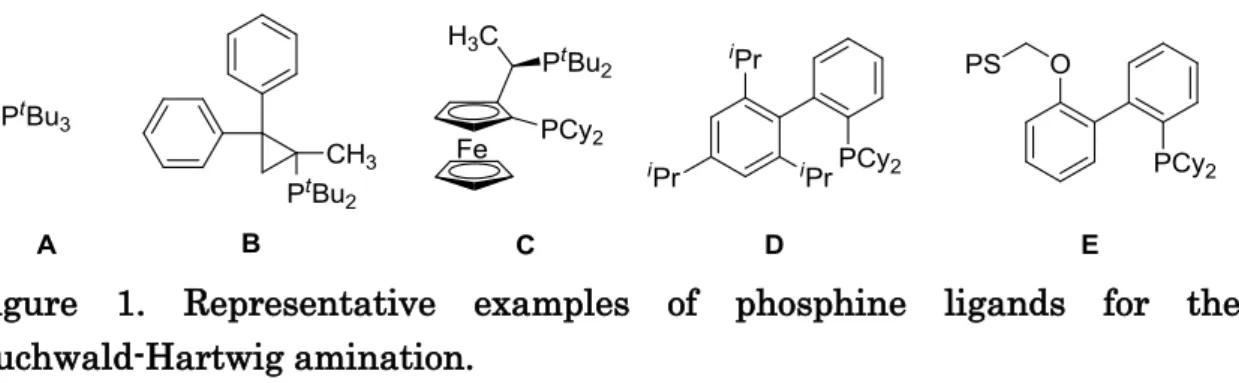
ligands for the C-N bond-forming cross-coupling reactions with above characters (Figure 1).
Figure 1
Since Buchwald and Hartwig discovered that the coupling of aryl halides and various amines could be catalyzed by palladium complexes, the catalytic amination of aryl halides, has been called as Buchwald–Hartwig reaction.
This reaction has intrigued synthetic chemists and is generally recognized as one of the most powerful methods for preparing a variety of arylamines.[1] However, in spite of increasing concern for the environment and the safety of chemical processes, only scattered interest has been given to the
heterogeneous- and aqueous-switching of catalytic amination, which would provide a green alternative to the Buchwald–Hartwig reaction.[ 10 , 11 ]
Arylamines have generated considerable interest owing to their presence as biologically active compounds and material for organic electronics. Efficient removal of the metal complexes from the reaction mixture of the catalytic amination process would allow not only the recovery of costly noble-metal
5
complexes but also the production of metal-free arylamines to provide clean compounds (Figure 2).
CH3 HN HN
O N
N H3C
N N
N Imatinib (Novartis)
Anticancer
N N
H3C
CH3
TPD
Hole transfer material
Figure 2
As mentioned above, palladium-catalyzed coupling has become a principal method of forming C-X bonds. However, studies to develop the synthesis of aryl sulfides have been less fruitful.[12] Although palladium thiolates with phosphine ligand, such as DPPE, Ph3P, form easily and undergo relatively fast reductive elimination with aryl groups, sulfide compounds prevent reductive elimination and deactivate the palladium catalyst owing to their strong coordinate ability.[13]
Scheme 6
6
Buchwald (Scheme 6)[14] and Hartwig (Scheme 6)[15] achieved the C-S bond-forming coupling with ferrocene-based ligand, which has strong electron-donating ability to palladium, and NaOtBu in organic solvent to provide corresponding sulfide compounds which often are seems active pharmaceutical ingredient (Figure 3). Active pharmaceutical ingredients required low metal-contamination.
S
O Cl
NH2 OH OH KRP-203, S1P3 antagonist
(Kyorin, Novartis) H3C CH3
S
NO2
N O
N CH3 O
LFA-1/CIAM-1 antagonist (Abbvie)
Figure 3
In the case of C-P bond-forming coupling, the resultant phosphine product prevents the desired reaction owing to the strong coordination as well as C-S bond-forming reaction. However, the palladium-catalyzed coupling of various phosphorous-based nucleophiles has previously reported.[ 16 ] Tertiary phosphines, which are widely used as ligands for transition metal chemistry, are prepared by the coupling of aryl halides with secondary phosphines in the presence of transition metal catalysts based on palladium[16], nickel[17] or copper[18]. However, common protocols have been
7
inefficient for the coupling of aryl bromides,[14, 19 ] and there has been reported of the coupling of electron deficient aryl chloride and with secondary phosphines[14]. In addition, previous reports have been focused on the preparation of triarylphosphines. Thus, developments of C-P bond-forming coupling, especially the reaction of aryl halides and dialkyl phosphine, were limited (Scheme 7).[14]
Scheme 7
Our group has recently developed amphiphilic polystyrene–poly(ethylene
glycol) (PS-PEG) resin-supported transition metal catalysts[ 20 ] which
promote various catalytic transformations smoothly in water under heterogeneous conditions, including palladium-catalyzed arylation (Suzuki–
Miyaura coupling), alkenylation (Heck reaction), alkynylation (Sonogashira coupling), carbonylation of aryl halides, -allylic substitution (Tsuji–Trost reaction), cyclization of 1,6-enynes, and addition of Carbon tetrachloride to olefins (Kharasch addition) (Scheme 8, Scheme 9).
8
Scheme 8
9
Scheme 9
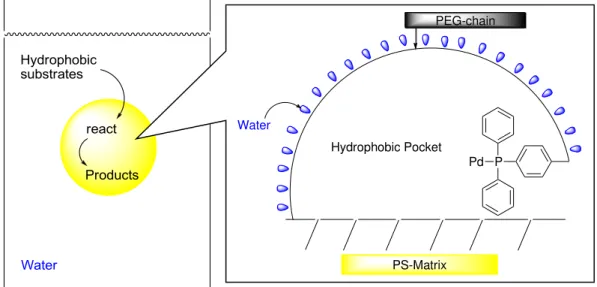
Many organic reactions are conducted in organic solvents from the viewpoint of solubility of the substrate. The amphiphilic PS-PEG resin-supported transition metal catalysts show interesting characteristics to promote the reaction in the water. The reason for the high activity of these catalysts in water has been clarified as follows. Organic molecules don’t dissolve in water; therefore, they are concentrated to polystyrene
10
matrix which has the highest hydrophobicity in the reaction system. This polymer matrix has transition metal complexes as active center, and the concentrated substrates react quickly to provide desired compounds.(Figure 4) Furthermore, the PS-PEG catalysts have some excellent characters in an environment aspect, for example, easily recovery and recycling, and high level metal uncontamination to products.
Figure 4. Schematic image of PS-PEG supported Pd complex catalysis in water.
If the C-X bond-forming coupling, including C-N, C-S, and C-P bonds, could be achieved in water with readily recoverable immobilized catalysts, the transformation could be considered an ideal C-X bond-forming coupling process.
From the above, I decided to study the development of novel amphiphilic
P Pd
PS-Matrix PEG-chain
Hydrophobic Pocket Water
11
polystyrene–poly(ethylene glycol) (PS-PEG) resin-supported transition metal
catalysts for various C-X bond-forming coupling. The result of the present study will be described from the next chapter.
1 For recent reviews, see: a) J. F. Hartwig, Acc. Chem. Res., 2008, 41, 1534; b) D. S. Surry, S. L. Buchwald, Angew. Chem., 2008, 120, 6438; Angew. Chem. Int. Ed., 2008, 47, 6338 ; c) R. Martin, S. L. Buchwald, Acc. Chem. Res., 2008, 41, 1461; d) J.-P. Corbet, G. Mignani, Chem. Rev., 2006, 106, 2651; e) B. Schlummer, U. Scholz, Adv. Synth. Catal., 2004, 346, 1599; f) J. F. Hartwig, Angew. Chem., 1998, 110, 2154; g) Angew. Chem. Int. Ed., 1998, 37, 2046.
2 J. F. Hartwig, Nature, 2008, 41, 314.
3 M. Kosugi, M. Kameyama, T. Migita, Chem. Lett., 1983, 927
4 a) R. A Widenhoefer, H. A. Zhong, S. L. Buchwald, Organometallics, 1996, 15, 2745, b) R. A Widenhoefer, S. L. Buchwald, Organometallics, 1996, 15, 2755
5 a) F. Paul, J. Patt, J. F. Hartwig, J. Am. Chem. Soc. 1994. 116, 5969; b) F.
12
Paul, J. Patt, J. F. Hartwig, Organometallics, 1994, 3030
6 A. S. Guram, S. L. Buchwald, J. Am. Chem. Soc. 1994. 116, 7901
7 a) J. Louie, J. F. Hartwig, Tetrahedron Lett., 1995, 36, 3609; b) A. G. Guram, R. A. Rennels, S. L. Buchwald, Angew. Chem. Int. Ed., 1995, 34, 1348
8 a)J. P. Wolfe, S. L. Buchwald, J. Org. Chem. 1996, 61, 1133; b) J. P. Wolfe, S. L. Buchwald, J. Org. Chem. 2000, 65, 1144; c) M. S. Driver, J. F. Hartwig, J. Am. Chem. Soc. 1996, 118, 7217
9 JPA1998-139742, M. Nishiyama, T. Yamamoto, Y. Koie, Tetrahedron Lett., 1998, 39, 617
10 For reviews on heterogeneous-switching, see: a) D. C. Bailey, S. H. Langer, Chem. Rev. 1981, 81, 109; b) S. J. Shuttleworth, S. M. Allin, P. K. Sharma, Synthesis 1997, 1217; c) S. J. Shuttleworth, S. M. Allin, R. D. Wilson, D. Nasturica, Synthesis 2000, 1035; d) F. Z. Dcrwald, Organic Synthesis on Solid Phase; Wiley-VCH, Weinheim, 2000; e) N. E. Leadbeater, M. Marco, Chem. Rev. 2002, 102, 3217; f) C. A. McNamara, M. J. Dixon, M. Bradley, Chem. Rev. 2002, 102, 3275; g) Chiral Catalyst Immobilization and
13
Recycling (Eds.: D. E. De Vos, I. F. J. Vankelecom, P. A. Jacobs), Wiley-VCH, Weinheim, 2000; h) S. V. Ley, I. R. Baxendale, R. N. Bream, P. S. Jackson, A. G. Leach, D. A. Longbottom, M. Nesi, J. S. Scott, R. I. Storer, S. J. Taylor, J. Chem. Soc. Perkin Trans. 1 2000, 3815; i) Q.-H. Fan, Y.-M. Li, A. S. C. Chan, Chem. Rev. 2002, 102, 3385; j) Y. Uozumi, Top. Curr. Chem. 2004, 242, 77; k) M. Guino, K. K. M. Hii, Chem. Soc. Rev. 2007, 36, 608; l) Z. Wang, G. Chen, K. Ding, Chem. Rev. 2009, 109, 322; m) J. Lu, P. H. Toy, Chem. Rev. 2009, 109, 815.
11 For reviews on aqueous-switching, see: a) C.-J. Li, T.-H. Chan, Organic Reactions in Aqueous Media, Wiley-VCH, New York, 1997; b) P. A. Grieco, Organic Synthesis in Water, Kluwer Academic Publishers, Dordrecht, 1997; c) W. A. Herrmann, C. W. Kohlpaintner, Angew. Chem. 1993, 105, 1588; Angew. Chem. Int. Ed. Engl. 1993, 32, 1524; d) U. M. Lindstrcm, Chem. Rev. 2002, 102, 2751; e) C.-J. Li, T.-H. Chan, Comprehensive Organic Reactions in Aqueous Media, Wiley-Interscience, New Jersey, 2007; f) Aqueous-Phase Organometallic Catalysis (Eds.: B. Cornils, W. A. Herrmann), Wiley-VCH, Weinheim, 2004.
14
12 a) T. Kondo, T. –a. Mitsudo, Chem. Rev., 2000, 100, 3205; b) M. A. Fernández-Rodráguez, J. F. Hartwig, J. Org, Chem., 2009, 74, 1663; c) J. E. R. Sadig, M. C. Willis, Synthesis 2011, 1. d) J. F. Hartwig, Acc. Chem. Res. 2008, 41, 1534.
13 D. Baranano, J. F. Hartwig, J. Am. Chem. Soc., 1995, 117, 2937
14 M. Murata, S. L. Buchwald, Tetrahedron, 2004, 60, 7397
15 M. A. F-Rodriguez, Q. Chen, J. F. Hartwig, J. Am. Chem. Soc., 2006, 128, 2180
16 a) T. Hirao, T. Masunaga, N. Yamada, Y. Ohshiro, T. Agawa, Bull. Chem. Soc. Jpn., 1982, 55, 909; b) Y. Xu, X. Li, J. Xia, H. Guo, Y. Huang, Synthesis, 1984, 781. 17; c) S. E. Tunney, J. K. Stille, J. Org. Chem. 1987, 52, 748; d) O. Herd, A. Hessler, M. Hingst,M. Tepper, O. Stelzer, J. Organomet. Chem., 1996, 522, 69; e) D. J. Ager, M. B. East, A. Eisenstadt, S. A. Laneman, Chem. Commun., 1997, 2359; f) G. Martorell, X. Garcías, M. Janura, J. M. Saá, J. Org. Chem., 1998, 63, 3463; g) F. Y. Kwong, K. S. Chan, Chem. Commun., 2000, 1069; h) A. Stadler, C. O. Kappe, Org. Lett., 2002, 4, 3541; i) D. J. Brauer, M. Hingst, K. W. Kottsieper, C. Liek, T. Nickel, M. Tepper, O. Stelzer,
15
W. S. Sheldrick, J. Organomet. Chem., 2002, 645, 14. 18; j) T. Imamoto, Pure Appl. Chem., 1993, 65, 655; k) B. H. Lipshutz, D. J. Buzard, C. S. Yun, Tetrahedron Lett., 1999, 40, 201; l) M. Al-Masum, T. Livinghouse, Tetrahedron Lett., 1999, 40, 7731; m) A.-C. Gaumont, M. B. Hursthouse, S. J. Coles, J. M. Brown, Chem. Commun. 1999, 63.
17 D. Cai, J. F. payack, D. R. Bender, D. L. Hughes, T. R. Verhoeven, P. J. Reider, J. Organomet. Met., 1994, 59, 7180
18 a) D. Gelman, L. Jiang, S. L. Buchwald, Org. Lett., 2003, 5, 2315; b) D. V. Allen, D. J. Venkataramn, J. Org. Chem., 2003, 68, 4590
19 J. R. Moncarz, N. F. Laritcheva, D. S. Glueck, J. Am. Chem. Soc., 2003, 68, 4590
20 For studies on polymer-supported transition metal complex catalysts from the authors’ group, see: a) Y. Uozumi, H. Danjo, T. Hayashi, Tetrahedron Lett.
1997, 38, 3557 (allylic substitution); b) H. Danjo, D. Tanaka, T. Hayashi, Y. Uozumi, Tetrahedron 1999, 55, 14341 (allylic substitution); c) Y. Uozumi, H. Danjo, T. Hayashi, J. Org. Chem. 1999, 64, 3384 (cross-coupling); d) Y. Uozumi, T. Watanabe, J. Org. Chem. 1999, 64, 6921 (carbonylation reaction);
16
e) Y. Uozumi, Y. Nakai, Org. Lett. 2002, 4, 2997 (Suzuki–Miyaura coupling);
f) Y. Uozumi, T. Kimura, Synlett 2002, 2045 (Heck reaction); g) Y. Uozumi, Y. Kobayashi, Heterocycles 2003, 59, 71 (Sonogashira reaction); h) Y. Uozumi, K. Shibatomi, J. Am. Chem. Soc. 2001, 123, 2919 (asymmetric alkylation); i) Y. Uozumi, H. Tanaka, K. Shibatomi, Org. Lett. 2004, 6, 281 (asymmetric allylic substitution); j) H. Hocke, Y. Uozumi, Synlett 2002, 2049 (asymmetric catalysis); k) H. Hocke, Y. Uozumi, Tetrahedron 2003, 59, 619 (asymmetric catalysis); l) H. Hocke, Y. Uozumi, Tetrahedron 2004, 60, 9297 (asymmetric catalysis); m) Y. Nakai, Y. Uozumi, Org. Lett. 2005, 7, 291 (asymmetric cycloisomerization); n) Y. Uozumi, M. Kikuchi, Synlett 2005, 1775 (cross-coupling); o) Y. Uozumi, M. Kimura, Tetrahedron: Asymmetry 2006, 17, 161 (asymmetric etherification); p) Y. Nakai, T. Kimura, Y. Uozumi, Synlett 2006, 3065 (cyclization); q) Y. Kobayashi, D. Tanaka, H. Danjo, Y. Uozumi, Adv. Synth. Catal. 2006, 348, 1561 (asymmetric alkylation); r) Y. Uozumi, T. Suzuka, R. Kawade, H. Takenaka, Synlett 2006, 2109 (allylic azidation); s) Y. Uozumi, T. Suzuka, J. Org. Chem. 2006, 71, 8644 (nitromethylation); t) Y. Uozumi, T. Suzuka, Synthesis 2008, 1960 (allylic sulfonylation); u) Y.
17
Uozumi, H. Takenaka, T. Suzuka, Synlett 2008, 1557 (asymmetric desymmetrization); v) Y. Oe, Y. Uozumi, Adv. Synth. Catal. 2008, 350, 1771 (Kharasch reaction); w) Y. Uozumi, Y. Matsuura, T. Arakawa, Y. M. A. Yamada, Angew. Chem. 2009, 121, 2746; Angew. Chem. Int. Ed. 2009, 48, 2708 (asymmetric cross-coupling); x) T. Suzuka, Y. Okada, K. Ooshiro, Y. Uozumi, Tetrahedron, 2010, 66, 1064 (Sonogashira coupling).
18
Chapter I: Development of novel amphiphilic polymer-supported phosphine ligands [1]
It has been well-documented that the aromatic amination is efficiently catalyzed by palladium complexes possessing sterically hindered alkylphosphine ligands, for example, RP(tert-C4H9)2 and RP(cyclo-cyclohexyl)2, and a variety of alkylphosphine ligands have been designed and prepared for driving the amination catalysis. The representative examples of the ligands are shown in Figure 1.[2, 3, 4, 5]
The amination is generally carried out in toluene with heating in the presence of a strong alkoxide base, such as NaOtBu, under homogeneous conditions. Buchwald reported an isolated example of aromatic amination in water in 2003, by use of 2-{di(cyclohexyl)phosphino}-2’,4’,6’-tri(isopropyl) biphenyl (compound D, Figure 1),[5] and pioneering work on the heterogeneous-switching of aromatic amination using an immobilized phosphine–palladium complex (ligand E, Figure 1) in 2001.[6, 7, 8]
19
Figure 1. Representative examples of phosphine ligands for the Buchwald-Hartwig amination.
However, to the best of our knowledge, no catalyst system has yet been developed to accomplish the heterogeneous- and aqueous-switching of the amination in one system. As a result, I decided to prepare the palladium complexes co-ordinatively anchored onto the amphiphilic polystyrene– poly(ethylene glycol) copolymer (PS-PEG)[ 9 ] resin-supported bulky alkylphosphines as possible water-compatible polymeric ligands, for aromatic amination catalyst.[10, 11]
Preparation of L1 (Scheme 1): Esterification of compound 1 with trimethyl orthoformate and catalytic hydrogen chloride generated by the reaction of acetyl chloride and MeOH provided the corresponding ester 2 in 80% yield. C-P bond-forming reaction of compound 2 in the presence of Pd catalyst was proceeded, followed by hydrolysis of ester gave phosphine-boran 4 in 47% yield. Condensation reaction of Tentagel S-NH2 (PS-PEG-NH2) and compound 4 with 1-(3-Dimethylaminopropyl)-3-ethylcarbodiimide (EDC) and
20
1-Hydroxybenzotriazole (HOBt) in DMF and deprotection with diethylamine gave the corresponding resin-supported phosphine L1. The structural studies on the resin-supported phosphine L1 were performed by gel-phase
31P{1H} NMR spectroscopy where a narrow singlet at = +36.8 ppm was observed to demonstrate the introduction of the di(tert-butyl)phosphino group onto the resin.
Scheme 1
Preparing L2 (Scheme 2) : Phosphination of monolithiated dibromoferrocene 5 with tBu2PCl and the following protection of the resulting phosphine with borane gave compound 6 in 32% yield. The reaction of compound 6 with n-butyllithium and the subsequent treatment with carbon dioxide provided the corresponding acid 7 in 69% yield.
21
Condensation of Tentagel S-NH2 with the acid 7 with the same method for the synthesis of L1 afforded compound 8. The structural studies on the resin-supported phosphine-boran 8 were performed by gel-phase 31P{1H} NMR spectroscopy where a singlet at = +43.6 ppm was observed to demonstrate the introduction of the borane protected di(tert-butyl)phosphino group onto the resin. Deprotection of phosphine-borane with diethylamine provides L2.
Scheme 2
Preparing L3 (Scheme 3): PS-PEG- OCH2CH2P(tert-C4H9)2 (L3) was readily prepared via the nucleophilic substitution of PS-PEG-Br[12] with lithium di(tert-butyl)phosphide. The structural studies on the resin-supported phosphine L3 were performed by gel-phase 31P{1H} NMR spectroscopy where a narrow singlet at = +19.7 ppm was observed to demonstrate the introduction of the di(tert-butyl)phosphino group onto the
22
resin. The ICP-atomic emission spectroscopy (AES) analysis demonstrated the loading value of the phosphine unit to be 0.21 mmol/g.
Scheme 3
Preparing L4 (Scheme 4) : L4 was prepared by same method of L3. The structural studies on the resin-supported phosphine L4 were performed by gel-phase 31P{1H} NMR spectroscopy where a narrow singlet at = −11.4 ppm was observed to demonstrate the introduction of the di(tert-butyl)phosphino group onto the resin.
Scheme 4
In conclusion, I prepared the amphiphilic PS-PEG resin-supported bulky alkylphosphines, as water-compatible polymeric ligands, for aromatic amination catalysis. In the next chapter, I will describe the Buchwald-Hartwig type amination with these PS-PEG resin-supported phosphine ligands in water.
23
Experimental section
All manipulations were performed under a nitrogen atmosphere. Nitrogen gas was dried by passage through P2O5. Water was deionized with a Millipore system as a Milli-Q grade and was degassed by the freeze-pump-thaw method prior to use. NMR spectra were recorded on a JEOL JNM-A500 spectrometer (500 MHz for 1H, 125 MHz for 13C, 202 MHz for 31P) or a JEOL JNM–AL400 spectrometer (400 MHz for 1H, 100 MHz for
13C, 162 MHz for 31P). Chemical shifts are reported in δ ppm referenced to an internal tetramethylsilane standard for 1H NMR. Chemical shifts of 13C NMR are given relative to CDCl3 as an internal standard (δ 77.0). The 31P NMR data are reported relative to external Ph3P. 1H, 13C, and 31P NMR spectra were recorded in CDCl3 or CD3OD at 25 °C. ICP-AES analyses were performed on Leeman Labs Inc. Profile Plus using palladium standard solution (KANTO CHEMICAL) and phosphine standard solution (KANTO CHEMICAL) as a standard. The ESI mass spectra were recorded on a JEOL JMS-T100LC spectrometer. The GC-MS was measured by an Agilent 6890 GC/5973N MS detector. The FAB mass spectra were recorded on a
24
JEOL MS700V. The IR spectra were obtained using a JASCO FT/IR-460plus spectrophotometer in ATR mode. PS-PEG amino-resin was purchased from RAPP POLYMERETM (TentaGel®S NH2, average diameter 0.90 μm, 1% divinylbenzene crosslinked, loading value of bromo residue 0.1-0.3 mmol/g). PS-PEG bromo-resin was purchased from RAPP POLYMERETM (TentaGel®S Br, average diameter 0.90 μm, 1% divinylbenzene crosslinked, loading value of bromo residue 0.2-0.3 mmol/g).
Preparation of polymer supported ligand L1.
To a mixture of 3-(4-bromophenyl)propionic acid (1) (3.02 g, 13.2 mmol) and THF (110 mL) was added trimethyl orthformate (18.0 g, 170 mmol) at ambient temperature. The reaction mixture was added Acetyl chloride (1.32 g, 16.9 mmol) in MeOH (18.6 mL) solution at ambient temperature and stirred for 15 hr. The mixture was evaporated in vacuo and added ethyl acetate (50 mL). The organic solution was washed with saturated NaHCO3
solution and brine. The organic layer was dried over Na2SO4 and concentered in vacuo. The residue was purified by flash chromatography to give colorless oil (2.57 g, 80.2 mol% of methyl 3-(4-Bromophenyl)-propionate)
25
(2). 1H NMR (500 MHz, CDCl3, 25 °C): 7.40 (d, 2H, J = 8.5 Hz), 7.08 (d, 2H, J = 8.5 Hz), 3.67 (s, 3H), 2.90 (t, 2H, J = 8 Hz), 2.61 (t, 2H, J = 8 Hz); 13C NMR (125 MHz, CDCl3, 25 °C): 173.0, 139.4, 131.6, 130.1, 120.1, 51.7, 35.4, 30.3.
Under the nitrogen atmosphere, a solution of methyl 3-(4-Bromophenyl)- propionate (2) (1.01 g, 4.14 mmol), tBu2PH (0.70 g, 4.82 mmol), Pd(dba)2 (127 mg, 0.22 mmol), Cs2CO3 (2.03 g, 6.22 mmol), KI (69.2 mg, 0.62 mmol) and toluene (10 mL) was refluxed for 28 h. The reaction mixture was added BH3-THF (1M solution, 5 mL) at ambient temperature and stirred for 1 h. The mixture was washed with water (20 mL) and brine (20 mL). The organic layer was dried over Na2SO4 and concentrated in vacuo. The residue was purified by flash chromatography to give blown oil (625 mg, 47.0 mol% of 3). 1H NMR (500 MHz, CDCl3, 25 °C): 7.90 (t, 2H, J = 8 Hz), 7.26-7.27 (m, 2H), 3.68 (s, 3H), 2.99 (t, 2H, J = 8 Hz), 2.66 (t, 2H, J = 8.5 Hz), 1.31 (t, 18H, J = 12.5 Hz), 0.50-1.00 (m,, 3H); 31P NMR (202 MHz, CDCl3, 25 °C) +43.1, +42.8; MS (EI(+)): m/z 308 [M−BH3] +.
To a solution 3 (219 mg, 0.68 mmol), 1,4-Dioxane (5 mL), and water (5 mL) was added NaOH (100 mg, 2.40 mmol) and the mixture was stirred for 12 h
26
at ambient temperature. The reaction mixture was washed with MTBE (10 mL) and added 3M hydrochloric acid (pH = 14 to 1). The mixture was extracted with MTBE (10 mL, 2 times) and the organic layer was washed with brine (10 mL). The organic layer was dried over Na2SO4 and concentrated in vacuo. The residue was purified by flash chromatography to give 4 in quantitative yield. 1H NMR (500 MHz, CDCl3, 25 °C): 7.91 (t, 2H, J = 8 Hz), 7.28 (d, 2H, J = 7 Hz), 3.00 (t, 2H, J = 7.5 Hz), 2.72 (t, 2H, J = 7.5 Hz), 1.31 (d, 18H, J = 13 Hz), 0.40-1.05 (m, 3H); 31P NMR (202 MHz, CDCl3, 25 °C) +43.2, +42.8.
A Merrifield vessel was charged with Tentagel S-NH2 (1.00 g, 0.123 mmol/g, 0.123 mmol of NH2), 4 (136 mg, 0.44 mmol), EDCI・H2O (127 mg, 0.66 mmol), HOBt (119 mg, 0.88 mmol), and DMF (20 mL), and the reaction mixture was shaken on a wrist-action shaker at 25 °C for 4 h. The reaction mixture was filtered and the resin was washed with DMF (20 mL, 5 times) and dichloromethane (20 mL, 8 times). The resin was dried under reduced pressure. The obtained resin and Et3N (10 mL) was shaken at 45 °C for 13 h. The reaction mixture was filtered and the resin was washed with dichloromethane (10 mL, 2 times). The resin was dried under reduced
27
pressure to give polymer supported ligand L1 (1.04 g). 31P NMR (162 MHz, CDCl3, 25 °C) +36.8.
Preparation of polymer supported ligand L2.
Under the nitrogen atmosphere, to a mixture of 1,1’-dibromoferrocene (2.05 g, 5.95 mmol) and THF (20 mL) was added n-Butyllithium (2.77 mol/L in hexane, 2.1mL 5.82 mmol) at -78 °C. The reaction mixture was stirred for 30 min and added tBu2PCl (1.19 g, 6.32 mmol). The reaction mixture was warmed to ambient temperature and stirred for 1 h. The reaction mixture was added BH3-THF complex (1.06 mol/L in THF, 6.3 mL, 6.68 mmol) at -5 °C and stirred at -5 °C for 12 h. The reaction mixture was added MTBE (30 mL) and washed with water (30 mL). The organic layer was washed with brine (30 mL) and dried over Na2SO4. The organic layer was concentrated in vacuo. The residue was purified by flash chromatography and recrystallized from MTBE and hexane to give 6 (1.11g, 31.7mol%). 1H NMR (500 MHz, CDCl3, 25 °C): 4.29-4.53 (m, 8H), 1.29 (d, 18H, J = 13 Hz), 0.40-0.95 (m, 3H); 31P NMR (202 MHz, CDCl3, 25 °C) +44.3, +44.0, +43.7, +43.5.
28
Under the nitrogen atmosphere, to a mixture of 6 (1.00 g, 2.37 mmol) and THF (20 mL) was added n-butyllithium (2.77 mol/L in hexane, 0.86 mL, 2.38 mmol) at -78 °C and stirred for 30 min. The reaction mixture was added CO2 (gas) and warmed to ambient temperature. The reaction mixture was stirred for 3.5 h and added MTBE (30 mL) and water (30 mL). The mixture was adjusted to pH=2 with 3N hydrochloric acid and separated. The organic layer was washed with brine (30 mL) and dried over Na2SO4. The solution was concentrated in vacuo. The residue was purified by flash chromatography to give 7 (633 mg, 68.7 mol%) as orange solid. 1H NMR (500 MHz, CDCl3, 25 °C): 4.91 (d, 2H, J = 2 Hz), 4.67 (d 2H, J = 2 Hz), 4.58 (s(br), 2H), 4.54 (s(br), 2H), 1.28 (d 18H, J = 13 Hz), 0.70 (m, 3H); 31P NMR (202 MHz, CDCl3, 25 °C) +43.7; MS (EI(+)): m/z 397 [M+Na] +
A Merrifield vessel was charged with Tentagel S-NH2 (1.00 g, 0.31mol/g, 0.31mol of NH2), 7 (246 mg, 0.633 mmol), EDCI (131 mg, 0.682 mmol), HOBt (83.7 mg, 0.620 mmol), and DMF (10 mL), and the reaction mixture was shaken on a wrist-action shaker at 25 °C for 16 h. The reaction mixture was filtered and the resin was washed with dichloromethane (10 mL, 4 times). The resin was dried under reduced pressure to give 8. 31P NMR (162 MHz,
29
CDCl3, 25 °C): 43.6. The resulted resin 8 was added Et3N (10 mL) and shaken at 50 °C for 16 h. The reaction mixture was filtered and the resin was washed with dichloromethane (10 mL, 2 times). The residue was dried in vacuo to give polymer supported ligand L4 (1.01 g). 31P NMR (162 MHz, CDCl3, 25 °C): 55.9.
Preparation of polymer supported ligand L3.
To a mixture of di-t-butylphosphine (10% in hexane, 1.83 g, 1.25 mmol) and THF (10 mL, three freeze pump thaw cycles) was added n-butyl lithium (2.69 mol/L in hexane, 0.47 mL, 1.25 mmol) for 1 hour and the mixture was stirred at -78 °C for 1 h under nitrogen atmosphere. The reaction mixture was added to the TentaGel® S Br (2.01g, 0.50 mmol of bromine residue) in THF (20 mL, three freeze pump thaw cycles) at -78 °C under nitrogen atmosphere and stirred for 1 hour. The reaction mixture was warmed up to room temperature slowly and stirred for 1 h at ambient temperature. The mixture was filtered and washed with water (20 mL, 3 times), THF (20 mL, 3 times) and CH2Cl2 (20 mL, 3 times). The residue was dried in vacuo for 18 hour to give the polymer supported ligand L3. 31P NMR (400 MHz, CDCl3,
30
25 °C): 19.7.
Loading amount of phosphine was analyzed by ICP-AES. Ligand L3 (19.7 mg) treated with 20% HNO3 (3 mL) at 90 to 95 °C for 21 h and filtered. The filtrate was filled up with pure water to 50 mL and analyzed by ICP-AES. The loading value of phosphine was 0.21 mmol / g.
Preparation of ligand L4.
Ligand L4 was prepared by similar procedure for the preparation of L3.
31P NMR (162 MHz, CDCl3, 25 °C): -11.4. The loading value of phosphine was 0.21 mmol / g.
1 This chapter are based on following papers, see: a) Y. Hirai, Y. Uozumi, Chem. Commun., 2010, 46, 1103; b) Y. Hirai, Y. Uozumi, Chem. Asian J., 2010, 5 (8), 1788.
2 Ligand A: a) M. Nishiyama, T. Yamamoto, Y. Koike, Tetrahedron Lett. 1998, 39, 617; b) J. F. Hartwig, M. Kawatsura; S. I. Hauck, K. H. Shaughnessy, L. M. Aleazer-Roman, J. Org. Chem. 1999, 64, 5575; S. I. Hauck, K. H. Shaughnessy, L. M. Aleazer-Roman, J. Org. Chem. 1999, 64, 5575.
31
3 Ligand B: K. Suzuki, Y. Hori, T. Kobayashi, Adv. Synth. Catal. 2008, 350, 652.
4 Ligand C: Q. Shen, S. Shekhar, J. P. Stambuli, J. F. Hartwig, Angew. Chem. 2005, 117, 1395; Angew. Chem. Int. Ed. 2005, 44, 1371.
5 Ligand D: a) X. Huang, K. W. Anderson, D. Zim, A. Klapars, S. L. Buchwald, J. Am. Chem. Soc. 2003, 125, 6653; b) K. W. Anderson, R. E. Tundel, T. Ikawa, R. A. Altma, S. L. Buchwald, Angew. Chem. 2006, 118, 6673; Angew. Chem. Int. Ed. 2006, 45, 6523.
6 Ligand E: C. A. Parrish, S. L. Buchwald, J. Org. Chem. 2001, 66, 3820.
7 Kobayashi has also reported the heterogeneous amination catalysis with a polymer-incarcerated Pd with an external alkylphosphine: a) R. Nishio, S. Wessely, M. Sugiura, S. Kobayashi, J. Comb. Chem. 2006, 8, 459; b) T. Inasaki, M. Ueno, S. Miyamoto, S. Kobayashi, Synlett 2007, 3209.
8 Other examples of the aromatic amination with heterogeneous palladium sources and external alkylphosphine ligands: a) M. Guin, K. K. Hii, Tetrahedron Lett. 2005, 46, 7363; b) Y. Monguchi, K. Kitamoto, T. Ikawa, T. Maegawa, H. Sajiki, Adv. Synth. Catal. 2008, 350, 2767.
9 a) E. Bayer, W. Rapp in Chemistry of Peptides and Proteins, Vol. 3 (Eds.: W.
32
Voelter, E. Bayer, Y. A. Ovchinikov, V. T. Iwanov), Walter de Gruter, Berlin, 1986, p. 3; b)W. Rapp in Combinatorial Peptide and Nonpeptide Libraries (Ed.: G. Jung), VCH, Weinheim, 1996, p. 425; c) X. Du, R. W. Armstrong, J. Org. Chem. 1997, 62, 5678; d) O. W. Gooding, D. Baudert, T. L. Deegan, K. Heisler, J. W. Labadie, W. S. Newcomb, J. A. Porco Jr. , P. J. Eikeren, J. Comb. Chem. 1999, 1, 113.
10 Soluble non-crosslinked polymer-supported aryl(dicyclohexyl)- phosphines have been developed for solution-phase aromatic amination under homogeneous conditions; see: A. Leyva, H. Garcia, A. Corma, Tetrahedron 2007, 63, 7097.
11 PS-PEG resin-supported aryl(dicyclohexyl)phosphine has been reported to promote the Suzuki–Miyaura coupling under heterogeneous conditions; see: a) K. Glegola, E. Framery, K. M. Pietrusiewicz, D. Sinou, Adv. Synth. Catal. 2006, 348, 1728; b) Y. Uozumi, Y. Matsuura, T. Arakawa, Y. M. A. Yamada, Angew. Chem. 2009, 121, 2746; Angew. Chem. Int. Ed. 2009, 48, 2708 (asymmetric cross-coupling).
12 Tenta Gel S Br (supplier=RAPP Polymer; loading value of Br residue=0.20–0.25 mmol/g; average diameter=90 mm) was used.
33
Chapter II: Heterogeneous Aromatic Amination of Aryl Halides with Arylamines in Water with PS-PEG Resin-Supported Palladium complexes [1]
The amphiphilic polystyrene–poly(ethylene glycol) copolymer (PS-PEG)[2] resin-supported bulky alkylphosphines were synthesized in the previous chapter (Figure 1).
PS-
PEG N
H
C CH2CH2 O
PtBu2
L1
PS- PEG NH
L2 C Fe
PtBu2
L3
PS-
PEG N
H C O
L5
PPh2 PS-
PEG P
tBu2
L4 PS-
PEG PCy2
O
Figure 1
Preliminary screening of condition: I have examined several amphiphilic PS-PEG resin-supported phosphine ligands for the amination reaction of bromobenzene (1A) (Table 1). Thus, the C-N bond-forming coupling reaction of 1A with morpholine (2) was carried out in refluxing aqueous KOH solution in the presence of a PS-PEG resin-supported palladium catalyst for 24 h. After being cooled the reaction mixture was filtered, and the catalyst beads were rinsed with EtOAc to extract the organic compounds.
34
Table 1. Amination of halobenzenes in water[a]
Entry L P/Pd Product Yield/%[b]
1 L3 1/1 4 74
2 L5 1/1 4 10
3 L1 1/1 4 22
4[c] L3 1/1 4 64
5 L3 2/1 4 86
6 L5 1/1 5A <1
7 L1 1/1 5A <1
8 L3 1/1 5A 82
9[c] L3 1/1 5A 81
10 L3 2/1 5A 92
11 L2 1/1 5A 41
12 L4 1/1 5A 3
13 L4 2/1 5A <2
[a] All reactions were carried out with PhBr (1A) in 20M aqueous KOH solution under reflux in the presence of 5mol% 1/2[PdCl(3-C3H5)]2 and a polymeric ligand (L) for 17-24h, unless otherwise noted. The ratio of 1 (mol)/2 or 3 (mol)/H2O (L) = 1.0/1.5/2.0. [b] Isolated yields. [c] PhCl (1A’) was used.
35
The combined extract was concentrated and the resulting residue was chromatographed on silica gel to give the N-phenylmorpholine (4) (Entries 1–5). The results reveal that the palladium-complex bound to the PS-PEG-di(tert-butyl)phosphine resin L3 is the best catalyst for the amination reaction of 1A and 2 in water. Thus, the palladium complex with L3 catalyzed the reaction of 1A and 2 in an aqueous KOH solution to give N-phenylmorpholine (4) in 74% isolated yield (Entry 1). Lower catalytic activity was observed in water with L5 and L1 (Entries 2 and 3). It is noteworthy that the polymer supported palladium complex of L3 also promoted the C-N coupling of chlorobenzene (1A’) under similar conditions to give 64% yield of 4 (Entry 4). The best result was obtained with a palladium complex prepared by mixing L3 and [PdCl(3-C3H5)]2 in a ratio of P/Pd = 2/1 to give compound 4 in 86% yield (Entry 5). A similar trend was also observed in the reaction of 1A with diphenylamine (3) (Entries 6–13). The
amination with diphenylamine hardly proceeded with a palladium complex of polymeric arylphosphines (Entries 6 and 7). Ferrocenyl[di(tert-butyl)] phosphine L2 gave a moderate yield of triphenylamine (5A) under similar conditions (Entry 11). A palladium complex of sterically demanding
36
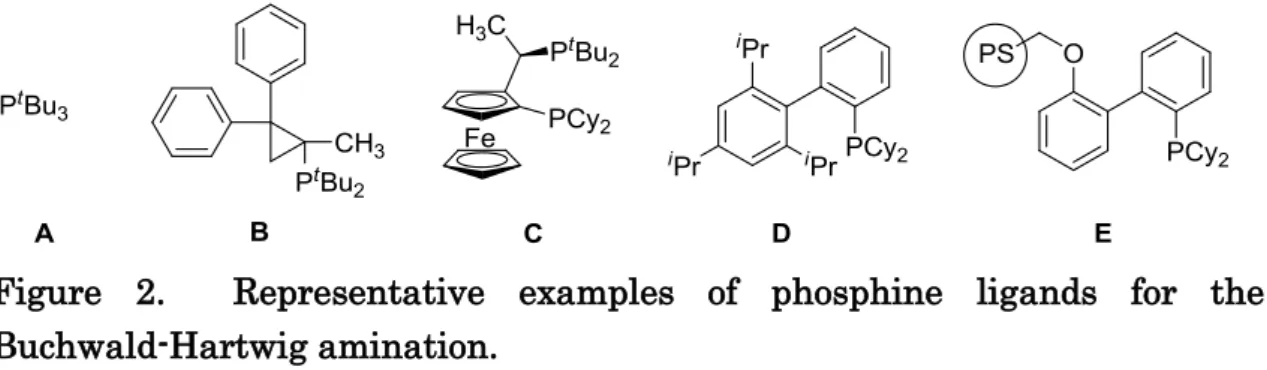
alkylphosphine L3 promoted the amination of bromobenzene (1A) as well as chlorobenzene (1A’) in refluxing aqueous KOH solution to give triphenylamine (5A) in 82 and 81% yield, respectively (Entries 8 and 9). A polymer supported palladium complex prepared from L3 (P/Pd = 2/1) provided 5A in 92% yield (Entry 10). The polymer supported palladium complex generated from the L4 hardly catalyzed the amination to give only 3% yield of 5A under similar conditions (entry 12). A polymer supported complex of L4 (P/Pd=2:1) again showed little catalytic activity for the amination (entry 13). The role of the P-substituents (tert-butyl vs cyclohexyl) is not clear yet, but it has been reported that [alkyl(tBu)2P] (Figure 2, A, B, or C) and [aryl(cyclo-Hex)2P] (Figure 2, D or E) can be used as an effective ligands for the Buchwald–Hartwig aromatic amination under the standard homogeneous conditions.
Figure 2. Representative examples of phosphine ligands for the Buchwald-Hartwig amination.
Amination reactions with indoline (7) and N-phenylpiperazine (9) were also examined successfully with L3 under otherwise the same conditions to
37
afford N-biphenyl-4-ylindoline (8) and N,N’-diphenylpiperazine (10) in 86 and 75% yield, respectively (Scheme 1).
Scheme 1. C-N coupling with nitrogen heterocycles.
Optimization of condition: According to the results for the screening of the ligand and P/Pd ratio, further optimization of reaction conditions was performed with changing Pd precatalyst and P/Pd ratio. Considering the utility of the products as electroactive materials, I decided to study the catalytic aromatic amination with diarylamines affording triarylamines. In contrast to the vast amount of research on aromatic amination with alkylamines, only scant attention has been focused on aromatic amination with diarylamines, which is thus still a major challenge even with homogeneous catalysts.[3] In addition, a clean synthesis of triarylamines with little metal contamination would be a welcome process owing to their
38
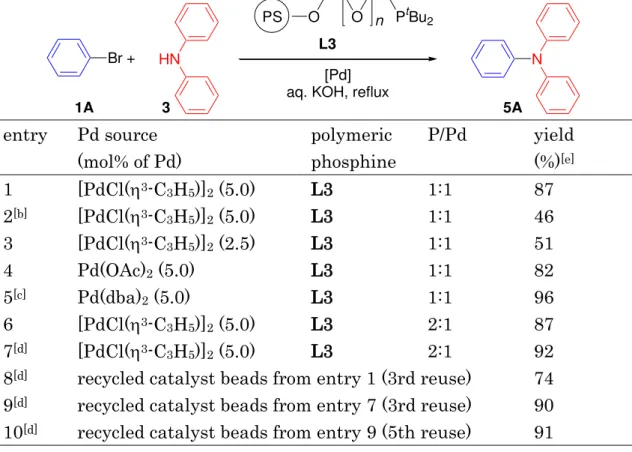
potential optoelectronic properties.[4] The reaction conditions were initially screened for the coupling of bromobenzene (1A) with diphenylamine (3) to afford triphenylamine (5A) with the palladium complexes by mixing the polymer supported phosphine L3, and the palladium reagent, [PdCl(3-C3H5)]2, [Pd(dba)2], or [Pd(OAc)2], in an appropriate ratio prior to their catalytic use (Table 2). Thus, the reaction of 1A with 3 (1.5 equiv to 1A) was performed with a palladium complex of PS-PEG resin-supported phosphine in aqueous KOH solution under reflux for 24 h. It is also noteworthy that the aromatic amination took place with KOH as a base in water, whereas an alkoxide base (e.g., NaOtBu) is frequently required to promote the reaction under the standard homogeneous conditions in an organic solvent. The hydrophobic organic substrates must diffuse into the hydrophobic polystyrene matrix in water to provide a highly self-concentrated reaction sphere where the coupling reaction releasing KBr into the aqueous phase should be significantly accelerated to reduce the initial molar concentration in the polymer matrix. After being cooled, the mixture was filtered, and the catalyst beads were rinsed with EtOAc to extract the organic products. The extract was concentrated in vacuo to give
39
crystals of triphenylamine (5A) with chemical purity of >95% as was determined by NMR and GC analysis without any chromatographic purification. The recovered polymer beads were recycled for amination under the same conditions without any further purification and additional charge of palladium. Representative results are summarized in Table 1 (entries 8-10), along with the recovered polymeric complexes. When the reaction was carried out in refluxing 20 M aqueous KOH with the polymeric complex prepared from L3 and di(-chloro)bis(3-allyl)- dipalladium(II) {[PdCl(3-C3H5)]2} (P/Pd=1/1), the desired Ph3N (5A) was obtained in 87% yield (Table 2, entry 1) (conversion of 4=100%, isolated yield of 5A=87%, purity of 5A=>95%). The chemical yield of 5A decreased as the concentration of palladium or base decreased (entries 2 and 3). A palladium complex prepared from [Pd(OAc)2] with L3 exhibited a slightly lower catalytic performance than that prepared from [PdCl(3-C3H5)]2 (entry 1 vs 4).
40
Table 2. Screening of the reaction conditions forming Ph3N (5A) via the reaction of PhBr (1A) and Ph2NH (3) in water with polymeric palladium complexes.[a]
Br+ HN N
[Pd] aq. KOH, reflux 3
PS O O n PtBu2 L3
1A 5A
entry Pd source (mol% of Pd)
polymeric phosphine
P/Pd yield (%)[e] 1 [PdCl(3-C3H5)]2 (5.0) L3 1:1 87 2[b] [PdCl(3-C3H5)]2 (5.0) L3 1:1 46 3 [PdCl(3-C3H5)]2 (2.5) L3 1:1 51
4 Pd(OAc)2 (5.0) L3 1:1 82
5[c] Pd(dba)2 (5.0) L3 1:1 96
6 [PdCl(3-C3H5)]2 (5.0) L3 2:1 87 7[d] [PdCl(3-C3H5)]2 (5.0) L3 2:1 92 8[d] recycled catalyst beads from entry 1 (3rd reuse) 74 9[d] recycled catalyst beads from entry 7 (3rd reuse) 90 10[d] recycled catalyst beads from entry 9 (5th reuse) 91
[a] All reactions were carried out in refluxing aqueous KOH (20M). The ratio of 1A (mol)/3 (mol)/H2O (L)=1.0:1.5:2.0, unless otherwise noted. [b] Aqueous 5 M KOH was used. [c] During the reaction, the polymeric palladium complex decomposed (palladium black precipitated out inside the polymer matrix). [d] The ratio of 1A (mol)/3 (mol)/H2O (L)=1.5:1.0:2.0.
[e] Yields of isolated product based on 1A (entries 1–6) or 3 (entries 7, and 8–10).
While palladium bis(dibenzylideneacetone) [Pd(dba)2] was found to be a good
41
Pd source, affording a high yield of 5A, as compared to [PdCl(3-C3H5)]2, the polymeric complex prepared with [Pd(dba)2] decomposed during the reaction (entry 5). When the amination was examined with the palladium complex prepared by mixing the polymer supported ligand L3 and [PdCl(3-C3H5)]2 in a ratio of P/Pd=2:1, 5A was obtained in 87% yield of isolated product (entry 6; yield based on 1A). When the reaction was carried out with 1A and 3 in a ratio of 1.5:1.0, i.e., the inverse substrate ratio to that of entry 6, the amination proceeded smoothly as in entry 6, to give 5A in 92% yield (entry 7; yield based on 3). Thus, the ratio of the reaction substrates (halide/amine) is optional.
Next, I examined the recyclability of the catalyst beads and found that the stability of the polymer supported catalyst significantly increased with a complexation ratio of P/Pd=2:1 (Table 2, entries 8–10), though the initial catalytic activity was not affected by the complexation ratio of phosphine to palladium (entry 1 vs 6). Thus, the catalyst beads prepared in a P/Pd ratio of 1:1 were recovered from the first run (entry 1) and subjected to several recycling runs through repetition of the standard manipulation (reaction and workup). Catalytic activity decreased as the recycling was repeated,
42
resulting in a 74% yield of 5A in the third recycling run. The polymer supported catalyst prepared in a P/Pd ratio of 2:1 was also recovered from the first run (entry 6) and reused to demonstrate its high recyclability. Thus, under similar conditions, the third and fifth reuses showed high catalytic performance affording 5A in 90% and 91% yield, respectively (entries 8 and 10).[5]
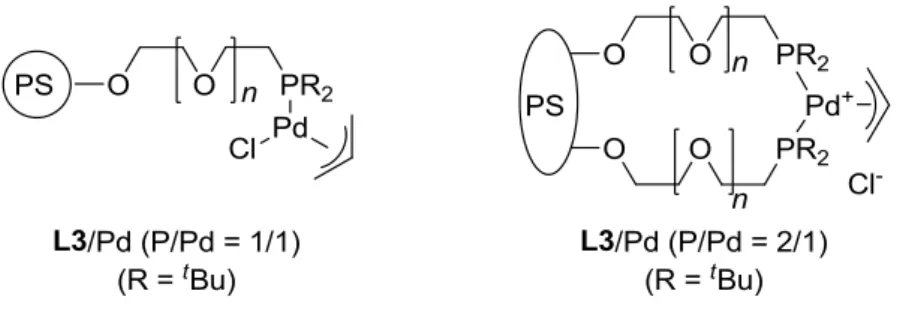
Structural studies on the polymer supported palladium complexes generated by mixing L3 and [PdCl(3-C3H5)]2 in ratios of 1:1 and 2:1 (P/Pd) were conducted with gel-phase 31P{1H} NMR and ICP-AES analyses (Figure 3). Formation of the palladium complexes [PdCl(3-C3H5)(phosphine)] (P/Pd=1:1) and [PdCl(3-C3H5)(phosphine)2]Cl (P/Pd=2:1) was achieved by mixing [PdCl(3-C3H5)]2 and an appropriate molar equivalent of the phosphine L3 in dichloromethane at ambient temperature for 60 min. Upon conversion of the polymeric phosphine L3 to the palladium–phosphine
complexes [PdCl(3-C3H5)(phosphine)] (P/Pd=1:1) and [Pd(3-C3H5)(phosphine)2]Cl (P/Pd=2:1), the phosphorus signals shifted downfield to +54.4 ppm and +40.6 ppm, respectively. Thus, the reaction progress with L3 (P/Pd=1:1) was conveniently monitored by gel-phase
43
31P{1H} NMR spectroscopy of the resin beads dispersed in [D]chloroform. After the complexation was completed, it was noted that a narrow singlet observed at = +19.7 ppm of the starting phosphine L3 disappeared and a new resonance at = +54.4 ppm increased. The remarkably low-field shift demonstrates that the phosphino group of L3 coordinates to palladium forming a -allylpalladium–phosphine complex on the amphiphilic solid support. Using similar procedures, I prepared a palladium–bis(phosphine) complex by mixing [PdCl(3-C3H5)]2 and 2 molar equivalents of the phosphine L3 (vs the palladium) where a new narrow singlet resonance at
=+54.8 ppm had appeared. ICP-AES analysis of the palladium–phosphine
complexes L3-Pd (P/Pd=1:1) and L3-Pd (P/Pd=2:1) showed the ratio of phosphorus, palladium, and chlorine to be 0.9:1.0:1.0 and 1.9:1.0:1.1, demonstrating that their structures are [PdCl(3-C3H5)(phosphine)] (P/Pd=1:1) and [PdCl(3-C3H5)(phosphine)2]Cl (P/Pd=2:1), respectively, as depicted in Figure 3. The high recyclability of the palladium complex, prepared with 2 molar equivalents of the polymeric phosphine L3 (vs the palladium) (Table 2, entries 8 and 9), can be attributed to the chelating coordination by the two phosphino groups.
44
Figure 3. Proposed structures of the polymeric palladium complexes.
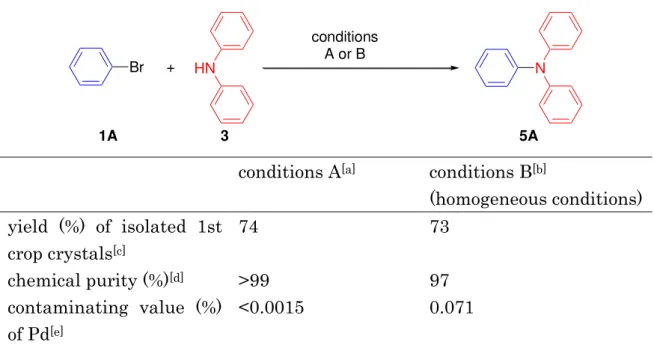
It is also noteworthy that little palladium residue was contaminated in the coupling product 5A when the procedure in entry 7 of Table 2 was employed. Thus, ICP-AES analysis revealed that the palladium species that leached from the polymeric catalyst to contaminate the 1 st crop crystals of Ph3N (5A; from ethyl acetate-hexane) was lower than the detection limit of ICP-AES analysis. The standard homogeneous amination conditions and usual post treatment (organic-aqueous extraction, filtration, solidification, recrystallization) gave crystals of 5A infected with 0.071% of palladium (Table 3, conditions B).
Consequently, the catalytic conditions employed in entry 7 of Table 2 were identified as the best system to achieve both heterogeneous- and aqueous-switching of the aromatic amination with high catalytic and recycling performance, which should realize a green and clean preparation of triarylamines with only negligible metal contamination.
45
Table 3. Comparative studies on the amination product 5A by heterogeneous and homogeneous aromatic amination of 1A with 3.[a]
Br + HN N
conditions A or B
1A 3 5A
conditions A[a] conditions B[b]
(homogeneous conditions) yield (%) of isolated 1st
crop crystals[c]
74 73
chemical purity (%)[d] >99 97
contaminating value (%) of Pd[e]
<0.0015 0.071
[a] Conditions A: According to the conditions employed in Table 2, entry 7. The reaction scale=5.2 mmol (Ph2NH). [b] Conditions B: The reaction was carried out with [Pd(dba)2] (5 mol% Pd), tBu3P (10 mol%), and NaOtBu (1.1 equiv) in 1,4-dioxane at 100 °C for 3 h (100% conversion). The reaction scale=5.2 mmol (Ph2NH). The ratio of 1A (mol)/3 (mol)/solvent (L)=1.5:1.0:2.0. [c] Recrystallized from EtOAc/hexane. [d] Determined by GC titration with [(4-CH3C6H4)3N] as an internal standard. [e] Determined by ICP-AES analysis.
Amination of various haloarenes: The heterogeneous aquacatalytic amination in water was examined with a variety of haloarenes under the reaction conditions identified above (see, Table 2, entry 7) and exhibited wide
46
substrate scope (Scheme 2). Thus, the amination catalysis with phenyl chloride and iodide proceeded in water as smoothly as that with phenyl bromide under the same conditions to afford triphenylamine (5A) in 75% and 89% yield, respectively. Electron-withdrawing and electron-donating substituents, such as CF3, CH3, OCH3, N(CH3)2, and Ph groups, were tolerated under the same conditions to give the corresponding triarylamines 5B–5J in good to excellent yield. The catalytic efficiency of the amination was strongly affected by substituents at the ortho position of the bromoarenes. Thus, the amination of ortho-tolyl bromide (1D) gave 44% yield of 5D, whereas that of meta- and para-tolyl bromides (1E and 1F) afforded the corresponding 5E and 5F in 88% and 95% yield, respectively. A similar steric effect was also observed with 1- and 2-bromonaphthalene (1K and 1L), where the desired triarylamines 5K and 5L were obtained in 20% and 87% yield, respectively. The heteroaromatic halide 1M also underwent amination in water under similar conditions to give diphenyl(pyridyl)amine 5M in 71% yield (Scheme 2).
47
PS O O n PtBu2 L3
+ HNPh2
[PdCl(3-C3H5)]2 (5 mol% Pd; P/Pd = 2/1)
aq. KOH, reflux
Ar Br (or I, Cl) Ar NPh2
1A-M 3 5A-M
NPh2
75% (from PhCl) 92% (from PhBr) 89% (from PhI)
NPh2 5B: 85% F3C
NPh2 5H: 65% H3CO
NPh2 5C: 91%
NPh2 5I: 96% F3C
(H3C)2N NPh2
5D: 44%
NPh2 5J: 91%
NPh2 5E: 88%
NPh2 5K: 20%
CH3
H3C
NPh2 5F: 95%
NPh2 5L: 87% NPh2
5G: 96%
N
NPh2 5M: 71% H3C
H3CO 5A:
Scheme 2. Amination of various haloarenes.
Double arylation of various anilines: Considering the lack of commercially available diarylamine derivatives (Ar2NH), the double arylation of primary anilines with haloarenes should offer a practical alternative synthetic route to various triarylamines (Scheme 3). The double arylation was achieved by the catalytic amination with 3 equivalents of bromobenzene with the aniline
48
11 in water. Thus, when the arylation of anilines bearing 2-trifluoromethyl, 2-methyl, 3-methyl, and 4-methyl substituents (11a–d) was carried out with the palladium complex with L3 in water in the presence of KOH, the arylation took place twice successively on the nitrogen of the aniline substrates to give the corresponding triarylamines 12a, 12b, 12c, and 12d in 85%, 86%, 83%, and 87% yield of isolated product, respectively, where 2.5 mol% molar ratio of palladium toward bromide substituent was enough to promote the double arylation (5 mol% to aniline).
Steric hinderance of the amino groups influenced the efficiency of the double arylation more than electronic factors. Thus, when the double arylation was examined with 2-methoxyaniline (11f) under similar conditions, the second N-arylation was significantly retarded to give 34% yield of the double-arylated compound 12f along with 43% of the N-monoarylated compound 12f’. The double N-arylation took place
successfully with the electron-rich anilines 11g and 11h to afford the N,N-diphenylanilines 12g and 12h in 85% and 92% yield, respectively. The reaction of the aniline substrates 11i and 11j, bearing the sterically demanding 2-morpholino or 2-tert-butyl group with bromobenzene resulted
49
in the formation of the monoarylation products 12i’ and 12j’ in high yield (Scheme 3).
Scheme 3. Double arylation of various anilines.
These observations prompted us to examine the stepwise introduction of different N-aryl groups on the nitrogen of anilines. Thus, 4-(dimethylamino)aniline (11h) reacted with 1 equiv of 4-bromobiphenyl (1L) under the N-arylation conditions in water to give N-naphth-2-ylaniline which was subsequently treated with 4-bromotoluene (1F, 1 equiv) to give
50
N-biphen-4-yl-N-(4-methoxy)phenyltol-4-ylamine (13) in 70% yield (Scheme 4).
Scheme 4. Stepwise N-arylation with different aryl groups.
In summary, the Buchwald–Hartwig amination was achieved in water under heterogeneous conditions by use of immobilized palladium complexes, coordinated by amphiphilic polystyrene–poly(ethylene glycol) resin-supported di(tert-butyl)phosphino group. I will show an application of the present catalytic system to synthesize some optoelectronic material in the next chapter.
51
Experimental section
All manipulations were performed under a nitrogen atmosphere. Nitrogen gas was dried by passage through P2O5. Water was deionized with a Millipore system as a Milli-Q grade and was degassed by the freeze-pump-thaw method prior to use. NMR spectra were recorded on a JEOL JNM-A500 spectrometer (500 MHz for 1H, 125 MHz for 13C, 202 MHz for 31P) or a JEOL JNM–AL400 spectrometer (400 MHz for 1H, 100 MHz for
13C, 162 MHz for 31P). Chemical shifts are reported in δ ppm referenced to an internal tetramethylsilane standard for 1H NMR. Chemical shifts of 13C NMR are given relative to CDCl3 as an internal standard (δ 77.0). The 31P NMR data are reported relative to external Ph3P. 1H, 13C, and 31P NMR spectra were recorded in CDCl3 or CD3OD at 25 °C. ICP-AES analyses were performed on Leeman Labs Inc. Profile Plus using palladium standard solution (KANTO CHEMICAL) and phosphine standard solution (KANTO CHEMICAL) as a standard. The ESI mass spectra were recorded on a JEOL JMS-T100LC spectrometer. The GC-MS was measured by an Agilent 6890 GC/5973N MS detector. The FAB mass spectra were recorded on a
52
JEOL MS700V. The IR spectra were obtained using a JASCO FT/IR-460plus spectrophotometer in ATR mode. PS-PEG bromo-resin was purchased from RAPP POLYMERETM (TentaGel®S Br, average diameter 0.90 μm, 1% divinylbenzene crosslinked, loading value of bromo residue 0.2-0.3 mmol/g).
Preparation of L1-Pd complex (P/Pd = 1/1): The polymer-supported ligand (L1) (1.00 g, 0.31 mmol of phosphine residue) was mixed with Di--chlorobis[(-allyl)palladium(II)] (56.7 mg, 0.31 mmol of Pd) in CH2Cl2 (10 mL) at ambient temperature and shaken for 1 h under a nitrogen atmosphere. The mixture was filtered and the resulting resin beads were washed with CH2Cl2 (10 mL, 3 times), dried in vacuo overnight to provide the L1-Pd complex (1.05 g). 31P NMR (162 MHz, CDCl3, 25 °C): =+62.9.
Preparation of L2-Pd complex (P/Pd = 1/1): Prepared by similar procedure for the preparation of L1-Pd complex (P/Pd = 1/1). 31P NMR (162 MHz, CDCl3, 25 °C): +55.9
![Table 1. Amination of halobenzenes in water [a]](https://thumb-ap.123doks.com/thumbv2/123deta/6165881.104844/36.892.123.771.197.793/table-amination-halobenzenes-water.webp)
![Table 1. C-S coupling of bromoarenes in water [a]](https://thumb-ap.123doks.com/thumbv2/123deta/6165881.104844/83.892.117.775.180.746/table-c-s-coupling-bromoarenes-water.webp)
![Table 2. Dicyclohexylphosphination of bromoarenes [a]](https://thumb-ap.123doks.com/thumbv2/123deta/6165881.104844/99.892.131.766.166.728/table-dicyclohexylphosphination-bromoarenes.webp)
