A study in resource federation for e-Science
Yutaka Kawai
DOCTOR OF PHILOSOPHY
Department of Accelerator Science
School of High Energy Accelerator Science
The Graduate University for Advanced Studies
2012
Abstract
This research seeks to seamlessly support the infrastructure of distributed com- puting and storage through the development and study of a software-abstraction layer that interfaces to multiple Grid middleware and to new Cloud environments. Through this abstraction it is possible to sustain uninterrupted access to resources that is robust to the dynamic nature of those resources (compute nodes may fail, storage resources may go offline while a computation is being performed). We studied the software-abstraction layer and provided our Universal Grid User In- terface (UGI) architecture for multiple kinds of Grid and Cloud middleware to support end users and application engineers. UGI is implemented based on A Simple API for Grid Applications (SAGA) and provides supplemental and ex- tended functions that are not included in SAGA.
We demonstrated that job submissions can be executed in the UGI-based user environment with different Grid resources. We provided and verified a simple way to execute the jobs based on High Energy and Nuclear Physics (HENP) libraries. For file manipulation, we demonstrated that an application can access the differ- ent file-system middleware in the Data Grids. The application enables to handle pieces as completed files, even if a large file is cut up and the separated parts are stored on different Data Grids. We managed the files distributed in heterogeneous Data Grids by using a catalog service. The example demonstrated that an applica- tion can obtain the location information about the pieces of files distributed among different kinds of Data Grids, and then access the distributed files.
For applied tools and applications, we demonstrated a method to reliably man- age files with Resource Namespace Service (RNS), a UGI-based Web application for Particle Therapy Simulation (PTSim), and an approach inspired by Ant Colony Optimization (ACO). Our method for reliably managing large files works on dif- ferent kinds of Data Grids using RNS. The volume of digital data and the size of an individual file are increasing due to the introduction of high-resolution images, high-definition audiovisual files, etc. The reliable storage of such large files is be- coming problematic with whole file replication as a failure in the integrity of the file is difficult to localize. Our method involves managing large files in Data Grids by splitting them into smaller units in a traceable manner and then managing the smaller units. The RNS catalog service contains EPR (Endpoint Reference) and metadata that describe the original locations as well as the checksum values. The example we shows how our Grid application can retrieve the actual file locations
and the checksum values from the RNS service.
Our second tool is a UGI-based Web application for PTSim. PTSim is a sim- ulation system for particle therapy. The application of particle physics to the medical environment is one of the application areas that have a direct benefit to mankind. PTSim makes use of the Geant4 toolkit to simulate the passage of par- ticles through the human body. It includes a Web interface that can be used by several collaborating medical particle therapy centers. The Web interface allows a non-Grid environment to be easily ported to Grid to take advantage of the addi- tional resources.
Our last tool is for an approach inspired by swarm intelligence, ACO. Swarm intelligence is one of approaches to provide a fault tolerant and efficient means of transferring data in a dynamic environment. Swarm intelligence is inspired pri- marily by observations of the collective behavior of social insects in addressing complex distributed problems. The basic idea is that each member of the swarm has simple rules that govern its behavior, but the interaction among the members of the swarm can be used to tackle problems that are difficult to solve with com- plicated numeric methods. We investigate the problem of data distribution among a client and servers in a dynamic environment. We regard each download from a server to the client as a single member in a swarm. The member’s behavior is sim- ply to reliably download a data file. Each member can communicate with other members to allow the swarm to settle on the best set of servers to download the data from based on the current status of the environment. ACO is one of Swarm intelligence methods. We created a simulator following the ACO based approach and showed that our approach works well, providing a fault tolerant and efficient means of transferring data in a dynamic environment.
We can utilize the computing and storage resources with our implementation and solution. The challenges of today’s researchers who need to collaborate with geographically distributed colleagues with distributed computing and storage re- sources can be overcome.
Acknowledgment
First of all, I appreciate my supervisor Takashi Sasaki. He gave me the opportu- nity to get into this research. He has not only helped me shape my research but also guided me in various aspects of my life as a researcher. Without him, this dissertation would not have appeared.
I am grateful to Go Iwai. He was my colleague in RENKEI project at KEK and also a committee member of this dissertation. He has supported me to work on papers, talks and presentation slides for academic conferences. Also, he helped me to set up my research environments in the beginning of my KEK life.
I would like to thank Hideo Matsuda who is another committee member. He leads the RNS development which I was working on a software adaptor for. He game me lots of discussions related to RNS and I was therefore able to improve my implementation.
I would also like to thank other committee members: Toshaiki Kaneko, Kento Aida, and Hiroyuki Matsunaga. I appreciated receiving their comments on my work and this manuscript.
I also thank to those who worked with me on the iRODS researches. Adil Hasan kindly suggested corrections against my wrong and vague parts in research aspects and also in English expressions. Francesca Di Lodovico and Yoshimi Iida suppoted to setup iRODS between KEK and QMUL. My implementaion used the iRODS testbed which is set up by them with Jean-Yves Nief from CC-IN2P3, Lyon, France and Mike Wan, Wayne Schroeder, Arcot Rajasekar and Reagan Moore from the DICE group.
I wish to acknowledge the valuable supports provided by Yoshiyuki Watase and Wataru Takase for the implementation of UGI and Web interfaces. I would like to thank members of Geant4 collaboration and members of PTSim devel- opment, especially, Takashi Akagi and Tomohiro Yamashita for using the DI- COM data. It is also a pleasure to acknowledge the SAGA developer team led by Shantenu Jha and Andre Merzky for their valuable suggestions and support.
I was encouraged much by some members in the RENKEI project: Kenichi Miura, Kazushige Saga, Kiyoshi Yamada, Eisaku Sakane, Yoshiyuki Kido, Yoshikazu Tanaka, Hitohide Usami, Osamu Tatebe, Shin’ichirou Takizawa, Nobukazu Yosh- ioka.
I also thank to those who gave me precious comments and advices at CRC in KEK: Sou Suzuki, Kouichi Murakami, Jiro Suzuki, Atsushi Manabe and Fukuko
Yuasa. I would also like to thank to CRC staffs, Mitsune Arai and Yumiko Kimura for supporting my office environments.
Special thanks are expressed to Shannon S Jacobs for correcting the English language of my conference papers, journals, and this manuscript.
Finally, I greatly thank my family. I appreciate my wife, Junko, for her pa- tience. She supported me at home while I concentrate on this study. Our children, Haruka and Wataru, bring me peace and comfort. My parents have given me fi- nancial and mental support for many years. Any of my success will be also theirs.
Contents
Abstract 1
Acknowledgment 3
1 Introduction 12
1.1 Motivation . . . 12
1.2 Definitions . . . 13
1.2.1 e-Science Definition . . . 13
1.2.2 Grid Definition . . . 13
1.2.3 Resource Federation . . . 14
1.3 Related Difficulties and Problems . . . 14
1.4 Research Approach . . . 15
1.5 Achievements . . . 16
1.6 Organization of this Dissertation . . . 16
2 Background and Related Work 18 2.1 Computing Resource Definitions . . . 18
2.1.1 Remote Execution of Applications . . . 19
2.1.2 Batch Queuing Systems (BQS) . . . 19
2.1.3 The Grid . . . 19
2.2 Job Submission . . . 20
2.2.1 Job Submissions to Different Middleware . . . 20
2.2.2 Related Work for Job Submission . . . 22
2.3 File Manipulation . . . 22
2.3.1 File Manipulation among Different Data Grids . . . 22
2.3.2 Related Work for File Manipulation . . . 23
2.4 User Interface . . . 25
2.4.1 Current User Interface to Control Differing Middleware . 25 2.4.2 Related Work for User Interface . . . 27
3 Design of Abstraction Layer 31 3.1 Common Interface Solution . . . 31
3.1.1 Job Submission with Common Interface . . . 31
3.1.2 File Manipulation with Common Interface . . . 32
3.1.3 User Interface for Interoperability . . . 32
3.2 UGI Design . . . 34
3.3 SAGA Implementation . . . 35
3.4 UGI Functionalities . . . 37
3.4.1 Job Handling . . . 37
3.4.2 File Manipulation . . . 38
3.4.3 Monitoring . . . 39
3.4.4 Authentication . . . 40
4 Implementation 41 4.1 Job Execution in Multi-Grid Environments . . . 41
4.1.1 Setup Demonstration . . . 41
4.1.2 UGI Implementation . . . 43
4.1.3 Job Submission with UGI . . . 44
4.1.4 Demonstration Results . . . 46
4.2 File Manipulation in Multi-Data Grids . . . 46
4.2.1 UGI Implementation . . . 47
4.2.2 File Access with UGI . . . 48
4.2.3 Demonstration Results . . . 52
4.3 Metadata Control in Multi-Grid Environments . . . 52
4.3.1 How to Access Distributed Files . . . 52
4.3.2 UGI Implementation . . . 55
4.3.3 UGI Example . . . 56
4.3.4 Demonstration Results . . . 58
5 Abstraction Layer Evaluation 60 5.1 Overhead Evaluation . . . 60
5.1.1 Inside of Abstraction Layer . . . 60
5.1.2 Evaluation for Job Submission . . . 61
5.1.3 Evaluation for File Manipulation . . . 63
5.2 Evaluation Method for Abstraction Layer . . . 67
5.2.1 Application Example . . . 69
5.2.2 Evaluation Results . . . 69
5.2.3 Correcting Comparison Tool . . . 70
5.2.4 Discussion . . . 73
6 Example Tools and Applications 75 6.1 Reliably Managing Files with RNS . . . 75
6.1.1 Background . . . 75
6.1.2 Related Work about Reliable File Management . . . 76
6.1.3 Access to Distributed Files with RNS . . . 76
6.1.4 Current Checksum Approach . . . 78
6.1.5 Split and Checksum Approach . . . 79
6.1.6 Performance Evaluation . . . 80
6.1.7 Discussion of UGI . . . 83
6.2 Particle Therapy Simulation (PTSim) . . . 85
6.2.1 PTSim Background . . . 85
6.2.2 PTSim Web Interface . . . 85
7 Applied Study 87 7.1 Ant Colony Optimization . . . 88
7.2 The Data Distribution Problem . . . 88
7.3 Related Work . . . 89
7.3.1 ACO Related Work . . . 89
7.3.2 Compared with Other Services . . . 90
7.4 Pheromone Definition . . . 90
7.4.1 Pheromone Element . . . 91
7.4.2 Pheromone . . . 92
7.5 Algorithm . . . 92
7.5.1 Algorithm to Select the Best Server . . . 93
7.5.2 Algorithm to Update the Information File . . . 93
7.5.3 Comparison with Traditional Method . . . 94
7.6 Simulation . . . 96
7.6.1 Model . . . 96
7.6.2 Procedure . . . 96
7.7 Simulation Results . . . 97
7.7.1 Phased Degradation . . . 97
7.7.2 Random Degradation . . . 99
7.8 Test Implementation . . . 100
7.8.1 iping/iping.py . . . 101
7.8.2 iget.py . . . 101
7.9 Test Results . . . 101
7.10 Discussion about UGI Use . . . 103
8 Conclusion 104
Bibliography 113
List of Publications 114
List of Figures
2.1 Job execution by remote server . . . 19
2.2 Job submission to Batch Queuing System . . . 20
2.3 Job submission to Grid middleware . . . 21
2.4 Difficulty of resource federation for job submissions . . . 21
2.5 Difficulty of resource federation for file access . . . 23
2.6 Difficulty of resource federation to control file locations . . . 23
2.7 RNS: Hierarchical namespace management. . . 24
2.8 Job Description Example of gLite . . . 26
2.9 Job Description Example of NAREGI . . . 26
2.10 The design of SAGA implemented in C++. . . 28
2.11 Job execution example in Python interface. . . 29
3.1 Submitting jobs to different Grids via Common Interface . . . 32
3.2 Place a common interface for job submissions . . . 33
3.3 Place a common interface for file access . . . 33
3.4 Place a common interface with RNS for file locations . . . 33
3.5 Implementation proposal for a software-abstraction layer . . . 34
3.6 Architecture of Universal Grid Interface . . . 36
3.7 UGI monitoring mechanism . . . 39
4.1 An example of WFML script . . . 42
4.2 An example of PBS script . . . 42
4.3 UGI-based user environment with Grid middleware. . . 44
4.4 Workflow diagram in the user environment based on UGI. . . 44
4.5 Job execution example using UGI. . . 45
4.6 Job task example using SAGA. . . 45
4.7 Bubble chamber photo image. . . 47
4.8 UGI-based user environment with Data Grids. . . 48
4.9 Workflow diagram in the user environment based on UGI. . . 49
4.10 iRODS network between KEK and Kings College. . . 49
4.11 File Access via UGI. . . 50
4.12 File Access to separated image data via UGI. . . 50
4.13 img cat ugi.py:The sample UGI application. . . 51
4.14 filelist.txt:The URL list of file locations. . . 51
4.15 Attribute definition of virtual directory . . . 53
4.16 UGI-based user environment with RNS. . . 55
4.17 Workflow diagram in the user environment based on UGI. . . 56
4.18 File access to separate pieces of a photograph via UGI. . . 57
4.19 img cat ugi.py – The sample UGI application with RNS. . . 57
4.20 The example of the attribute definition . . . 58
4.21 EPR example indicating Gfarm resource . . . 58
5.1 Call mechanism in SAGA with STA . . . 60
5.2 PBS script for overhead evaluation . . . 61
5.3 C++ code for overhead evaluation . . . 62
5.4 Python script for overhead evaluation . . . 63
5.5 Shell script to execute time commands. . . 63
5.6 Job submission performance in Torque . . . 64
5.7 File access to separate pieces of a photograph via SAGA. . . 64
5.8 img cat cmd.cpp – The sample code for Case 1. . . 66
5.9 img cat saga.cpp – The sample code for Case 2. . . 67
5.10 img cat saga rns.cpp – The sample code for Case 3. . . 68
5.11 Performance results of file manipulation with SAGA and RNS . . 69
5.12 Performance results of file manipulation with normal commands and SAGA . . . 71
5.13 i-commands vs. SAGA and iRODS . . . 72
5.14 cat command vs. SAGA and local-file system . . . 72
5.15 gf-commands vs. SAGA and Gfarm . . . 73
5.16 Gfarm: GSI vs. Shared Secret . . . 73
5.17 customized i-commands vs. SAGA and iRODS . . . 74
5.18 customized cat vs. SAGA and local-file system . . . 74
6.1 Metadata example contains checksum value . . . 77
6.2 A part of SAGA C++ source example . . . 78
6.3 Splitting a file with checksum . . . 79
6.4 Combining pieces with comparing checksum . . . 79
6.5 Access to distributed pieces in different Data Grids . . . 80
6.6 Performance evaluation results without SAGA . . . 82
6.7 Performance evaluation results with SAGA . . . 83
6.8 Script to execute a nuttcp test for network evaluation . . . 83
6.9 Script to execute a dd command for storage evaluation . . . 84
6.10 A part of UGI application example . . . 84
6.11 Application for PTSim work bench . . . 86
7.1 Environments of ants-foods and clients-data. . . 91
7.2 Simulator uses several information files. . . 97
7.3 Transfer-Rate and Pheromone for the phased degradation. . . 98
7.4 Transfer-Rate in the traditional way. . . 99
7.5 Transfer-Rate and Pheromone in the random degradation model. . 99
7.6 Random degradation model with Algorithm 7.3. . . 100 7.7 Transfer-Rate and Pheromone in the actual case. . . 102 7.8 ACO approach in different Data Grids with UGI. . . 103
List of Tables
2.1 Matrix between experiment and middleware. . . 20
2.2 Examples: Command differences between gLite and NAREGI. . . 26
2.3 Examples: Command differences between iRODS and Gfarm. . . 27
2.4 Pathname Examples between iRODS and Gfarm. . . 27
2.5 Frequently invoked APIs in SAGA job module. . . 29
2.6 Frequently invoked APIs in SAGA file module. . . 30
2.7 Frequently invoked APIs in SAGA replica module. . . 30
3.1 SAGA adaptors developed in KEK. . . 36
3.2 SAGA adaptors developed by other contributors. . . 37
4.1 Frequently invoked UGI APIs for job submissions. . . 43
4.2 Frequently invoked UGI APIs for file manipulations. . . 48
4.3 Frequently invoked UGI APIs to handle metadata. . . 55
4.4 Physical resource locations of the divided example files. . . 58
5.1 Average and standard deviation of the performance results. . . 61
7.1 The example of an information file (e.g. n=10, h=4) . . . 93
Chapter 1
Introduction
1.1 Motivation
For efficient research we need to use information and communication technology effectively. Grid computing and Cloud technologies are leading examples of dis- tributed processing technologies using the Internet. Grid computing has already been used widely since it was developed with a focus on the accelerator science field. However, for the present Grid computing technology, the development and operation of each kind of middleware varies widely among different countries or areas. For this reason, the interoperability among different kinds of middleware has become a major problem.
This research focuses on an infrastructure for seamless distributed comput- ing studied and developed as a software-abstraction layer interface that can be used with multi-Grid middleware and new Cloud environments. The calculations and simulations in the accelerator science require many computing and storage resources. Even if one site is damaged due to a disaster and the computing re- sources are diminished, it is possible to prevent discontinuation of research by using the resources of other sites. If a unified procedure that can be easily used is available to handle the applications and data in the different sites and systems, then utilizing the distributed processing and storage resources on a global scale is more possible.
System complexity of Grid or Cloud computing is increasing but application engineers and system administrators need to modify their systems, to add extra services and to support users. The new required software libraries and interfaces are always requested. The troubles and problems of Grid systems are also reported by users everyday (e.g. the Global Grid User Support (GGUS) [1]) Then, the system-complexity increase impacts on their workload. Therefore, a client-based system that is no impact or changes on the server-side is required. Our software- abstraction layer is designed to be independent from any middleware. We finally found algorithms inspired by swarm intelligence[2] to obtain distributed data in an optimal way without any change or overhead on the middleware-side. Our software-abstraction layer and the client-based algorithms are good combination
to utilize resources in different kinds of Grid middleware.
1.2 Definitions
1.2.1 e-Science Definition
The UK National e-Science Centre (NeSC) [3] defines “e-Science” as: e-Science is “the large scale science that will increasingly be carried out through distributed global collaborations enabled by the Internet.
” [4, 5]
According to the intentions of NeSC, e-Science typically has to provide to
“access to very large data collections, very large scale computing resources and high performance visualization back to the individual user scientists.”[4] They also say “The Grid is an architecture proposed to bring all these issues together and make a reality of such a vision for e-Science.”[4]
Grid computing is one of the foundations to make e-Science a reality. How- ever, we are studying the realistic situations involving today’s Grid computing. We found that the current state of Grid computing is inadequate for e-Science in the truly intended sense. We first define the Grid and then consider its limitations in the next sections.
1.2.2 Grid Definition
A history of the Grid definition appears in Professor Foster’s document “What is the Grid? A Three Point Checklist” [6]. Ian Foster et al. wrote an initial definition of the Grid in 1998 as:
“A computational Grid is a hardware and software infrastructure that provides dependable, consistent, pervasive, and inexpensive access to high-end computational capabilities.” [7]
They later refined the definition in the article[8] as:
“Grid computing is concerned with coordinated resource sharing and problem solving in dynamic, multi-institutional virtual organi- zations.” [8]
The key concept is the ability to negotiate resource-sharing arrangements among a set of participating parties (providers and consumers) and then to use the result- ing resource pool for various purposes. They defined this as a Virtual Organization (VO):
“The sharing that we are concerned with is not primarily file ex- change but rather direct access to computers, software, data, and other resources, as is required by a range of collaborative problem-solving and resource-brokering strategies emerging in industry, science, and engineering. This sharing is, necessarily, highly controlled, with re- source providers and consumers defining clearly and carefully just what is shared, who is allowed to share, and the conditions under which sharing occurs. A set of individuals and/or institutions defined by such sharing rules form what we call a virtual organization.” Finally, Ian Foster provided three criteria for a Grid as below:
1) A Grid must coordinate resources that are not subject to centralized control. 2) A Grid must use standard, open, general-purpose protocols and interfaces. 3) A Grid must deliver nontrivial qualities of service (e.g., relating to response
time, throughput, availability, and security) for co-allocating multiple re- source types to meet complex user demands.
The Grid definition will be discussed in more detail in Section 2.1.
1.2.3 Resource Federation
The efforts of e-Science middleware providers have certainly resulted in more mature Grid technology in recent years. In the last 10 years, different nations or regions have developed and deployed different Grid middleware infrastructures for e-Science. However, each Grid middleware is still utilized as just a fundamen- tal infrastructure and is far behind of the primary idea analogized with electrical power Grid.
Therefore, federating those resources on different Grids scattered around the world becomes the very essence of e-Science now. Today’s international scientific collaboration requires the resource federation which provides shared hardware and software resources on the different kinds of middleware.
1.3 Related Difficulties and Problems
The current kinds of Grid middleware are variedly developed among different communities, regions, and countries. As examples, Globus [9] is developed in the US, EGEE [10] gLite [11] is developed by the European Organization for Nuclear Research (CERN) [12], and NAREGI [13, 14] (NAtional REsearch Grid Initia- tive) is created as the Japanese national Grid middleware by the National Institute of Informatics (NII) [15]. The Globus technology has led in the Grid computing area since 1997, when the first version of the Globus Toolkit [16] appeared. Most
of the other kinds of Grid middleware, such as gLite and NAREGI, also use the Globus technology in their architectures. However, each kind of Grid middleware still has a different interface.
Foster’s criteria require that a Grid interface be general-purpose, but such an interface does not yet exist. The problem is that each kind of Grid middleware in use has its own specialized interface. Users encounter difficulties in handling these different kinds of Grid middleware. Each Grid relies on advanced middleware to interface between its resources and applications[17]. Users have to be aware of the underlying middleware layer and therefore they also have to make their applications run within the middleware infrastructures that they are using.
In the High Energy Accelerator Research Organization (KEK) [18], there are a number of computing systems and storage resources in different kinds of Grid environments. It is not easy for the users at KEK to switch to different mid- dleware. Learning how to use different kinds of Grid middleware is a burden on the users whenever there are problems or when new middleware infrastruc- ture appears. Also, recent scientific challenges require worldwide collaboration among researchers and sharing of their resources, such as computing systems, large amounts of distributed data, software, and knowledge.
Therefore it is an essential to provide a uniform architecture for application developers and to offer a high-level abstraction layer as a bridge between the mid- dleware and applications.
1.4 Research Approach
This dissertation describes the required functions to handle the various kinds of Grid middleware with a unified interface. Today, we have several kinds of Grid middleware: Globus from the US, EGEE gLite that is mainly developed by CERN, NAREGI, the Japanese national Grid middleware, and so on. There are also some local batch schedulers such as PBSPro, Torque, and LSF (Load Sharing Facil- ity) [19]. In terms of storage resources, there are different kinds of Data Grid middleware, including GridFTP (Globus) and The integrated Rule-Oriented Data System (iRODS) [20, 21] that was primarily developed in the US, Grid data farm (Gfarm) [22] that was developed by Tsukuba University in Japan, and others.
We tried to handle these different kinds of Grid middleware with our imple- mentation so that our experimental implementation can be of practical use in ac- tual research environments, according to the requirements of the researchers by joining Open Grid Forum (OGF) [23] workgroups. We especially joined an OGF working group of A Simple API for Grid Applications (SAGA) [24], created some adaptors for SAGA, and evaluated our and their prototypes. We contributed to fa- miliarize the Japanese Grid middleware, NAREGI, in the SAGA working group with creating a NAREGI adaptor for SAGA.
With our implementation, we tried to clear the unified-interface benefits with
actual use cases through working with projects related to Grid middleware and Data Grids, and published its contributions. We worked with RENKEI [25, 26] (REsources liNKage for E-scIence) project to discuss issues about Grid middle- ware in terms of NAREGI. We shared the issues and benefits about Globus-based middleware with the members from TeraGrid [27] and the successor XSEDE (Ex- treme Science and Engineering Discovery Environment) [28]. We also shared those about gLite middleware with the experts in CERN and KEK. In terms of Data Grids, we worked with the members of iRODS, Gfarm, and the Resource Namespace Service (RNS) [29, 30] to share the cutting-edge technologies of dis- tributed file system and metadata.
1.5 Achievements
Here are the achievements of this work:
1. A method to provide interoperability with different kinds of Grid and Cloud middleware.
2. A new architecture to utilize distributed resources.
3. The development of a new software interface to utilize the computing and storage resources of different kinds of Grid and Cloud middleware.
4. Example solutions using the new interface.
1.6 Organization of this Dissertation
This dissertation is organized as follows. In Chapter 2 we describe the background of this study and discuss related work to clarify the current problems when using distributed resources in different kinds of middleware. Also, we review previous and related work on the utilization of distributed resources.
Chapter 3 describes our software-abstraction layer, the Universal Grid User Interface (UGI). UGI with its various functions allows us to share Grid and Cloud resources as well as local resources.
In Chapter 4 we describe our implementation. The methods for job submission with different Grid resources are discussed in Section 4.1 and in Section 4.2 we show how to access distributed storage resources in different kinds of Data Grids. In Section 4.3 we show how to manage files distributed in heterogeneous Data Grids with a catalog system. We discuss performance evaluations and the methods for the software-abstraction layer in Chapter 5.
Chapter 6 deals with how to solve complex cases using our implementation. Section 6.1 describes a method for reliably managing files distributed in differ- ent kinds of Data Grids with RNS. This approach results in more reliability for
large-file replication since different sub-file units can be stored on different stor- age systems, thus reducing the risks due to hardware failures. Section 6.2 shows an example of UGI application that is a Web based user interface for Particle Ther- apy Simulation (PTSim) [31, 32]. The prototype of the Web interface allows users to easily request most of their job operations.
In the last part of the dissertation, Chapter 7, we consider an applied study to solve complex distributed problems. The demonstration showed that our Swarm Intelligence approach can find the optimum performance parameters in a real en- vironment. This research has the potential to be used in different kinds of Data Grids with UGI.
Chapter 2
Background and Related Work
We face challenges in using different Grid resources with various kinds of mid- dleware today. It is easy for a user to access the resources within a given kind of middleware, but there are significant interoperability problems if a user wishes to combine (or federate) resources from different Grid and Cloud providers. We need to ensure compatibility with our applications that are designed for our own middleware environments. Researchers are now geographically distributed due to the globalization of research activities and their middleware environments are different.
The problems can be broken down into three main areas:
• Job Submission: executing jobs and obtaining results
• File Manipulation: sharing files and managing the catalogs in distributed storage
• User Interfaces: submitting jobs and manipulating files with a unified inter- face
In this chapter we first define Grid computing and then present problems and related work in each of these areas.
2.1 Computing Resource Definitions
The distributed resources in the Internet can be classified into two general groups. One is computing resources for submitted jobs and the other is storage resources for manipulating files. To define the Grid, we discuss the submission of jobs using computing resources in this section. When considering how to use the distributed computing resources, there are three approaches to job submission:
1. Remote Execution of Applications 2. Batch Queuing Systems
3. T he Grid
Each of these approaches requires a more complex system, with Grid comput- ing being the most complex. Here is a summary of each approach for reference.
2.1.1 Remote Execution of Applications
There are many different ways to execute commands or run programs on a remote server. For UNIX machines, examples include rsh, rlogin, telnet, and ssh [33]. Users log into a remote server and execute their programs on that server (Fig- ure 2.1). This is the simplest method, but the degree of parallelism is restricted by the server.
User
Remote Server
Job
Figure 2.1: Job execution by remote server
2.1.2 Batch Queuing Systems (BQS)
A Batch Queuing System (BQS) can manage batch jobs and multiple worker nodes (Figure 2.2). The worker nodes are typically organized as a computing clus- ter. The BQS clients submit jobs to the BQS server and the BQS server schedules the submitted jobs to be executed on a selected worker node within the cluster. Users can increase the degree of parallelism compared to using a remote execu- tion host.
2.1.3 The Grid
Figure 2.3 shows a rough design of the current implementation of Grid middle- ware. Each kind of Grid middleware basically consists of several main compo- nents. The following components are the examples of NAREGI:
• Super Scheduler (SS): Manages multiple CEs
• Computing Element (CE): Manages its own BQS
• Information System (IS): Manages resource information about the Grid
• Security System: Manages account and VO authentication for the Grid
User
Job Job Job
BQS Server
JobJobJob
BQS
Worker Nodes
Figure 2.2: Job submission to Batch Queuing System
• Portal System: Provides environment tools for users of the Grid. (such as workflow tools, a Web interface, application-sharing tools, etc.)
The security and portal systems are closely related in many cases because authentications are required to use the environment tools. In order to discuss the file manipulation in a Data Grid, each Storage Element (SE) can be viewed as in Figure 2.3, linked to or replaced with a CE.
2.2 Job Submission
2.2.1 Job Submissions to Different Middleware
There are a number of computing resources with different kinds of middleware for job submissions in use today. Users need to ensure their backward compati- bility because the applications of the users are specific to their own middleware environments. Table 2.1 summarizes the current situation regarding middleware that is being used, planned, or developed in several of the Virtual Organizations (VO) participating at KEK (as of May 2012). Some VOs use non-interoperable middleware in their resources.
VO gLite NAREGI Gfarm SRB iRODS
ILC Using Planning Planning
Belle Using Planning Using Using
Medical App. Using Developing Planning
Atlas Using
J-PARC Planning Planning Planning Testing
Table 2.1: Matrix between experiment and middleware.
BQS
BQS
IS
SS
Security & Portal System
Grid Middleware
CE
1CE
nUser JobJob
Job
Job
Job Job
Figure 2.3: Job submission to Grid middleware
Grid‐A
Grid‐B
However, users encounter difficulties because the interfaces of Grid‐B and Cloud‐X are different from Grid‐A
Cloud‐X JobJobJob
Trying to use other Grid resources when encountering the lack of computing resources in Grid‐A
Figure 2.4: Difficulty of resource federation for job submissions
For the resource federation, here is a simple example involving different kinds of middleware: Grid-A, Grid-B, and Cloud-X (Figure 2.4). If the users usually use Grid-A but Grid-A is not operating correctly, they cannot continue working without the computing resources of Grid-A. In such a situation, they could use Grid-B or Cloud-X instead. However, there will be new problems in using such alternative resources because the interfaces of Grid-B and Cloud-X are different from those of Grid-A.
2.2.2 Related Work for Job Submission
There are several framework projects for Grid middleware to solve the above is- sues. Harald Gjermundrod developed the g-Eclipse [34] framework, which pro- vides a workbench toolset based on the Eclipse architecture. This requires using the Eclipse GUI whenever a job is submitted. This is not suitable for researchers who mostly work with shell scripts or command interfaces. The gEclipse archi- tecture is restricted to Eclipse-based plugin systems and its design depends on the middleware functions. There is a gLite middleware as an example, but some of the components required by gLite are scattered in various places in the architecture.
Erik Elmroth et al. created the Grid Job Management Framework (GJMF) [35]. The Job Control Service (JCS) is one component of GJMF, providing a functional abstraction of the underlying middleware and offering a platform- and middleware- independent job submission and control interface. GJMF supports the Globus and NorduGrid/ARC middleware. However, it is difficult to support other middleware because that would require changing the JCS components at the source level.
The Distributed Resource Management Application API (DRMAA) [36] pro- vides a generalized API to facilitate integration of application programs. DRMAA is limited to job submission, job monitoring and control, and retrieval of the fin- ished job status. These functions are close to the functions we need. In the SAGA specification [37] they note that “This API is also intended to incorporate the work of the DRMAA-WG [38]. Much of this specification was taken directly from DR- MAA specification [36]”. Therefore the experience of creating DRMAA is used to build the SAGA specification and DRMAA rendering in SAGA is possible. SAGA is a part of our software-abstraction layer (described in Section 2.4.2).
2.3 File Manipulation
2.3.1 File Manipulation among Different Data Grids
As shown Table 2.1, there are also a number of storage resources with different Data Grid middleware. Users again need to be careful about the backward incom- patibilities. Again, we show a simple example that is similar to the situation in job submission. For the resource federation, we have different kinds of middle- ware: DataGrid-A, DataGrid-B, and Cloud-X (Figure 2.5). If users usually use DataGrid-A but DataGrid-A has some problems, they can use Grid-B or Cloud-X instead. However, they would still have difficulties due to the differences among DataGrid-A, DataGridB, and Cloud-X.
Other difficulties involve controlling the file locations in such differing Data Grid environments. Figure 2.6 shows two difficulties. One of them is that the path-name definition is different among the Data Grids. The other is that the file location must be shared among different users. We introduced RNS to manage files distributed in heterogeneous Data Grids. The detail of RNS is described in
DataGrid‐B DataGrid‐A
Cloud‐X
Trying to use other storage resources when encountering the lack of storage resources in DataGrid‐A
However, users encounter difficulties because the interfaces of DataGrid‐B and Cloud‐X are different from DataGrid‐A
Figure 2.5: Difficulty of resource federation for file access
DataGrid‐A DataGrid‐B
App App
Storage Storage
How to find file locations? Where are the files stored?
Figure 2.6: Difficulty of resource federation to control file locations
Section 2.3.2. The information about the physical file locations in our environ- ment is managed as metadata entries in RNS.
2.3.2 Related Work for File Manipulation
RNS Overview
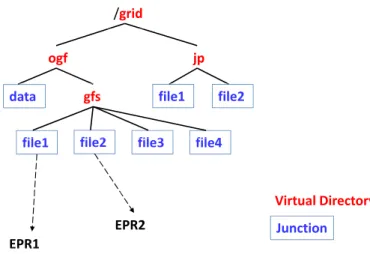
RNS, which was introduced in GFD101[29], “offers a simple standard way of mapping names to endpoints within a Grid or distributed network” [29]. As shown in Figure 2.7[39, 30], RNS provides hierarchical namespace management with name-to-resource mapping[39]. RNS has two fundamental types of entries, vir- tual directories and junctions. A virtual directory represents a non-leaf node in a hierarchical RNS namespace tree. A junction links a reference to an existing re- source into the hierarchical RNS namespace. All compliant RNS implementations must have a valid WSAddressing[40] EPR.
The RNS application prototype is available from Osaka University[30] and
/grid
ogf jp
data gfs
fil 1 fil 2 fil 3 fil 4 file1 file2
file1 file2 file3 file4
EPR1
EPR2 Junction
Virtual Directory
EPR1
Figure 2.7: RNS: Hierarchical namespace management.
the University of Tsukuba[41] as a sub-project of the RENKEI project. The RNS servers and clients in the application communicate with XML messages using SOAP(Simple Object Access Protocol)[42] as defined in GFD101, and each RNS directory or junction entry can also contain its own XML messages as metadata.
As regards how to manage the file catalog in RNS, the RNS research group developed a metadata management system[43]. They assume the service sites become widely distributed and the number of the services is rapidly increasing. We can hierarchically search against all the RNS servers with a single query like a Domain Name System (DNS). RNS entries can spread over multiple servers. A logical file catalog in RNS can be built up among those RNS servers. RNS can manage a large-scale file catalog and static load distribution using multiple servers. In terms of dynamically updating the catalog among the servers, other researchers showed in their paper [44] but it causes increasing complexities of our test systems and environments. Therefore, in this study, we used RNS statically.
Our software-abstraction layer involves the RNS client implementation to man- age files distributed in heterogeneous Data Grids. The API of the RNS prototype in our implementation is described in Chapter 4.
Other Catalog Services
There are several existing catalog services. The Storage Resource Broker (SRB) [45] has a uniform data access API and a metadata catalog. The SRB-derived iRODS inherits SRB’s architecture and provides additional functions for rules and micro- services that can be customized by users[46]. OGSA-DAI(Open Grid Services Architecture - Data Access and Integration)[47] provides a client for metadata management with XML in the same way as RNS. Hermes[48] provides a desk- top client for file transfer and data management with metadata. These services include mechanisms for resource discovery. However, the mechanisms are unique
to each service. To register the resources of a different service in the catalog of one service, additional adaptors must be used to access the other service, though OSGA-DAI tried to reduce these problems using an RNS approach[49, 50]. RNS can obtain an EPR using the SOAP protocol without those extra efforts.
AMGA (ARDA Metadata Grid Application)[51, 52] is a metadata catalogue service and part of the gLite middleware. AMGA provides a special SQL-like lan- guage to express queries but it has a limited number of operators[53]. In contrast, RNS accepts a general XQuery[54] to search the XML metadata.
Our work focuses on using RNS to minimize the special extensions needed by our Grid environments when managing distributed files.
Other Solutions for File Manipulation
Various projects are underway to reliably manage files and to aggregate different heterogeneous Data Grids or file systems for efficient data sharing. Here is a summary of work related to various aspects of our study.
Zeng Dadan et al. used different file systems for their Map-Reduce implemen- tation [55]. They supported three file systems: a local file system, HDFS (Hadoop Distributed File System)[56] and the Kosmos File System[57]. However, they load and configure the interface within Hadoop, which limits their work to file systems supported by Hadoop.
Hamid-Reza Mizani et al. proposed VOFS (Virtual Organization File System) to hide the heterogeneity of aggregated file systems[58]. VOFS also has a meta- data management service so that VOFS can handle traditional information (file size, last modification time, creation time, files in a directory, etc.) and VOFS- specific metadata. However, VOFS requires each registered file system to install a VOFS server.
Horst E Wedde et al.[59], Dan Feng et al.[60], and Yinjin Fu et al.[61] all discuss efficient metadata management. However, they are using only one or a few kinds of file systems.
Our solution with UGI is not limited to any specific environment. In addi- tion, one only needs to modify a configuration file to switch file systems. UGI can handle the differences with the URL schema itself, thus our application can dynamically switch file systems. File systems do not need any customization in the solution and RNS can handle the resources of any kind of file system. Those are described in Section 4.2 and Section 4.3.
2.4 User Interface
2.4.1 Current User Interface to Control Differing Middleware
We need an interface to access middleware for job submission and file manipula- tion. Each current middleware has its own special interface and the interfaces are
Executable = ”test.sh”; StdOutput = ”std.out”; StdError = ”std.err”;
Figure 2.8: Job Description Example of gLite
<?xml version=”1.0” encoding=”UTF−8” standalone=”no”?>
<JobDefinition xmlns=”http://schemas.ggf.org/jsdl/2005/06/jsdl” xmlns:naregi=”http://www. naregi.org/ws/2005/08/jsdl−naregi−draft−02”>
<JobDescription>
<JobIdentification>
<JobName>Program</JobName>
</JobIdentification>
<Application>
<POSIXApplication xmlns=”http://schemas.ggf.org/jsdl/2005/06/jsdl−posix”>
<Executable>test.sh</Executable>
<WorkingDirectory>workdir</WorkingDirectory>
</POSIXApplication>
</Application>
</JobDescription>
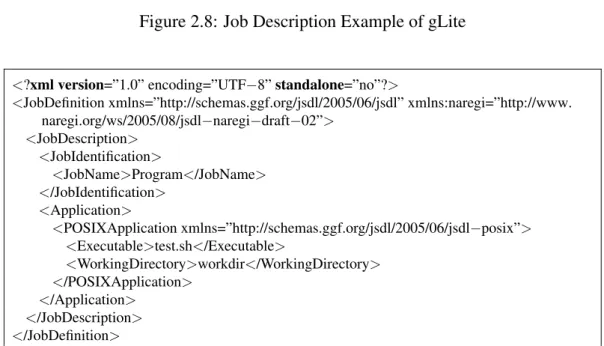
</JobDefinition>
Figure 2.9: Job Description Example of NAREGI
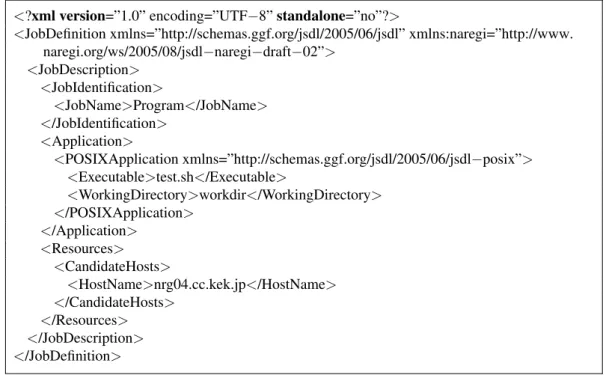
not compatible with each other. For example, Table 2.2 shows some examples of the differences between two kinds of middleware, gLite and NAREGI, in their job submission commands. There are not only differences in commands, but also job description differences between them. The differences of these job descriptions are shown in Figure 2.8 for gLite and Figure 2.9 for NAREGI. When we want to use both kinds of middleware, we must prepare job descriptions in both styles and manually switch them to execute the appropriate commands.
Function gLite NAREGI
Proxy Delegation glite-wms-job-delegate-proxy naregi-signon
Job Submission glite-wms-job-submit naregi-job-submit
Job Status glite-wms-job-status naregi-job-status
Job Cancellation glite-wms-job-cancel naregi-job-cancel
Job Retrieval glite-wms-job-output naregi-std-print
Table 2.2: Examples: Command differences between gLite and NAREGI.
For file manipulation, the situation is the same as for job submission. For ex- ample, Table 2.3 shows the differences between two kinds of middleware, iRODS and Gfarm, for storage commands. Beyond the command differences, there are also pathname differences between them. The differences in their pathname are shown in Table 2.4. We can specify any pathname in Gfarm, but iRODS requires
a ZoneN ame in the beginning of its pathname.
Function iRODS Gfarm
List Files ils gfls
Copy File icp gfrep
Remove File imv gfmv
Concatenate File iget - gfexport
Create Directory imkdir gfmkdir
Table 2.3: Examples: Command differences between iRODS and Gfarm.
Middleware Pathname Example
iRODS /tempZone/home/user1
Gfarm /home/user1
Table 2.4: Pathname Examples between iRODS and Gfarm.
To add new middleware for computing or storage, the operations and styles of the new middleware must be understood. Such extra work is basically wasteful for researchers, since the tasks of the job are quite often unchanged.
2.4.2 Related Work for User Interface
Using a Grid system involves using specialized commands and rules to access the middleware. The differences among these commands and rules can cause problems for application developers and users. Using a framework interface is one of solutions.
The Distributed and Unified Numerics Environment (DUNE) [62, 63] pre- pares abstract interfaces and a modular toolbox to solve particular equations with different kinds of Grid middleware. The DUNE framework consists of a number of modules: core modules and extra modules. Several Grid implementations can be used through the DUNE interface with the core modules. The extra modules allows to use other further Grid implementations. However, the DUNE interface does not apply published standards and it is especially designed for solving partial differential equations (PDEs).
The Open Cloud Computing Interface Core (OCCI) [64, 65] gives an abstrac- tion to identify, classify, associate and extend distributed resources. However, OCCI is mainly used for Cloud systems because “OCCI was originally initiated to create a remote management API for IaaS model based Services” and the cur- rent OCCI is “suitable to serve many other models in addition to IaaS, including e.g. PaaS and SaaS.”
SAGA is another architecture that provides a unified interface that conceals the differences among the different middleware infrastructures. A SAGA implemen- tation is part of our software-abstraction layer, but SAGA does not have enough
Figure 2.10: The design of SAGA implemented in C++.
functionality in such areas as authentication and job monitoring. We briefly de- scribes SAGA in the next section. Supplemental and extended functions beyond SAGA are supported by UGI (Section 3.3).
SAGA Overview
SAGA [66, 24], is Open Grid Forum (OGF [23]) standard compliant software and is one of the realistic approaches to realize such an environment that is in- dependent of the evolution of the middleware. SAGA is designed to be a bridge among the various kinds of Grid middleware (Figure 2.10 [67]). Once a SAGA adaptor for each kind of middleware has been prepared, the application develop- ers only need the functional API without worrying about the specific features of the middleware. We can use any type of Grid resources if the appropriate SAGA adaptors are available. The SAGA community has released several SAGA core implementations[24]. The current SAGA C++ implementation supports a wide range of Grid middleware [68]. Python, C++ and Java APIs are currently avail- able as the functional SAGA APIs. The APIs are used for the job modules, file modules, and replica modules.
SAGA APIs for Job Modules
Application developers can use these modules when invoking the APIs to submit jobs to the specified middleware. Application users need only specify the scheme to switch to different Grid middleware with the same job description. Table 2.5 shows some examples that application developers can invoke SAGA APIs for job submissions.
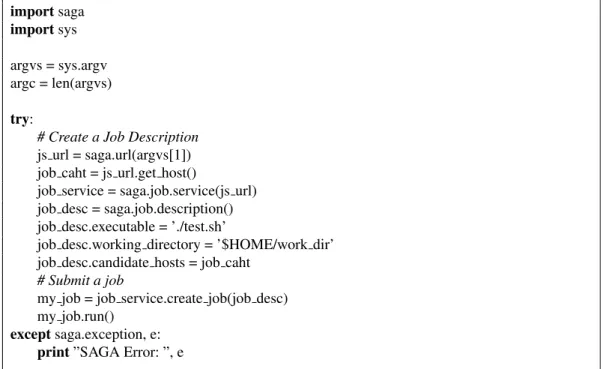
A SAGA job description has several attributes. The application developer can configure them one time and reuse the job description to submit jobs on other middleware infrastructures. The sample configuration of a SAGA job description
importsaga importsys argvs = sys.argv argc = len(argvs) try:
# Create a Job Description js url = saga.url(argvs[1]) job caht = js url.get host()
job service = saga.job.service(js url) job desc = saga.job.description() job desc.executable = ’./test.sh’
job desc.working directory = ’$HOME/work dir’ job desc.candidate hosts = job caht
# Submit a job
my job = job service.create job(job desc) my job.run()
exceptsaga.exception, e: print”SAGA Error: ”, e
Figure 2.11: Job execution example in Python interface.
is shown in Figure 2.11. Application users need only specify the job service (e.g. NAREGI or gLite) and modify a part of job description to switch it to another service.
SAGA APIs for File Modules
Application developers can use the file-module APIs to use file systems via SAGA. The application users need only specify the scheme and logical path to switch to some other file system middleware. Table 2.6 shows some examples that the ap- plication developers can call SAGA API to use the Data Grids.
SAGA APIs for Replica Modules
We also need to control metadata via SAGA. The logical file and the logical di- rectory in the SAGA replica package allow us to handle the required metadata. Application developers can use these APIs to handle metadata for logical files and
SAGA API Function
saga::url::url() Specify job service (e.g. NAREGI or
Torque).
saga::job::description::description() Create a job description. saga::job::service::create_job(description) Create a job with description.
saga::job::job::run() Submit a job.
Table 2.5: Frequently invoked APIs in SAGA job module.
SAGA API Function
saga::url::url() Specify directory or file location.
saga::filesystem::directory::open(file) Open a file in the directory.
saga::filesystem::file::read() Read the file.
saga::filesystem::file::write(*buffer) Write buffer data to the file. saga::filesystem::file::get_size() Get file size of the file.
saga::filesystem::file::copy() Copy the file.
Table 2.6: Frequently invoked APIs in SAGA file module.
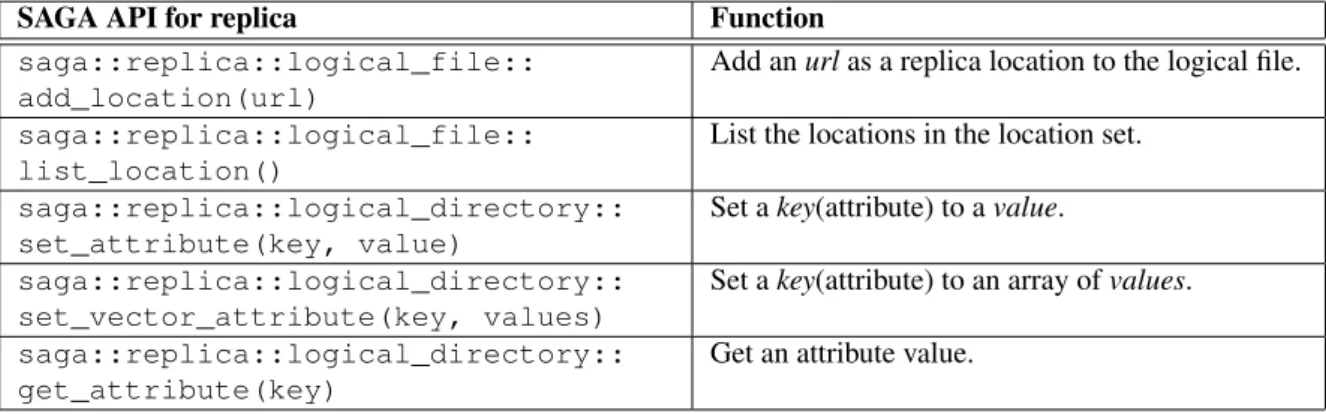
directories. Table 2.7 shows some examples of application developers calling the SAGA APIs to handle metadata for the logical file and directory.
SAGA API for replica Function
saga::replica::logical_file:: add_location(url)
Add an url as a replica location to the logical file. saga::replica::logical_file::
list_location()
List the locations in the location set. saga::replica::logical_directory::
set_attribute(key, value)
Set a key(attribute) to a value. saga::replica::logical_directory::
set_vector_attribute(key, values)
Set a key(attribute) to an array of values. saga::replica::logical_directory::
get_attribute(key)
Get an attribute value.
Table 2.7: Frequently invoked APIs in SAGA replica module.
Chapter 3
Design of Abstraction Layer
This chapter describes a software-abstraction layer interface, the Universal Grid User Interface (UGI), to control the resources of different kinds of middleware. Today’s international scientific collaboration requires the resource federation which provides shared hardware and software resources from various kinds of Grid and Cloud middleware. One of the solutions involves a unifying interface between the users and the middleware. We designed and implemented a UGI that provides a seamless environment for end users of such remote resources (Grid or Cloud resources) with their local resources. The UGI functions include job handling, manipulating files, general file cataloging, and monitoring jobs. UGI includes the SAGA (Simple API for Grid Applications) architecture and external components that are not supported by SAGA. Our prototype UGI implementation provides a Python API, a command line interface, and a Web interface.
3.1 Common Interface Solution
Current kinds of Grid middleware conform to most of Foster’s criteria (Section 1.2.2) but there are still some issues. A general-purpose interface is one of his criteria, but has not been fully realized. Each of the current Grid middleware systems has a special interface based on its own architecture and none of the interfaces is designed as a generalized interface. The next level of interfaces should resolve the challenges of the interface differences among the Grid middleware and make simultaneously available all of the different resources in Grid middleware (Fig- ure 3.1). The target of this dissertation is to solve these interface problems.
3.1.1 Job Submission with Common Interface
Figure 3.2 shows that a common interface enables the users to easily access dif- ferent resources. Local clusters can also be used via the common interface. In addition, users can use all of the resources simultaneously. Such a situation can be described as a resource federation for job submissions.
Grid
ABQS
Grid
BBQS
Grid
XBQS
Common Interface
User
JobJobJob
Job
Job
Job
Figure 3.1: Submitting jobs to different Grids via Common Interface
3.1.2 File Manipulation with Common Interface
Preparing a common interface is also beneficial for file access. Figure 3.3 shows that the common interface allows the users to easily access different kinds of stor- age. Local file systems can be also used via the common interface. Obviously, users want to use all of the kinds of storage simultaneously.
We need to address two difficulties when controlling the file locations in dif- ferent Data Grid environments, as mentioned in Section 2.3.1. RNS can provide a unified namespace among the Data Grids and its information can be shared among different users. RNS was introduced into the common interface to manage files distributed in heterogeneous Data Grids (Figure 3.4). The information about the physical file locations in our environment can be managed by the common inter- face. This makes it easier to share the metadata about each file between different Data Grids. Then users can access all of the available storage simultaneously and benefit from the catalog services for different kind storage resources.
3.1.3 User Interface for Interoperability
The common interface is a key component to solve the difficulties of job submis- sion and file manipulation among different kinds of Grid and Cloud resources. One of the implementations concerns is where to place a software-abstraction layer for the common interface. The design objective of the software-abstraction layer is to hide the complex treatment of middleware from users and to provide them with seamless access to local, Grid, and Cloud resources.
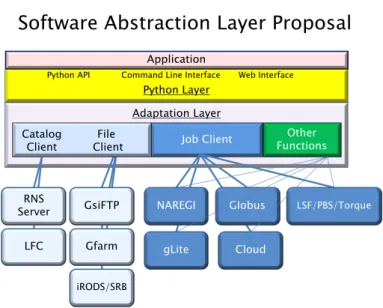
Figure 3.5 shows the architecture of the software-abstraction layer with a Python layer and an Adaptation layer. Users prefer to use easy interfaces such
Grid‐A
Grid‐B
Cloud‐X JobJobJob
JobJobJob
JobJobJob
Local Cluster JobJobJob
Interface
Local Cluster can be used via the common interface
The common interface enable to access different resources easily.
Figure 3.2: Place a common interface for job submissions
DataGrid‐B DataGrid‐A
Cloud‐X
Interface
Local File System
The common interface enable to access different storages easily.
Local File System can be used via the common interface
Figure 3.3: Place a common interface for file access
Gfarm iRODS
App App
Storage Storage
Interface
RNS Find file locations
DB
Catalog Service
The common interface provides
understandable information of file locations
Figure 3.4: Place a common interface with RNS for file locations
as shell scripts, shell commands, and Web interfaces. Therefore the Python layer needs to provide at least a Python API, shell commands, and a Web Interface. The
Other Functions Job Client
RNS
Server Globus
Gfarm GsiFTP
LFC
NAREGI
gLite Python Layer
Application
iRODS/SRB
LSF/PBS/Torque
Cloud Python API Command Line Interface Web Interface
Software Abstraction Layer Proposal
Catalog Client
File Client
Adaptation Layer
Figure 3.5: Implementation proposal for a software-abstraction layer
reason for adopting Python for the API is its popularity with scientists for quick development of custom applications for their fields of study. The Adaptation layer allows all of the clients to handle any middleware and consists of job clients, file clients, and catalog clients. The Adaptation layer is also flexible to include other functions for extra tasks such as authentication and monitoring.
In our currently supported environments, jobs are submitted to five kinds of middleware: NAREGI, Globus, gLite, PBSPro, and Torque. To manage files, we use three kinds of Data Grids: iRODS, Gfarm, GridFTP. The information about the physical file locations in our environment is managed as metadata entries in RNS. The abstraction layer helps application developers in building real applica- tions for the end-user scientists.
The implementations of the software-abstraction layer must be easily main- tainable and expandable for new kinds of middleware.
3.2 UGI Design
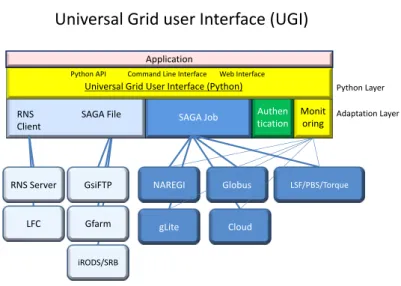
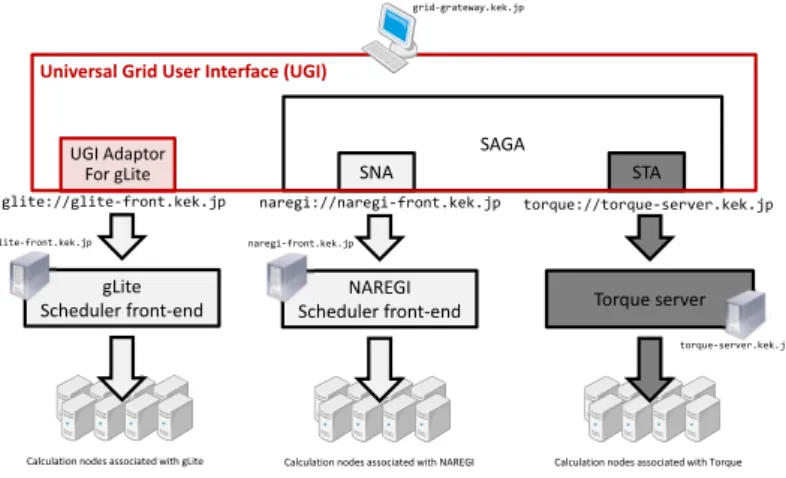
We designed a high-level user interface, UGI, and Figure 3.6 shows the archi- tecture of the software building blocks. UGI is implemented based on SAGA and also provides supplemental and extended functions beyond SAGA. The UGI- based Web interface with the various functions can share Grid and Cloud resources as well as local ones. In order to share scientific resources among collaborators, we have to cope with different user interfaces to these different kinds of Grid mid- dleware. We adopted SAGA to span the different Grid environments. SAGA aims to address this heterogeneity and currently provides working implementations in C++ and Java.
The current design of UGI functions includes job handling, file manipulation,
general file catalog, and monitoring. It runs on a host with SAGA C++ core libraries, adaptors, and client software necessary to use the Grid middleware and Data Grids.
For job handling, UGI supports multiple job submissions to various Grid kinds of middleware infrastructure and local batch systems at the same time using same job submission scripts. The job load sharing can be controlled according to the availability of resources. The end users’ applications handle the results and data files according to their own work flow designs, which may call for such as proce- dures as chaining jobs, post processing, and graphic display.
UGI provides file manipulation functions such as copy, remove, transfer, and catalog registration. These functions accept various file storage protocols within the same API: Local file system, GridFTP, Gfarm, and iRODS. The file catalog is a crucial facility for sharing large amounts of distributed scientific data. For shar- ing files among different Grid middleware, a middleware-independent file catalog system is needed. UGI adopted the OGF standard RNS as its file catalog. We collaborated with Osaka University and the University of Tsukuba to implement the RNS as a general-purpose file catalog system. It provides a tree structure of the name space with virtual directories and junctions. Each junction has an EPR. Both virtual directories and junctions can contain metadata about the files or di- rectories. The metadata can be queried to find appropriate files to use from a large archive of scientific data.
For monitoring a large number of jobs dispatched in different kinds of Grid environments, we introduced a lightweight database. The database can store not only job status data, but also job-related information such as job parameters, anal- ysis conditions, output file locations, etc. Usually the status transition of jobs submitted to Grid middleware is delayed due to the propagation time from the middleware to the client. In UGI, a dispatched job can update the database by itself through a XML-PRC [69] mechanism.
3.3 SAGA Implementation
SAGA Adaptors
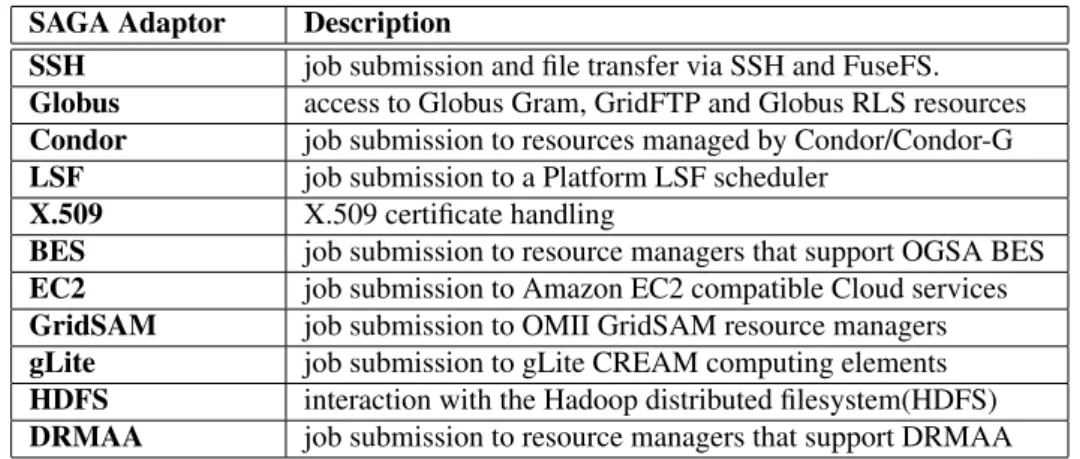
SAGA is a part of our UGI implementation. We implemented the required soft- ware modules to internationalize NAREGI. Actually, we developed the SAGA adaptors shown Table 3.1, in compliance with the SAGA specification, as stan- dardized within the OGF[66, 70].
Other SAGA adaptors for other kinds of Grid middleware have been developed in other countries. Table 3.2 shows the currently available SAGA adaptors [68].
Through working on the SAGA adaptor implementations, we found that SAGA has some limitations in addressing our requirements. We cannot monitor the sta- tus of each job in real time via SAGA, SAGA does not support different kinds of authentication processes, and SAGA cannot handle directly copying files among
Universal Grid user Interface (UGI)
Monit oring Authen tication SAGA Job
RNS Server Globus
Gfarm GsiFTP
LFC
NAREGI
gLite
Universal Grid User Interface (Python)
Adaptation Layer Python Layer Application
iRODS/SRB
LSF/PBS/Torque
Cloud
Python API Command Line Interface Web Interface
RNS Client
SAGA File
Figure 3.6: Architecture of Universal Grid Interface
Name Full Name Middleware
SNA SAGA NAREGI Adaptor NAREGI
STA SAGA Torque Adaptor Torque
SPA SAGA PBSPro Adaptor PBSPro
SIA SAGA iRODS Adaptor iRODS
SGFA SAGA Gfarm Adaptor Gfarm
SRA SAGA RNS Adaptor RNS
Table 3.1: SAGA adaptors developed in KEK.
different Data Grids. We describe these SAGA limitations in the next. SAGA Limitations addressed by UGI
There are four problems in the current SAGA framework. First, there is a need to monitor jobs in real time. We cannot get real-time job status using the SAGA approach because the current system is designed to poll each job for its status. The number and complexity of jobs in recent research projects is increasing so we need to obtain the status of each job in real time. A UGI client can attach an epilogue script to report the job status via XML-RPC so that the job status can be monitored in real time.
Another problem is that the authentication for each kind of Grid middleware is different. SAGA supports only X.509 certificate [71] authentication by follow- ing the Globus procedure. NAREGI is one kind of Grid middleware that requires special commands that are not same as the Globus GSI (Grid Security Infras- tructure) [72] authentication commands. We cannot use SAGA for the NAREGI authentication, and therefore we need a unified interface for any kind of Grid authentication. UGI can easily invoke commands for each kind of Grid authenti-