Studies in mid-infrared properties of galaxies
at intermediate redshift
based on the AKARI North Ecliptic Pole surveys
The Graduate University for Advanced Studies
School of Physical Science
Space and Astronautical Science
Kazumi Murata
August 25, 2014
Abstract
In this thesis, mid-infrared properties of galaxies are investigated with data from the AKARINorth Ecliptic Pole surveys (NEP-surveys). For many years, for the understand- ing of galaxy evolution and formation, many researches have been conducted in various ranges of wavelengths. However, previous studies did not pay much attention to dust features in galaxies at intermediate redshift due to sparse filter sampling of previous tele- scopes, although the dust features have much information of the star-formation and phys- ical conditions of the interstellar matters. On the other hand, the AKARI NEP-surveys have been carried out with a continuous mid-infrared wavelength coverage of Infrared Camera on-board AKARI satellite. With this survey data, three studies are carried out in this thesis.
First, the catalogue of the AKARI NEP-Deep survey is revised by devising new image analysis methods. Although this survey has an unique advantage of continuous filter coverage from 2 to 24 µm over nine photometric bands, the initial version of the survey catalogue left room for improvement in the image analysis stage; the original images were strongly degraded due to anomalous behaviour of the detector and the optical system. In this study, new image analysis methods are devised and all the images are re-analysed for the improvement of the detection limit and the reliability of the source extraction. The scattered light and stray light from the Earth limb are removed, and artificial patterns in the images are corrected by creating appropriate templates. Artificial sources due to bright sources are also removed by using their properties or by masking them out visually. Detection images are produced by stacking six mid-infrared bands for the mid-infrared source extraction. This reduces the sky noise and faint sources can be extracted more reliably. As a result, the detection limits of all mid-infrared bands are improved by
∼20%, and the total number of detected objects is increased from 7300 into 9560. The 5 σ detection limits in the catalogue are 11, 9, 10, 30, 34, 57, 87, 93 and 256 µJy in the N2, N3, N4, S7, S9W, S11, L15, L18W and L24 bands respectively. The 1 σ astrometric accuracies of these band detections are 0.48, 0.52, 0.55, 0.99, 0.95, 1.1, 1.2, 1.3 and 1.6 arcsec respectively. The false-detection rate of all nine bands is decreased to less than 0.3%.
Second, the galaxy-number counts of the nine AKARI/IRC bands are presented. We perform source extraction on the revised images in order to produce reliable number counts. Completeness and difference between observed and intrinsic magnitudes are cor- rected through a Monte Carlo Simulation. Stellar contribution is subtracted by using stellar fraction estimated with optical data. The resultant source counts are provided down to the 80 % completeness limit; 0.18, 0.16, 0.10, 0.05, 0.06, 0.10, 0.15, 0.16, and 0.44 mJy in the 2.4, 3.2, 4.1, 7, 9, 11, 15, 18 and 24 µm bands. At bright side of the counts of all bands, the counts show a flat distribution, consistent with the Euclidean Universe while the faint side shows a deviation, which suggests an evolution in the galaxy population at early universe. The counts are compared with the previous galaxy counts at similar waveband, and they are consistent with each other. The counts are also compared with evolutionary models, showing good agreements with each other. The model with spectral energy distribution (SED) evolution implies that ULIRGs at z∼1 have a local LIRG SED. By integrating the models down to the 80% completeness limits, it is calcu- lated that the AKARI NEP-survey revolved 20-50% of the cosmic infrared background, depending on the wavebands.
Finally, the behaviour of the polycyclic aromatic hydrocarbon emission is investigated at redshift range of z=0.3-1.4. This study is conducted with 1868 samples from the revised catalogue of the AKARI North Ecliptic Pole Deep survey. The continuous filter coverage at 2-24 µm enables the measurements of 8 µm luminosity, which is dominated by polycyclic aromatic hydrocarbon emission, for galaxies at up to z = 2. The IR8 (≡ LIR/L(8)) and 8 µm to 4.5 µm luminosity ratio (νL(8)/νL(4.5)) are compared with the starburstiness, RSB, defined as a ratio of specific star-formation rate to that of main- sequence galaxy. All AGN candidates are excluded from the present sample by using an SED fitting. It is found that νL(8)/νL(4.5) increases with starburstiness at log RSB < 0.5 and stays constant at log RSB > 0.5. On the other hand, IR8 is constant at log RSB
< 0 while it increases with starburstiness at log RSB > 0. This behaviour is seen in all redshift range of the current study. These results indicate that starburst galaxies have a deficit in polycyclic aromatic hydrocarbon emission compared with that in main-sequence galaxies. It is also found that galaxies with extremely high νL(8)/νL(4.5) ratio have only moderate starburstiness. These results suggest that starburst galaxies have compact star-forming regions with intense radiation that destroys PAHs, and/or have dusty HII
regions resulting in lack of UV photons.
Contents
1 Introduction 1
1.1 Infrared view of galaxy evolution . . . 1
1.2 AKARI NEP survey . . . 5
1.3 Outline of the thesis . . . 7
2 Revised catalogue of the AKARI NEP-Deep survey 10 2.1 Introduction . . . 10
2.2 Revision of image analysis . . . 11
2.2.1 Subtracting scattered light . . . 11
2.2.2 Flat-fielding . . . 13
2.2.3 Subtracting the stray light from the Earth limb . . . 14
2.2.4 Correcting for the SORAMAME pattern . . . 15
2.2.5 Removing muxbleed and column pull-down effects . . . 17
2.2.6 Removing artefacts caused by bright objects . . . 17
2.2.7 Addition of images . . . 20
2.2.8 Associations . . . 20
2.2.9 Astrometry . . . 21
2.2.10 Mosaicking . . . 21
2.2.11 Photometric calibration . . . 22
2.3 Catalogue . . . 24
2.3.1 Source detection . . . 24
2.3.2 Photometry . . . 27
2.3.3 Completeness . . . 30
2.3.4 Reliability of the source detection . . . 31
2.3.5 Astrometric accuracy . . . 33
2.3.6 Comparison with previous catalogues . . . 33
2.4 Summary . . . 35
3 Galaxy number count of nine AKARI bands 43 3.1 Introduction . . . 43
3.2 Data and Methods . . . 44
3.2.1 AKARI NEP survey . . . 44
3.2.2 Source extraction and photometry . . . 45
3.2.3 Reliability . . . 46
3.2.4 Completeness . . . 48
3.2.5 Stellar fraction . . . 51
3.3 Results and Discussion . . . 51
3.3.1 Source counts . . . 51
3.3.2 Comparison with other surveys . . . 53
3.3.3 Comparison with evolutionary models . . . 58
3.4 Summary . . . 65
4 PAH deficit of starburst galaxies 69 4.1 Introduction . . . 69
4.2 Data and sample . . . 72
4.3 Results . . . 78
4.4 Discussion . . . 81
4.5 Summary . . . 83
5 Conclusion 88
List of Figures
1.1 Tielens2008 . . . 2
1.2 MIPS24 µm count . . . 3
1.3 Star-formation history . . . 4
1.4 PAH emission vs infrared luminosity . . . 4
1.5 SED with AKARI bands . . . 5
1.6 NEP survey area . . . 6
1.7 Observation mode . . . 9
2.1 Data reduction chart . . . 12
2.2 Subtraction of scattered light . . . 13
2.3 Subtraction of stray light from the Earth limb . . . 14
2.4 SORAMAME . . . 16
2.5 Muxbleed and column pull-down . . . 18
2.6 Artefact in NIR images . . . 19
2.7 Flux errors . . . 29
2.8 Completeness . . . 32
2.9 Flux histogram . . . 37
2.10 Positional accuracy of the nine IRC bands with the MegaCam z′ band. . . 38
2.11 Comparison of new and old catalogues:NIR . . . 39
2.12 Comparison of new and old catalogues:MIR-S . . . 40
2.13 Comparison of new and old catalogues:MIR-L . . . 41
2.14 Example of L15 image . . . 42
3.1 Flux histogram of both NEP-Deep and NEP-Wide surveys for each band . 47 3.2 Number of sources from east and west sides of the NEP-Wide images . . . 49
3.3 Completeness of the NEP-Deep source extraction of each band . . . 50
3.4 Stellar fraction as functions of fluxes for each band . . . 52
3.5 Differential source counts from NIR bands . . . 54
3.6 Differential source counts from MIR-S bands . . . 55
3.7 Differential source counts from MIR-L bands . . . 56
3.8 Evolution of F (z) and G(z) . . . 61
3.9 SED from Draine & Li 2007 . . . 64
3.10 Differential source count models with SED evolution for MIR-S bands . . . 66
3.11 Differential source count models with SED evolution for MIR-L bands . . . 67
4.1 Deficit in far-infrared fine structure . . . 71
4.2 IR8 versus starburstiness . . . 72
4.3 LIR versus L8 from Lee et al.(2013) . . . 73
4.4 Comparison between photometric and spectroscopic redshifts . . . 75
4.5 Comparison of infrared luminosities . . . 77
4.6 Infrared luminosity divided by the stellar mass against redshift . . . 79
4.7 IR8 and νL(8)/νL(4.5) against starburstiness . . . 85
4.8 Redshift dependence of the relation IR8, νL(8)/νL(4.5) against starburstiness 86 4.9 Redshift dependence of the relation between IR8 and LIR . . . 87
List of Tables
1.1 Summary of the NEP-Deep and Wide surveys . . . 6
1.2 Summary of the IRC properties . . . 7
1.3 Exposure time of each AOT . . . 8
2.1 List of the standard stars . . . 23
2.2 Conversion factors . . . 24
2.3 SExtractor parameters . . . 26
2.4 Summary of catalogue . . . 27
2.5 Cumulative number of detected objects . . . 28
2.6 Positional accuracy . . . 33
3.1 Galaxy Evolution Parameters for the models . . . 61
3.2 Summary of the model parameters . . . 63
Chapter 1
Introduction
1.1 Infrared view of galaxy evolution
In order to reveal galaxy evolution and formation, infrared observation has been received much attention due to its properties. Although galaxies emit their energy at ultraviolet to optical wavelength range, most of their energy is absorbed by interstellar dust and is re-radiated at infrared. The re-radiation from dust is more important for galaxies with higher star-formation rate and at more distant universe. Consequently, the infrared observation plays a key role in exploration of galaxy evolution and formation.
One of the most important discovery of the Infrared Astronomical Satellite (IRAS) all sky survey is a population of luminous infrared galaxies (LIRGs) and ultra luminous infrared galaxies (ULIRGs). LIRGs are galaxies with infrared luminosity of LIR>1011 L⊙
while ULIRGs are one order of magnitude brighter galaxies (Sanders & Mirabel 1996). The bulk of their energy results from dust embedded star-formation (SF) and/or an active galactic nucleus (AGN). The distinction of their spectra is clear at mid-infrared; galaxies hosting an AGN show a power law spectra while star-forming galaxies show prominent broad emission feature of polycyclic aromatic hydrocarbon (PAH).
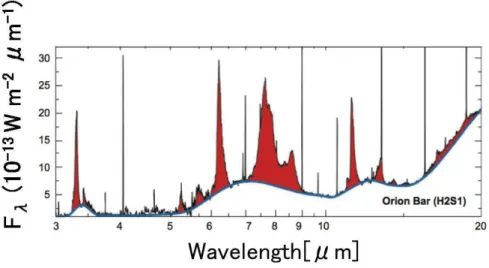
The predominant PAH features in mid-infrared spectra reflect star-forming activity and physical condition of interstellar matters. PAH molecules are thought to be located in photo-dissociation regions (PDRs), be excited by UV light from young stars, and emit their energy at 3.3, 6.2, 7.7, 8.6 and 11.3 µm (Fig.1.1). A mid-infrared spectrum of a star-forming galaxy is characterised by the PAH features while an AGN dominated
Figure 1.1: Example spectrum of PAH features. Broad emission features can be seen at 3.3, 6.2, 7.7, 8.6 and 11.3 µm. Figure is from Tielens (2008).
galaxy shows a power-law spectrum so that the PAH emission is used as a diagnostic tool of a star-forming galaxy and an AGN. The PAH emission also depends on the surrounding environment. PAHs can be destroyed by strong UV light associated with compact HII regions, which leads weak PAH emission. Besides, when UV photons are absorbed by dust surrounding young stars and cannot excite PAHs, PAH emission should be lower compared with infrared luminosity. Therefore PAH emissions have much information to understanding galaxy properties.
As an effective way to study dusty star-formation history, counting the number of galaxies in unit area as a function of an observed flux density in mid-infrared bands has been conducted. It depends strongly on dust features. For example, galaxies with strong PAH 7.7 µm emission is less easy to be fainter with redshift when the feature is redshifted into the observing bands, which leads to increase galaxy counts at a flux density. As an example, a MIPS 24µm source count is shown in Fig.1.2. The source counts at 15 µm and 24 µm bands, into which the PAH 7.7 µm emission is redshifted at z∼1 and z∼2, have been well established by a number of researchers (Elbaz et al. 1999; Lagache et al. 2004; Papovich et al. 2004; Chary et al. 2004; Rowan-Robinson 2009; Pearson et al. 2010; B´ethermin et al. 2011; Cai et al. 2013). From their studies, it is revealed a strong evolution at redshift z<1.5 as well as that LIRGs and ULIRGs are dominant sources of cosmic infrared background at z∼1.
Figure 1.2: Galaxy number count of 24 µm bands obtained from Spitzer observation. It shows a peak at S∼0.3 mJy. Also shown are the galaxy evolutionary models fitted with the observing counts. Figure is from Lagache et al. (2004).
Such a strong evolution is confirmed more directly by measuring the redshift of indi- vidual galaxies (Le Floc’h et al. 2005; P´erez-Gonz´alez et al. 2005; Magnelli et al. 2009; Goto et al. 2010) by using ISO, Spitzer, and AKARI satellite. As shown in Fig.1.3, total infrared luminosity density is more than one order of magnitude higher at z∼1 than today. Besides, the relative contribution of LIRGs and ULIRGs rapidly increase at z=0.5-1.5, indicating that this epoch is quite important in understanding the galaxy evolution.
However, the role of the PAH emission in galaxy evolution is not yet understood. PAHs show different behaviour in high-z universe; ULIRGs at higher redshift have stronger PAH emission than local counterpart (Rigby et al. 2008; Huang et al. 2009; Takagi et al. 2010, see Fig.1.4). Although some infrared SEDs explain such difference (Elbaz et al. 2011), there remains contravention (Lee et al. 2013). One of the main causes of this contravention is a sparse filter sampling at 8-24 µm in the previous satellite. Into this wavelength range, the PAH 7.7 µm emission is redshifted from z=0.5-2 at which the co-moving star-formation is dramatically changed.
Figure 1.3: Evolution of co-moving infrared luminosity density studied in Magnelli et al. (2011). The shaded area indicates total cosmic infrared density, which is one order of magnitude higher at z=1 than today. The filled areas show the relative contribution from “normal” galaxies (yellow), LIRGs (orange) and ULIRGs (red). Rapid increase at z=0.5-1.5 in the contribution from LIRGs and ULIRGs can be seen.
Figure 1.4: 7.7 µm luminosity against infrared luminosity. Although local ULIRGs (black crosses) show a weak 7.7 µm luminosity at given infrared luminosity, high-z ULIRGs (black circles and Log L(IR)>12) show higher 7.7 µm luminosity. Figure is from Takagi et al. (2010).
Figure 1.5: Three type of galaxy spectra; Mrk231 as AGNs with green line, M82 as star-forming with blue line, and Elliptical galaxy with red line. Response curves of nine AKARI/IRC bands are also shown.
1.2 AKARI NEP survey
In order to progress this field, the Japanese-led AKARI satellite (Murakami et al. 2007) has a good advantage of continuous filter coverage at 2-24 µm with nine photometric bands. With these nine bands a large and deep galaxy survey has been conducted towards the North Ecliptic Pole (Matsuhara et al. 2006; Wada et al. 2008). Thanks to the continuous wavelength coverage, 8 µm luminosities can be measured without associated uncertainties from the K-correction for galaxies at critical epoch z∼0.5-2. Besides, the dense filter sampling at mid-infrared range makes it possible to distinguish galaxy population. Fig.1.5 shows three types of galaxy SEDs, Mrk231 as AGNs, M82 as starburst galaxies, and elliptical galaxies. These SEDs are similar at optical wavelength, but the distinction is clear at mid-infrared.
The NEP-survey consists of two surveys: NEP-Deep and NEP-Wide. The NEP-Deep survey covers a ∼0.5 deg2 circular area located at (RA = 17h56m, DEC = 66◦37′) just offset from the ecliptic pole while the NEP-Wide covers larger 5.8 deg2 surrounding the
Figure 1.6: The area of NEP-Deep and Wide surveys. The small orange area indicates the NEP-Deep survey field while green large area indicates the NEP-Wide field. Dark orange square area in the NEP-Deep area indicates a field where deep Subaru/S-cam observations are available. Figure is from Matsuhara et al. (2006).
Table 1.1: Summary of the NEP-Deep and Wide surveys.
Survey Exposure time[sec] per area AREA[deg2] Observation mode
Deep ∼2000 ∼0.5 AOT05
Wide ∼250 ∼5.8 AOT03
NEP-Deep field as shown in Fig.1.6. The typical exposure time of these surveys is ∼2000 and ∼250 sec per area, respectively. The properties of these surveys are summarised in Table 1.1.
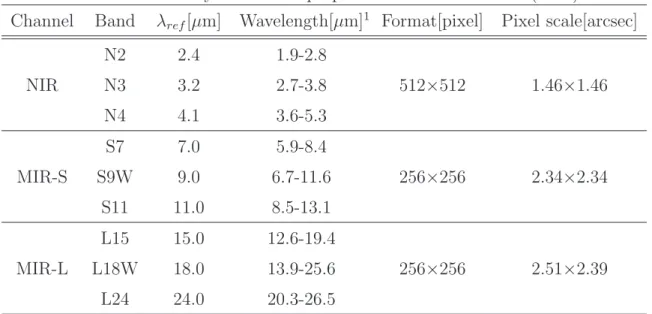
The observation was conducted with the Infrared Camera (IRC; Onaka et al. 2007). The IRC has three channels, NIR, MIR-S, and MIR-L, which work simultaneously with fields of view (FoV) of 10’× 10’. While NIR and MIR-S share the same FoV using a beam splitter, MIR-L has an FoV separated by 20’ from that of NIR/MIR-S. The pixel scales of NIR, MIR-S, and MIR-L are 1.46×1.46, 2.34 ×2.34 and 2.51×2.39 arcsec, respectively. Each channel is equipped with three filters: N2, N3 and N4 in NIR, S7, S9W and S11 in MIR-S, and L15, L18W and L24 in MIR-L with the numerals corresponding to the reference wavelength of each filter. The ’W’ indicates a wide wavelength coverage; S9W
covers most of the wavelength range of S7 and S11, while L18W covers most of the wavelength range of L15 and L24. The properties of the IRC are summarised in Table 1.2.
Table 1.2: Summary of the IRC properties from Onaka et al. (2007).
Channel Band λref[µm] Wavelength[µm]1 Format[pixel] Pixel scale[arcsec]
N2 2.4 1.9-2.8
NIR N3 3.2 2.7-3.8 512×512 1.46×1.46
N4 4.1 3.6-5.3
S7 7.0 5.9-8.4
MIR-S S9W 9.0 6.7-11.6 256×256 2.34×2.34
S11 11.0 8.5-13.1
L15 15.0 12.6-19.4
MIR-L L18W 18.0 13.9-25.6 256×256 2.51×2.39
L24 24.0 20.3-26.5
1 Defined as the area where the responsivity for a given energy exceeds 1/e of the peak.
The pointing observation with IRC is divided by four modes of Astronomical Obser- vation Template (AOT; Lorente et al.2008). As shown in Fig.1.7, the exposure time, filter change and the number of the dithering depend on the AOT. In a normal mode operation (Fig.1.7a), the NIR carries out one short and one long exposure while the MIR-S and MIR-L one short and three long exposures. In the IRC05 (same as AOT05), the NIR takes one short and one very long exposure frames while the MIR-S and MIR-L carry out two sets of a normal observation (Fig.1.7b). AOT02 and AOT03 conduct a filter change and a dithering, while AOT05 has no filter change nor dithering, instead of the long exposure (Fig.1.7c). The exposure time of each AOT is shown in Table 1.3.
1.3 Outline of the thesis
In this thesis the mid-infrared properties of galaxies at intermediate redshift are inves- tigated based on the AKARI NEP-surveys. The 8 µm luminosity is traced by the nine AKARI filters for z<2 galaxies.
Table 1.3: Exposure time of each AOT. Band Short/Long exp time[sec]
NIR Short 4.6572
Long 44.4144
(AOT05) 65.4528
MIR-S/L Short 0.5844
Long 16.3632
In chapter 2, the AKARI NEP-Deep survey catalogue is revised. The original images of the survey were significantly degraded due to the behaviour of the detector and the optical system. The images are re-analysed with new image analysis methods, and the revised catalogue is presented.
In chapter 3, galaxy number counts at the nine AKARI/IRC bands are investigated based on the revised images produced in the previous chapter. As the band filters are new, these number counts provide valuable information in understanding galaxy evolution. The number counts are compared with simple galaxy evolutionary models.
In chapter 4, the behaviour of PAH emission of star-forming galaxies are evaluated at redshift range z=0.3-1.4 to which the previous study could not pay much attention. Starburst galaxies show relative weakness of PAH emission throughout the redshift range of this study.
Finally in chapter 5, these three topics are summarised.
Figure 1.7: Summary of each AOT. a.) In general mode (AOT02, 03, and 04), NIR band has a short and a long exposure frames while MIR band has a short and three long frames. b.) In the IRC05 (AOT05) mode, NIR band has a short and a very long exposure frame while MIR has two sets of the general observation. Independently of the AOT mode, MIR- S and MIR-L take a frame exactly at the same time. c.) Sequence of the frame in each AOT. AOT05 has no filter change nor dithering in order to obtain long exposure time. AOT02 and AOT03 conduct an observation using two and three bands, respectively, with a dithering. AOT04 is a spectroscopic observation mode. Each observation takes dark frames before and after the ∼10 minutes observation. After the operation, a manoeuvre (an attitude control) is carried out. The figure is from Onaka et al.(2007).
Chapter 2
Revised catalogue of the AKARI
NEP-Deep survey
In this chapter, the catalogue of the AKARI NEP-Deep survey is revised with new image analysis methods. With the new methods, final mosaic images were significantly improved. It leads approximately 20 % improvement of the source detection limits and detection of 9560 objects with 99.7 % reliability even in single band detection. This chapter is based on Murata et al.(2013).
2.1 Introduction
In order to investigate dusty galaxies at intermediate redshift, the AKARI NEP-Deep survey has a unique advantages of continuous wavelength range of 2-24 µm with nine photometric bands. The catalogue of this survey is produced by Wada et al. (2008) and Takagi et al. (2012). In their work, ∼20 000 objects were detected at NIR bands while ∼7 300 objects were extracted at MIR bands. Using these catalogues, Takagi et al. (2010) found ULIRGs with brighter PAH emission compared with the local counterpart, while Goto et al.(2010) evaluated 8 µm luminosity function of galaxies at z=0.4-2 without K-correction.
However, the original NEP-Deep catalogue leaves room for improvement, especially in the image analysis stage, because most of the images are contaminated by scattered light inside the detector, stray light from the Earth limb, artificial sources due to bright objects, and patterns from the optical system. The flat-fielding of the 15, 18, and 24 µm
images over-corrected the flux of a point source at the edge of the field of view by ∼10% (Arimatsu et al. 2011). By solving these problems, the catalogue can be improved both in the detection limit and in the reliability of the source extraction.
In this chapter new image analysis methods are devised and the catalogue for the AKARI NEP-deep survey is revised. This chapter is organised as follows: In section 2.2 data reduction with the new methods is described. In section 2.3.1 and 2.3.2 source extraction and photometry are described. In section 2.3.3 to 2.3.5, the completeness, the reliability and the astrometric accuracy in the catalogue are evaluated. In section 2.3.6 the catalogue is compared with previous versions. The work in this chapter is summarised in section 2.4.
2.2 Revision of image analysis
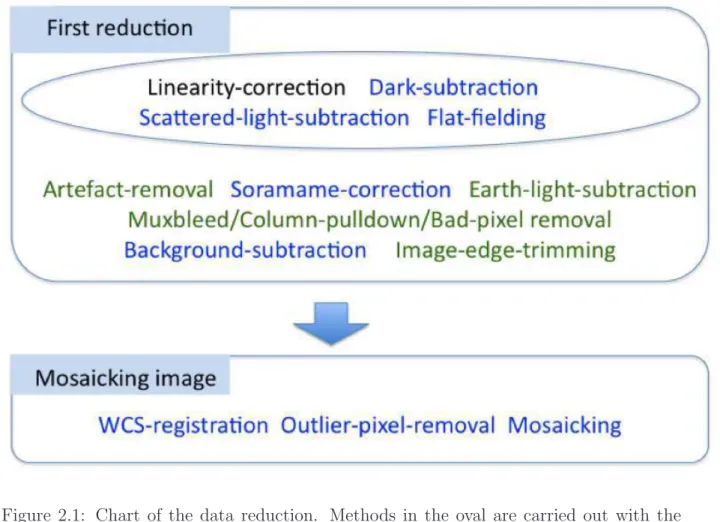
To remove or reduce contamination in the previous images, new image analysis meth- ods were devised. The scattered light, stray light, and the patterns in the images were removed by creating templates of their patterns. The artefacts were deleted with their specific characteristics or were simply visually masked out. Furthermore, to increase the total number of images, additional images not from the NEP-deep but from the same region were combined. The astrometry, mosaicking, and the photometric calibration were also revised. General processing such as dark-subtraction and linearity correction were conducted with the standard IRC imaging pipeline1. In the following subsection, the revised points of the image analysis are described in detail. The data reduction sequence is summarised in Fig.2.1.
2.2.1 Subtracting scattered light
In the MIR-S bands, scattered light from the edge of the detector arrays contaminates the images, resulting in a cross-shaped pattern. This effect originates primarily from the sky background, such that all of the images are contaminated by the scattered light. The characteristics of the scattered light in the S7 and S11 bands were investigated by Sakon et al. (2007), but not for S9W. The IRC imaging pipeline used in the previous work applied the simple mean image for the S7 and S11 scattered-light templates as the one
1Version 20110225. The previous work used version 20071017
Figure 2.1: Chart of the data reduction. Methods in the oval are carried out with the IRC pipeline. Methods with blue colour indicate revised methods while greens indicate new methods applied in this study.
for S9W. Even though the wavelength coverage of S9W overlaps those of S7 and S11, this simple mean image is not appropriate for subtracting scattered light in S9W band since the spectrum of the sky background is not uniform.
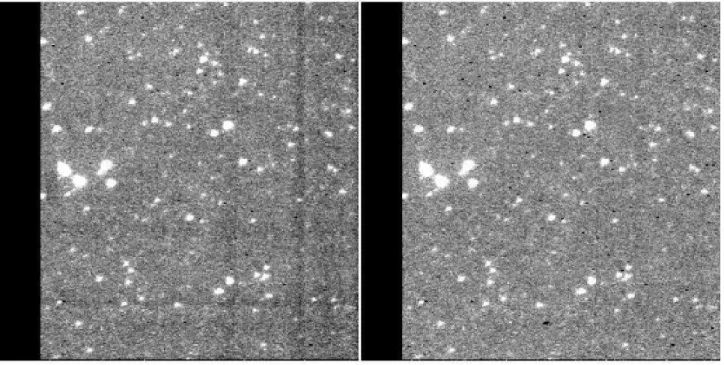
In this study, a new template for the scattered light in the S9W band was produced. Although the method described in Sakon et al. (2007) is hard to apply for the S9W band because of the small number of available images, a weighted mean of S7 and S11 templates better accommodates the spectrum of the sky background. Typical values for the sky background in the S7 and S11 bands are 440.639 and 2364.74 ADU (instrumental units). With these values as weights, the S7 and S11 templates were combined, which were then scaled and subtracted from each S9W image. As a result, the scattered light was subtracted more efficiently (Fig.2.2).
On the other hand, in the MIR-L channels the incident light is scattered over the
Figure 2.2: Subtraction of scattered light in the S9W image. In the previous image (left) the residual of the cross-shaped pattern is seen at the right bottom of the image, whereas the new (right) image shows a much more efficient subtraction.
detectors (Arimatsu et al. 2011), and this pattern also appeared in the flat frames used in the pipeline. Hence these flat frames were used as templates for the scattered light, subtracting them from each image.
2.2.2 Flat-fielding
Revised flat frames for each IRC band were created and flat-fielding was carried out. The flat frames for the MIR-L in the previous work were affected by scattered light as described above. Arimatsu et al. (2011) subtracted the scattered light and created new flat frames for L15 and L24. Since the wavelength coverage of L18W overlaps those of L15 and L24, in this work the flat frame of L18W was created via a weighted mean of the flat frames of L15 and L24. The weight was calculated as the inverse of the conversion factor from ADU to Jy of each band.
In addition, the flat frames of MIR-S were also affected by the so-called soramame (subsection 2.2.4) pattern. These flat frames were revised with images that had no such pattern.
Figure 2.3: Subtraction of stray light from the Earth limb. The left image is contaminated by the stray light, which was removed in the right image. The scale of these images is identical.
2.2.3 Subtracting the stray light from the Earth limb
All images taken from April to August contain stray light from the Earth limb (Fig.2.3 left). This light is as strong as the zodiacal light and seriously degrades the image quality in the MIR-S/L images. Since the pattern is not uniform, objects in the valley of the stray light are hardly detectable even if they are as bright as a few hundred micro Jansky. Templates of the stray-light pattern for each image were made and subtracted the stray- light, noting that when the observing date and the incident angle of the stray-light of the images are similar, the stray-light pattern itself is also similar. To produce these templates, an image set was prepared in which the incident angles and the observing dates agree within 2 degrees and 8 days. The sky background in each image was normalised to unity and the images were combined with the median value. In doing so, a 3 σ clip with an upper and lower limit of 1.2 and 0.8 was performed to remove bright objects from the images. After the process, a median-filter box car filter with a three pixel size was applied to the combined images to additionally reduce the photon noise, assuming that the stray
light does not fluctuate on such small scales. The resulting templates were then scaled and subtracted from each image. As a result, the stray light was clearly removed (Fig.2.3 right). Notably, although the pattern can change within a given image set, its templates could not be produced because of the low number of image frames. If many more images were available, that is, other than NEP images, the criteria could be more strict and the templates would improve.
2.2.4 Correcting for the SORAMAME pattern
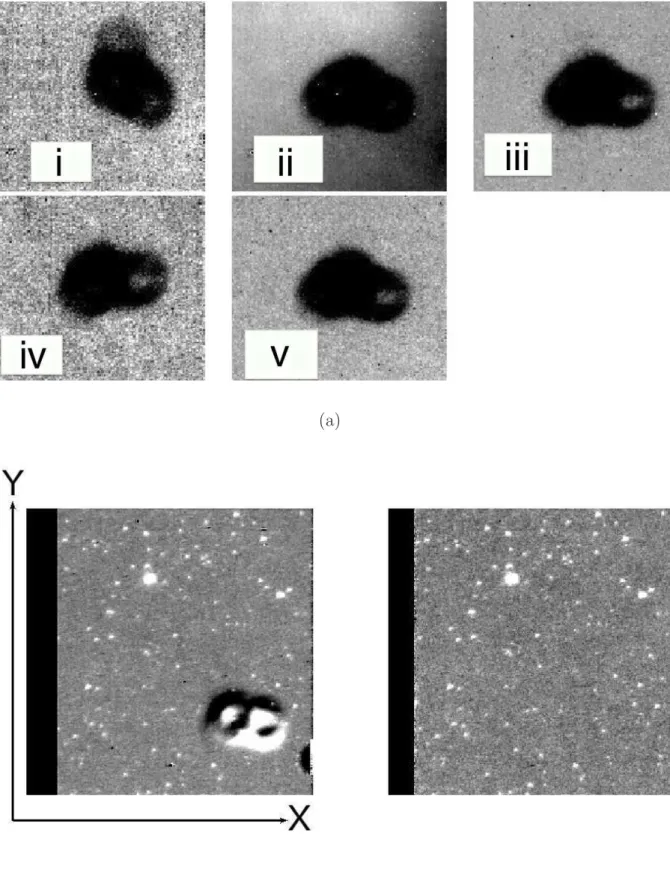
The MIR-S images taken before 7 January 2007 have a pattern referred to as soramame2 at (X=150:237, Y=41:105) in detector coordinates. The cause of the pattern is still unknown, but it seems that an obstruction in the optical system affected the image view. Although this affected the pixel values at a level of merely ∼1 %, the accurate flux measurements could not be performed because the sky background is much brighter than the source signal. However, the pattern can be corrected for in the same manner as the flat-fielding, but with the additional caveat that it has a time dependence (this is why previous efforts were not able to correct it). It was found that the pattern can be roughly divided into five periods (Fig.2.4a) as follows:
i. 2006/4/23 - 2006/4/26, ii. 2006/5/18 - 2006/10/13, iii. 2006/10/15 - 2006/12/8, iv. 2006/12/9 - 2006/12/14, and v. 2006/12/15 - 2007/1/7.
The blank periods among these five periods arise because there are no images in these periods used for this work.
Even within the same period the pattern changes on a time scale of several days, there- fore an image set was prepared in which the observing dates of each image agree within three days. The sky background in each image was normalised to unity and the images were combined with their median value. In doing so, 3 σ clipping with upper and lower limits of 1.2 and 0.8 was performed after masking all objects in each image. Then the tem- plate was scaled and subtracted from each image, and the region (X=150:237,Y=41:105) was divided by the template. As a result, the pattern was corrected for more appropri-
2This means “broad bean” in Japanese, due to its shape in the image.
(a)
(b)
Figure 2.4: (a) Five types of the soramame pattern. The pattern (ii) has a gradient in the sky value, showing that it also contains stray light. (b) The pattern was corrected for
ately than in the previous work (Fig.2.4b). It should be noted that the pattern in period (ii) also contains stray light, and in this case the correction was difficult. Similarly as for the stray-light template, more images are required to create more appropriate templates.
2.2.5 Removing muxbleed and column pull-down effects
When bright objects or strong cosmic rays are incident on the NIR band detectors, the images are contaminated by two kinds of cross-talk: muxbleed and column pull-down (Fig.2.5a left). In particular the former causes many artefacts (Fig.2.5b left), since it inserts higher and lower values in turn to pixels in the same row as a pixel with a higher value than thresholds. On the other hand, the column pull-down decreases the pixel value in the same column as the pixel (Lorente et al. 2008). The thresholds were found to be
∼4000ADU for AOT05 and ∼7000ADU for AOT03. To remove these effects, all pixels contaminated by the cross-talk were masked out before mosaicking the images (Fig.2.5a right). As a result, these contaminations disappeared in the mosaicked images (Fig.2.5b right).
On the other hand, an effect similar to the column pull-down also appears in MIR-S/L images. It arises because bright objects cause the pixel response to temporally degrade. If bright objects are incident on the MIR-S/L detectors during the slow scan of the Far- Infrared Surveyor instrument (Kawada et al. 2007), the objects were moving along the scan direction in the detector. Since the direction of the slow scan is similar to the column direction, this pull-down effect occurred. This pull-down effect was identified with sigma clipping and was masked the columns.
2.2.6 Removing artefacts caused by bright objects
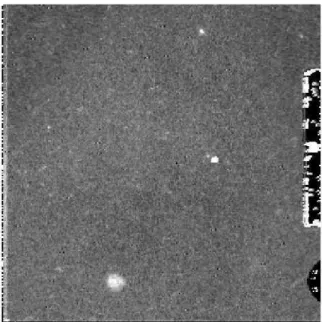
The IRC images have various kinds of artefacts caused by scattered light. When a bright source is incident on the detector in the NIR images, an artefact appears at the symmetri- cal position with respect to (X=115,Y=350) in the detector coordinate system (Fig.2.6). The artefact is out of focus because the optical path is not regular, hence it was able to visually identify the artefact and mask the position with a circle of 36 arcsec radius - larger than the artefact size. Another kind of artefact appears at 55 arcsec to the right of the source position in the NIR images, and an additional artefact appears in the 29
(a)
(b)
Figure 2.5: (a) Muxbleed and column pull-down occur due to bright objects that con- taminate the same rows and columns as the objects (left). These rows and columns were masked before mosaicking the images (right). (b) As a result, the artefacts disappeared in the mosaicked image (right). It should be noted that the region of panel (a) is different from that of panel (b).
Figure 2.6: Artefact in N2 band. It appears in the top left corner and is caused by the bright object in the top centre. Since this artefact is out of focus, it can be identified visually. The artefact was masked out with a circle of 36 arcsec radius.
arcsec above of the source position in the N3 images. These artefacts are in focus and their brightness is a few percent of that of the source; it is difficult to mask these arte- facts because of the high source density in the NIR images, although main artefacts are removed when the muxbleed and column pulldown were masked. Hence a caution must be taken when faint objects were used without other independent detection such as an optical catalogue.
In MIR-S images an artefact appears at 55 arcsec above the source position (Arimatsu et al. 2011, see also their Fig 1), with a brightness of a few percent of that of the source. This position was masked out with a circle of 18 arcsec radius for sources brighter than 14 mag in each band. This threshold was chosen such that the brightness of the artefacts is negligible. Notably, although secondary and tertiary artefacts also exist, they are too faint to be considered.
Finally, MIR-L images have other kinds of artefacts (Arimatsu et al. 2011, see also their Fig.3). Since these artefacts are much brighter and appeared only around NGC6543 (Cat’s Eye nebula) the images with these artefacts were not used.
2.2.7 Addition of images
To increase the number of images, aditional images from other observations around the NEP were used: The NEP-wide survey, time observations for sensitivity monitoring, performance verification and ultra-deep observations. To avoid affecting the uniformity of the survey depth, all images of the NEP-wide and some images of the others were added. These images were processed with the same methods as the NEP-deep images. As a result, the total number of individual images was increased by ∼15%, leading to an improvement in the survey depth of up to 7%.
2.2.8 Associations
After the processes described above, sky subtraction, bad-pixel-masking and trimming of bad parts in the images were performed. To subtract the sky background, median- filtered images with a box size of 31 pixels, which is larger than the PSF, were created after masking the bright objects using a 3 σ clipping technique. In this process the sky background without contamination from bright objects was measured. Then the median- filtered images were subtracted from each image.
For the bad pixel mask, dark frames from observations conducted within several days of the NEP images was used. Typically, 100 dark images were stacked and an area of around 15 pixels around each pixel in the stacked dark frame was used to calculate the median value and normalised median absolute deviation (Beers et al. 1990).
kpi− med{pi}k > 3 σ (2.1)
σ = 1.4826 med{kpi− med{pi}k}, (2.2) where pi indicates the pixel values and med indicates the median value. If the pixel value deviated more than 3σ from the median value, the pixel was regarded as a bad pixel and was masked.
The edge and the masked region of each image were trimmed because these regions might not have a regular response, especially in images contaminated by stray light. The trimmed regions were [X=1:412,Y=381:512] in NIR, [X=1:32,Y=1:256] and three pixels at the edges of MIR-S, [X=237:256,Y=1:256] and three pixels at the edges of MIR-L images.
2.2.9 Astrometry
In the previous work, world coordinate system (WCS) information was derived after stack- ing the images in each individual pointing observation with the standard pipeline. This led to an increase in the amount of pixelation, that is, for distortion correction, alignment images for the first stacking and mosaicking in the next step. Since pixelation would cor- rupt the images, it is best to reduce the number of instances of this process. Consequently, mosaicked images should be created with only one degree of pixelation. Therefore, in this work, the WCS was attached to each image in each individual observation.
The 2-Micron All Sky Survey (Skrutskie et al. 2006) was applied as a reference cata- logue for the astrometry in the N2, N3, N4, S7 and S9W images. For the S11 and L15 bands, the S9W catalogue was used, and for the L18W and L24 bands, the L15 cata- logue was used since only a few objects in these bands have counterparts in the 2MASS catalogue.
In adding WCS information to the N2, N3 and N4 images, the PUTWCS task in the IRC pipeline was used, in which source extraction and a cross-match with 2MASS catalogue are automatically performed. For the longer wavelength bands following method was adopted: 1.) the pixel size was reduced to half the size to improve the precision of the cross-match. 2.) all images in each observation were stacked. 3.) the 2MASS, S9W or L15 catalogue were cross-matcged to register the WCS information carefully, and all of the WCS information was visually confirmed. 4.) the WCS information was copied on the original images in each observation. By this process, the WCS information was registered on the images without pixelation. Note that the image distortion correction was included in this calibration.
2.2.10 Mosaicking
Before mosaicking the images, pixels having outlier values was masked out with a method similar to that implemented in the “A WISE Outlier Detector” (Masci & Fowler 2009) with 4-sigma clipping, where sigma is defined by Eq. 2.2. This is because the outlier value can affect the interpolation of the pixel value in the next step.
To create mosaicked images, all images were projected onto one common image with the WCS information and combined them. In projecting the images, pixelation with linear
interpolation was carried out, without pixels that differed by more than 0.7 pixels from the original position. With this process the pixel size was reduced from 1.46, 2.34 and 2.45 arcsec to 0.7, 1.0 and 1.0 arcsec for the NIR, MIR-S, and MIR-L bands. After the projection, all the images were stacked by taking an average value with 4-sigma clipping. To improve the reliability of source extractions and photometry, two mosaicked images were prepared with different image sets among which the images were divided according to two observation spans so that each pixel in the two images had the same number of images (see also subsection 2.3.1), hereafter referred to as the A and B images, and the mosaicked image of the whole data set, the A+B image. Besides, their noise and coverage images were produced, with pixel values containing the standard deviation of the pixel values and the number of images used to combine them.
2.2.11 Photometric calibration
Although photometric calibration of AKARI/IRC has been estimated in Tanab´e et al. (2008) with standard stars, the standard calibration factor would differ due to a difference of the image analysis. Their image was processed through standard imaging pipeline while the pixelation of the present image was minimised. Hence, the photometric calibration should be optimised for this image analysis.
To obtain the calibration factor from ADU to µJy, the flux densities of standard stars were compared with their observed value in terms of ADU. The flux densities of the standard stars were calculated by equation (4) in Tanab´e et al. (2008),
fλiquoted=
Rλie
λis Ri(λ)λfλ(λ)dλ
λiRλiλiseRi(λ)dλ , (2.3) where fλ is taken from the Cohen templates (Cohen et al. 1996, 1999, 2003a,b; Cohen 2003), Ri is the spectral response of each IRC band3, and λis and λie are the wavelengths at which Ri becomes zero. Since most of the standard stars are in the NEP field, only stars in this field was used for the NIR and MIR-S bands. For the MIR-L bands these stars are too faint, hence other standard stars were also used. The stars used in this calibration are listed in Table 2.1. The images of the standard stars were analysed with the same method as the NEP-deep images. Some objects were not used because of saturation or contamination from nearby bright objects. Aperture photometry was carried out for
3http://www.ir.isas.jaxa.jp/ASTRO-F/Observation/RSRF/IRC FAD/, unit: electron per energy
Table 2.1: List of the standard stars used for the photometric calibration.
Name R.A. Dec. Ks mag
1757132 269.305190 67.061363 11.155 KF03T1 269.433111 66.448715 9.923 KF03T2 269.464464 66.517632 8.963 KF06T2 269.658286 66.781174 11.149 KF03T3 269.754790 66.557289 10.925 KF03T4 269.766472 66.516495 10.091 KF09T1 269.846003 66.048943 8.114 KF06T4 269.858598 66.916161 11.240 KF01T4 271.013118 66.912766 8.067 KF01T5 271.016205 66.928833 11.072 Bp66 1073 270.789993 66.469994 7.544
only MIR-L
HD42525 91.539091 -66.039622 5.751 HD166780 272.161750 57.979667 3.963 HD158485 261.520167 58.651917 6.145 NPM1p67 0536 269.727750 67.793556 6.409 NPM1p65 0451 253.404333 65.638194 6.524 Bp66 1060 269.000771 66.928619 6.720
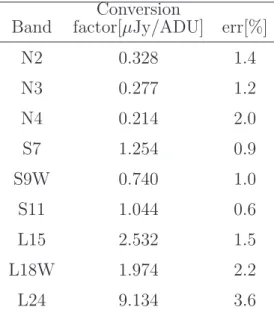
Table 2.2: Conversion factors from ADU to µJy for each band. The aperture radii are 9 and 6 pix for NIR and MIR-S/L. These correspond to 6.3” and 6.0”.
Band factor[µJy/ADU]Conversion err[%]
N2 0.328 1.4
N3 0.277 1.2
N4 0.214 2.0
S7 1.254 0.9
S9W 0.740 1.0
S11 1.044 0.6
L15 2.532 1.5
L18W 1.974 2.2
L24 9.134 3.6
several aperture radii. Then the ADU values from the aperture photometry were compared to the flux densities of the standard stars and obtained the conversion factors for each aperture photometry. Table 2.2 shows the conversion factors at 6.3 and 6.0 arcsec aperture radii for NIR and MIR-S/L. These sizes are similar to or slightly larger than the PSF size. It should be noted that the flux calibration is based on only about ten objects so that calibration errors may be underestimated.
2.3 Catalogue
2.3.1 Source detection
Different algorithms for source detection in the MIR and NIR bands were used because the detections are limited by different effects. Because the detection from the MIR bands is limited by the sky noise, detection images were created by stacking all six bands, to significantly reduce the sky noise. On the other hand, the detection from the NIR bands is limited by source confusion, therefore source extraction was conducted directly from each band image.
To create the detection images for the MIR source extraction, all six MIR bands were
stacked with a χ2 method, similar to the procedure described by Szalay et al. (1999). In this process, the pixel values of each image were converted into a χ2 value with the noise and coverage image of each mosaicked image created in subsection 2.2.10,
χ2i = |Si/σµi| (Si/σµi) (2.4)
σµi = σi/qNi (2.5)
i = a1, a2, ..., a6, b1, ..., b6,
where Si is the pixel value of the mosaicked images, σi and Ni are those of the noise and coverage images, and i indicates the A and B images of each MIR band from S7 to L24. Note that the definition of the χ2 is not standard to account for the conservation of the sign of the value, that is, no real object should be on the pixels with negative value. In the stacking process, pixels in which the values were lower than -9 (which corresponds to -3σ), or the number of images used for mosaicking were lower than 15 were clipped, to remove any outlier values. In this process the a1 to a6 and b1 to b6 images were stacked separately and they are called A and B images, respectively.
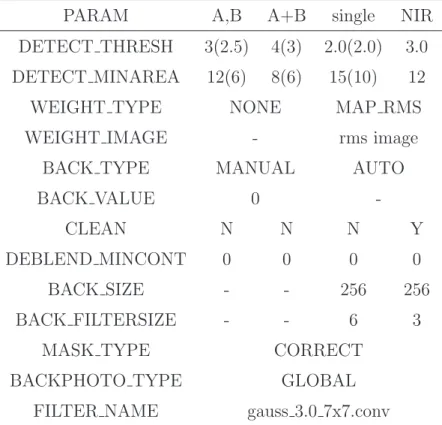
To improve the reliability of the source extraction, the following method was adopted with the detection images. Reference samples were prepared and objects selected from the reference sample and detected in at least one of the single-band mosaicked images were regarded as real sources. To construct the reference sample, sources were extracted from the A, B and A+B χ2 images and single-band images with SExtractor (Bertin & Arnouts 1996) twice with the different parameter sets listed in Table 2.3. First, the parameters were set to be initial estimates (in round brackets in Table 2.3). Objects from from the χ2 and the single-band images were compared. In this process 8,676 objects were detected at the same position within 1.5 arcsec in all χ2 images and in at least two single-band images. In addition, 178 objects were detected in all χ2 and the three single-band images at the same position within 2.5 arcsec. These objects were considered to be real and were listed as reference samples. Secondly, the parameters were more tightly constrained (without round brackets in Table 2.3) and all objects detected in all χ2 images at the same position within 2.5 arcsec were listed as the reference sample. In total, 9,701 sources were obtained as references.
Sources were extracted from each single-band image and compared them with the references. When a source was detected at the same position within 2.5 arcsec from the
Table 2.3: SExtractor parameters. Values in round brackets are for the initial detection to create the reference sample.
PARAM A,B A+B single NIR
DETECT THRESH 3(2.5) 4(3) 2.0(2.0) 3.0 DETECT MINAREA 12(6) 8(6) 15(10) 12
WEIGHT TYPE NONE MAP RMS
WEIGHT IMAGE - rms image
BACK TYPE MANUAL AUTO
BACK VALUE 0 -
CLEAN N N N Y
DEBLEND MINCONT 0 0 0 0
BACK SIZE - - 256 256
BACK FILTERSIZE - - 6 3
MASK TYPE CORRECT
BACKPHOTO TYPE GLOBAL
FILTER NAME gauss 3.0 7x7.conv
reference, it was considered to be real. Notably, a region centred at (R.A.=269.60858, Dec.=66.62320) with the radius of 5 arcmin was not used to avoid the scattered light from NGC6543 (Cat’s Eye nebula), because it creates many artificial sources. For detection from the single-band images, weight images whose pixel values were the rms values created from the noise images divided by the square root of the coverage images was applied.
The total number of objects detected in each band are listed in Table 2.4. More than 6,000 objects were detected in each single-MIR band, except for the L24 band. Since the sensitivity of L24 band is relatively low, the number of detected objects is just above 3,000. Table 2.5 shows the number of objects detected in multiple bands. It also shows that the number of objects detected with at least one band is 9560, an increase of ∼2,000 compared to the previous work.
For the source extraction from the NIR images, a detection image was not applied since the detection is limited by source confusion, and stacking the three NIR bands can hardly improve the detection limit. Instead, to improve the reliability of the source detection, only objects with optical counterparts were entered into the publishded catalogue. For
Table 2.4: Effective area, the number of detected sources in the positive and negative images, and the 5σ limit for each band.
Band Area[min2] Number Fake(%) Slim=5σ [µJy]
N2 2069 17108 5(0.03) 11.5
N3 2083 19933 3(0.02) 9.0
N4 2053 18671 0(0) 10.4
S7 2100 6307 16(0.25) 29.7
S9W 2068 7059 18(0.25) 33.6
S11 2082 6005 13(0.22) 56.5
L15 2143 6233 10(0.16) 86.8
L18W 2149 6526 9(0.14) 93.1
L24 2186 3278 7(0.21) 255.6
optical catalogues, the catalogue based on CFHT/MegaCam z′ band (Oi et al. 2014), the WIRCam Ks band, and the Subaru/S-cam z′ band was used. The detection limits of these catalogues are ∼24, 23 and 26 AB mag, respectively. Compared with the N2 band, the WIRCam Ks-band catalogue has almost the same wavelength coverage, but is
∼2 mag deeper. Sources in each NIR band were detected and compared with the optical catalogues with a search radius of 2.1 arcsec, slightly larger than the 3 σ positional accuracy. Furthermore, any objects with an S/N < 2 were removed (see also subsection 2.3.2) since they probably are fake sources. The parameters of SExtractor are also listed in Table 2.3 and the number of detected objects is listed in Table 2.4. It shows that the number of the sources is lower than 20,000 for the entire NIR bands, a decrease from the previous work. This is because the detection-criteria are stricter than the previous work to improve the reliability. Moreover, because of the detection limit and/or areal coverage of these optical catalogues some objects were excluded. However, these objects have a minor impact on the results, as described in subsection 2.3.6.
2.3.2 Photometry
Aperture photometry was performed on the A+B images with aperture radii of 6.0 and 6.3 arcsec for MIR and NIR bands with SExtractor. Aperture correction was not needed because it had been calculated in the conversion factor for each aperture radius.
Table 2.5: Cumulative number of objects detected in at least NBand bands NBand Number Fake(%)
1 9560 45(0.47) 2 8975 19(0.21)
3 6948 8(0.12)
4 4742 1(0.02)
5 3355 0(0.00)
6 1823 0(0.00)
Photometric errors were also estimated with A and B images by measuring the fluxes at the same position in the A and B images. It was assumed that the error distribution of the fluxes from the A and B images are the same, and the relation between the expected difference of two samples and the standard deviation was used;
hk∆ki = q2/π × σA−B (2.6)
= q2/π × σA,B×
√2, (2.7)
where ∆ is the difference of fluxes from A and B images, and σA−B = σA,B ×
√2. Since the average error is expressed as σavg = σA,B/√2, the standard deviation of the fluxes in the A+B image can be written as
σA+B =qπ/8 × k∆k. (2.8)
To express these values as a function of the fluxes, the median of these values were taken in a log flux bin size of 0.08 and fitted them with the following functions (Fig.2.7):
∆f ×qπ/8 = a × flux2+ b × flux + c f or N IR (2.9)
∆f ×qπ/8 = a ×qf lux + b f or M IR. (2.10)
The higher value of the difference multiplied by qπ/8 and the fitting result was adopted as the flux error. The detection limit for each band was calculated from the fitting results and is listed in the last column of Table 2.4.
One might think PSF photometry to be superior to this method, especially in blended sources. However, since the positional precision is only moderate in the catalogue (1∼2
0.1 1 10 100
1 10 100 1000
Difference/20.5[µJy]
Flux[µJy] N2
0.1 1 10 100
1 10 100 1000
Difference/20.5[µJy]
Flux[µJy] N3
0.1 1 10 100
1 10 100 1000
Difference/20.5[µJy]
Flux[µJy] N4
0.1 1 10 100
1 10 100 1000
Difference/20.5[µJy]
Flux[µJy] S7
0.1 1 10 100
1 10 100 1000
Difference/20.5[µJy]
Flux[µJy] S9W
0.1 1 10 100
1 10 100 1000
Difference/20.5[µJy]
Flux[µJy] S11
1 10 100
1 10 100 1000
Difference/20.5[µJy]
Flux[µJy] L15
1 10 100
1 10 100 1000
Difference/20.5[µJy]
Flux[µJy] L18W
1 10 100
1 10 100 1000
Difference/20.5[µJy]
Flux[µJy] L24
Figure 2.7: Flux errors are estimated from the difference between the fluxes from the A and the B images. Flux errors in all nine bands are shown. Red points indicate the difference multiplied by qπ/8. Green crosses indicate the median value in a log flux bin size of 0.08. The blue dotted line shows the fitting result. The higher value of the red point and the line was adopted as the flux error.
arcsec compared with PSF size, 5∼7arcsec), the centring of the PSF fitting is difficult, hence aperture photometry is a preferred method.
2.3.3 Completeness
The completeness level of the detections were calculated via simulations with artificial sources. Artificial sources were injected with the same radial profile as the PSF into the revised images and extracted them with SExtractor with the same parameters. The input artificial sources were separated by more than 60 pixels from each other to avoid self-confusion. The PSFs were investigated by Arimatsu et al. (2011) for S7, S11, L15 and L24 bands. For other bands, simple PSFs were created with point sources or the weighted average of the above PSFs. The sources was regarded as successfully extracted when the position of the extracted source agreed within 2.5 and 2.1 arcsec for the MIR and NIR bands, respectively, the same criteria as for the matching with χ2 or ground-based catalogues, and the magnitude agreed within 0.5 mag, the same as Wada et al.(2008). The completeness was defined as the ratio of the number of extracted sources to the number of input sources. The calculation was performed at each magnitude with an interval of 0.2 mag. For the MIR bands 100 sources were injected per simulation, and this was repeated 20 times. On the other hand, for the NIR bands, considering the source density, only 20 sources were injected per simulation and this was repeated 100 times. The results are shown in Fig.2.8.
Fig.2.9 shows the flux histograms obtained from this work with red solid lines, while the previous ones (from Takagi et al.) are shown as green solid lines. In the left and right panels, catalogues of the MIR-S and MIR-L bands are compared. The L15 and L18W source counts in the previous work are distributed at ∼10 % to brighter flux densities than new ones. This might result from the different flux calibration or from the flat-fielding (see also subsection 2.3.6). At the faint end of the previous work, the source counts of all bands show a tail, which can be due to their detection algorithm in which sources were searched from an initial position from the detection images. In the present source counts, the peak in the counts in S7, S9W, S11, L15, L18W, and L24 bands are at 33, 40, 57, 120, 120 and 250 µJy, whereas the flux histograms from the previous work shows the peaks at 58, 58, 69, 160, 144 and 300 µJy. Despite the dependence of the flux binsize, it indicates that the detection limits in this catalogue are ∼20 % deeper than the previous
ones in all bands. Although the previous work has evaluated the completeness of their catalogue, this could not be compared with the present catalogue because the previous completeness calculation was evaluated only from detection images, and does not reflect the completeness of the single-band detection.
The results were compared with the Wide-field Infrared Survey Explorer (Wright et al. 2010) NEP catalogue, which has four overlapping bands at 3.4, 4.6, 12 and 22 µm (Jarrett et al. 2011). This showed that source counts of these bands peak at 41, 30, 166 and 1355 µJy. On the other hand, the source counts of the N3, N4, S11 and L24 bands peak at 13, 11, 57 and 250, much deeper than those of WISE.
For the NIR catalogue only objects that matched with the ground-based catalogue was used, which might introduce a bias against the reddest and faintest sources. It was estimated how the completeness could be reduced in the worst case, assuming all objects to be mismatched with ground-based catalogues to be real. It was found that these effects were only 2∼3 % at a 50 % completeness limit of the N2, N3 and N4 bands, which are 56, 55 and 38µJy. However, the completeness at brighter than 1000 µJy was reduced by more than 20 %. The reason was that these objects were saturated in the ground- based catalogue and were not listed (Oi et al. 2014). Therefore it was concluded that the completeness at fainter than 1000 µJy was not reduced significantly by this effect.
2.3.4 Reliability of the source detection
To determine the reliability of the source detection, the false-detection rate was estimated with the negative images. The negative images are almost identical to the positive images multiplied by -1, but the pixels with values higher than 9 were masked in the same way as the positive images. If the false detection was caused only by sky noise, the number of fake sources is expected to be the same in both positive and negative images. Source extraction was performed on the negative images with the same method as for the positive images. The estimated numbers of the false detections are also summarised in Table 2.4. The estimated false-detection rate in all nine bands is lower than 0.3 %. Therefore it can be concluded that the single-band detection in the present catalogue is reliable at 99.7 %. Table 2.5 also shows the number of false detections against the number of detected sources in each band. As shown in the table, there are 45 (0.5 %) false detections, whereas the previous work estimated as many as 113 (1.6 %) false detections. For detections in
0
0.1
0.2
0.3
0.4
0.5
0.6
0.7
0.8
0.9
1
1 10 100 1000
Completeness
Flux [ µ Jy]
N2
N3
N4
S7
S9W
S11
L15
L18W
L24
Figure 2.8: Detection completeness as a function of flux density in all nine IRC bands.
Table 2.6: Positional accuracy of the N2-L24 band R.A.[arcsec] Dec.[arcsec]
Band mean rms mean rms total
N2 0.00178 0.32928 -0.046154 0.34887 0.4797 N3 -0.01869 0.34988 -0.057003 0.37982 0.5164 N4 -0.01438 0.37579 -0.068680 0.4029 0.5510 S7 -0.01615 0.68214 -0.18314 0.72016 0.9919 S9W -0.03116 0.64642 -0.11099 0.69198 0.9469 S11 -0.04926 0.75423 -0.11858 0.78146 1.0861 L15 -0.04964 0.86742 -0.13958 0.83613 1.2048 L18W -0.04578 0.87502 -0.15706 0.91297 1.2646 L24 -0.04736 1.1095 -0.099424 1.0903 1.5556
two or more bands, the present catalogue is expected to contain only 19 fake sources, which corresponds to 0.2 %. It was concluded that a detection with multiple MIR bands in the present catalogue is reliable at 99.8 %.
2.3.5 Astrometric accuracy
The accuracy of the astrometric coordinates was estimated with the CFHT/MegaCam catalogue (Oi et al. 2014), whose positional accuracy is better than 0.2 arcsec. Since the detection limit of the CFHT/MegaCam catalogue is 24 mag in z′ band, it is deep enough to cross-match with the AKARI catalogue to determine the astrometric accuracy. The AKARI catalogue was cross-matched with the MegaCam catalogue with a search radius of 5 arcsec and then calculated the differences in their positions. In doing so objects with multiple counterparts were not used. The results are summarised in Table 2.6 and Fig.2.10. As shown in the figure and the table, the positional accuracy of AKARI sources is better than 2 arcsec.
2.3.6 Comparison with previous catalogues
Previous versions of the NEP-deep catalogues have been produced by Wada et al. (2008) and Takagi et al. (2012). The former produced nine single-band catalogues, the latter
a MIR-merged catalogue with NIR photometry. A comparison between these previous catalogues and the revised catalogue is necessary to assess the merits and the demerits in the present analysis. In the following the revised NIR catalogue was compared with that of Wada et al. (2008) and the revised MIR catalogue with that of Takagi et al. (2012).
The left panels of Fig.2.11-2.13 show the ratio of the present flux to the previous flux against present flux for objects detected in both the previous and revised catalogues. An object in the previous catalogue whose coordinate agreed within 2 arcsec was regarded to be the same object. Fig.2.11 shows the present NIR fluxes are ∼10% higher than the previous ones while Fig.2.13 shows the present L15 and L24 fluxes are ∼10% fainter than the previous ones. These differences may be the consequence of the flux calibration. If this is the case, the present flux measurements are more reliable because the calibration was optimised for this analysis. On the other hand, other effects may contribute. In NIR band, the method of sky subtraction can affect the flux measurement. The previous work applied a median filter with a box size of 21 pixels for the sky subtraction. This box size is not large enough and the outskirts of the PSF would be subtracted as sky background. Hence the previous work may have underestimated the source fluxes. In contrast, the present study applied a median filter with a box size of as large as 31 pixels; besides, objects has been masked out beforehand. It should be noted that this effect is strongest in the NIR band because the sky background is not as high compared with the brightness of the objects. The difference in the L15 and L24 bands can be a consequence of the uncertainty in flat-fielding, because flat frames in the previous work can overcorrect the flux of a point source by∼10% (Arimatsu et al. 2011). At faint side of the comparison in MIR bands, the present fluxes are systematically lower. It can be due to the selection effect of the previous catalogue; since the previous detection limit is worse than the present catalogue, faint objects could be detected only when they are bright due to an error.
On the other hand, some present objects are more than ten times brighter than the previous catalogue entries. Some of them were visually checked and it was found that these objects were very faint in the previous images. The example images are shown in Fig.2.14. In addition, the previously calculated WCS was not as accurate and higher pixel values were clipped when the images were combined, or the sources are in the stray-light valley (see also subsection 2.2.3). In this work, the WCS information was registered very carefully, and the stray light was subtracted. Hence, the present values are more reliable
for these objects than previous versions of the catalogue.
In the right panels of Fig.2.11-2.13 the green dashed lines show the flux distribution of the previous catalogue version sources that are not detected in the present catalogue. The red solid lines show the expected number of missed objects, calculated from the completeness of each band. Since the present detection threshold of the NIR sources is much stricter than any previous work, many objects are missed in the present catalogue. Conversely, the previous catalogues have many fake sources instead. These number of missed objects could be explained by the incompleteness (red curve in the figures). How- ever, there are significant number of missed MIR-L sources. The location of these objects are visually checked. It was confirmed that most of these sources are located at which strongly contaminated by stary-light from the Earth limb or a place where WCS infor- mation was incorrect in the previous L18W image. Therefore, it was concluded that the incompleteness due to the missed sources does not affect statistical completeness analysis.
2.4 Summary
A revised near- to mid-infrared catalogue for the AKARI NEP-deep survey was presented. All images were re-analysed with new image analysis methods to remove scattered light in the detectors and camera optics, stray-light from the Earth limb, and artefact patterns in the images by creating templates for their patterns. Artificial sources caused by bright objects were removed with their characteristics or were otherwise visually masked. In addition, flat frames were revised to improve the accuracy of the flux measurement by as much as ∼ 10 %. Besides, other ancillary AKARI images in the NEP region were added, increasing the number of images by ∼15 %. For the MIR source extraction, detection images were produced with all six bands with a χ2 method, in which the sky noise was significantly reduced. For the NIR catalogue, only objects with optical counterparts were considered to reduce the number of false detections. For the optical catalogues, catalogues based on the CFHT/MegaCam z’ band, WIRCam Ks band and Subaru/S-cam z′ band were used.
The detection limit, the number of detected sources, and the reliability of the resulting catalogue were evaluated. It was concluded that the detection limit of the MIR catalogue has been improved by ∼20 %, and while the addition of the images can contribute at most
∼7 %; this indicates that the revised image analysis and the source extraction method contributes in a major way to the improvement of the catalogue, although it was difficult to determine which method dominates the improvement. As a result, the 5 σ detection limits in the present catalogue are 11, 9, 10, 30, 34, 57, 87, 93 and 256 µJy in the N2, N3, N4, S7, S9W, S11, L15, L18W and L24 bands, respectively. The corresponding 50
% completeness limits for these bands are 56, 55, 38, 29, 34, 50, 86, 94 and 247 µJy, respectively. The number of MIR objects was increased by ∼2000 to 9560 compared with Takagi et al. (2012). Furthermore, the false-detection rate has been much reduced, making the new catalogue reliable at 99.7 % even in the single-band detection.
The comparison with the previous and the revised catalogues showed the merits and the demerits of the new image analysis. The present fluxes and those of the previous catalogue differ slightly by up to 10 %, which might be caused by the difference in flux calibration. Some objects seemed to recover more fluxes, since the WCS information was registered very carefully, or the stray light from the Earth limb was subtracted. In addition, the comparison implied that the flat-fielding accuracy was improved. Some objects were not detected in the present catalogue, even though they were listed in the previous catalogue, which might be explained by the detection incompleteness, and hence does not significantly affect the results.
The new catalogue is much improved in the detection limit, the number of sources and the reliability of the source extraction, and will provide an extremely valuable database for studying the activity in galaxies up to z∼2.
![Table 1.3: Exposure time of each AOT. Band Short/Long exp time[sec]](https://thumb-ap.123doks.com/thumbv2/123deta/6154609.103235/17.892.292.608.194.378/table-exposure-time-aot-band-short-long-time.webp)