A Systematic Approach to Regular-
Expression-Based Queries on Big Graphs
1e-)uc Tung
)octor of Philosophy
)epartment of Informatics
School of 2ultidisciplinary Sciences
SO0EN)AI (The Graduate University for
Advanced Studies)
Regular-Expression-Based Queries
on Big Graphs
by
Le-Duc Tung
Dissertation
submitted to the Department of Informatics
in partial fulfillment of the requirements for the degree of
Doctor of Philosophy
SOKENDAI (The Graduate University for Advanced Studies)
March 2016
Abstract
Graphs have been increasingly important to represent data such as the World Wide Web, social networks, biological networks. With the explosion of information, big data leads to big graphs. These big graphs are often stored in a distributed system, leading to many difficulties in proposing efficient algorithms for processing big graphs.
While many distributed programming models for graphs have been proposed, MapReduce and Pregel have been shown to be scalable to deal with big data as well as big graphs. Nonetheless, to obtain scalability, these models offer restricted forms in which users specify their programs. Hence, it is non-trivial for users to write their complicated programs as well as to obtain efficient ones.
On the other hand, regular expression has been used as a powerful way to intuitively query data from graphs. Many useful applications of queries based on regular expressions have been discovered, such as, finding relationships in social networks, or finding chains of reactions in biological networks. However, evaluating regular- expression-based queries on distributed graphs is non-trivial. First, regular expressions imply a highly sequential evaluation. Second, distributed evaluations often produce intermediate graphs whose size is larger than the input graph, and require a large amount of communications.
This dissertation’s objective is to bridge the gap between regular-expression-based queries and scalable distributed programming models. We study systematic approaches to build a general framework that automatically translates regular-expression-based queries into efficient distributed programs.
First, we focus on select-where regular path (SWRP) queries that return a graph constructed from subgraphs following paths whose labels spell a word in a regular expression. Queries can be nested and composed. We propose a structural-recursion
iv
based approach to translating SWRP queries into efficient programs in Pregel. SWRP queries are first translated into structural recursive functions on graphs. Then structural recursive functions are compiled into efficient programs in Pregel. The approach ensures that the sizes of intermediate graphs generated during the evaluation are minimized and close to the size of the final result. To the best of our knowledge, this is the first time a Pregel algorithm for SWRP queries is proposed.
Second, we propose a functional-based approach to further improve the performance of SWRP queries. We observe that there is a computation during the evaluation of SWRP queries takes more time than the other computations. This demands further refinement of our framework. We start with a more fundamental query that is a regular reachability (RR) query. An RR query is to decide whether or not two given vertices are connected by a directed path the concatenation of whose edge/node labels spells a word in a given regular expression. We propose a functional-based approach to a distributed evaluation of RR queries, which uses functions to encode mappings between sets of states in the automaton of the given regular expression. This approach exploits parallelism by processing a long path in a distributed manner, and it also reduces the computation and communication costs during the evaluation by encoding state transitions. Then we show how to apply this approach to improve the performance of the evaluation of SWRP queries.
Finally, we extend SWRP queries to support shortest-path conditions. We show that this extension requires us to solve an additional problem that is a shortest regular category-path (SRCP) query. An SRCP query is a variant of a constrained shortest path query whose constraints are expressed by a category-based regular expression. By using a dynamic programming formulation, we show that SRCP queries can be answered efficiently by a series of single source shortest path searches. This is useful because we can utilize fast single source shortest path algorithms that are optimized for different graphs (road networks, social networks, biological networks) and environments (shared or distributed memory).
Acknowledgements
As a student, I have learned a lot from any person I met on my journey of research. I would like to send my thankful messages to all of them.
First of all, I would like to express my most sincere gratitude and appreciation to my supervisor, Professor Zhenjiang Hu for his valuable guidance, patience and encouragement throught my research during the past three years. Thanks to him, I have opened my eyes to the world of academic. He gave me lots of freedom in pursuing my researcher direction. At the same time, he was always open to help me during this long journey. To be his student is my great pleasure and luck, and I really appreciate everything he has done to me. Thank you, my respectable professor!
In addition, I would like to deeply thank my advisors Assistant Professor Soichiro Hidaka, Assistant Professor Hiroyuki Kato and the committee members, Professor Shin Nakajima, Professor Ken-ichi Kawarabayashi, and Professor Hideya Iwasaki for their encouragement, insightful comments and hard questions. My special thanks go to Assistant Professor Soichiro Hidaka for sharing with me his deep knowledge on structural recursion on graphs. His knowledge was very useful for me to complete my dissertation.
I would like to acknowledge The Hitachi Scholarship Foundation for not only providing me with financial supports to complete three years of my doctor course, but also helping me get familiar with Japanese culture as well as many high technologies from Hitachi company. I also thank National Institute of Informatics (NII) for providing a perfect working environment for my research.
I would like to deeply thank members of PoPP group for their invaluable comments on my research. I thank Professor Hideya Iwasaki for his timely encouragement, Associate Professor Kiminori Matsuzaki, Doctor Akimasa Morihata, Doctor Chong Li,
vi
and Doctor Shigeyuki Sato for sharing their wide knowledge on parallel programming. I specially thank Associate Professor Kento Emoto for having a long discussion with me on the constrained shortest path problem. His professional research skills partially inspired me during my research.
I would like to send my thankful messages to all members in our IPL laboratory for their suggestions and comments in many works. I also thank my fellow labmates in our research room (R1611, NII) for all fun we have had in the last three years. Memories in our laboratory are going with me forever.
Moreover, I would like to thank all members of the group of Vietnamese and my colleagues at NII for sharing many useful research skills as well as life in Japan.
I would like to take this special occasion to thank my mother and my young brother for their continuous support and encouragement.
Finally, I thank with love to my wife Dinh Thi Nga for her tireless support, continuous encouragement, and unwaving love. Thank my beloved daughter Le Thu Thuy for being a source of unending joy and love during my research as well as my life.
To My Family.
Table of Contents
Abstract iii
Acknowledgements v
List of Figures xiii
List of Tables xvii
1 Introduction 1
1.1 Motivations and Objectives . . . 1
1.2 Challenges . . . 2
1.3 Problem Statement . . . 4
1.4 Contributions . . . 5
1.5 Dissertation Overview . . . 7
2 Preliminaries 9 2.1 Graph Data Models . . . 9
2.1.1 Definitions . . . 9
2.1.2 The Meaning of ϵ-Edges . . . 12
2.1.3 Graph Equivalence . . . 13
2.2 Graph Constructors . . . 14
2.3 Regular Expression . . . 15
2.4 Distributed Programming Models . . . 17
2.4.1 MapReduce . . . 17
2.4.2 Pregel . . . 17
x Table of Contents
3 Select-Where Regular Path Queries 23
3.1 Definition of Select-Where Regular Path Queries . . . 24
3.2 Specifications for SWRP Queries . . . 27
3.2.1 Structural Recursion . . . 27
3.2.2 Expressing SWRP Queries by Structural Recursion . . . 28
3.3 On Obtaining Efficient Pregel Programs to Big Graphs . . . 31
3.3.1 Specifications without Conditions . . . 31
3.3.2 Specifications with Conditions . . . 40
3.4 Implementation and Experiments . . . 45
3.4.1 Implementation . . . 45
3.4.2 Experiments . . . 48
3.5 Related Work . . . 57
3.6 Summary . . . 58
4 Regular Reachability Queries 59 4.1 Definition of Regular Reachability Queries . . . 60
4.2 Simultaneous Finite Automaton . . . 61
4.3 Functional-based Evaluation of Regular Reachability Queries . . . 63
4.3.1 Evaluation Strategy . . . 63
4.3.2 Partial Evaluation . . . 64
4.3.3 Global Evaluation . . . 66
4.3.4 Optimizations . . . 69
4.4 Implementation and Experiments . . . 70
4.4.1 Implementation . . . 70
4.4.2 Experiments . . . 70
4.5 Related Work . . . 82
4.6 Discussion . . . 84
5 SWRP Queries with Shortest Path Conditions 85 5.1 Definition of SWRP Queries with Shortest Path Conditions . . . 87
5.2 Practical Shortest Regular Category-Path Queries . . . 88
5.2.1 SRCP Queries . . . 88
5.2.2 P-SRCP: a Practical Class of SRCP Queries . . . 89
5.2.3 Expressiveness of P-SRCP . . . 91
5.3 Derivation of an Efficient Algorithm for P-SRCP Queries . . . 94
5.3.1 SREs as Directed Acyclic Graphs . . . 94
5.3.2 Dynamic Programming Formulation . . . 95
5.3.3 Single Source Shortest Path Search . . . 98
5.3.4 Optimizations . . . 99
5.4 Implementation and Experiments . . . 101
5.4.1 Implementation . . . 101
5.4.2 Experiments . . . 102
5.5 Related Work . . . 107
5.6 Summary . . . 109
6 Conclusion 111 6.1 Summary of the Dissertation . . . 111
6.2 Future Work . . . 112
6.2.1 Supporting More Queries . . . 112
6.2.2 Making the Framework More Efficient . . . 113
Bibliography 115
List of Published Works 125
List of Figures
1.1 A rooted, directed edge-labeled graph of paper citation network. . . 2
1.2 Overview of a querying framework for graphs. . . 4
2.1 Examples of rooted edge-labeled graphs. . . 10
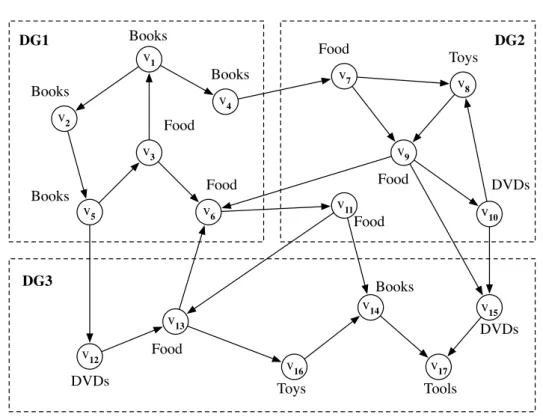
2.2 An example of a distributed vertex-labeled graph including 3 fragments. Here, we ignore edge labels (assuming that edges have no labels). . . . 12
2.3 Meaning of ϵ-edges. The left graph with ϵ-edges is value equivalent to the right graph without ϵ-edges. . . 13
2.4 Graph constructors. . . 16
2.5 MapReduce programming model. . . 18
2.6 Pregel programming model. . . 19
2.7 Maximum value example [15] in the Pregel model. Dotted lines are messages. Shaded circles are vertices voted to halt. . . 20
3.1 Example a2d_xc: relabels edges a to d and contracts edges c. . . 29
3.2 The syntax of structural recursion specifications for SWRP queries. . . 29
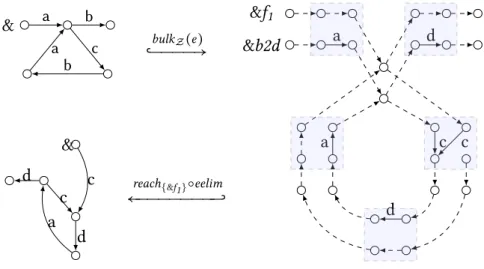
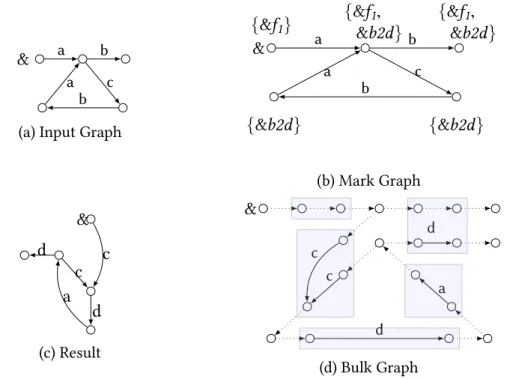
3.3 Bulk semantics to evaluate the specification c_b2d. . . 35
3.4 Graphs generated during the evaluation of the specification c_b2d. . . 38
3.5 The result of the 1st specification without conditions. . . 41
3.6 The result of evalIfThenElse algorithm. . . 42
3.7 The result of the 2ndspecification without conditions. . . 43
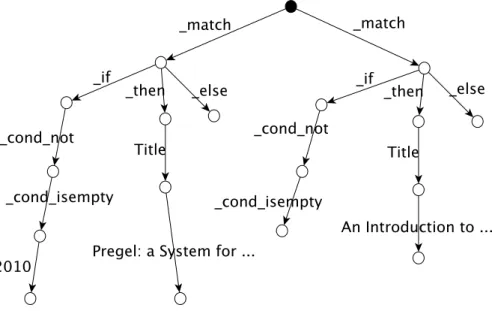
3.8 A graph encoding a statement “if isempty(f ($g)) then . . .”. . . 43
3.9 Overview of our framework. . . 46
3.10 Varying graph size (Citation dataset). . . 50
xiv List of Figures
3.11 Varying the number of CPUs (Citation dataset). . . 50
3.12 Varying graph size (Youtube dataset). . . 51
3.13 Varying the number of CPUs (Youtube dataset). . . 51
3.14 Query Q1 on Yahoo! AltaVista Web Page Graphs. . . 54
3.15 Query Q2 on Yahoo! AltaVista Web Page Graphs. . . 55
4.1 A DFA for(Books∗)(Food∗)(Books+). . . 60
4.2 An SFA for the DFA shown in Figure4.1. . . 62
4.3 A distributed evaluation strategy for RR queries. . . 64
4.4 A dependency graph constructed on Sc. Note that this is not a distributed graph. We use dotted rectangles to denote that from which fragment vertices come. . . 68
4.5 Experiment results with various graph sizes (YouTube and DBLP). . . . 73
4.6 Experiment results with various graph sizes (MEME and Internet). . . 74
4.7 Experiment results with various query sizes (YouTube and DBLP datasets). 76 4.8 Experiment results with various query sizes (MEME and Internet datasets). . . 77
4.9 Experiment results with varying number of partitions (Youtube and DBLP). . . 78
4.10 Experiment results with varying number of partitions (MEME and Internet). . . 79
4.11 Experiment results for costs of different components (Youtube and DBLP). 80 4.12 Experiment results for costs of different components (MEME and Internet). . . 81
4.13 How functional-based algorithms are affected by graph characteristics. 83 5.1 Two equivalent graphs. . . 88
5.2 A P-SRCP query example⟨s,t, O (GY ∣ B) V⟩. All edges have the same weight of 1. Two of the SRCPs are shaded in grey and pink. dR(s,t) = 9. 91 5.3 Relationship between SRCP queries and existing queries. . . 93
5.4 A query graph of the query⟨s,t, O (GY ∣ B) V⟩. Integers in nodes are OIDs. Superscripts of categories are equivalent row indices in the DP table. The subgraph from the node 1 to the node 5 is a DAG graph corresponding to the SRE O(GY ∣ B) V. . . 97
5.5 A table of optimal costs for the query in Figure5.2. The first column contains names of categories. The first row contains indices of vertices in a category. Curved arrows on the left indicate computation steps
and its orders. . . 98
5.6 A testbed framework for SRCP queries. . . 101
5.7 TPQ/GTSPP queries (k = 5). . . 104
5.8 TPQ/GTSPP queries (д= 10, 000). . . 104
5.9 Queries with multiple options (k = 8,д = 10, 000). . . 105
5.10 GSP queries (д= 10, 000). . . 105
List of Tables
3.1 Real-life graphs. . . 48
3.2 Experiment graphs extracted from Yahoo! AltaVista Web Page Hyper- link Connectivity Graph. . . 52
3.3 Execution time (sec) on Amazon Product Dataset. . . 56
4.1 Mappings of states in the SFA shown in Figure4.2. . . 63
4.2 An example of the output of the partial evaluation. . . 67
4.3 Real-life datasets. . . 71
5.1 The number of computation steps in each query. . . 106
5.2 Performance of optimizations. . . 107
1
Introduction
1.1 Motivations and Objectives
Graphs are flexible in modeling many kinds of data from the unstructured to the structured. To query graph data, a typical way is using regular expression to find paths in the graph [1]. Most of graph querying languages supports regular-expression-based queries, for example, Strudel [2], UnQL, [3], SPARQL [4,5], GXPath [6]. There are many potential applications in various domains using regular-expression-based queries as a key component.
• Social networks: Checking whether there exists a common friend who lives in Tokyo among two American friends [7]. Finding an influence network of a person based on friendship, or location [8].
• Biological networks: Finding every gene whose expression is directly or indirectly affected by a given compound. Finding the shortest path between two substances that includes a third substance [9].
2 Chapter 1. Introduction
Figure 1.1: A rooted, directed edge-labeled graph of paper citation network.
• World-Wide-Web: Discovering patterns via path analysis patterns [10, 11]. Exploiting the structure and topology of the document networks [12].
With the explosion of data as well as complicated relationships between data entities, graphs are too big to be processed in the main memory of a single machine. This leads to distributed programming models targeting to a scalable processing of big data in general (MapReduce, [13,14]) as well as big graphs in particular (Pregel, [15]).
Motivated by useful applications of regular-expression-based queries and the scalability of distributed graph processing models, the main objective of this dissertation is to propose automatic mechanisms to translate regular-expression-based queries into efficient programs in distributed graph processing models. These mechanism should be integrated together to form a general framework to query data from big graphs.
1.2 Challenges
Evaluating regular-expression-based queries in a distributed environment is a challeng- ing problem. Let us consider a big graph representing a citation network as shown in Figure1.1, where information is stored on edges. The following regular-expression- based queries (written in the UnQL+ language [16]),
select $p
where {_*.Paper ∶ $p} in $db, Year.Int.2010 in $p
returns all papers published in 2010; it finds all subgraphs (bound by $p) reachable from the root (the black vertex in Figure1.1) by a path whose edge labels form a word in the regular expression _*.Paper, while these subgraphs must satisfy the condition that they contain a path whose edge labels form a word in the regular expression Year.Int.2010.
To this query, the decision whether to include a paper bound by $p in the result or not needs additional computation to check the conditions over $p, which leads to two difficulties in evaluating the conditions efficiently. First, when we go deeper along directed edges to check the condition of $p, we will have to keep a record of where $p is bound, so as to trace back after checking. Second, the subgraph $p may refer to the whole big graph because of possible cycles and the condition may be involved and time-consuming, so we need to find a good way to parallelize the checking process and make it work efficiently.
The problem becomes even more difficult when there are subqueries and additional conditions. Consider that we would like to compute an influence graph of a paper based on citations.
select (select $a
where
{Author ∶ $a} in $p,
LivingIn.America in $a) where
{_*.Paper ∶ $p} in $db, Year.Int.2010 in $p,
_*.referTo.Paper.Title.“Pregel” in $p
This query finds all authors living in America who have papers published in 2010 which directly/indirectly refer to the paper entitled “Pregel”. To this query, the difficulty is not only evaluating conditions over graphs, but also checking whether a graph $a belongs to a graph $p or not. It is because these two graphs may be stored at two different machines.
In addition, although distributed processing models are designed to be scalable to
4 Chapter 1. Introduction
Figure 1.2: Overview of a querying framework for graphs.
big data, it is non-trivial to describe graph algorithms [17,18,14]. This is because, in order to obtain a good scalability, these models are often limited to a specific form of computation. For example, the MapReduce model requires user describing computations in functions “Map” and “Reduce”, while the Pregel model requires writing programs in a common function that applies on every vertex of a graph. Some regular-expression-based queries have been proposed on top of MapReduce or Pregel. For example, Fan et al. [19] proposed a MapReduce algorithm to answer point-to-point regular reachability queries, which returns a boolean answer. Nolé et al. [20] proposed a Pregel algorithm to processing regular path queries (a subset of GXPath [6], not including backward navigation and branching ), that returns a set of pairs of vertices connecting by a path satisfying the regular expression. Nonetheless, to the best of our knowledge, none of them returns a graph as a result, making queries not able to be nested or composed.
1.3 Problem Statement
A general framework for evaluating select-where regular path queries usually consists of the following components (as shown in Figure1.2).
• Desugaring: This converts input queries into a calculational form which represents computations over graphs.
• Optimization: This component consists of high-level optimizations. Rules are applied to transform a naive program into an efficient one. Rules can be classified into two levels: general rules to minimizes operations of a program;
and model-targeted rules to make a program fit well with underlying distributed processing models (e.g., MapReduce, Pregel).
• Code Generation: This component accepts optimized programs and generates codes in the underlying distributed processing models.
With the above framework, the following research questions are raised.
• What are suitable calculational forms that not only allow expressing regular- expression-based queries on graphs and enjoy powerful optimization rules, but also potentially enable parallelism.
• Once we have found a suitable calculational form, how to transform a program written in that calculational form into one that consists of basic algorithms in the underlying distributed processing models. Once this can be done, we can utilize efficient algorithms that are well developed.
• How can the framework be extended to aggregation operators, e.g. shortest paths based on regular expressions.
1.4 Contributions
By answering those research questions, this dissertation makes the following four contributions.
First, we propose a structural-recursion-based approach to obtain Pregel programs automatically for a subset of select-where regular path queries. These queries are in the form of
QP ∶ select QP 1($g1) where {RE ∶ $g1} in $g
This approach can help not only utilize many useful optimization rules developed for structural recursions, but also obtain an efficient Pregel program. In this approach, no matter how complex a query is, it is finally expressed in the form of a structural recursive function or a composition of structural recursive functions, by applying optimization rules. We then derive an efficient algorithm that minimizes intermediate data generated during its computation. Our idea is a mark-and-generate computation. In the phase Mark, we first mark each vertex with a set of states that are yielded by the
6 Chapter 1. Introduction
automaton of a regular expression for paths starting from the root vertex to each vertex. Then, in the Generate phase, we use a bulk computation to generate the final result by applying a common computation on every edge in parallel.
Second, we propose a novel approach to obtain Pregel programs for another subset of select-where regular path queries that consist of conditions over graphs. In general, this class has the form of
QC ∶ select QC1($g1) where
{RE ∶ $g1} in $g, RE in $g1, . . .
where the condition “RE in $g1” says whether there exists a path in the graph $g1 whose edge labels form a word in RE. We may have multiple conditions over a graph. Our idea is a generate-and-test computation: speculatively generating results without considering the condition, and pruning (by testing) those that do not satisfy the condition. This idea is based on the observation that a single condition check could double the computation because of speculative computation compared to sequential computation, but as will be seen later, it can be fully compensated by a carefully designed full parallel computation with multiple processors. To this end, we rewrite these queries into two queries in the first class (QP 1,QP 2) and a specific iterative parallel algorithm. The first query QP 1is to speculatively compute both result graphs (each constructed from the select part) and conditional graphs (each constructed from the where part) and group them into a single intermediate graph. Our proposed iterative parallel algorithm is to propagate conditional checking results around the intermediate graph. The second query QP 2 extracts the final result from the propagated graph. Interestingly, the query QP 2is always the same and independent of the input query.
Third, we propose a functional-based approach to obtain a parallelism in answering a point-to-point regular reachability query. By lifting a deterministic finite automaton of a regular expression to a simultaneous finite automaton whose states are states- to-states mapping functions, we propose an efficient distributed algorithm in the MapReduce model. Practical results show that this approach can significantly speedup local computations and reduce communication overhead. We show how this functional-
based approach can be extended to apply to the phase Mark that takes much time during the evaluation of select-where regular path queries.
Fourth, we propose a shortest regular category-path query to return shortest paths whose vertex labels form a category-based regular expression. We show that a select-where regular path queries extended with shortest-path conditions can be solved by using a shortest regular category-path query. For example, a query,
QS ∶ select
select $g2
where{RE2∶ $g2} in $g1
$g2closest to $g where{RE1∶ $g1} in $g
returns all graphs $g2that are followed by a path—starting from the root of $g—whose labels form a regular expression “RE1.RE2” and whose length is shortest (assuming that the length of a path is the number of edges on the path). This query requires to find all vertices (roots of $g2) connected from the root of $g by a path whose vertex labels form a category-based regular expression “_∗ .C1._∗ .C2”, where C1 and C2 are sets (categories) of roots of $g1and $g2, respectively. By using a dynamic programming formulation, we show that a shortest regular category-path query can be efficiently answered by a sequence of single source shortest path searches. This is useful because we can utilize fast single source shortest path algorithms that are optimized for different types of graphs (road networks, social networks, biological networks) and environments (shared or distributed memory).
1.5 Dissertation Overview
This dissertation is organized as follows.
In chapter 2, we introduce basic notions and models that are used throughout the dissertation.
In chapter 3, we give a formal definition of select-where regular path queries. Our contributions in translating select-where regular path queries into Pregel programs are discussed in detail. We design and implement a light-weight framework based
8 Chapter 1. Introduction
on our solutions to answer select-where regular path queries. Experimental results with real-life graph instances show that our framework has a good scalability. The intermediate graphs generated are small compared with the input graph.
In chapter 4, we introduce a functional-based approach to answer point-to-point regular reachability queries. This serves as a preliminary experiment to show the advantage of the functional-based approach in answering regular reachability queries. Our experiment with the MapReduce model shows that this approach gains a significant speedup compared with state-of-the-art approaches. We end this chapter by showing how this approach can be extended to speedup the evaluation of select-where regular path queries.
In chapter 5, we introduce a shortest regular category-path query and show its role in integrating shortest-path conditions into select-where regular path queries. We show how to reduce the query to a series of single source shortest path searches. Experimental results on road networks show that our solution can utilize existing fast single source shortest path algorithms.
In chapter 6, we give a summary of the dissertation and discuss future work.
2
Preliminaries
In this chapter, we introduce basic notions that are used throughout the dissertation. We give a definition of graph data model. Graphs in this model are up to bisimilarity. Graph constructors are introduced to help build a graph from smaller graphs. Graph constructors are also used in queries to construct the final result. These notions are borrowed from UnCAL—an unstructured calculus for querying graph data. Then, we give a definition of regular expression we focus on in this dissertation. Finally, we briefly explain some well-known distributed processing models for big graphs.
2.1 Graph Data Models
2.1.1 Definitions
Following UnCAL (a unstructured calculus for querying graph data [3]), a graph is modeled as a directed edge-labeled graph extended with markers and ϵ-edges. It is shown that this graph model is powerful enough for representing various datasets
10 Chapter 2. Preliminaries
&1 2
5
3
4
a b
c b a
(a) A simple graph
1
& 0 2 3
4
5 6
a b 7
c b
b a
d
(b) An equivalent graph Figure 2.1: Examples of rooted edge-labeled graphs.
from the unstructured, the semistructured to the structured [21,22]. In this model, edges contain data, while vertices are unique identity objects without labels. Markers (with a prefix &) are symbols to mark certain vertices as input vertices or output vertices. Edges labeled with a special symbol ϵ are called ϵ-edges. One could consider markers as initial/final states and ϵ-edges as “empty” transitions in automata.
LetL be a set of labels, LϵbeL ∪ {ϵ}, and M be a set of markers denoted by &x,
&y, &z, . . . There is a distinguished marker &∈ M called a default marker.
Definition 2.1 (Directed Edge-Labeled Graph [3]) A directed edge-labeled graph G is a quadruple(V, E, I, O), where V is a set of vertices, E ⊆ V × Lϵ× V is a set of edges, I ⊆ M × V is an one-to-one mapping from a set of input markers to V, and O ⊆ V × M is a many-to-many mapping fromV to a set of output markers.
For &x, &y ∈ M, let v = I(&x) be the unique vertex such that (&x,v) ∈ I, we call v an input vertex. If there exists a(v, &y) ∈ O, we call v an output vertex. Note that there are no edges coming to input vertices or leaving from output vertices. Let DBXY denote data graphs with sets of input markersX and output markers Y. When X = {&}, DBXY is abbreviated to DBY, and DB∅is abbreviated to DB. A graph that has only one input markerX = {&} and has no output marker Y = ∅ is called a rooted graph, in which the vertex v = I(&) is called the root vertex of the graph. Graphs with multiple markers are internal data structures that are generated with graph constructors.
Figure2.1(a)shows an example of a rooted directed edge-labeled graph in which V = {1, 2, 3, 4, 5}, E = {(1, a, 2), (2, b, 3), (2, c, 4), (4, b, 5), (5, a, 2)}, I = {(&, 1)}, and O = {}. The vertex with id 1 is the root of the graph, and is marked with &.
Definition 2.2 (Path) A path ρ in a directed edge-labeled graph is a sequence of edges,
denoted by
v1Ðl→ v1 2Ðl→ v2 3Ðl→3 ⋯ÐÐ→ vlk−1 k, where(vi,li,vi+1) ∈ E, 1 ≤ i ≤ k − 1.
We denote(u,ϵ∗,v) A E and (u,ϵ∗.a,v) A E whenever there exists a path from u to v whose edge labels are ϵ . . . ϵ or ϵ . . . ϵa, respectively.
Definition 2.3 (Weighted Graph) A graph Gw = (V, E, I, O,w) is a weighted graph, if it is a directed edge-labeled graph, and the function w ∶ Lϵ→ R+ is to map each edge label to a positive, real-valued weight.
Definition 2.4 (Vertex-Labeled Graph) A vertex-labeled graph is a directed edge- labeled graphs extended with a labeling function over vertices. We denote a vertex-labeled graph by Gv = (V, E, I, O, σ ), where σ ∶ V → L is a function mapping each vertex in Gv to a label.
We adopt the model for distributed vertex-labeled graphs presented in [23]. In a distributed graph, the vertices are partitioned into N fragments. Each fragment is maintained at a site, whereas each site may take charge of more than one fragment.
Definition 2.5 (Distributed Vertex-Labeled Graphs) A distributed graph for a graph Gv = (V, E, I, O, σ ) is a set of fragments, each of which is a 6-tuple. For example, the i-th fragment is DGi = (Vi,Ei,Ii,Oi,σi,Ci,). Vi is a partition of V, i.e., V1⊎ ⋯ ⊎Vn= V. Ei = E ∩ (Vi×Lϵ×Vi) denotes the corresponding edges. σiis the labeling function forVi. Ci = E ∩ (Vi×Lϵ×(V ∖ Vi)) is the set of cross edges, each of which connects a vertex in DGi to a vertex in another fragment. Ii = {u ∣ (v,u) ∈ (C1∪ ⋯ ∪ Cn),u ∈ Vi} denotes the set of input vertices. Oi= {u ∣ (v,u) ∈ Ci} denotes the set of output vertices. It is worth noting that output and input vertices are duplicated among fragments.
Example 2.1 Figure2.2shows an example of a distributed graph that is partitioned into three fragments, DG1, DG2, and DG3. For example,
DG1= (V1,E1,I1,O1,σ1,Ci)
12 Chapter 2. Preliminaries
Books
Books
Books
Food
Books
Food
DVDs
Books
Tools Toys
Food
Food Food
Food
DVDs DVDs Toys
DG1
DG3
DG2 v1
v2
v3
v4
v5 v6
v7 v
8
v9
v10
v11
v12
v13
v14 v15
v16 v17
Figure 2.2: An example of a distributed vertex-labeled graph including 3 fragments. Here, we ignore edge labels (assuming that edges have no labels).
where
V1= {v1,v2,v3,v4,v5,v6},
E1= {(v1,v2), (v1,v4), (v2,v5), (v3,v1), (v3,v6), (v5,v3)}, I1= {(&z1,v6)},
O1= {(v7,&z2), (v11,&z3), (v12,&z4)} C1= {(v4,v7), (v6,v11), (v5,v12)}.
Here, for brevity, we ignore edge labels when labels are empty. For example,(v1,v2) denotes the edge with an empty label(v1,“ ”,v2).
2.1.2 The Meaning of ϵ-Edges
Theoretically, an ϵ-edge from a vertex v to v′means that all edges emanating from v′ should be emanating from v [3]. Eliminating an ϵ-edge(v,ϵ,v′) means removing this
l ≡
a b c
l
a b a
c b c
Figure 2.3: Meaning of ϵ-edges. The left graph with ϵ-edges is value equivalent to the right graph without ϵ-edges.
ϵ-edge and for each edge,(v′,a, w), emanating from v′, adding a new edge(v, a,w). Figure2.3shows an example of two equivalent graphs: one contains ϵ-edges and the other has no ϵ-edges. In this dissertation, we use dotted arrows to denote ϵ-edges.
2.1.3 Graph Equivalence
Two directed edge-labeled graphs G1and G2 are value equivalent, in notation G1≡ G2, if there exists an extended bisimulation from G1to G2.
Definition 2.6 ( [3]) Let G1= (V1,E1,I1,O1),G2 = (V2,E2,I2,O2) be two graphs, both with input markersX and output markers Y. An extended simulation from G1to G2 is a relation S ⊂ V1× V2 such that:
• if (u1,u2) ∈ S ∧ (u1,ϵ∗.a,v1) A E1 with a ≠ ϵ, then there exists a node v2 s.t.
(u2,ϵ∗.a,v2) A E2 and(v1,v2) ∈ S,
• if(u1,u2) ∈ S ∧ (&x,u1) ∈ I1then(&x,u2) ∈ I2,
• if(u1,u2) ∈ S ∧ (u1,ϵ∗,v1) A E1∧ (v1,&y) ∈ O1), then there exists a node v2s.t. (u2,ϵ∗,v2) A E2∧ (v2,&y) ∈ O2, and
• (I1(&x), I2(&x)) ∈ S, for every &x ∈ X .
An extended bisimulation from G1to G2is an extended simulation S for which S−1is also an extended simulation.
For example, the graph in Figure2.1(a)is value equivalent to the graph in Fig- ure2.1(b). The new graph (Figure2.1(b)) has an additional ϵ edge from the root and an
14 Chapter 2. Preliminaries
edge(7, d, 3) unreachable from the root. It adds a new edge labeled b, (2, b, 6), from the vertex 2.
2.2 Graph Constructors
Before looking at graph constructors in details, we need to define an additional operation “⋅” (Skolem function) to generate new markers. The operation ⋅ returns a different marker for every pair of &x and &y. We assume ⋅ to be associative, (&x⋅ &y)⋅ &z = &x⋅ (&y⋅ &z), and & to be its identity, &⋅ &z = &z⋅ & = &z. Given two sets of markersX , Y, we denote X ⋅ Y the set {&x⋅ &y ∣ &x ∈ X , &y ∈ Y }.
There are nine graph constructors in UnCAL. From these constructors, we can build arbitrary directed edge-labeled graphs.
G ∶∶= {} {empty graph (one vertex, one input marker)}
∣ {l ∶ G} {singleton graph (an edge pointing to the root of a graph)}
∣ G ∪ G {graph union}
∣ &x ∶= G {relabel the root vertex with a new input marker}
∣ &y {graph with one output marker}
∣ () {empty data graph (no vertices, edges and markers)}
∣ G ⊕ G {disjoint union}
∣ G @ G {append of two graphs}
∣ cycle(G) {graph with cycles}
Intuitively, definitions of the constructors are given in Figure2.4. Informally,{} constructs a graph of only one vertex labeled with default input marker &,{l ∶ G} constructs a new graph G′ from the graph G by adding the edge labeled l pointing to the root of G. The source vertex of l becomes the root of G′. The operator ∪ unions two graphs of the same input markers with the aid of ϵ-edges. The next two constructors allow us to add input and output markers: &z ∶= G takes a graph G ∈ DBXY and relabels input vertices with the input marker &z, thus the result is in DBZ⋅XY ; &y returns a graph of a single vertex labeled with the default input marker & and the output marker
&y.() constructs an empty graph without any markers and vertices. The disjoint union G1⊕ G2 requires two graphs G1 and G2 have disjoint sets of input markers.
The operator G1@G2 vertically constructs a graph by adding ϵ-edges from output vertices of G1to input vertices with the same markers of G2. It requires G1∈ DBXY and G2∈ DBYZ, thus G1@G2∈ DBXZ. Finally, the last operator allows us to introduce cycles by adding ϵ-edges from an output marker to the input marker named after it.
Example 2.2 The graph in Figure2.1(a)can be constructed as follows (but not uniquely).
&z @ cycle((&z ∶= {a ∶ &z1})
⊕(&z1∶= {b ∶ {}} ∪ {c ∶ {b ∶ &z2}})
⊕(&z2∶= {a ∶ &z1})) ⊓⊔
For brevity, we write{l1∶ G1, . . . ,ln∶ Gn} to denote {l1∶ G1} ∪ . . . ∪ {ln∶ Gn}, and (G1, . . . ,Gn) to denote G1⊕ . . . ⊕ Gn.
2.3 Regular Expression
The syntax of a regular expression is:
R ∶∶= a ∣ _ ∣ R“∣”R ∣ R“∗” ∣ R“.”R ∣ (R)
where a∈ Lϵ is a label, and _ denotes a wildcard that matches any label. Further, “∣”, “∗” and “.” denote alternation, Kleene closure, and concatenation, respectively. “.” can be omitted. We may write R+ as a shorthand for RR∗.
Definition 2.7 (Path Satisfaction) A path ρ = v1 Ðl→ v1 2 Ðl→ v2 3Ðl→ ⋯3 ÐÐ→ vlk−1 k is said to satisfy a regular expression R if the string “l1l2. . .lk−1” spells out R.
It is well known that any regular expression can be translated into a deterministic finite automaton (DFA) [24].
16 Chapter 2. Preliminaries
{}↪ &
(a) Empty graph (one vertex, one input marker)
& G0
l
{l ∶ G0}
↪
&
G0 G
l
(b) Singleton graph
G1
&z1 &z2 G2
&z1 &z2
G1∪ G2
↪ G1 G2
&z1 &z2
ε ε ε ε
(c) Union of two graphs
&z
G0
&y1 &y2
&z∶= G0
↪ G
&z ⋅ &y1 &z ⋅ &y2
(d) Label the root vertices with some input marker
&y
↪ &
&y
(e) Graph with one output marker
()↪ ∅
(f) Empty data graph (no vertices, edges and markers)
G1
&x1 &x2
G2
&y1 &y2
G1⊕ G2
↪ G1 G G2
&x1 &x2 &y1 &y2
(g) Disjoint union of two graphs
G1
&x1 &x2
&y1 &y2
G2
&y1 &y2
G1 G
&x1 &x2
G2
ε ε
G1@G2
↪
(h) Append of two graphs
G0
&x1 &x2
&x1 &x2
cycle(G0)
↪ G
&x1 &x2
(i) Graph with cycles
Figure 2.4: Graph constructors.
2.4 Distributed Programming Models
2.4.1 MapReduce
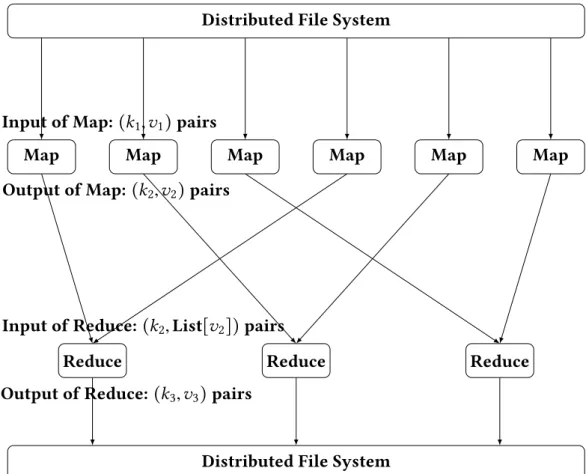
MapReduce [13] is a framework to process big data. A widely used open source implementation is Hadoop [25]. In MapReduce programming model, users only need to write two functions: Map and Reduce. Figure2.5shows the MapReduce programming model. Map functions accept a list of key-value pairs of(key1, value1) as its input and produce a list of pairs of(key2, value2). After that, Shuffle and Sorting phase will collect pairs with the same key and group them into pairs of(key2, listOfValues), these phases are automatically done by the underlying system. For each different key and a list of its values, the system will invoke a reduce function to process. Reduce functions will emit results that are pairs of(key3, value3). Data, which are used during computation of a MapReduce job, are usually stored in a high performance distributed file system.
2.4.2 Pregel
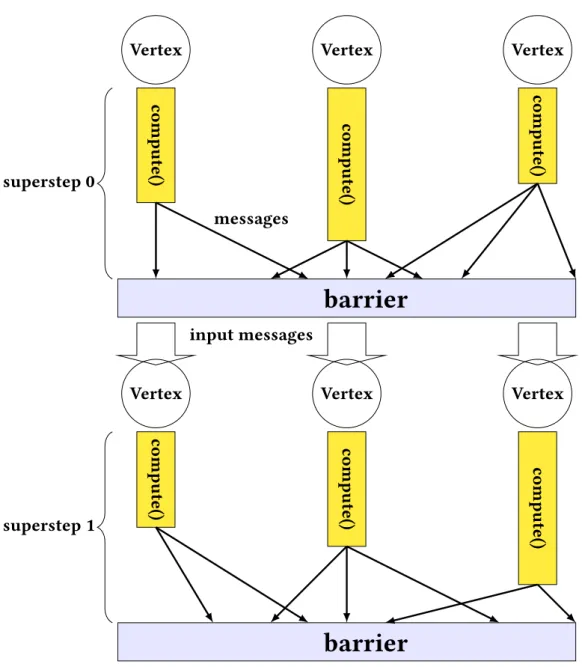
Pregel [15] is a model to process big graphs in a distributed way. It is widely used by Google and Facebook to analyze big graphs. Figure2.6shows the Pregel programming model. It is inspired by the Bulk-Synchronous Parallel (BSP) model [26] whose computation consists of a sequence of supersteps. It follows the vertex-centric approach where a common function, compute(), is applied to every vertex. A vertex can access its outgoing edges locally. During a superstep, a vertex receives messages from the other vertices, does its computations (updating its value, mutating outgoing edges, etc.), and sends messages to the other vertices. One vertex can decide not involving to the next superstep by voting to halt (to be inactive). A computation terminates when there is no message in transit or every vertex becomes inactive. Machines used to do vertex computations are called workers. A master is responsible for coordinating the activities of workers. A Pregel phase is a sequence of supersteps to do a computation unit logically.
18 Chapter 2. Preliminaries
Distributed File System
Map Map Map Map Map Map
Reduce Reduce Reduce
Distributed File System Input of Map:(k1,v1) pairs
Output of Map:(k2,v2) pairs
Input of Reduce:(k2,List[v2]) pairs
Output of Reduce:(k3,v3) pairs
Figure 2.5: MapReduce programming model.
Vertex Vertex Vertex
compute() compute() compute()
barrier
Vertex Vertex Vertex
compute() compute() compute()
barrier
input messages messages superstep 0
superstep 1
Figure 2.6: Pregel programming model.
20 Chapter 2. Preliminaries
Example 2.3 (Maximum Value Example [15]) Figure 2.7shows an example that propagates the maximum value of vertices’ values to every vertex. During a superstep, a vertex learns the maximum value from coming messages sent by its neighbors. If its value is updated to a larger value, it sends the new value to its neighbors. Otherwise, it sends nothing, and becomes inactive (by voting to halt). The algorithm terminates when there are no messages in transit. Listing2.1shows the pseudocode for the algorithm.
3 6 2 1 Superstep 0
6 6 2 6 Superstep 1
6 6 6 6 Superstep 2
6 6 6 6 Superstep 3
Figure 2.7: Maximum value example [15] in the Pregel model. Dotted lines are messages. Shaded circles are vertices voted to halt.
void compute(Vertex vertex, Iterable<MsgValue> msgs) {
if (getSuperstep() == 0) {
// send messages to the neighbors for (Edge edge : vertex.getEdges()){
VertexId targetId = edge.getTargetVertexId();
sendMessage(targetId, new Message(vertex.getValue())); }
} else {
// get the maximum value from received messages Long MaxValue = vertex.getValue();
for (MsgValue msg : msgs){
MaxValue = (msg > MaxValue) ? msg : MaxValue; }
if (MaxValue > vertex.getValue()){ // update the vertex value
vertex.setValue(MaxValue);
// send messages to the neighbors for (Edge edge : vertex.getEdges()){
VertexId targetId = edge.getTargetVertexId(); sendMessage(targetId, new Message(MaxValue)); }
} else {
voteToHalt(); }
} }
Listing 2.1: Pseudocode for the function Vertex.compute() in the Pregel model to compute the maximum value.
3
Select-Where Regular Path Queries
In this chapter, we formally define select-where regular path queries. Our contributions are presented in detail, where we show how to obtain Pregel programs for select-where regular path queries. Structural recursion is introduced as a calculation form to express queries. Although it has been shown that structural recursion is a powerful tool to systematically develop parallel programs on lists, arrays and trees [27,28,29,30], it is new to use it to derive scalable programs on graphs. In this chapter, we propose efficient computations for specifications written by structural recursion on graphs. Based on our solutions, we design and implement a light-weight framework on top of Pregel. We show experimental results in detail and conclude this chapter with a discussion.
24 Chapter 3. Select-Where Regular Path Queries
3.1 Definition of Select-Where Regular Path Queries
A select-where regular path (SWRP) query Q($g) on a rooted directed edge-labeled graph $g is defined as follows (the syntax is borrowed from the UnQL language [3]).
Q($g) ∶∶= select E($g)
∣ select E($g1) where {R ∶ $g1} in $g
∣ select E($g1) where {R ∶ $g1} in $g, P($g1)
∣ select E($l, $g1) where {R ∶ {$l ∶ $g1}} in $g, P($g1)
where R represents a regular expression described in Section2.3. The select part is to return the final result by using an expression E over a graph variable or a pair of a label variable ($l) and a graph variable ($g). The where part is a generator using regular expressions, e.g., “{R ∶ $g1} in $g” is to generate graphs following paths—starting from the root of $g—whose labels form R. Each of these graphs is bound by $g1. Besides, the generator “{R ∶ {$l ∶ $g1}} in $g” allows binding labels of edges following paths satisfied R to a label variable $l and use the label variable to construct the final result in an expression E. Inside the where part, we can define conditions P over a graph variable ($g1) as well as over label variables.
An expression E on a graph $g is to construct the final result. The expression E($g) may consist of three of graph constructors, sub-queries (Q($g)), conditional statements, user-defined functions (UDF), and function application (fname).
E($g) ∶∶= {} ∣ {a ∶ E($g)} ∣ E($g) ∪ E($g) ∣ Q($g)
∣ if P($g) then E($g) else E($g)
∣ UDF($g), fname($g)
E($l, $g) ∶∶= E($g) ∣ {$l ∶ E($g)} ∣ E($l, $g) ∪ E($l, $g)
Once there exists a label variable in an expression, we only allow it to be used in graph constructors.
A condition P over a graph $g is defined as follows. P($g) ∶∶= isempty(Q($g)) ∣ R in $g1
∣ !P($g) ∣ P($g) && P($g) ∣ P($g) || P($g) R ∶∶= a ∣ _ ∣ R“∣”R ∣ R“∗” ∣ R“.”R ∣ (R)
where the condition isempty is to check whether the result of a query is an empty graph or not; the condition “R in $g” is to check whether there exists a path from the root of $g whose edge labels form R. Conditions can be composed by operators AND (&&), OR (||), or NOT (!).
One can define user-defined functions to do transformations, e.g., changing all edges labeled “Publication Venue” to “Conference”, finding all graphs following paths satisfied a regular expression and removing them, etc. User-defined functions are defined by structural recursive functions as follows.
U DF($g) ∶∶= let sfun fname({lp1∶ дp1}) = E(lp1,дp1)
∣ fname({lp2∶ дp2}) = E(lp2,дp2)
∣ . . .
∣ fname({lpn∶ дpn}) = E(lpn,дpn)
in E($g)
∣ letrec sfun fname1({lp11∶ дp11}) = E(lp11,дp11)
∣ fname1({lp12∶ дp12}) = E(lp12,дp12)
∣ . . .
∣ fname1({lp1n ∶ дp1n}) = E(lp1n,дp1n) and
. . . and
sfun fnamem({lpm1∶ дpm1}) = E(lpm1,дpm1)
∣ fnamem({lpm2∶ дpm2}) = E(lpm2,дpm2)
∣ . . .
∣ fnamem({lpmn∶ дpmn}) = E(lpmn,дpmn) in E($g)
where a single structural recursive function is defined by using the keywords “let sfun” and mutually structural recursive functions are defined by using “letrec sfun”. Struc- tural recursive functions are discussed in detail in Sections 3.2.1and3.2.2.
Let us look at some examples of SWRP query.
1our extension to UnQL+ queries
26 Chapter 3. Select-Where Regular Path Queries
Example 3.1 The simplest query is a regular path query [31]. Assume that we want to return all papers’ titles from a citation graph. A such query is written as follows.
select $t
where {Paper.Title.String ∶ $t} in $db
where, the variable $t is bound to each graph that follows a path starting from a root in which the concatenation of its edge labels satisfies the regular expression Pa- per.Title.String. The result graph is the union of graphs bound by $t.
Example 3.2 We can reorganize data returned by graph variables to construct a new graph.
select {Article ∶ (
{Year ∶ select $y where {Year.Int ∶ $y} in $p}
∪
select $t where{Title.String ∶ $t} in $p)} where {Paper ∶ $p} in $db
This query binds variables $t and $y to the title and the year of a paper $p, respectively. After that, it constructs, for each paper, a graph that has one edge labeled Article pointing to the union of two graphs: one has one edge labeled Year pointing to the graph
$y, and another is the graph $t.
Example 3.3 This is an example of using conditions in an SWRP query. select $p
where {Paper ∶ $p} in $db, Year.Int.2010 in $p
This query returns papers published in 2010. It combines regular path expressions and conditions over graphs. .
Example 3.4 We can also perform transformations over graphs by using a user-defined function (UDF). For example, for each paper returned by the query in Example3.3, we
relabel edges Conference to Venue. select
letrec sfun
c2v({Conference ∶ $g}) = {Venue ∶ c2v($g)} c2v({$l ∶ $g}) = {$l ∶ c2v($g)}
in c2v($p)
where {Paper ∶ $p} in $db, Year.Int.2010 in $p
Here, we use a structural recursive function c2v to relabel edges Conference. The function c2v is defined with matching patterns. This function does not change the structure of the input graph. It only modifies the label of edges—from Conference to Venue.
3.2 Specifications for SWRP Queries
3.2.1 Structural Recursion
Structural recursion is a powerful mechanism to traverse and restructure data in functional programming. It is shown that structural recursion is useful to systematically construct parallel programs on lists, arrays and trees [30]. Structural recursion on graphs was developed from structural recursion on trees, in order to manipulate unstructured data [3]. One of the advantages of structural recursion is the ability of composing multiple structural recursive functions to describe many complex transformations over graphs. Although compositions usually lead to large intermediate graphs or multiple graph traversals, we can solve those problems systematically by rewriting multiple structural recursive functions into one structural recursive function using tupling/fusion rules or marker-directed optimizations [3,32,33]. Therefore, once we can transform SWRP queries to structural recursive functions and parallelize structural recursive functions, we can achieve the scalability for SWRP queries on big graphs and utilizes many useful rewriting rules over structural recursion.
Given a function e∶∶ Lϵ → DBZZ, whereZ = {&z1, . . . ,&zn}. A function, f ∶∶ DBXY →DBX ⋅ ZY ⋅ Z,
28 Chapter 3. Select-Where Regular Path Queries
is called a structural recursion if it is defined by the following equations f({}) = (&z1∶= {}, . . . , &zn ∶= {})
f({$l ∶ $g}) = e($l, $g) @ f ($g) f($g1∪ $g2) = f ($g1) ∪ f ($g2)
f(&y) = (&z1∶= &y ⋅ &z1, . . . ,&zn ∶= &y ⋅ &zn)
Intuitively, evaluation proceeds as follows: starts from the root of a graph and checks one of three cases. If the graph is empty, it applies the first line (return{}). If the graph is a singleton graph then it applies the second line: this leads to a recursive call of f on a subgraph. Finally, if the graph is not a singleton, then it decomposes the graph arbitrarily into two graphs $g1 ∪$g2, and it applies the function f recursively on each of them. The fourth line deals with graphs with only one output vertex, e.g, when computing f({$l ∶ &y}), we need to compute f (&y). It is obvious that the function terminates on trees, and interestingly it has been shown that the function terminates on graphs with cycles as well [3].
In this dissertation, the first, the third and the fourth equations are always in those forms, so we omit them in the sequel and encode f as recZ(λ($l, $g).e). For brevity, sometimes we just write rec(e).
Example 3.5 The following structural recursion a2d_xc relabels edges a to d and contracts edges c. Applying this function to the graph in Figure3.1(a)results in the graph in Figure3.1(b).
a2d_xc($db) = rec(λ($l, $g).
if $l = a then {d ∶ &} else if $l= c then {ϵ ∶ &}
else{$l ∶ &})($db) ⊓⊔
3.2.2 Expressing SWRP Queries by Structural Recursion
The syntax of a specification for an SWRP query is shown in Figure3.2. Functions between the keywords main and where are the starting point in a specification. By
&1 2
5
3
4
a b
c b a
(a) An Input Graph
& 1 2
5
d b 3
d b
(b) The Output Graph
Figure 3.1: Example a2d_xc: relabels edges a to d and contracts edges c.
proд ∶∶= main f [ ○ f ] where decl⋯decl { specification }
decl ∶∶= f ({l ∶ $g}) = t { structural recursive function } t ∶∶= {} ∣ {l ∶ t} ∣t ∪ t { graph constructors }
∣ f ($g) { function application }
∣ if bcond then t else t { if_then_else }
bcond ∶∶= isempty(t) { an expression returns an empty graph not}
∣ bcond && bcond { AND condition }
∣ bcond || bcond { OR condition }
∣ !bcond { NOT condition }
l ∶∶= a ∣ $l { label (a ∈ Strinд) and label variables }
Figure 3.2: The syntax of structural recursion specifications for SWRP queries.
default, it applies on the input graph. Function composition is denoted by “ ○ ”, and, from its definition, we have (f1 ○ f2) x = f2(f1x). Structural recursive functions are defined in the form of pattern matching. The body of a function is an expression consisting of graph constructors, recursive function calls and conditional statements. We do not allow free graph variables inside an expression, instead we use a copy function, say id($g), to obtain the value of the graph variable $g. By using the id function, we can do optimizations, i.e. a tupling rule to obtain a structural recursive function from mutually structural recursive functions.
In this dissertation, specifications having no conditional statements are referred to as specification without conditions, and the ones having conditional statements are referred to as specification with conditions.
Example 3.6 The following query finds all graphs following a path satisfying an expression _*.c, and then transforms all edges labeled b in those graphs into edges
30 Chapter 3. Select-Where Regular Path Queries
labeled d,
select
letrec sfun
b2d({b ∶ $g}) = {d ∶ b2d($g)} b2d({$l ∶ $g}) = {$l ∶ b2d($g)} in{c ∶ b2d($r)}
where {_ ∗ .c ∶ $r} in $db is translated to the following specification c_b2d.
main f1where
f1({c ∶ $g}) = {c ∶ b2d($g)} ∪ f1($g) f1({$l ∶ $g}) = f1($g)
b2d({b ∶ $g}) = {d ∶ b2d($g)} b2d({$l ∶ $g}) = {$l ∶ b2d($g)}
Example 3.7 Nested queries, they are translated using a function composition to a query. As an example,
select $r
where {_ ∗ .c ∶ $r} in (select $p where {_*.d ∶ $p} in $db) is translated to the following specification.
main f1○f2 where
f1({d ∶ $g}) = id($g) ∪ f1($g) f1({$l ∶ $g}) = f1($g)
f2({c ∶ $g}) = id($g) ∪ f2($g) f2({$l ∶ $g}) = f2($g)
id({$l ∶ $д}) = {$l ∶ id($д)}
![Figure 1.1: A rooted, directed edge-labeled graph of paper citation network. • World-Wide-Web: Discovering patterns via path analysis patterns [ 10 , 11 ].](https://thumb-ap.123doks.com/thumbv2/123deta/6141652.101311/21.892.145.752.187.390/figure-directed-labeled-citation-discovering-patterns-analysis-patterns.webp)

![Figure 2.7: Maximum value example [ 15 ] in the Pregel model. Dotted lines are messages](https://thumb-ap.123doks.com/thumbv2/123deta/6141652.101311/39.892.253.638.358.655/figure-maximum-value-example-pregel-model-dotted-messages.webp)