NIRA Working Paper Series
March 2004
Asian Bond Markets Research Mission
— Research Report —
Proposals towards the Reform of Systems and
Infrastructure for the Further Development of
Bond and Capital Markets in Japan
Shigehito Inukai + 3
NIRA Working Paper Series No. 2004-4
NOTE: NIRA Working Paper Series is circulated in order to stimulate discussion and comments. Views expressed in Working Paper Series are those of authors and do not necessarily reflect those of NIRA.
You can download this and other papers at the NIRA Web site:
NIRA Working Paper Series No. 2004-4
March 2004
Asian Bond Markets Research Mission
— Research Report —
Proposals towards the Reform of Systems and Infrastructure
for the Further Development of Bond and Capital Markets in Japan
Corporate Finance and Treasury Association of Japan (CFTA)
Japan Capital Markets Association (JCMA)
Shigehito Inukai* (Secretary-General, JCMA)
(Mitsubishi Corporation & NIRA)
Junichiro Ando (Hitachi Capital Corporation)
Takashi Kato (Secretariat, CFTA and JCMA)
Mamoru Fujimoto (Trade Win Co., Ltd.)
* Senior Fellow, National Institute for Research Advancement (NIRA) (E-mail: [email protected])
Summary
The Asian nations which experienced the impact of the Asian financial crisis have already improved the frameworks of their domestic bond markets. Japan should draw valuable lessons from the example of these nations and make efforts to catch up with them by establishing the infrastructure necessary for creating an open bond market which in easy to utilize and which will function as Asia’s central market. This will in turn contribute to establishing the necessary foundation for the sustainable development of Asia as a whole.
Executive Summary
Position of current research
As part of their efforts to promote the development of capital markets in Japan, the Corporate Finance and Treasury Association of Japan (CFTA) and the Japan Capital Markets Association (JCMA) have conducted research1 into the bond markets of leading Asian countries, which in recent years have received little attention from market participants in Japan.
In light of the current lack of comprehensive information on regulations and infrastructure in leading Asian countries which are in the process of market reconstruction following the Asian financial crisis, one objective of this research is to clarify areas in which Japan’s capital markets are deficient in comparison to those of other Asian countries from the perspective of enabling the nation to play a key role in the Asian region. Furthermore, utilizing also the results of research conducted previously, this research mission has the ultimate objective of formulating recommendations to aid in the development of world-class capital markets.
Bond market development in four Asian countries
The research mission2 conducted interviews with 48 market participants at 18 separate organizations, including regulatory authorities and securities clearing organizations, in South Korea, Hong Kong, Malaysia, and Singapore. These interviews provided a near-complete understanding of the status of the bond markets and securities settlement systems in these countries.
Although South Korea’s market is relatively large, bond markets (including government bonds) in the three other countries are small in comparison to Japan’s. Nevertheless, corporate bond markets in all the countries surveyed are either comparable or larger than government bond markets, and have grown rapidly over the past several years.
The rapid growth of these bond markets can be attributed to a variety of factors. First, faced with non-functioning banks due to the Asian financial crisis and the temporary prospect of a collapse in bank-guaranteed bond issues and loan markets, government authorities placed emphasized the development of bond markets, and in a short period of time established a variety of bond-related regulations and institutions intended to facilitate the issuance and circulation of government bonds.
These trends were especially pronounced in South Korea. Moreover, the governments of Hong Kong, Malaysia, and Singapore were pressed to develop healthy local currency denominated bond markets as an investment target for public pension funds and other institutional investors, and made this an important national goal. Interest rates have declined as a result of deflation in these countries, and slumping stock markets in recent years have created a greater need for more stable investment products. This has led to the growing importance of domestic bond markets. Above all else, the drive of top leadership and youthful staff members enabled the government authorities in these countries to plan and implement securities market reforms in an extremely short period of time.
Overview of bond markets in each country
An overview of the status of regulatory systems and infrastructure in the four countries surveyed is provided below.
1) South Korea
Within a very short period, South Korea has independently implemented regulatory and infrastructural reform of its extremely advanced stock and bond markets. These reforms were carried out under the strong leadership of the Financial Supervisory Service, the agency responsible for securities supervision. The bond settlement cycle in South Korea is normally T+0, but due to the increase in delivery versus payment (DVP) ratios, there are plans to change the cycle to T+1.
2) Hong Kong
The domestic stock market in Hong Kong has reached its limit, and there is little prospect for major expansion. As a result, the Hong Kong Monetary Authority is steadily developing a securities settlement system based on a vision of playing a central role in Asia similar to that of London’s financial district and the Euroclear securities settlement facilities in Brussels.
3) Malaysia
Malaysia developed its comprehensive and ambitious Capital Market Master Plan in 2001 under the leadership of the Securities Commission, the country’s securities supervisory agency.
4) Singapore
Singapore is gradually easing currency control and other regulations imposed during the financial crisis and is moving to deregulate bond markets. At the same time, a new settlement system has been introduced and Central Depository (Pte) Limited, the sole central securities depository and part of the Singapore Exchange Limited, is developing and operating a number of systems. Singapore has an especially strong rivalry with Hong Kong, and is seeking to gain a superior footing in that competition.
Status of bond issuing regulatory and settlement systems
This research mission focused on the status of bond issuing regulatory and settlement systems, and revealed the following broad commonalities among the four countries.
1) Bond issuing regulatory systems
Bonds in the countries surveyed are basically positioned as a “professional” rather than
“retail” product. As a result, registration and disclosure requirements when bonds are issued are determined on a case-by-case basis and details are not subject to examination and approval procedures. Bond issuers and arrangers determine the information required and prepare registration and disclosure materials. They tend to use methods that ensure there are no omissions in details. Consequently, the burden of filing when issuing bonds in these countries seems low compared to Japan. Moreover, these countries do not have special exemption provisions for certain product types and additional requirements are imposed only as needed for asset-backed securities (ABS) and other securitization products. Regulatory systems are therefore extremely simple. The range of
“professional” investors—this category corresponds to qualified investors in Japan—includes wealthy individuals, and the scope of prospectus preparation exemptions is extremely broad compared to Japan. Moreover, the determination of qualifications is made independently by banks, securities firms, and other such institutions based on laws and regulations (no prior notification is required). We were impressed by the clear advantage of this system in terms of practicality.
2) Bond settlement systems
All the countries surveyed utilize DVP systems that operate on a real time gross settlement (RTGS) basis using funds from the central banks as bond settlement systems. These systems are capable of handling government bonds as well as corporate bonds; these countries have thus already
Although issuing volume is low compared to Japan, these countries have uniform settlement mechanisms for bonds and ABS, and sufficient consideration should be given to this point when improving settlement systems in Japan. Moreover, these systems were developed, expanded, and put into operation in the short span of one to two years (the mission did not conduct detailed research on this matter). We believe further exchange of information on the development, operation, and cost of these settlement systems would be valuable.
Conclusion
In conclusion, the mission’s survey left the impression that progress in reforming regulatory systems and infrastructure for debt and equity capital markets in these Asian countries has far outpaced reform in Japan. Compared with current conditions in Japan, including base infrastructure and related tax systems, these countries have already achieved a quite enviable position.
In Japan, the reform of securities settlement systems has been under debate for quite some time, but has as yet not been actually implemented. There is a sense of crisis concerning the possibility of being completely excluded from global markets. What Japan now requires is determination to be displayed by supervisory authorities, central banks and central securities depositories, which collectively make up the national infrastructure. There is, perhaps, little time still available to attempt to reach agreement on formats – it is time for bold decisions by a strong leadership. It is important for Japan to humbly reflect on its current circumstances and to be prepared to learn from Asia.
I Introduction
1. Research objectives
The Corporate Finance and Treasury Association of Japan (CFTA) and the Japan Capital Markets Association (JCMA) have made constructive recommendations3 from the standpoint of experienced market professionals on the development of a legal system for electronic commercial paper and electronic bonds and on the development of infrastructure and the market environment. In light of the objectives of the financial “big bang,” it is important that Japan’s capital markets develop world-class market infrastructure and assume a central role, in particular in Asia. This basic agenda remains unchanged. On the basis of this perspective, the JCMA has assessed the current status of Japan’s infrastructure with reference to a concept of the ideal status of capital markets. With a particular focus on debt markets, the JCMA has addressed the questions of what is specifically lacking compared to Europe, the US, and Asia in terms of a legal framework, settlement systems, and business practices, and what priorities and formats are required to develop desirable capital market systems in Japan. The JCMA approaches these questions with an awareness of the important responsibility that it bears in making recommendations from the standpoint of market professionals and issuers with expertise and practical experience in major markets of various countries.
The focus on these issues led to the dispatch of a mission two years ago to research securities settlement systems in Europe. The final report4 of this research caused a stir among market participants, and partly for this reason, the current mission set out to conduct research into the bond markets of leading Asian countries, which have received little attention from market participants in Japan in recent years. The mission sought to clarify deficiencies in Japan’s capital markets and offer recommendations for developing world-class capital markets.
Preliminary research revealed a lack of comprehensive and up-to-date information concerning Asian bond markets at financial and research institutions in Japan. The current mission was fortunate to receive considerable understanding and support from the individuals interviewed, and was therefore able to gain a near-complete understanding of the status of debt capital markets and securities settlement systems in leading Asian countries.
3 http://www.lookjapan.com/JV/02MarEF.htm http://www.enkt.org/katudou/index.html
Organizations visited
Given its research objectives, the mission visited securities supervisory authorities responsible for promoting market development and providing the relevant legal framework, settlement organizations in charge of administering settlement systems, and financial institutions that provide issuing services as market intermediaries. Specifically, the mission visited the following institutions.5
Securities Supervisory Authorities
Korea: Financial Supervisory Service (FSS6) Hong Kong: Hong Kong Monetary Authority (HKMA7) Malaysia: Securities Commission (SC8)
Singapore: Monetary Authority of Singapore (MAS)
Settlement Organizations
Korea: Korea Stock Exchange (KSE)
Hong Kong: Hong Kong Monetary Authority (HKMA9)
Hong Kong Exchange & Clearing Limited (HKEx) Singapore: Singapore Exchange Limited (SGX)
5 See “Supplementary Reference 1. List of Organizations Visited” for more details concerning the organizations the mission visited. (Please refer the material written in Japanese.
http://www.enkt.org/katudou/pdf/asiaten.pdf )
6 The FSS is a special public corporation established in April 1999 with the merger of four financial supervisory agencies. The FSS acts on behalf of two government agencies, the Financial Supervisory Committee (FSC) and the Securities and Futures Commission (SFC).
7 Supervisory organizations in Hong Kong include the Securities & Futures Commission (SFC) in addition to the HKMA.
Financial Institutions
Korea: J.P. Morgan Securities (Far East) Limited J.P. Morgan Chase Bank
Hong Kong: Hong Kong and Shanghai Banking Corporation (HSBC) Tokyo Mitsubishi International (HK) Limited
Daiwa Securities SMBC Hong Kong Limited Malaysia: J.P. Morgan Chase Bank Berhad
Other
Korea: Korea Institute of Finance (Private research institution) Hong Kong: ORIX Asia Limited (Business corporation)
Malaysia: Rating Agency Malaysia Berhad (Rating agency) Adnan Sundra & Low (Law office)
Singapore: Institute of Southeast Asian Studies (Government institution)
The organizations visited by the mission were sent questionnaires10 in advance and interviews were conducted on the basis of these questionnaires. All the organizations reviewed the questionnaires before the interviews, and more than half prepared materials appropriate to the purpose of the visit. This helped facilitate efficient meetings and information gathering.
2. Organization of this report
This report begins with a factual discussion based on the results of the research mission (Chapters II-IV). This is followed by recommendations on what this research can teach us about how Japan should proceed with reform in the future (Chapter V).
Chapter II, “Current Status of Asian Bond Markets,” begins with a discussion of trends in the size of bond markets in the four countries visited over the past several years, and the background to these trends. This is followed by an explanation of measures taken in each country to promote the development of bond markets, and a comparison with the current status of bond markets in Japan. Chapter III, “Legal Framework for Bond Issuance,” discusses the procedures and regulations in each country for issuing bonds in addition to the regulations and taxation system for bond investors. It then highlights differences in bond issuing regulations in Japan.
Chapter IV, “Bond Settlement Systems,” discusses the current status of bond settlement systems and efforts being made towards reform in each country. It then highlights certain differences in Japan’s pursuit of settlement system reform.
Chapter V, “Recommendations for Regulatory and Infrastructural Reform in Japan,” provides a discussion based on Chapters III and IV of the measures required for the future development of the bond and commercial paper markets in Japan with respect to the legal framework of bond issuance and bond settlement systems.
II Current Status of Asian Bond Markets
Chapter II: Key points
a. Trends in market size
This section looks at the size (outstanding balance) of bond markets as a source of corporate financing in Asian countries compared to equity markets (aggregate market value) and bank financing (bank loans outstanding). It also breaks down bond markets to look at the size (outstanding balance and amount of issues) of public and corporate bond markets. Of particular interest is the extent to which corporate bond markets are expanding.
b. Composition of market participants
This section examines the composition of bond issuers and investors. It also looks at the proportion of foreign bond issuers and foreign investors in these bond markets.
c. Efforts towards market development
This section explores whether government authorities in each country have adopted or plan to adopt measures to expand corporate bond markets.
1. South Korea a. Market size
South Korea’s bond market was the largest among those of the Asian countries visited by this mission. The outstanding balance of bond issues exceeded 500 trillion won (approximately ¥52 trillion), surpassing the aggregate market value of the stock market by a wide margin (Figure 1). The bond market is expected to equal South Korea’s GDP in 2002.
Figure 1. Size of South Korea’s financial markets (Source: KSE)
The outstanding balance of corporate bond issues totaled 140 trillion won (approximately
¥14.6 trillion) as of end-November 2002, accounting for roughly 25% of the total bond market (Figure 2). The lack of an increase in outstanding corporate bonds compared to public bonds has the strong appearance of a “flight to quality” in the wake of the financial crisis, and is likely the result of a situation in which only companies with high creditworthiness are able to issue bonds. (Issues by companies with a AAA rating accounted for an extremely high 48.8% of corporate bond issues in 2001).
0 100 200 300 400 500 600
1998 1999 2000 2001
(triKRW)
Bonds S toc ks
150 200 250 300 350 400 450
(triKRW)
P ublic bonds C orporate bonds
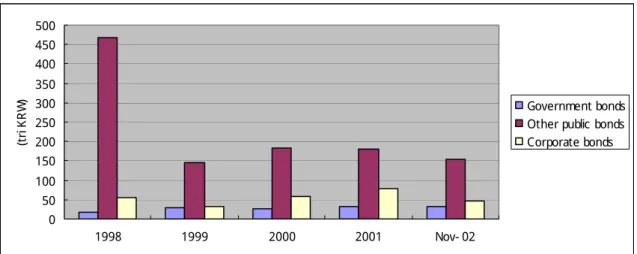
On an issue amount basis, a total of 47.5 trillion won (approximately ¥4.9 trillion) of corporate bonds were issued in 2002 (Jan-Nov), accounting for approximately 20% of the total amount of bond issues (Figure 3). Until the year preceding the financial crisis, corporate bonds accounted for nearly 70% of bond issues, but this figure fell instantly to 10%. This decline can be attributed to a sharp increase in the issuance of Monetary Stabilization Bonds (MSB) by the central bank for the purpose of monetary adjustment as a result of the financial crisis. However, the outstanding balance of MSBs is expected to decline owing to the stabilization of financial conditions in South Korea and to the government’s adoption of a low interest rate policy.
Figure 3. Issue amount by bond type (Source: KSE, JPMorgan)
Liquidity in the bond market is not especially high owing to a basic tendency among investors to
“buy and hold.” However, liquidity is gradually increasing due to the introduction of a primary dealer system for government bonds in 1999 and an inter-dealer trading system for public bonds at the Korea Stock Exchange (KSE) (Figure 4). Furthermore, in order to increase bond liquidity, in order to increase bond liquidity, the Financial Supervisory Service (FSS), has adopted mark-to- market requirements for public issues and has abolished tax withholding for repo and bond lending transactions.
0 50 100 150 200 250 300 350 400 450 500
1998 1999 2000 2001 Nov- 02
(triKRW)
Government bonds Other public bonds Corporate bonds
Figure 4. Trading volume by bond type (Source: KSE, JPMorgan)
b. Composition of market participants
The vast majority of issuers and investors are domestic companies. The proportion of foreign issuers and investors represents only a few percentage points. A breakdown of investors in the bond market shows banks to be the largest investors, but the proportion of investment trusts and pension funds has increased significantly in recent years (Figure 5).
Figure 5. Investment balances by investor (Source: JPMorgan)
0 100 200 300 400 500 600 700 800 900
1998 1999 2000 2001 Nov- 02
(triKRW)
Government bonds Other public bonds Corporate bonds
0 10 20 30 40 50 60
1999 2000 2001 Nov- 02
(triKRW)
Banks
Insuranc e c ompanies Investment trusts
Non- bank financ ial institutions F oreign investors
P ension funds and other
1) Opened markets to foreign investors
2) Reformed the government bond market (Introduced primary dealers and reopenings to create fungibility)
3) Enhanced risk awareness (Mark-to-market requirements and development of the Korea Securities Dealers Association (KSDA) yield matrix)
4) Introduced a bond futures market (Three-year bond futures have the fifth highest trading volume in the world)
5) Introduced securitization products (Developed systems for collateralized bond obligations (CBO), collateralized loan obligations (CLO), and asset-backed commercial paper (ABCP)) 6) Established an exchange repo market
These measures have enabled the majority of institutional problems to be solved in the past several years.
Current plans for major institutional changes include the proposed change of the bond settlement cycle from T+0 to T+1 (scheduled to begin in June 2003). With the current T+0 settlement, the DVP settlement ratio is low at around 40%, due to matching among investment banks and investment trust companies being too late for the cutoff time, among other reasons. The settlement cycle for normal bond trading will therefore be changed to T+1 in an effort to quickly increase the DVP ratio.
2. Hong Kong 1. Market size
Hong Kong’s bond market is still developing. With an outstanding balance of HK$526 billion (approximately ¥8.3 trillion) as of end-2002, it pales by comparison to a stock market valued at HK$3.6 trillion and bank loans outstanding of HK$1.8 trillion (Figure 6). Apart from a few major corporations, companies tend to prefer bank loans, which have low financing costs. On the bank side, there is little resistance to increasing loan receivables due to the extremely low ratio of non- performing loans in Hong Kong. Consequently, there have been no signs to date of a shift from indirect to direct markets.
Figure 6. Size of Hong Kong’s financial markets (Source: HKMA)
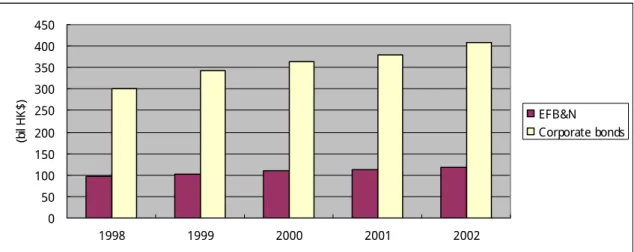
Corporate bonds account for approximately 80% of total bonds outstanding (Figure 7). In Hong Kong, Exchange Fund Bills and Notes (EFB&N) issued based on Hong Kong’s foreign exchange reserves are positioned on an equal basis to government bonds. However, Hong Kong has historically been financially healthy and the government has not needed to actively issue these bonds as a means to raise funds. Consequently, the outstanding balance is currently not very high. (Although the situation is similar in Singapore, its government issues bonds on a regular basis in order to provide benchmarks for bond markets, rather than out of financial necessity.)
0 1000 2000 3000 4000 5000 6000
1998 1999 2000 2001 2002
(bilHK$)
Bonds L oans S toc ks
Figure 7. Outstanding balances by bond type (Source: HKMA)
Nevertheless, in response to growing demand in recent years for Hong Kong dollar denominated bonds from institutional investors, notably the Mandatory Provident Fund (MFP; a public pension fund), bond issues by the Hong Kong government and government-affiliated institutions have increased, and public bonds have surpassed corporate bonds on an issue amount basis (Figure 8). Interest rates are currently at historic lows in Hong Kong and banks are aggressively expanding their loan portfolios. This means the financing needs of companies are largely satisfied by bank loans, and as a result, the amount of corporate bonds outstanding is showing little growth.
Figure 8. Issue amount by bond type (Source: HKMA)
0 50 100 150 200 250 300 350 400 450
1998 1999 2000 2001 2002
(bilHK$)
EF B&N C orporate bonds
0 50 100 150 200 250 300 350
1998 1999 2000 2001 2002
(bilHK$)
EF B&N C orporate bonds
b. Composition of market participants
Banks are the largest issuers of corporate bonds in Hong Kong. Among general business enterprises, only a few major corporations conduct issues. Banks are the largest issuers because the 20% BIS risk weighting of bank bonds is low compared to general corporate bonds, making bank bonds the preferred choice of financial institutions, which represent the largest investors.
The Hong Kong and Shanghai Banking Corporation enjoys the dominant position among the financial institutions underwriting Hong Kong dollar bonds, with an approximately 25% share on a new issue amount basis. (The Standard Chartered Bank ranks second, with an approximately 10% share.) Hong Kong financial institutions are essentially universal banks, and because there is no separation between banking and securities, companies basically consult with the same financial institution regardless of whether they seek to raise funds through loans or bonds.
However, there is little overall demand on the part of companies for raising Hong Kong dollar denominated funds. Due in part to sharp declines in real estate values, major projects in Hong Kong which require Hong Kong dollars fall mostly in areas such as highway and subway construction, which are undertaken primarily by public institutions.
c. Efforts towards market development
The Hong Kong Monetary Authority (HKMA) considers the development of a Hong Kong dollar denominated bond market for individual investors to be a priority policy issue. It is promoting bond issues by government-affiliated financial institutions such as the Hong Kong Mortgage Corporation. This position was prompted by the recent slump in the stock market (despite a strong preference for equity investment in Hong Kong, a growing number of investors are seeking stability owing to the decline in the stock market). The HKMA believes it is important to provide individual investors with new investment products other than stocks and deposits.
As part of efforts to further develop bond markets, the HKMA has decided to list all EFB&Ns on the Hong Kong Exchanges and Clearing Limited and has lowered the minimum trading unit.
3. Malaysia a. Market size
Malaysia’s bond market has grown since the financial crisis in 1997 to reach 292.6 billion ringgit (approximately ¥9.3 trillion) as of end-2002 (Figure 9). This growth can be attributed to the financial crisis prompting banks to restrict lines of credit in order to avoid the risk of non-performing loans, and to a shift by general business enterprises from financing through loans to bond issues due to the switch to collateral-backed loans, among other reasons. Other contributing factors include the near impossibility of raising foreign currency funds as a result of foreign exchange regulations prompted by the financial crisis, and a growing preference among investors for government bonds as a more profitable investment than loans and stocks.
Figure 9. Size of Malaysia’s financial markets (Source: Bank Negara Malaysia)
A breakdown of bonds outstanding shows that although corporate bonds accounted for over 50% as of end-2002, the ratio of government bonds is gradually increasing (Figure 10). This can be attributed to an increase in the government’s procurement of funds in order to stimulate the economy following the financial crisis, and to bond issues to raise funds by government-affiliated agencies such as Danaharta, Danamodal, and Khazanah, which are involved in disposing of non-performing loans and industrial revitalization.
0 100 200 300 400 500 600
2000 2001 2002
(bilRM) Bonds
L oans S toc ks
Figure 10. Outstanding balances by bond type (Source: Bank Negara Malaysia)
However, with a decline in the issue amount of government bonds in 2002 (Figure 11), the outstanding balance of government bonds is likely to stop increasing. Malaysia does not have a fiscal deficit, and now that it has dealt with the financial crisis, it has little need to raise funds for fiscal purposes. Nevertheless, given the importance of establishing a yield curve and improving liquidity in secondary markets, it plans to issue bonds on an ongoing basis in order to help develop bond markets.
0 20 40 60 80 100 120 140 160 180
2000 2001 2002
(bilRM)
Government bonds Corporate bonds
0 5 10 15 20 25 30 35 40
1998 1999 2000 2001 2002
(bilRM)
Government bonds Corporate bonds
for government bonds requiring primary dealers to trade in certain secondary markets. In addition, the availability of the latest price information for all bonds with the launch of the Bond Information and Dissemination System (BIDS) in 2000 has probably made a particular contribution to improving the liquidity of corporate bonds.
Figure 12. Trading volume by bond type (Source: Bank Negara Malaysia)
b. Composition of market participants
Almost all bond issuers are business enterprises (including non-banks). Due to foreign exchange regulations, there are virtually no issues by non-residents or foreign currency denominated issues. (Government agencies and certain major corporations such as Petronas raise funds in overseas markets). The issue format is generally a “bought deal” or private placement to professional investors. This is because the issuing procedures (preparing a prospectus, etc.) for general public offerings are complicated, and retail issues are quite rare as bonds are normally products for professional investors.
The largest investor in bond markets is the Employee Provident Fund, a public pension fund. This giant institutional investor holds 60% of government bond issues. The next largest investors are banks and insurance companies. Overall, public and financial institutions hold an extremely high 90% of government bonds and 80% of corporate bonds. Investment by social insurance funds is expected to steadily increase in the future, a factor which will cause a corresponding increase in the amount of bond issues.
0 50 100 150 200 250 300 350
1999 2000 2001 2002
(bilRM)
Government bonds Corporate bonds
c. Efforts towards market development
The Securities Commission has taken over the securities supervisory duties of Bank Negara Malaysia. After becoming the sole securities supervisory agency, it issued new guidelines on corporate bond issues in July 2000 and new guidelines on ABS issues in 2001. Alongside these efforts, the Securities Commission strengthened market infrastructure by launching the BIDS bond information system in October 1997 and the RENTAS RTGS-DVP settlement system in 1999.
Moreover, the Securities Commission announced the Capital Market Master Plan in April 2001 as a strategic plan for overall capital markets. This ten-year plan was recently launched; Phase I, which is currently being implemented, focuses on measures to “strengthen the domestic market.”
4. Singapore a. Market size
Singapore’s bond market has more than doubled in size over the past five years to reach S$141.1 billion (approximately ¥9.8 trillion) as of end-2002 (Figure 13).
Figure 13. Size of Singapore’s financial markets (Source: MAS for bonds, SGX for stocks)
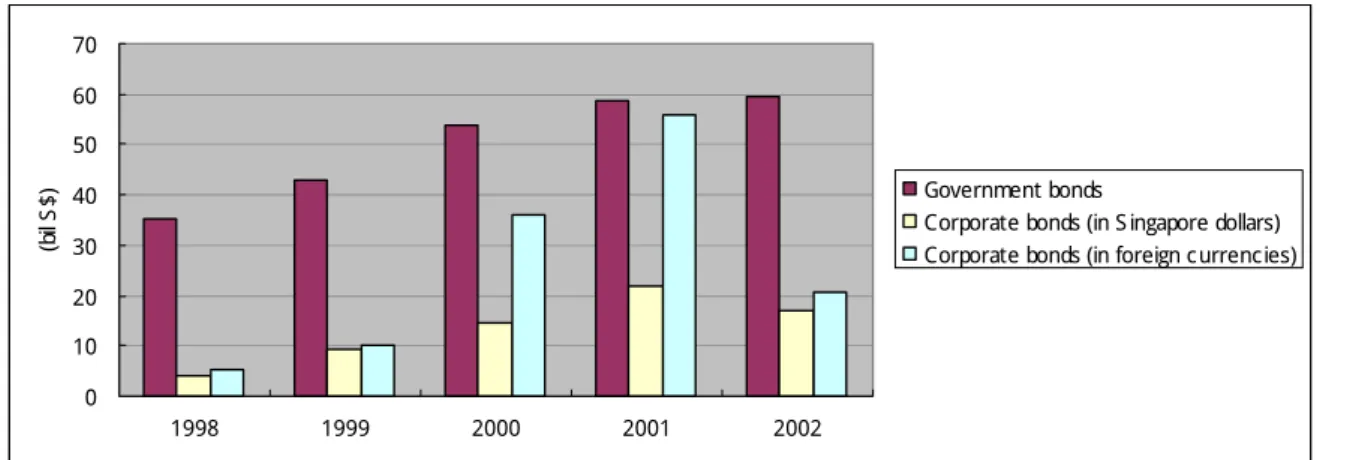
In Singapore, as in other Asian countries, the shift away from excessive dependence on bank loans toward direct markets has become an important issue since the financial crisis. Government authorities have focused on developing domestic bond markets and both government and corporate bonds have expanded steadily (Figure 14).
Figure 14. Outstanding balances by bond type (Source: MAS)
0 50 100 150 200 250 300 350 400 450 500
1998 1999 2000 2001 2002
(bilS$)
Bonds S toc ks
0 10 20 30 40 50 60 70
1998 1999 2000 2001 2002
(bilS$) Government bonds
C orporate bonds (in S ingapore dollars) C orporate bonds (in foreign c urrenc ies)
The outstanding balance of new issues has shown a gradual upward trend, in particular for government bonds (Figure 14). Commercial paper with maturities less than one year issued by non- residents account for over 50% of foreign currency denominated debt securities.
Figure 15. Issue amount by bond type (Source: MAS)
The increase in corporate bond issues can be attributed to participation of government-affiliated financial institutions (mortgage, etc.) in bond markets and to growing fund raising needs as a result of mergers and acquisitions by financial institutions and telecommunications companies.
b. Composition of market participants
A variety of entities issue Singapore dollar bonds, including general business enterprises, financial institutions, real estate companies, and government-affiliated organizations. The proportion of real estate companies was high until recently, but the amount of funds they raise has been declining in recent years. At the same time, issues by business enterprises, financial institutions, and government-affiliated organizations have been increasing. Moreover, with the easing of regulations for foreign companies, issues by US and European financial institutions and companies, Asian companies, and international financial institutions have been gradually increasing.
Domestic investors account for 99% of investors in Singapore dollar denominated bonds. By contrast, non-residents account for 92% of investors in foreign currency bonds. Banks are the largest
0 10 20 30 40 50 60 70
1998 1999 2000 2001 2002
(bilS$) Government bonds
C orporate bonds (in S ingapore dollars) C orporate bonds (in foreign c urrenc ies)
Almost all issues, whether denominated in Singapore dollars or foreign currencies, are by private placement (96% for Singapore dollar bonds and 99% for foreign currency bonds). Bonds are essentially a product for sophisticated investors.
c. Efforts towards market development
The Monetary Authority of Singapore (MAS) first developed a government bond market with a view to expanding overall bond markets. Specifically, MAS issued government bonds with multiple maturities in order to establish a 15-year benchmark yield, introduced a reopen system to increase the size of issue lots, and established a repo market. At the same time, to hasten the development of a corporate bond market, MAS eased regulations (abolished prior approval requirements, allowed unrated bond issues to qualified investors, etc.) in order to encourage successive bond issues by government-affiliated organizations and issues by foreign-owned companies.
The MAS has recently taken steps to establish hedge markets (bond and interest rate futures, swaps), set standards for repo transactions, and improve settlement systems, with a view to increasing liquidity in secondary markets.
5. Conclusion a. Market size
Bond markets are expanding in each of the four countries visited by the survey. To varying degrees, this can be attributed to a wide range of measures implemented by government authorities for the purpose of developing the markets. In the background of these efforts is a decline in bank loans prompted by the financial crisis, slumping stock markets, and the growing importance of bonds as an investment target for public pension funds and other institutional investors.
Japan’s bond market has also grown significantly in recent years (Figure 16), but this is almost entirely the result of rapid growth in the outstanding balance of government bonds, especially treasury bills (TB) and financing bills (FB). Corporate bonds outstanding have shown little growth (Figure 17). On an issue amount basis, corporate bonds account for an extremely low 3% of total bond issues (approximately 8% of private bond issues including bank bonds; Figure 18), in part reflecting a decline in corporate willingness to procure funds due to the deflationary environment.
Figure 16. Size of Japan’s financial markets (Source: BOJ, Monthly Statistics of Japan, TSE monthly statistics)
Figure 17. Outstanding balances by bond type (Source: BOJ, Monthly Statistics of Japan)
0 100 200 300 400 500 600 700 800
1998 1999 2000 2001 J un- 02
(¥trillion)
B onds B ank loans S t oc ks
0 100 200 300 400 500 600
1998 1999 2000 2001 J un- 02
(¥trillion)
P ublic bonds B ank bonds/ B ank C P C orporat e bonds/ C P
Figure 18. Issue amount by bond type (Source: BOJ, Monthly Statistics of Japan)
The ratio of corporate bonds to the overall bond market is lower in Japan than in any of the four Asian countries visited in the survey (Figures 19 and 20). (The difference is even more pronounced when bank bonds are excluded from corporate bonds).
Figure 19. Proportion of corporate bonds to overall bond market (outstanding balance; end-2001)
0 50 100 150 200 250 300 350 400
1998 1999 2000 2001
(¥trillion) P ublic bonds
(F inanc ing bills) B ank bonds C orporat e bonds
(Data for S ingapore does not inc lude foreign c urrenc y c orporate bonds; the c orporate bonds c ategory for J apan inc ludes bank bonds)
0% 20% 40% 60% 80% 100%
S outh K orea Hong K ong Malaysia S ingapore J apan
Corporate bonds and other bonds P ublic bonds
Figure 20. Proportion of corporate bonds to overall bond market (issue amount; 2001)
In Japan’s bond market, government bonds account for 74% on an outstanding balance basis and have surpassed 91% on an issue amount basis. The market therefore appears to be a mature market with high liquidity. In reality, however, there is no balance in terms of issue valuations and the market lacks depth. We believe measures to develop the corporate bond market are particularly necessary to change this situation and create a bond market with true depth.
b. Composition of market participants
While the composition of bond issuers varies from country to country, bond investors in the four Asian countries surveyed are primarily financial institutions and public pension funds. Malaysia, followed by Singapore and Hong Kong, has seen significant growth in the outstanding balance of bond holdings by public pension funds. They are now (or are fast becoming) the largest investors in bond markets. Government authorities, aware of the importance of local currency bond markets as an investment target for public pension funds, are pursuing a variety of measures to help develop bond markets.
The proportion of bond issues and investments by non-residents is extremely low in the bond markets of these countries, with the exception of foreign currency bonds. There are two major
(Data for S ingapore does not inc lude foreign c urrenc y c orporate bonds; the c orporate bonds c ategory for J apan inc ludes bank bonds)
0% 20% 40% 60% 80% 100%
S outh K orea Hong K ong Malaysia S ingapore J apan
C orporate bonds and other bonds P ublic bonds
c. Efforts towards market development
Government authorities in these four countries have taken the following steps to promote the development of bond markets:
1) Establishing benchmarks by developing primary and secondary markets for government bonds and government agency bonds (and also developing interest derivative markets as needed) 2) Developing an issuing and taxation environment that offers incentives to corporate bond issuers
and investors
3) Developing bond settlement systems (RTGS-DVP settlement systems)
Government authorities sought through these measures to achieve balanced growth in public and corporate bond markets, and we were impressed by the development of various regulatory systems and infrastructure in such a short period of time. Looking at the present situation in Japan, although item 1) above, the establishment of benchmarks, is almost completed, Japan lags behind the surveyed countries in the second two items. We believe these issues require immediate attention.
To date, Japan has adopted a variety of measures to promote the market, primarily targeting government bonds. As noted earlier, however, we believe that it will be extremely important to develop regulatory systems and infrastructure for non-government bonds in a short space of time in order to create a bond market with depth and genuine significance.
III Legal Framework for Bond Issuance
Chapter III: Key points
a. Bond issuing regulatory systems
This section looks at the regulatory systems relating to bond issuing procedures and bond issuing applications in the surveyed countries. It also examines disclosure exemption provisions based on issue format (public or private offering) or product type, and requirements for corporate bond issues (e.g. rating acquisition).
It then discusses the time period required to gain approval for corporate bond issues and looks at any provisions, such as the issue suspension period in Japan, that create problems for issuing bonds in a flexible manner. It concludes by examining whether the countries discussed have a shelf registration system for issuing bonds on an ongoing basis.
b. Investor regulations
This section looks at regulations that impose restrictions on investors when investing in corporate bonds, and how the surveyed countries regulate what are known as “qualified institutional investors” in Japan.
c. Bond taxation
This section addresses taxes on bond investments, and in particular how these countries handle interest tax withholding, which has become an issue in Japan.
d. Future direction of reforms
This section explores current issues in fostering bond markets and plans for future reforms concerned with issuing and holding bonds.
1. South Korea
a. Bond issuing regulatory system
The primary feature of bond issuing practices in South Korea is that all procedures including filing are performed via a web-based system. The entire process is paperless. Filing with the Financial Supervisory Committee (FSC), which is the securities supervisory agency, can be broadly separated into the following three steps:
1) Issue registration
2) Filing (Securities report and preliminary prospectus) 3) Issue results report
Initial issue registration is performed prior to selecting a lead manager, and prescribed items are filed with the FSC via the web-based system. Filing entails the submission of documents detailed in the prescribed items (draft prospectus, etc.) via the web-based system. After filing, the bond issue is announced and subscription and sales activities can begin on the day the filing enters into force (10 days after filing for non-guaranteed bonds). The details of these activities are reported to the Korean Securities Depository (KSD) and an issue results report is filed with the FSC via the web-based system. These procedures are followed for all bonds.
Publicly issued bonds are required to be rated by a minimum of two rating organizations. Privately placed bonds are not subject to this requirement and the question of rating is left to the discretion of the issuer. Aside from this, there are no exemption rules for private offerings. Moreover, there are no special provisions containing exemption rules for specific products such as commercial paper programs.
The bond issue approval period is now seven days, shortened from the pre-financial crisis period of fourteen days. There are no special provisions for an issue suspension period, and this matter is left to the discretion of the issuer. Although a shelf registration system is in place, only credit card companies and other non-banks actually use the system.
b. Investor regulations
South Korea has no special regulations governing investment grades (bonds rated BBB and higher are considered “investment grade,” but there is no system to regulate investment in “non- investment grade” bonds). For trust banks, however, all bond holdings are required to be marked-to- market. This provision was introduced in conjunction with a mark-to-market requirement for all publicly issued bonds as a measure to increase bond liquidity and protect investors. In response,
there are currently three bond valuation companies that are independent from financial institutions and which announce market values for public and corporate bonds.
c. Bond taxation
Tax on bond interest is withheld at a rate of 15% for residents and 27.5% for non-residents. However, non-residents that are residents of a country with which South Korea has concluded a tax treaty may qualify for a reduction of or exemption from withholding tax.
In either case, the KSD is required to withhold tax for all bonds deposited at the KSD, and it pays interest to each participant on the basis of their account information. For bonds not deposited at the KSD, the paying party is required to withhold tax, but because nearly 99% of all bonds issued in South Korea are deposited at the KSD, the KSD withholds and pays almost all interest tax to the national government.
Corporate capital gains are subject to aggregate taxation, with profits up to 100 million won subject to income tax of 10% and profits over 100 million won to income tax of 27%.
d. Future direction of reforms
Since its founding, the Financial Supervisory Service (FSS) has developed a variety of securities systems, including web-based systems for issuing bonds. In addition to the items already mentioned, a standard contract between an issuing body, underwriter, and trustee has been developed under the direction of the FSS.
Due to the prompt development of appropriate systems for new products such as ABS, outstanding issues grew ten-fold in just one year from the first issuance in 1999. At the present time, structured bonds have grown to account for over 50% of total issues in the bond market.
Given the above, the FSS believes that its reforms with respect to issuing bonds are generally complete. We predict that the FSS will focus future reform efforts on measures to enhance settlement safety and bond liquidity.
2. Hong Kong
a. Bond issuing regulatory system
Prior approval of the Hong Kong Monetary Authority (HKMA) is not required when issuing bonds in Hong Kong. Therefore, there is no minimum required number of days for bond issues. (Private offerings can theoretically be issued the same day.) However, although prior approval is not required, there are guidelines for issuing procedures. In general, it takes about a week and a half to issue privately placed bonds and about three weeks for publicly issued bonds. The Securities and Futures Commission (SFC), which determines the guidelines, has shown its willingness to simplify and lighten the procedural burden at the request of market participants.
The bond market is fundamentally a professional market, and as such, almost all issues are privately placed. Public issues are extremely limited owing to a lack of issue flexibility due to the requirement of preparing a prospectus and to the fact that there is essentially no demand for raising funds from individuals. Moreover, although a listing examination is required for listing on an exchange, because issuers are not seeking bond liquidity, virtually no corporate bonds are listed (government agency bonds are the exception).
With regard to disclosure documents, because Hong Kong’s legal system is based on the English system of common law, issuers generally consult with a law firm and prepare documents to “satisfy the needs of market participants.” Consequently, government authorities do not provide individual guidance on issue disclosure.
A rating is not required for issuing bonds in Hong Kong, and in actuality there are few companies that have acquired a rating. Additionally, there is no shelf registration system, and the concept of an issue suspension period does not exist.
b. Investor regulations
Hong Kong has no system for designating qualified institutional investors, but the SFC does determine a code of conduct for professional investors, and the term “professional investor” is defined in this code. The qualification of investors is therefore determined by each financial institution on the basis of this code of conduct.
Hong Kong has no investment regulations for non-residents. Hong Kong is fundamentally an open market, and there are no trading regulations for products denominated in either Hong Kong dollars or other currencies.
c. Bond taxation
Individuals are not taxed on either capital gains or interest. For corporations, treatment varies as follows depending on the type of bond.
1) Exchange Fund Bills and Notes and similar government bonds and international organization bonds are not taxed.
2) Government agency bonds and corporate bonds that meet certain conditions are taxed at a rate of 8% (50% reduced rate).
3) Other bonds are taxed at 16%.
d. Future direction of reform
As touched on above, the HKMA’s current focus is on developing a retail bond market. The SFC has simplified procedures for publicly issued bonds with a view to easing requirements, in order to encourage the development of a retail bond market.
Potential obstacles to developing a retail bond market include: (1) the high cost for companies of issuing bonds through public offering compared to borrowing from banks; and (2) the cost to individual investors from bond custody fees, etc. We believe the high cost for companies can be solved by easing requirements for issuing procedures, and the cost to investors by growth in the retail bond market to a certain size.
3. Malaysia
a. Bond issuing regulatory system
From July 2000, all bonds issued in Malaysia, with the exception of bonds issued or guaranteed by the government, have required approval by the Securities Commission based on the Guidelines on the Offering of Private Debt Securities. Bonds previously needed the approval of the Kuala Lumpur Stock Exchange (KLSE), Foreign Investment Committee, and the central bank, but now only the approval of the Securities Commission is required.11
The preparation of the abovementioned Guidelines substantially reduced the regulatory requirements for issuing bonds. For general bond issues, the following three documents are submitted to the Securities Commission.
1) Issuer and Advisor Declaration 2) Term Sheet
3) Information Memorandum
The details of the Issuer and Advisor Declaration and Term Sheet are determined by the Guidelines, and approval by the Securities Commission is based solely on the details contained in these two documents. The Information Memorandum is only registered with the Securities Commission, and the details are not individually examined. The Declaration represents an oath by the issuer and advisor that disclosure will be fair and in accordance with the Guidelines. The Term Sheet encompasses the essential 28 items required for issuing bonds. The Information Memorandum is prepared solely as disclosure material (abbreviated prospectus) for market participants. Normally, the advisor prepares a Due Diligence Report concerning documents relating to the issue, and this is generally submitted with the Issuer and Advisor Declaration.
Issuing bonds generally requires the preparation of a prospectus, but this requirement does not apply when bonds are issued to so-called sophisticated investors (banks, professional investors, government agencies, and other specially designated investors), and an Information Memorandum is prepared instead. In reality, over 90% of all bonds are issued to sophisticated investors.
Malaysia has no disclosure exemption provisions depending on the type of product issued, but additional guidelines were prepared for ABS. With respect to product specific regulations, redemption term regulations were prepared for commercial paper and medium-term notes
11 As an exception, bonds issued by foreign corporations require prior approval from the Controller
(maximum of seven years). The Guidelines also contain many provisions for Islamic bonds based on Islamic law.
The Guidelines stipulate the approval period for bond issues as within 14 days for ordinary bonds and within 28 days for ABS. There are no provisions for a bond suspension period and issue- related documents cannot be amended following approval (notification concerning post-issue changes is not required). Malaysia has developed a shelf registration system, but because it is relatively new, there are few examples of its use at the present time.
The acquisition of a rating is normally required when issuing bonds, but there is no minimum rating requirement. However, appropriate risk information must be disclosed for bonds that are below investment grade (BBB). Almost all bonds actually issued are rated AA or higher.
b. Investor regulations
With regard to investor-related regulations, there are investment restrictions for government agencies (including public pension funds) and for insurance companies (these can only invest in bonds rated BBB or higher).
For non-residents, there are no regulations for securities, but there are regulations in foreign exchange laws (the approval of government authorities is required to exchange ringgits and foreign currencies). As a result, the ratio of foreign investors holding bonds is less than 5%.
New bond issues (including commercial paper and medium-term notes) must be registered with the Fully Automated System for Tendering (FAST), a bidding system operated by the central bank.12
c. Bond taxation
Malaysia does not tax capital gains. Moreover, interest is tax-free for residents and tax is withheld at a rate of 15% for non-residents. Residents other than individuals were previously taxed, but this requirement was eased in an effort to encourage bond investment.
d. Future direction of reform
The basic regulatory system for issuing bonds is already in place, but there are plans to make modifications on an ongoing basis in order to promote further market development. Specific
measures under consideration include an easing in the tax requirements for ABS and the abolition of interest tax for non-residents to encourage investment by foreigners.
There are plans to move forward with reform of securities markets based on the Capital Market Master Plan.
4. Singapore
a. Bond issuing regulatory system
In Singapore, because of the requirement to prepare a prospectus for publicly issued13 corporate bonds, the majority of bonds are privately placed with sophisticated investors, who are not subject to disclosure with a prospectus. Exemption provisions for disclosure depend solely on whether or not the investor is a sophisticated investor. There are no provisions for exemption from disclosure for specific products. There are several additional entry items for ABS and other securitization products.
With regard to the details of a prospectus or Information Memorandum in the case of private placement, although there is a checklist, there is no template or model for entry items. These documents are therefore prepared on the basis of the idea of “covering the information required by investors.” The review by the Monetary Authority of Singapore (MAS) is basically only a check to ensure that the checklist items are included. The level of detail is left to the issuer and arranger. Consequently, the format of disclosure documents is different for each arranger.
The flow of MAS procedures is application receipt, prospectus review, filing, and registration. The entire process from application to registration takes from 14 to 21 days.
Singapore does have a shelf registration system, but the effective period is a maximum of six months. In other words, ongoing bond issues require that an application be filed at least once every six months. Moreover, in the event of “significant changes” in registration details during the effective period, a supplement must be filed in each case. The determination of “significant changes” is left to the discretion of the issuer, and as a rule a notification is issued when a change is judged important for investors. A system for an issue suspension period regardless of whether or not a supplement is filed has not been established. Should an issuer determine that an important matter should be made known to investors, it is considered best for the issuer to independently suspend the issue.
It is not necessary to acquire a rating for a bond issue, but only sophisticated investors are able to purchase unrated bonds (this has not become a significant constraint).
b. Investor regulations
Singapore has no particular regulations concerning investors. Investment targets are essentially determined independently. However, public funds such as the Central Provident Fund determine an institutional investment grade rating.
Sophisticated investors exempt from disclosure regulations are defined as wealthy individuals with assets of over S$1 million or annual incomes of over S$200,000, and corporations with net assets of over S$5 million.
c. Bond taxation
Singapore does not have a capital gains tax (Tax on income from bonds is treated as ordinary income tax). Interest on qualifying debt securities is taxed at a reduced rate of 10% for corporations, while non-residents are not taxed. Qualifying debt securities include all bonds managed by an Approved Bond Intermediary14 in Singapore.
d. Future direction of reform
Ongoing deregulation efforts are expected in order to encourage the further development of the corporate bond market. Authorities are considering abolishing the guidelines that govern the Information Memorandum required when applying for a bond issue. (We believe the final goal is for bond issues based entirely on voluntary disclosure.) Authorities are also planning to ease any remaining regulations for transferring Singapore dollar funds out of the country.15
14 There were a total of 27 financial institutions with Approved Bond Intermediary status as of end-2001.
5. Conclusion
a. Bond issuing regulatory systems
There is one major difference in the requirements for bond issue applications between South Korea and the other three countries surveyed. South Korea does not have any special exemption provisions for disclosure requirements and instead all application procedures are performed online. By contrast, the other three countries effectively have prospectus disclosure exemption provisions for almost all bonds. In either case, however, the provisions do not prevent efficient issuing.
In South Korea, performing all application procedures online via a web-based system results in a decided difference in terms of issue efficiency compared to the paper-laden requirements in Japan. (A web-based system standardizes and simplifies disclosure, which essentially eliminates the major problem of preparing documents, even in the absence of exemption provisions.)
In the other three countries, almost all bonds are issued to professional investors, thereby exempting the bonds from prospectus requirements and making application documents extremely simple. Moreover, details of information memorandums accompanying applications are checked only to see whether they conform to guidelines prepared by government authorities. There is no particular guidance on the level of detail. (Issuers and arrangers are basically responsible for providing the information required by investors.)
There is one further major difference between Japan and the countries surveyed in terms of disclosure requirements. This is the concept of an issue suspension period. The countries we visited do not have such provisions. Although supplemental filing may be required for any “significant changes” in disclosure information, as this is not, per se, related to the advisability of the issue, these countries share a common stance that issuers should determine whether or not to suspend an issue in the event of significant changes. This stance is underpinned by a basic belief that the decision on whether to suspend an issue should be based on the personal responsibility of issuers under the supervision of the market (investors) rather than being left to government authorities.
b. Investor regulations
Hong Kong, Malaysia, and Singapore have disclosure exemption provisions for “professional investors,” but due to the broad scope of application and the fact that there is no requirement for
The countries we visited do not have exemption disclosure provisions for specific products as Japan does, and their bond issuing systems have the advantage of being extremely simple.
c. Bond taxation
The greatest impediment to bond liquidity in Japan is the “taxable / non-taxable” issue, which does not exist in the four Asian countries surveyed. This issue is the same regardless of whether or not interest tax is withheld. (Although it took some time, we were able to convey some idea of the problems associated with tax withholding in Japan to the individuals we interviewed; they had no idea that Japan’s tax system was so complicated.)
With regard to interest tax, Hong Kong, Malaysia, and Singapore are establishing tax-free or reduced tax incentives under certain conditions with a view to developing bond markets. Moreover, even when tax is withheld, in the case of a central securities depository making interest payments, it is the central securities depository that withholds tax, resulting in virtually no administrative burden on financial institutions. We believe that if Japan implemented a simple system similar to those in operation in these Asian countries, it would be able to significantly reduce the cost (commissions, etc.) to both issuers and investors associated with principal and interest payments.
d. Future direction of reform
The development of bond issuing regulatory systems has been essentially completed in the countries discussed in this report, and they are now considering how to simplify and ease disclosure requirements to promote further market development.
Malaysia is considering tax-free measures for non-residents, but there are no other plans for major changes to interest tax. This means that basic tax measures have also been completed.
The framework for issuing bonds in Japan is more complicated than in these countries, and we believe it is necessary to simplify this system to encourage market development, to ease requirements to broaden the scope of investors, and to fundamentally reform the tax withholding system.
IV Bond Settlement Systems
Chapter IV key points
a. Bond settlement systems
This section discusses the status of bond dematerialization and immobilization as well as book- entry systems and delivery-versus-payment (DVP) systems for bond settlement. Bond settlement cycles are also covered.
b. DVP settlement systems
This section looks at whether the four Asian countries have central bank fund settlement systems and related bond DVP settlement systems (funds and securities are delivered at the same time). If these systems have been established, we examine what kind of DVP settlement method is used.
c. Future direction of settlement system reform
This section looks at current settlement system issues and future plans for settlement system reform.