ASIAN DEVELOPMENT BANK
Implementation Guidelines for Thailand
ASEAN+3 BOND MARKET FORUM
SUB-FORUM 1 PHASE 3 REPORT
August 2015
Creative Commons Attribution 3.0 IGO license (CC BY 3.0 IGO)
© 2015 Asian Development Bank
6 ADB Avenue, Mandaluyong City, 1550 Metro Manila, Philippines Tel +63 2 632 4444; Fax +63 2 636 2444
www.adb.org; openaccess.adb.org Some rights reserved. Published in 2015. Printed in the Philippines.
ISBN 978-92-9257-079-8 (Print), 978-92-9257-080-4 (e-ISBN) Publication Stock No. RPT157592-2
Cataloging-In-Publication Data Asian Development Bank.
ASEAN+3 multi-currency bond issuance framework: Implementation guidelines for Thailand—ASEAN+3 Bond Market Forum sub-forum 1 phase 3 report
Mandaluyong City, Philippines: Asian Development Bank, 2015.
1. Regional cooperation. 2. Regional integration. 3. ASEAN+3. 4. Bond market I. Asian Development Bank. The views expressed in this publication are those of the authors and do not necessarily relect the views and policies of the Asian Development Bank (ADB) or its Board of Governors or the governments they represent.
ADB does not guarantee the accuracy of the data included in this publication and accepts no responsibility for any consequence of their use. The mention of speciic companies or products of manufacturers does not imply that they are endorsed or recommended by ADB in preference to others of a similar nature that are not mentioned.
By making any designation of or reference to a particular territory or geographic area, or by using the term “country” in this document, ADB does not intend to make any judgments as to the legal or other status of any territory or area. This work is available under the Creative Commons Attribution 3.0 IGO license (CC BY 3.0 IGO)
https://creativecommons.org/licenses/by/3.0/igo/. By using the content of this publication, you agree to be bound by the terms of said license as well as the Terms of Use of the ADB Open Access Repository at openaccess.adb.org/termsofuse
This CC license does not apply to non-ADB copyright materials in this publication. If the material is attributed to another source, please contact the copyright owner or publisher of that source for permission to reproduce it. ADB cannot be held liable for any claims that arise as a result of your use of the material.
Attribution—In acknowledging ADB as the source, please be sure to include all of the following information: Author. Year of publication. Title of the material. © Asian Development Bank [and/or Publisher]. https://openaccess.adb.org. Available under a CC BY 3.0 IGO license.
Translations—Any translations you create should carry the following disclaimer:
Originally published by the Asian Development Bank in English under the title [title] © [Year of publication] Asian Development Bank. All rights reserved. The quality of this translation and its coherence with the original text is the sole responsibility of the [translator]. The English original of this work is the only oicial version.
Adaptations—Any adaptations you create should carry the following disclaimer:
This is an adaptation of an original Work © Asian Development Bank [Year]. The views expressed here are those of the authors and do not necessarily relect the views and policies of ADB or its Board of Governors or the governments they represent. ADB does not endorse this work or guarantee the accuracy of the data included in this publication and accepts no responsibility for any consequence of their use.
Please contact [email protected] or [email protected] if you have questions or comments with respect to content, or if you wish to obtain copyright permission for your intended use that does not fall within these terms, or for permission to use the ADB logo.
Note: In this publication, “$” refers to US dollars.
Tables and Figures iv Abbreviations v
I. AMBIF Elements in Thailand 1
Summary of AMBIF Elements 1
Description of AMBIF Elements and Equivalent Features in Thailand 1
Domestic Settlement 1
Harmonized Documents for Submission (Single Submission Form) 2 Registration or Profile Listing in ASEAN+3 (Place of Continuous Disclosure) 3
Currency 3
Scope of Issuers 4
Scope of Investors 4
II. AMBIF Bond and Note Issuance: Relevant Features in Thailand 7
Governing Law and Jurisdiction 7
Language of Documentation and Disclosure Items 8
Credit Rating 8
Selling and Transfer Restrictions 9
Note Issuance Programs 9
Bondholder Representative 9
III. AMBIF Bond and Note Issuance Process in Thailand 11
Overview of Regulatory Processes 11
Regulatory Processes by Corporate Issuer Type 11
Regulatory Process Map: Overview 11
Issuance Processes in Local Currency 13
Issuance Process for Resident Issuer 13
Issuance Process for Resident Nonfinancial Institution Issuer 16 Issuance Process for Resident Financial Institution Issuer 16
Issuance Process for Nonresident (Foreign) Issuer 17
Issuance Process for Nonresident (Foreign) Nonfinancial Institution Issuer 21 Issuance Process for Nonresident (Foreign) Financial Institution Issuer 21
Issuance Process for FCY-Denominated Bonds and Notes 21
Issuance Process for Resident Issuer of FCY Bonds and Notes 21 Issuance Process for Nonresident (Foreign) Issuer of FCY Bonds and Notes 22
Appendixes 23
1 Resource Information 23
2 Glossary of Technical Terms 24
Tables and Figures
TABLES
1 AMBIF Elements and Equivalent Features in Thailand 2
2 Regulatory Processes by Corporate Issuer Type 12
FIGURES
1 Regulatory Process Map: Overview 12
2 Regulatory Process: Issuance of PP-AI by Resident Issuer 13 3 Regulatory Process: Issuance of PP-AI by Resident Financial Institution
Issuer (Capital Raising Only) 17
4 Regulatory Process: Issuance of PP-AI by Nonresident (Foreign) Issuer 19 5 Regulatory Process: Issuance of PP-AI in Foreign Currency by Resident Issuer 22
ABMF ASEAN+3 Bond Market Forum
ADRB AMBIF Documentation Recommendation Board AMBIF ASEAN+3 Multi-Currency Bond Issuance Framework ASEAN Association of Southeast Asian Nations
ASEAN+3 ASEAN plus the People’s Republic of China, Japan, and the Republic of Korea
B.E. Buddhist Era
BOT Bank of Thailand
CSD central securities depository
FCY foreign currency
MOF Ministry of Finance of Thailand
MTN medium-term note
OTC over-the-counter
PDMO Public Debt Management Office (of the Ministry of Finance of Thailand) PP-AI Private Placement for Accredited Investors
SEC The Securities and Exchange Commission, Thailand SET Stock Exchange of Thailand
SF1 Sub-Forum 1 of ABMF
SNA Special Nonresident Baht Account SSF Single Submission Form
ThaiBMA Thai Bond Market Association
THB Thai baht (ISO Code)
TSD Thai Securities Depository
USD US dollar (ISO Code)
AMBIF Elements I
in Thailand
This chapter describes the key features of the ASEAN+3 Multi-Currency Bond Issuance Framework (AMBIF), also known as AMBIF Elements, and puts into perspective the equivalent features of the domestic professional bond market in Thailand.1
Summary of AMBIF Elements
The Thai professional domestic bond market, comprising Private Placement to Accredited Investors (PP-AI) issuances, fulfills all the prerequisites for AMBIF as defined in the ASEAN+3 Bond Market Forum (ABMF) (Sub-Forum 1) Phase 2 Report. PP-AI brings together private placement and professional investor concepts with an underlying clear regulatory and approval process.
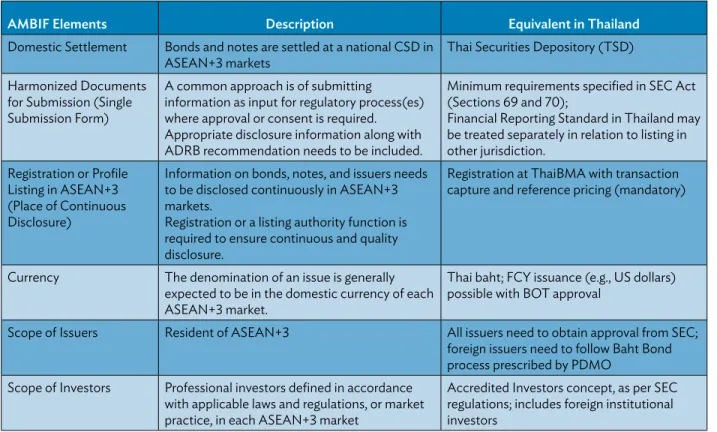
Table 1 identifies the features and practices of the Thai domestic bond market that directly correspond with or are equivalent to the key elements of AMBIF.
Description of AMBIF Elements and Equivalent Features in Thailand
Domestic Settlement AMBIF
AMBIF is aimed at supporting the domestic bond markets in ASEAN+3. To be recognized as a domestic bond or note, an AMBIF bond or note needs to be settled at the designated central securities depository (CSD). Hence, domestic settlement needs to be a key feature of an AMBIF bond or note.
In Thailand
While there is no regulatory requirement that bonds and notes traded over-the-counter (OTC) need to be settled at the Thai Securities Depository (TSD), most debt securities, in particular those aimed at international professional investors, are settled by TSD. Bonds and notes traded on the Stock Exchange of Thailand (SET) are required to be settled by TSD. Private placement issuances may be settled at an appointed custodian bank acting as depository. However, these bonds and notes are not considered eligible for the purposes of AMBIF.
1 ASEAN+3 refers to the 10 members of the Association of Southeast Asian Nations (ASEAN) plus the People’s Republic of China, Japan, and the Republic of Korea.
Harmonized Documents for Submission (Single Submission Form) AMBIF
Based on the review of application forms for issuance approval, offering circulars, information memorandums, and program information formats in ASEAN+3, the core information was similar or comparable across markets. Hence, the Single Submission Form (SSF) that can be applied to all of the relevant regulatory processes for bond and note issuance across markets was proposed. The information contained in the SSF can be submitted to all relevant regulatory authorities and market institutions for relevant approvals or consent, or used in the context of the submission (e.g., as a checklist) in anticipation of an AMBIF bond or note issuance. In Thailand
The Securities and Exchange Commission, Thailand (SEC) will recognize the SSF format as long as the requirements of Thai regulations continue to be observed. The SEC does not prescribe a particular form or format for PP-AI documentation and disclosure items, but specifies the minimum content of such disclosure in Sections 69 and 70 of the Securities and Exchange Act B.E. 2535, 1992 (SEC Act), as amended. For details on these minimum requirements, please refer to Chapter III.
Table 1: AMBIF Elements and Equivalent Features in Thailand
AMBIF Elements Description Equivalent in Thailand
Domestic Settlement Bonds and notes are settled at a national CSD in ASEAN+3 markets
Thai Securities Depository (TSD)
Harmonized Documents for Submission (Single Submission Form)
A common approach is of submitting
information as input for regulatory process(es) where approval or consent is required. Appropriate disclosure information along with ADRB recommendation needs to be included.
Minimum requirements specified in SEC Act (Sections 69 and 70);
Financial Reporting Standard in Thailand may be treated separately in relation to listing in other jurisdiction.
Registration or Profile Listing in ASEAN+3 (Place of Continuous Disclosure)
Information on bonds, notes, and issuers needs to be disclosed continuously in ASEAN+3 markets.
Registration or a listing authority function is required to ensure continuous and quality disclosure.
Registration at ThaiBMA with transaction capture and reference pricing (mandatory)
Currency The denomination of an issue is generally expected to be in the domestic currency of each ASEAN+3 market.
Thai baht; FCY issuance (e.g., US dollars) possible with BOT approval
Scope of Issuers Resident of ASEAN+3 All issuers need to obtain approval from SEC; foreign issuers need to follow Baht Bond process prescribed by PDMO
Scope of Investors Professional investors defined in accordance with applicable laws and regulations, or market practice, in each ASEAN+3 market
Accredited Investors concept, as per SEC regulations; includes foreign institutional investors
ADRB = AMBIF Documentation Recommendation Board; AMBIF = ASEAN+3 Multi-Currency Bond Issuance Framework;
ASEAN+3 = Association of Southeast Asian Nations plus the People’s Republic of China, Japan, and the Republic of Korea; BOT = Bank of Thailand; CSD = central securities depository; FCY = foreign currency; PDMO = Public Debt Management Office; SEC = The Securities and Exchange Commission, Thailand; ThaiBMA = Thai Bond Market Association; US = United States.
Source: ABMF SF1.
AMBIF Elements in Thailand
3
The validity of an English document as the single official submission for filings with the SEC and official correspondence with Thai regulatory authorities is still under consideration, but the content of the SSF is recognized by the SEC.
Registration or Profile Listing in ASEAN+3 (Place of Continuous Disclosure) AMBIF
Information on issuers, bonds, and notes needs to be disclosed continuously in ASEAN+3 markets. A registration or listing authority function to facilitate continuous disclosure is required. This can ensure the quality of disclosure and help create a well-organized market for AMBIF issuances with transparency and a quality of information that would differentiate AMBIF issuances from ordinary private placements for which information is often neither available nor guaranteed. Owing to this important feature, an AMBIF secondary market is expected to emerge as the number of issuances increases.
A profile listing is a listing without trading on an exchange. The objective of the listing is to make bonds and notes visible and more information available to investors via a recognized listing place, particularly those investors with more restrictive mandates, such as mutual and pension funds. A profile listing at a designated listing place can ensure the flow of continuous disclosure information and possibly even reference pricing in some markets.
In Thailand
In the Thai market, registration is defined as the process of providing bond or note information to the Thai Bond Market Association (ThaiBMA) by issuers or their agents, which is a condition set by the SEC for the offering of bonds and notes in the primary market, as well as reporting trade data by OTC counterparties in the secondary market. All bond dealers and traders in Thailand are required to be members of ThaiBMA.
All debt securities issued and offered for sale in Thailand,2 regardless of issuer domicile or currency, have to be registered with ThaiBMA.3 In addition, Thai law mandates that ThaiBMA members capture their OTC bond transactions within 15 minutes of deal closure. ThaiBMA calculates and publishes reference prices on the basis of trade prices submitted, and collects material disclosure information. ThaiBMA also provides significant transaction, volume, and general statistics on the bond market to interested parties.
The registration with ThaiBMA fulfills the intention of the Registration or Profile Listing feature under AMBIF. However, professional bonds and notes in Thailand are typically traded in the OTC market. In any case, the supervision and enforcement of continuous disclosure obligations by the issuers of bonds and notes in Thailand remains with the SEC.
Currency AMBIF
In the context of AMBIF, the denomination of an issue is generally expected to be in the domestic currency of each ASEAN+3 market. But this does not exclude the possibility of issuing in other currencies if market practice regularly supports these other currencies and the relevant domestic currency or cash clearing capabilities exist. At this stage, US dollars,
2 This includes all debt securities issued and ofered for sale in Thailand with the exception of Limited Number Private Placements (fewer than 10 investors) and short-term notes.
3 In contrast, bonds and notes issued in Thailand but ofered for sale outside Thailand need not be registered with ThaiBMA.
Japanese yen, and offshore Chinese renminbi are the currencies other than domestic currencies in which bonds and notes tend to be issued in ASEAN+3 markets.
In Thailand
Debt securities in Thailand are predominantly issued in Thai baht, but can also be issued in a foreign currency if the issuer and investors so agree; this requires the approval of the Bank of Thailand (BOT). In the case of a foreign issuer issuing THB-denominated bonds or notes, the approval of the Public Debt Management Office (PDMO) is required as well. In the past few years, only a few USD-denominated bonds and notes have been issued in Thailand. The issuance of bonds denominated in offshore Chinese renminbi was first observed in June 2015.
Scope of Issuers AMBIF
As AMBIF is aimed at supporting the development of domestic bond markets in the region and promoting the intraregional recycling of funds, an issuer needs to be a resident of an ASEAN+3 market.
In Thailand
In addition to Thai residents, nonresident legal entities may issue THB-denominated bonds and notes under the Baht Bond concept, as well as bonds and notes denominated in a foreign currency. (For details on the Baht Bond concept, please refer to Chapter III.) Nonresident issuers are defined in the SEC Act (in the description of foreign issuers) as “a unit or organization of foreign government, international organization and juristic person under the law of a foreign jurisdiction.” More specifically, nonresident issuers are defined under a Ministry of Finance Notification for PDMO as
1. international financial institutions (e.g., Asian Development Bank, International Finance Corporation, and International Monetary Fund),
2. foreign governments,
3. financial institutions of foreign governments,
4. juridical entities that have been established under foreign laws, and 5. special purpose vehicles.4
A bond or note issued by a special purpose vehicle may not be regarded as an AMBIF bond or note at this point.
Scope of Investors AMBIF
Professional investors are defined in accordance with regulations and/or market practice in each market in ASEAN+3. Some jurisdictions have a clear definition of professional investors, while other jurisdictions may need to establish the concept through agreements.
Professional investors are institutions defined by law and licensed or otherwise registered with regulators by law in their economy of domicile and, hence, are subject to governance and inspection based on securities market and/or prudential regulations. In addition, most of
4 A special purpose vehicle is established for the purpose of a securitization in which the originator is a foreign government agency or organization and/or foreign juridical person.
AMBIF Elements in Thailand
5
them are also subject to oversight as well as professional conduct and best practice rules by a self-regulatory organization, such as an exchange or a market association.
In Thailand
In 2009, the SEC defined—in its Notification of the Securities and Exchange Commission No. KorChor. 5/2552 Re: Determination of Definitions in Notifications Relating to Issuance and Offer for Sale of Debt Securities—a number of professional investor types across the Institutional Investor and High Net Worth Investor categories. The number and level of detail of these definitions were expanded through the Accredited Investor concept, a comprehensive professional investor scheme in the context of private placements of debt securities.
In 2012, the SEC’s Notification of the Securities and Exchange Commission No. KorChor. 9/2555 Re: Determination of Definitions of Institutional Investors and High Net Worth Investors provided a clear and comprehensive definition for Accredited Investors, comprising both Institutional Investors and High Net Worth Investors, and summarized as follows:
1. Institutional Investors refer to a. BOT;
b. commercial banks;
c. banks established under specific law; d. finance companies;
e. credit foncier; f. securities companies;
g. non-life insurance companies; h. life insurance companies; i. mutual funds;
j. private fund managed by a securities company for investment of investor under (a) to (i), (k) to (z), or a High Net Worth Investor;
k. provident funds;
l. government pension fund; m. Social Security Fund; n. National Saving Fund;
o. Financial Institutions Development Fund;
p. derivatives business operator under the Derivatives Act;
q. future business operator under the law concerning agricultural futures trading; r. international financial institutions;
s. Deposit Protection Agency; t. SET;
u. juristic person in the category of statutory corporation;
v. juristic person whose shares are held by person under (a) to (u), in aggregate, exceed 75% of all shares with voting rights;
w. foreign investors with the same characteristics as investors under (a) to (v); x. fund manager whose name is registered as a qualified fund manager under
the Notification of the Office of the Securities and Exchange Commission Concerning Rules, Conditions, and Procedures for Appointing and Performing of Duty of Fund Manager;
y. derivatives fund manager whose name is registered as qualified derivatives fund manager under the Notification of the Office of the Securities and Exchange Commission Concerning Rules, Conditions, and Procedures for Appointing and Performing of Duty of Fund Manager; and
z. any other investors as specified by the SEC.
2. High Net Worth Investors refer to
a. juristic persons having any of the following characteristics:
i. having shareholder equity, in accordance with latest audited financial statements, not less than THB100 million; or
ii. having direct investment in securities or derivatives, in accordance with latest audited financial statement, not less than THB20 million; and b. an individual, when combined with spouse, having any of the following
characteristics:
i. having net asset value not less than THB50 million, providing that value of property which is a permanent residence of such individual shall not be included;
ii. having annual income not less than THB4 million; or
iii. having direct investment in securities or derivatives not less than THB10 million.
Accredited Investors also include foreign institutional investors as long as they fall into any of the regular investor types specified under the Accredited Investors concept. There are many foreign institutional investors already investing in Thailand.
Institutional Investors in Thailand may invest in overseas markets subject to limits or
regulations set by their regulators or boards. For example, mutual funds may invest up to 15% of their net asset value, subject to a single entity limit, according to prudential regulations.
AMBIF Bond and Note Issuance: II
Relevant Features in Thailand
In addition to the market features corresponding to the AMBIF Elements, a number of general Thai market features for bond and note issuance to professional investors (PP-AI issuances) will need to be considered, and are described in this chapter.
Governing Law and Jurisdiction
Governing law and the jurisdiction for specific service provisions in relation to a bond or note issuance may have relevance in the context of AMBIF, since potential issuers may consider issuing under the laws or jurisdiction of a country or market other than the place of issuance. The choice of governing law or the contractual preferences of stakeholders can affect the accessibility to a specific investor universe that may otherwise not be accessible if a bond or note were issued under the laws of the place of issuance. However, it is necessary to point out that laws related to bond and note issuance and settlement must be governed by the laws and regulations of the place of issuance since AMBIF bonds and notes are domestic bonds and notes.
Thai law accepts the contracting parties’ right to agree on the governing law or jurisdiction for contractual arrangements. The legal basis is contained in the Conflict of Laws Act B.E. 2481, 1938.
In 2006, the Ministry of Finance (MOF) issued the Notification: Permission to Issue Baht- denominated Bonds or Debentures by Foreign Entities in Thailand, which stipulates rules for foreign entities to issue THB-denominated bonds or debentures. Clause 8 of the notification (Applicable Laws and Applicable Jurisdiction) states that “[the] Grantee shall include in the terms and conditions of the bond or debenture approved pursuant to this Notification a stipulation that such terms and conditions are subject to the laws of the Kingdom of Thailand, and that any legal proceedings related to such bond or debenture be subject to Thai court unless the Minister has approved otherwise.”5
There is no specific requirement of the description of an event of default, which will depend on the terms and conditions defined for the bond or note offering.
Should the parties involved in a bond or note issuance choose to use Thai law, the jurisdiction of the issuance would fall to Thai courts by default. If, in contrast, issuance parties agree on another governing law, the parties would also have to specifically determine the jurisdiction of a court in which provisions of the bond or note issuance (e.g., settlement agency) could be enforced and any disputes would be heard and decided.
5 Ministry of Finance of Thailand. http://www2.mof.go.th/webmanage/ps_releases/3/42-2006.pdf
In the case of issuance of THB-denominated bonds and notes in Thailand, including when contracting parties choose a governing law other than Thai law for the contract, it would still be natural to elect Thai law as the law specific to issuance- and settlement-related matters. In any case, the actual use of governing laws or jurisdictions other than those of Thailand may be subject to clarification or legal advice from a qualified law firm, as may be necessary.
Language of Documentation and Disclosure Items
It is envisaged that most of the ASEAN+3 markets participating in AMBIF will be able to accept the use of a common document in English; however, some markets may require the submission of approval-related information in their prescribed format and in the local language. In such cases, concessions from these regulatory authorities for a submission of required information in English, in addition to the local language and formats, may be sought. Under Thai law, it is expected that a language other than Thai would be accepted for the purpose of contractual documents and official submissions. At this stage, foreign issuers are allowed to use official submissions or the filing of applications and disclosure items in English. To offer this feature (English version) to Thai issuers offering bonds and notes to PP-AI in multiple jurisdictions, the SEC is aiming to revise related regulations in 2015.
Credit Rating
Under SEC regulations, a credit rating for PP-AI issuances is not mandatory. However, in cases of a foreign issuer offering THB-denominated debt securities under the Baht Bond concept to Accredited Investors, PDMO requires a credit rating in every case, except when the bonds or notes are issued by a government or with a government guarantee.
However, market participants may still prefer to have a credit rating in place since many market participants designated as professional investors may not be able to replicate in- house the credit assessment process undertaken by the credit rating agencies.
If a rating for an issuer and/or a PP-AI issuance is required between the parties involved, only the rating of a credit rating agency approved by the SEC will be acceptable in the Thai market.
According to the Notification of the Office of the Securities and Exchange Commission No. SorChor. 7/2555 Re: Credit Rating Agencies Approved to Issue Credit Rating for Instruments Subject to Rules Concerning Issuance and Offer for Sale and Investment of Funds, SEC- approved credit rating agencies include
1. those established under Thai law with approval from the SEC; and 2. the following credit rating agencies established under foreign law:
a. Standard & Poor’s; b. Moody’s;
c. Fitch Ratings; and
d. Rating and Investment Information, Inc.
No regional credit rating agencies, other than those mentioned above, have been approved by the SEC. Rating and Investment Information, Inc. is not accepted by PDMO.
AMBIF Bond and Note Issuance: Relevant Features in Thailand
9
Selling and Transfer Restrictions
Selling and transfer restrictions for the issuance of bonds and notes to professional investors are well defined for PP-AI issuance in the Thai market.
Pursuant to the 2012 Notification of the Securities and Exchange Commission No. KorChor. 9/2555 Re: Determination of Definitions of Institutional Investors and High Net Worth Investors, any issuance to professional investors using the concessions for PP-AI issuance on disclosure and regulatory processes must indicate that a bond or note issuance is a PP-AI issuance (including foreign institutional investors) in all offer documents, including the term sheet of a proposed bond or note issue, and related correspondence.
Note Issuance Programs
AMBIF promotes the use of note issuance programs, such as the medium-term note (MTN) format, because they not only give funding flexibility to issuers but also represent the most common format of bond and note issuance in the international bond market. This means that potential issuers, as well as investors and intermediaries, are likely to be familiar with note issuance programs and related practices. Hence, this would make AMBIF comparable to the relevant practices in the international bond market. At the same time, it is expected that potential issuers may benefit from reusing or adopting existing documentation or information on disclosure items.
At this stage, the issuance of domestic bonds and notes to professional investors via an MTN program is not evident in the Thai market. However, Thailand has an MTN-like program in which the issuer who has updated publicly available information (e.g., a Thai listed company or a foreign company that has submitted updated information to the SEC) can refer to such information in the offering circular, instead of submitting the whole document. In addition, the cooling-off period for the issuance under PP-AI is only 1 business day.
However, PDMO cannot grant a blanket approval to a foreign issuer for the maximum issuance amount in any given period under this MTN-like note issuance program, due to the limited quota available. Therefore, approval will be given on an issuance-by-issuance basis. The SEC is in the process of evaluating the benefits of bond and note issuance via an MTN- like program similar to international markets.
Bondholder Representative
SEC regulations require the appointment of a bondholder representative only if a bond or note is offered through a public offer. This is not mandatory for PP-AI issuances. However, PDMO requires the appointment of a bondholder representative for bonds and notes issued by a foreign issuer under the Baht Bond program in every case.
The SEC does not require the issuer to appoint a bondholder representative when a bond or note issued in another jurisdiction is offered for sale in the PP-AI market.
According to the SEC Act, the issuer shall appoint the bond or debenture holder
representative in Thailand during the tenure of the bond for the benefits to the holders. The
bondholder representative calls for bondholder meetings or undertakes all such activities as may be required on behalf of the bondholders, including in the case of a default.
Bondholder representatives typically are banks or financial institutions, and have specific fiduciary and fiscal responsibilities under Thai law.
AMBIF Bond and Note Issuance III
Process in Thailand
This chapter describes the regulatory processes and necessary steps for the issuance of bonds and notes to Accredited Investors in the Thai market.
Overview of Regulatory Processes
Regulatory Processes by Corporate Issuer Type
Thai regulations distinguish between domestic and foreign issuers, but there is generally no distinction between general corporate issuers and financial institutions, unless a financial institution intends to issue a bond or note to satisfy capital requirements. Additional approvals are needed for issuers planning to issue bonds or notes in a foreign currency. In order to make the issuance processes by issuer type more comparable across ASEAN+3 markets, Table 2 features common issuer type distinctions that are evident in regional markets. Not all markets will distinguish all such issuer types. Sovereign issuers may be subject to different regulatory processes.
Regulatory Process Map: Overview
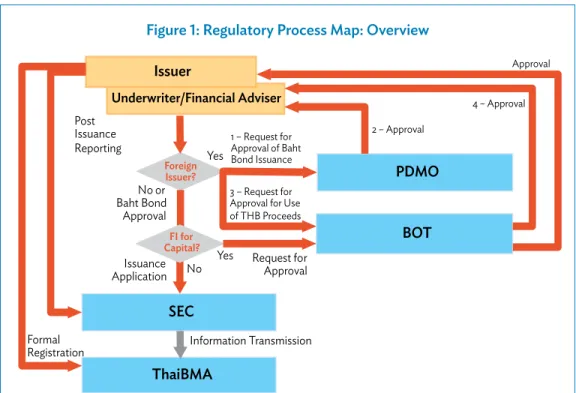
The regulatory process map shown in Figure 1 may help with the navigation of the applicable regulatory processes in Thailand for proposed bond or note issuance. Individual processes are explained in detail below.
There is no requirement for the use of an underwriter for a bond or note offering under PP-AI. However, in cases when an issuer wants to appoint an underwriter, such an underwriter must be licensed by the SEC.
In addition to appointing an underwriter, an issuer may appoint another person to help in preparing and submitting the offering circular to the SEC; this party is called a Financial Adviser.6 However, in practice, most underwriters also hold a Financial Adviser license; in such cases, the underwriter and the Financial Adviser will be the same party.
At the same time, even if an issuer of bonds or notes appoints an underwriter, or a Financial Adviser, the issuer may file the necessary documents directly with the SEC.
6 The Financial Adviser is a legal entity licensed by the SEC; the Financial Adviser license is diferent from that of an underwriter. The duties of a Financial Adviser include the preparation and submission of an ofering circular to the SEC. Under PP-AI, the SEC does not require issuers to appoint a Financial Adviser. However, if an issuer appoints one, it must be licensed by the SEC.
Table 2: Regulatory Processes by Corporate Issuer Type
Type of Corporate Issuer SEC BOT PDMO ThaiBMA
Resident issuer
Resident nonfinancial institution issuer X X
Resident financial institution issuer 1, 2 X X X
Resident issuer issuing FCY-denominated
bonds and notes X X X
Nonresident issuer
Nonresident nonfinancial institution issuer X X3 X X
Nonresident financial institution issuer X X3 X X
Nonresident issuer issuing FCY-denominated
bonds and notes X X X
BOT = Bank of Thailand; FCY = foreign currency; PDMO = Public Debt Management Office; SEC = Securities and Exchange Commission, Thailand; ThaiBMA = Thai Bond Market Association.
1 Financial institutions only require approval from the BOT if a bond is issued for capital requirements.
2 Resident financial institutions in Thailand include branches of foreign financial institutions that fall under the supervision of the BOT.
3 The BOT does not approve issuance as such, but instead the use of THB-denominated issuance proceeds from a Special Nonresident Baht Account.
Source: ABMF SF1 with inputs from the BOT, PDMO, SEC, and ThaiBMA.
Figure 1: Regulatory Process Map: Overview
Underwriter/Financial Adviser
SEC
PDMO
BOT
Foreign Issuer?
Issuer
Yes
No or Baht Bond Approval
ThaiBMA
1 – Request for Approval of Baht Bond Issuance
2 – Approval
Request for Approval FI for
Capital?
Approval
No
Formal Registration
Post Issuance Reporting
Yes
4 – Approval
3 – Request for Approval for Use of THB Proceeds
Information Transmission Issuance
Application
BOT = Bank of Thailand; FI = financial institution; PDMO = Public Debt Management Office; SEC = Securities and Exchange Commission, Thailand; ThaiBMA = Thai Bond Market Association.
Source: ABMF SF1.
AMBIF Bond and Note Issuance Process in Thailand
13
Issuance Processes in Local Currency
This section describes the issuance processes for private placement bonds and notes aimed at Accredited Investors (PP-AI issuances) in Thai baht, the dominant issuance currency in the Thai market.
Distinctions are made according to specific issuance processes for particular corporate issuer types, as may be practical. In some cases, bonds and notes issued by a foreign government or a government-linked agency also require SEC approval and may be subject to additional approvals that are not detailed in the AMBIF Implementation Guidelines for Thailand. Issuance Process for Resident Issuer
A resident issuer is defined as a corporate legal entity under Thai law; this includes the branches of foreign financial institutions under the banking services supervision of the BOT or other corporate issuers falling under Thai regulatory governance.
The regulatory process map shown in Figure 2 may help with the navigation of the applicable regulatory processes in Thailand for issuance of PP-AI by a resident issuer. The following steps need to be observed when a resident corporate issuer wants to issue under PP-AI in Thailand. Step 1: Filing of (Draft) Offering Circular with the SEC
All applications for the issuance of bonds and notes, including proposed issuance to professional investors under PP-AI, need to be filed with the SEC. For PP-AI issuance, the issuer or underwriter only need to file a draft offering circular. Requirements for the filing of a
Figure 2: Regulatory Process: Issuance of PP-AI by Resident Issuer
Underwriter/Financial Adviser
SEC Issuer
1 – Filing of Offering Circular 2 – Approval
ThaiBMA 3 – Formal
Registration
Information Transmission
4 – Post- Issuance Reporting
SEC = Securities and Exchange Commission, Thailand; ThaiBMA = Thai Bond Market Association. Source: ABMF SF1.
draft offering circular are laid out in the SEC Act. Sections 69 and 70 stipulate the minimum disclosure requirements for issuers, without prescribing a particular format for submission. This allows issuers or their agents to utilize typical documentation for issuance of bonds and notes to professional investors, such as an information memorandum or an offering circular, as long as all required information is contained therein. In the Thai market, a short prospectus refers to typical documentation in order to distinguish documentation specific to PP-AI issuances from public offers. A short prospectus is equivalent to an information memorandum or an offering circular in style and content.
The offering circular itself, known as Form 69-DEBT-II&HNW, was introduced in the Notification of the Capital Market Supervisory Board No. TorChor. 10/2556 Re: Submission of an Offering Circular for Offer for Sale of Debt Securities dated 11 March 2013, and replaces the previous format known as Form 69-S.
According to Section 69 of the SEC Act, an offering circular (for PP-AI) must contain the following details:
1. objective of the offer for sale of the securities to the public or any person; 2. name of the issuing company that issues securities;
3. capital of the company;
4. amount and type of the securities offered for sale; 5. expected selling price per unit of securities; 6. nature of the business;
7. financial condition, business operations, and material information of the business; 8. management and major shareholders of the issuing company;
9. auditor regularly contacted financial institutions, and legal advisor of the issuing company;
10. procedures for the subscription, underwriting, and allocation of securities; and 11. other information as specified in the notification of the Capital Market Supervisory
Board.
In addition, Section 70 of the SEC Act prescribes that the offering circular for the sale of bonds and notes under PP-AI shall also contain the following information:
1. rights and restrictions related to the transfer of bills or debentures; 2. return on debentures and bills;
3. property or other collateral used as security of repayment, if any; 4. debenture holder representative, if any;
5. encumbrances on property of the company that issues securities in the case of unsecured securities;
6. outstanding debt from previous issues of bills or debentures; 7. procedure, time, and place of repayment;
8. procedures for conversion of rights, if any; and
9. other information as specified in the notification of Capital Market Supervisory Board. To avoid the resale of PP-AI debt securities to other types of investors, the SEC requires the issuer to register the transfer restrictions to ensure that the sale and resale of these debt securities will only occur among Accredited Investors.
From 1 July 2015, the filing of an offering circular with the SEC should be done online through the Initial Product Offering System (IPOS), which will initially be available only in Thai, with an English version available at a later stage.
AMBIF Bond and Note Issuance Process in Thailand
15
At present, the SEC does not approve note issuance through an MTN program. As mentioned earlier, Thailand has an MTN-like program for THB-denominated bond and note issuance.
The SEC charges a fee, which is payable on the submission date, for the filing of an offering circular.
The SEC has confirmed that the SSF may be used for this filing since the SSF was reviewed by the SEC and contains all relevant information required of an offering circular and the provisions of Sections 69 and 70 of the SEC Act, as detailed above.
Step 2: Approval of Offering Circular by the SEC
The SEC reviews the (draft) offering circular, and may provide feedback as necessary. The SEC may instruct the promoters of a public limited company, a company, or owner of securities to attach any documents other than those specified in the offering circular. The issuer or underwriter may revise or, possibly, resubmit the offering circular, as may be necessary. When this is the case, a cooling-off period of 1 day will have to be observed. The offering circular becomes effective upon expiry of the cooling-off period after
submission of completed documents and if no further amendments to the offering circular are submitted. The SEC will issue a formal letter to inform the issuer that the offering circular becomes effective. After the effective date, the issuer may proceed with offers of sale to investors.
The issuance approval by the SEC does not carry an expiry date. However, if an issuer has not issued bonds and notes under an approval within a certain period of time (e.g., 6 months from approval date) the issuer is required to update information in the offering circular with the SEC.
Once the SEC approves the offering circular, the bond and note information required for the registration with ThaiBMA will be transmitted automatically from IPOS to ThaiBMA’s Bond Registration Information System. The issuer or its agent may also print this information from IPOS for use in the formal registration (Step 3).
Step 3: Registration with ThaiBMA
The registration of a bond or note issue with ThaiBMA is required by SEC regulations as a condition for the offering of bonds and notes in the primary market in Thailand.
Starting from 1 July 2015, however, the ThaiBMA registration process has been integrated with the SEC approval process. When bond and note issuers submit their filing to the SEC through IPOS (Step 1) and the issuance is subsequently approved by the SEC (Step 2), the bond and note information will be electronically submitted to the ThaiBMA registration database. The issuer can then print the official registration form already containing all required information from IPOS and submit it to ThaiBMA as the formal registration request. The registration process is normally completed within 24 hours. It includes a one-time registration fee and an annual fee for the first 6 years of the tenure of the bond or note, which are charged by ThaiBMA to the issuer.
Upon ThaiBMA registering the bond and note information (completion of the registration process), the information is available on the ThaiBMA website for general viewing. Step 4: Post-Issuance Reporting to the SEC
Notification of the Securities and Commission No.SorChor.21/2541 RE: Reporting of Securities for Sales to the Public prescribes that issuers or their underwriter (or Financial Adviser) need to submit to the SEC a post-issuance report upon the completion of the bond or note offering, in this case to accredited investors. The post-issuance reporting is expected to be submitted to the SEC within 15 days after the end of the month in which the sales were made (e.g., an issuance or sale in February would require reporting by 15 March).
Issuance Process for Resident Nonfinancial Institution Issuer
In Thailand, the issuance process for resident issuers that are nonfinancial institutions is the same as described above.
Issuance Process for Resident Financial Institution Issuer
In Thailand, the issuance process for resident financial institutions is the same as described above. The regulatory process map shown in Figure 3 may help with the navigation of the applicable regulatory processes in Thailand for issuance of PP-AI by a resident financial institution.
However, in such cases where a bond or note issuance by a resident financial institution is intended to support capital requirements, a resident financial institution might file an application for issuance approval from the BOT in parallel with an application for issuance approval from the SEC. The additional process is described in this section.
The following steps need to be observed when a resident financial institution wants to issue under PP-AI in Thailand and use the proceeds to support capital requirements.
Step 1a: Filing of (Draft) Offering Circular with the SEC
Please refer to Issuance Process for Resident Issuer, Step 1. Step 1b: Request for Approval from the BOT
The issuer will need to file a request for approval with the BOT’s Financial Institution Applications Department. All capital instruments must meet the criteria as prescribed in the BOT’s regulations on capital requirements, which comprise two main features: (i) no incentives to redeem and (ii) loss absorbency.
Step 2a: Approval of Offering Circular by the SEC
Please refer to Issuance Process for Resident Issuer, Step 2. Step 2b: Approval from the BOT
The BOT’s Financial Institution Applications Department will review the application and supplementary documents and may, at its discretion, ask for clarification or additional information.
AMBIF Bond and Note Issuance Process in Thailand
17
Provided that the application and documents are in order, the necessary information has been provided, and the review is satisfactory, the Financial Institution Applications Department will issue a letter of approval for the bond or note issuance.
There is no fee charged by the BOT for this approval process. Step 3 Onward: Formal Registration and Post-Issuance Reporting
Once SEC and BOT approvals have been obtained, the resident financial institution has to follow the remaining regulatory process steps outlined above. The regulatory process map shown in Figure 4 may help with the navigation of the applicable regulatory processes in Thailand for issuance under PP-AI by a nonresident (foreign) entity.
Issuance Process for Nonresident (Foreign) Issuer
In the event that the issuer is a nonresident (foreign) entity, THB-denominated bond or note issuance may only be undertaken utilizing the so-called Baht Bond process, which is administered by PDMO and subject to periodic application and approval.
Nonresident issuers are defined in the SEC Act (in the description of foreign issuers) as “a unit or organization of foreign government, international organization and juristic person under the law of a foreign jurisdiction.” More specifically, nonresident issuers are defined under a Ministry of Finance Notification for PDMO as
Figure 3: Regulatory Process: Issuance of PP-AI by Resident Financial Institution Issuer (Capital Raising Only)
Underwriter/Financial Adviser
SEC
Resident Financial Institution Issuer
1a – Filing of Offering Circular 2a – Approval
ThaiBMA 3 – Formal
Registration
Information Transmission
BOT
2b – Approval 1b – Request for Approval 4 – Post-
Issuance Reporting
BOT = Bank of Thailand; PP-AI = Private Placement to Accredited Investors; SEC = Securities and Exchange Commission, Thailand; ThaiBMA = Thai Bond Market Association.
Source: ABMF SF1.
1. international financial institutions (e.g., Asian Development Bank, International Finance Corporation, and International Monetary Fund),
2. foreign governments,
3. financial institutions of foreign governments,
4. juridical entities that have been established under foreign laws, and 5. special purpose vehicles.
The objective of the Baht Bond process is to control the maximum amount of THB- denominated bond or note issuances by nonresidents, who often swap the proceeds into a foreign currency. In line with this objective, the SSF (IV: Information on the Notes, 2. Other Information of the Notes, item 16) requires describing the name of the cross-currency swap intermediaries in the case of THB-denominated bonds and notes issued by non- Thai residents.
PDMO presently invites issuers to submit an application during three periods in a calendar year. Currently, submission dates can be any working day in March, July, and November. An approval is preceded by consultations with the BOT and SEC.
Following PDMO approval, the issuer may issue the authorized amount within a 9-month time frame, counted from the date of submission of the Baht Bond issuance application. If a foreign issuer is granted an approval but does not issue any bonds or notes in the authorized period, PDMO may penalize the issuer. As such, the SSF (IV: Information on the Notes, 2. Other Information of the Notes, item 17) requires describing the timing of a bond issuance within the period authorized by PDMO in the case of THB-denominated bonds and notes issued by non-Thai residents.
PDMO’s regulatory process for Baht Bonds is described in more detail in an official
document available on the website of the MOF: http://www.pdmo.go.th/upload/ebook_img/ Baht_Denominated_Bond_%20in_Thailand_Version_2014.pdf
Successful PDMO approval is followed by the regulatory process of PP-AI approval from the SEC.
Under current SEC regulations, a nonresident (foreign) issuer needs to appoint a contact person in Thailand. The purpose of the contact person is to field questions or requests directed at the issuer, and to disseminate information provided by the issuer to bondholders in Thailand.
The SEC Act states that “[the issuer] shall appoint a representative in Thailand to act as a person during the tenure of the bond or note in order to receive letters, orders, notices, and documents, or to contact the relevant authorities.”7 Contact persons do not have fiduciary or fiscal responsibilities under the law.
The duties of a contact person have traditionally been carried out by law firms, but could also be performed by other professional firms, banks, or financial institutions.
The following steps need to be observed by a nonresident (foreign) issuer when applying for a THB-denominated bond issuance (PP-AI) under the Baht Bond process.
7 Securities and Exchange Commission, Thailand. http://www.sec.or.th/EN/SECInfo/LawsRegulation/ Documents/actandroyal/1Securities.pdf
AMBIF Bond and Note Issuance Process in Thailand
19
Figure 4: Regulatory Process: Issuance of PP-AI by Nonresident (Foreign) Issuer
Underwriter/Financial Advisor
SEC Nonresident Issuer
3 – Filing of Offering Circular 4 – Approval
ThaiBMA 5 – Formal
Registration Information Transmission
PDMO 2 – Approval
1 – Request for Approval of Baht Bond Issuance
Financial Institution 8 – SNA Opening
9 – Post- Issuance Reporting
BOT 6 – Request
for Use of Proceeds
7 – Approval
BOT = Bank of Thailand; PDMO = Public Debt Management Office; PP-AI = Private Placement for Accredited Investors; SEC = Securities and Exchange Commission, Thailand; SNA = Special Nonresident Baht Account; ThaiBMA = Thai Bond Market Association.
Source: ABMF SF1.
Step 1: Letter of Application of Baht Bond Issuance to PDMO
The issuer or underwriter submits an application letter, together with relevant documents, to the Finance Minister (to the attention of PDMO); this letter of application should contain information on the
1. objective of fundraising, 2. type of bond,
3. maturity, 4. issue size,
5. offering method (private placement), 6. timing of issuance,
7. use of proceeds,
8. cross-currency swap intermediaries, if applicable, 9. credit rating requirement(s), and
10. collateral guarantee, if applicable.
The applicant issuer must provide sufficient evidence to show that it has the legal capacity to issue securities under its governing laws.
Since the issuer also needs to file an offering circular with the SEC, the applicable minimum disclosure requirements set out in Sections 69 and 70 of the SEC Act will need to be observed.
Step 2: Approval from PDMO
PDMO, in conjunction with representatives from the BOT and SEC, will review the letter of application and supplementary documents. PDMO may request additional documents from the foreign issuer during its consideration process.
PDMO will return an approval (or rejection if so warranted) within 1 month of the submission deadline. At the same time, if an issuer or their agent submits an application much earlier than one of the filing deadlines, this would result in additional waiting time since the 1-month approval timeline is only calculated from one of the given submission deadlines.
At present, PDMO should not be expected to approve note issuance through an MTN program. However, Thailand has an MTN-like program for THB-denominated bonds and notes; the challenge is that PDMO would not be able to approve the maximum issuance amount under such a note issuance program within any given period (e.g., 9 months). For more details, please refer to Chapter II.
There is no fee for PDMO’s Baht Bond approval process.
Steps 3 and 4: Filing of (Draft) Offering Circular with the SEC and Approval
Once PDMO approval is obtained, the nonresident (foreign) issuer would have to follow the PP-AI issuance approval process prescribed by the SEC. For more details, please refer to the regulatory process described above.
Step 5: Formal Registration with ThaiBMA
Once PDMO and SEC approvals have been obtained, the nonresident issuer or its agent has to formally register the bond or note with ThaiBMA, as outlined above.
Steps 6 and 7: Request for Use of Thai Baht Proceeds from BOT and Approval
Approval from PDMO is a prerequisite (Step 2).
The issuer or its agent is required to obtain BOT approval for the use and remittance of Thai baht funds originating from a Baht Bond issuance. This approval is required prior to the opening of a Special Nonresident Baht Account (SNA).
Step 8: Opening of an SNA with a Financial Institution
Approval from the BOT for the use of Thai baht proceeds from Baht Bond issuance is a prerequisite (Steps 6 and 7).
Following approval from the BOT, the nonresident issuer or its underwriter (Financial Adviser) is required to open a designated SNA with a financial institution in Thailand, which will act as custodian of the issuance proceeds.
Issue proceeds may only be withdrawn for specific purposes, including defined investment or swap transactions. Reporting on the SNA to the BOT is to be provided by the domestic financial institution under separate regulations.
AMBIF Bond and Note Issuance Process in Thailand
21
Step 9: Issuance Reporting to the SEC
As per the PP-AI issuance approval process described above, the nonresident issuer, or its agent, will need to submit a report to the SEC upon completion of the bond or note offering to Accredited Investors.
Issuance Process for Nonresident (Foreign) Nonfinancial Institution Issuer
In Thailand, the issuance process for all nonresident issuers is the same. Hence, the issuance process for a nonresident nonfinancial institution follows the process as outlined in Issuance Process for Nonresident (Foreign) Issuer.
Issuance Process for Nonresident (Foreign) Financial Institution Issuer
In Thailand, the issuance process for all nonresident issuers is the same. Hence, the issuance process for a nonresident financial institution follows the process as outlined in Issuance Process for Nonresident (Foreign) Issuer.
Issuance Process for FCY-Denominated Bonds and Notes
The issuance of bonds and notes in currencies other than Thai baht, such as US dollars, is possible but not common in the Thai market. In market terminology, bonds and notes issued in foreign currency are generally referred to as FCY bonds. Only a few FCY bonds have been observed in the Thai market in recent years. FCY bonds issued in Thailand are subject to issuance approval from the SEC and BOT, and are required to be registered with ThaiBMA (unless offered outside Thailand only).
This section describes the process for PP-AI issuances in foreign currencies as a matter of reference only.
FCY bonds from noncorporate issuers, such as foreign governments or government-linked entities, may also be subject to SEC approval and additional approvals. However, this document is focused on the regulatory process for corporate issuances only.
Issuance Process for Resident Issuer of FCY Bonds and Notes
FCY-denominated bonds and notes require the prior approval of the BOT, in addition to the approval process for PP-AI issuances prescribed by the SEC. There are no distinctions by issuer type in the approval process for FCY bonds.
The regulatory process map shown in Figure 5 may help with the navigation of the applicable regulatory processes in Thailand for issuance of PP-AI in foreign currency by a resident issuer. The following steps will need to be observed when a resident issuer wants to issue PP-AI in Thailand in a foreign currency.
Step 1: Request for Approval from the BOT
The issuer or underwriter (Financial Adviser) will need to file a request for approval with the BOT’s Foreign Exchange Administration and Policy Department.
The application needs to contain detailed information on intended remittances of FCY proceeds or cross-currency swaps relating to the proceeds.
Step 2: Approval from the BOT
The BOT’s Foreign Exchange Administration and Policy Department will review the
application and supplementary documents, and may, at its discretion, ask for clarification or additional information.
Provided that the application and documents are in order, the necessary information has been provided, and the review is satisfactory, the BOT’s Foreign Exchange Administration and Policy Department will issue a letter of approval for the bond or note issuance. There is no fee charged for this BOT approval process.
Step 3 Onward: Filing of (Draft) Offering Circular with the SEC
Once the BOT approval is obtained, the resident issuer would have to follow the issuance approval process prescribed by the SEC. For more detail, please refer to the regulatory process described above.
Issuance Process for Nonresident (Foreign) Issuer of FCY Bonds and Notes The issuance process for nonresident issuers is the same as described above.
Figure 5: Regulatory Process: Issuance of PP-AI in Foreign Currency by Resident Issuer
Underwriter/Financial Adviser
SEC Issuer
3 – Filing of Offering Circular 4 – Approval
ThaiBMA 5 – Formal
Registration
Information Transmission
BOT
2 – Approval 1 – Request for Approval 6 – Post-
Issuance Reporting
BOT = Bank of Thailand; PP-AI = Private Placement for Accredited Investors; SEC = Securities and Exchange Commission, Thailand; ThaiBMA = Thai Bond Market Association.
Source: ABMF SF1.
Appendix 1
Resource Information
For easy reference and access to further information about the topics discussed in the AMBIF Implementation Guidelines for Thailand—including the relevant policy bodies, regulatory authorities, and securities market-related institutions, and the Thai bond market at large—interested parties are encouraged to utilize the following links (all websites available in English):
ASEAN+3 Multi-Currency Bond Issuance Framework—Single Submission Form http://tinyurl.com/AMBIF-Single-Submission-Form
ASEAN+3 Bond Market Guide—Thailand
https://wpqr4.adb.org/LotusQuickr/asean3abmf/Main.nsf/h_Index/4CC53EFBD63D7BA34 82579D4001B5CED/$file/abmf%20vol1%20sec%2010%20tha.pdf
Bank of Thailand
https://www.bot.or.th/English/Pages/default.aspx Ministry of Finance of Thailand
http://www2.mof.go.th
Public Debt Management Office of the Ministry of Finance of Thailand
http://www.pdmo.go.th/upload/ebook_img/Baht_Denominated_Bond_%20in_Thailand _Version_2014.pdf
Securities and Exchange Commission, Thailand http://www.sec.or.th/EN/Pages/Home.aspx Stock Exchange of Thailand
http://www.set.or.th/en/index.html
(This website is also available in Chinese and Japanese.) Thai Bond Market Association
http://www.thaibma.or.th/main.html
(Visitors may be required to accept a disclaimer statement before entering the website.)
Accredited Investors Professional investors concept in Thailand
Baht Bond Defined by the Ministry of Finance to describe a scheme under which foreign issuers may issue THB-denominated bonds or debt securities
conflict of law Concept under Thai law that permits the use of law other than Thai law in contracts or agreements if both (all) parties so agree
filing Action of submitting documentation for a PP-AI to the SEC information memorandum Typically used for key documentation for a private placement to
professional investors
listing Typically, action of submitting a bond issue or other securities to an exchange for the purpose of price finding, disclosure or profiling; in Thailand, presently often used instead of registration with ThaiBMA offering circular Typically used for key documentation for a private placement to
professional investors in Thailand
prospectus Key documentation of public offers of securities
registration Action of registering a bond issue with ThaiBMA; required under present regulations
short prospectus Key documentation of private placements (only for Thailand)