This document is downloaded at: 2018-03-23T18:11:21Z
Introduction
Acute cholecystitis is one of the most common diseases for emergent treatments, which is frequently encountered in daily medical consultation. The Tokyo Guidelines 2013 (TG13), which is updated from TG07, provides a simple criteria and management strategy for acute cholecystitis (1-3). TG13 recommends that it is preferable to perform laparo-scopic cholecystectomy (LC) soon after admission, particu-larly when less than 72 hours have passed since the onset of symptoms (4). In TG13, early LC within 72 hours of the onset of acute cholecystitis (ONSET) is indicated for the patients with grade I (mild) acute cholecystitis. In the patients with grade II (moderate) acute cholecystitis, who suffers severe local inflammation, immediate gallbladder drainage such as percutaneous transhepatic gallbladder
drainage (PTGBD) is indicated, and then, medical treatments and delayed elective cholecystectomy are performed. Like-wise, the patients with grade III (severe) acute cholecystitis also require the urgent management for organ dysfunction and severe local inflammation by immediate gallbladder drainage (4). The delayed elective cholecystectomy following gallbladder drainage is performed 2 to 3 months after the PTGBD, although the duration of gallbladder drainage is controversial (4). In the gallbladder drainage, TG13 shows three techniques of biliary drainage for acute cholecystitis, including PTGBD, percutaneous transhepatic gallbladder aspiration, and endoscopic nasogallbladder drainage. Among the three techniques, PTGBD is a standard drainage method for severe local inflammation due to the acute cholecystitis (5). TG13 on the basis of the evidence from retrospective multi-center analyses are very useful and helpful for the
MS#AMN 07211
Results of elective laparoscopic cholecystectomy for acute cholecystitis
following percutaneous transhepatic gallbladder drainage
Tamotsu Kuroki, Amane Kitasato, Takayuki Tokunaga, Hiroaki Takeshita, Ken Taniguchi, Shigeto Maeda & Hikaru Fujioka
Department of Surgery, Nagasaki Medical Center, National Hospital Organization, Omura, Japan
The Tokyo Guidelines 2013 (TG13) provides a simple criteria and management strategy for acute cholecystitis. The optimal interval between performing percutaneous transhepatic gallbladder drainage (PTGBD) and delayed elective laparoscopic cholecystectomey (LC) and the suitable period of PTGBD, is controversial. In this study, we evaluate the operative outcome of elective LC with PTGBD for the management of acute cholecystitis. We analyzed 21 patients who underwent elective LC following PTGBD. The diagnosis and severity grading for acute cholecystitis was based on TG13. All patients showed grade II/III acute cholecystitis by TG13. Median time interval from onset of acute cholecystitis to PTGBD was 1.5 days (range 0-6). In all
patients, local inlammation of gallbladder was improved by PTGBD. Median time interval from PTGBD to elective LC was 46 days (range 12-74). Only one patient (5%) showed bile leakage, and median postoperative hospital stay was 5 days (range 4-15). In conclusion, delayed elective LC following emergent PTGBD is a safe and effective treatment strategy for patients with
complicated acute cholecystitis.
ACTA MEDICA NAGASAKIENSIA 61: 111−115, 2017
Key words: Elective laparoscopic cholecystectomy; Percutaneous transhepatic gallbladder drainage; Tokyo Guideline 2013
Address correspondence: Tamotsu Kuroki, Department of Surgery, Nagasaki Medical Center, National Hospital Organization, 2-1001-1, Kubara, Omura city, Nagasaki 856-8562, Japan.
Tel: +81-957-52-3121; Fax: +81-957-54-0292; Email: [email protected]
112 Tamotsu Kuroki et al.: Elective LC after PTGBD
management of acute cholecystitis using severity assessment criteria, clinical flowcharts, and many new diagnostic and therapeutic modalities (1-5). However, the suitable period of PTGBD after ONSET, the optimal time interval between PTGBD and cholecystectomy is controversial. This study was conducted in order to clarify the precise protocol of the management strategies for acute cholecystitis.
Patients and Methods
Patients
This retrospective analysis was undertaken in the patients with LC for acute cholecystitis in the National Hospital Organization Nagasaki Medical Center between January 2015 and December 2016. The severity grading of acute cholecystitis was based on TG13 (3). In this period, ninety-two patients were diagnosed as acute cholecystitis, among them, 21 patients who underwent elective LC following PTGBD were enrolled in this study. In this study, other 71 patients who received antibiotics and elective LC without PTGBD were excluded. Our standard management for the patients with grade I acute cholecystitis is elective LC following antibiotics therapy, whereas PTGBD is indicated for the patients with grade II or grade III acute cholecystitis, or the patients with grade I acute cholecystitis who are unre-sponsive to conservative treatments. Those patients with PTGBD undergo elective and scheduled LC. Ultrasonogra-phy (US) , computed tomograUltrasonogra-phy scan (CT), and magnetic resonance cholangiopancreaticography (MRCP) were per-formed for all patients in the present study. Inper-formed consent was obtained from all patients, and the study protocol was approved by the Ethics Committee of National Hospital Organization Nagasaki Medical Center.
Percutaneous transhepatic gallbladder drainage
PTGBD was performed according to the TG13 (5), which was performed using US under local anesthesia. After US guided transhepatic gallbladder puncture was performed with an 18-gauge needle, a 7-Fr drainage catheter was placed in the gallbladder using guidewire technique under fl uoros-copy. Cholangiogram was taken to confirm that the drainage catheter was in the correct position within the gallbladder.
Operative technique
All LCs were performed by fixed members including expert biliary surgeons. LC was performed using four-trocar
technique under general anesthesia. The patients were placed in the supine position. The PTGBD catheter was removed just before operation. The first 12-mm laparoscopic trocar was inserted at the umbilicus using an open technique, and pneumoperitoneum was set at 8 mm Hg. The maximum intraabdominal pressure was 12 mm Hg. Three additional trocars were inserted: two 5-mm trocars levels with the right subcostal area, one 12-mm trocar level with the subxiphoid. First, we dissected the junction between the neck of the gallbladder and the cystic duct at the inferior margin of the gallbladder. After dissection of the triangle of Calot, the cystic duct and the cystic artery were exposed and clipped and then divided with laparoscopic scissors. The gallbladder was dissected from the liver bed using a regular hook electrocau-tery device. When it was extremely difficult to expose and dissect the triangle of Calot or the neck of the gallbladder due to severe inflammation, the laparoscopic subtotal chole-cystectomy was performed. The infundibulum of the gall-bladder was transected by a laparoscopic stapler in subtotal cholecystectomy. A disposable retrieval bag was inserted directly, and the gallbladder was then extracted. No intrap-eritoneal drainage tube was placed.
Data collection and statistical analysis
The preoperative clinical status was examined by age, gender, American Society of Anesthesiologists (ASA) classification, laboratory findings such as leukocyte count and CRP, radio-logical findings such as wall thickness of the gallbladder on CT imaging. Numerical data were shown as the median and range, and evaluated using Mann-Whitney U-test. Statistical analysis was carried out using SSPS version 23 (SSPS, Chi-cago, IL). P < 0.05 was considered statistically significant.
Results
Clinical characteristics on admission
PTGBD
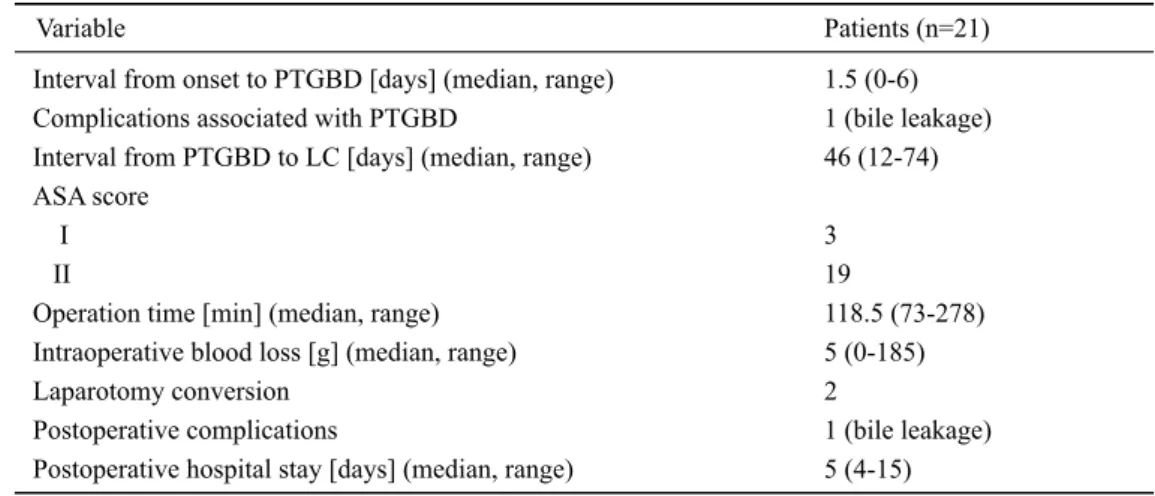
Median time interval from onset to PTGBD was 1.5 days (range 0-6). Eleven patients (52%) underwent PTGBD within one day after admission. Bile leakage occurred in one patient (5%) as the complication associated with PTGBD, which was Grade IIIa according to the Clavien-Dindo classification (6). In all patients, body temperature was restored to normal, leucocyte counts and CRP levels were within the normal
range, and local inflammation of gallbladder was improved by PTGBD. Seventeen patients (81%) were discharged with-out the PTGBD catheters and thereafter underwent elective LC. On the other hand, 4 patients (19%) including one patient with bile leakage due to PTGBD were not discharged, and underwent elective LCs with PTGBD catheters. The median time interval from PTGBD to elective LC was 46 days (range 12-74) (Table 2).
Variable Patients (n=21)
Age [years] (median, range)
Gender
male
femal
Comorbidity
Cardiovascular disease
Pulmonary disease
Hypertension
Diabetes mellitus
Chronic liver disease
Antiplatelet/Anticoagulation therapy
Tokyo Guidelines 2013
grade II (moderate)
grade III (severe)
WBC on admission [count/mL] (median, range)
CRP on admission [mg/dl] (median, range)
Gallbladder wall thickness using CT [mm] (median, range)
66 (38-90)
12
9
4
3
2
2
2
4
19
2
13,700 (9,500-22,400)
19.29 (0.3-29.3)
4.5 (2-12)
Table 1. Clinical characteristics of 22 patients with elective laparoscopic cholecystectomy following percutaneous transhepatic gallbladder drainage
Variable Patients (n=21)
Interval from onset to PTGBD [days] (median, range) Complications associated with PTGBD
Interval from PTGBD to LC [days] (median, range) ASA score
I II
Operation time [min] (median, range) Intraoperative blood loss [g] (median, range) Laparotomy conversion
Postoperative complications
Postoperative hospital stay [days] (median, range)
1.5 (0-6) 1 (bile leakage) 46 (12-74)
3 19
118.5 (73-278) 5 (0-185) 2
1 (bile leakage) 5 (4-15)
114 Tamotsu Kuroki et al.: Elective LC after PTGBD
Intra- and post-LC
Three patients with severe inflammation underwent laparoscopic subtotal cholecystectomy due to extreme dif-ficulty in exposure and dissection of the triangle of Calot. Median operative time was 118.5 min (range 73-278). Median intraoperative blood loss was 5 g (range 0-185). No patient underwent intraoperative cholangiography. Two patients (10%) were converted from LC to open
cholecys-tectomy due to severe adhesion between gallbladder and colon and/or duodenum. Median postoperative hospital stay was 5 days (range 4-15) (Table 2). Relationship between the time interval from ONSET to PTGBD and operative time or intraoperative blood loss were shown in Table 3. The time interval from ONSET to PTGBD of < 2 days or ≧ 2 days showed no significant difference in the operative time and the intraoperative blood loss.
Discussion
TG13 recommended the optimal surgical treatment according to the severity of acute cholecystitis (4). Immediate or Early LC within 72 hours after onset is indicated for the patients with Grade I acute cholecystitis, whereas in the patients with Grade II/Grade III, elective LC after medical treatments and gallbladder drainage including PTGBD is indicated. In the patients with Grade II/III, immediate or early LC is difficult due to severe local inflammation of the gallbladder, which increases the conversion rate from LC to open cholecystec-tomy. In addition, urgent LC for acute cholecystitis with severe local inflammation of the gallbladder increases intra-operative complications including hemorrhage and bile duct injury. Several studies recommend elective LC after gallbladder drainage including PTGBD (7-9), which is a safe and useful interventional procedure as a gallbladder drainage as TG13 recommends (5). In our series, PTGBD improved moderate or severe local inflammation of the gallbladder, the compli-cation rate of which was 5%. In addition, several comorbidities were found such as cardiovascular disease, and 4 patients (19%) were receiving antithrombotic therapy. No hemor-rhagic complication by PTGBD occurred, although Shibasaki et al. (10) reported the risk of hemorrhage by PTGBD in patients who received antithrombotic therapy.
Yamada et al. (11) reported that the most important predictor of successful LC following PTGBD for acute cholecystitis is the time interval from onset to PTGBD of ≤ 73.5 hours. In our series, the median time interval from
ONSET to PTGBD was 1.5 days, and the time interval from ONSET to PTGBD of < 2days or ≧ 2days revealed no significant difference in the operative time and in the intra-operative blood loss. However, in our opinion, PTGBD is a feasible, effective, and relatively safe procedure, which can reduce the difficulty and morbidity of LC, especially, in high-risk patients with acute cholecystitis. An extremely high mortality rate was reported in patients with severe comorbidities who underwent LC for acute cholecystitis (12-14). Therefore, it is important to perform PTGBD as soon as possible after evaluating the severity of acute chole-cystitis according to TG13 and the patientʼs condition including comorbidity.
The optimal time interval from PTGBD to elective LC is controversial. Han et al. (15) reported that the perioperative complication rates were higher in patients who underwent LC within 3 days after PTGBD than in patients who under-went LC at more than 3 days after PTGBD. Inoue et al. (16) reported that LC for severe acute cholecystitis was techni-cally difficult within 9 days after PTGBD. They recom-mended the time interval from PTGBD to elective LC later than 9 days after PTGBD. On the other hand, Yamada et al. (11) suggested that the interval from PTGBD to elective LC did not influence the difficulty of LC. They reported that the median time interval from PTGBD to elective LC was 15 days. In our series, the interval was 46 days and longer than in several reports. However, perioperative complication rates were comparable to them (11, 15, 16). In addition, we can more appropriately evaluate the perioperative risks Table 3. Relationship between the interval from the onset of acute cholecystitis to PTGBD and intraoperative factors
Interval from the onset to PTGBD
< 2 day (n=11) ≧ 2 day (n=10) P-value
Operation time [min] (median, range)
Intraoperative blood loss [g] (median, range)
147 (92-278)
5 (0-185)
110 (73-181)
5 (0-40)
0.09
during the interval from PTGBD to elective LC. Our results suggest that longer time interval from PTGBD to elective LC dose not reduce surgical safety of LC.
Several studies suggest that elective LC following PTGBD in acute cholecystitis reduce the complication rates and the conversion rate to open cholecystectomy, especially in elderly and complicated patients (17-20). In our series, there were no severe complications and the conversion rate to open cholecystectomy was 10%. PTGBD is feasible, effective, and relatively safe procedure for the treatment of acute cholangitis, which can reduce the difficulty of LC and the morbidity rate of peri-LC because of improvement of severe acute inflammation, especially in high risk patients with several comorbidities. The most important things for the management of acute cholecystitis is to evaluate the severity criteria according to TG13 and the patientʼs condition including comorbidities, and to perform the gallbladder drainage as soon as possible in the selective patients.
In conclusions, elective LC following immediate PTGBD is an effective treatment strategy for the patients with moderate or severe acute cholecystitis and several comorbidities. In addition, establishment of the guideline of the optimal time interval between PTGBD and elective LC for moderate or severe acute cholecystitis is needed and expected in the next Tokyo guideline.
Acknowledgment
The authors have no conflicts of interest to disclose.
References
1. Takada T, Strasberg SM, Solomkin JS et al. TG13: Updated Tokyo Guidelines for the management of acute cholangitis and cholecystitis. J Hepatobiliary Pancreat Sci 20: 1-7, 2013
2. Miura F, Takada T, Strasberg SM et al. TG13 flowchart for the man-agement of acute cholangitis and cholecystitis. J Hepatobiliary Pancreat Sci 20: 47-54, 2013
3. Yokoe M, Takada T, Strasberg SM et al. New diagnostic criteria and severity assessment of acute cholecystitis in revised Tokyo guidelines. J Hepatobiliary Pancreat Sci 19: 578-585, 2012
4. Yamashita Y, Takada T, Strasberg SM et al. TG13 surgical manage-ment of acute cholecystitis. J Hepatobiliary Pancreat Sci 20: 89-96, 2013
5. Tsuyuguchi T, Itoi T, Takada T et al. TG13 indications and technique for gallbladder drainage in acute cholecystitis (with videos). J Hepato-biliary Pancreat Sci 20: 81-88, 2013
6. Dindo D, Demartines N, Clavien PA. Classification of surgical com-plications: a new proposal with evaluation in a cohort of 6336 patients and results of a surgery. Ann Surg 240: 205-213, 2004
7. Chikamori F, Kuniyoshi N, Shibuya S, Takase Y. Early scheduled laparoscopic cholecystectomy following percutaneous transhepatic gallbladder drainage for patients with acute cholecystitis. Surg Endosc 16: 1704-1707, 2002
8. Kim HO, Ho Son B, Yoo CH, Ho Shin J. Impact of delayed laparo-scopic cholecystectomy after percutaneous transhepatic gallbladder drainage for patients with complicated acute cholecystitis. Surg Laparosc Endosc Percutan Tech 19: 20-24, 2009
9. Kim IG, Kim JS, Jeon JY et al. Percutaneous transhepatic gallbladder drainage changes emergency laparoscopic cholecystectomy to an elective operation in patients with acute cholecystitis. J Laparoendosc Adv Surg Tech A 21: 941-946, 2011
10. Shibasaki S, Takahashi N, Toi H et al. Percutaneous transhepatic gall-bladder drainage followed by elective laparoscopic cholecystectomy in patients with moderate acute cholecystitis under antithrombotic therapy. J Hepatobiliary Pancreat Sci 21: 335-342, 2014
11. Yamada K, Yamashita Y, Yamada T, Takeno S, Noritomi T. Optimal timing for performing percutaneous transhepatic gallbladder drainage and subsequent cholecystectomy for better management of acute cholecystitis. J Hepatobiliary Pancreat Sci 22: 855-861, 2015 12. Morse BC, Smith JB, Lawdahl RB, Roettger RH. Management of
acute cholecystitis on critically ill patients: contemporary role for cholecystostomy and subsequent cholecystectomy. Am Surg 76: 708-712, 2010
13. Chok KS, Chu FS, Cheung TT et al. Results of percutaneous transhe-patic cholecystostomy for high surgical risk patients with acute chole-cystitis. ANZ J Surg 80: 280-283, 2010
14. Winbladh A, Gullstrand P, Svanvik J, Sandström P. Systemic review of cholecystostomy as a treatment option in acute cholecystitis. HPB (Oxford) 11: 183-193, 2009
15. Han IW, Jang JY, Kang MJ, Lee KB, Lee SE, Kim SW. Early versus delayed laparoscopic cholecystectomy after percutaneous transhepatic gallbladder drainage. J Hepatobiliary Pancreat Sci 19: 187-193, 2012 16. Inoue K, Ueno T, Nishina O et al. Optimal timing of cholecystectomy
after percutaneous gallbladder drainage for severe cholecystitis. BMC Gastroenterol 17: 71, 2017
17. Choi JW, Park SH, Choi SY, Kim HS, Kim TH. Comparison of clinical result between early laparoscopic cholecystectomy and delayed laparoscopic cholecystectomy after percutaneous transhepatic gall-bladder drainage for patients with complicated acute cholecystitis. Korean J Hepatobiliary Pancreat Surg 16: 147-153, 2012
18. Mizrahi I, Mazeh H, Yuval JB et al. Perioperative outcomes of delayed laparoscopic cholecystectomy for acute calculous cholecystitis with and without percutaneous cholecystectomy. Surgery 158: 728-735, 2015
19. Yeo CS, Tay VW, Low JK, Woon WW, Punamiya SJ, Shelat VG. Out-comes of percutaneous cholecystostomy and predictors of eventual cholecystectomy. J Hepatobiliary Pancreat Sci 23: 65-73, 2016 20. Hu YR, Pan JH, Tong XC, Li KQ, Chen SR, Huang Y. Efficacy and