Ph.D. Thesis
Resonant Leptogenesis Based on
Non-equilibrium Quantum Field Theory
Kengo Shimada
High Energy Accelerator Research Organization (KEK) and
The Graduate University for Advanced Studies (SOKENDAI), Oho 1-1, Tsukuba, Ibaraki 305-0801, Japan
Abstract
Dynamics of matter fields on a classical space-time are believed to obey the prin- ciple of quantum field theory (QFT). In the early universe, the expansion of the universe originating from the inflation causes various non-equilibrium phenom- ena of quantum fields, and the most rigorous descriptions of such phenomena are obtained from the non-equilibrium QFT framework. However, in general, the first principle of QFT gives very complicated equations, and then, we need reasonable approximations to understand the phenomena.
In this thesis, as an example of non-equilibrium phenomena with significant quantum effects, we investigate the evolution of the lepton number asymmetry when the right-handed (RH) neutrinos have almost degenerate masses |Mi − Mj| ≪ Mi. Because of the resonant oscillation resulting from the degenerate mass spectrum, the propagating process of RH neutrino is no longer classical process and the conventional Boltzmann equation fails to take into account the enhancement of CP asymmetry in the decay of the RH neutrino Ni. To describe the quantum propagating process, we rely on the Schwinger-Dyson (SD) equation from the non-equilibrium QFT with two levels of approximation. The first one is the Kadanoff-Baym (KB) equation as the evolution equation of full propagators as a systematic truncation of the SD equation. By solving the KB equation of the RH neutrino directly, the resonantly enhanced CP -violating parameter εi associated with the quantum propagating process and decay of the RH neutrino Ni is obtained. It is proportional to an enhancement factor (Mi2− Mj2)MiMj/((Mi2− Mj2)2+ R2ij) with the regulator Rij = |MiΓi+ MjΓj|. This regulator differs from the one derived by the calculation based on the equilibrium quantum field theory Rij = |MiΓi− MjΓj|. By focusing on the origin of the difference, we clarify what is missed in the conventional approach.
The second level of the approximation is to derive the evolution equation of the so-called density matrix of RH neutrino, which is usually used to describe the baryogenesis through the RH neutrino flavor oscillation, from the KB equation. Instead of solving the KB equation directly, we obtain the analytic solution of the density matrix equation under the assumption that the deviation from thermal equilibrium is small where the differential equation is reduced to a linear algebraic equation. Again we obtain the CP violating parameter ε in the thermal resonant leptogenesis, with the regulator consistent with the previous analysis.
Through these analyses, we see the importance of the non-equilibrium QFT as the starting point for the approximations, for the reason that it describes all the processes (propagation and collision) in the single frame work.
This thesis is based on our works [90, 91].
Contents
1 Introduction and overview 5
2 Baryogenesis through Leptogenesis 11
2.1 Right-handed neutrino and its interaction . . . 12
2.1.1 CP -asymmetry in Majorana neutrino decay . . . 13
2.1.2 Kinematic equation for the lepton number . . . 16
2.1.3 RIS subtraction . . . 20
2.2 The simplest model and the Davidson-Ibarra bound . . . 24
2.2.1 Weak washout regime . . . 26
2.2.2 Strong washout regime . . . 28
2.2.3 Lepton flavor effects . . . 33
2.3 Resonant enhancement of CP -violating parameter . . . 36
2.4 Summary and comments . . . 39
3 Evolution equations of lepton numbers from non-equilibrium QFT 42 3.1 Green functions and KMS relations . . . 42
3.2 Kadanoff-Baym equations . . . 44
3.3 Evolution of lepton number in the expanding universe . . . 46
3.4 Boltzmann equation for the lepton number . . . 49
3.5 Summary and comments . . . 52
4 Right-handed neutrino propagators and the enhancement of CP -asymmetry 54 4.1 Resonant oscillation of RH neutrinos . . . 54
4.1.1 Retarded/Advanced propagators . . . 55
4.1.2 Diagonal GdR/Ain thermal equilibrium . . . 57
4.1.3 Off-diagonal G′R/Ain thermal equilibrium . . . 58
4.1.4 Wightman functions . . . 60
4.1.5 Diagonal Wightman Gd≷ in thermal equilibrium . . . 60
4.1.6 Off-diagonal Wightman G′≷ in thermal equilibrium . . . . 61
4.1.7 Short summary . . . 62
4.2 Propagators out of equilibrium . . . 63
4.2.1 Deviation of self-energy from the thermal value . . . 63
4.2.2 Notice for notations . . . 64
4.2.3 Retarded propagator out of equilibrium ∆GR . . . 65
4.2.4 Diagonal Wightman out of equilibrium ∆Gd≷ . . . 66
4.2.5 Off-diagonal Wightman out of equilibrium ∆G′≷ . . . 68
4.2.6 Short summary . . . 70
4.3 Boltzmann eq. from Kadanoff-Baym eq. . . 70
4.3.1 Lepton asymmetry out of equilibrium . . . 71
4.3.2 Effect of ∆G≷ on the lepton asymmetry: C∆f . . . 72
4.3.3 Washout effect on the lepton asymmetry: CW . . . 74
4.3.4 Backreaction of the generated lepton asymmetry: CBR . . 75
4.3.5 CP -violating parameter . . . 76
4.3.6 Short summary . . . 77
4.4 Physical interpretation of the regulators . . . 77
4.4.1 On-shell and off-shell separation of G′≷(eq) . . . 78
4.4.2 On-shell and off-shell separation of ∆G′≷. . . 79
4.4.3 Short summary . . . 80
4.5 Summary and comments . . . 81
5 Density matrix formalism and resonant leptogenesis 84 5.1 From KB to density matrix evolution . . . 84
5.1.1 Kramers-Moyal expansion of the Kadanoff-Baym equation 84 5.1.2 KB equation for small deviation from Geq≶ . . . 86
5.2 Kinetic equation for density matrix . . . 90
5.2.1 Kinetic equation for RH neutrinos . . . 90
5.2.2 Kinetic equation for lepton number . . . 93
5.2.3 Kinetic equations in terms of Yield variables . . . 95
5.3 Solution of the kinetic equations . . . 96
5.3.1 Formal solution of δYN . . . 97
5.3.2 CP -violation parameter ε . . . 98
5.3.3 Explicit forms of δYN . . . 99
5.3.4 CP -violating parameter ε when eC = 0 . . . 102
5.4 Final lepton asymmetry . . . 103
5.5 Summary and comments . . . 105
6 Conclusion 106 A Non-equilibrium QFT 110 A.1 CTP formalism . . . 110
A.2 Evolution equations of various propagators . . . 111
A.3 2PI formalism . . . 114
B Self-energies Σ, Π 116 C Another derivation of ∆G′≷ 119 C.1 Solving KB equation for G(eq)ij≷ . . . 120
C.2 KB equation for ∆Gij≷ . . . 120
C.3 Diagonal component ∆Gdii≷ . . . 122
C.4 Off-diagonal component ∆G′≷ij . . . 123
C.5 ∆G′≷ based on a wrong assumption G′≹= 0 . . . 124
D Derivation of the kinetic term dtfN 124
E Explicit forms of C−1 and eC−1 125
1 Introduction and overview
Origin of the baryon asymmetry in the universe is one of the mysteries, that can- not be explained within the combination of today’s standard model of particle physics (SM) and standard cosmology. The baryon asymmetry is parametrized as the baryon to photon ratio
η ≡ nBn− nB
γ
0
≈ 6.03 × 10⁻¹⁰× (Ωbh2
0.022 )
(1.1) where nB, nB, nγ are the number densities of baryon, anti-baryon and pho- ton, respectively, and the subscript 0 implies the present values. At the second equality, it’s rewritten in terms of the baryonic fraction of the critical density ΩB ≡ ρB/ρcr with the present Hubble parameter h ≡ H0/100km s−1Mpc−1 = 0.673 ± 0.010 [1]. The value of baryon asymmetry is extracted from the two independent observations. The first one is the measurement of the primordial abundances of the light elements [2]. Big bang neucleosynthesis (BBN) sce- nario leads to the baryon to photon ratio corresponding to the value of the cosmological parameter
ΩBh2= 0.02202 ± 0.00046 (BBN) . (1.2) The second one is the measurement of the cosmic microwave background (CMB). Plank 2015 results [1] give the cosmological parameter
ΩBh2= 0.02222+0.00045−0.00043 (CMB) . (1.3) The yield value of the baryon asymmetry
YB≡ nB− ns B
0
≈7.04η (1.4)
is another parametrization of the baryon asymmetry, which is convenient in calculations because the entropy density s = g∗(2π2/45)T3 is conserved in the expansion of the universe, where g∗= g∗(T ) is the number of degrees of freedom in the plasma with temperature T . s0/nγ,0≈ 7.04 is used at the second equality. Therefore, we have to explain the observed value of the yield YB ≈ 8.56 × 10⁻¹¹ by adding some new degrees of freedom to the SM.
Three necessary conditions to generate the baryon asymmetry is known as the Sakharov’s conditions [3]. Although the SM satisfies the Sakharov’s condi- tions, the observed number of baryon asymmetry cannot be produced due to the smallness of the CP -asymmetry in the CKM matrices and the modest elec- troweek phase transition following the Higgs boson mass mh ≈ 126GeV. The simplest and reasonable extension of the SM is to introduce the three right- handed (RH) neutrinos Ni with large Majorana masses Mi, which gives not only the successful baryogenesis through leptogenesis [4] but also explanation of the neutrino oscillation via seesaw mechanism [5], see [6] for a comprehen- sive review. In this scenario, RH neutrinos are produced thermally through the
interaction with the SM particles’ thermal bath or the reheating process after inflation. As temperature decreases with the expansion of the universe down to the Majorana mass scale, RH neutrinos become out of thermal equilibrium and their CP -asymmetric decay into the SM leptons and the Higgs produce lepton number asymmetry in the universe. The lepton number asymmetry is then con- verted into the baryon number asymmetry through the non-perturbative B + L -violating process of sphalerons in the SM [8].
If the Majorana masses of the RH neutrinos have a hierarchical structure, the lightest Majorana mass must satisfy the Davidson-Ibarra(DI) bound [11], M >∼ 109GeV in order to produce sufficient lepton number asymmetry. This lower bound requires high reheating temperature Trh>∼ 109GeV. In general, such a high reheat temperature is not favored because of the production of unwanted particles with rather long lifetime, which could spoil the BBN. The famous example is the so-called gravitino problem[12] arising in supersymmetric models. Hence, finding the way to escape the DI bound seems to be an important task. One of well-studied directions for this purpose is to take into account the lepton flavor effects [26, 27, 28]. However, even though such flavor effects are fully considered, the reheating temperature cannot be lowered considerably in the leptogenesis with hierarchical (or non-degenerate) mass spectrum of RH neutrinos. (As mentioned below, the successful baryogengesis scenarios based on the ARS mechanism [56] prefer GeV scale RH neutrinos. In this thesis, however, we focus on the usual leptogenesis scenario where the RH neutrino decay process is responsible for the final baryon asymmetry.)
The solution to lower the temperature is highly-degenerate mass spectrum of the RH neutrinos [39, 40, 41]. When at least two of the RH neutrinos are degen- erate in their masses, the DI bound can be evaded. In this case, quantum oscil- lation of almost degenerate RH neutrinos resonantly enhance the CP -violating decay and hence, lepton number asymmetry can be produced sufficiently even for RH neutrino masses smaller than TeV scale. This scenario is known as the resonant leptogenesis. Such light RH neutrinos have attracted attention in light of the lepton flavor violation, neutrinoless double β decay and high energy col- lider experiments, for example [43]–[47]. It’s also interesting possibility in the theoretical perspective because light RH neutrinos with M <∼ TeV do not give large radiative corrections, and then, they could be indispensable peaces of the theories connecting the EW and Planck scale directly [48]–[51].
In the resonant case, the CP -asymmetry in the decay of Ni mainly comes from an interference of the tree and the self-energy one-loop diagrams. It is expressed by the CP -violating parameter
εi≡ ΓΓNi→ℓϕ− ΓNi→ℓϕ
Ni→ℓϕ+ ΓNi→ℓϕ
= ∑
j(̸=i)
ℑ(h†h)2ij
(h†h)ii(h†h)jj
(Mi2− Mj2)MiΓj
(Mi2− Mj2)2+ R2ij (1.5) where h is the neutrino Yukawa coupling and Γi ≃ (h†h)iiMi/8π is the decay width of Ni. The resonant enhancement of the CP -violating parameter was
discussed in [38]. Systematic considerations were performed by Pilaftsis [39], and he found that the regulator in the denominator is given by Rij = MiΓj. If the mass difference is larger than the decay width, we have |Mi2− Mj2| ≫ Rij, and εiis suppressed by Γi/M ∼ (h†h)ii. However, in the degenerate case, |Mi− Mj| ∼ Γ and ε can be enhanced to O((h†h)0) ∼ 1. Hence the determination of the regulator Rij is essential for a precise prediction of the lepton number asymmetry in the resonant leptogenesis. The authors [19][42] calculated the resummed propagator of the RH neutrinos and obtained a different regulator Rij = |MiΓi− MjΓj|. By using their result, the enhancement factor becomes much larger. Since the scale of the leptogenesis is sensitive to the form of the regulator, it’s important to systematically obtain the correct form of the regulator.
Conventionally, leptogenesis is often calculated based on the classical Boltz- mann equation [80] which describes the time evolution of the phase space dis- tribution function of on-shell particles. In the Boltzmann equation, the interac- tions between particles are taken into account through the collision terms that comprise the S-matrix elements calculated separately in the framework of (equi- librium) quantum field theory. The authors [58] applied the non-equilibrium Green’s function method with the Kadanoff-Baym (KB) equations developed in studies of the transport phenomena [81, 82] and derived the full-quantum evolution equation for the lepton number in the hierarchical mass case. Using this method, one can systematically take into account quantum interference, fi- nite temperature and finite density effects. The method was intensively used in the leptogenesis in various papers [61]–[78]. In the resonant leptogenesis, since the quantum interference effect is crucial to the evaluation of the CP -violating parameter, we can expect importance of such a full-quantum mechanical for- mulation based on the KB equations. In [59], the authors used the method to obtain an oscillating CP -violating parameter in the flat space-time. Then ap- plying it to the Boltzmann equation in the expanding universe, they calculated the lepton number asymmetry. In the strong washout regime, the oscillation is averaged out and the lepton number asymmetry is expressed with an effec- tive CP -violating parameter. Then the maximal value agrees with the case of Rij = MiΓj [60].
Recently Garny et al. [71] systematically investigated generation of the lepton asymmetry in the resonant leptogenesis. In the investigation, they con- sidered a non-equilibrium initial condition in a time-independent background and calculated the final lepton number asymmetry. Starting from the vacuum initial state for the RH neutrinos, they read off the CP -violating parameter from the generated lepton asymmetry. The effective regulator they derived is Rij = MiΓi+ MjΓj, which differs from the previous results, Rij = MiΓj by [39] or Rij = |MiΓi− MjΓj| by [19, 42]. In our work [90], half of this thesis is based on, the validity of the regulator Rij = MiΓi+ MjΓj is confirmed also in the thermal leptogenesis caused by the expansion of the universe.
In the νMSM [52, 53], the RH neutrinos are responsible for baryogenesis. However, baryon asymmetry is generated in the different way from the thermal leptogenesis, based on the ARS mechanism [56] but with the helicity asymme- try in RH neutrinos. Two of RH neutrinos have degenerate Majorana mass spectrum around Mi∼ GeV, and then they start to decay after the electroweak sphaleron shutoff. (The lightest RH neutrino with keV scale Majorana mass becomes warm dark matter.) Therefore, only the flavor asymmetry generated through RH neutrino production process are relevant for the final baryon asym- metry (total lepton asymmetry is almost zero because the helicity-flipping pro- cess through the Majorana mass is negligible for T ≫ Mi). And high reheating temperature Trh>∼ 109GeV is no longer required. In this scenario, to evaluate the baryon asymmetry generated during the production process of RH neu- trinos, the density matrix formalism [57] is employed, which is a multi-flavor generalization of the Boltzmann equation and which can taken into account the quantum coherence in the (SM lepton and RH neutrino’s) flavor oscillation. However, the most important mechanism to generate sufficient baryon number is the same as in the resonant leptogenesis, namely, resonant oscillation between different flavors of RH neutrino.1
If the density matrix formalism is a correct method to take the coherent flavor oscillation, it must be derived from KB equation under some appropriate assumptions, and lead to the consistent result with the one directly obtained from the KB equation [71]. The authors of [70] showed that the equation of the density matrix can be obtained from the KB equation, and applied to the analysis of the resonant leptogenesis in the same situation as [71], namely, the non-equilibrium initial condition in the flat space-time. In our work [91], the latter part of this thesis is based on, it’s shown that the results obtained [71] and [70] are consistent with each other, by using the approximation which is valid in the typical case of resonant leptogenesis. Moreover, we have obtained the general form of the CP -violating parameter in the resonant leptogenesis.
The purpose of this thesis is to see (i) how useful the non-equilibrium QFT is in order to correctly understand the quantum effects in non-equilibrium sit- uation, and (ii) how it’s reduced more simple and practical framework like the density matrix formalism, through the detailed investigation of the resonant leptogenesis.
This thesis is organized as follows.
In section 2, we give a brief review of the leptogenesis scenario. After intro- ducing the RH neutrinos and their interaction, we see the conventional deriva- tion of the CP -violating parameter and the kinetic equation of the lepton num- ber. This approach needs an artificial treatment, called real intermediate state subtraction, which relates to the insufficiency of the conventional approach. And we see the lower bound on the lightest RH neutrino mass in the simplest model
1In some parameter region, the RH neutrinos are not required to degenerate in their mass [54]. However, instead of the tuning in their masses, the tuning in the neutrino Yukawa coupling is necessary [55] to make the large interaction rate compatible with the light neutrino spectrum through the seesaw mechanism.
of leptogenesis and the effects of lepton and RH neutrino’s flavor effects. In section 3, we focus on how the counterpart of the collision term in the usual Boltzmann equation is expressed in the non-equilibrium QFT. In section 3.1 and 3.2, we summarize the basic properties of various Green functions and the Kadanoff-Baym (KB) equations that must be satisfied by them. Then we derive the evolution equation of the lepton number in the expanding universe in section 3.3, The evolution equation is written in terms of the propagators of the RH neutrinos, the SM leptons and the Higgs boson. In section 3.4 we explain how the KB equation is reduced to the ordinary Boltzmann equation. In section 3.5, it’s mentioned that the most important ingredient to get the evolution equation for the lepton number is the Wightman propagators of the RH neutrinos. The flavor diagonal component is directly related to the distribution function, but more important for the lepton asymmetry is its off-diagonal component.
In section 4, we investigate how the expansion of the universe affects various propagators of RH neutrino. We derive the deviation of off-diagonal compo- nents of the Wightman propagator of RH neutrino by solving the KB equation directly. Plugging the solution into the evolution equation of lepton number ob- tained in section 3, we get the Boltzmann equation-like form with the modified CP -violating parameter. In section 4.1, we focus on the resonant oscillations in the thermal equilibrium. We study the properties of the retarded and ad- vanced propagators in which the information of the spectrum is encoded, and the Wightman functions including the information of the distribution functions. In section 4.2, we scrutinize the behavior of Green functions out of equilibrium. By considering the KB equations, it gets to be clear how the deviation from the equilibrium distribution function is generated. And we show that the devia- tions of the flavor off-diagonal Wightman functions behave differently from the retarded and advanced Green functions. In section 4.3, we apply the calculated deviations of the Wightman functions of the RH neutrinos into the evolution equation derived in section 3, and obtain the quantum Boltzmann equation for the lepton number asymmetry. We read off the CP -violating parameter ε and show that the regulator is given by Rij = MiΓi+ MjΓj. In section 4.4, we give a physical interpretation why the regulator Rij = MiΓi+ MjΓj appears instead of Rij = MiΓi− MjΓj. In particular, we show that if we neglect a part of quantum effects (off-shell contributions), the regulator is erroneously given by Rij = MiΓi− MjΓj. In section 4.5, we summarize our results following from the method in which the KB equation of RH neutrino is directly solved.
In section 5, instead of solving the KB equation directly, we reduce it into the evolution equation of the density matrix of RH neutrinos. Plugging the analytic solution of the equation into the evolution equation of the lepton number, we get the lepton number Boltzmann equation with the CP -violating parameter which is consistent with the one obtained in section 4. In section 5.1, by taking the multi-flavor generalization of quasi-particle ansatz for the Wightman propagator of RH neutrino, we derive the evolution equation of the density matrix of RH neutrino. In this derivation, well-known Kramers-Moyal expansion is employed and only the lowest order of the expansion is kept. As a result, the collision term is written by the Fourier transform of the self-energy of RH neutrino.
In section 5.2, we obtain the explicit form of the collision term by applying the quasi-particle ansatz to all the propagators in the imaginary part of self- energies. Then in manner of the optical theorem, the multi-flavor generalization of the squared amplitudes of decay and scattering process are obtained. The real part of self-energy is identified as the quantum correction to the energy of RH neutrino and contributes to flavor oscillation of RH neutrinos. In section 5.3, assuming the smallness of deviation from thermal equilibrium, we get the analytic solution of the equation. Plugging it into the equation of lepton number, we read off the CP -violating parameter. In general, it’s shown that the regulator of the resonant enhancement includes the annihilation rate as well as the decay rate. In section 5.4, we discuss more practical definition of the CP -violating parameter convenient to obtain the final lepton asymmetry. The back reaction from generated lepton number is also taken into account. In section 5.5, we summarize the observations obtained from the method in which the KB equation of RH neutrino is reduced to the evolution equation of the density matrix of RH neutrino.
Finally, section 6 is devoted to the conclusion of this thesis.
In appendix A, we give a brief introduction to the closed time path (CTP) formalism and the KB equations. In appendix B, we derive the self-energies for the RH neutrinos and the SM leptons based on the 2PI formalism. In appendix C, we give anther derivation of the off-diagonal component of the Wightman functions out of equilibrium. The calculation explains why the regulator Rij = MiΓi+MjΓjnaturally appears. In appendix D, we give details of the derivation of kinetic term of the evolution equation of the density matrix. In appendix E, the explicit forms of the analytic solution of the density matrix are shown.
2 Baryogenesis through Leptogenesis
In this section, the leptogenesis scenario is briefly reviewed. The interaction between the RH neutrinos and the SM lepton and Higgs boson gives the CP - asymmetric decay of the RH neutrino. In the simplest model of the leptogenesis, in which only the lightest RH neutrino is responsible for the lepton number gen- eration, the lower bound of the lightest Majorana mass M1>∼ 109GeV appears in order for the sufficient CP asymmetry in the decay process, and rather high re- heating temperature Trh>∼ 109GeV is required. Lepton and RH neutrino flavor effects cannot lower this bound on Trh considerably. However, it can be evaded by considering the degenerate mass spectrum of the RH neutrinos. In this case, the quantum effects become more important, and the conventional calculations, reviewed in this section, must be replaced with the calculation based on the non-equilibrium QFT as we discuss in the later sections.
Before introducing the concrete model, let us look at the conditions to dy- namically generate the baryon number [3]. (i) Baryon number should not be conserved. This is required in order to generate the baryon asymmetry from the initial state with B = 0. Even if the initial state of the universe has a baryon number, the inflation dilutes it significantly. (ii) C and CP symmetries must be broken. If either C or CP were unbroken, the processes involving baryons have their C or CP conjugate processes involving anti-baryons, and their inter- action rates are the same. Then, no net baryon number is generated. (iii) Out of equilibrium dynamics are necessary. If the state is in thermal equilibrium, it must be characterized by a few parameters such as the temperature and the conserved charges, and then non-conserved quantities must be zero. All of these conditions are satisfied in the SM. But two of them are too small to reproduce the observed baryon asymmetry: (i) Non-conservation of the baryon number is provided by the non-perturbative effect which changes the Chern-Simons num- ber of the SU (2) gauge field in the early universe [8]. It leads to the processes involving nine left-handed quarks and three left-handed leptons, and violates the B + L number [7]. (ii) C and CP are violated by the electroweak (EW) interactions and the complex phase in the CKM matrix respectively. However, the magnitude of CP -violation is too small and new CP -violating sources are needed. (iii) The significant deviation from equilibrium could be generated if the EW phase transition were strongly first order. But the observed Higgs mass 126GeV is too heavy to make the phase transition first order [10]. This also requires some new physics beyond the SM.
In the leptogenesis scenario [4], the RH neutrinos, which are introduced via the seesaw mechanism [5], can be responsible for the successful baryogenesis. Their Yukawa couplings provide the new source of the CP violation. Their large Majorana masses not only violate the lepton number as the seed of the baryon number, but also make their equilibrium number densities behave differently from those of the SM particles which construct the thermal bath, and cause the significant deviation from equilibrium.
2.1 Right-handed neutrino and its interaction
The model we consider is an extension of the SM with RH neutrinos νR,i. i is the flavor index, i = 1, 2, 3. We set Ni = νR,i+ νR,ic . The Lagrangian is given by
L = LSM+1 2N
i(i /∇ − Mi)Ni+ Lint , (2.1)
Lint≡ −hαi(ℓαaϵabϕ∗b)PRNi+ h†iαN
iPL(ϕbϵbaℓαa) (2.2) where α, β = 1, 2, 3 and a, b = 1, 2 are flavor indices of the SM leptons ℓαa and isospin SU (2)L indices respectively. Mi is the Majorana mass of Ni. hiα is complex matrix as the Yukawa coupling of Ni, ℓαa and the Higgs ϕa doublet. PR/L are chiral projections on right/left-handed fermions. It’s convenient to assign the lepton number ±1 to the chirality ±1 component PR/LN , so that, if the Majorana mass term were set to be zero, the lepton number would conserved at the classical level. The SM Lagrangian LSM includes the interaction term
−λα(ℓαaϕa)eαR + h.c. for the charged leptons eαR, with the diagonal and real Yukawa coupling λ. Although M and λ are complex matrices in general, the basis for the Ni, ℓα and eβR have been chosen so that they can be reduced to the diagonal and real matrices. In this basis, the neutrino Yukawa coupling h is left as a general complex matrix. By the phase redefinitions of ℓ and eR, three phases can be removed and hence, h has 15 physical parameters. There are in total 21 physical parameters in the lepton sector of the theory.
Introducing the right-handed neutrino with the Majorana mass M leads to the mass matrix for the left-handed neutrinos
Lmν =1 2ν
L†mννLc + h.c. (2.3)
in the low energy effective theory. Hence it can explain the flavor oscillation in fluxes of solar, atmospheric, reactor and accelerator neutrinos, that requires the two mass-squared differences and mixing angles [13]
∆m2sol≡ m2ν2− mν21 = (7.50+0.59−0.48) × 10−5eV , (2.4)
∆m2atm,NO≡ m2ν1− mν21 = (2.457+0.150−0.140) × 10−3eV , (2.5)
∆m2atm,IO≡ m2ν2− mν23 = (2.449+0.141−0.142) × 10−3eV , (2.6)
s212≡ sin2θ12= 0.304+0.040−0.034 , (2.7) s213,NO≡ sin2θ12,NO= 0.0218+0.0032−0.0032, (2.8) s213,IO≡ sin2θ12,IO= 0.0219+0.0032−0.0031 (2.9) where the subscripts NO and IO stands for the normal ordering case (mν1 <
mν2 < mν3) and the inverted ordering case (mν3 < mν1 < mν2), respectively.
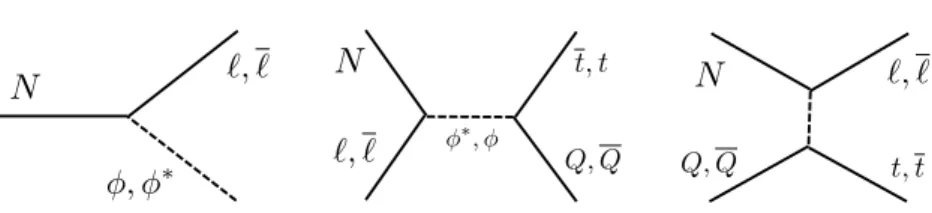
Figure 1: Tree and one-loop diagrams of the RH neutrino decay into the SM lepton and Higgs boson.
The Majorana mass term (2.3) originates from the dimension five operator (ℓαϕ)(ℓβϕ) which appears after integration of the heavy right-handed neutri- nos with the Majorana masses Mi. Hence, the mass matrix for the left-handed neutrinos is given as
mν= hM−1hTv2 (2.10)
where v = 174GeV is the vacuum expectation value of the Higgs boson. 2.1.1 CP -asymmetry in Majorana neutrino decay
Due to the complex phases in the neutrino Yukawa h, the decay process of the RH-neutrino into the SM lepton and Higgs boson becomes CP -asymmetric. At the moment, we focus on the case with hierarchical mass spectrum of the RH neutrinos. We are interested in the radiation-dominated era with the high temperature T > TEW, then the SU (2) symmetry is not broken and all of the SM particles are massless.2
The matrix elements of the tree diagram in Fig.(1) and its CP -conjugate process are written as
iMtreeNi,s→ℓαaϕb= −ihαiuα(p)PRui,s(q)ϵab , (2.11)
iMtreeNi,s→ℓα
aϕ∗b = −ih
†iαvi,s(q)PLvα(p)ϵba (2.12) where s represents the spin degrees of freedom of the RH neutrino. Summing the spin of the RH neutrino and SU (2) and flavor indices, we get the squared amplitude
|MtreeNi→ℓϕ|2≡
∑
s,a,b,α
|MtreeNi,s→ℓαaϕb|
2= ∑
s,a,b,α
|MtreeNi,s→ℓα
aϕ∗b|
2 (2.13)
= gw(h†h)ii(2q · p) = gw(h†h)iiMi2 (2.14)
2In this section, we just omit the thermal masses of the SM particles ∼ gT for simplicity.
where gw = 2 is the SU (2) degrees of freedom. Therefore, there is no CP - asymmetry at the lowest order of (h†h). The decay rates of the RH neutrino into the SM (anti-)particles is given as
ΓNi→ℓϕ= ΓNi→ℓϕ (2.15)
=
∫
dΠℓpdΠϕk(2π)4δ4(q − p − k)∑
s,a,α
|MtreeNi,s→ℓαaϕb|
2
= gw(h†h)ii
32π Mi . (2.16)
The total decay width of the i-th RH neutrino is obtained as ΓNi = ΓNi→ℓϕ+ ΓNi→ℓϕ=
(h†h)ii
8π Mi . (2.17)
The CP -asymmetric contributions come from the interferences between the tree and one-loop diagrams. The matrix elements of the ”vertex” diagram in Fig.(1) and its CP -conjugate process are given as
iMvertexNi,s→ℓαaϕb= +ihαjMjbj(q
2)(h†h)∗
jiuα(p)PR/qui,s(q)ϵab, (2.18)
iMvertexNi,s→ℓα
aϕ∗b
= +i(h†h)∗ijMjbj(q2)h†jαvi,s(q)/qPLvα(p)ϵba. (2.19) Although bj is defined by the one-loop integral, its imaginary part
ℑ[bj(q2)] = 1 16π√q2Mj
f (Mj2
q2 )
Θ(q2) , (2.20)
f (x) =√x (
1 − (1 + x) ln (1 + x
x ))
, (2.21)
is finite and contributes to the CP -asymmetry in the decay process as seen below. From the ”self-energy” diagram in Fig.(1), we get
iMself−energy
Ni,s→ℓαaϕb = −ihαjuα(p)PRG
jj(q)Πji(q)u
i,s(q)ϵab (2.22)
= −ihαj(Mi(h†h)ji+ Mj(h†h)∗ji
) Mia(q2)
q2− Mj2uα(p)PRui,s(q)ϵab ,
iMself−energy Ni,s→ℓαaϕ∗b = −ih
†
jαvi,s(q)Π
ij(q)Gjj(q)P
Lvα(p)ϵba (2.23)
= −ih†jα
(Mi(h†h)ij+ Mj(h†h)∗ij) Mia(q
2)
q2− Mj2vi,s(q)PRvα(p)ϵba . Gjj = i(/q − M + iϵ)−1 is the standard bare Feynman propagator of the j-th RH neutrino. Π is the self-energy of the RH neutrino (B.3), with the bare
propagators of the SM lepton and Higgs boson. It can be separated into two parts as
Πji(q) = −i(/qPR(h†h)ji+ /qPL(h†h)∗ji)a(q2) (2.24) where a comes from the loop integral, and after the renormalization, it’s written as
a(q2) = 1 16π2
( ln|q
2|
µ2 − 2 − iπΘ(q2) )
. (2.25)
The first term of (2.24) represents the self-energy diagram in which the lepton number flows in the same direction as the 4-momentum q, and it gives the first terms of the matrix elements (2.22) and (2.23). Note that Mi2’s in these expressions come from the on-shell momentum q2 = Mi2. For theses terms, the decay amplitudes don’t pick up the scalar component of the RH neutrino propagator G which is proportional to the Majorana mass violating the lepton number as mentioned below the Lagrangian (2.1). Hence, they correspond to the lepton number conserving processes. On the other hands, The second term of (2.24) represents the self-energy diagram in which the lepton number flows in the direction opposite to the 4-momentum. it gives the second terms of the matrix elements (2.22) and (2.23) as the lepton number violating contributions. The leading order CP -asymmetry in the Ni decay processes appears from interferences between these one-loop diagrams and the tree level ones. The difference between the squared amplitudes of Ni→ ℓαϕ and Ni→ ℓ
αϕ processes is given as
∆|M|2i,α≡∑
s,a,b
( MNi,s→ℓαaϕb
2− MN
i,s→ℓαaϕ∗b
2)
= − 2gwMi3Mj
∑
j(̸=i)
(
ℜ[h†iαhαj(h†h)ijbj(Mi2)
]
− ℜ[h†jαhαi(h†h)jibj(Mi2)] ) + 2gwM
3 i
Mi2− Mj2
∑
j(̸=i)
(
ℜ[a(Mi2)h†iαhαj
{(h†h)ijMj+ (h†h)jiMi
}]
− ℜ[a(Mi2)h†jαhαi
{(h†h)jiMj+ (h†h)ijMi}]
)
=gwM
i2
4π
∑
j(̸=i)
(
ℑ[h†iαhαj(h†h)ij]
{ f
(Mj2 Mi2
)
+ MiMj Mi2− Mj2
}
(2.26)
+ ℑ[h†iαhαj(h†h)ji]
Mi2 Mi2− Mj2
) .
The first term proportional to f comes from the vertex corrections (2.18) and (2.19). The second term comes from the lepton number violating parts of the
self-energy corrections (2.22) and (2.23). The lepton number conserving part of the self-energy gives the last term of (2.26). Note that this term vanishes when the lepton flavor index α is summed.
Finally, we get the CP -violating parameter of the decay process Ni→ ℓαϕ: εiα≡
ΓNi→ℓαϕ− ΓNi→ℓαϕ∗
∑
α
(ΓNi→ℓαϕ+ ΓNi→ℓαϕ∗
) (2.27)
= ∆|M|
2i,α
2|MtreeNi→ℓϕ|2
+ O(h†h)2
= ∑
j(̸=i)
{ℑ[h†iαhαj(h†h)ij]
8π(h†h)ii
g(xji) +ℑ[h
†iαhαj(h†h)ji]
8π(h†h)ii
1 1 − xji
}
, (2.28)
where
xji= M
j2
Mi2 , g(x) =
√x (
1 − (1 + x) ln (1 + x
x )
+ 1
1 − x )
. (2.29)
g(x) behaves as −x−1/2× 3/2 in the limit of x ≫ 1. In the limit of xji = Mj2/Mi2 → 1, this expression becomes infinity and not applicable. Such a case with the almost degenerate mass spectrum is the main interest of this thesis. 2.1.2 Kinematic equation for the lepton number
In the conventional approach, the SM lepton number is calculated by using the Boltzmann equation. The Boltzmann equation is a classical equation which describes the time evolution of the one-particle distribution function f (X, p) in the phase space:
p · Df(X, p) = C(X, p) . (2.30)
p is the on-shell 4-momentum of the particle and Dµ = ∂Xµ + Γρµνpρ∂pν is the (Wigner transformed) covariant derivative. The r.h.s. is called as the collision term. The Boltzmann equation is a Markovian equation, that is, the collision term C(X, p) depends only on the physical quantities at X and there is no mem- ory integral. The quantum effects are taken into account only in the collision term. In the spatially flat universe we are interested in, the derivative operator in the r.h.s. is given as p · D = ωp∂t− H(|p|2/a2)∂ωp ≡ ωpdt where a = a(t) is the scale factor and p/a is the spatial physical momentum. Then the time evolution of the distribution function fℓαa,p = fℓαa(t, p) of the SM lepton ℓαa is described by
ωpdtfℓαa,p= CD,ℓαa + Cscatt,ℓαa , (2.31)
CD,ℓαa/ωp= 1 2ωp
∑
i,s,b
∫
dΠNqidΠϕkb(2π)4δ(q − p − k) (2.32)
×{|MNi,s→ℓαaϕ|2(1 − fℓαa,p)(1 + fϕb,k)fNi,s,q
− |Mℓαaϕb→ Ni,s|2fℓαa,pfϕb,k(1 − fNi,s,q)
} ,
Cscatt,ℓαa/ωp= 1 2ωp
∑
i,b,a′,b′,s
∫ dΠℓ
β a′
p′ dΠ ϕb
k dΠ ϕb′ k′ (2π)
4δ(p + k − p′− k′) (2.33)
×{|Mℓβ
a′ϕb′→ℓαaϕb|
2(1 − fℓαa,p)(1 + fϕb,k)fℓβ a′,p′
fϕ
b′,k′
− |Mℓα
aϕb→ℓβa′ϕb′|
2f
ℓαa,pfϕb,k(1 − fℓβ
a′,p′
)(1 + fϕ
b′,k′)
}
where fϕb,k, fℓβ
a′,p′, fϕb′,k
′and fNi,s,qare the distribution functions of ϕb, ℓβa′, ϕb′, Ni,s
with momenta k, p′, k′, q′ respectively.3 For the anti-lepton ℓ, CD,ℓα
a and
Cscatt,ℓαa are obtained just by replacing ℓ with ℓ in (2.32) and (2.33). For the distribution function fNi,s,q of the RH neutrino Ni,s with the momentum q, we get the similar equation:
dtfNi,s,q = 1 2ωp
∑
α,a,b
∫
dΠℓpαadΠϕkb(2π)4δ(q − p − k) (2.34)
×{|Mℓαaϕb→Ni,s|2fℓαa,pfϕb,k(1 − fNi,s,q)
− |MNi,s→ℓαaϕ|2(1 − fℓαa,p)(1 + fϕb,k)fNi,s,q
}
+ 1 2ωp
∑
α,a,b
∫ dΠℓ
α
padΠϕkb(2π)4δ(q − p − k)
×{|Mℓαaϕb→Ni,s|
2f
ℓαa,pfϕb,k(1 − fNi,s,q)
− |MNi,s→ℓαaϕ|2(1 − fℓαa,p)(1 + fϕb,k)fNi,s,q
}.
These Boltzmann equations construct the system of infinite number of dif- ferential equations. However, we can integrate the momenta by taking some assumptions, and then the number of differential equations to be solved si- multaneously is reduced to the finite number. The distribution functions are assumed to depend on the momenta in the following way:
fp= n neq × f
MB
p , neq=
∫ d3p
(2π)3f
MB
p =
1 a3
∫ d3p
(2π)3f
MB
p (2.35)
3Note that the processes mediated by the SM gauge interactions are very fast and their effects are taken into account by assuming that the SM lepton and Higgs boson are in kinematic equilibrium, that is, their distribution functions can be well described by the Fermi-Dirac and Bose-Einstein distribution function with time dependent chemical potentials.
where n is a number density and fpMB is the Maxwell-Boltzmann distribution function:
fpMB= e−ωp/T , ωp=√m2+ |p|2/a2 . (2.36) Using Maxwell-Boltzmann instead of the Bose-Einstein or Fermi-Dirac statistics makes a difference in neq of order 10% at T = m. For consistency, the quantum statistical factors (1 − fℓ), (1 − fN) and (1 + fϕ), representing the induced emission and Pauli blocking, must be neglected. The temperature region we are interested in is higher than the electro-weak temperature TEW, then the system is SU (2) symmetric and the distribution functions of the SM lepton and Higgs boson does not depend on the SU (2) indices: fℓαa = fℓα, fϕb = fϕ. And we assume that the distribution function of the RH neutrino does not depend on the spin degrees of freedom: fNi,s = fNi. Then the number densities are defined as
nℓα= gw
∫ d3p
(2π)3fℓα,p, nℓα = gw
∫ d3p
(2π)3fℓα,p , (2.37)
nϕ= gw
∫ d3k
(2π)3fϕ,k , nϕ= gw
∫ d3k
(2π)3fϕ,k , (2.38)
nNi= gN
∫ d3q
(2π)3fNi,q (2.39)
where gN = 2 is the number of spin degrees of freedom. By integrating the momenta in (2.31) and (2.34) without quantum statistical factors, we obtain the evolution equations for these number densities:
dtnℓα+ 3Hnℓ=∑
i
(
γNi→ℓαϕ
nNi
neqNi − γℓαϕ→Ni nℓα
neqℓα
nϕ
neqϕ )
(2.40) + (scattering process) ,
dtnℓα+ 3Hnℓ=∑
i
(
γNi→ℓαϕnNi
neqNi − γℓαϕ→Ni nℓα neq
ℓα
nϕ neq
ϕ
)
(2.41) + (scattering process) ,
dtnNi+ 3HnNi=∑
α
(
γℓαϕ→Ni
nℓα
neqℓα
nϕ
neqϕ − γNi→ℓαϕ nNi
neqNi )
(2.42)
+∑
α
(
γℓαϕ→Ninℓα neqℓα
nϕ
neqϕ − γNi→ℓαϕ nNi
neqNi )
,