for Mathematical Search
Minh-Quoc NGHIEM
Department of Informatics
The Graduate University for Advanced Studies
A thesis submitted for the degree of
Doctor of Philosophy
Foremost, I would like to thank my supervisor, Prof. Aizawa Akiko, who shared with me a lot of her expertise and research insight. I also like to express my gratitude to Prof. Miyao Yusuke, whose thoughtful advise often served to give me a sense of direction during my studies. I am deeply grateful to the Vietnam government and Japan Student Services Organization for the support that they gave me in order to study in Japan. And I wish to thank everybody in my laboratory for their advises and supports.
Semantic enrichment of mathematical expressions is an important component in the mathematics understanding system, and plays a key role in content-based search engine for mathematical expressions. This dissertation presents a new approach to the semantic enrichment of mathematical expression problem. The problem is formulated as adding semantic form to the presentation form of mathematical ex- pressions. More specific, it is the problem of translating a mathemat- ical expression from its Presentation MathML to Content MathML. The proposed approach uses statistical machine translation method to learn the translation rules automatically from parallel MathML markup data. The structural difference between Presentation and Content MathML is solved by introducing new segmentation rule. An enhancement to statistical machine translation system is made by us- ing an support vector machines classifier to disambiguate the ambigu- ous mathematical terms with features extracted from both presenta- tion form mathematical expressions and surrounding text. Combining theses system archives improvements over prior semantic enrichment systems.
This dissertation also presents a content-based mathematical search system which is an application of semantic enrichment of mathemat- ical expressions. The approach uses semantic enrichment of math- ematical expressions to convert mathematical expressions into their
quality of search system is improved over presentation-based systems. This dissertation makes noteworthy contributions to mathematical- related research field. It confirms that natural language process- ing techniques can be applied to solve mathematical expressions re- lated problems. Since mathematical content is a valuable information source for many users, this finding has important implications for developing mathematical-related systems.
Contents v
List of Figures ix
List of Tables xi
1 Introduction 1
2 Literature review 7
2.1 Mathematical expression representation . . . 7
2.1.1 TEX . . . 8
2.1.2 OpenMath . . . 9
2.1.3 OMDoc . . . 9
2.1.4 MathML . . . 10
2.2 Mathematical Presentation to Content Conversion . . . 12
2.2.1 System of Grigole et al. . . 13
2.2.2 SnuggleTeX . . . 13
2.2.3 LaTeXML . . . 14
2.2.4 System of Wolska et al. . . 14
2.3 Statistical Machine Translation and its applications . . . 15
2.3.1 Word alignment . . . 15
2.3.2 Applications of Machine Translation . . . 16
2.4 Mathematical Search System . . . 17
2.4.1 Presentation-based systems . . . 17
2.4.1.1 Springer LaTeXSearch . . . 17
2.4.1.2 MathFind . . . 18
2.4.1.3 Digital Library of Mathematical Functions . . . . 18
2.4.2 Content-based systems . . . 19
2.4.2.1 Wolfram Function . . . 19
2.4.2.2 MathWebSearch . . . 20
2.4.2.3 MathGO! . . . 20
2.4.2.4 MathDA . . . 20
2.4.2.5 System of Nguyen et al. . . 21
3 Semantic Enrichment of mathematical expressions 22 3.1 Overview . . . 22
3.2 Proposed System . . . 25
3.2.1 System Overview . . . 25
3.2.2 Preprocessing . . . 26
3.2.3 Extracting Rules . . . 28
3.2.3.1 Extracting Segmentation Rules . . . 28
3.2.3.2 Extracting Translation Rules . . . 30
3.2.4 Content MathML Generation . . . 32
3.3 Experimental Results and Discussions . . . 34
3.3.1 Evaluation Setup . . . 34
3.3.2 Evaluation Methodology . . . 35
3.3.3 Experimental Results . . . 38
4 Sense Disambiguation of Mathematical Term 42
4.1 Mathematical Sense Disambiguation Data Creation . . . 43
4.1.1 Overview . . . 43
4.1.2 Method . . . 44
4.2 Mathematical Sense Disambiguation System . . . 47
4.2.1 Overview . . . 47
4.2.2 Method . . . 49
4.2.2.1 Statistical-based rule extraction . . . 49
4.2.2.2 SVM disambiguation . . . 50
4.2.2.3 Translation . . . 54
4.3 Evaluation . . . 54
4.3.1 Mathematical Sense Disambiguation Data Creation . . . . 54
4.3.1.1 Evaluation Setup . . . 54
4.3.1.2 Evaluation Results . . . 54
4.3.2 Mathematical Sense Disambiguation System . . . 57
5 Content-based mathematical search 62 5.1 Overview . . . 62
5.2 Methods . . . 65
5.2.1 Data collection . . . 65
5.2.2 Semantic enrichment of mathematical expressions . . . 66
5.2.3 Indexing . . . 67
5.2.4 Searching . . . 67
5.3 Experimental Results . . . 69
5.3.1 Evaluation Setup . . . 69
5.3.2 Evaluation Methodology . . . 70
5.3.3 Experimental Results . . . 72
6 Conclusion 75
Publication list 78
References 81
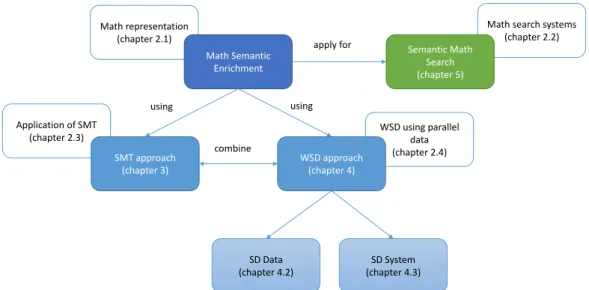
1.1 Overview structure of the thesis. . . 6
2.1 Mathematical expressions on Wikipedia. . . 8
2.2 Mathematical expression written using TEX. . . 9
2.3 MathML presentation markup for the expression arctan(0)=0. . 11
2.4 MathML content markup for the expression arctan(0)=0. . . 11
2.5 Well-known quadratic formula written in ASCIIMathML. . . 12
2.6 Illustration of EM algorithm. . . 16
3.1 System Framework . . . 25
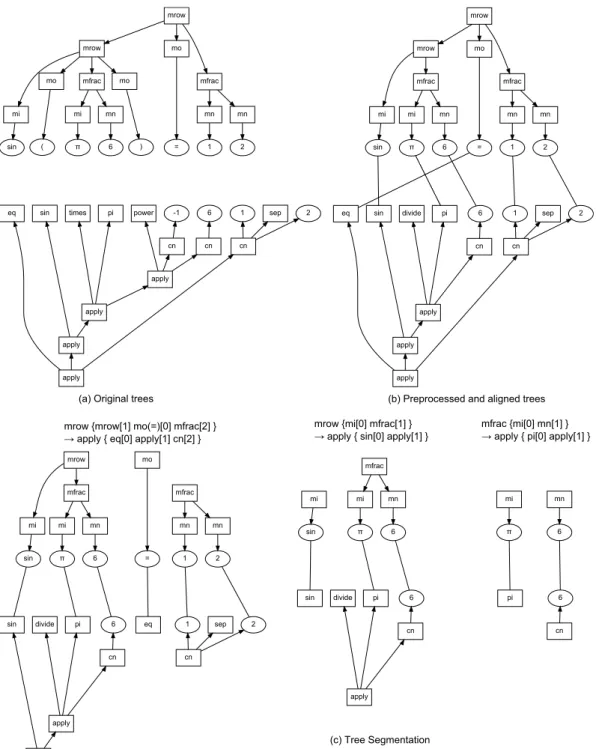
3.2 (a) Original Presentation and Content MathML Markup tree rep- resentations (b) preprocessed trees and the alignment between the nodes (c) segmentation process. . . 27
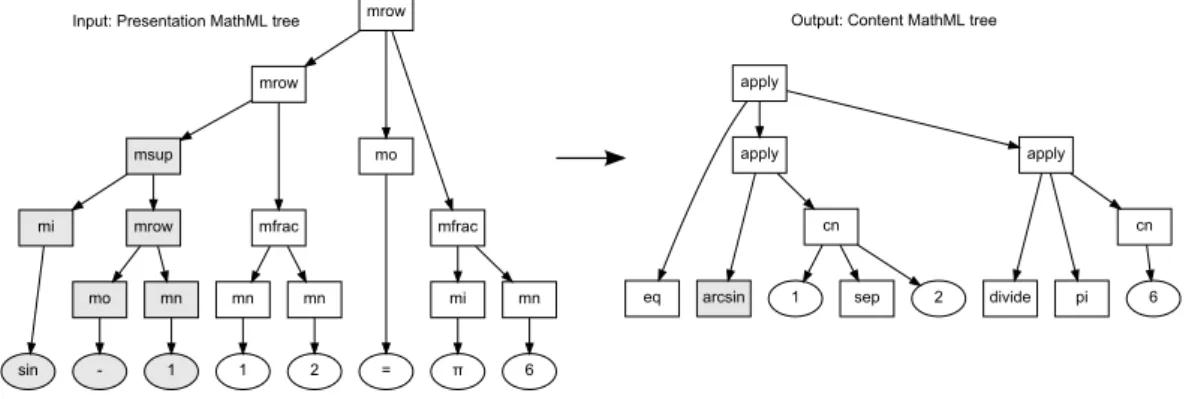
3.3 Disambiguation example . . . 34
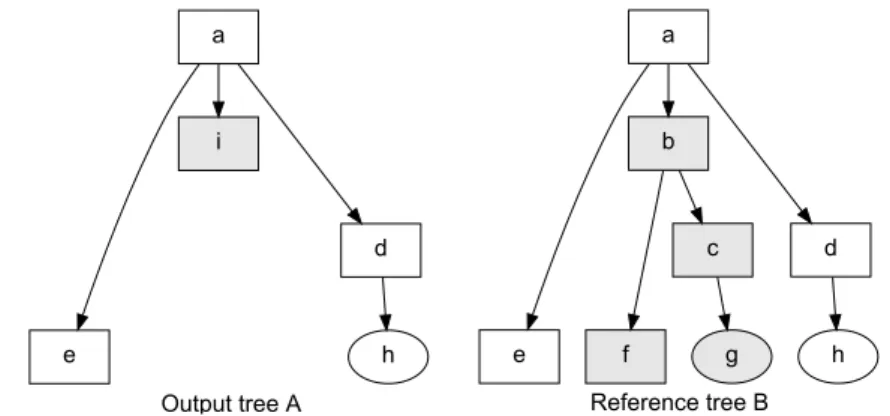
3.4 Example of an output tree (A) and a reference (B). . . 37
3.5 Correlation between TEDR and PTR scores and training set size. 39 3.6 Comparison of the different systems. . . 41
4.1 Steps for generating the data for MTSD. . . 45
4.2 Example of alignment results for GIZA++ before and after apply- ing the heuristic rules for the expression arctan(0)=0. . . 46
4.3 System Framework . . . 50
5.1 System Framework. . . 65
5.2 Index terms of the expression sin(π8). . . 68
5.3 Query terms of the expression sin(π8). . . 69
5.4 Top 10 precision of the search system. . . 72
5.5 Comparison of different systems. . . 73
3.1 Examples of segmentation rules extracted from Wolfram Functions
Site dataset . . . 30
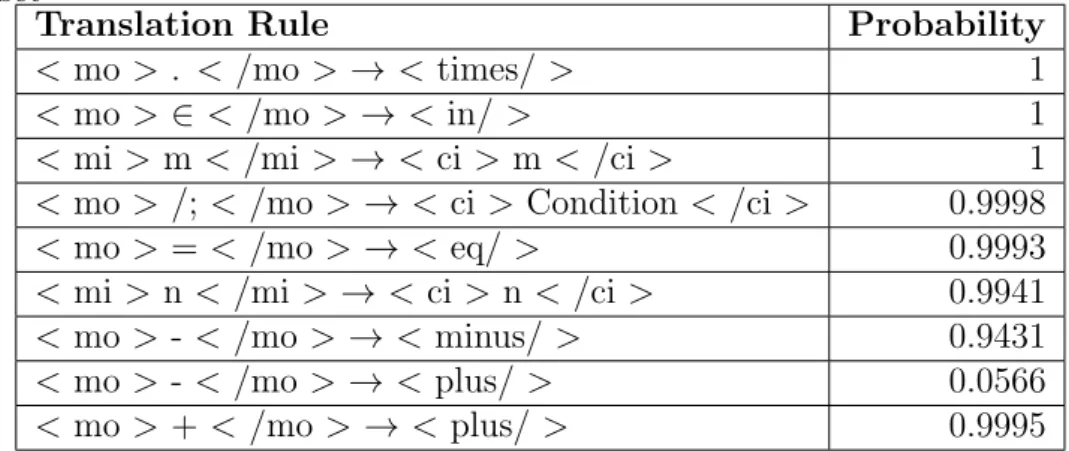
3.2 Examples of translation rules extracted from Wolfram Functions Site dataset . . . 32
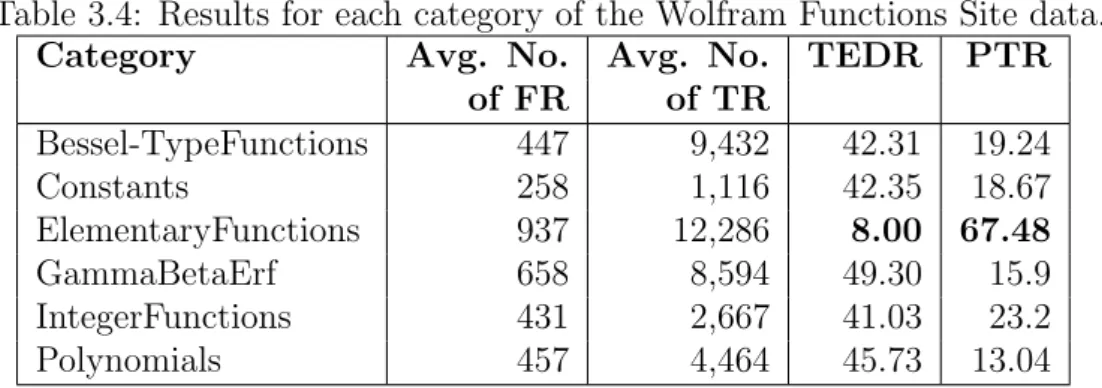
3.3 Data statistics. The first six categories were collected from the Wolfram Functions site. The last was extracted from 20 ACL papers. 35 3.4 Results for each category of the Wolfram Functions Site data. . . 39
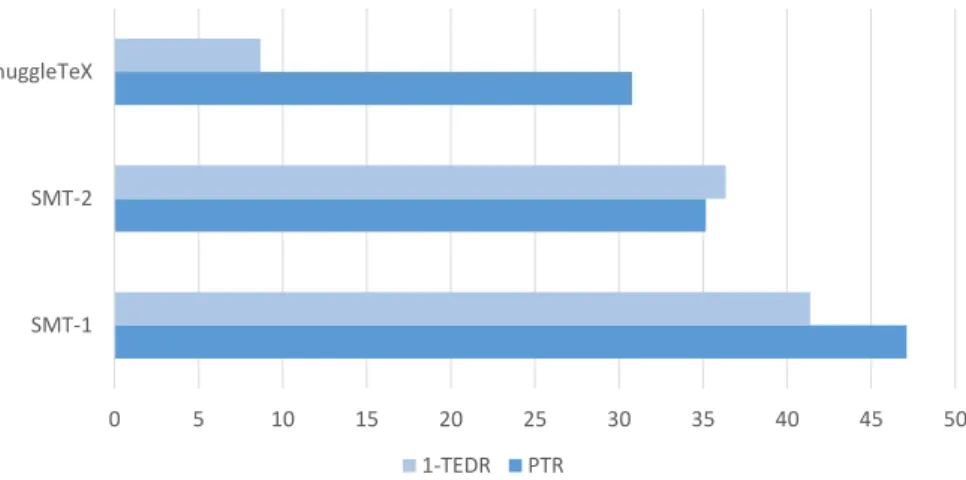
3.5 Results for ACL-ARC data. SMT-1 used ACL-ARC data, ten-fold cross-validation. SMT-2 used the rules extracted from WFS Data. 40 4.1 Presentation mi elements and their associated Content elements . 51 4.2 Features used for classification . . . 52
4.3 Generated data . . . 55
4.4 Sense disambiguation accuracy for ambiguous mi terms . . . 56
4.5 Examples of mathematical expressions and their description in ACL-ARC dataset . . . 59
4.6 Disambiguation accuracy . . . 60
4.7 Semantic enrichment TEDR . . . 61
5.1 Queries. . . 71
5.2 nDCG and Precision at 10 scores of the search systems. . . 72
Introduction
The issue of retrieving semantically similar mathematical expressions has received considerable critical attention [Aizawa et al., 2013]. Semantic search for math- ematical expressions improves search accuracy by ascertaining the contextual meaning of mathematical terms as they appear in a search-able database to gen- erate more relevant results. Semantic enrichment of mathematical expressions is an important component of the mathematics understanding system. It plays a key role in a content-based search engine for mathematical expressions. The process of associating semantic tags, usually concepts, with mathematical ex- pressions, so-called semantic enrichment, is an important technology for fulfilling the dream of a global digital mathematical library.
A considerable amount of literature has been published on retrieving semanti- cally similar mathematical expressions [Adeel et al.,2008; Kohlhase & Prodescu, 2013; Kohlhase & Sucan, 2006; Liska et al.,2013;Nguyen et al., 2012; Wolfram, 2013]. These studies used two freely available toolkits, SnuggleTeX [McKain, 2013] and LaTeXML [Miller, 2013], for semantic enrichment of mathematical expressions. Mathematical expressions are first semantically enriched to their content-based format, which is Content MathML (see 2.1.4). Search is then per-
formed by matching the queries with indexed mathematical terms in the database. The experimentally obtained results show that the proposed approaches, using classical information retrieval strategies, can perform better than other methods. Research efforts to date have tended to examine retrieval of semantically sim- ilar mathematical expressions specifically rather than semantic enrichment of mathematical expressions. Much uncertainty remains about the relation between the performance of mathematical search systems and the performance of semantic enrichment components. Prior attempts to address the semantic enrichment of mathematical expressions problem include SnuggleTeX [McKain, 2013] and La- TeXML [Miller, 2013]. These systems use handwritten rule-based methods for disambiguation and translation. Two issues limit these solutions:
• As handwritten rule-based systems, these systems require mathematical knowledge and human involvement;
• These systems remain at the experimental stage because of difficulties with processing complex mathematical symbols and because of the wide-ranging nature of mathematical expressions.
Furthermore, no research has been found that has surveyed how well semantic enrichment components perform.
Therefore, this study has two primary aims:
• To develop an understanding of semantic enrichment of mathematical ex- pressions and its performance.
• To investigate the contribution of semantic enrichment of mathematical expressions to content-based mathematical search systems.
This dissertation will first develop a semantic enrichment of mathematical ex- pressions system based on machine-learning techniques and will then go on to
establish a method for automatic evaluation of the performance of semantic en- richment of mathematical expressions system. This dissertation will also develop a content-based mathematical search system and examine the contribution of se- mantic enrichment of mathematical expressions to a content-based mathematical search system.
This study was undertaken to address the following research questions:
• How well do machine-learning-based approaches perform compared to hand- written rule-based approaches on the problem of semantic enrichment of mathematical expressions?
• To what extent can we apply natural language processing techniques to the problem of semantic enrichment of mathematical expressions?
• How is the performance of semantic enrichment of mathematical expressions system affecting content-based mathematical search systems?
Chapter 3, 4, and 5 of this dissertation respectively address the three research questions above.
This dissertation follows machine-learning-based approaches, with in-depth analysis of the relation between mathematical expressions and natural language text. The data used in this dissertation were collected from the Wolfram Func- tions Site [Wolfram,2013], the world’s largest collection of mathematical expres- sions. Other data were also prepared by annotating mathematical expressions drawn from 20 papers from the archives of the Association for Computational Linguistics Anthology Reference Corpus [Bird et al., 2008; Kan, 2013]. Exper- iments are performed using a ten-fold cross validation or reserved test set on numerous mathematical expressions to ensure the correctness of the proposed approaches.
This report is the first of a study making a complete evaluation of a semantic enrichment of mathematical expressions system. This study provides a testing dataset for mathematical term sense disambiguation and suggests two standard metrics for evaluating this task: the tree-edit-distance error rate and the perfect translation rate. This is also the first study to evaluate the relation between the performance of mathematical search system and the performance of semantic enrichment component. The results of this research will serve as a base for future studies in this field.
Throughout this dissertation, the term “semantic enrichment” of mathemati- cal expressions will be used to refer to adding Content MathML markup to Presen- tation MathML markup of mathematical expressions. This definition is the same as that of David McKain [McKain, 2013] who defined “semantic enrichment” as generating “semantically richer” outputs than its usual display-oriented Presenta- tion MathML. Fundamentally, semantic enrichment means enriching the content of data by tagging, categorizing, or classifying data in relation mutually, to dic- tionaries, or other base reference sources. A considerable amount of literature has been published on “semantic enrichment” including semantic enrichment of jour- nal articles [Batchelor & Corbett, 2007], and semantic enrichment of text [Pe˜nas
& Hovy, 2010].
The main reason for choosing this topic is inspired by the idea of Tim Berners- Lee about “Semantic Web” [Berners-Lee, 2000]. His vision suggests that com- puters of the future can analyze all data on the Web, as well as understand the contents of human language. With the huge amount of information available on the Web, automatic extraction, organization, and summarization of web infor- mation is necessary. In the future, it will not be necessary for people to surf hundreds of web pages, or read dozens of articles to find the information they need. A computer will automatically do all the work: analyze an article, find
related articles, and summarize all the information, and then provide it to users. Semantic enrichment of mathematical expressions is the first step toward this goal.
The overall structure of the dissertation takes the form of six chapters, in- cluding this introductory chapter, as depicted in Figure1.1. Chapter2begins to lay out the background by introducing mathematical expression representation. It then provides an overview about the related work on semantic enrichment of mathematical expressions and mathematical search systems. Chapter3presents a method for semantic enrichment of mathematical expressions based on a Statisti- cal Machine Translation approach. Portions of this chapter were published previ- ously as [Nghiem et al., 2013a]. Chapter 4 describes an additional enhancement for semantic enrichment of mathematical expressions by introducing the method for sense disambiguation of mathematical terms. Portions of this chapter were published previously as [Nghiem et al., 2013b,c]. Chapter 5 describes a method for content-based mathematical search system and the contribution of semantic enrichment of mathematical expressions to that system. Chapter6concludes the dissertation and points to possible avenues for future work.
Application of SMT (chapter 2.3)
Math search systems (chapter 2.2) Math representation
(chapter 2.1)
Math Semantic Enrichment
Semantic Math Search (chapter 5) apply for
SMT approach (chapter 3)
SD Data (chapter 4.2)
SD System (chapter 4.3) combine
WSD using parallel data (chapter 2.4) WSD approach
(chapter 4)
using using
Figure 1.1: Overview structure of the thesis.
Literature review
This chapter begins by laying out the background by introducing representation of mathematical expressions. It then provides an overview about the related work on semantic enrichment of mathematical expressions and mathematical search system.
2.1 Mathematical expression representation
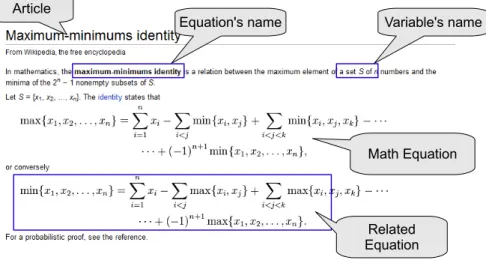
Many websites such as Wikipedia use images to present mathematical expressions. Using images, the rendering of mathematical expression is independent of client- side browser resources. Figure2.1portrays a page from a mathematical section on Wikipedia with mathematical expressions displayed as images. Images provide a methodologically uniform approach, but the result is not machine-readable. It is possible to use optical character recognition (OCR) software to recognize mathematical expressions and convert them to accessible formats. A well-known example of mathematical OCR software is InftyReader [Suzuki et al.,2004].
Several markup languages for mathematical expression representation. Com- mon mathematical markup languages are TEX, ASCIIMathML, OpenMath, OM-
Article
Math Equation Variable's name Equation's name
Related Equation
Figure 2.1: Mathematical expressions on Wikipedia.
Doc, and MathML. The markup languages are divisible into two main types: presentation markup and content markup. Presentation markups, which include TEX, ASCIIMathML, and Presentation MathML, are used to describe the layout structure of a mathematical expression. Content markups, which include Open- Math, OMDoc, and Content MathML, provide explicit encoding of the underlying mathematical structure of an expression.
2.1.1 TEX
TEX [Knuth, 1984; Lamport, 1986] is a typesetting system which can typeset complex mathematical expressions. TEX is popular in academia and has been commonly used by many researchers, especially in mathematics. TEX provides a text syntax for mathematical expressions so that authors can typeset expressions in their papers by themselves. An expression is printed as a person would write it by hand, or as a person would typeset the expression. On certain web pages, such as Wikipedia, mathematical expressions can be displayed in TEX format using the alt attribute.
Figure2.2portrays a mathematical expression and its written form using TEX.
\sin \alpha = \frac {\textrm{opposite}} {\textrm{hypotenuse}} = \frac {a} {h} sin � =ℎ� �� �� =�ℎ
Figure 2.2: Mathematical expression written using TEX.
2.1.2 OpenMath
OpenMath [Buswell et al., 2004] is a standard markup language for representing the meaning of mathematical expressions. It emphasizes the representation of semantic information and is not intended to be used directly for presentation. OpenMath uses an extensible Content Dictionary for encoding the semantics of mathematics. It enables mathematical expressions to be exchanged among computer programs, stored in databases, or published on the world wide web. OpenMath has a strong relation to the MathML markup language; it is useful to complement MathML.
2.1.3 OMDoc
OMDoc [Kohlhase,2006] (Open Mathematical Documents) is a semantic markup format for mathematical documents. It covers the whole range of written math- ematics including mathematical expressions, statements, and theories. OMDoc is used in e-learning, data exchange, and document preparation. It also empha- sizes representation of semantic information that is not primarily presentation- oriented. OMDoc uses OpenMath and Content MathML formats to present mathematical expressions.
2.1.4 MathML
The best-known open markup format for representing mathematical expressions on the web is MathML [Ausbrooks et al., 2010]. It is a format recommended by the W3C Math Working Group as a standard to represent mathematical expres- sions. MathML is an XML application for describing mathematical notations and encoding mathematical content within a text format. MathML has encoding of two types: content-based encoding, called Content MathML and presentation- based encoding, called Presentation MathML. Content MathML addresses the semantic meaning whereas Presentation MathML addresses the display of the mathematical expressions.
Presentation MathML specifically examines the display of an expression and has about 30 elements. The presentation elements of Presentation MathML are divided into two classes: token elements and layout schemata. Token ele- ments represent identifier names, function names, numbers, and so forth. Layout schemata build expressions from parts. Figure2.3shows the Presentation Markup of the expression arctan(0)=0 1.
Content MathML provides an explicit encoding of the underlying mathemat- ical meaning of the mathematical expression rather than its layout. It uses the apply element to represent the function application. The function being applied is the first child element under apply, remaining child elements are operands or parameters. Content MathML has over a hundred different elements for different functions and operators. Figure2.4 shows the Content Markup of the expression arctan(0)=0.
One disadvantage of MathML is it is not designed to be written by a human. To overcome this problem, ASCIIMathML [ASCIIMathML, 2013] provides an easy means to write mathematical expressions. Mathematical expressions repre-
1http://functions.wolfram.com/01.14.03.0001.01
Presentation MathML
< mrow >
< mrow >
< msup >
<mi > tan </ mi >
< mrow >
<mo > - </ mo >
<mn >1 </ mn >
</ mrow >
</ msup >
<mo >( </ mo >
<mn >0 </ mn >
<mo >) </ mo >
</ mrow >
<mo >= </ mo >
<mn >0 </ mn >
</ mrow >
Figure 2.3: MathML presentation markup for the expression arctan(0)=0. sented using ASCIIMath markup are easy to produce because they mainly use ASCII characters to represent the mathematical symbols. The script of ASCI- IMathML is open source and available under a GPL license. Figure 2.5 shows the ASCIIMathML markup of the well-known quadratic formula.
MathML presentation and content markups are chosen in this dissertation to represent mathematical expressions for the following reasons:
ContentMathML
< apply >
< eq / >
< apply >
< arctan / >
<cn >0 </ cn >
</ apply >
<cn >0 </ cn >
</ apply >
Figure 2.4: MathML content markup for the expression arctan(0)=0.
ASCIIMathML x =( - b + - sqrt ( b ^2 -4 a c ))/(2 a )
Figure 2.5: Well-known quadratic formula written in ASCIIMathML.
• Since its release in 1997, MathML has grown to become a general format that enables mathematics to be served, received, and processed in widely various applications.
• MathML is useful to encode both mathematical notation and mathematical content.
• Large collections of mathematical expressions are already available in MathML, and access to these collections is easy.
• All other markups including eqn [Kernighan & Cherry, 1975], OpenOf- fice.org Math [Oracle, 2013], ASCIIMathML, and OpenMath can be con- verted into MathML using freely available toolkits [Stamerjohanns et al., 2009].
2.2 Mathematical Presentation to Content Con-
version
As described in the previous section, mathematical expressions consist of presentation- based and content-based formats. Mathematical search systems can either use presentation-based or content-based format as indexed terms. Whereas presentation- based systems capable of returning exact or similar matches, content-based sys- tems can return more meaningful results. However, content-based search systems need a mathematical expression in content-based format. Because content-based
mathematical expressions are usually not available, conversion or semantic en- richment of mathematical expressions is necessary.
Few studies have addressed the problem of semantic enrichment of mathe- matical expressions. In this section, we list some of the work on interpreting the meaning of mathematical expressions. Two available systems support generation of Content MathML markup from Presentation MathML or LaTeX: SnuggleTeX and LaTeXML. Other systems of Grigore et al. [2009] and Wolska & Grigore [2010]; Wolska et al. [2011] specifically identify the correct meaning or class of a mathematical term.
2.2.1 System of Grigole et al.
Grigore et al. [2009] proposed an approach to understanding mathematical ex- pressions based on the text surrounding the mathematical expressions. The main concept underlying this approach is to use the surrounding text for disambigua- tion based on word sense disambiguation and lexical similarities. First, a local context C (five nouns preceding a target mathematical expression) is found in each sentence. For each noun, the system identifies a Term Cluster (derived from the OpenMath Content Dictionary). The highest semantic scores obtained are weighted, summed up, and normalized by the length of the considered context. The Term Cluster with the highest similarity score is assigned as the interpreta- tion. When this approach was evaluated for 451 manually annotated mathemat- ical expressions, the best result was an F0.5 score of 68.26.
2.2.2 SnuggleTeX
A project called SnuggleTeX [McKain, 2013] addresses the semantic interpreta- tion of mathematical expressions. The project provides a direct method to gen- erate Content MathML from Presentation MathML based on manually encoded
rules. The current version at the time of writing this paper supports operators that are the same as ASCIIMathML [ASCIIMathML,2013]. For example, it uses the ASCII string “\in” instead of the symbol “∈”. One important shortcoming of this approach is that it always makes the same interpretation for the same Presentation MathML element.
2.2.3 LaTeXML
Lamapun [Ginev et al.,2009] project investigates semantic enrichment, structural semantics, and ambiguity resolution in mathematical corpora. The project uses LaTeXML [Miller,2013] for conversion from LaTeX to MathML. Unfortunately, no evaluation of these systems has been made to date.
2.2.4 System of Wolska et al.
Wolska & Grigore[2010];Wolska et al.[2011] presented a knowledge-poor method for identifying the denotation of simple symbolic expressions in mathematical dis- course. Based on statistical co-occurrence measures, the system sorted a simple symbolic expression under one of seven predefined concepts. Here, the authors found that lexical information from the linguistic context immediately surround- ing the expression improved results. This approach achieves 66% agreement with the gold standard of manual annotation by experts. From our perspective, the predefined concepts are closely related to syntactic function, not the semantics of the terms.
2.3 Statistical Machine Translation and its ap-
plications
Statistical machine translation (SMT) [Brown et al., 1990, 1993; Chiang, 2005; Yamada & Knight, 2001] is by far the most widely studied machine translation method. SMT uses a very large dataset of good translations, which comprises a corpus of texts already translated into another language called a parallel corpus. It uses these parallel texts to infer a statistical model of translation automatically. The statistical model is then applied to new texts to derive a translation.
2.3.1 Word alignment
Most of the methods on extracting translation rules from a parallel corpus start with a word alignment. In the word alignment process, each element in one language is matched with the corresponding element in the other language. Many word aligners are available today, including GIZA++ [Och & Ney, 2003],
MGIZA++ [Gao & Vogel, 2008], and Berkeley Aligner [Liang et al., 2006]. This dissertation uses GIZA++ toolkit which implements the IBM Models 1–5 and an HMM word alignment model. The training of these models is done using the Expectation-Maximization (EM) algorithm.
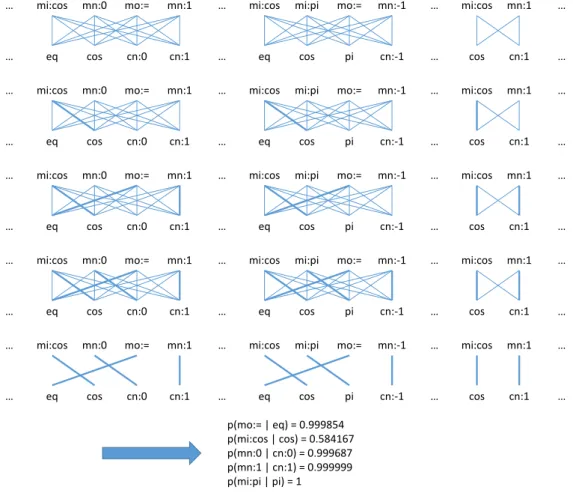
EM algorithm is used to estimate parameters in statistical models, where the model depends on unobserved variables. In word alignment, the EM algorithm first initializes model parameters. It then iterates alternates between performing an expectation step, and a maximization step. Expectation step assigns proba- bilities to the missing data. Maximization step estimates model parameters from completed data. Figure2.6presents an example of EM algorithm with source lan- guage is Presentation MathML elements and target language is Content MathML elements.
… mi:cos mn:0 mo:= mn:1 … mi:cos mi:pi mo:= mn:-1 … mi:cos mn:1 …
… eq cos cn:0 cn:1 … eq cos pi cn:-1 … cos cn:1 …
… mi:cos mn:0 mo:= mn:1 … mi:cos mi:pi mo:= mn:-1 … mi:cos mn:1 …
… eq cos cn:0 cn:1 … eq cos pi cn:-1 … cos cn:1 …
… mi:cos mn:0 mo:= mn:1 … mi:cos mi:pi mo:= mn:-1 … mi:cos mn:1 …
… eq cos cn:0 cn:1 … eq cos pi cn:-1 … cos cn:1 …
… mi:cos mn:0 mo:= mn:1 … mi:cos mi:pi mo:= mn:-1 … mi:cos mn:1 …
… eq cos cn:0 cn:1 … eq cos pi cn:-1 … cos cn:1 …
… mi:cos mn:0 mo:= mn:1 … mi:cos mi:pi mo:= mn:-1 … mi:cos mn:1 …
… eq cos cn:0 cn:1 … eq cos pi cn:-1 … cos cn:1 …
p(mo:= | eq) = 0.999854 p(mi:cos | cos) = 0.584167 p(mn:0 | cn:0) = 0.999687 p(mn:1 | cn:1) = 0.999999 p(mi:pi | pi) = 1
…
Figure 2.6: Illustration of EM algorithm.
2.3.2 Applications of Machine Translation
Word Alignment-based Semantic Parsing [Wong & Mooney, 2006] applies MT techniques to learn semantic parsers. The fundamental idea is to use SMT to learn to translate from natural language to a meaning representation language. A word alignment model is used for lexical acquisition, and a syntax-based translation model is used as the parsing model. Results of this study show that SMT is applicable to semantic parsing.
Several reports have described encouraging results for word sense disambigua- tion based on parallel corpora [Carpuat & Wu,2007; Chan & Ng, 2005; Diab &
Resnik, 2002; Lefever & Hoste, 2010; Lefever et al., 2011; Pad´o & Lapata, 2009; Tufi¸s et al., 2004]. Ide et al. [2002] used translation equivalents derived from parallel aligned corpora to determine sense distinctions that are applicable to automatic sense-tagging. They evaluated their work using a subset of 33 nouns covering a range of occurrence frequencies and degrees of ambiguity [Ide et al., 2001], with results indicating no significant difference in agreement rates for the algorithm and for human annotators. The main limitation of this study is its dependence on aligned corpora, which are not easily obtainable.
2.4 Mathematical Search System
As the demand for mathematical searching increases, several mathematical re- trieval systems have come into use. Most systems use the conventional text search techniques to develop a new mathematical search system [National In- stitute of Standards and Technology, 2013; Springer, 2013; Uniquation, 2013]. Some systems with specific format for mathematical content and queries [Al- tamimi & Youssef,2008;Miner & Munavalli,2007;Yokoi & Aizawa,2009;Youssef, 2005; Youssef & Altamimi, 2007]. Based on a different mathematical markup, current mathematical search systems are divisible into presentation-based and content-based systems. Presentation-based systems duel with the presentation form whereas content-based systems duel with the meanings of mathematical formulae.
2.4.1 Presentation-based systems
2.4.1.1 Springer LaTeXSearch
Springer offers a free service, Springer LATEX Search [Springer, 2013], to search for LaTeX code within scientific publications. It enables users to locate and view
equations containing specific LATEX code, or equations containing LATEX code that is similar to another LATEX string. A similar search in Springer LATEX Search ranks the results by measuring the number of changes between a query and the retrieved formulae. Each result contains an entire LaTeX string, a converted image of the equation, and information about and links to its source. However, the ranking algorithm performs poorly when only measuring the number of changes.
2.4.1.2 MathFind
MathFind [Munavalli & Miner, 2006] is a math-aware search engine under de- velopment by Design Science. This work extends the capability of existing text search engines to search mathematical content. The system analyzes expres- sions in MathML and decomposes the mathematical expression into a sequence of text-encoded math fragments. Queries are also converted to sequences of text and the search was done as normal text search. However, treating mathematical expressions as text can not fully capture the structural notations of mathematical formulae.
2.4.1.3 Digital Library of Mathematical Functions
The Digital Library of Mathematical functions (DLMF) project at NIST is a mathematical database available on the Web [Miller & Youssef,2003;National In- stitute of Standards and Technology, 2013]. Two approaches are used for search- ing for mathematical formulas in DLMF. The first approach converts all mathe- matical content to a standard format. The second approach exploits the ranking and hit-description methods. These approaches enable simultaneous searching for normal text as well as mathematical content.
In the first approach [Youssef,2005], they propose a textual language, Textual- ization, Serialization and Normalization (TexSN). TeXSN is defined to normalize
non-textual content mathematical content to standard forms. User queries are also converted to the TexSN language before processing. Then, a search is per- formed to find the mathematical expressions that match the query exactly. As a result, similar mathematical formulae are not retrieved.
In the second approach [Youssef, 2007], the search system treats mathemat- ical expressions as a document containing a set of mathematical terms. This paper introduces new relevance ranking metrics and hit-description generation techniques. They claimed that the new relevance metrics are far superior to the conventional tf-idf metric. The new hit-descriptions are also more query-relevant and representative of the hit targets than conventional methods. However, this paper lacked a thorough subjective evaluation including numerous users and a carefully selected benchmark of queries.
Other notable math search systems include Math Indexer and SearcherSojka
& L´ıˇska [2011], EgoMath Miutka & Galambo [2011], and ActiveMath Siekmann [(visited on 01 March. 2014].
2.4.2 Content-based systems
2.4.2.1 Wolfram Function
The Wolfram Functions Site [Wolfram, 2013] is the world’s largest collection of mathematical formulas accessible on the Web. Currently the site has 14 function categories containing more than three hundred thousand mathematical formulae. This site allows users to search for mathematical formulae from its database. The Wolfram Functions Site proposes similarity search methods based on MathML. However, content-based search is only available with a number of predefined con- stants, operations, and function names.
2.4.2.2 MathWebSearch
The MathWebSearch system [Kohlhase & Prodescu, 2013; Kohlhase & Sucan, 2006] is a content-based search engine for mathematical formulae. It uses a term indexing technique derived from an automated theorem proving to index Content MathML formulae. The system first converts all mathematical formulae to Content MathML markup and uses substitution-tree indexing to build the index. The authors claimed that search times are fast and unchanged by the increase in index size. However, MathWebSearch is currently restricted to an exact formula search without similarity search and full-text search.
2.4.2.3 MathGO!
Adeel et al. [2008] proposed a mathematical search system called the MathGO! Search System. The approach used conventional search systems using regular ex- pressions to generate keywords. For better retrieval, the system clustered mathe- matical formula content using K-Som, K-Means, and AHC. They did experiments on a collection of 500 mathematical documents and achieved around 70–100 per- cent precision. However, the complexity of their algorithm is expected to increase when the number of templates increases.
2.4.2.4 MathDA
Yokoi and Aizawa [Yokoi & Aizawa, 2009] proposed a similarity search method for mathematical expressions that is adapted specifically to the tree structures ex- pressed by MathML. They introduced a similarity measure based on Subpath Set and proposed a MathML conversion that is apt for it. Their experiment results showed that the proposed scheme can provide a flexible interface for searching for mathematical expressions on the Web. However, the similarity calculation is the bottleneck of the search when the database size increases. Another shortcoming
of this approach is that the system only recognizes symbols and does not perceive the actual values or strings assigned to them.
2.4.2.5 System of Nguyen et al.
Nguyen et al. [2012] proposed a math-aware search engine that can handle both textual keywords and mathematical expressions. They used Finite State Machine model for feature extraction and representation framework captures the semantics of mathematical expressions For ranking, they used the passive–aggressive on- line learning binary classifier. Evaluation was done using 31,288 mathematical questions and answers downloaded from Math Overflow [MathOverflow, 2013]. Experimental results showed that their proposed approach can perform better than baseline methods by 9%. However, results for other kinds of mathematical document retrieval have not been reported.
Semantic Enrichment of
mathematical expressions
This chapter presents a method for semantic enrichment of mathematical expres- sions based on Statistical Machine Translation approach. Portions of this chapter were previously published as [Nghiem et al., 2013a].
3.1 Overview
The semantic enrichment of mathematical expressions is among the most sig- nificant areas of discussion related to the digitization of mathematical and sci- entific content and its applications. The challenge entails associating semantic tags, usually concepts, with mathematical expressions. Encoding the underlying mathematical meaning of an expression confers several benefits:
• It facilitates more precise information exchange between systems that pro- cess mathematical objects;
• It improves the accuracy of mathematical search systems by enabling se- mantic searching of mathematical expressions;
• It also benefits computer algebra systems, automated reasoning systems, and multi-lingual translation systems.
As with natural language, the semantic enrichment of mathematical expres- sions is a nontrivial task. Although more rigorous than natural language, mathe- matical notations are ambiguous, context-dependent, and vary from community to community. The difficulty in inferring semantics from a presentation stems from the many-to-many potential mappings from presentation to semantic [Aus- brooks et al., 2010]. Examples include binomial coefficients, which can be pre- sented in varying notations: C(n, k),nCk,nCk, Cnk, Ckn. Moreover, each notation can have other author-dependent meanings aside from the binomial coefficient itself.
This chapter introduces an automatic semantic enrichment method for math- ematical expressions to analyze and disambiguate mathematical terms. In this study, MathML [Ausbrooks et al., 2010] Presentation Markup is used to dis- play mathematical expressions and MathML Content Markup is used to convey mathematical meaning. The semantic enrichment task then becomes the task of generating Content MathML outputs from Presentation MathML expressions.
Prior attempts to address this problem include SnuggleTeX [McKain, 2013] and LaTeXML [Miller, 2013]. These systems use handwritten rule-based meth- ods for disambiguation and translation. The first discussions and analyses of semantic enrichment of mathematical expressions emerged during version 1.2.0 of SnuggleTeX within the Maths Assess Project [MathsAssess, 2013]. However, these features are still to be considered experimental and no research has been found that surveyed how well semantic enrichment component performs.
This chapter proposes an approach based on Statistical Machine Translation (SMT) [Brown et al., 1990] techniques. In the proposed framework, the under- lying mathematical meaning of an expression is inferred from the probability
distribution p(c|p) that a semantic expression c is the translation of presenta- tion expression p. The probability distribution is automatically calculated given parallel markup MathML data which contains both Presentation and Content MathML markup for a single expression. The data used in this study was col- lected from the Wolfram Functions Site [Wolfram,2013] (WFS). Another parallel markup MathML data was also prepared by annotating mathematical expressions drawn from 20 papers from the ACL Anthology Reference Corpus [Bird et al., 2008; Kan, 2013] (ACL-ARC).
The SMT approach has a number of attractive features over rule-based ap- proach. The first advantage of using SMT is we can make better use of resources. As mentioned above, there is a great deal of mathematical expressions in MathML parallel markup format, i.e. the Wolfram Functions Site data. The second ad- vantage of using SMT is we can quickly produce the translation rule set. The rule-based translation system requires the manual development of rules, which can be costly, and which often do not generalizable.
The main disadvantage of the SMT method is that it does not work well be- tween languages that have significantly different word orders which is the case of Presentation to Content MathML. Several attempts have been made to over- come the different word order problem by re-ordering one language side [Birch & Osborne, 2011; Nagata et al., 2006; Yang et al., 2012]. To deal with this short- coming, the dissertation proposes a type of rule, named the “segmentation rule”. Segmentation rules are used for the purpose of reducing the different word order between Presentation and Content MathML expressions. These rules are learned at the same time the system learns the translation rule from MathML parallel markup data.
Evaluation was performed by using a ten-fold cross validation on mathemat- ical expressions from the six categories of the Wolfram Functions Site. This ex-
periment evaluated the effectiveness of the proposed learning method. Another experiment was performed to assess the correlation between systems performance and training set size. The proposed method is compared to prior work [McKain, 2013] using a data set collected from ACL-ARC scientific papers. Results show that proposed approach yields improvements in the mathematics semantic en- richment problem, generating fewer errors and outperforming this previous work.
3.2 Proposed System
3.2.1 System Overview
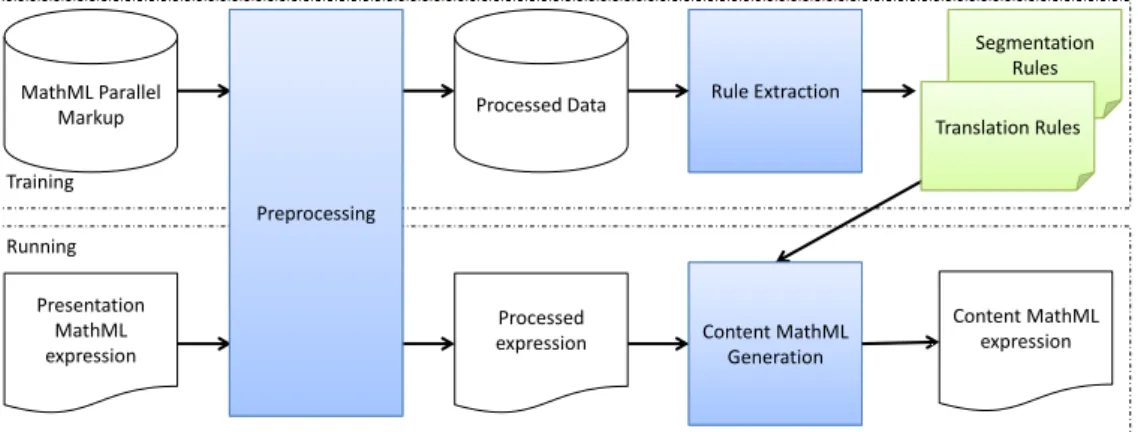
The same framework of SMT system is applied here. The parallel markup ex- pressions are used to automatically infer a statistical model of translation (rules for translation and their probabilities). The statistical model is then applied to new expressions to derive a translation. Figure 3.1 gives the system framework.
Rule Extraction Rule Extraction
Segmentation Rules Segmentation
Rules Translation Rules Translation Rules Processed Data
MathML Parallel Markup
Presentation MathML expression
Processed
expression Content MathML Generation Content MathML
Generation
Content MathML expression Preprocessing
Preprocessing Training
Running
Figure 3.1: System Framework
The system has two phases, a training phase and a running phase, and consists of three main modules.
• Preprocessing: Processes MathML expressions. It removes error expressions and XML tags that convey no meaning.
• Rule Extraction: Extracts rules for translation, given the training data. There are two types of rules: segmentation rules and translation rules. Each rule is associated with its probability.
• Content MathML Generation: Generates Content MathML expressions from input Presentation MathML expressions using rules from the Rule Extraction step.
3.2.2 Preprocessing
In MathML Presentation Markup, certain elements are used for formatting pur- poses only: the mtext and mspace tags are used to insert a space between ex- pressions. Some mtable tags are used to number the mathematical expressions. A pair of parentheses indicates that the expressions in the parentheses belong to- gether. These elements are removed in specific cases where the structure encodes the same information. Keeping these elements can produce misleading results. Expressions with more than 200 nodes in their Content Markup are removed for simplification. Figure 3.2-(b) illustrates an example of this step.
The data contains expressions that convey the same meaning, but their Con- tent MathML are written in different ways. To improve the alignment results, the system normalized two expressions having the same content meaning on the Con- tent MathML side. Currently, these three cases are implemented in the proposed system:
• sqrt(X) and X12
• X − Y and X + (−Y )
• X1 and X−1
cn 6 pi
apply
divide sep 2
cn 1
apply sin
apply eq
6
π 1 2
mn mi
sin
mn mn
= mfrac
mi
mfrac mo mrow
mrow mrow
mrow mo
mfrac
mi
mfrac
=
mn mn
sin
mi mn
1 2
π 6
eq
apply sin
apply
1
cn
sep 2
times
apply
pi power
apply 6
cn -1
cn
mo mo
( )
mrow mo
mfrac
mi mfrac
=
mn mn
sin
mi mn
1 2
π 6
eq sin
apply
1
cn
sep 2
divide
apply
pi 6
cn
mrow {mrow[1] mo(=)[0] mfrac[2] }
→ apply { eq[0] apply[1] cn[2] }
mi
mfrac
sin
mi mn
π 6
sin divide
apply
pi 6
cn
mrow {mi[0] mfrac[1] }
→ apply { sin[0] apply[1] }
mi mn
π 6
pi 6
cn
mfrac {mi[0] mn[1] }
→ apply { pi[0] apply[1] }
(a) Original trees (b) Preprocessed and aligned trees
(c) Tree Segmentation
Figure 3.2: (a) Original Presentation and Content MathML Markup tree repre- sentations (b) preprocessed trees and the alignment between the nodes (c) seg- mentation process.
3.2.3 Extracting Rules
There are two sets of rules extracted: segmentation rules and translation rules. Segmentation rules are used to segment Presentation MathML trees into smaller subtrees. Translation rules are used to translate Presentation MathML trees into Content MathML trees. Segmentation rules and translation rules operate the same as “grammar rules” and “rule table” in SMT systems.
3.2.3.1 Extracting Segmentation Rules
Segmentation rules are proposed to divide a large Presentation MathML tree into smaller subtrees while maintaining alignment with their corresponding Content MathML trees.
Long sentences pose a common problem for SMT. System training with long sentence pairs requires more memory and CPU time. The translation quality is also low due to poorly aligned words in long sentence pairs. In this study, 151.2 nodes is the average length of mathematical expressions in the dataset (counting only the leaf nodes). The 30.66 average node is still high, even after removing expressions with more than 200 nodes in their Content Markup. Long mathe- matical expressions must be segmented into shorter ones. Note that segmenting MathML expressions is easier than segmenting natural language sentences since the structural information is explicitly encoded using XML.
For a given mathematical expression pair (p, c), we have p1, p2, ..., pn as sub- trees of p and c1, c2, ..., cm as subtrees of c. A segmentation of (p, c) is defined as a sequence of subtree pairs (ps1, c1), (ps2, c2), ..., (psm, cm), where ps1, ps2, ..., psm are corresponding subtrees of
c1, c2, ..., cm.
To achieve segmentation, GIZA++ [Och & Ney, 2003] toolkit is used to ob- tain alignment between the leaf nodes of Presentation and Content MathML
trees. Figure 3.2-(b) shows an example of this alignment. Segmentation Rules are extracted based on this alignment. For each Content MathML subtree ci, the corresponding Presentation MathML subtree psi is the subtree satisfying the following condition:
psi = arg max
j P(pj|ci, a) (3.1)
P(pj|ci, a) is calculated by obtaining the ratio of number of alignments between pj and cito the total of alignment in a, where variable a represents the alignments between p and c.
P(pj|ci, a) = count[a(pj, ci)]
|a| (3.2)
The following constraint is applied: distinct Presentation subtrees cannot be aligned with the same Content subtree. The only exception is the case of operators. Many identical operators subtrees in a Presentation subtree can be aligned with one Content subtree. This allowance is made because the Content function can have more than two arguments, while the Presentation operator permits only two. A segmentation that does not satisfy this constraint is invalid. A segmentation rule is created each time the system segments the tree. Each segmentation rule is associated with a probability which represents how likely it is that the right-hand side of the rule will happen given the left-hand side.
Figure 3.2-(c) shows an example of segmentation process and extracted seg- mentation rules. Table3.1gives examples of segmentation rules. In the table, the numbers, such as [1], represent corresponding Presentation and Content markup subtrees.
Table 3.1: Examples of segmentation rules extracted from Wolfram Functions Site dataset
Segmentation Rule Probability
mrow { mrow[1] mo(=)[0] msup[2] } 1
→ apply { eq[0] apply[1] apply[2] }
mrow { mrow[1] mo( /; )[0] mrow[2] } 0.9998
→ apply { ci( Condition )[0] apply[1] apply[2] }
mrow { mrow[1] mo( = )[0] mrow[2] } 0.9946
→ apply { eq[0] apply[1] apply[2] }
mrow { mrow[1] mo( ∝ )[0] mrow[2] } 0.9511
→ apply { ci( Proportional )[0] apply[1] apply[2] }
mrow { msup[1] mo( . )[0] mrow[2] } 0.8582
→ apply { times[0] apply[1] apply[2] }
3.2.3.2 Extracting Translation Rules
If the subtree cannot be segmented or if the segmentation is invalid, a translation rule is extracted. Translation rules are used to translate a Presentation tree directly into a Content tree. Each translation rule is also associated with its frequency of occurrence throughout the training process. Training halts when no expressions can be segmented. Algorithm 1 gives the pseudo code for extracting the rules.
Function “UpdateProbability” uses Equation (3.2) to calculate the probability of each rule. Function “GetTranslationRule” and “GetSegmentationRule” extract the appropriate rules from the traning sample. Function “ExtractRule” calls ifself recursively until the subtree cannot be segmented anymore. Table 3.2 shows examples of translation rules.
Note that the rule <mo>-</mo> → <plus/> is a legal translation rule but its probability is low. The rule is extracted from those expressions which contain addition of 3 or more terms, i.e. X − Y + Z (plus between X and −Y and Z), these expressions were not normalized in the preprocessing step. Alignment errors or segmentation errors can also lead to wrong rule extraction.
Algorithm 1 Extract Translation Rules and Segmentation Rules Input: set of training MathML files parallel markup M
Output: list of segmentation rules SR list of translation rules T R
function EXTRACTRULES(M ) SR ← ∅
T R ← ∅
A = ALIGN(M) ⊲ alignments of nodes (output of GIZA++) for all m ∈ M do
EXTRACTRULE(m,A,SR,T R) end forreturn SR, T R
end function
function EXTRACTRULE(m,A,SR,T R)
tr = GetTranslationRule(m) ⊲ Extract the translation rule if T R contains tr then
UpdateProbability(T R) else
T R ← T R ∪ {tr} end if
sr = GetSegmentationRule(m) ⊲ Extract the segmentation rule if SR contains sr then
UpdateProbability(SR) else
SR ← SR ∪ {sr} end if
let subTrees[1 .. N] be subtrees of m for i = 1 → N do
EXTRACTRULE(subT rees[i],A,SR,T R)
⊲ Extract rules of each subtree end for
end function
function GetRules(m) ⊲ GetTranslationRule, GetSegmentationRule for all stP ∈ m do
stC, count ← GetMaxAlign(m,A) ⊲ get the content sub-tree stC has most alignments to stP
end for
return MakeRule(subT reeP , subT reeC, count) end function
Table 3.2: Examples of translation rules extracted from Wolfram Functions Site dataset
Translation Rule Probability
< mo > . < /mo > → < times/ > 1
< mo > ∈ < /mo > → < in/ > 1
< mi > m < /mi > → < ci > m < /ci > 1
< mo > /; < /mo > → < ci > Condition < /ci > 0.9998
< mo > = < /mo > → < eq/ > 0.9993
< mi > n < /mi > → < ci > n < /ci > 0.9941
< mo > - < /mo > → < minus/ > 0.9431
< mo > - < /mo > → < plus/ > 0.0566
< mo > + < /mo > → < plus/ > 0.9995
3.2.4 Content MathML Generation
Segmentation rules and translation rules are applied for the translation at this step. Given a Presentation MathML tree, the system will generate a correspond- ing Content MathML tree. A greedy translation method is used here to reduce translation time. If more than two rules can be applied to translate a tree, the rule with higher probability is chosen.
The translation process is as follows: First, the same pre-process module is applied on the Presentation MathML tree. The difference here is that the sys- tem removes only non-semantic elements. Second, if the processed tree can be translated using translation rules, then apply the rule for translation. If not, the segmentation rule is applied to segment the tree into subtrees. If no rule can be applied, return a translation error. Third, the translation rules are applied to translate the Presentation MathML subtrees into Content MathML subtrees. Fi- nally, the translated Content MathML subtrees are grouped to form the complete Content MathML tree.
Algorithm 2 gives the translation algorithm. The “GetBestRule” function searches for the rule with highest probability in the rule list. The “Apply” func- tion applies a translation rule to a Presentation MathML tree and returns the
translated Content MathML tree. The “RebuildTree” function combines the translated subtrees into a complete tree based on the alignment indexes in the segmentation rule. In some cases, the system was unable to apply any of the segmentation or translation rules, generally due to unseen data. For those cases, the system ignored the root of the subtree and translated its children. This would generate errors at the root of the subtree but improve overall performance. Heuristic translations are also applied to translate numbers and identifiers in the mn and mi tags.
Algorithm 2 Translate Presentation to Content MathML tree Input: Presentation MathML tree preTree
segmentation rules SR translation rules T R
Output: Content MathML tree contentTree function TRANSLATE(preT ree)
rule1 ← GetBestRule(preTree, TR) if rule1 6= null then
returnApply(tRule, preTree) end if
rule2 ← GetBestRule(preTree, SR) if rule2 6= null then
let pSub[1 .. N] be subtrees of preTree let cSub[1 .. N] be new contentTree for i = 1 → N do
cSub[i] = TRANSLATE((pSub[i])) end for
returnRebuildTree(cSub, sRule)
⊲ combines cSub based on the segmentation rule else
return< cerror/ > end if
end function
Using the proposed approach, the system is capable of handling ambiguous cases. Figure 3.3 shows an disambiguation example. Normally the term < mi > sin < /mi > is translated to <sin/> but when it is accompanied by < mrow ><
mo > − < /mo >< mn > 1 < /mn >< /mrow >, the system can correctly translated it to < arcsin/ >.
apply
eq
apply apply
arcsin cn
divide pi cn
1 sep 2 6
mrow mrow
mo mfrac msup
mfrac
=
mi mn
mi mrow
mn mn
π 6
sin
mo mn
1 2
- 1
Input: Presentation MathML tree Output: Content MathML tree
Figure 3.3: Disambiguation example
3.3 Experimental Results and Discussions
3.3.1 Evaluation Setup
The evaluation used two datasets for the experiments:
• The first dataset is Wolfram Functions site data (WFS) and contains math- ematical expressions collected from the Wolfram Functions site [Wolfram, 2013], a site created as a resource for educational, mathematical, and scien- tific communities. The site contains the world’s most encyclopedic collec- tion of information on mathematical functions. All formulas on this site are available in both Presentation MathML and Content MathML format. In the experiments, there are six mathematical categories: elementary func- tions, constants, Bessel-type functions, integer functions, polynomials, and Gamma Beta Erf. The dataset contains 205,653 mathematical expressions in total.
• The second dataset is ACL Anthology Reference Corpus [Bird et al., 2008; Kan,2013] (ACL-ARC) which contains mathematical expressions extracted from scientific papers in the area of Computational Linguistics and Lan- guage Technology. This corpus is also a target corpus of the mathemati- cal formula recognition task in The ACL 2012 Contributed Task [Schafer et al.,2012]. Currently, mathematical expressions are drawn from 20 papers to investigate the cross-domain applicability of the proposed method. All mathematical expressions in these papers are manually annotated with both Presentation Markup and Content Markup. The total number of mathe- matical expressions in the data set is 2,065. Table3.3gives various statistics for these datasets.
The default parameter setting of GIZA++ is used to obtain the alignments between Presentation MathML terms and Content MathML terms.
Table 3.3: Data statistics. The first six categories were collected from the Wol- fram Functions site. The last was extracted from 20 ACL papers.
Category No. of math
expressions Bessel-TypeFunctions 1,960
Constants 709
ElementaryFunctions 30,220
GammaBetaErf 2,895
IntegerFunctions 1,612
Polynomials 1,489
ACL-ARC 2,065
3.3.2 Evaluation Methodology
Training and testing were performed using ten-fold cross-validation. For each category, the original corpus was partitioned into ten subsets. Of the ten subsets, a single subset is retained as validation data for testing the model, using the
remaining subsets as training data. The cross-validation process was repeated ten times, with each of the ten subsets used exactly once as validation data. The ten results from the folds then averaged to produce a single estimate. In both datasets, formula-wise partition is used.
Given a Presentation MathML expression e, let A is the correct Content MathML tree and B is the output tree of the automatic translation. Evaluation was done by counting the correctness of tree B by comparing it directly to tree A. In the experiments, the system extended the conventional definition of Translation Edit Rate and applied a specific metric that combines the following:
• Tree Edit Distance [Zhang & Shasha, 1989]: The tree edit distance is the minimal cost of transforming A into B using edit operations. Three types of edit operations are possible: substituting, inserting, or deleting a node.
• Translation Edit Rate [Snover et al., 2006]: The translation edit rate is an error metric for machine translation that measures the number of edits required to change a system output into one of the references.
The new metric is called the Tree Edit Distance Rate (TEDR). TEDR is defined as the ratio of (1) the minimal cost of transforming tree A into another tree B using edit operations and (2) the maximum number of nodes of A and B. It can be computed using Equation 4.1.
T EDR(A → B) = T ED(A, B)
max{|A|, |B|} (3.3)
For example, Figure3.4 depicts an output tree (A) and a reference (B). Com- pared to the reference tree, the system must substitute 1 node, insert 3 nodes, and delete 0 node in the output tree, so that T ED(A, B) = 4, while the maximum number of nodes of the two trees is 8. Therefore, T EDR(A → B) = 48 = 0.5. T EDR = 0 is optimal for this metric.
a
e
b
d
f c
h g
a
e
i
d
h
Output tree A Reference tree B
Figure 3.4: Example of an output tree (A) and a reference (B).
There are two methods to calculate the TEDR value of multiple tree pairs. The tree-based method (macro averaged) calculates the TEDR value of each tree pair and then average them. The main disadvantage of this method is that it treats small and large trees equally. The node-based method (micro averaged) first sums up the TED value of these multiple tree pairs and then divides this value to the sum of maximum number of nodes. The second method was chosen because it gives better estimation of how many nodes are wrongly translated. For easier interpretation, the chart representation of the result uses 1 − T EDR. In this scenario, the higher the 1 − T EDR score, the better the system.
Besides TEDR, another metris is used which is the Perfect Translation Rate (PTR). PTR is simply the percentage of perfectly translated expressions. PTR is calculated by counting how many expressions are correctly translated and then divide this number to the number of expressions. This metric is important in applications which require perfect translation, such as searching for exact math- ematical expressions.