Discussion Paper No.245
Secure Implementation in Queueing Problems
Katsuhiko Nishizaki
February 2012; revised August 2012
GCOE Secretariat
Graduate School of Economics OSAKA UNIVERSITY
1-7 Machikaneyama, Toyonaka, Osaka, 560-0043, Japan
GCOE Discussion Paper Series
Global COE Program
Human Behavior and Socioeconomic Dynamics
Secure Implementation in Queueing Problems
∗Katsuhiko Nishizaki† August 13, 2012
Abstract
This paper studies secure implementability (Saijo, T., T. Sj¨ostr¨om, and T.Yamato (2007) “Se- cure Implementation,” Theoretical Economics 2, pp.203-229) in queueing problems. Our main result shows that the social choice function satisfies strategy-proofness and strong non-bossiness (Saijo, Sj¨ostr¨om, and Yamato, 2007), both of which are necessary for secure implementation, if and only if it satisfies constancy on the domains that satisfy weak indifference introduced in this paper. This result implies that only constant social choice functions are securely implementable on weakly indif- ferent domains in queueing problems. Weak indifference is weaker than minimal richness (Fujinaka, Y. and T. Wakayama (2008) “Secure Implementation in Economies with Indivisible Objects and Money,” Economics Letters 100, pp.91-95). Our main result illustrates that secure implementation is too difficult in queueing problems since many reasonable domains satisfy weak indifference, for example, convex domains.
Key words: Secure implementation, Dominant strategy implementation, Nash implementation, Strategy-proofness, Queueing problems.
JEL classification: C44, C72, D61, D71, D82
∗This paper is based on my M.A. thesis presented to the Graduate School of Economics, Osaka University. I would like to thank Tatsuyoshi Saijo, Masaki Aoyagi, Yuji Fujinaka, Kazuhiko Hashimoto, Shuhei Morimoto, Shinji Ohseto, Shigehiro Serizawa, Takuma Wakayama, and seminar participants at the 2008 Japanese Economic Association Spring Meeting, Tohoku University, for their helpful comments. I am especially grateful to Tatsuyoshi Saijo, Yuji Fujinaka, and Takuma Wakayama for their valuable advices. I also acknowledge for the Global COE program of Osaka University for the financial supports. The responsibility for any errors that remain is entirely the author.
†Graduate School of Economics, Osaka University, 1-7, Machikaneyama, Toyonaka, Osaka 560-0043, Japan. E-mail: [email protected].
1 Introduction
1.1 Background
In this paper, we consider the following situations: agents have to queue up to enjoy a service which can- not be consumed by more than one agent simultaneously. 1 Examples of such situations are the use of large-scaled experimental installations, event sites, and so forth. Organ transplantation is another exam- ple. In a queue, each agent has to wait her turn; waiting is a cost for her and such a cost can be described as a unit waiting cost, that is, the cost of waiting for one agent to finish enjoying a service.2 Therefore, the total waiting cost for each agent is calculated as follows: the number of agents preceding her times her unit waiting cost. In this paper, we assume that monetary transfers among agents are allowed. 3 In fact, each agent has a linear utility function: her utility level is equal to her monetary transfers minus her total waiting cost. In such environments, we study the problems of allocating positions in a queue to agents with monetary transfers. These problems are called queueing problems.
In allocating positions in a queue to agents with monetary transfers, we adhere to several criteria. For example, cost minimization is widely accepted. To achieve cost minimization, we need to know each agent’s unit waiting cost which is private information to her. To make each agent reveal this private information, we construct certain mechanisms. Mechanism design theory, especially implementation theory, has studied which mechanisms are suitable for resolving such allocation problems.4
When we consider the structure of mechanisms, manipulability of agents is an important problem: certain agents might manipulate the outcome of the mechanism in their favor. Such a manipulation might induce a non-optimal outcome. Strategy-proofness is a standard property for non-manipulability.5This property requires that the truthful revelation is a weakly dominant strategy for each agent in the direct revelation mechanism associated with the social choice function. A social choice function is one that associates an allocation with agents’ private information. This function characterizes certain optimal outcome according to the information. A direct revelation mechanism associated with a social choice function is a mechanism in which (i) the set of strategy profiles is equivalent to the domain of the function and (ii) the game form is equivalent to the function.
Strategy-proofness is a desirable property but has a shortcoming: the strategy-proof mechanism might have a Nash equilibrium which induces a non-optimal outcome. This problem is solved by se- cure implementation (Saijo, Sj¨ostr¨om, and Yamato, 2007) which requires that there exists a mechanism in which (i) each dominant strategy equilibrium induces an optimal allocation and (ii) each Nash equilib- rium also induces an optimal allocation, that is, double implementation in dominant strategy equilibria and Nash equilibria.6This concept is considered to be a benchmark for constructing mechanisms which
1Mitra (2005) and Chun and Heo (2008) consider the situations in which there exist several services.
2Note that it is implicitly assumed that each agent has a constant unit waiting cost. Moreover, we assume that each agent’s unit waiting cost might be different from other agents.
3Note that monetary transfers include not only financial transactions between any two agents but also discriminations of the usage fee.
4Mechanism design theory consists of implementation theory and realization theory. See Jackson (2001, 2003) and Maskin and Sj¨ostr¨om (2002) for implementation theory and Hurwicz and Reiter (2006) for realization theory.
5See Barber`a (2010) for the relationship between strategy-proofness and implementation theory.
6See Mizukami and Wakayama (2007) and Saijo, Sj ¨ostr¨om, and Yamato (2007) for dominant strategy implementation and Maskin (1977), Repullo (1987), and Saijo (1988) for Nash implementation.
work well in laboratory experiments.7 In certain environments, the possibility of secure implementation is studied: voting environments (Saijo, Sj¨ostr¨om, and Yamato, 2007; Berga and Moreno, 2009), public good economies (Saijo, Sj¨ostr¨om, and Yamato, 2007; Nishizaki, 2011), the problems of providing a di- visible and private good with monetary transfers (Saijo, Sj¨ostr¨om, and Yamato, 2007; Kumar, 2009), the problems of allocating indivisible and private goods with monetary transfers (Fujinaka and Wakayama, 2008), Shapley-Scarf housing markets (Fujinaka and Wakayama, 2011), and allotment economies with single-peaked preferences (Bochet and Sakai, 2010). 8 These studies illustrate how difficult it is to find securely implementable social choice functions with desirable properties.
Queueing problems are special cases of sequencing problems in which certain agents might enjoy a servicing time which is different from those of other agents. 9 Moreover, sequencing problems are special cases of quasi-linear environments. In the environments, Groves mechanisms (Groves, 1973) are well-known for a class of direct revelation mechanisms which satisfy strategy-proofness and decision- efficiency. 10 Decision-efficiency requires that the allocation assigned by the social choice function maximizes total welfare of the group. It is also well-known that Groves mechanisms are the only direct revelation mechanisms that satisfy strategy-proofness and decision-efficiency on the domains that satisfy smooth connectedness (Holmstr¨om, 1979).11Unfortunately, Green and Laffont (1979) show that Groves mechanisms rarely satisfy budget-balance. 12 Budget-balance requires that the social choice function assigns an allocation in which there exists no monetary transfer from outside the group or wasted within the group. 13 Since the combination of decision-efficiency with budget-balance is equivalent to Pareto- efficiency in quasi-linear environments, the above results show how difficult it is to construct strategy- proof and Pareto-efficient direct revelation mechanisms.
Since queueing problems are special cases of quasi-linear environments, the same results as Holm- str¨om (1979) hold in queueing problems. 14 However, there exist strategy-proof and decision-efficient mechanisms which satisfy more desirable properties including budget-balance in queueing problems than in broader environments. In queueing problems, equally distributed pairwise pivotal rules (Suijs,
7See Cason, Saijo, Sj¨ostr¨om, and Yamato (2006) for experimental results on secure implementation.
8See also Saijo, Sj¨ostr¨om, and Yamato (2003) for theoretical results on secure implementation.
9The constancy of unit waiting costs assumed in queueing problems implies that all agents enjoy the same servicing time. Scheduling problems are also special cases of sequencing problems. See Mendelson and Whang (1990), Suijs (1996), Mitra (2002), Hain and Mitra (2004), Mishra and Rangarajan (2007), and Chun (2011) for sequencing problems and Moulin (2007, 2008) for scheduling problems.
10The pivotal mechanism (Clarke, 1971) and the second-price auction (Vickrey, 1961) are included in the class. See also Groves and Loeb (1975) for Groves mechanisms and Tideman and Tullock (1976) and Moulin (1986) for the pivotal mechanism.
11See also Green and Laffont (1977), Walker (1978), and Suijs (1996) for the uniqueness of Groves mechanisms in term of domain-richness condition. Moreover, see Hashimoto and Saitoh (2010) for a domain expansion of the pivotal mechanism and Saitoh and Serizawa (2008) and Sakai (2008) for domain expansions of the second-price auction.
12Similar results are obtained by Groves and Ledyard (1977), Walker (1980), and Hurwicz and Walker (1990) in non- excludable public good economies, Ohseto (2000) in the problems of allocating an indivisible good, and Schummer (2000) in the problems of allocating heterogeneous indivisible goods. For domain-richness conditions for the existence of budget- balanced Groves mechanisms, see Groves and Loeb (1975), Green and Laffont (1979), Laffont and Maskin (1980), Tian (1996), and Liu and Tian (1999) in non-excludable public good economies and Mitra and Sen (2010) in the problems of allocating heterogeneous indivisible goods.
13See Rob (1982) and Mitsui (1983) for the relationship between budget-balance and the number of agents.
14See also Dolan (1978) for a class of direct revelation mechanisms which satisfy strategy-proofness and decision-efficiency in queueing problems.
1996), which is a subclass of Groves mechanisms, satisfy budget-balance. 15 Kayı and Ramaekers (2010) show that equally distributed pairwise pivotal rules are the only direct revelation mechanisms that satisfy strategy-proofness, decision-efficiency, budget-balance, and equal treatment of equals in queue- ing problems. 16 Equal treatment of equals requires that any two agents’ utility levels assigned by the social choice function should be equal when they have an equal unit waiting cost. Moreover, Hashimoto and Saitoh (2011) show the relationship between decision-efficiency and anonymity which is stronger than equal treatment of equals in queueing problems. 17 Anonymity requires that any two agents’ utility levels assigned by the social choice function should be exchanged when their unit waiting costs are exchanged. On the other hand, Mitra and Mutuswami (2011) show that the k-pivotal mechanisms (Mitra and Mutuswami, 2011) are the only direct revelation mechanisms that satisfy pairwise strategy- proofness, decision-efficiency, equal treatment of equals, and weak linearity in queueing problems. 18 Pairwise strategy-proofness is stronger than strategy-proofness but weaker than weak group strategy- proofness.19 Weak linearity is a linearity property for monetary transfers.
1.2 Motivation
Unfortunately, almost all previous studies show negative results on secure implementation: there rarely exists a non-trivial securely implementable social choice function. On the basis of these results, in- vestigating which environment has a non-trivial securely implementable social choice function is an interesting topic. In this paper, we conduct such an investigation into queueing problems.
It is well-known that there rarely exists a social choice function which satisfies strategy-proofness, decision-efficiency, and budget-balance in quasi-linear environments. However, in queueing problems which are special cases of quasi-linear environments, there exist social choice functions which satisfy the above properties. 20 This means that strategy-proofness in queueing problems is much weaker than in broader environments. On the basis of this relationship, we study the possibility of secure implementation in queueing problems since strategy-proofness is necessary for secure implementation.
15This name is given by Kayı and Ramaekers (2010). See Mitra (2001) for a characterization of a domain-richness condition for the existence of direct revelation mechanisms that satisfy strategy-proofness, decision-efficiency, and budget-balance in queueing problems.
16Kayı and Ramaekers (2010) also study certain properties of social choice correspondences which assign a non-empty set of allocations. See also Maniquet (2003) and Chun (2006a) for studies of social choice correspondences and the Shapley value in queueing problems. Note that equal treatment of equals can be replaced by symmetry in the result of Kayı and Ramaekers (2010). Symmetry requires that the allocation that is constructed by exchanging the only two consumption bundles for agents with an identical unit waiting cost in the allocation assigned by the social choice correspondence should be also assigned. By definition, we know that there exists no social choice function that satisfies symmetry.
17By the results of Kayı and Ramaekers (2010) and Hashimoto and Saitoh (2011), we have an alternative characterization of equally distributed pairwise pivotal rules. See Chun (2006b) for the relationship between decision-efficiency and envy-freeness (Foley ,1967) which is stronger than anonymity in queueing problems.
18The k-pivotal mechanism is equivalent to the pivotal mechanism when k=n, where n is the number of agents.
19Note that pairwise strategy-proofness is stronger than effective pairwise strategy-proofness (Serizawa, 2006).
20This fact is due to the linearity of utility functions.
1.3 Related Literature
This paper is most closely related to the one written by Fujinaka and Wakayama (2008), that studies the problems of allocating indivisible and private goods with monetary transfers. 21 They show that only constant social choice functions are securely implementable when the domain satisfies minimal richness (Fujinaka and Wakayama, 2008). Since queueing problems are special cases of their ones, we have the same constancy result in queueing problems if the domain satisfies minimal richness by their result. However, there exist many reasonable domains that do not satisfy minimal richness in queueing problems. This implies the possibility of the existence of non-constant securely implementable social choice functions in queueing problems.
1.4 Our Result
Our main result shows that on many reasonable domains, only constant social choice functions satisfy strategy-proofness and strong non-bossiness (Saijo, Sj¨ostr¨om, and Yamato, 2007), both of which are necessary for secure implementation, in queueing problems. In fact, we show a constancy result on the domains that satisfy weak indifference, a new domain-richness condition introduced in this paper. Note that weak indifference is weaker than minimal richness which implies a constancy result on secure implementation in broader environments.
This paper is organized according to the following sections. In Section 2, our model is introduced. We define properties of social choice functions related to secure implementability in Section 3 and domain-richness conditions in Section 4. Certain preliminary results on properties of social choice func- tions are shown in Section 5. In Section 6, we show our main result. Section 7 concludes this paper. Appendix shows the relationship between weak indifference and certain domain-richness conditions.
2 Model
We study the problems of allocating positions in a queue to agents with monetary transfers. Let I ≡ {1, . . . , n} (n ≥ 2) be a set of agents. Letσ≡(σi)i∈I∈ In be a queue, where, for each i∈ I,σi is the position for agent i in the queue σ and for each i, j∈ I with i 6= j,σi6=σj. Note that each position is an indivisible and private good.
Each agent can consume the only one position with a positive or negative amount of money. For each i∈ I, let(σi,ti)∈ I × R be a consumption bundle for agent i, where tiis a monetary transfer for agent i. Let t≡(ti)i∈I∈ Rnbe a profile of monetary transfers and(σ,t)∈ In× Rnbe a profile of consumption bundles, called an allocation. Let
Z≡ (
(σ,t)∈ In× Rn
σ is a queue and
∑
k∈I
tk≤ 0
)
be the set of feasible allocations.22
21See Svensson (1983) and Alkan, Demange, and Gale (1991) for the problems of allocating indivisible and private goods with monetary transfers.
22In a feasible allocation, the sum of monetary transfers should be non-positive. Our results do not depend on this non- positivity. This requirement is generically assumed in queueing problems.
Each agent has a linear utility function. For each i∈ I, let ci∈ R++≡ {x ∈ R | x > 0} be a unit waiting cost for agent i and Ci⊆ R++ be a set of unit waiting costs for agent i. For each i∈ I, let u : I× R ×Ci→ R be the utility function for agent i such that for each(σi,ti)∈ I × R and each ci∈ Ci,
u(σi,ti; ci)≡ −(σi− 1)ci+ti.
Let C≡∏i∈ICibe the domain and c≡(ci)i∈I∈ C be a profile of unit waiting costs. For each i ∈ I, let c−i≡(cj)j6=i∈ C−i≡∏j6=iCjbe a profile of unit waiting costs for agents other than agent i.
An allocation is assigned by a social choice function for each profile of unit waiting costs. Let f : C→ Z be a social choice function. For each c ∈ C, let(σ(c),t(c))∈ Z be the allocation associated with the social choice function f at the profile of unit waiting costs c and(σi(c),ti(c))∈ I × R be the consumption bundle for agent i∈ I in the allocation(σ(c),t(c)).
Remark 1. Our model is a special case of the one presented by Fujinaka and Wakayama (2008). The difference from their model is the number of each good and the existence of a “null” good. In our model, the number of each position is equal to one and each agent necessarily consumes a position. On the other hand, in their model, the number of each object is equal to or more than one and each agent does not necessarily consume an object. There exists another difference in utility functions. In our model, each agent’s valuation of a position decreases in the order and the marginal valuation is constant. On the other hand, in their model, each agent’s valuation of an object is almost unrestrictive. This difference strongly affects our results.
3 Properties of Social Choice Functions
Saijo, Sj¨ostr¨om, and Yamato (2007) introduce secure implementation which is identical with double implementation in dominant strategy equilibria and Nash equilibria.23 They show that the social choice function is securely implementable if and only if it satisfies strategy-proofness, strong non-bossiness, and the outcome-rectangular property (Saijo, Sj¨ostr¨om, and Yamato, 2007).24 In this paper, we study securely implementable social choice functions in queueing problems. Especially, we focus on social choice functions which satisfy strategy-proofness and strong non-bossiness.
Strategy-proofness requires that the truthful revelation is a weakly dominant strategy for each agent in the direct revelation mechanism associated with the social choice function.
Definition 1. The social choice function f satisfies strategy-proofness if and only if for each c, c′∈ C and each i∈ I,
−(σi(ci, c′−i)− 1)ci+ti(ci, c′−i)≥ −(σi(c′i, c′−i)− 1)ci+ti(c′i, c′−i).
23See Saijo, Sj¨ostr¨om, and Yamato (2007) for the definition of secure implementation.
24Strong non-bossiness is called non-bossiness in their paper. They characterize securely implementable social choice func- tions by strategy-proofness and the rectangular property (Saijo, Sj ¨ostr¨om, and Yamato, 2007) and show that the rectangular property is equivalent to strong non-bossiness and the outcome-rectangular property. See Saijo, Sj ¨ostr¨om, and Yamato (2007) for the definitions of the rectangular property and the outcome-rectangular property and Mizukami and Wakayama (2008) for an alternative characterization of securely implementable social choice functions in terms of a stronger version of Maskin mono- tonicity (Maskin, 1977). See also Berga and Moreno (2009) for an alternative characterization of minmax rules in single-peaked voting environments in terms of strong non-bossiness.
Strong non-bossiness requires that each agent cannot change the outcome by her deviation while maintaining her utility level in the direct revelation mechanism associated with the social choice function. Definition 2 (Saijo, Sj¨ostr¨om, and Yamato, 2007). The social choice function f satisfies strong non- bossiness if and only if for each c, c′∈ C and each i ∈ I, if
−(σi(ci, c−i)− 1)ci+ti(ci, c−i) =−(σi(c′i, c−i)− 1)ci+ti(c′i, c−i), then
(σ(ci, c−i),t(ci, c−i)) = (σ(c′i, c−i),t(c′i, c−i)).
By definition, strong non-bossiness is stronger than non-bossiness (Satterthwaite and Sonnenschein, 1981). 25 This property is also stronger than quasi-strong non-bossiness (Mizukami and Wakayama, 2007; Saijo, Sj¨ostr¨om, and Yamato, 2007) which is necessary for dominant strategy implementation.26
Constancy requires that any revelations are not reflected on the outcome in the direct revelation mechanism associated with the social choice function.
Definition 3. The social choice function f satisfies constancy if and only if for each c, c′∈ C, (σ(c),t(c)) = (σ(c′),t(c′)).
4 Domain-Richness
In the problems of allocating indivisible and private goods with monetary transfers, where each agent has a quasi-linear utility function, Fujinaka and Wakayama (2008) show that if the domain satisfies minimal richness, then only constant social choice functions are securely implementable.
Definition 4 (Fujinaka and Wakayama, 2008). The domain C satisfies minimal richness if and only if for each i∈ I, each c′i, c′′i ∈ Ci, eachσi′,σi′′∈ I, and each T ∈ R, if
(σi′′−σi′)c′′i <T <(σi′′−σi′)c′i, then there exists ci∈ Ci such that
(i) (σi′′−σi′)ci=T ,
(ii) (σi′′−σi)ci≤(σi′′−σi)c′i for eachσi∈ I \ {σi′,σi′′}.
Since our model is a special case of the one presented by Fujinaka and Wakayama (2008), only constant social choice functions are securely implementable in our model if the domain satisfies minimal richness by their result. However, Example 1 shows that many reasonable domains do not satisfy minimal richness in our model.
25The social choice function f satisfies non-bossiness if and only if for each c, c′ ∈ C and each i ∈ I, if (σi(ci, c−i),ti(ci, c−i)) = (σi(c′i, c−i),ti(c′i, c−i)), then(σ(ci, c−i),t(ci, c−i)) = (σ(c′i, c−i),t(c′i, c−i)).
26The social choice function f satisfies quasi-strong non-bossiness if and only if for each c, c′∈ C and each i ∈ I, if −(σi(ci, c′′−i)− 1)ci+ti(ci, c′′−i) =−(σi(c′i, c′′−i)− 1)ci+ti(c′i, c′′−i) for each c′′−i∈ C−i, then (σ(ci, c−i),t(ci, c−i)) = (σ(c′i, c−i),t(c′i, c−i)). Saijo, Sj¨ostr¨om, and Yamato (2007) call this property weak non-bossiness. Mizukami and Wakayama (2007) and Saijo, Sj¨ostr¨om, and Yamato (2007) independently show that the social choice function is dominant strategy imple- mentable if and only if it satisfies strategy-proofness and quasi-strong non-bossiness.
Example 1. Let i∈ I and Ci =R++. Moreover, let c′i=3, c′′i =1,σi′=1,σi′′=2, and T =2. In this case, we have
(σi′′−σi′)c′′i =1 < T < 3= (σi′′−σi′)c′i.
Let ci∈ Ci be such that(σi′′−σi′)ci =T , that is, ci=2. This implies that condition (i) in Definition 4 holds. On the other hand, if ci=2, then
(σi′′−σi)ci=−2 > −3= (σi′′−σi)c′i forσi=3. This implies that condition (ii) in Definition 4 does not hold.
Example 1 implies that there exist the other quasi-linear environments that Fujinaka and Wakayama (2008) do not study, that is, we have the possibility of the existence of non-constant securely imple- mentable social choice functions in certain quasi-linear environments. However, our main result implies that on many reasonable domains, only constant social choice functions are securely implementable in queueing problems. In fact, we show that if the domain satisfies the following condition, called weak indifference, then any social choice function satisfying strategy-proofness and strong non-bossiness also satisfies constancy.
Definition 5. The domain C satisfies weak indifference if and only if for each i∈ I, each c′i, c′′i ∈ Ci, eachσi′,σi′′∈ I, and each T ∈ R, if
(σi′′−σi′)c′′i <T <(σi′′−σi′)c′i,
then there exists ci∈ Ci such that
(σi′′−σi′)ci=T .
By definition, weak indifference is weaker than minimal richness. In our model, weak indifference is equivalent to convexity.27 By bringing this relationship together with the result of Holmstr¨om (1979), we know that weak indifference is stronger than smooth connectedness in our model. Moreover, we know that smooth connectedness is stronger than convexity, that is, smooth connectedness is equivalent to convexity in our model. 28 This implies that in our model, weak indifference is also equivalent to smooth connectedness.
Remark 2. Fujinaka and Wakayama (2008) show the possibility of the existence of non-constant se- curely implementable social choice functions on the domains that satisfy monotonic closedness (Schum- mer, 2000). 29 In our model, there exists no monotonically closed domain except for the case of n=2 due to the linearity of utility functions.30
27See Appendix for the relationship between weak indifference and convexity.
28See Appendix for the relationship between smooth connectedness and convexity.
29In quasi-linear environments, Schummer (2000) shows a constancy result on bribe-proofness (Schummer, 2000) on mono- tonically closed domains. Bribe-proofness is stronger than strategy-proofness. He also shows that only all-dictatorial (Schum- mer, 2000) social choice functions satisfy bribe-proofness on smoothly connected domains. All-dictatorship requires that each agent is actually a dictator on the range of the social choice function.
30See Appendix for the existence of monotonically closed domains and the relationship between weak indifference and monotonic closedness in the case of n=2.
5 Preliminary Results
In what follows, we show certain preliminary results on strategy-proofness in our model. Note that all preliminary results are irrespective of domain-richness conditions. For simplicity of notation, let σi≡σi(ci, c−i), σi′≡σi(c′i, c−i),σi′′≡σi(c′′i, c−i)and ti≡ ti(ci, c−i), ti′≡ ti(c′i, c−i), ti′′≡ ti(c′′i, c−i)for each c, c′∈ C and each i ∈ I.
Lemma 1 shows that each agent’s monetary transfer depends on her position in the queue if the social choice function satisfies strategy-proofness.
Lemma 1. Suppose that the social choice function f satisfies strategy-proofness. For each c, c′∈ C and each i∈ I, ifσi=σi′, then ti=ti′.
Proof. Suppose, by contradiction, that there exist c, c′∈ C and i ∈ I such thatσi=σi′and ti6=ti′. If ti<ti′, then we have−(σi− 1)ci+ti<−(σi′− 1)ci+ti′. This is a contradiction to strategy-proofness. If ti>ti′, then we have−(σi− 1)c′i+ti>−(σi′− 1)c′i+ti′. This is also a contradiction to strategy-proofness. Remark 3. Lemma 1 corresponds to Claim 1 in Proposition 1 of Fujinaka and Wakayama (2008).
By Lemma 1, we know that for each c, c′∈ C and each i ∈ I, if −(σi− 1)ci+ti=6 −(σi′− 1)ci+ti′, thenσi6=σi′when the social choice function f satisfies strategy-proofness.
Lemma 2 shows that if there exists a unit waiting cost such that some two different consumption bundles are indifferent in terms of utility level, then the position associated with the unit waiting cost is in between the two positions if the social choice function satisfies strategy-proofness. In Lemma 2, we use the following notation: for each i∈ I, each ci∈ Ci, each(σi,ti)∈ I × R, and eachσi′∈ I, let
ti(σi′;(σi,ti), ci)≡(σi′−σi)ci+ti.
This implies−(σi− 1)ci+ti=−(σi′− 1)ci+ti(σi′;(σi,ti), ci), that is,(σi′, ti(σi′;(σi,ti), ci))is indiffer- ent to(σi,ti)for agent i with ci.
Lemma 2. Suppose that the social choice function f satisfies strategy-proofness. For each c, c′∈ C and each i∈ I, ifσi<σi′ and there exists ci′′∈ Ci such that−(σi− 1)c′′i +ti =−(σi′− 1)c′′i +ti′, then σi≤σi′′≤σi′.
Proof. Suppose, by contradiction, that there exist c, c′∈ C and i ∈ I such thatσi<σi′,−(σi− 1)c′′i +ti=
−(σi′− 1)c′′i +ti′for some c′′i ∈ Ci, andσi′′<σiorσi′<σi′′. We consider the case ofσi′′<σi. By the hypothesis, we have
c′′i = t
i′− ti
σi′−σi
. (1)
By the definition of ti, we have
ci= ti(σ
′
i;(σi,ti), ci)− ti
σi′−σi
. (2)
By the definition of tiand strategy-proofness, we have−(σi′−1)ci+ti′<−(σi′−1)ci+ti(σi′;(σi,ti), ci), that is,
ti′< ti(σi′;(σi,ti), ci).31 (3)
31Note that the equality does not hold. If it holds, then we have ci=c′′i by (1) and (2). This implies that f should be a correspondence since we consider the case ofσi′′<σi.
si
0 'i
s
ti
t'i
c"i
"i
s
ci
) ), , (
; '
( i i i i
i t c
t s s
)
" ), , (
;
" ( ) ), , (
;
"
( i i i i i i i i i
i t c t t c
t s s < s s
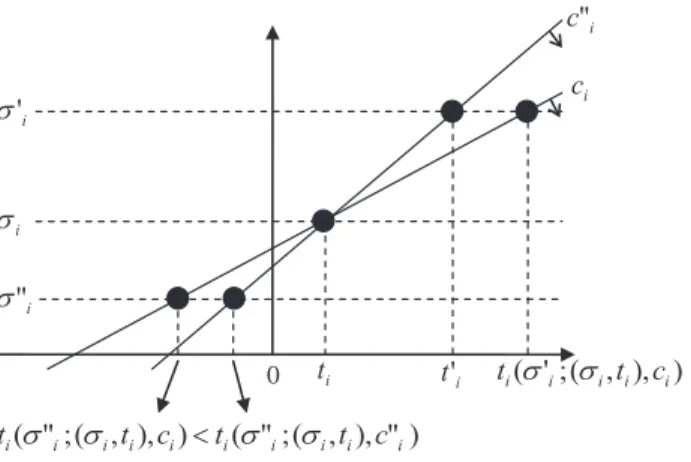
Figure 1: Proof of Lemma 2
By (1), (2), (3), and σi <σi′, we have c′′i <ci. Since we consider the case of σi′′<σi, this implies (σi′′−σi)c′′i +ti>(σi′′−σi)ci+ti, that is,
ti(σ′′
i ;(σi,ti), ci)< ti(σi′′;(σi,ti), c′′i). (4)
By the definition of tiand strategy-proofness, we have−(σi′′−1)ci+ti′′≤ −(σi′′−1)ci+ti(σi′′;(σi,ti), ci), that is,
ti′′≤ ti(σi′′;(σi,ti), ci). (5)
Moreover, by the definition of tiand strategy-proofness, we have−(σi′′− 1)c′′i +ti′′≥ −(σi′′− 1)c′′i + ti(σ′′
i ;(σi,ti), c′′i), that is,
ti(σi′′;(σi,ti), c′′i)≤ ti′′. (6) By (5) and (6), we have ti(σi′′;(σi,ti), c′′i)≤ ti(σi′′;(σi,ti), ci). This is a contradiction to (4) (see Figure 1).
Similarly, we have a contradiction to strategy-proofness in the case ofσi′<σi′′.
Remark 4. There exists no result of Fujinaka and Wakayama (2008) corresponding to Lemma 2. Lemma 2 strongly depends on the decreasingness of utility functions in positions, which is not assumed in their model.
6 Main Result
By bringing preliminary results on strategy-proofness together with strong non-bossiness and weak in- difference, we show our main result. In line with the previous section, for simplicity of notation, let σi≡σi(ci, c−i),σi′≡σi(c′i, c−i),σi′′≡σi(c′′i, c−i),σi∗≡σi(ci∗, c−i),σi∗∗≡σi(c∗∗i , c−i)and ti≡ ti(ci, c−i), ti′≡ ti(c′i, c−i), ti′′≡ ti(c′′i, c−i), ti∗≡ ti(c∗i, c−i), ti∗∗≡ ti(c∗∗i , c−i)for each c, c′∈ C and each i ∈ I.
Theorem. Suppose that the domain C satisfies weak indifference. The social choice function f satisfies strategy-proofness and strong non-bossiness if and only if it satisfies constancy.
i
0 'i
ti t'i
c"i
"i
! i
!
ti t"i
ci
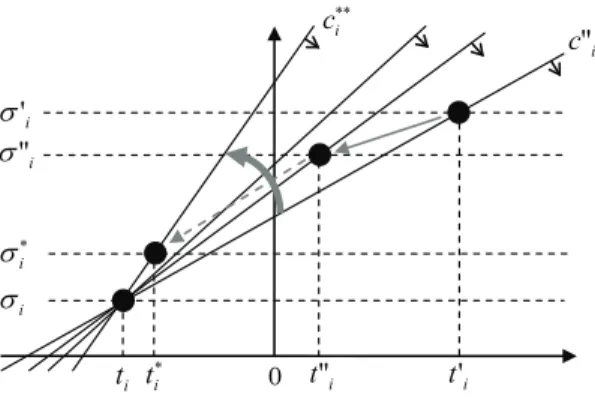
Figure 2: Proof of Theorem
Proof. Since the “if” part is obvious, we only prove the “only if” part. Let c, c′∈ C. To prove(σ(c),t(c)) = (σ(c′),t(c′)), we firstly show
(σ(ci, c−i),t(ci, c−i)) = (σ(c′i, c−i),t(c′i, c−i))
for each i∈ I. Suppose, by contradiction, that there exists j ∈ I such that (σ(cj, c− j),t(cj, c− j))6= (σ(c′j, c− j),t(c′j, c− j)). By strong non-bossiness, this implies−(σj− 1)cj+tj6=−(σ′j− 1)cj+t′j. By strategy-proofness, this implies
−(σj− 1)cj+tj>−(σ′j− 1)cj+t′j. (7) By Lemma 1, this implies σj 6= σ′j, that is, σj <σ′j or σj >σ′j. We consider the case of σj <σ′j. Since(σ(cj, c− j),t(cj, c− j))6= (σ(c′j, c− j),t(c′j, c− j)), by strong non-bossiness, it also implies−(σj−
1)c′j+tj6=−(σ′j− 1)c′j+t′j. By strategy-proofness, this implies
−(σj− 1)c′j+tj<−(σ′j− 1)c′j+t′j. (8) By (7) and (8), we have(σ′j−σj)c′j<t′j− tj<(σ′j−σj)cj. Since C satisfies weak indifference, this implies that there exists c′′j ∈ Cj such that(σ′j−σj)c′′j =t′j− tj, that is,
−(σj− 1)c′′j+tj=−(σ′j− 1)c′′j+t′j. (9) Since we consider the case ofσj<σ′j, by Lemma 2, this impliesσj≤σj′′≤σ′j. Ifσ′′j =σj, then, by (9) and strong non-bossiness, we haveσj=σ′j. This is a contradiction. Similarly, we have a contradiction ifσ′′j =σ′j. Therefore, we know
σj<σ′′j <σ′j.
By applying the above argument to the left inequality repeatedly, we can find c∗j, c∗∗j ∈ Cj such that σj<σ∗j and−(σj− 1)c∗∗j +tj=−(σ∗j − 1)c∗∗j +t∗j, where there exists no position betweenσj andσ∗j induced by a unit waiting cost for agent i given c− j since each position is indivisible (see Figure 2). In this case, we haveσ∗∗j =σj orσ∗∗j =σ∗j. By strong non-bossiness, these implyσj =σ∗j. This is a contradiction. Similarly, we have a contradiction in the case ofσj>σ′j.
Without loss of generality, let i=1. Therefore, we have
(σ(c1, c−1),t(c1, c−1)) = (σ(c′1, c−1),t(c′1, c−1)). (10)