A Case Study of Five Chinese Kindergarten Teachers’ Perceptions and Reactions to Children’s Displays of Emotions in the Classroom
by Hou Rong
A Master’s dissertation submitted to Osaka Jogakuin University Graduate School of International Collaboration and Coexistence in the 21st Century, Master’s Course,
in fulfillment for degree requirements.
Advisor: Prof. Scott Johnston January 28, 2020
Abstract
Teaching children higher level emotions (e.g., empathy, gratitude, love) has been present in the curriculum of kindergartens in China for a long time. Conversely, little attention has been paid to teaching children lower level emotions (e.g., happiness, sadness, anger). This study examined five kindergarten teachers’ perceptions and reactions toward young children’s expressions of lower level emotions in a way to explore kindergarten teachers’ beliefs about young children’s lower level emotions. It was revealed that the participating teachers (1) have limited knowledge or
misperceptions of young children’s lower level emotions; (2) pay little attention to children’s expressions of lower level emotions; (3) tend to respond to children’s displays of emotions in three patterns which are ignore, disapprove, and/or support; and (4) tend to ignore/disapprove children’s displays of “unreasonable” negative emotions. The results of this study could be helpful for the development of intervention programs and in-service training to help kindergarten teachers better meet children's emotional learning needs.
Acknowledgement
My deep gratitude goes first to Professor Scott Johnston, who expertly guided me through my graduate education and who shared with me the valuable knowledge that will be a treasure for my study and my career in the future. Beside my advisor, I would like to thank my thesis committee: Professor Steve Cornwell and Professor Mitsuko Maeda for their encouragement and insightful comments.
My appreciation also extends to Osaka Jogakuin University Graduate School. This master’s thesis would not have been possible without their financial support. Thanks also go to the principal and the participating teachers from the kindergarten where my fieldwork was conducted. Their support and collaboration in classroom observations and in interviews are indispensable to this study.
I also owe special thanks to all the professors who have taught me in my
graduate education and to my graduate school fellows: Bibiana, Susmita, and Deting. It was an honor for me to be able to spend the past two years with them in Osaka Jogakuin University Graduate School, which was an incredibly happy and valuable experience in my life.
Finally, I would like to thank my twin sister, my parents, and my friends who encouraged me and gave me support to complete this master’s thesis. I also express my thanks to all those who helped me in one or the other way, directly or indirectly throughout my research work.
Table of Contents
Introduction ... 1
Literature Review ... 3
Young Children’s Emotions ... 3
Emotion Socialization ... 8
Teachers’ Beliefs about Children’s Emotions ... 12
Teacher-child Relationship and Emotional Development ... 13
Research Questions ... 14
Methodology ... 15
Exploratory Case Study ... 15
Sampling ... 15
Collecting Data ... 17
Analyzing Data ... 18
Contextual Information ... 20
Sky Kindergarten ... 20
The Five Participating Teachers ... 22
Half-day at Sky Kindergarten ... 24
Findings and Discussions ... 31
Emotions Captured in Classrooms ... 31
Teachers’ Perceptions of Children’s Emotions... 41
Teachers’ Reactions toward Children’s Emotions ... 51
Teacher-child Relationship: Keeping a distance ... 58
Suggestions and Limitations ... 60
Suggestions ... 60
Limitations ... 62
References ... 66
Appendices ... 73
Appendix A ... 73
Introduction
Emotion competence is increasingly recognized as one of the most significant areas of early learning and development (Goodman, Josh, Nasim, & Tyler, 2015). A considerable amount of research indicates that children who have effective emotional skills are believed to yield better results in academic learning and social relation with others than children with poor emotional skills (e.g., Denham, et al., 2003; Goodman, 2015; Hyson, 2004; Sharp, 2001). However, for young children aged three to six, they are just beginning to learn how emotions (e.g., happiness, sadness, disgust, fear, anger) work. Their abilities to interpret others’ emotional states, or to understand, express, and regulate their own emotions are not as high as adults.
Despite the critical influence that parents make on children’s emotional
development (Eisenberg, Cumberland, & Spinrad, 1998; Saarni, 1999), as significant adults in children’s lives, teachers are also believed to play a pivotal role in the emotional development of children. A range of research conducted in the early childhood educational field suggests that a child’s emotional development can be affected by his or her experiences with teachers, both in the classroom and within the whole school environment (e.g., Denham, Bassett, & Zinsser, 2012).
In China, this is particularly true in recent years because of the increase in the number of young children enrolled in kindergarten and the long hours children spend in them. Kindergartens in China have seen a long history of teaching children
emotions, but what is noteworthy is that the emotional teaching they emphasize in curriculum is surrounding a higher level emotions (e.g., empathy, gratitude, love), rather than the basic, or lower level emotions (e.g., happiness, sadness, disgust, fear, anger). Furthermore, findings also indicate that academic training is more important in kindergarten’s curriculum (Ning, 2015); lack of attention to the lower level
emotions has characterized many classrooms; conversations about feelings are rare in early childhood programs (Ju, 2014).
Preschool education has been deemed a critical period for children’s emotional development (Vasta, Miller, & Ellis, 2004). Children’s expressions of lower level emotions need to be valued by kindergarten teachers. The aim of this research is to ascertain teachers’ beliefs about young children’s lower level emotions through studying their perceptions and reactions toward young children’s displays of lower level emotions in a classroom context.
Understanding teachers’ points of views and practices are critical steps that can lead to the development of intervention programs and in-service training to help teachers better meet children's emotional learning needs. Through training and awareness of specific beliefs, teachers would be more informed about what to focus on as they attempt to support the emotional development of young children.
Literature Review
My goal is to examine Chinese kindergarten teachers’ beliefs about young children’s lower level emotions. Before reaching that goal, a description, summary and evaluation of the works in relation to this area of study will be presented in this part. The literature review of this study is organized into four sections. The first section mainly elaborates on some theories relevant to lower level emotions and the emotions which have been taught in kindergartens in China. The second section describes theories of emotion socialization as well as kindergarten teachers’ role in it to affect children’s emotional development. The third section reports some research results of kindergarten teachers’ beliefs about children’s lower level emotions. The final section extends to discuss the strong links between the teacher-child relationship and the outcomes of children’s emotional development.
Young Children’s Emotions
What are emotions?
Even though there are many concepts about emotions, not all theorists agree on how to classify emotions or what the basic emotions actually are. One of the best known psychologists Paul Eckman (1999) identified six basic emotions that he suggested were universally experienced in all human cultures. The emotions he identified were happiness, sadness, disgust, fear, surprise, and anger. Later on, other emotions, pride, shame, embarrassment, and excitement were also included in his list of basic emotions.
Some researchers have suggested that emotions exist in something of a
hierarchy. Primary emotions such as love, joy, surprise, anger, and sadness can then be further broken down into secondary emotions (Plutchik, 1980). For example,
secondary emotions such as affection and longing are from the primary emotion, love. According to Plutchik (1980), secondary emotions can be broken down still further
into tertiary emotions. For example, tertiary emotions such as liking, caring, compassion, and tenderness come from the secondary emotion, affection.
Researchers in China have also explained their understanding of emotions. According to professor and psychologist, Wang (2003), emotions are interpreted in a different way from what was suggested by Eckman and Plutchik. He considered that emotions should be classified into two types, which are “情绪(qing xu)” and “情感 (qing gan).” Qing xu is viewed from a biological perspective that emerges at the beginning of one’s life. For instance, infants possess the ability to smile and cry. This type of emotion has strong associations with one’s biological needs, such as food, water, warmth, and sleep. On the other hand, qing gan emerges later after one begins his/her social interaction with others. It is feelings obtained through pursuit of
knowledge, arts, interpersonal communication, and through other social needs. Love, respect to others, and empathy are examples of qing gan.
To apply these categories to early childhood education, Qing xu and qing gan are also used in the study of children’s emotions. As described in teaching materials for teacher training program, children’s emotions, qing xu (lower level emotions) show an impulsive, changeable, and exposed nature (qing xu, n.d.). Children tend to have weak control of their own emotions. Their behaviors are affected easily by their emotions. Furthermore, their emotions are unstable, and rather than hiding their emotions, children tend to express their emotions without reservation.
Qing gan refers to higher level emotions which can be further broken down into moral sense, intellectual sense, and aesthetic sense. Their differences are shown below (see Table 1) (Qing gan, n.d.).
Table 1.
Explanation of moral sense, intellectual sense, and aesthetic sense.
Emotions (qing gan) Definitions Examples
Moral sense
Emotions triggered by evaluating people’s intention, behavior, and ideas based on social norms.
The feelings you have when you see a stranger helping a homeless man.
Intellectual sense Emotions triggered in the process of learning.
Curiosity, learning motivation etc.
Aesthetic sense
Emotions triggered in the process of evaluating nature, society, and their connection with arts based on one’s own aesthetic standard.
The feelings you have when you are in nature enjoying a beautiful view.
Emotions taught in kindergarten in China.
The higher level emotions, qing gan have been emphasized in children’s emotion education for a long time. According to the Educational and Developmental
Guidelines for Children Aged Three to Six (the Ministry of Education of the People’s Republic of China, 2012), childhood serves as a critical period for young children to learn qing gan. Lacking life experiences and knowledge, young children are more likely to be immersed in and influenced by emotion education. In reality, a
considerable number of events are held in kindergartens to foster children’s qing gan. Love, empathy, gratitude, curiosity, moral sense, and other emotions are taught in a flexible and constant way. For example, kindergarten holds theme activities (e.g., activities for Mother’s Day, Teacher’s Day, National Tree Day, and National Day) to cultivate children’s love for their school, communities, teachers, families, and country (Qing gan education, n.d.); Kindergarten teachers provide children opportunities to
understand and experience their own feelings through music and painting in arts classes (Yuan, 2009), picture books (Wang, 2018), story-telling (Zhang, 2019), and role-playing in pretend play (Xue & Xiao, 2011) are used to teach children
perspective-taking ability and empathy as well as how to relate to others’ feelings. However, less emphasis is put on the teaching of the lower level emotions, qing
xu. Qing xu might not be a disturbing problem for adults, but the same cannot be said
for young children aged three to six. Even though communication with others (e.g., parents, teachers, peers) gradually extends their evaluation of and awareness of their own feelings and of emotion-evoking events (Saarni, 2000), they are just beginning to learn how emotions work, so even the lower level emotions, qing xu (or basic
emotions) might disturb them (Dewar, 2018). Thus, an emphasis on the higher level emotions, qing gan is not enough. Children should be provided with opportunities to learn and practice the lower level emotions, qing xu.
An increasing number of studies have investigated children’s emotional readiness in preschool and its interrelationship with adjustment (e.g., Miller, et al., 2006) and social development (e.g., Denham, et al., 2003), and its role as a predictor of behavior in the later school years (e.g., Fine, et al., 2001). In China, there is also a growing recognition of the importance of young children’s emotional experience during preschool years. Educational and Developmental Guidelines for Children Aged Three to Six emphasizes the importance to nurture an emotionally stable and happy child. Some suggestions are put forward in the guidelines for kindergarten teachers to use in class (see Table 2).
Table 2.
Suggestions for nurturing an emotionally stable and happy child:
Topics Details
1. Teachers need to create a warm and carefree environment where children can feel secure:
a. Maintain positive emotions, influencing children with positive and happy feelings; b. Do not yell at or hit children if they
misbehave. Calm yourself down.
2. Teachers need to coach children to express and regulate their emotions:
a. Express your own emotions properly, in a way to model emotions in front of your students. (e.g., no acting while in anger); b. Talk about things evoking emotions (e.g.,
happiness, anger). Encourage your students to share emotions with others. c. Do not suppress their expression of
emotions. Coach them when needed. (e.g., If a child is having a tantrum, do not suppress his/her negative emotions, but calm him/her down, then talk about his/her behaviors.)
d. Coach children to cope with their
negative emotions once you find out that they dwell on uncomfortable emotions. This guideline, focusing on five different themes (e.g., health (both physical and mental), language skills, social development, science, and arts) of children’s
development, only provides some suggestions to teachers in terms of teaching young children emotional skills and emotion management. It does not come down to
teaching techniques and methods teachers can actually use to enhance children’s emotional skills.
Research (e.g., Pirskanen, et al., 2019) conducted to investigate children’s emotions in educational settings showed that some teachers, most notably in
Australia, Finland, and Spain, reported putting a lot of effort into teaching children to identify, express, and manage emotions. They had a multitude of techniques for
enhancing children’s emotional skills and several teachers reported that they had participated in training on the theme. The same research said that in China, enhancing children’s emotional skills was talked about in only one interview. However, the Chinese teachers stressed the changeable and uncontrollable nature of children’s emotions. Research conducted in China also indicated that academic training was given precedence in kindergarten curriculum (Ning, 2015), and participating teachers tended to ignore children’s expressions of emotions in early childhood programs (Ju, 2014).
Emotion Socialization
Even if Chinese teachers are less likely to put conscious efforts in teaching children emotional skills with a multitude of techniques, they directly or indirectly influence children’s emotional development because children’s emotional well-being may be influenced by the socialization that children have with teachers in a school context.
What is emotion socialization?
Although the term “socialization of emotion” first appeared in 1928 in the
psychological literature (Jastrow, 1928), the systematic study of emotion socialization, and of children’s emotional development is a relatively recent occurrence. Beginning from the 1990s, ideas about emotion socialization were receiving more and more attention in the field of education.
“Emotion socialization” conveys the essential idea that children learn to understand, express, and self-regulate emotions in social contexts. It refers to the direct and indirect ways that adults promote children’s capacities to experience emotions, identify, and understand the contexts of emotions in themselves and in others, and efficiently manage their emotions (Friedlmeier, Corapci, & Cole, 2011; Hastings & De, 2008).
Process of emotion socialization.
There are many ways that an adult may influence children’s emotional development. Kitzmann and Howard (2011) summarized that in the psychological literature, these have been conceptualized into four key processes: (1) immediate response to a child’s emotions; (2) modeling of emotions-relevant behaviors; (3) discussion with the child about emotions; and (4) the indirect effect of adult’s “meta-emotion philosophy” or beliefs and feelings about “meta-emotions. Some of these processes show adults’ deliberate attempts to influence children’s emotional development, but many processes could be considered unconscious because adults teach children about emotions naturally in daily interaction, without special focus on how to affect their emotional development. The following part will continue to explain these four processes.
The first process of emotional socialization occurs when adults respond to children’s expression of emotions. Generally, there are two types of response: non-supportive and non-supportive. To be more specific, John Gottman and his colleagues (Gottman, Katz, & Hooven, 1996) have identified three common patterns of non-supportive type of response: (1) some adults dismiss children’s emotions. Children’s feelings are silly and unimportant for them; (2) some adults disapprove children’s emotions. They notice children’s feelings but consider them as offensive; (3) some adults acknowledge and accept children’s emotions but make no efforts to help them cope with the emotions. By contrast, adults who give supportive responses to
children’s emotions are those who not only accept and acknowledge children’s
emotions, but also help children come up with strategies for coping with the emotions. They take time to see things from children’s perspective and make them feel
understood and respected. They talk with children about emotions and help them put their own feelings into words (Dewar, 2018).
Adults’ expression of emotions, reactions to their own and others’ emotions, and ways of coping with emotions serve as important models for children to imitate when they are dealing with their own emotions. Although little research on this topic is
conducted in the context of early childhood educations, research said that parents’ reactions to young children’s emotions and their direct instruction about emotions are important socialization tools that support the development of children’s emotions (Denham, Bassett, & Wyatt, 2010).
The third process of emotion socialization occurs through adults’ discussions with children about emotions. This process shows conscious attempts by adults to teach children emotional knowledge. For example, teachers conduct discussion with children to help them label and understand the causes of emotions (Sun, Lv, & Liu, 2018); teachers talk to the children about their own feelings and model what they do when they have different feelings; teachers actively teach children how to recognize emotions in themselves and others; and teachers comment on or ask questions about how children are feeling (Mclaughlin, Aspden, & Clarke, 2017).
The fourth process occurs through adults’ “meta-emotion philosophy.” Literally, “meta-emotions” refers to emotions about emotions. When we evoke a certain emotion, we also deal with subsequent emotions regarding how we experienced the primary emotion (Jager & Bartsch, 2006). For example, anxiety (the subsequent emotion) may follow anger (the primary emotion). According to Gottman and his colleagues (Gottman, Katz, & Hooven, 1996), “meta-emotion philosophy” refers to the idea that adults (parents) have an organized set of beliefs, thoughts, and feelings about their own and their children's emotions (e.g., parents’ beliefs about acceptable way to express or cope with their own or their children’s emotions). For example, adults who are open to the emotions of themselves and their children are likely to convey this openness through supportive reactions toward children’s emotion and vice versa, they view children’s negative emotions as harmful. Adults’ “meta-emotion
philosophy” may help or hamper the emotional development of the children. Studies (e.g., Yeh, Cheng, & Yang, 2005) suggested that there is a relation between adults’ “meta-emotion philosophy” and children’s depression, as well as children’s coping skills.
Importance of teacher’s role in emotion socialization.
In China, the enrolment rate for kindergartners aged three to six has grown rapidly during recent years and was 86% in 2017, compared to 50% in 2009
(UNESCO, 2019), which indicates that a considerable number of children spend their daytime in kindergarten with their teachers and classmates rather than at home with their parents or relatives. The growing influence that teachers and classmates have on children cannot be denied or dismissed.
The teacher, defined as the person whom a child will face and who will influence them in their life the most after their relatives/parents (Pianta, 1999), is believed to play a critical role in affecting young children’s emotional development during preschool years (Denham & Burton, 2003). Their awareness of children’s emotional expression and selection of activities to meet children’s emotional needs play an important role to enhance children’s emotional development (Zhang & Qian, 2011).
The impact that teachers have on children’s emotional development is obvious. There is an association between teachers’ response to children’s emotions (especially negative emotions) and the social-emotional development of children. For instance, according to researcher Dan Fei and her colleagues (Dan, Liang, & Xue, 2014), children show better capability to manage and express their own emotions when their expressions of negative emotions receive supportive responses from the teachers. On the contrary, when teachers ignore or suppress children’s emotions through threats (or punishment), children are likely to misinterpret their own negative emotions, and their learning of coping skills might be hindered as well.
Teachers’ Beliefs about Children’s Emotions
In the previous section on emotion socialization, it has been discussed that adults (teachers) socialize children’s emotional development in a direct or indirect way. Actually, one point that needs to be emphasized is that how they do emotion socialization is closely connected with their beliefs about children’s emotions.
Beliefs involve intentions and perspectives for displaying or not displaying certain behaviors. Teachers’ beliefs represent their general knowledge and feelings of objects, people, and events that affect their general planning, interactive thoughts, and decisions in classroom (Nisbett & Ross, 1980).
It is essential to know teachers’ beliefs in the classroom concerning emotions, as researchers have found that teachers present their beliefs in their classroom by
“teaching what they are” and “what they believe” (Howard, 2006; Irvine, 2003; Tatum, 1997). To situate this research’s results in the area of teaching children
emotional skills, teachers’ beliefs about children’s emotions decide what kind of rules and parameters they select when dealing with children’s emotional expression in a school setting, or how to facilitate opportunities and activities to meet children’s emotional needs.
Teachers hold different beliefs and perceptions about children’s emotions. For example, according to a study conducted by researchers in China, Sun Lu and her colleagues (Sun, Lv, & Liu, 2018), teachers tend to have different beliefs with regard to children’s expression of negative emotions: (1) some teachers consider negative emotions (especially intense emotions) as offensive and annoying; (2) some teachers view expression of negative emotions with gender or age differences (e.g., little boys or kindergartners of greater age should be better at regulating their negative
emotions.); (3) while in some teachers’ opinions, expression of negative emotions gives children opportunities to cope with emotions, which is beneficial to their mental
health as well as emotion management. Furthermore, this research also examines teachers’ beliefs about the attribution of children’s negative emotions, which indicates that four teachers (out of ten teachers) attribute children’s negative expression of emotions to family dynamics (or parenting); six teachers attribute these emotions to the nature of three-to-six-year-old children who are still learning how emotions work on themselves.
Teacher-child Relationship and Emotional Development
The relationship between children and adults is a significant phenomenon which directly or indirectly reveals social, emotional, and academic results in early
childhood (Denham, Bassett, & Zinsser, 2012; Morris, et al., 2013; Pianta, 1998). The quality of the relationship children form with their teachers within preschool years is associated with the social, emotional, and behavioral compatibility of children at school (e.g., Driscoll, et al., 2011).
When teachers establish responsive and supportive relationships with children, they create an environment that brings children together and engenders, for each child in the group, feelings of attachment, security, and trust. This environment of
relationships provides the platform for positive development of children’s emotions, or further, creates the opportunities for emotional teaching through which teachers help children to extend their ideas and practices of emotions.
While positive teacher-child relationships play a pivotal role in supporting children’s emotional development, negative teacher-child relationships (characterized by conflict and weaker attachment) hamper the emotional development of the
children. For example, a teacher-child relationship full of conflict may give rise to anxiety and fear in the child about going to school. The child will as a result be unlikely to seek the help of their teacher when emotional problems arise (Howes & Ritchie, 2002).
Research Questions
The research questions addressed in this paper are:
1. What are kindergarten teachers’ understandings about children's emotions? 2. How do kindergarten teachers respond to children's displays of emotions?
Why have these questions been brought up for this research and what is their relationship with the literature review?
As the literature review indicates, kindergartens in China have seen a long history of teaching children higher level emotions. Conversely, little is known about the situation of teaching children lower level emotions. This study examined
kindergarten teachers’ beliefs about young children’s lower level emotions in a way to explore the current situation in Chinese kindergartens. It is considered that teachers’ beliefs about young children’s lower level emotions are critical points to examine, not only because they have potential to bring positive benefits to children’s emotional development, but also because they influence children the most in a school setting. Teachers’ beliefs tend to affect the way they socialize children’s emotional
development. My interest and focus are to study their beliefs by examining children’s ways of expressing their emotions in the classroom context as perceived and
responded to by teachers, so naturally these two research questions were brought up for this study.
Methodology
Often researchers talk about the quantitative and qualitative methods of doing research. However, Yin (2018), suggests that case study is also a methodology that may be different from other qualitative research because of its focus on cases. Exploratory Case Study
According to Yin (1994), there are many research strategies such as experiment, survey, archival analysis, and case study. Each strategy can be used for all three purposes – exploratory, descriptive, or explanatory, but when to use each strategy depends on three conditions: (1) the type of research questions posed; (2) the extent of control an investigator has over actual behavioral events; (3) and the degree of focus on contemporary as opposed to historical events.
Taking the above-mentioned three conditions into consideration, exploratory case study was selected to be the research strategy of this study. Reasons were as following: (1) the research questions of this study mainly focus on “what” and “how” which are appropriate for exploratory purpose; (2) early childhood programs are still being conducted right now. Thus, kindergartens and kindergarten teachers are
accessible for this study; (3) and this study is examining contemporary events. Sampling
Kindergarten teachers are the key participants needed for this study. Five teachers who worked in the same kindergarten were chosen as the informants of this study. This part will explain what kind of sampling methods were used to choose the kindergarten and participating teachers.
Kindergarten.
Sky Kindergarten (Sky Kindergarten is not the real name of the kindergarten where the fieldwork was conducted.) was chosen to be the sample of this research due
to convenience sampling. It is most accessible to this author, and it could provide useful information for this study.
Participating teachers.
Sky Kindergarten was staffed with 18 teachers (nine head teachers and nine co-teachers). Two teachers (one head teacher and one co-teacher) were in charge of one class. Head teachers had more power in class decision-making and took more
responsibilities than co-teachers did. They were likely to exert bigger influence on the children. Thus, informants of this study were selected from those nine head teachers.
All the head teachers in Sky Kindergarten were differing in educational backgrounds, teaching experience, qualification, and other aspects. Purposive sampling was conducted according to five aspects (e.g., school; educational level; certificate of Early Childhood Education (ECE); working years; and the grade they teach) (see Appendix B). After a thorough examination of all the information, five head teachers were chosen to be the samples of this study. Their profiles are shown in the following table (see Table 3).
Table 3.
Participating Teachers’ Profile
Name Age School Educational level Certificate of ECE Working years Grade Ms. Zhang 44 Normal school Secondary Vocational School
Yes 23 years Grade 3
Ms. Huang 25 Tourism school Secondary Vocational School No 2 years Grade 1 Ms. Yu 34 Normal school Three-year college
Yes 12 years Grade 1
Ms. Peng 38 Normal school
Three-year college
Yes 15 years Grade 2
Ms. Tu 41 Normal school
Three-year college
Yes 10 years Grade 2
Note: Teachers’ names here are not their real names.
Collecting Data
As case studies focus more on concrete details, classroom observations and semi-structured interviews which can provide more details to answer the research questions were considered suitable for this study (Yin, 2018).
Classroom observations provided some data about teachers’ beliefs from a researcher’s perspective, while interview questions were designed to examine teachers’ understanding of children’s emotions from a teacher’s self-narrated
perspective. This section will explain how the data of this research was collected by classroom observations and semi-structured interviews.
Classroom observations.
Classroom observations began on May 9, 2019 and were completed on May 30, 2019. Since teachers’ perceptions and responses toward children’s emotions were the
focus of this observation, classroom atmosphere, children’s expression of emotions as well as verbal and physical interactions between teachers and children were observed in an unmanipulated classroom context. Individual teachers were observed
continuously for 120 to 180 minutes at a time from 9:00 A.M to 12:00 A.M., during which free play, teacher-led activities, lunch hours were observed and recorded. Interactions during transition times, clean-up times, and break times were also observed.
Semi-structured interviews.
After classroom observations, semi-structured interviews were conducted and recorded by tape recorder on June 4 and June 5, 2019. The five teachers who were observed in classroom context were interviewed. To achieve optimum use of interview time, each of the respondents was asked to answer about 10 preset open-ended questions for 20-30 minutes (see Appendix A). Questions raised from classroom observations were also asked in this semi-structured interview. The interviews were recorded with a digital recorder and transcribed, and all the interviews which were conducted in Chinese were translated into English by this author.
Privacy.
All the five participating teachers signed consent forms which indicate that they understand the purpose of this study and are taking part voluntarily. Consent forms also made it clear that the identity of participants (including their real names) will remain confidential and classroom observations/interviews will be anonymized and pseudonymized in the study.
Analyzing Data
For the classroom observations, observation notes were mainly used to examine research question one: how do kindergarten teachers react to children’s displays of
emotions? This thesis summarized different patterns of reactions by the teachers, and it also went further to analyze teachers’ ideas about their reactions by means of examining their interview answers.
For the interviews, words or interview answers from the teachers were mainly used to examine research question two: what are teachers’ understandings about children’s emotions? Individual cases were made for each teacher, but the cases were analyzed for key ideas. In other words, the teachers were analyzed under categories which were created based on all the words from them. Observation notes were also used to analyze/validate teachers’ answers to some interview questions.
Furthermore, classroom observations and interviews provided numerous useful data for the purpose of this research. The main issue is how to present the data in a clear and effective way. According to Yin (1994), case study evidence (data) does not need to be presented in a traditional narrative form. A question-and-answer form is also an alternative way to present the evidence. For this thesis, question-and-answer format serves as a more effective way to present the evidence for clarity, thus, most data gathered in the fieldwork was analyzed under key ideas and was presented in question-and-answer format.
Contextual Information
Sky Kindergarten
Sky Kindergarten is a non-profit private whole-care kindergarten located in a lively street where lots of residential buildings have been constructed. Most of the children studying in this kindergarten are living in this neighborhood. With 280 kindergartners enrolled, it is staffed with one principal, 18 teachers, two kitchen chefs, one cleaner, and one security guard. Only two teachers are responsible for one class. No caregiver is present (caregivers are normally required by the Educational
Department of People’s Republic of China). The tuition fee for each semester is only Chinese Yuan 3,400 yuan/child (about 55,000 Japanese Yen/child) which is only half or one third of the cost to enter the for-profit kindergartens in the same city. The lunch and snack fees are Chinese Yuan 10 yuan/day/child (about 150 Japanese
Yen/day/child).
Children spend almost the whole day in Sky Kindergarten (from 8:30 AM to 17:00 PM). School rules require them to eat breakfast and lunch in school and after a small nap in the afternoon, parents pick them up after classroom activities finish at 16:00 PM. The following one-day schedule of a grade-three class shows the routine of a typical day at Sky Kindergarten (see Table 4.).
Table 4.
One-day schedule of a grade-three class.
Time Activities
7:00-8:30 arrival, free play 8:30-9:00 breakfast
9:00-9:40 singing practice 9:40-10:00 break time 10:00-10:30 free play
10:30-11:00 dance/ morning exercise 11:00-11:30 recitation
11:30-12:00 lunch
12:00-12:30 entertainment (watch cartoon) 12:30-14:30 nap
14:30-15:00 transition time for class 15:00-15:30 snack
15:30-16:00 arts
15:30-16:00 singing practice 16:00-17:00 free play, departure
In Sky Kindergarten, the enrollment ages of all the kindergartners are from three to six. They are organized into two grade-one classes, three grade-two classes and four grade-three classes based on their ages (see Table 5). Similar to other
kindergartners in China, children in Sky Kindergarten will spend three years in kindergarten before the start of formal education in primary school.
Table 5.
School System of Sky Kindergarten.
Grade Age Group Class number Class size
Grade 1 3-4 years old 2
About 30 students Grade 2 4-5 years old 3
Grade 3 5-6 years old 4
The Five Participating Teachers
Talking about the teachers in Sky Kindergarten, a proud smile appears on Principal Yan’s face. Obviously, she is satisfied with their work. Even though the Educational Department of People’s Republic of China stresses the need in its official documents issued in 2013 to have at least two teachers plus one caregiver for any full-day kindergarten class (The Central People’s Government of People’s Republic of China, 2013), Sky Kindergarten, without caregivers, is obviously under-staffed with only two teachers for each class with around 30 children. However, in the mind of Principal Yan, caregivers are not needed because without caregivers, teachers in her kindergarten can still do a good job. She compliments the teachers in her kindergarten by saying that they have a great deal of teaching experience and competence. They are diligent, efficient, and responsible to the children. Under the teaching and guidance of these teachers, children from Sky Kindergarten are cultivated with better
manners/behaviors, better academic skills and they are likely to be more academically successful than the children from other kindergartens.
Ms. Zhang is the oldest and the most experienced teacher among the participants. She is in charge of a class of grade three. Before working for six years at Sky
Kindergarten, she had worked for eighteen years in other kindergartens after graduating from a normal school. Co-operating with her co-teacher, Ms. Hu, she
arranges the classroom decorations and teaches the children everything required in the curriculum. Students in her class are good at academic knowledge, singing, and drawing. Partly because of her personal character, Ms. Zhang seldom smiles in front of her students. She more often displays her stern face rather than showing caring emotions as well as love to her class. Ms. Zhang sets limits and controls children’s behavior very much and the overall mood in her class is too controlled.
Ms. Huang is the youngest teacher among the participants. She is in charge of a class of grade one. Unlike other teachers who were educated in normal school, Ms. Huang graduated from a vocational school of tourism several years ago. After working in a non-educational area, she changed the direction of her career path to become a teacher of Sky Kindergarten in 2016. Now she is making efforts to obtain a certificate of ECE while teaching in this kindergarten. Ms. Huang’s bad temper is fully known by all the teachers in Sky Kindergarten. She is easily annoyed or made angry by misbehaving or disobedient children. According to her interview responses, a little girl refuses to attend school because she is fearful of her.
Ms. Tu is responsible for a class of grade two. She has been teaching in
kindergarten for twelve years after graduating from a normal school with a degree of three-year college education. Unlike Ms. Zhang and Ms. Huang, oftentimes Ms. Tu talks with her students with a smiling face and in a soft tone. When asked about what the important things are for a child in preschool years, Ms. Tu places great value on academic learning and play. She wants to create a classroom where children could enjoy play and study. One thing she also mentions is that as a teacher, being strict and harsh is sometimes needed to correct the shortcomings of her students.
Ms. Peng is responsible for a class of grade two. As an early childhood educator, she has fifteen years of teaching experience. Always speaking in a soft and warm tone, Ms. Peng is patient and friendly to her young students. She sets less limits on children’s behavior and the overall mood in her classroom is comparatively happy and
light, but it does not mean that Ms. Peng is always nice and friendly. Sometimes she is strict to mischievous children, and in her opinion, being strict to her students will not affect the teacher-child relationship in a negative way if the children also feel loved by her.
Ms. Yu is in charge of a class of grade one. She has ten years of teaching
experience. Though not always speaking to the children in a soft and warm tone, Ms. Yu has a close relationship with her students. She would share jokes with them or tease them in a playful way during break time. Ms. Yu doesn’t want to be too harsh or strict because it will ruin her close relationship with the students. However, she has to be harsh sometimes as she needs them to stop misbehaving, and she believes that being severe is an effective tool to urge her students to learn academic knowledge. Half-day at Sky Kindergarten
During this observational case study, all the teachers and children in Sky Kindergarten were undergoing a busy preparation for the two upcoming big events, which are the kindergarten assessment held by the municipal Educational Department on May 27 and the singing performance for the International Children’s Day (June 1). Both of these two events brought extra workload and pressure on these teachers. It was a race against time. Teachers had to finish classroom decoration in a limited amount of time before May 27. Meanwhile, their three-to-six-year-old students also needed a considerable amount of their attention in daily classes, as well for the singing performance.
Despite the fact that teachers were overwhelmed with pressure and overwork, most of the children were cheerful and delightful all the same. Since half of this semester had gone by, they seemed to have gotten used to school life. Their laughter and voices of recitation and of singing could be heard from time to time on every school day.
The following timetable shows a half-day schedule of a grade-three class (see Table 6) on May 9, 2019. As the classroom observation was conducted in the morning from when the class began at 9:00 AM to the lunch time at noon, the following part will give a description of a typical half-day at Sky Kindergarten.
Table 6.
Half-day schedule of a grade-three class.
Summer in Guangdong Province is humid and hot. At 8:00 on a sunny Thursday morning in May, some parents/grandparents have arrived at Sky Kindergarten’s front gate on electric bikes, each carrying a child riding on the back. After parking their electric bikes, they take their child/grandchild by the hand and lead them up a corridor to the classroom. Many children cheerfully walk up the steps to join their friends in the classroom. Only a few children show unwillingness to attend school.
Children who arrive at school earlier could play different educational games in the classroom until breakfast begins at 8:30. During this free-play time, Teacher Ms. Zhang is already in the classroom with the children. She watches the children play or joins them to have a little talk from time to time.
By 8:30, after the children gradually arrive at the classroom, the teacher stops
Time Activities
7:00-8:30 arrival, free play 8:30-9:00 breakfast
9:00-9:40 singing practice 9:40-10:00 break time 10:00-10:30 free play
10:30-11:00 dance/ morning exercise 11:00-11:30 recitation
free-play time. She has them sit by their table and begins to distribute buns to them. There are seven tables in the classroom. Each of the table is sat with five children. They study, play, and eat breakfast/lunch on these tables. Being well-trained on manners, these five-to-six-year-old boys and girls draw their chairs back to the table every time when they leave their seat. After lining up to get the bun from the teacher, each of them moves back to their seat to eat their bun. Most of them seem to have a hearty appetite for the bun.
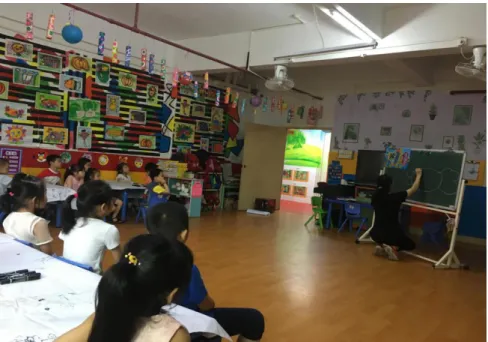
Equipment in the classroom is simple but shows teachers’ attentiveness to teaching as well as to their students (see Figure 1). In front of the room are a
television, a blackboard, an electric piano, and some shelves for children to put their school bags and water bottles. The walls and ceilings are originally white which seem to be too dull for a young children’s classroom, so teachers have decorated the whole walls with colorful papers as well as the children’s paintings. Along the classroom walls, Ms. Zhang also set up five playing fields as free-play corners for the children to play during unstructured activity. These playing fields have different themes which focus on cultivating children’s math skills, reading ability, creativity, arts, and hands-on experience. The temperature, inside as out, is above 30 degree Celsius.
Figure 1. The classroom decoration of a grade-three class
The first lesson begins at 9:00 and lasts for 20 to 30 minutes during which Ms. Zhang arranges the children in a big semi-circle for singing. The song kids sing is a song celebrating soldiers’ bravery and defiance to enemies in war. Lyrics are written on a white board. Some Chinese characters are very difficult for a six-year-old child, but these children can recognize most of the characters and they sing together. In order to have them sing well, Ms. Zhang turns into a strict teacher in this class. She leads the children to sing for two times, then has them sing several times. However, not all the children could focus on the song. Some do not want to sing. Some whisper with their classmates beside them. One little boy is asked to sit alone in the middle of the circle because he refuses to sing with the whole class. This little boy seems bored and still does not show any interest in the song, but because he does not make any noise, Ms. Zhang does not pay any attention to him. She focuses on leading the whole group to sing better.
The next class (from 10:00 to 10:30) is free play time. Children are told to sit down at their tables. Once they are seated, Ms. Zhang tells them to discuss and decide the game by themselves. Teammates in the same team must play the same game. After
several minutes of discussion, each team finally reaches an agreement. They get their toys or blocks on the table. They tease and talk to their peers throughout the game. At the same time, Ms. Zhang is not involved in playing with any of the teams. She is in front of the classroom drawing something for the classroom decoration. One little girl is not satisfied with her teammate (one little boy) because he grabbed her favorite block. She is sitting there without doing anything but shows an unhappy face. Ms. Zhang does not notice anything.
Kids are not allowed to speak in a large voice during free play. When noises become bigger and bigger, Ms. Zhang stops her work and says to the children, “Which team is making the biggest noise? OK, this team makes the biggest noise. This team will be the first one to finish their game. The noisiest team is not allowed to play their game.” Her words seem to be effective. Children begin to play with much smaller voices. After walking up and down the aisles checking each team, Ms. Zhang returns to her own seat in front of the room to continue her work.
By 10: 30, children are told to collect and put their toys back to the shelves as later they are going to do morning exercise in an empty area outside of the classroom. The empty area is only big enough for a maximum of four classes of children. Ms. Zhang arranges her students in five lines. Some children grow a bit restive, pushing and talking with their peers in a playful way. Ms. Zhang stops in front of them and says, “Keep still!” She walks up and down the aisles trying to make them stand in a straight line and keep enough space for morning exercise. When the music begins, Ms. Zhang goes back to the front, leads the children in morning exercise. Most of them participate with enthusiasm, while one little boy is unwilling to join in. He remains still, silent with a bored face. Ms. Zhang spots him, goes toward him and tells him to stand in front of his classmates to lead the morning exercise.
At 10:50, children move back to their classroom. Ms. Zhang tells them to drink some water and go to the bathroom which is a small room connected with the
classroom. Seventeen girls leave their seat for the bathroom. The remaining boys stay in their seat drinking water from the bottles they bring to school. Inside the bathroom there is a long ditch running along the wall. Under Ms. Zhang’s direction, all the girls pull down their pants and squat over the ditch, then before leaving the bathroom, they wash and wipe their hands with the small towels hanging on the wall. After the girls return to the classroom and take their seats, boys take turns to do the same thing as the girls did. Children love break time. They laugh and talk with peers while drinking water. Ms. Zhang sits in front of the room watching the children. She talks with the co-teacher Ms. Hu and from time to time, some boys will come to Ms. Zhang for a small talk. She makes jokes with the boys, asks them questions about their holiday and things happening in their family. The whole classroom is filled with a light and happy atmosphere.
Ten minutes later (at 11:00), children are told to put their bottles back on the shelves because soon they will continue to have the last lesson in the morning. Ms. Zhang tells them to take their chairs out from the table to the empty area of the
classroom and to sit in a semi-circle. With a book held in Ms. Zhang’s hands, she asks the children to recite three small stories as well as the math tables they have learned. Most of them are confident with their ability to recite. They participate with
enthusiasm. Ms. Zhang’s eyes keep moving from the book to the children to check their performance. Several children either do not have any sound coming out from their mouths because they have forgotten the story, or else they squirm in their chairs and talk to their friends nearby. Ms. Zhang asks them to come to the front. One after another, they are told to recite by turn. Only those who are able to recite with a clear and confident voice could return to their seat, otherwise, they have to stay at the front.
At 11:30, as the recitation check draws to an end, lunch is delivered from the central kitchen and brought into the classroom in stainless steel buckets. The children march to the bathroom and wash their hands. After coming back to the classroom,
they are told to line up to get their bowl of food. Ms. Zhang reminds the children to eat in silence and not waste any food while she distributes the food. If they chat with their desk mates in a large voice, she says in a strong tone, “You are so noisy. There is no need to talk while you are eating. ” Ms. Zhang walks around their tables checking on their progress after distributing the lunch. She stands beside the table of a
particularly slow eater, and says with a stern face, “You are so slow. Look at how much food you have in your bowl. Are you still talking?” This little girl, without reply, continues to eat her food.
Daily schedule in other classrooms.
The above-described half-day schedule is a good representation of how all the classes/activities are undergoing in all the classrooms of Sky Kindergarten. What is important to mention here is that (1) art (drawing & singing), math, language skills (reciting & reading) and morning exercise occupy the main part of the daily schedule; (2) free play is on the schedule, but is not arranged on a daily basis. Furthermore, as in other classrooms, free play is present not for educational purposes mainly, but for transitional purpose between activities. For instance, children are asked to play before breakfast begins, or they play while waiting for their parents to pick them up at the end of the school day; (3) most of the classes are teacher-directed and are held in group form where children have to obey some rules (e.g., no talking, be attentive, no squirming).
It seems that the principal and the teachers in Sky Kindergarten are focusing on the academic training and behaviors/manners of the children, which shows much similarity with what was described in the famous book, Preschool in Three Cultures written by Tobin, Davidson, and Wu in 1989. The education of children’s lower level emotions is not present on the schedule; neither is it in daily school life.
Findings and Discussions
For my research, I discuss Findings and Discussions together, as this seems a more effective way to present the data for clarity. Findings are organized into four sections. The first section reports incidents of six kinds of emotions that were displayed by children in a classroom setting. These incidents help to understand the context of emotions in the classroom. The second section examines teachers’ perceptions about children’s emotions that happened in a classroom context. In the third section, teachers’ reactions toward children’s displays of emotions are examined. Finally, in the fourth section, some efforts are made to discuss the distance that the five participating teachers want to keep in their teacher-child relationship.
Emotions Captured in Classrooms
As the observations started in May when half of the semester had gone by, most children had already gotten accustomed to their school life as well as their friends, teachers, and environment in Sky Kindergarten. Participating teachers said that the children showed much more stability in emotions than they did at the beginning of the semester. However, “much more stability in emotion” does not mean that these
children hardly display any negative emotions, or they could nicely handle their
emotions. They have emotions all the same and the emotions come in different kinds. This study only examines six different varieties of lower level emotions
displayed by children in a classroom context. These emotions are sadness, excitement, anger, fear, frustration, and embarrassment. This section will report one to two
vignettes related to each of the six emotions before we get to the next section where teacher’s perceptions of young children’s emotions will be discussed.
Sadness.
As the singing contest which is going to be held for International Children’s Day is getting closer, Ms. Zhang gathers her students to practice at least two times each school day. Most students’ interest in the practice only lasts the first 15 minutes. From then on, several students begin to lose their patience and start teasing or whispering to peers standing nearby. They try to find something interesting to do rather than engage in the practice. One of the boys, Mingyang, is noticed by Ms.Zhang. He is told to stand in front of his classmates to sing the song alone. Though unwilling at first, Mingyang finally leaves the group to stand before his peers at the repeated request of Ms. Zhang. He sings in a small and hesitant voice which doesn’t satisfy Ms. Zhang at all. Ms. Zhang turns her face from him to the class and says, “Do you want Mingyang to leave our class?” All the children are amused by this question. They answer with “yes.” Ms. Zhang turns to Mingyang again and says, “See? Nobody wants to have a classmate like you.” Mingyang’s face takes on an unhappy expression.
2. May 21st, 2019, free play, Ms. Yu
After a forty-minute singing practice, Ms. Yu asks her students to play outdoor on the plastic slide outside the classroom as a small reward for their good
performance in the singing practice. All the children are excited to go outside. They line up and follow the co-teacher Ms. Chen’s instructions to leave the classroom. Ms. Yu stays in the classroom to help two remaining boys with their drawings. A few minutes later, a little girl Meixi walks back into the classroom crying. She wants to play the “little train game” rather than slide. Sitting with the boys at a table on one side of the classroom, Ms. Yu talks to Meixi who stands several meters away, still crying. “It’s OK if you don’t want to play on the slide. I’m a little bit tired. I can’t play “little train” with you today. Let’s play it next time after the morning exercise.” Ms. Yu is obviously tired. She does not say anything more even though Meixi is still wiping her tears in silence. About one minute later, Meixi stops crying. Ms. Yu advises her again to play on the slide outside. Meixi walks out the classroom to join
her peers. Excitement.
1. May 22nd, 2019, story time, Ms. Tu
Ms. Tu tells her students a story which is designed to teach children knowledge of feet and toes. All the students sit in a semi-circle, showing great interest in the story. Without holding a book or chalk, Ms. Tu just sits on a small chair in front of them, telling the story with interesting and expressive words. She keeps asking some questions in an effort to keep them engaged in the story. “How many Xiaojiaoya (toes) do we have?” “What are they?” Children are all in high spirits to give Ms. Tu their answers “five!!” “Some are long!” “Some are short!” “Some are fat and some are slim!” Ms. Tu repeats their answers and shows her approval smile to them. Then she continues with the question, “What are our Xiaojiaoya used for?” After thinking for a second, some boys raise their hands and say, “They can run!” “They can walk!” and “They can ride a bike!” Ms. Tu repeats their answers and then she adds one answer that thrills all the children “and they can also race with a big wolf!”
Meanwhile she stretches her arms and makes a big sound of “wooooo” trying to scare her students by pretending to be a big wolf. Children all scream with excitement. Their eyes are bright with happiness.
2. May 27th, 2019. Free play time, Ms. Peng
Officers from the Municipal Educational Department come to evaluate today. In order to pass this school evaluation, principal Yan changed today’s schedule to meet its standard, which is to have children play most of the time in school. Children obviously love play. The whole Sky Kindergarten is filled with happiness and noise as rules of no big noise during play is loosened up today. All the classes enjoy
themselves in different games. In Ms. Peng’s class, she has all her students get their own jumping ropes and wait outside the classroom. After reminding the children to be
careful during play, she stands near the classroom doorway watching them playing. When some girls have difficulties adjusting the length of their ropes, Ms. Peng comes to help them out. A smile appears on her face as she sees some boys jumping rope in an awkward way. She makes fun of them a little bit then teaches them how to jump better. Those who are good at rope jumping not only jump alone, but also invite their peers to jump together. Talking, laughing, and sweating, the whole class seems to enjoy this moment a lot.
Anger.
1. May 15th, 2019, lunch time, Ms. Peng
A little boy, Jianjian finishes his lunch earlier than the others. Without anything interesting to do, he sneaks to the free-play corners wanting to get some toys to play with. Playing with toys at lunch time is against the rules and all the children know this clearly. Jianjian doesn’t have the courage to break the rule. He only enjoys the toys by touching them and re-situating some of the items. Soon this misbehavior is spotted by his classmate - Junhao. Junhao reminds him of the rule first, but without effect, then he hits Jianjian on the hand. Jianjian becomes angry. He runs to tattle to Ms. Peng who is by now sweeping the floor in the classroom. Ms. Peng stops her work, asks both of them to stand together for detailed information. She doesn’t criticize them, but asks Junhao in a warm tone, “Why did you hit Jianjian?” Junhao reports that “He played with the toys.” Ms. Peng looks at Jianjian “Why did you play with the toys?” Jianjian doesn’t reply. Ms. Peng continues to talk to Junhao with a soft tone, “Remember, it’s not good to hit other people. Even though Jianjian did the wrong thing, you shouldn’t hit him.” She has them say sorry and shake hands with each other. Anger seems to disappear in a short time. The two boys smile with each other and are friends again.
School evaluation is only eleven days away, but there are still a lot of decorations that need to be done in Ms. Peng’s classroom. Ms. Peng wants to have more free time for decorations, so she asks Ms. Tu for a favor. Now at this moment we see Ms. Tu leading two classes of students to recite short stories in one classroom and Ms. Peng is busy with decorations in her classroom. A sudden combination of two classes excites some of the boys. They become curious about some of the strange faces. Whispering and laughing, their attention is distracted away from the recitation to these little new strangers in the same room. One of the little boys, Kangkang who is talking aloud is seen by Ms. Tu. She calls out his name, asks him to stand up and recite again in a strict tone. Kangkang immediately cries, but he still manages to recite at the same time. Standing several meters away from Kangkang, Ms. Tu responds to his crying with an explanation, “I told you to sit quietly, sit quietly, didn’t I? Was I mistaken about you? Who should feel wronged?” Kangkang is still wiping his tears. Showing a bit of rebellious spirit and anger, he answers without any hesitation, “I should feel wronged.” Ms. Tu replies, “Do you really think you are right? Please spend more time considering about it. If all I did is wrong, didn’t you do anything wrong?” She
continues to talk to the whole class, “If I don’t speak in a strict tone, nobody would listen to me.”
Fear.
1. May 21st, 2019, singing practice taught by Ms. Tu
Ms. Tu is worried about the singing performance. She would like her class to practice every day expecting that her students would do a good job in the
performance. However, these four-year-old young children cannot understand her intention. Their interest and patience to practice hardly lasts for ten minutes. After ten minutes, the song becomes dull to them. They either forget to do some of the gestures to the song or forget their position in line or get distracted by other things around or squirm in line. Ms. Tu makes several attempts to correct them, but all are proven
ineffective. Eventually a strong feeling of annoyance comes to her. She speaks to her students in a severe tone and loud voice, “How come you all are being so shiftless in this practice!?” “I don’t think we need the costumes (that are already bought) for this performance anymore! I will return them!” All the students are extremely upset by Ms. Tu’s reaction. They stand still, without making any sound at all. Ms. Tu continues to say, “I don’t allow you to do this on the stage! With such poor performance, how could you go on the stage?! You don’t feel ashamed? I do!” The whole classroom is very quiet. Some children feel too scared to look at Ms.Tu.
2. May 28th, 2019, morning exercise led by Ms. Huang
Children in Ms. Huang’s class are only age three to four. Most of them stand well in four lines for morning exercise: no talking and no squirming. Ms. Huang stands in front and faces her students while leading the exercise. She pays attention to those children who do not move or who are doing something else instead of the exercise. Some children quite enjoy the dancing and moving but some don’t even move or look at Ms. Huang. Ms. Huang would occasionally remind them to stay focused. However, one little girl Yanyan who does not concentrate on the exercise does something that irritates Ms. Huang. She stops leading the exercise, goes to Yanyan and asks her to leave this classroom. Yanyan expresses her unwillingness to leave. She does not say anything but only stays there with a frown face, which intensifies Ms. Huang’s anger. Without any more words, she grabs Yanyan by her right hand and right leg, carrying her in a forcible way to a grade one classroom nearby. Yanyan cries and struggles so hard during this process. She keeps shouting, “I don’t want to go there (to the other class)!!” Ms. Huang remains firm on her decision. After putting Yanyan into the other classroom, she comes back to move Yanyan’s school bag and water bottle to the classroom where Yanyan is now.
Frustration.
1. May 9th, 2019, free play led by Ms. Zhang
During free play time, children are told to sit down at their tables. Once they are seated, Ms. Zhang tells them to discuss and decide the game by themselves.
Teammates in the same team must play the same game. After several minutes of discussion, each team finally reaches an agreement. After getting their toys or blocks on the table, they joyfully play and talk with each other through the game. However, not all the children are satisfied with the team decision. One little girl, Mengfei comes to Ms. Zhang to ask for help because her team has some disagreement in playing the same game. Ms. Zhang responds in a strong tone, “I told each team to decide its game by discussion. Why didn’t your team reach an agreement after discussion? What does it mean to discuss? Didn’t you and your teammates discuss?” Mengfei is a little bit disappointed and frustrated with Ms. Zhang’s response. She does not say anything but moves back to her seat.
2. May 27th, 2019. Free play led by Ms. Huang
In Ms. Huang’s classroom, she also set up five playing fields as free-play corners for the children to play during unstructured activity. These playing fields have
different themes emphasizing children’s math skills, reading ability, creativity, arts, and hands-on experience. After repeating some rules children need to obey while playing in the corners, Ms. Huang arranges her class into five groups and has them go into the five corners to play for about twenty minutes. A little girl, Fangfang doesn’t have any interest in reading books; instead she wants to play with a big doll in the other corner called “Baby’s House.” Without asking Ms. Huang, Fangfang moves to the “Baby’s House” and takes off her shoes, wanting to join her classmates inside. Obviously, this is against the rules. Ms. Huang stops her immediately after seeing her taking off shoes at the corner’s doorway. Showing a frowned expression, Fangfang looks at Ms. Huang, and still insists on going in. However, Ms. Huang remains firm
on her decision. She looks Fangfang in the eye, strengthens her tone and repeats, “NO.” Without further explanation and talking, Fangfang moves back to the reading corner with a frustrated look.
Embarrassment.
1. May 14th, 2019, drawing class taught by Ms. Zhang
In drawing class, Ms. Zhang is teaching the children to draw a colorful fish. At first, she leads them to draw the fish with simple basic shapes such as triangles and circles on the blackboard, then asks them to fill their fish with any patterns and colors they like. After that, Ms. Zhang is walking around to see their progress of drawing. Those who are less able to copy the fish on the blackboard are corrected: A girl whose fish is drawn too small on a white paper is told to draw bigger. A boy Junsheng makes a terrible mess to his fish even though he has been asked to make it better several times. This time, Ms. Zhang stops in front of his table. Showing dissatisfaction at his drawing, she asks, “Can you draw slowly? What are you drawing right now? A total mess.” While commenting on Junsheng’s fish, Ms. Zhang holds up his drawing and one that is nicely done by a girl nearby to show other students the big difference. Being amused by Junsheng’s drawing, the whole class laughs out loud. Junsheng seems to be embarrassed by their laughter. He doesn’t say anything. Ms. Zhang continues to say, “Don’t laugh at Junsheng. Actually, his fish is big enough, but the problem is that he didn’t pay attention to drawing the patterns of this fish. Let’s see what he can do to make it better.” Ms. Zhang gives the drawing back to Junsheng and begins to check other students.
Noteworthy points in the vignettes.
The vignettes mentioned above are certainly just a small fraction of the emotion-evoking vignettes that happen every day in the classrooms. They provide a glimpse of the participating teachers’ ways in their responses to children’s displays of emotions