NII-Electronic Library Service
7?:e1mpaneseJburnalofRsychenomicScience
2e03, Vol,22,Na. I,58 66
Lecture
Contributions
of
experimentalpsychology
toneuropsychology
Max
CoLTHEART
Macquarie
University*
Neuropsychological
effects ofbrain
damage
on mental processes are varied and complex.Cognitive
modelsfrom
experimental psychology help us make sense ofthem.
Such
models now existfor
many differentdomains of cognition, allowing us insightintohow braindamage affectscognition in each of these domains-even
higher-order
domains
of cognition such as beliefformation.
Work
which applies experimental psycho]ogy to neuropsychologyin
thisway also supports some very general conclusions about cognition, such as thatthemind ishighlymodular, and thatrnental representations are typicallylocalrather than distributed.Key
words:experimental psychology, neuropsychology, modularity,Lexicon,
cognition, connectionism, dyslexiaNeuropsychology isthe study of the relationship
between the brainand psychological processes such
as
language,
memory, object recognition, skilledac-tion and thought. Neuropsychological research is
frequentlydone by investigatingways in which such
psychological processes can
be
disturbed
by
braindarnage,
Such
investigations
need data from experi-menta] psychology which tellus how thesepsycho-logicalprocessesare normally carried out
in
peoplewith
intact
brains,
We
cannot understand waysin
which psychological processes are functioningab-normally after brain damage unless we know how
they
function
normally, thatis,
in
people withoutbrain
damage,
Atthesame time,we can learnmore about theories
of nermal psychological functions
by
studyingpeo-ple
in
whom suchfunctions
have
been
impaired
by
brain
damage.
This area of research isknown as cognitive neu-ropsychology. Ithas two essential features:
'
The
use ofdata
from
people with abnormalitiesef some cognitive system to develop, test or
extend
theories
about thatsystem,. The use of theoriesof some cognitive system to
explain data
from
people with abnormalities inthatcognitive
domain.
* Macquarie
Centre
for
Cognitive
Science,
quarie University,Sydney, NSW 2109,Australia
rnax@maccs,mq,edu,au
reading,
Cognitive
neuropsychologyis
thus theapplication of experimental cognitivepsychology
to neuropsy-chology,
Cognitive
neuropsychology was much practicedin
the sccondhalf
of theNineteenth
Century,
and quite sophisticated models of language processing wereproposed by Wernicke
(1874)
and Lichtheim(1885),
bascd
on their research on aphasia,The
rise ofbehaviourisrnat thebeginning of theTwentieth
Cen-tury,and the lack of success of the cognitive
neuro-psychologistsof thatera
in
theirattempts tolocalize
inthe
brain
thc components of theircognitivernod-els of ]anguage-processing, ledtothedisappearance
of cegnitive neuropsychology formany decades. A
seminal paper on reading
disorders
afterbrain
dam-age-that
is,
on acquireddyslexia-published
by
Marshall
&
Newcornbe(1973)
ledtotherebirth of thesubject,
Acquired
Dyslexia
&
the
Dual
Route
Model
ofReading
Marshall
&
Newcombe
(1973)
dcscribed
threedif-ferent
forrns
of acquireddyslexia
and proposed a sirnple rnodel of how reading aloud occurs whichthey used tointerpretthe differentsymptoms seen in
these
acquireddyslexias.
More
sophisticated models of reading now exist, and so more sophisticatedin-terpretationsof acquired dyslexia are possible.
Current models ofreading, whether connectionist
The Japanese Psychonomic Society
The JapanesePsychonomic Society
M.
CoLTHEART:
Contributions of experimental psychology toneuropsychology59
ttt...
.x
tv
r,tt,.t."
r semanttcsystem.tx.. ...-..
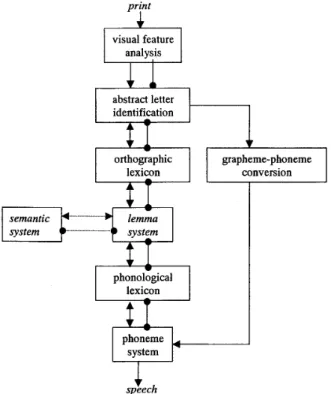
x ttt, Prtnt visualfeatureanalysis abstractletter identification orthegraphielexicon grapheme-phoneme conversiofiJphonologicallexicon
phonemesystem speechFigure
1.
The
DRC
mode] of visual wordtionand reading aloud,
(e,g.
Plaut, McClel]and, Seidenberg, & Patterson(1996)
or nonconnectionist(e.g,
Coltheart,
Rastle,Perry,Langdon,
&
Zeigler,2001) allincorporate thegeneralidea thatthereare two computational
path-ways
from
print to speech inthe human readingsystem.
One
of thesepathways iscapable of reading aloud pronounceable nonwordsbut
has
some orcom-pletediMculty inreading aloud irregularor
excep-tionwords
(words
which disobey standardspelling-to-sound rules);
in
theDRC
model ofColtheart
etaL(2001)
thisis
thenonlexical reading route.Thc
otherpathway inthesemodels
is
capable of reading a]eudallwords but incapable of reading aleud pronounce-able nonwords:
in
theDRC
model ofColtheart
et al,(2001)
thisis
thelexical
reading routc,Figure
1
shows theprocessing architecture ef theDRC model.
Coltheart
et aL(2001)
described
numerous resultsfrom
studies of visual word recognition and reading aloud which are correctly simulatedby
thismodel.They also showed thatsimulations of various
forms
of acquireddyslexia
can be achieved: one canarti-ficially
lesion
the model and showthat
its
nowim-paired reading shows symptoms that correspond to
symptoms seen in peop]e whose reading has been
impaired
by
brain
darnage
Csee
also Coltheart,Lang-don, & Ha]ler,1996).
In
theform
of acquireddyslexia
known asPhono-togz'cal
dyslexia
(Beauvois
&
Derouesne 1979;Fun-nell, 1983;
for
review seeColtheart,
1996),
theabilitytoread aloud pronounceable nonwords
is
selectivelyimpaired relative to the ability toread aloud words.
Phonological
dyslexia
occurs not onlyin
readers ofalphabetic scripts, but also
in
readers ofJapanese:
Patterson,
Suzuki,
&
Wydell
(1996)
reported acase of aJapanese
reader who after a stroke could read realwords written in hiragana very well
(even
whenthese were words which were norrnally written
in
kanji)
but
scoredO/90
inreading 2-3 character hira-gana nonwords.Inphonological
dyslexia,
nonword reading maybe
completely abolished
(Funnell,
1983)but morecom-monly some
degree
of nonword reading abilityre-mains. Insuch cases, thereare several propertiesof
nonwords which
influence
thelikelihood
that thephonological
dyslexia
will succeedin
reading thernaloud.
In
sotne cases(Beauvois
& Derouesn6, 1979;Berndt, Haendiges,
Mitchum,
&
Wayland,
1996),
non-words arc read more successful]y when they are
pseudohomophonic
<i.e,
pronounced exactlylike
some real word-for example KOAT or PHOCKS)
and thisadvantage
ts
greater
when thepseudohomo-phone isorthographically similar to
its
parent word(e,g.
KOAT) than when itisnot(e.g,
PHOCKS),Both
of theseeffects are seen
in
thebehaviour of the DRCmodel when
its
ability toread nonwordsis
impaired
by causing it$noniexical route tooperate abnor-mally slowly
(Colthcart
et al. 1996,2001). Inother cases of phonologicaldyslexia
(Beauvois
&Derou-esne 1979),nonword rcading
is
worsefor
nonwordsin
which multiple lettersmap onto asingle phoneme(e.g.
OOV)
than with nonwords which haveone-to-one mappings of
letters
to phonemes(e,g,
OLV),Such cases would seem to
have
animpairment
in
the
graphemic parsing stage of the nonlexical reading
route
{Coltheart,
1985).
Application of models of reading tothe study of
phonological dyslexia thu$ shows us net only that
this
is
a separate subtype of acquired dyslexiabut
even thatit
itself
has
different
subtypes: thenon-NII-Electronic Library Service
60 The
Japanese
Journal
of PsychonomlcScience Vol.22,
No, 1word reading arises because the nonlexical route is operating tooslowly whereas
in
other casesit
arisesbecause of impairment of a specific component of
thisroute, the graphemic parsing stage,
If
phonological dyslexia isdue to someform
ofimpairment of thenonlexical route, it
is
worthcon-sidering what one might expect
if
the oppositeim-pairment-an
impairment
of the lexical readingroute--occurred. Since in
the
DRC
rnodel that routeis
required forthe
successful reading ofirregular
words
(such
as blood,are,move,yacht
or gauge),what wouldbe
expectedis
se]ective impairment inthe
reading of irregularwords with preservation ofregu-larword reading and nonword reading.
Marshall
and
Newcombe
described
a patte;nlike
thisintwo
patients with acquired dyslexia and named the
pat-ternsumbce
dJ,slexia
;fora particularlypure case of surfacedyslexia,
seeMcCarthy
& Warrington(1986)
and fora review of this
form
of acquireddyslexia
seePatterson,
MarshalL
&
Celtheart
(1985).
Ihave noted thatphonological
dyslexia
occurs not onlyin
readers of alphabetic scripts, but also in readers ofJapanese.
What about surface dyslexia?This
is
a complex question,because itsanswerde-pends upon
the
definition
of'`surfacedyslexia".
If
the
definitionof surface dyslexia isworse reading of
irregular
than regular words, thenthis
condition could not be identifiedinJapan
because the terms"irregular
word" and "regular
word" are definedonly
with respect toalphabetic scripts,
However.
Japa-nese patients have been reported who, after
brain
injury,ean stillread nonwords written
in
kana,
but
make errors
in
reading kanjiwords, errors thatcouldbe
treatedas analogous tothekindsof regularizationerrors that surface
dyslexic
readers of alphabetic scripts make.Should
thisbe
called surface dyslexiain
Japanese?
For
arguments that itshou]d, see e.g.Patterson,
Suzuki,
Wydell, & Sasanuma(1995).
Even
ifsuch arguments are not accepted, thissubtype of acquired
dyslexia
in
Japanese
is
clearly differentfrom
Japanese
phonological dyslexia Any model ofthe
Japanese
reading system would thereforehave
tobe lesioned
in
different
ways tosimulate these twosubtypes ef
Japanese
acquired dyslexia.
Just
as isusual in phonologicaldys]exia,
theim-pairment of reading isnot absolute
in
surfacedys-lexia
i.e,
the patient does not score O% correct on reading aloud irregularwords. A major determinantof
the
likelihood
thatanirregular
word willbe
read correctly isitsfrequency, with accuracybeing
high-er forhigh-frequency
irregular
words thanfor
low-frequency
irregular
words.Coltheart
et aL(1996;
seealso
Coltheart
et al. 2001> successfully simulated surfacedyslexia,
includingthe
relationship of wordfrequency to reading success with
irregular
words,by impairing theoperation of the
lexical
route ofthe
DRC
model.Specifically,
thiswas doneby
reducingthesensitivity toinput of the orthographic
represen-tations in
the
model's orthographiclexicon.
Thiscauses the model tornisread many exception words
(especially
when they arelow
in
frequency)
whileleavinguntouched itsaccuracy
in
reading aloudreg-ular words and nonwords. What ismore, when
ir-regular words are misread by thelesionedmodeL
the
reading errors are regularization errors(i.e.
readingthe irregularword according tothe rules, such as
reading
blood
torhyme with"mood''),
andregulariza-tion errors are characteristic of surface dyslexia on
patientswith thisform of acquired
dyslexia.
Inoted earlier that thereare differentsubtypes of
phonological
dyslexia;
there are alsodifferent
sub-types of surface dyslexia, In one subtype, there
appears tobean impairment inor around the
ortho-graphic
lexicon
(as
in
theDRC simulation) But ifonerefers totheDRC rnodel inFigure 1,one can see that
thereare various other lociat which an
impairment
would harm
the
reading ofirregular
words whilesparing the reading of regular words and nonwords:
for
example, failuretoaccess wordsin
thephonologi-cal lexicon when reading aloud would compel
reli-ance on the nonlexical reading
for
reading aloud andhence
cause a surfacedyslexia.
This output iorm of surface dyslexia has been described(for
further
dis-cussion ofthe
possiblesubtypes of surface dyslexiaand their
interpretation
interrnsof amodei likethatshown
in
Figure 1,see Coltheart& Funnell,1987).
Semantics
Figure
1
is
an over-simplified model ofthe
readingcom-The Japanese Psychonomic Society
The JapanesePsychonomic Society
M.
COLTIIEART:Contributions
of experirnental psycho]ogy toneuropsychologyprehension,
and'this
isbecause itlacksa component
representing werd meanings-a semantic systern.
That
systemis
sketchedin
thefigure,
but
repre-sentedin
grey
because
it
has
notbeen
implemented
inthemodel, Ifone implemented a semantic system
in this modeL one would have to decide how this
system should
be
interfaced
with the othercompo-nents. Some preliminary work on thisquestion in
the context of the DRC model has been reported by
Watters
&
Patel
(1998a,
1998b).
They
developed
a system ofsemantic representationsior
asmall setof words using the hicrarchical sernantic representa-tions provided by the ]exicaldatabase Wordnet(Mil-ler,Beckwith, Fellbaum,
Gross,
&
MMer,
1990)
andthey
interfaced
thissystem with theDRC
model ofFigure 1via a system of nodes which they referred to
as a word sensc system,
but
whichI
willreferto
as alemma
system.This
preduces the architecture shownin
Figure
2,
In
models of speech production such as that ofLevelt, Roelofs, & Meyer
(1999;
see also Roelofs(2000)
for
the computational version of thismodeLknown
asWEAVER-+),
production of spoken words during spontaneous speech or picturenamingi semanticsystem
Figure2. A schematic elaboration of the DRC
model
to
include a lemma system as aninterface
'
tosernantlcs.
61
involves communicating from a semantic system to
a phonelegical
lexicon.
Intervening
between
these
two
levels
of representationis
asystem oflemmas,
It
is
at this levelthat syntactic information about aword isheld
(for
example, gramrnatical gender, the mass noun vs.count noundistinction,
and-a Japa-neselangua'ge
example-information aboutclassi-fiersinthislanguage). Adding asystem of lemmas to
the DRC modeL as issketched in Figure 2,might
allow
it
effectivelyto
be
merged with theWEAV-ER-+ model to
produce
a more general model which can simulate all the effects in visual wordrecognition and reading aloud thatthe
DRC
modelcan simulate and alltheeffects
in
speech productionthatthe
WEAVER++
model can simulate.So far Ihave only discussed the effects of brain
damage
on reading aloud.But
in
other patientsit
is
semantics thatis
affected i.e,the ability tounder-stand language. There arc a numbcr of ways in
which theFigure 2model could beimpaired inorder
togenerate acomprehension
impairment,
Damage
tothe
lemrna
systern orits
communication withseman-ticswould produce
impaired
cornprehension of both spoken and written words even though thesemantic systemitself
is
stillintact.
Or
there
couldbe
damage
tothe sernantic system
itself.
Consider the following conversation with the
pa-tient AC
(Coltheart,
Inglis,Cupples, Michie,Bates,&Budd,
1998):
MCi
"Howmany
legs
does
an oysterhave?"
AC:"Afew"
MC: "I
see, What abeut an ant?"
AC:
"Some." MC:'tAcaterpMar?"
AC: "Nolegs" MC: "Whataboutasnake?" AC: "None"MC:
"Andaseagull?" AC: "Fourlegs"
Why
could notAC
do
this
task?
Coltheart
et al,(1998)
investigated
a number of possibilities,asfol-lows:
(a)
AC has tostsemantic knowledge inthe semanticcatego2y
ofanimats
:No;because
hewas still atob-NII-Electronic Library Service
62 The
Japanese
Journal
of Psychonomic Science VoL 22,No. 1
jects
as possessing legsor not;
{b)
AC
has
tost
semanticknowleclge
about theerCIJ`bossesses
legs":
No;
because
he
was still
at chance when asked toclassify anirnals as
possessing tailsor not;
(c)
AC has lostsemantic knowle(igeabout theparts
thatobjects
Possess:
No;
because
he
was stillat chance when asked toclassify objects by theiroverall shape
(round
versus long)or by theircolour
(typica]ly
coloured or not);
(d)
AC
has lostallsemanticfenowlecige
erties
of
obtiects: No; because he was notpaired at classifying objects accQrding to
Pereeptual
properties(dangerous
versus
less;
anAustralian
animal versus aAustralian animal; edible versus inedible;land
creature versus sea creaturc);
(e)
AC has lostsemantic knowtedge about thePer
ceptuat
properties
of
obiects:No;
because
he
was not impaired at classifying objects
ing to nonvisual perceptual properties
cally rnakes a noise versus does not make a
noise; possesses an odour versus
does
notsess an odour}.
In
surn, then,AC
has
intact
knowledge
of nonper-ceptual semantic properties of animate andinani-mate objects, and intactknowledge of perceptual
semantic propertiesof such objects, as long as these are not visuat properties.
What
he
is
lost
is,
spe-cifically, allknowledge
of the visual properties of such object$, These results suggest that theseman-ticsystem isnot a single body of knowledge, but
tnstead
is
asetof separate subsystems eiknowledge,
one of which isknowledge of the visual propertiesof object$: itisthat
separate subsystem whichAC
has
lost.This
led
Coltheart
et al.{1998)
to propose aconception oftheoverall sernantic system as asetof
perceptual knowledge subsystems, one foreach
sen-sory modality, plus a nonperceptual
(i.e,
conceptual)knowledge
subsystem,This study of AC indicated one way in which
semantic impairments can becatagory-specijic: inhis casc
the
impairment
was restrictedto
aparticular
kind
of
ioformation
(visual
information),
There are atleast
two other waysin
which semanticimpairments
can be category-specific: sometimes they are
re-stricted
to
aparticular
semantic catagoi))(e,g,
anirnate objects) and sometimes they are restricted toaPaF
ticularmodality
of
input
(e.g.
picturesversus printedwords). Thus cognitive neuropsychology has ledus to an especially rich and cornplex conception of the organization of the sernantic system;
for
further
dis-cussion of thisextremely largetopic,see e.g. the bookon thissubject by Forde & Humphreys
(2002),
So
far
I
have
discussed
the
contribution oftheories from experimentalpsychology
toneuropsychologyin
just
two domains of cognition, reading andseman-tics,
The
samekinds
of contributionhave
alsooc-curred
in
otherdomains,
such as music processing(Peretz
&
Coltheart,
2003),
attention, objectrecogni-tion,face recognition, calculation, spelling, skilled
action and many others;
for
reviews of such work, see Rapp(2001),
As well as contributing toour knowledge of
cogni-tion
inspecific cognitivedomains,
however,
cegni-tivcneuropsycholegical work
has
contributedin
arather general way to our overall conceptions of
cognition-our genera] conccptions concerning,
for
example, the modularity of mind and
the
nature of rnental representations,Modularity
andLocal
Representation
Two fundarnental and interrelatedquestions here
are:
(a)
Howmodulariscognition?
(b)
Are all mental representation distributed,ordo at leastsome cognitive systems use local
representations?
Iwill discusstheseissuesinrelation tothe concept
of "menta]
lexicon",
soI
needto
sayfir$t
whatI
meanby
thisconcept.
Lexicon:
abody
oflocal
representations repre-senting stimulus forms insome particulardomainPhonological
lexicon:
contain$ the phonologicalforms
of allthe words whose phonelogy youknow,
one entry per word.
OrthQgrophic texicon: contains the orthographic
forrns
of allthewords whose orthography youknow,
one entry
per
word,The Japanese Psychonomic Society
TheJapanesePsychonomic Society
M. CoLTHEART: Contributions
forms
(structural
descriptions?)
of all the objects whese appearance you know, one entry per object.Does the human mind contain such cornponents?
The
idea
that there arelexicons
is
frequently
re-jected
in current connectionist models of cognition such as theconnectionist models of readingproposed
by
Scidenberg
&
McClelland
(1989)
and Plaut,McClelland,
Seidenberg,
&
Patterson
(1996)
or theconnectionist mode] ef speech recognition proposed
by
Gaskell
&
Marslen-Wilson(1997>.
Such
rejectionsqrise
because of connectionism's reliance ondistrib-uted rather than
local
representation$, andbecause
connectionists are intrinsicallyunsympathetic to
modularity.
A
taskfrequently
usedjn
experimental psychol-ogyis
lexical
decision:
judging
whethcr or not aprinted
(or
speken) stimu]us isa word or a nonword.There's a comparable task with pictures, known as
object
decision:
pictures of real objects or of non-objects(composed
of componentsfrom
real objects,with these components put together
in
plausibleways) are shown and
the
subject has to decide whether thevisual stimulus isa real object or not.How do people carry out such tasks?
If
rnentallexiconswith
local
representations exist, the answeriseasy:
just
look the stimulus up inthe relevantlexicon.
If
it
is
there,
sayYES;
otherwise sayNO.
But ifthereare no mcntal lexicons,explaining how
peopleare able toperform thesetasksso quickly and
so accurately
is
not simple,The
connectionistan-swer here has typically been: people interrogate
theirsemantic system.
If
the stimu]ushas
activatedthe scmantjc system, then
it
mustbe
a real word orobjeet, so rcspond YES; ifsemantic activation is
absent, or
if
it
is
weaker than some criterion, respondNo
(see
Plaut,
1997,for
thisapproach tovisuallexical
decision and Gaskell & Marslen-Wilson
(1997)
for
thisapproach to auditory lexicaldecision).Such an answer makes a very clear prediction:people with
impaired
semantic systems cannotbe
normal atvi-sual lexicaldecision,auditory lexicaldecision,or
object decision.
There
have
been
numerousfalsifications
of thisprediction
in
the cognitive-neuropsychological lit-erature:ofexperimental psychology toneuropsychology 63
Visual lexicatdecision
(a>
DC
(Lambon
Ralph,
Ellis,
&
Franklin,
1995}
was severely impaired at comprehending
printed words
but
in
the
norma] range at uallexical
decision.
(b}
JO
<Lambon
Ralph, Sage,&
Ellis,1996;bon Ralph, Ellis,
&
Sage, 1998) was alsoverely
impaired
at comprehending printedwords
but
in
thenormal range atvisual lexical
decision,
(c)
EM(Biazely
& Coltheart,submitted) was alsoseverely
impaired
at comprehending printedwords butinthenorma] range atvisual
lexical
decisionAuditoty
lexical
decision
(a)
KW(Hall
& Riddoch, 1997) was severelypaired at understanding spoken words
but
in
the normal range at auditory lexicaldecision.
(b)
Dr O(Franklin,
Howard, & Patterson, 1994)was
impaired
atcomprehending spoken werdswhen they were abstract,
but
in
the normalrange on an auditory lexica]deci$iontask
taining many abstract words.
Object
decisien
(a)
SB
(Sheridan
&
Humphreys,
1993)
showcd aselective semantic impairment foranimals and
foodstuffs
but was in the normal range onobject decision tasks even though the task
stimuli
included
many representations of mals and foodstuffs.
(b)
JB
(Humphreys
& Riddech, 1987) had aeral semantic irnpairment but perforrned in
the normal range on an object
decision
task,Itistherefore not correct to claim that lexical
decision
and objectdecision
tasks
are perforrnedbyconsulting the semantic system,
That
leaves
our ability toperform
thesetasks unexplainedby
theo-rists who argue that mental lexiconsof Iocal repre-sentations do not exist; and thissupports the claim
thattheword and object processing systern
is
highly
modular(being
composed of separate lexicons)anduses localrather than distributed representations,
since thisclaim predicts
that
therewill be patientswho are semantically
impaired
but
normal onlexical
NII-Electronic Library Service
64 The
Japanese
Journal
of Psychonomic Science VoL22, No, 1
Cognitive
Neuropsychiatry
In
theearlydays
ofits
renaissance, cognitive neu-ropsychology mainlyfocussed
on studyingdisorders
of basic cognitive processes such as language or
memory or perception,and examples of this kind of work are
discussed
above.In
recent years,however,
the attention of some cognitive neuropsychologistshas turned todisordersof higher-levelmental
proc-esses such as reasoning or
belief
fermation.
Abnor-malities of such higher-ordercognitiveprocesses
are often regarded as psychiatricconditions; hence theapplication of cognitive neuropsychology to such
conditions isknown as cognitive neuropsychiatry,
Its
ultirnate aim, sinceit
is
abranch
of cognitiveneuropsychology, is to develop models of these
higher-ordercognitive processeson
the
basis
ofdata
frorn
peoplewithdisorders
oftheseprocesses,and toseek touse such models to
interpret
suchdisorders.
So
far,
most work in cognitive neuropsychiatryhasbeen on delusionalbeliefs.A number of
different
kinds
ofdelusional
belief
have
been
recognizedfor
along
time.They
include:
. Iam dead
(the
Cotard delusion).
.I
am constantlybeing
followed
aroundby
agroup of peopleIknow,
butIcan
not recognizethem because they are always disguised
(the
Fregolidelusien}.
.
My
spousehas
been
replacedby
animpostor
(the
Capgras
delusion).
.Other people are inserting thoughts into my
mind
(thought
insertion;usually associated withschizophrenia),
. Other
people
can control the movements of my
body
(alien
control; usually associated withschizophrenia).
.
This
arm[the
speaker'sleft
arm]is
not mine,it's
yours.
.WhcnIlook into
thc
mirror, the personIsee isnot me,
but
some stranger who]ooks
just
like
me
(mirrored-selfmisidentification},
Although conditions likethesehave typicallybeen
explained inpsychiatric
terms,
it
has
become
clear recently that many, and even possibly all,areneu-ropsychological
in
origin, For example, patientswith Capgras delusion failtoshow the normal
aute-nomic arousal response
to
picturesoffamiliar
faces
(Ellis,
Young,
Quayle,
&
de Pauw, 1997};itseemshighly
plausible
thatthisis
implicated
in
the belief thatone's spouse(the
sight of whose face ought to activate one's autonomic nervous system maximally)has
been
replacedby
a complete stranger(since
a stranger's face would be much lessarousing}. Thisneuropsychological disconnection between the face
recognition system and
the
autonornic nervoussys-tem seems a necessary component ef Capgras
delu-sion, butitisnot stdi7cient tocause thedelusion,since
the
disconnection
is
also seenin
peoplewho are notdeluded
(Tranel,
Damasio,&
Damasjo,
1995).
My
colleagues and
I
(see
e.g,Langdon
&
Coltheart,
2001
;Davies & Coltheart,2001; Davies, Coltheart,
Lang-don,
&
Brcen,
20e2)
have
therefore
proposed atwo-factor
theory of delusion,The two factorswhich we rcgard asjointly
necessaryfor
thedevelopment of adelusional
belief
are:
(a)
the presence of somc neuropsycho]ogicalnormality responsible
for
the initialrenee of the
belief
(e,g,
the autonomicnection inCapgras delusion)and;
(b)
darnage
tea right cerebralhemisphere
system
for
belief
evaluationis
responsiblefor
failure
to reject thebelief;ifthissystem were intact,
the initialbeliefwould beevaluated and then
rejected
(because,
for
example, thebelief
is
bizarre
orimplausible,
orbecause
everyoneis
tellingthe deluded person that thebeliefisa
falseone).
This
two-iactoraccount appears tooffer plausibleexplanations of many of theforms of delusion listed
'
above,
though
far
more workis
neededif
the
account'
is
tobe
adequately evaluated.
Future
Directions
in
Cognitive
Neuropsychology
`Developmental cognitive neuropsychology.
There isan important distinctionbetween acquired
and develQpmental disordersof cognition, When a
person
had
acquired some cognitive ability to anormal
level
but then suffered braindamage
which reduced or eliminated thisability, this
The Japanese Psychonomic Society
The JapanesePsychonomic Society
M. CoLTHEART: Contributions of experimental psychology toneuropsychology
65
sents an acquired
disorder
of cognition,When
aperson has never attained a normal levelof
formance of some cognitive ability,thisrepresents
a
developmental
disorder
of cognition.mental cognitive neuropsychology
is
thetionof experimental cognitive psychology tothe
understanding of
developmenta]
disordersofnition such as developmental dyslexia or specific
language impairment.
Its
aimis
tolearn
moreabout the ways
in
which children normally acquireparticularcognitive abilities by studying children
who are
having
specificdicaculties
in
acquiringany such cognitive ability.
.
The
relatienshipbetween
cognitivepsychology
and cognitiye neuroimaging of thebrain. Inthe
past
decade,a popular(and
very expensive)ed of studying cognition
has
been
to measureneural activity within thebrain
(using
PET, fMRI,MEG
etc,)as a person isperforming a cognitivetask.
What
aims does such workhave?
One obvious aim islocaiizationof cognitive mod-ules in
the
brain.
However,
you can not localise cognitive modules inthe brainusing imaging unlessyou have a theory frornexperimental psychology
about what those modules actually ace. So you can
not use imaging to
discovcr
what the modules are.That
means thatcognitive neuroimagingis
depend-ent upen experimental psychology,
Are thereother possibleaims of cognitive
neuro-irnaging?
For
example, coulddata
from
cognitive neuroimaging beused todevelop new theoriesabout cognition. or to decidebetween existing theories?I
don't
thinkthere hasbeen
any cognitiveneuroimag-ing work which
has
achieved thisparticularaim;I
am evendoubtful
about whether this will everbe
achieved infuture cognitive neureimaging work.Concluding
Remarks
'
Cognitive
models frornexperimental psychologycan provide explanations of acquired or
develop-mental disorders of cognition, methods for as-sessing suchdisorders,
and information about where treatment sheuld be directed.' Data from people with such disorders provides
ways of testingthesernodels.
.This approach works even
for
high
lcvel
cogni-tive
disorders
such asdelusions
or hallucina-tions..Resu]ts
obtained with this approach strong]y sugge$t that cognitive systernsinvolve
a veryhigh
degree
of modularity..
Results
obtained with thi$approach alsostrong-lysuggest that cognitive representations are
in
many cases loca]rather than
distributed.
References
Beauvois,
M
F.
&
Derouesne,
J.
1979 Phonological alexia: Three dissociations.fouTnal
of
Neurology,
IVeurosuTgeT),,and Rsychiatrv,42,1115-1124,
Berndt,
R.S,, Haendiges, A.N. Mitchum,C,C.
&
Wayland,
S.
C.
1996 An investigationofnonlexicalreading impairments. Cognitive
NeurQPsycholQgy,
13,763-801.
Blazely,
A. & ColthearLM
<submitted)
Scmanticmentia with and without surface
dyslexia
Coltheart,M.
&
Funnell,E.
1987
Reading
anding:One lexiconor two? InAllpert,D.A.,MacKay,
D.G., Prinz,W,, & Scheerer, E,
(Eds,),
Langucrge
Percoption
and P},oduction:Shared Mechanismsin
Listenitrg,Reading and Writing, London:
demic Press.
Coltheart,
M. 1985 Cognitive neuropsychology andthe study of reading.
In
Posner,
M,
I,,
&
Marin,
O.
S.M.(Eds.),
Attentionand Pe7:for7nanceXL
dale,New
Jersey:
Lawrence
Erlbaum
Associates.
Coltheart,
M. Inglis,L,,Cupples,
L.
Michie,
P,,Bates,A.,
&
Budd,B.
1998
A
semantic subsystem specifictothe storage of
information
about visualutes of anirnate and inanimate objects, IVleurocase,
4,
353-370.
Coltheart,M.
(Ed,)
1996
Phonologicat
Dyslexia. Hove:Lawrence
Erlbaum
Asseciates.Coltheart,M,
2002
Cognitive
neuropsychology. In
Wixted,
J.
(Ed.)
Stevens'
llandbook
of
ExPerimentalRsychol(rgy,
Third
Edition,
Volume 4:Methodology.
John
Wiley
&
Sons,pp, 139-174.Coltheart,
M.,
Langdon, R.,& Haller,M. 1996tationalcognitive neuropsycho]ogy and acquired
dyslexia.
In Dodd, B. WorraL L.&
Campbell
R.
(Eds).
Evaluating TheoriesofLanguage:
Evidenceffom
DisonteredCommunication.
London:
Whurr
Publishers.
Coltheart,
M,,Rastle, K. Perry,C.
Langdon,
R. &Ziegler,
J.
2001 DRC: ADual
Route Cascadedrnodel of visual word recognition and reading
aloud. RsychologicalReview, 108,204-256.
Davies, M,,& Coltheart,M.
2000
Introduction:
NII-Electronic Library Service
66
TheJapanese
Journal
ofPsychonomic
Science
VoL 22,No. 1Davies,
M.
Coltheart,
M.
Langdon,
R.&
Breen, N. 2002Monothematic
delusions:
Towards atwo-factoraccount, PhilosQPhy,
Rsychiatry
&
llsychol-Qg),,8,133-lss.
Ellis,
H.
D.
Young,
A,W.Quayle,
A,
H.,
&
de
Pauw,
K,
W.
1997 Reduced autonomic responses tofacesin
Capgras
delusion,
Proceedingsof
theRoyal
Societ),
London
B,
264,
1085-1092,
Forde, E.M.
E.,
&
Hurnphreys,
G.
W.
(Eds.)
2002Cate-gor:y-SPect17cit),inBrain and
Mind,
Hove:
ogy Press.
Franklin,
S.
Howard, D,,&
Patterson,K.
1994
stract word meaning deafness. Cognitive
chology,
11,
1-34.Funnell,
E.
1983
PhQnological
processes inreading:New evidence
from
acquired dyslexia.Britishnal
of
Rsychology,74,159-180.GaskelL M. G. & Marslen-Wilson,
W.
L.
1997
grating form an rneaning:
A
distributed
model ofspeech perception. Langucrge and Cognitive
esses,
12,
613-656,
Hall,
D.A. & Riddoch, M.J. 1997 Word meaning
deafness:
Spelling
words that are not understood,
Cegnitive
AIbumpsychology,
14,
1131-1164,
Lambon Ralph.
M.
A.
Ellis,
A.
W.
&
Franklin,
S,
1995Semantic losswithout surface dyslexia.
IVburocase,
1,
363-369.
Lambon
Ralph,
M,
A,,
Ellis,
A.W., & Sage, K.1998
Word
meaning blindnessrevisited. Cogvettive
mpsychotogy,
15,389-400,
Lambon
Ralph,
M.
A.
Sage,
K.
&
Ellis,
A.
W.
1996
Word
meaning blindness:A
newform
ofacquireddyslexia.CagnitiveNleumpsycholqg),,13,
617-639.
Langdon,
R. & Coltheart.M.20el
The
cognitiveneuropsycholegy of
delusions,
Mind & Langztage,15,184-218.
Levelt, W,J.M.
Roelofs,
A.
&
Meyer,
A.
1999 Atheory of lexicalaccess
in
speech production.havioraland Brain
Sciences,
22,
1-75.
Lichtheim, L.1885 On aphasia. Brain,7,433-484.
Marshall,
J.C.
& Newcombe, F,1973
Patterns
ofparalexia:
A
psycholinguisticapproach.Jbumal
of
R!ychotinguistic
Research,
2,175-199.McCarthy,
R.
&
Warrington,
E.K. 1986 Phonologica]reading: Phenomena and paradoxes, Cortex,22,
359-380,
Miller,G.A.,Beckwith, R,,Fellbaurn,
C.,
Gross.
D.,
&
Miller,
K,
J,
1990
Introduction toWordNet:An
line
lexicaldatabase. interveationalfoumal
cogrophy,
3,
235-244,
Patterson,
K,
E.,
Marshall,
J.
C.,
&
Coltheart,
M.(Eds.).
1985
Sudece
llyslexia:
Cognitive
andIVburopsycho-IQgical
Studies
ofPhonolagicalReading.
Hove:
Law-rence Erlbaum
Associates,
1985,
Patterson,K. Suzuki, T. & Wydell, T.N. 1996
pretinga case of
Japanese
phonological alexia:The
key isinphonology, CagnitiveNbuTopsycholog),,
6,
803-822,
Patterson,
K.
Suzuki,
T.
WydelL
T,N,,&
Sasanuma,S.
1995Progressive
aphasia and surface alexia inJapanese.
IVeurocase,1,
155-165.
Peretz,I.,
&
Coltheart,
M.
2003
Modularity
of musicprocessing. AIdtureNeuroscience
(in
press),Plaut,D.C.1997 Structure and functioninthe
lexical
system:
Insights
from distributedmodels of word reading andlexical
decision,
Langteage
andCogni-tiveFbeocesses,
12,
765-805,
Plaut,D.C. McCle]land,
J,L.
Seidenberg,
M.S.
&
Patterson,
K.E.
1996
Understanding
normal andimpaired word reading:
Computational
principlesin quasi-regular domains. RspuchotogicatReview,
103,
56-115.
Rapp,
B,
<Ed,}
2001
The
handboole
of
cognitiveneuro-Ps),chology:
Whatdofcits
reveal about the humanmind. Hove:PsychologyPress.
Roelofs,A. 2000 WEAVER++ and other
tionalmodels of lemma retrieval anq word-form
encoding. In Wheelden, Linda
(Ed.),
Aspeetsof
language
production,
Cambridge,
Mass: MIT Press, pp,71-114.Riddoch,
MJ.
&
Humphreys,
G.
W. 1987 Visual
ject
proc¢ssingin
optic aphasia:A
casc of semanticaccess agnosia.
CQgnitive
NeuropsycholQgry,
4,185.Seidenberg,
M. S.& McClelland,
J.
L.1989A
uted,
developmental
model of word recognitionand naming. RsychotagicalReview, 96,523-568.
Sheridan,
J.
&
Humphreys,
G,W.
1993 Asemantic category-specific recognition
ment, CognitiveIVizurQPsycholqg]),
10,
143-184.
Tranel,D.Damasio, H,,& Damasio,
A.
R.1995Double
dissociation
between overt and covertface
nition.
Ibunzal
of
Cqgnitive
Neuroscience,
7,432.Watters,
P,
A,,
&
PateL
M.
1998a
Medelling
semantic processes using
WordNet.
Gtot
tional,3,23-24,
Watters, P.A. & Patel,M 1998b Lexical ambiguity
resolution using a competitive neural network.
Asia-Pticilic
Language Research,1,OO-OO.Wernicke,
C.
1874 Der Aphasischeplex.
![Figure 1. The DRC mode] of visual word recogni-](https://thumb-ap.123doks.com/thumbv2/123deta/9864895.982425/2.892.95.425.133.531/figure-drc-mode-visual-word-recogni.webp)