Role of Environmental Aid in Economic Growth and Poverty Reduction:
Evidence from Bangladesh! 105
Role of Environmental Aid in Economic
Growth and Poverty Reduction:
Evidence from Bangladesh
!
*Anupam Saha
1 (Revised April 23, 2007)Abstract
A great deal of study on cross country literature and some on spe-cific country literatures have set an appeal that growth is inevitable for poverty alleviation. Growth is also commonly viewed as economic ele-ment unfavorable to environele-ment. Under the circumstances how a sus-tainable economic growth can be achieved while preserving the environ-ment and at the same time reducing the poverty from the context of Bangladesh, is the objective of this paper. From a country specific per-spective, it intends to find a causal link between growth and poverty of Bangladesh and aid has been instrumented based on the thinking that spe-cific type of aid(specially the aid targeted at the environmental projects)
leads to economic growth through protection of environment. The first part of this paper rationalized the relationship between aid and growth and the second part showed the effects of growth on poverty. This study has urged that, in Bangladesh, generalized aid does not attach positive
*The manuscript will only be published after examination and approval from one external academic
referee and one academic referee member of the university(The editorial committee of Hikone
Ronso).本稿は,学内外の査読者2名によって審査され,2007年4月23日に掲載が認めら
れたものである。(『彦根論叢』編集委員会)
106 The Hikone Ronso No. 368 September 2007
contribution to GDP growth rather categorical aid is more efficient than generalized aid, provided it ought to be treated under good policy environ-ment. We separated aid from generalized aid to environmental one. It demonstrated that under shocking policy-environment neither non-environmental aid nor non-environmental aid does work; if aid is got to work it should be entrusted with good policy environment. Specifically envi-ronmental aid treating under good policy environment results in increase in growth which means that with preservation of environment with the support of environmental aid we can accelerate economic growth and re-duce poverty in Bangladesh, if government has appropriate policies to-wards it. Although this truth is not applicable to other countries but it validates when we consider Bangladesh as a case study country.
Key words: Economic Growth, Environmental Aid and Poverty Reduc-tion.
1.Introduction
Economic growth and poverty alleviation are two layers of devel-opment process. Whether economic growth is essential for country’s de-velopment or poverty alleviation is next to it, while preserving our envi-ronment, is our region of focus. This study has attempted to identify a causal link between economic growth and poverty existing in Bangla-desh. It seems difficult to find any direct causal link between economic growth and poverty alleviations when we, at the same time, want to pre-serve our environment, unless an instrumental approach is incorporated into the link. Following the hypothesis, environmental aid as instrument has been used to lay down a causal link between economic growth and poverty alleviation. For the sake of sustainability preference aid has been
Role of Environmental Aid in Economic Growth and Poverty Reduction:
Evidence from Bangladesh! 107
separated into environmental and non-environmental aid. There is still a lot of debate whether environmental aid is a good performer either to country’s economic growth or so much to environmental conservation. This study has attempted to show how and what extent environmental aid is contributing to economic growth in Bangladesh. To better understand and for simplicity, the paper has been divided into two parts. First part establishes the necessity of external assistance in the form of aid and its effects on the economic growth of Bangladesh and the second part has been set up to procure a relationship between economic growth and pov-erty alleviation in Bangladesh.
2.Literature Review
There are many approaches to growth theory prevailing in the growth literature. One approach of the new growth theory sees that per-sistent economic growth arising learning from others, externalities in in-vestment and increasing returns to scale. This idea is formalized by Ar-row(1962)and rediscovered by Romer et al.(1997, CAER II Discussion
paper no.5), who urges that externalities arising from learning by doing and knowledge spill over positively affects the productivity of labor and thus the aggregate level of income of an economy. Lucas(1988)whose
model goes back to Uzawa(1965),stress education and the creation of
human capital, Romer et al.,(1997), Grossman and Helpman
(1991)fo-cused on the creation of new technological change as important source of economic growth. Other important strand in the development of growth models is the Schumpeterian model, put forwarded by Aghion and How-itt(1992). In their work, innovation is the major force of sustained eco-nomic growth. Another direction argues that persistent ecoeco-nomic growth can also be achieved by productive public capital or investment in public
108 The Hikone Ronso No. 368 September 2007
expenditure.
This line of research was initiated by Arrow and Kurz(1970)and
further followed by Barro(1990)and Semmler(1999). Very recent re-search by Semmler et al., 2005 has identified many forces of growth like human capital, openness, well organized financial sector, rule of law, economic and political stability, attitude towards work, and so on.
It is evident that growth is not all about of economic develop-ment. Country enjoying economic growth is supposed to be pro-poor growth. But pro-poor growth itself is envisaged with many views. For some(Klasen, S., 2003), growth is pro-poor when the incomes of the poor are rising more than average income, thus poor are benefiting from the growth disproportionately and inequality between the poor and the non-poor is falling. This is the relative definition of pro-poor growth. For other(Ravallion, M., and Chen. S., 2003),what matter is the rate
at which the incomes of the poor rises. This is the absolute definition of pro-poor growth. It recognizes that the rate of growth in the incomes of the poor determines when their incomes will exceed $1/day(target
em-bodied in MDG)2.
At the heart of both the absolute and relative definitions of pro-poor growth is a concern with increasing the incomes of the pro-poor. But what is the right measure of the rate at which the income of the poor are rising? Researchers have choice in this regard. They have focused on the incomes of those who are marginally poor or rate at which the gap be-tween the incomes of the extreme poor and income of the poor who are at the poverty line falling. However, a consensus seems to be emerging that the appropriate measure is the growth of the average incomes of all poor people, i.e. all people below the poverty line3. This also focuses on the
Role of Environmental Aid in Economic Growth and Poverty Reduction:
Evidence from Bangladesh! 109
policies and ensures that all sections of the poor benefit from growth not just those nearest to the poverty line or indeed those furthest away.
Macroeconomic performance as measured by inflation and unem-ployment may affect the level of poverty(Balke and Slottje, 1993). It is also well known that the level of unemployment impacts the rate of pov-erty. In addition to macroeconomic performance policy variables such as government expenditure on goods and services and in particular, transfer programs are all factors that may have impact on the level of poverty. Burnside and Dollar(2000)argues that policy plays a very important
role when a country deserves the external assistance to work.
Let us get back to the relationship between economic growth, poverty and environment. As per our objectives of the study we have laid down a causal relationship between economic growth and poverty reduc-tion. With limited resource and with lack of capital hardly any country at-tain economic growth or more precisely pro-poor growth unless the coun-try has enough savings to invest or external finance to fill up the savings-investment gap. As mentioned, the economy of Bangladesh is suffering from short fall of capital to instigate economic growth to alleviate pov-erty. External capital deemed essential to success of poverty alleviation program as well as to an increase in growth. Foreign assistance in terms of aid has been considered as a substitute of external finance. In stead of taking other form of external assistance why aid is taken as an instrument for growth has been analyzed in the later part of this paper.
Recent research by the World Bank on aid effectiveness and the implication for the allocations of the donor aid has prompted a vigorous debates. These debates are mainly on the impact of aid on growth,
condi-3)Threshold of poverty line is attempted to be drawn in the paper by Ravallion, M. and Chen S.,
110 The Hikone Ronso No. 368 September 2007
tionality, selectivity and the implications for poor performers. Two op-posing viewpoints have emerged. According to one aid only really works only when government policy is good and more selective alloca-tion of aid to “good-policy/high poverty”4countries will lead to larger re-ductions in poverty. According to the other aid effectiveness is not con-ditional on policy and the implication of former for more selective aid al-locations are treated with concern. This paper in fact supports the earlier ideologically. Bangladesh is a typical embodiment of the two-gap the-ory: gap between savings and investment. For a GDP growth rate of at least 6 to 7 percent per year, given the capital-output ratio of 3, at least 18 to 21 percent of GDP should be invested. But Bangladesh saves much less, national savings is 24.5% percent of Gross National Income in 2004. The second gap relates to the lack of foreign exchange. Commodity ex-ports can finance slightly more than half of imex-ports, and remittances from overseas workers can cover the import bill for about two months. Thus foreign assistance in the form of remittance fills this gap and play very important role in Bangladesh economy.
‘Assessing Aid’(1998)by World Bank uses the database
devel-oped by Burnside and Dollar,(1997), covering 56 developing countries over the period 1973-1993. Key finding of this research is that aid only works when government policies are good and the reallocation of aid to good-policy/high-poverty countries will lead to larger reduction in pov-erty. But ‘Assessing Aid’ finds that the pattern of actual aid allocations, particularly bilateral aid is highly inefficient, being only weakly targeted at poor countries and even less at well-managed countries.
4)This group of researchers argues that aid would be effective only when its proper allocation is
en-sured. They suggest that poor country with good policy has to be given priority while allocating aid.
Role of Environmental Aid in Economic Growth and Poverty Reduction:
Evidence from Bangladesh! 111
The above discussion with reference to the question of ability and aid conditionality to promote reforms presents that aid has no impact on good government policy. In addition, aid flows appears to be largely fungible. Both of these arguments are used by Collier and Dollar in their book ‘Assessing aid’ to reinforce the point that aid should be focused on good policy countries. I conclude that government commitment is more important than attempts to target aid. In general the better organized a country’s budget system, the greater control that governments exert over their own and donor finance.
3.Why Aid?
In absence of aid what might we consider as a source of external assistance is FDI(Foreign Direct Investment). Which one is better and which one ensures sustainable growth in an economy raises huge debate. We will not necessarily come with any conclusive claim in favor of any particular approach rather we will try to demonstrate the reason behind why aid is considered as instrument for poverty alleviation in Bangladesh.
Global capital flows have experienced very pronounced shifts in the 1990 s. In recent past the private components of these flows(FDI), portfolio investment and commercial Bank lending have reached new re-cords. Policy reform and technological change led to record level of FDI in 2000, $1.3 trillion compared to an annual average of $190 billion for the 1988-93 periods(UNCTAD). Although most FDI is still occurring within the OECD area, developing counties have successfully attracted FDI inflows in the 1990 s. By 2000 the total inflow has grown more than $240 billion. In relative terms Official Development Assistance(ODA)
in other words aid flows are lower(53.1 billion in 2000, OECD), but they still remain a very significant financial source in the developing world.
112 The Hikone Ronso No. 368 September 2007
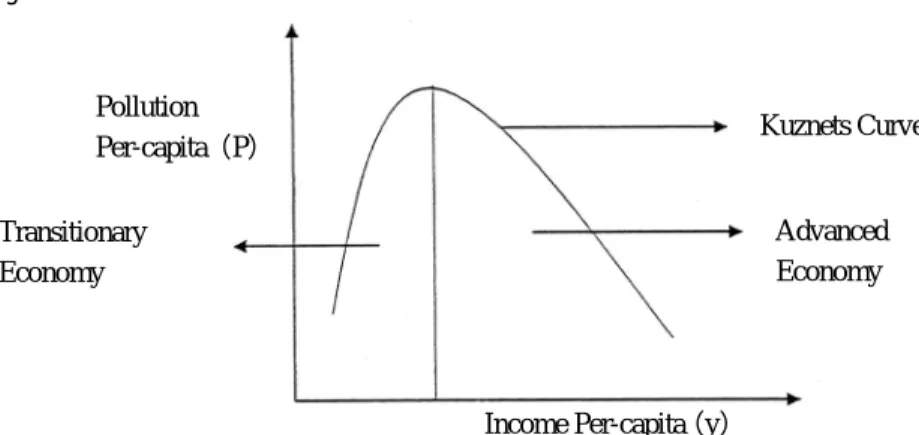
Researchers’ common focus is on the question of whether foreign investors are fleeing from high-environmental standard countries and re-locating to lower standard counties thus creating “pollution heaven”. Consequently a related question arises whether competition for FDI is driving environmental standards downwards(race to bottom hypothesis). But how does foreign assistance in the form of FDI affects environment? As trade and investment expand, the use of natural resource is expected to increase as well. For a given pollution coefficient and given composi-tion of produccomposi-tion the scale effects on the environment are expected to be negative. Some empirical evidences suggest that pollution increases at the early stages of development but decreases once a certain income level is reached(Grossman and Kruger 1995). These studies hypothesize that the level of environmental pollution depends upon the level of per capita income where income is an indicator of economic growth and on the level of population. The existence of an “inverted-U” relationship be-tween pollution and development is known as the “Environmental Kuznets Curve(EKC)”5(see Andreoni and Levinson, 2001; Panayotou
1997; Seldon and Song, 1994).
Figure 1: Environmental Kuznets Curve
Pollution
Per-capita(P) Kuznets Curve
Advanced Economy Transitionary
Economy
Role of Environmental Aid in Economic Growth and Poverty Reduction:
Evidence from Bangladesh! 113
FDI becomes relevant to the concept of EKC debate to the extent that investment is expected to contribute to economic growth, especially in the host country. Although these are all about the demerits of FDI, ob-viously FDI is essential for a economy to take off. It transfers skill, knowledge, know-how to the host country. Innovation and technology transfer through FDI leads to economic growth in a country.
We have seen that FDI is relatively weak in performing preserva-tion of environment and has less direct link to the hard core and poor people of the society. In poverty alleviation, aid has more relevancy and efficiency than any other formal assistance. Poor can have comparatively easy access to aid generated utilities. Although there goes a continuous argument whether aid is inevitable for the country’s economic growth. The evolution of concessional financing to Third World countries from its postwar origins in the Marshall Plan to the debt crisis engulfed virtu-ally the entire Third World in the early 1980 s. Its success in reconstruct-ing Europe after war has paved its way and still it is continued to support the Third World countries. Any private capital is generally targeted to profit making sector, where poverty and environmental issues are mostly ignored. Similar to private capital, foreign direct investment and other portfolio investments does not necessarily meet the interest of the poor and the environment. Though indirectly, these help poor by generating employment and economic growth and thus protect environment after at-tainment of certain level of income. Meanwhile at the cost of such level of outcome we will have to incur a huge damage to environment. Now question arises should the country wait until she reaches a certain level of
5)This pattern has been called the ‘environmental Kuznets Curve’ due to the fact that
environment-income relationship is similar to the pattern of environment-income inequality with respect to time described by Simon Kuznet, 1955.
114 The Hikone Ronso No. 368 September 2007
income while another form of investment(aid)available in an economy.
Aid does not necessarily affect environment negatively due to its own characters and objectives, rather poor may directly benefit from aid pro-duced utilities. Moreover a big portion of aid is channeled for environ-mental protection and social development. We will discuss more about aid, in particular environmental aid in the consequent parts of this paper.
4.Aid Institution in Bangladesh
Bangladesh is a typical embodiment of the two-gap theory. One is the gap between savings and investment. For a GDP growth rate of at least 6 to 7 percent per year, given the capital-output ratio of 3, at least 18 to 21 percent of GDP should be invested. But Bangladesh saves much less, national savings being 15.6 percent of GDP in 1994-1995. The sec-ond gap relates to the lack of foreign exchange. Commodity exports can finance slightly more than half of imports, and remittances from overseas workers can cover the import bill for about two months.
It is usually said that Bangladesh is over-dependent on foreign aid. External aid financed around two-thirds of investment for develop-ment in its first two decades, and around 50 to 60 percent of imports. Al-though one of the most popular national objectives continues to increase self reliance on national resources, it is only since 1990 that reliance on external aid has declined. Greater public resources mobilization, along with higher private savings, boosted by increasing overseas wage earn-ers’ remittance, have made it possible to increasing the share of domestic resources in financing development.
Aid provides budget support for the government. Almost the en-tire sale proceeds of commodity and food aid enter the budget. Aid helps the transfer, adoption and adaptation of technology. Interacting with the
Role of Environmental Aid in Economic Growth and Poverty Reduction:
Evidence from Bangladesh! 115
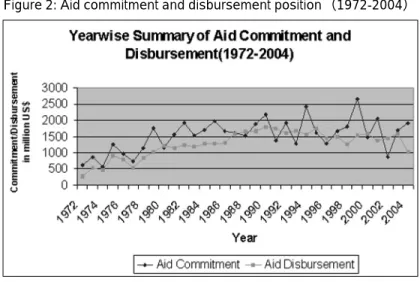
articulated, stable and open economic systems of development partners aid assists in institutional and market development. It helps in the inte-gration of the economy with the world. In times of famine and natural disasters, aid has saved human life in Bangladesh. An overview of recent aid commitment and disbursement to Bangladesh by various donors is presented in figure 2.
4.1 Sectoral Allocation and Distribution of ODA
Sectoral preferences of donors are quite varied. The areas of USAID’s6involvement are food and fertilizer, rural credit, rural electrifi-cation, population planning and rural infrastructure development. Dutch assistance covers agriculture and food control, inland water transport, and drinking water. NORAD7concentrates on health, education, rural devel-opment, women’s development and transport development. DANIDA’s8
main thrust is on the rural poor and fisheries development. CIDA9
pre-fers to fund railway transport, agriculture and irrigation, energy, popula-tion and rural development, thereby having mix of large projects of the traditional type and social sector program characterized by small projects. Japan the biggest bilateral donor for Bangladesh(Figure 3), is interested in physical infrastructure, rural development, manpower & skill develop-ment and poverty alleviation.
6)USAID stands for United States Agencies for International Development 7)NORAD stands for The Norwegian Agency for Development Cooperation 8)DANIDA stands for Danish International Development Agency 9)CIDA stand for Canadian International Development Agency
116 The Hikone Ronso No. 368 September 2007
The biggest multilateral donor, the IDA10has a large portfolio of the pro-jects covering irrigation and flood control, energy, industry and transpor-tation and programs in vocational, technical and primary education & ru-ral development, population planning and financial sector reforms. The IMF is mainly concerned with balance of payments stabilization. The ADB’s preferred areas are agriculture and agro based industries, rural de-velopment, environment, energy, transport and communication and in-dustry. UNDP concentrates on technical assistance and institutional building. IDB has so far funded projects in rural development, education, power, health, transport and water resources. UNICEF, true to its name is devoted to the development of children. These varied preferences of vari-ous donor countries and multilateral agencies have been brought under Bangladesh Consortium meeting under the leadership of the World Bank.
10)IDA stands for International Development Association
Figure 2: Aid commitment and disbursement position(1972-2004)
Source: Flow of External Resources into Bangladesh,2001, Ministry of Finance, Bangladesh.
Role of Environmental Aid in Economic Growth and Poverty Reduction:
Evidence from Bangladesh! 117
There are some commitments of aid through personal initiatives, but the number of these initiatives is very small. A significant amount of dis-guised aid is injecting to the economy of Bangladesh but these are basi-cally backed by the political interest and other small interests groups.
In recent years, significant external aid went to electricity, trans-port and communication, water and flood control, and industry. These four sectors accounted for almost 60 percent of the project aid during 1985-1995. The emphasis on these sectors reflects the priority given by the government to accelerating the development of physical
infrastruc-11)This figure is taken from OECD home page: http://www.oecd.org/dataoecd/56/21/1867292. gif,
Date: 20/03/2007
118 The Hikone Ronso No. 368 September 2007
ture. Agriculture received only 7 percent and education, along with relig-ious affairs, only 6 percent. Aid to industry has been declining, reflecting the shrinking role of government in industrial investment. The SAP
(Structural Adjustment Policies)undertaken under the aegis of IMF had a main conditionality that new public sector investment in industry should be discouraged, and this has been accepted as a policy priority by the government. Although there are huge debt on the effectiveness of aid, from the perspective of Bangladesh whether aid can contribute to eco-nomic development is the subject of our interest.