
Balanced Line Separators of Unit Disk Graphs
3
0
0
全文
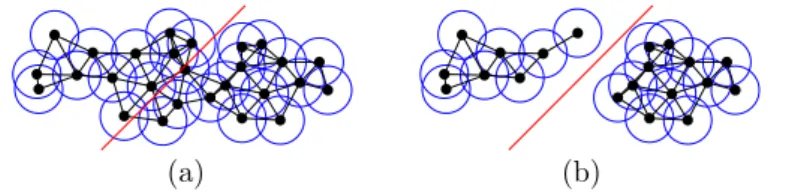
(2) Vol.2018-AL-167 No.5 2018/3/8. IPSJ SIG Technical Report. tively. Note that the graph induced by the set A consists of the intersection graph of the balls inside the separator (similarly, B for the balls outside the separator and S for the balls intersecting the sphere). We emphasize that, even though the size of the separator is larger than the one from Lipton–Tarjan for planar graphs (specially for high values of d), the main advantage is that the three subgraphs it creates are geometric graphs of the same family (intersection graphs of balls in Rd ). The bound on the separator size does not hold up well when k is large, √ even for d = 2: if n disks overlap at a single point and the √ other disks form a path we have k = n and m = Θ(n), where m is the number of edges in the intersection graph. √ Hence, the separator has size O( kn) = O(m3/4 ). Fox and Pach [7] gave another separator result that follows the same spirit: the intersection graph of a set of Jor√ dan curves in the plane has a 2/3-separator of size O( m) if every pair of curves intersects at a constant number of points.*1 A set of disks in R2 satisfies this condition, and thus the theorem applies to disk graphs. Their proof can be turned into a polynomial-time algorithm. However, we need to construct the arrangement of disks, which takes O(n2 2α(n) ) time, where α(n) is the inverse Ackermann function [5], and in practice an efficient implementation is nontrivial. From a geometric perspective these two results show that, given a set of unit disks in the plane, we can always find a closed curve in the plane (a circle [17], [20] and a Jordan curve [7], respectively) to partition the set. The disks intersected by the curve are those in the separator, and the two disjoint sets are the disks inside and outside the curve, respectively. Results In this paper we continue the idea of geometric separators and show that a balanced separator always exists, even if we constrain the separator to be a line (see Fig. 1). Given a set of n unit disks with m pairs of intersecting disks, we show √ that a line 2/3-separator of size O( (m + n) log n) can be found in expected O(n) time, and that an axis-parallel line √ 4/5-separator of size O( m + n) can be found in deterministic O(n) time. Comparing our results with the previous work, our algorithm matches or improves in four ways, see also Table 1. (i) simplicity of the shape: circle [17], [20] vs. Jordan curve [7] vs. our line, (ii) balance of the sets A and B: 3/4 [17], [20] vs. 2/3 for both [7] and us, (iii) size of √ the separator: O(m3/4 ) [17], [20] vs. O( m) [7] vs. our √ ˜ m).*2 Finally, (iv) our algorithms are easy to impleO( ˜ 2 ) [7] ment and asymptotically faster: O(n) [17], [20] vs. O(n vs. our O(n). *1. *2. Without restriction on the number of √ intersection points for every pair of curves, the bound of O( m log m) can be achieved [16]. ˜ The O(·) notation suppresses sublogarithmic factors. In particular, we note that our separator is slightly larger than the. c 2018 Information Processing Society of Japan ⃝. We emphasize that our results focus on unit disk graphs, while the other results hold for disk graphs of arbitrary radii, too. Indeed, if we want to separate disks of arbitrary radii with a line, we show that the separator’s size may be as large as Ω(n). We also prove that for unit disks our algorithm may fail to find a line 2/3-separator of size better than √ √ O( m log(n/ m)) in the worst case. In this sense, the size of our separators is asymptotically almost tight. Experimental results are also presented. We evaluate the performance of our algorithm, compare it with the method by Fox and Pach [7] in terms of the size of the produced separators for random instances, and conclude that our algorithm outperforms theirs for the intersection graphs of unit disks. Working with a line separator for intersecting disks has some difficulty. If we chose to separate pairwise disjoint geometric objects by a Jordan curve, then we could employ a volume argument for the interior of the curve. However, we cannot use a volume argument for line separators since the line does not determine a bounded region. Other Related Work In a different context, line separators of pairwise disjoint unit disks have also been studied. Since the disks are pairwise disjoint, the intersection graph is trivially empty and can be easily separated. Instead, the focus is now to find a closed curve that intersects few disks, such that the two connected components it defines contain roughly the same number of disks. Alon et al. [2] proved that for a given set D of n pairwise disjoint unit disks,*3 there exists a slope a such that every √ line with slope a intersects O( n log n) unit disks of D. In particular, the halving line of that slope will be a nice sep√ arator (each halfplane will have at most n/2 − O( n log n) disks fully contained in). Their proof is probabilistic, which can be turned into an expected O(n)-time randomized algorithm [15]. A deterministic O(n)-time algorithm was afterwards given by Hoffmann et al. [13], who also showed how √ to find a line ℓ that intersects at most O( n/(1 − 2α)) unit disks and each halfplane contains at most (1−α)n disks (for any 0 < α < 1/2). L¨offler and Mulzer [15] proved that there √ exists an axis-parallel line ℓ such that ℓ intersects O( n) disks, and each halfplane contains at most 9n/10 unit disks. For comparison purposes, these three results are also shown in Table 1. A significant amount of research has focused on the search for balanced line separators of unit disk graphs in the plane, but unlike the ones mentioned before no guarantee is given on the shape of the separator. Yan et al. [21] studied a separator of unit disk graphs for designing a low-delay compact routing labeling scheme for ad-hoc networks modeled by unit disk graphs. Their separator is a 2/3-separator, but has no. *3. Fox-Pach separator. The result extends to pairwise disjoint fat objects that are convex and of similar area (see Theorem 4.1 of [2]). For the sake of conciseness we only talk about unit disks.. 2.
(3) Vol.2018-AL-167 No.5 2018/3/8. IPSJ SIG Technical Report. (a) Fig. 1. An example of a line separator of a unit disk graph. (a) A family of unit disks (blue) and a line (red). (b) Removing the disks intersected by the red line leaves a disconnected graph. Table 1. result [17], [20] [7] This paper This paper [2], [13], [15] [13] [15]. (b). Comparison of our results with other geometric separator results.. separator shape circle Jordan curve line axis-parallel line line line axis-parallel line. balance 3/4 2/3 2/3 4/5 1/2 1−α 9/10. size guarantee. Fu and Wang [9] studied the case where a √ √ unit disk graph is a n × n grid generated from a regular grid, and proved that there exists a line 2/3-separator of size √ at most 1.129 n. They used the obtained separator to give the first subexponential-time algorithm for the protein fold√ ing problem in the HP model. The bound of 1.129 n was √ afterwards improved by Fu et al. [8] to 1.02074 n. We note that it is not known whether a minimum-size 2/3-separator of a unit disk graph can be computed in polynomial time, although the problem is known to be NP-hard for graphs of maximum degree three [4], 3-regular graphs [18], and planar graphs [10]. Finally, Alber and Fiala [1] studied the existence of separators for disk intersection graphs, but ask for additional constraints to the set of disks (such as requiring the disks to be at least λ units apart, or bounding the ratio between the radii of the smallest and the largest disks). References [1] [2] [3] [4] [5]. [6] [7] [8]. [9] [10]. Jochen Alber and Jir´ı Fiala. Geometric separation and exact solutions for the parameterized independent set problem on disk graphs. J. Algorithms, 52(2):134–151, 2004. Noga Alon, Meir Katchalski, and William R. Pulleyblank. Cutting disjoint disks by straight lines. Discrete & Computational Geometry, 4:239–243, 1989. Noga Alon, Paul Seymour, and Robin Thomas. A separator theorem for nonplanar graphs. J. Amer. Math. Soc., 3:801– 808, 1990. Thang Nguyen Bui and Curt Jones. Finding good approximate vertex and edge partitions is NP-hard. Inf. Process. Lett., 42(3):153–159, 1992. Herbert Edelsbrunner, Leonidas J. Guibas, J´ anos Pach, Richard Pollack, Raimund Seidel, and Micha Sharir. Arrangements of curves in the plane—topology, combinatorics and algorithms. Theor. Comput. Sci., 92(2):319–336, 1992. David Eppstein, Gary L. Miller, and Shang-Hua Teng. A deterministic linear time algorithm for geometric separators and its applications. Fundam. Inform., 22(4):309–329, 1995. Jacob Fox and J´ anos Pach. Separator theorems and Tur´ antype results for planar intersection graphs. Advances in Mathematics, 219(3):1070–1080, 2008. Bin Fu, Sorinel Adrian Oprisan, and Lizhe Xu. Multidirectional width-bounded geometric separator and protein folding. Int. J. Comput. Geometry Appl., 18(5):389–413, 2008. Bin Fu and Wei Wang. Geometric separators and their applications to protein folding in the HP-model. SIAM J. Comput., 37(4):1014–1029, 2007. Junichiro Fukuyama. NP-completeness of the planar sepa-. c 2018 Information Processing Society of Japan ⃝. separator size O(m3/4 ) √ O( m) ˜ √m) O( √ O( √ m) O( √ n log n) O( n(1 √− 2α)) O( n). [11] [12]. [13]. [14] [15] [16] [17] [18] [19] [20]. [21]. run-time O(n) ˜ 2) O(n O(n) O(n) O(n) O(n) O(n). object type arbitrary disks pseudodisks unit disks unit disks disjoint unit disks disjoint unit disks disjoint unit disks. rator problems. J. Graph Algorithms Appl., 10(2):317–328, 2006. John R. Gilbert, Joan P. Hutchinson, and Robert Endre Tarjan. A separator theorem for graphs of bounded genus. J. Algorithms, 5(3):391–407, 1984. Sariel Har-Peled and Kent Quanrud. Approximation algorithms for polynomial-expansion and low-density graphs. In Proc. of the 23rd Annual European Symposium, pages 717– 728. Springer, 2015. Michael Hoffmann, Vincent Kusters, and Tillmann Miltzow. Halving balls in deterministic linear time. In Proc. of the 22th Annual European Symposium, pages 566–578. Springer, 2014. Richard J. Lipton and Robert Endre Tarjan. A separator theorem for planar graphs. SIAM Journal on Applied Mathematics, 36(2):177–189, 1979. Maarten L¨ offler and Wolfgang Mulzer. Unions of onions: Preprocessing imprecise points for fast onion decomposition. JoCG, 5(1):1–13, 2014. Jiˇr´ı Matouˇsek. Near-optimal separators in string graphs. Combinatorics, Probability & Computing, 23(1):135–139, 2014. Gary L. Miller, Shang-Hua Teng, William P. Thurston, and Stephen A. Vavasis. Separators for sphere-packings and nearest neighbor graphs. J. ACM, 44(1):1–29, 1997. Rudolf M¨ uller and Dorothea Wagner. α-Vertex separator is NP-hard even for 3-regular graphs. Computing, 46(4):343– 353, 1991. Jaroslav Neˇsetˇril and Patrice Ossona de Mendez. Grad and classes with bounded expansion II. Algorithmic aspects. Eur. J. Comb., 29(3):777–791, 2008. Warren D. Smith and Nicholas C. Wormald. Geometric separator theorems & applications. In Proc. of the 39th Annual Symposium on Foundations of Computer Science, pages 232–243, 1998. Chenyu Yan, Yang Xiang, and Feodor F. Dragan. Compact and low delay routing labeling scheme for unit disk graphs. Comput. Geom., 45(7):305–325, 2012.. 3.
(4)
図
関連したドキュメント
This class of starlike meromorphic functions is developed from Robertson’s concept of star center points [11].. Ma and Minda [7] gave a unified presentation of various subclasses
581] asserts the existence for any natural number N of a partition of the unit sphere S d ⊂ R d+1 into N regions of equal area and small diameter.. The recursive zonal equal area
modular proof of soundness using U-simulations.. & RIMS, Kyoto U.). Equivalence
By means of a new univalence criterion for the analytic functions in the open unit disk U based upon the Becker , s criterion, but which doesn’t contain |z|, we give another
Figure 1: The framework in (a) is not globally rigid, but nonetheless it is the unique unit ball realization of the graph with the given edge lengths (up to congruences)....
We find a polynomial, the defect polynomial of the graph, that decribes the number of connected partitions of complements of graphs with respect to any complete graph.. The
Further- more, as an application of a refined version of the arithmetic Riemann- Roch theorem, we show that the above current, when restricted to a torsion section, is the
We also explore connections between the class P and linear differential equations and values of differential polynomials and give an analogue to Nevanlinna’s five-value
