On the Mechanism of Loess Landslides Induced by the 1920 Haiyuan Earthquake, China
○Gonghui Wang1), Dexuan Zhang2), Gen Furuya1), Kyoji Sassa1), and Hiroshi Fukuoka1)
1)
Research Centre on Landslides, DPRI, Kyoto University
2)
School of Civil Engineering and Mechanics, Shanghai Jiao Tong University, China
1. INTRODUCTION
During the 1920 Haiyuan, China, earthquake, many catastrophic landslides were triggered on loess area, killing about 100,000 people. For rapid long traveling landslides, usually following mechanisms could be considered: (1) flow involving debris and air; (2) flow involving debris alone; (3) flow involving debris and water; (4) sliding on a cushion of air; and (5) sliding on a cushion of steam (Lucchitta 1979). Due to the fact of semi-arid environment of loess plateau and great void ratio in loess of aeolian origin, it was deemed by some researchers that these earthquake-triggered rapid landslides were due to the suspension of silt in air, i.e., displaced loess sliding on a cushion of air. Nevertheless, detailed field and laboratory investigation on a huge landslides triggered by this earthquake strongly indicates that liquefaction on the water-saturated loess soil was the main reason for these landslides.
2. FIELD INVESTIGATION
In 2002 and 2003, we surveyed the dense area of landslides triggered by the 1920 Haiyuan earthquake in Xiji county, China, and had detailed investigation on the Dangjiacha landslide (Fig. 1). It was clarified that standing groundwater exists within the landslide on the source area (see Points A and B in Figs. 1-2), even 80 years after the event. Point A is a well supplying water for several families with a water table 22 m below the present ground surface; while B is a very shallow well for animal drinking. It was also found that the loess on the source area was in great void ratio. Therefore, it is reasonable to infer that liquefaction was triggered within the water-saturated loess layer.
3. LABORATORY EXAMINATION
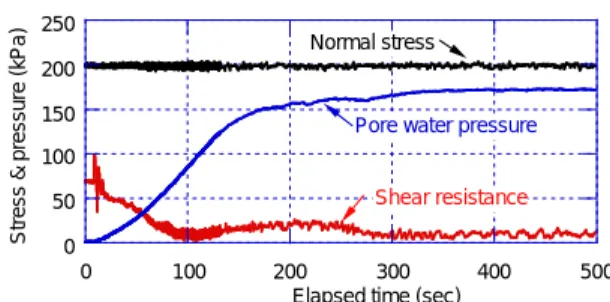
Loess samples were taken from the source area of Dangjiacha landslide, and applied to a series of ring shear tests by using a newly developed ring-shear apparatus, DPRI-5 (Sassa et al. 2004). At first, the loess sample was saturated by water and applied to monotonic or cyclic shearing in attempt to examine the liquefaction potential of in-situ loess soil as well as its undrained response to cyclic shear loadings. The test results showed that the loess soil is highly liquefiable, and shear failure could be triggered during cyclic loading. Secondly, the oven-dried loess sample was applied to a certain of initial air pressure and sheared by the application of monotonic/cyclic loadings. Monotonic shearing tests showed that the increase of air pressure with increase of shear displacement was very small such that no significant reduction on the shear resistance occurred (Fig. 3). Cyclic shearing tests showed that no shear failure continued after the termination of cyclic loading.
Therefore, it is concluded that liquefaction of the water-saturated loess resulted in the rapid long traveling of Dangjiacha landslide, and was most probably the key reason for many other similar landslides on this area.
Fig. 1. Dangjiacha landslide triggered by the 1920 Haiyuan Earthquake, China.
Fig. 2. Long standing ground water on the source area.
Fig. 3. Monotonic shearing on loess samples saturated by water (a) and air (b).
Fig. 4. Undrained response of water-saturated loess sample to cyclic loading in ring shear test.
Water A B 0 50 100 150 200 250 0 100 200 300 400 500 St re s s & pr es su re (k P a )
Elapsed time (sec) Normal stress
Pore water pressure
Shear resistance A B 0 50 100 150 200 0 200 400 600 800 1000 1200 S tr e ss and p res su re (k Pa)
(a) Normal stress
Pore water pressure
Shear resistance 0 50 100 150 200 0 20 40 60 80 100 120 Time (sec) (b) Normal stress AIr-pressure Shear resistance