C16
Experimental Study of Groynes as a Bank Erosion Countermeasure in Meandering Channels with
Different Sinuosity
〇Saroj KARKI, Yuji HASEGAWA, Hashimoto MASAKAZU, Hajime NAKAGAWA, Kenji KAWAIKE
The present study aims to investigate the performance of impermeable groynes in meandering channels with both erodible bed and banks having different sinuosity and ratio of radius of curvature to the channel width (R/B). Measurement of channel topography, water level, and surface velocity distribution were taken. Although overall deflection of high velocity zone towards the channel center was observed, results revealed higher erosion in case of channel with low sinuosity and low R/B ratio.
1. INTRODUCTION
Groynes are widely implemented countermeasures for bank protection especially in natural bends or meandering channels. Various experimental studies in meandering channels have been conducted in the past to study the effect of groynes on the flow field, local scour, sediment transport, channel evolution, etc. However, most of the studies on groynes have been performed in the fixed bed and fixed bank channels. Moreover, such experiments focused only in a single channel bend or meandering channel with single sinuosity. In this context, the current study attempts to investigate the effectiveness of impermeable groynes in meandering channels with erodible bed and erodible bank under varying channel sinuosity and R/B ratio.
2. EXPERIMENTAL SETUP
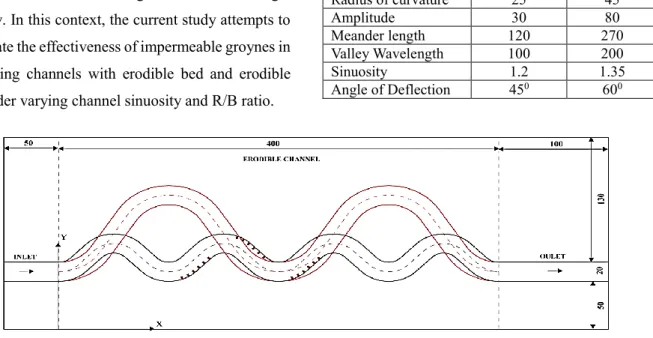
The experimental arrangement as shown in Fig.1 consists of a flume filled with uniform and non-cohesive sediment (Dmean=0.72mm and specific gravity=1.41) where the designed sine-generated (SG) meandering channels were excavated and groynes were placed. Experiments were conducted under a steady discharge of 0.95l/s for a duration of one hour.
Table 1: Parameter of the SG experimental channels Parameter (cm) Channel S1 Channel S2
Width 20 20 Radius of curvature 25 45 Amplitude 30 80 Meander length 120 270 Valley Wavelength 100 200 Sinuosity 1.2 1.35 Angle of Deflection 450 600
3. RESULTS AND CONCLUSIONS
In both channels, scour holes were formed near the groynes as shown in Fig.2. However, the scour holes were deeper and extended for longer length in channel S1 with lower sinuosity and lower R/B ratio. Pool and riffle sequence developed more clearly in channel S1. Near the apex just upstream of the initial groynes higher bank erosion was observed in both channels. This erosion along with scour holes resulted in the formation of stagnant zone extending from upstream of the groynes to the upstream of apex. The size of this stagnant zone was much bigger in channel S1. Similarly, in the space between the groynes more erosion occurred in the case of channel S1. From Fig.3, it can be seen that at the early stage of experiment, more in-channel deposition occurred in S1. Also erosion beyond the bankline was also slightly higher in case of S1.
[cm]
Fig.2: Final bed elevation at t=60min for channel
S1(top) and S2(bottom).
Fig.3: Comparison of Erosion-Deposition vol. for
channel S1 and S2 at different time period.
Fig.4: Bed elevation and water level variation at the tip
of the groynes in channel S2.
Point bar formed slightly downstream of the apex in case of S1 while slightly upstream of apex in case of S2. As a result, flow thalweg shifted close to outer bank before reaching the apex which resulted in higher bank erosion at the apex in case of S2. However, the size of the curvature induced point bar was relatively larger in case of channel S1 which may be the reason for erosion of outer banks as seen in Fig.2. The change in the bed elevation and water level at the groynes tip suggest that initial groynes are subjected to higher scour which gradually decreased along the downstream as shown in
Fig.4. It can be concluded that channel with low sinuosity and low R/B ratio tend to show more variability in channel morphology. The overall deflective effect of groynes was observed although the erosion of outer banks occurred, specially, in the region between the groynes which may be due to the continuous scour near the bank toe even with low velocity. From the observations, it can be said that channels with low sinuosity and low R/B ratio are more prone to erosion, thus require more bank protection.
-4000 0 4000 8000
Case S1-Within Original channel Case S1-Beyond original Bankline Case S2-Beyond Original Bankline Case S2- Within Original Channel
De p o sit io n Sediment Vol per unit length of meander, cm3/m E ro si o n 0-20 20-40 40-60
Time interval ( minutes)
-3 -1 1 3 5 1 2 3 4 5 6 7 8 9 10 11 12 E le v a ti o n , cm Position of Groynes
Groynes Initial bed level
Bed level 20min Bed level 40min
Bed level 60min Water level 20min
Water level 40min Water level 60min
Original channel Groynes