Aluminum Hydroxide. III. Iron (III)
journal or
publication title
福井大学工学部研究報告
volume
15
number
2
page range
183-188
year
1967-09
URL
http://hdl.handle.net/10098/4906
Studies on Coprecipitation of Metal Ions with
Aluminum Hydroxide. III. Iron (III)
Tatsuo YONEKUBO
(Received Nov. 30. 1966)
The adsorption of iron (III) ions on aluminum hydroxide was investigated, using ammonium hydroxide or sodium hydroxide as precipitant. In this study, precipitate of aluminum hydroxide was usually prepared directly in the solu-tion containing iron salt, but in some case, it was pre-formed and iron salt solution was added to it later on. The relation between percentage of iron adsorbed and pH value was investigated in detail. Effects of concentrations of aluminum salt and ammonium salt were also examined. The amounts of iron in precipitate or filtrate were determined spectrophotometrically. 1 Introduction
As was described in the previous paper,1) a series of studies has been attempted to obtain fundamental information on coprecipitation of metal ions with hydroxide. In this paper, iron (III) was chosen as the metal to be precipitated with aluminum hydroxide, and was determined spectrophotometrically by o-phenanthroline method.2)
The relation between percentage of iron precipitated with aluminum hydroxide and pH value of the solution must be investigated in detail, because the former may be greatly affected by the latter. as recognized in the cases of copperS) and nickeJ.ll But some differ-ence may be found, because iron differs from copper and nickel in the following points: iron is more readily precipitated as hydroxide than copper or nickel owing to its less soluble property; moreover, in ammoniacal solution, copper and nickel form soluble ammine complexes, thus giving small values of coprecipitation percentage in that pH range. Therefore, the form of curve derived from the relation between percentage of iron pre-cipitated and pH value of the solution may be considerably different from that of copper or nickel. The pH value of solution was adjusted with ammonia water or hydrochloric acid, in some case, with sodium hydroxide_ The effect of concentration of aluminum salt or ammonium salt was also examined. Furthermore, an attempt was tried to examine the efficiency of pre-formed carrier. Thus, the conditions for obtaining sufficient value of adsorption percentage of iron were discussed.
2 Expernnental Method
2-1 Reagents All chemicals used were reagent grade materials. Standard iron salt solution (1 x IO-2M) was prepared from ferric chloride or iron alum and was kept slightly acidic with hydrochloric acid and sulfuric acid, respectively. Working solutions of iron
were prepared before each experiment by diluting the standard solution with pure wa-ter. Aluminum salt solutions were prepared from aluminum chloride or sulfate (5x 10⁻²M).
and were kept slightly acidic.
2 -2 Apparatus A Hitachi spectroelectric photometer, model FPW -4, was employed with 1-cm cells for all the absorbance measurements. The pH measurements were carried out with a Toa-Dempa glass electrode pH meter, model HM-5A.
2·3 Procedure Aqueous solution of ammonia (or sodium hydroxide) was added from a pipette to the mixture of the solutions of iron salt, aluminum salt, and ammonium chloride (or sodium chloride), so as the final volume of the solution became 100 ml. The solution was heated on a water bath for 10 minutes and kept for more than 8 hours, standing in a thermostat, at 25.0±0.1°C. Then the pH of the solution was measured. and the precipitate was filtered through Toyo-Roshi filter paper No.5A. The precipitate was then dissolved with 10 ml of 6 N hydrochloric acid, and the solution was transferred to a 100 ml volumetric flask. The pH of the solution was adjusted to 3.4-4.1 by adding 30 ml of 20% sodium acetate, then 2 ml of 1 % hydroxylamine hydrochloride were added. Fin-ally 5 ml of 0.2% o-phenanthroline were added. diluted to 100 ml and wen shaken. After standing more than 15 minutes, absorbance of the solution was measured at 500 m.u against the reagent blank, and the adsorption percentage of iron on aluminum hydro-xide was caluc1ated.
3 Results and Discussion
3.1 Calibration Curve. The procedure for preparing the calibration curve for iron was as follows: an aliquot of the standard iron solution was pipetted into a 100 ml volu-metric flask, and 10 rol of 6N hydrochloric acid and 30 rol of 20% sodium acetate were added, thus the solution being adjusted
at pH 3.4-4.1. Then 2 m1 of 1 % hyd· roxylamine hydrochloride and finally 5 ml of 0.2% o-phenanthroline were added and well shaken. After standing about 15 minutes, the absorbance of the solu-tion was measured at 500 m.u against the reagent blank. The experimental res-ults are plotted in Fig. 1. As can be seen in Fig. 1, the absorbance and con-centration were in a good linear rela-tioship.
3-2 Effect of pH of the Solution
0.500 0.400 8 0.300 ;::
~
00:;a
0.200 0 .. 100The effect of pH of the solution on 0
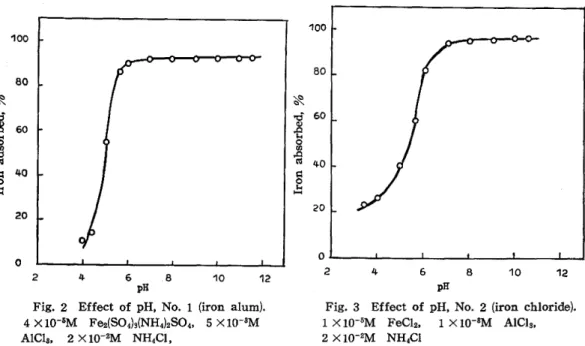
the adsorption percentage of iron was investigated using iron alum or alu-minum chloride. The results are shown
o
1 2 ~ 4~~t]x10+ , Mil
5
~ .,:J
.8
~
~ Q 0..::
100 80 60 40 20 0 2 4 6 8 10 12 pHFig. 2 Effect of pH, No. 1 (iron alum). 4 X lO-IiM Fe2(S04h(NH4bS04. 5 X 1O-8M
AICla, 2 X 1O-2M NH4Cl, ~ "O~
.e
~ ~S
..!::: 100 80 60 40 20 0 2 4 6 8 10 12 pHFig. 3 Effect of pH, No. 2 (iron chloride).
1 X 1O-5M FeC12, 1 X 1O-8M AICIg,
2 X 1O-2M NH4Cl
in Figs. 2 and 3. Maximum percentage of adsorption appeared at the range of pH>6 or 7, reaching 90% or more. Below this range, the adsorption percentage de-creased rapidly, but were not zero even at pH 4, namely, 10 % or 25 %. Iron behaves differently from copper or nickel in this point; this may be attributed to the fact that hydroxide of iron is less soluble than that of copper or nickel. Moreover, iron differs from them in the next point: namely
there is no decreasing tendency in ad-sorption percentage, in the right hand of these curves. This may be understood as follows; in ammoniacal solution, cop-per or nickel forms soluble ammine com-plex, whereas iron does not, and remains as precipitate.
Thus. it has been proved that iron can be adsorbed in broader pH range (pH 6 or 7-11) compared with copper or nickel.
a-a
Effect of Concentration of Alu-minum Salt While keeping the other variables constant, iron was pre-cipitated in various concentrations of aluminum chloride. The concentration of aluminum chloride affected a little as shown in Fig. 4; when theconcentra-100 BO 20 o ---~--~~--~ ____ ~ ____ -L~ o 2 4 6 8 (AICl,) X10'l, 1'1/1
Fig. 4 Effect of concentration of aluminum salt.
4 X 10⁻¹> M Fe2(S04)s(NH4)zS04, 2 X 10'-2 M NH4CI, pH = 7
10
to obtain high adsorption efficiency, a proper concentration of aluminum salt must be chosen; a too high concentration of the salt is disadvantageous, because it may produce so much carriers that disturb the complete dissolution of iron in the precipitate.
100 ~ 100 80
l{V
-
-80 ~ ~ .,j QJ 60
~
rtf 60 QJ .0 S rn "0 cd !1J ~ 40 '"' I=l 40 I:l 0 I-< H 0 I-< J-I 20 20 0 0 I I.
0 1 2 3 4 5 ~r)x1<f t Mil 0 2 4 6 8 10(NH,. Cr.) x1 0,.
MIl. Fig. 5 Effect of concentration of iron. Fig. 6 Effect of concentration of ammonium5 X 1O-8M AIC1a• 2 X 1O-2M NH4C1,pH7 salt. 4 X 1O-5M Fe2(S04)a(NH4)2S0h
5 X 1O-8M AICla, 2 X lO-llM NH4Cl,
3-4 Effect of Concentration of Iron Salt While keeping the other variables cons-tant, iron was precipitated at about pH 7, in various concentration of iron salt. The effect is indicated in Fig. 5; in dilute solution of iron salt, with the increasing concen-tration of iron. the decreasing adsorption was observed, but the decreasing slope became very gentle, and at last, the adsorption percentage reached almost a cons-tant value.
3-5 Effect of Concentration of Ammonium Chloride While keeping the other vari-abIes constant. iron was precipitated at pH 7 in various concentrations of ammonium chloride. The concentration of ammonium chloride affected adsorption percentage as shown in Fig. 6; it was comparatively small in the range of low concentration of the salt, but it reached nearly constant in the range over 0.1 M.
Thus, ammonium chloride favoured the adsorption of iron on aluminum hydroxide; this is a distinct difference from copper or nickel, and this may be attributed to the difference thatlhe soluble ammine complex can be formed or not.
3-6 Effect of Precipitant In all the above experiments, ammonia water was used as the precipitant of aluminum hydroxide. but now, it was tried to use sodium hydroxide instead of ammonia water, pH value of the solution being adjusted with sodium hydroxide, and sodium chloride. The results are shown in Fig. 7; the maximum adsorption
per-100 80 ~ 60 'cr Q.)
~
rn 40 "0 ~ ~.§
20 0 2 4 6 8 10 pHFig. 7 Effect of precipitant
(sodium hydroxide), 1 XlO'''M FeCh, 1 X 1O-3M AIC1a, 2 X 1O-2M NaCl 100 80 ~ "O~ 60 Q.)
-e
0 rn 40 ~ ~ 0 ~ ~ 20 0 12 2 4 6 8 10 12 pH Fig. R Effect of anion.1 X 1O-5M FeCIs• 1 X 1O-3M Ah(S04)S, 2 X 1O-2M NH4Cl
centage appeared at pH>6, exceeding over 95 % in that range, and about 30 % even at pH 4. Thus, iron was almost completely adsorbed in proper pH range of the solution if sodium hydroxide was used as precipitant.
3-7 Effect of Anion of Aluminum Salt When aluminum sulfate was used instead of chloride, the relation between adsorption percentage and pH was such as shown in Fig. 8; namely, the adsorption percentage was generally larger compared with that in the case of chloride, and maximum value appeared at pH>6, reaching almost 100 %.
The larger adsorption percentage may be partly attributed, according to Hardy-Schulze law, to the stronger power of -sulfate ion for the precipitation of aluminum hydroxide which is positively charged, because sulfate ion is divalent anion, whereas chloride ion is monovalent; but this is not applicable, of course, to the pH range in which aluminum hydroxide cannot exist, for example, at pH 4 or pH 10. It may be partly attri-buted to the fact that the properties of aluminum hydroxide prepared in sulfate4) or
chloride medium are different from each other; for example, difference in adsorptive power or adsorptive area of the carriers may be caused from their different states of aggregation. It needs further investigation to elucidate these factors completely.
3-8 Efficiency of Pre-fonned Carrier In the above experiments, precipitate of alu-minum hydroxide was prepared directly in the solution containing iron salt. Now, an experiment was tried to examine the efficiency of pre-formed aluminum hydroxide that was prepared as follows; 25 ml of 1 N ammonia water and 10 ml of 2 N hydrochloric acid were added to 10 ml of 0.01 M aluminum chloride in a 50 m! centrifuge tube, the pH value being about 8. The precipitate was centrifuged at a rate of 2000 r. p. Ill. for about 3 minutes. The obtained precipitate of aluminum hydroxide was washed three times with water and poured into a 100 ml beaker, then 10 ml of 1 x 10⁻⁴M ferric chloride, 10
ml of 2 M ammonium chloride and ali-quot of 0.1. 1 N ammonia water or 0.1 N hydrochloric acid were added into the beaker so as the pH of the solution was adjusted in various values. The solution was kept at 25.0±O.1°C for more than 8 hours, filtered through a filter paper. and the amounts of iron in the precipitate
100 80 60 40 20 0 2 4 6 8 10 12 pH
were determined spectrophotometrically. The results are shown in Fig. 9; in the range of pH 6-11. the adsorption per-centage exceeded over 90%. Furthermore. in this case, iron was more readily solu-ble compared with the case of not pre-formed carrier; this may be attributed
Fig. 9 Efficiency of pre-formed carrier. 1 X 1O-5M FeCla, 2 X 1O-2M NH4CI
to the fact that. when iron was
pre-cipitated with pre-formed carrier. adsorption of iron on the surface of the carrier is predominant, whereas occlusion of iron inside the carrier is little. After all. it has been proved that the pre-formed aluminum hydroxide is considerably effective to adsorb minute amounts of iron in the solution at pH>6.
4, Summary
The adsorption of minute amounts of iron (III) in the solution. using aluminum· hyd-roxide as the carrier was investigated. The precipitant was ammonia water or sodium hydroxide. The adsorption percentage of iron was greatly affected by the pH of the solution. The maximum value was obtained in the range of pH>6. reaching almost 100%. when the concentration of the reagents was chosen properly. The pre-formed carrier was also considerably effective to obtain a good result. The effects of anions of alumi-num salts and concentrations of ammonium chloride. iron salt. and alumialumi-num salt were also examined.
The author wishes to express his gratitude to Professor Masayoshi Ishibashi and Professor Taitiro Fujinaga for their kind advice and encouragement.
References
1) T. Yonekubo, Bulletin of Chern. Soc. Japan, to be published.
2) E. B. Sandell, "Colorimetric Determination of Traces of Metals," Interscience Publishers, Ins., (1959), 3rd Ed., p 525.
3) T. Yonekubo, J. Chern. Soc. Japan, Pure Chern. Sect. (Nippon Kagaku Zasshi), 84, 502 (1963). 4) Y. Tanikawa, Y. Kumagai, N. Kat 0, K. Tanikawa, Japan Analyst, 14, 320 (1965).