Department of Home Health Nursing, School of Nurs-ing, Osaka City University
2Elderly Citizens Care O‹ce, Department of Health and Welfare, Izumi City Municipal
3Advanced Medical Care and Clinical Research Center, Gifu University Hospital
4Department of Biostatistics, School of Medicine, Yokohama City University
Corresponding Author: Ayumi Kono
Department of Home Health Nursing, School of Nurs-ing, Osaka City University,
1517 Asahi Abeno, Osaka 5450051, Japan
2021 Japanese Society of Public Health
Information
Five-year disease-related risk of mortality in ambulatory frail older
Japanese
Ayumi K
ONO, Naomi F
UKUSHIMA2
, Takuma I
SHIHARA3
,
Noriko Y
OSHIYUKIand Kouji Y
AMAMOTO4
Objectives We investigated the 5-year disease-related mortality risk, including that associated with ne-oplasms, mental/behavioral/neurodevelopmental disorders, and diseases of the circulatory sys-tem and respiratory syssys-tem,in ambulatory frail Japanese older adults.
Methods We retrospectively analyzed long-term care and health insurance claims data in this cohort study performed between April 2012 and March 2017. The primary outcome was mortality, and the secondary outcome was care-need level decline. Risk factors were determined based on the International Statistical Classiˆcation of Disease and Related Health Problems, 10th
Revi-sion codes, hospitalization, and institutionalization. The study included 1,239 ambulatory frail older adults newly certiˆed as needing Support-Level care at baseline (April 2012March 2013) across three Japanese municipalities.
Results Of the 1,239 participants, 454 (36.6) died. Neoplasms (hazard ratio [HR] 2.69, 95 conˆdence interval[CI] 1.973.68) or respiratory system diseases (HR 1.62, 95CI 1.26 2.08) were independently associated with mortality. Mental/behavioral/neurodevelopmental disorders(HR 1.39, 95CI 1.171.66) or diseases of the respiratory system(HR 86, 95CI 7599) were independently associated with care-need level decline.
Conclusions This study suggests that neoplasms or respiratory system diseases were associated with a high mortality risk and that mental/behavioral/neurodevelopmental disorders were associated with care-need level decline among ambulatory frail older adults. Optimal disease management and eŠective long-term care are important to delay the onset of these events in older adults cer-tiˆed as needing Support-Level care.
Key wordscare-need level decline, frail, ICD-10, mortality, older adults Nihon Koshu Eisei Zasshi 2021; 68(4): 267275. doi:10.11236/jph.20002
I. INTRODUCTION
Frailty is a state of increased vulnerability following a stressor, with the risk of adverse outcomes1)
includ-ing disability2)or mortality2,3). Numerous studies
con-ducted in western countries have shown that transi-tions to states of greater frailty were more common
than transitions to states of lesser or no frailty4~6).
However, a meta-analysis indicated that the frailty prevalence in older Japanese adults was lower than that in other counties7,8). The transition in frail older
Japanese might be unique because the Japanese government implemented health and welfare policies in recent decades, as the front-runner of super-aging societies9). Japan, with 27.7 of its total national
adult population aged 65 years in 201710), has the
highest life expectancy (male=81.09, female=87.26 years old in 2018) in the world11). Japan has
public-based care insurance programs for older adults, managed by local municipal governments. A public long-term care insurance (LTCI) program has been operating since 200012). Additionally, Japan achieved
universal coverage in health insurance for Japanese citizens in 1961, and the Late Elders' Health Insur-ance Program was established in 2008 as health insur-ance for all older adults aged 75 years13).
implement new beneˆts in the LTCI program(called ``KAIGO YOBO-NICHIJYO SEIKATSU SHIEN JIGYO'' in Japanese) to target ambulatory frail older adults certiˆed at the two lowest of seven care-need levels(Support Levels 1 or 2, called ``YOSHIEN 1 or 2'' in Japanese) to prevent them from developing disa-bility or dependency14). The new beneˆts in the LTCI
program mainly focus on preventing functional decline, including assisting with household chores or locomotion, physical exercise, training to prevent cog-nitive decline, and education for oral health and nutri-tion, but excluding disease management.
The risks of mortality or dependency of ambulatory frail older Japanese have rarely been clariˆed15),
par-ticularly the disease-related risk of mortality has not been investigated su‹ciently, although several recent cohort studies with su‹cient sample sizes have report-ed risk of mortality16~18) and care-need level
decline19~21)in the general older Japanese population.
Recently, a seven-year large cohort study in the Unit-ed States22) suggested that heart disease, cancer,
respiratory conditions, and dementia could be risk fac-tors for mortality in frail older adults. The progress to death or functional decline of ambulatory frail older adults might diŠer from that of general older adults who might include people falling suddenly into disa-bled status or death from vigorous status, and disease-related risk factors in ambulatory frail older Japanese need to be clariˆed.
The study aimed to identify the ˆve-year disease-related risk of mortality, with respect to neoplasms, mental/behavioral/neurodevelopmental disorders, diseases of the circulatory system, and diseases of the respiratory system22), which were classiˆed by the
In-ternational Statistical Classiˆcation of Disease and Related Health Problems, version 10(ICD-10) codes, using records of hospitalization, and institutionaliza-tions, in ambulatory frail older Japanese. The secon-dary outcome of the study was care-need level decline, as status changes in long-term care needs could also be predicted as changes related to mortality risk and the process of dying among older adults. The present study utilized both long-term care (LTC) and health insurance claims data, accumulated electronically by local governments. We also identiˆed risk stratiˆed by gender, as it is well-established that the prevalence of23) and transition24,25) in frailty diŠers by gender.
II. METHODS
1. Design and study settingsThe study utilized a ˆve-year retrospective cohort design and was conducted from April 2012 to March 2017 as part of the Southern Osaka Health and Aging (SOHA) study; data were collected from LTC and health care insurance claims of ambulatory frail older adults aged 65 years. The SOHA is still being im-plemented in three municipalities―Izumi, Izumiotsu,
and Misaki―in the southern part of Osaka, Japan, and the study will collect data for a further ˆve years. The municipalities include residential or moun-tainous areas, which are located close to each other, and are around 5060 km from downtown Osaka. The percentages of older adults in Izumi (20.0) and Izumiotsu (21.3) were slightly lower, but that in Misaki (31.8) was higher than the national average of 24.1 at March 201326).
2. Study participants
We operationally deˆned ambulatory frail older adults as older adults who were certiˆed as being in a Support Level of the LTCI program.
The LTCI reimburses expenses for home and/or facility care for older adults with LTC needs. First, ol-der adults apply to their local government to have their care-needs assessed and scored by trained investigators using a standard comprehensive examination, which includes approximately 80 items. Based on a national standardized computer-aided system, applicants are assigned to one of seven levels of LTC need certiˆca-tions, consisting of Support Level 1 (less frail) or 2 (frailer), or Care Levels 1 (less disabled) to 5 (most disabled). Older adults who are certiˆed as being in a Support Level are ambulatory, which includes being able to walk and be independent in most activities of daily living, and not having serious cognitive function-al decline, but having frailty and a little di‹culty in in-strumental activities of daily living27). Those who are
certiˆed as being in a Care Level are more severely disabled, have dementia or are chair- or bed-bound, and are eligible for admission to facilities oŠering con-tinuous LTC28).
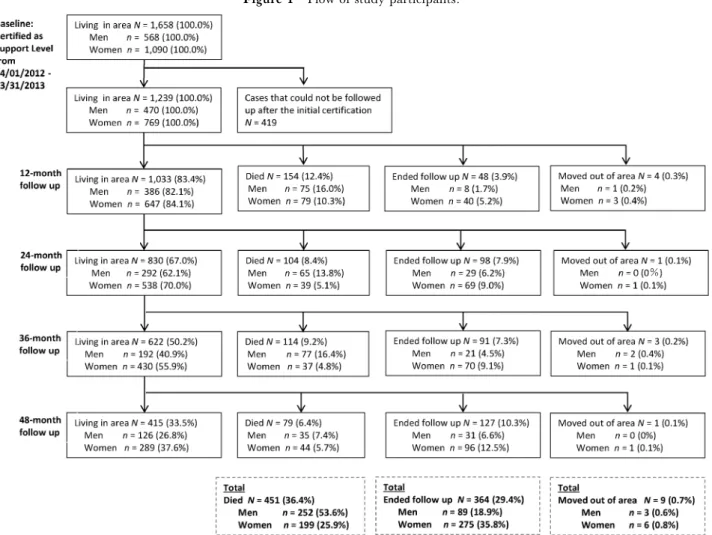
The participants were all of the 1,658 older adult residents who were newly certiˆed as Support Levels 12 in the LTCI program from April 2012 to March 2013 at the baseline, and consisted of 1,180 persons in Izumi, 363 persons in Izumiotsu, and 115 persons in Misaki, selected from each municipality record. The date on which the follow-up period ended was March 31, 2017. In the LTCI program, typically, the certiˆ-cations renew every six months when applicants need continuous LTC; however, some older adults do not renew the certiˆcation if they do not want to. Out of 1,658 persons, 419 persons were certiˆed only a single time at baseline and never applied for subsequent cer-tiˆcation during the study period, which means that their values at baseline and follow-ups were the same and the Kaplan-Meier Curves and Cox proportional hazard regression could not be performed. Therefore, the number of persons analyzed was 1,239. We includ-ed study participants who were newly certiˆinclud-ed during the period but with histories of certiˆcations before April 2012. We did not follow participants who moved out of the three municipalities (Figure 1).
3. Procedures
includ-Figure 1 Flow of study participants.
ing LTC and health insurance claims, care-need com-prehensive examinations assessed by trained investiga-tors and resident registers, were collected from records accumulated electronically by each local government. LTC and health insurance claims datasets were recorded monthly. After unique numbers were as-signed to each insured person to allow identiˆcation across these data, all data were anonymized to the researchers who analyzed them.
Health insurance claims data for participants who receive health care by public assistance because of low income were missing, as this data providing system is independent of the health insurance data.
The Nursing Research Ethical Committee of Osaka City University approved the study (no. 29-6-1, February 2, 2018). The study protocol was registered in the UMIN Clinical Trials Registry approved by the International Committee of Medical Journal Editors (no. UMINR000040040, December 12, 2018).
4. Measures
1) Demographic characteristics of participants
Characteristics of participants included age, gender, number of household members, and care-need level. Age, gender, and number of household members were collected from the resident register dataset. Dates for number of household members were April 1, 2012 for
participants in Izumi and Misaki, and April 1, 2014 for those in Izumiotsu because Izumiotsu's register system was changed, so we were unable to collect the number of household members on April 1, 2012. Care-need level was collected from the care-Care-need compre-hensive examination dataset.
2) Outcomes
The primary outcome of the present study was mor-tality, and the secondary outcome was care-need level decline. Date of death was obtained from the resident register dataset. Seven categories(Support Levels 12 or Care Levels 15) of care-need level were collected from the care-need assessment dataset. Care-need level decline was deˆned as individuals who moved into Care Level 1 or lower from Support Level 1 or 2 at baseline28).
3) Candidate risk factors
To identify the risk of mortality and care-need level decline, candidate risk factors included disease group identiˆed by ICD-10 codes29), hospitalizations, and
stitutionalization. Because the hospitalization and in-stitutionalization could have occurred because of dis-ease, we included them as the candidate risk factors of the primary outcome. However, care-need level decline could occur in advance of institutionalization, and we did not include institutionalization as a
secon-Table 1 Demographic characteristics of participants Age Mean (SD) 79.0(6.8) Gender Men,n () 470(37.9) Women,n () 769(62.1) Number of house-hold members at baseline Alone,n () 396(32.0) Two people,n () 503(40.6) Three people,n () 144(11.6) More than four people,
n () 155(12.5)
Care-need level at
baseline Support Level 1:mildly disabled,n () 733(59.2) Support Level 2:
severely disabled,n ()
506(40.8) Note. N=1,239; SD, standard deviation.
dary outcome.
The occurrence of hospitalizations and ICD-10 codes were obtained from the health insurance claims dataset. We utilized four diseases categories, including neoplasms, mental/behavioral/neurodevelopmental disorders, diseases of the circulatory system, and dis-eases of the respiratory system22) from the major
dis-ease categories of ICD-10, which could be considered risk factors of mortality among older frail adults. For example, individuals diagnosed with both ``essential hypertension'' and ``subsequent myocardial infarc-tion'' in the same month were counted as having two categories of diseases of ``the circulatory system.''
The occurrence of institutionalization was collected from the LTCI claims dataset. Institutionalization was deˆned as using services in three types of facilities: nursing homes for the elderly (called Tokuyo in Japanese), rehabilitation facilities (Roken), or hospitals for the elderly (Ryoyogata) under the LTCI program.
4) Adjusted variables
Adjusted variables in the Cox regression models in-cluded gender, age, number of household members, municipalities, history of certiˆcation in the LTCI pro-gram, and home-based service utilization.
History of certiˆcation in the LTCI program before baseline and home-based service utilization by par-ticipants were recorded as they could be related to risk. Home-based service utilization from the LTCI claims dataset was categorized in eight groups including home aid, visiting nursing, visiting bathing, visiting rehabilitation, adult daycare, outpatient rehabilitation, respite stay, and providing assistive devices.
5. Statistical analysis
All statistical analyses were performed using R ver-sion 3.5.1 (http://www.rproject.org), with a two-sid-ed P-value less than .05 indicating statistical sig-niˆcance. Baseline characteristics of participants were presented as frequencies and percentages for categori-cal variables. Since normality of age was met, age was summarized with means and standard deviations (SD). All variables except age and municipalities were dichotomous.
For the primary analysis, to assess the relationships between primary outcome and candidate risk factors. Hazard ratios(HRs) and their 95 conˆdence inter-vals (CIs) were calculated using multivariable Cox proportional hazard models, including time-varying covariates and baseline factors. We provided the time-varying Cox models for evaluating hospitalization, in-stitutionalizations, and each ICD-10 code, respective-ly, and each variable was treated as a time-dependent variable. Each model was adjusted for gender, age, numbers of household members, municipalities, and history of certiˆcation in the LTCI program and home-based services utilization including home aid, visiting-nursing, -bathing, or -rehabilitation,
adult-day care, outpatient rehabilitation, respite stay, and providing assistive devices.
For the secondary analysis, the relationships be-tween the secondary outcome and risk factors were also conˆrmed using multivariable cox proportional hazard analysis after adjusting for confounding fac-tors.
Subgroup analyses by gender were also performed. Kaplan-Meier curves for mortality and care-need level decline are reported by gender.
III. RESULTS
1. Demographic characteristics of participants at baseline
The ‰ow of study participants is shown in Figure 1. There were 470 men (37.9) and 769 women (62.1), for a total of 1,239 (100.0) participants who were registered as living in the area at baseline. The total number of participants who died during the period was 451 (36.4), including 252 (53.6) of 470 (100.0) men and 199 (25.9) of 769 (100.0) women; additionally, 9 (0.7) par-ticipants moved out of the area. The parpar-ticipants were registered sequentially in ˆscal year 2012 at baseline, and a total of 364 participants were reached at follow up; these are identiˆed in Figure 1, which shows when participants ended their follow ups. Thus, the number of participants who were living in the area and fol-lowed up on was 415 (33.5) at the 48-month follow up.
Demographic characteristics of participants at base-line are shown in Table 1. In all participants, the mean age was 79.0 years old (SD 6.8), and 32.0 (n =396) were living alone. The proportion of par-ticipants receiving public assistance from the sample of all participants was 7.8.
2. Kaplan-Meier Curves for mortality and care-need level decline by gender
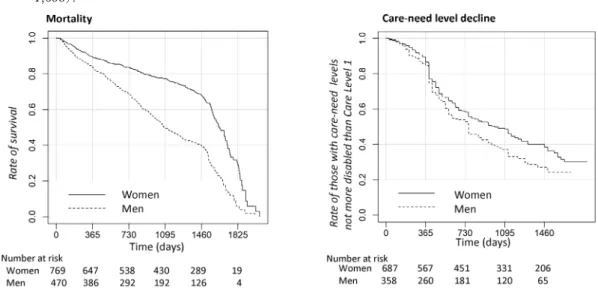
Kaplan-Meier Curves for mortality according to gender were described and showed that men were
Figure 2 Kaplan-Meier Curves for mortality and care-need level decline according to gender in subjects (N= 1,658).
Table 2 Adjusted risk of mortality in subjects (N=1,239) Factorsaassociated
with mortality
All (N=1,239) Men (N=470) Women (N=769)
Crude HR (95CI) Adjusted HRb (95CI) Crude HR (95CI) Adjusted HRb (95CI) Crude HR (95CI) Adjusted HRb (95CI) Hospitalizationsc 3.35 (2.614.29)(1.823.37)2.47 (2.464.65)3.38 (1.583.57)2.37 (2.194.70)3.20 (1.634.18)2.61 Institutionalizationsc 1.95 (1.362.8) 1.00 (.581.73) 2.48 (1.444.28) 1.00 (.432.31) 1.94 (1.193.14) .97 (.432.22) Neoplasms (2.393.91)3.06 (1.973.68)2.69 (1.492.86)2.07 (1.272.84)1.09 (2.375.10)3.48 (2.866.98)4.47 Mental/behavioral/ neurodevelopm ental disorders 1.06 (.81.41) (.721.40)1.01 (.681.22).91 (.621.97)1.10 (.561.32).86 (.471.48).83 Diseases of the circulatory system .93 (.721.20) .76 (.571.01) .90 (.641.26) .83 (.551.23) .92 (.641.33) .71 (.461.09) Diseases of the respiratory system (1.301.97)1.60 (1.262.08)1.62 (1.472.60)1.96 (1.262.58)1.80 (.781.50)1.08 (.811.78)1.2 HR=Hazard Ratio 95CI=95 Conˆdence Interval
P<.05; P<.01; P<.001
a The individual explanatory variables were hospitalizations, institutionalizations, and ICD-10 codes including neoplasms, mental/behavioral/neurodevelopmental disorders, diseases of the circulatory system, and diseases of the respiratory sys-tem.
b Adjusted for gender, age, numbers of household members, municipalities, care-need levels, history of certiˆcation in the LTCI program, and homebased services utilization including home aid, visiting-nursing, -bathing, or -rehabilitation, adult-day care, outpatient rehabilitation, respite stay, and providing assistive devices.
c yes vs. no=1 vs. 0
more likely to die (Figure 2). Those for care-need lev-el decline according to gender were described and showed that care-need levels of men were more likely to decline(Figure 2).
3. Adjusted risk of mortality
The adjusted hazard ratio of mortality by time-varying Cox proportional hazards regression is shown in Table 2. Hospitalizations (adjusted HR=2.47,
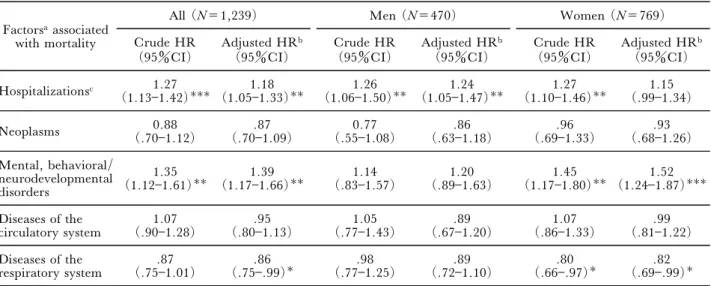
Table 3 Adjusted risk of care-need level decline in subjects (N=1,239) Factorsaassociated
with mortality
All (N=1,239) Men (N=470) Women (N=769)
Crude HR (95CI) Adjusted HRb (95CI) Crude HR (95CI) Adjusted HRb (95CI) Crude HR (95CI) Adjusted HRb (95CI) Hospitalizationsc 1.27 (1.131.42)(1.051.33)1.18 (1.061.50)1.26 (1.051.47)1.24 (1.101.46)1.27 (.991.34)1.15 Neoplasms (.701.12)0.88 (.701.09).87 (.551.08)0.77 (.631.18).86 (.691.33).96 (.681.26).93 Mental, behavioral/ neurodevelopmental disorders 1.35 (1.121.61) 1.39 (1.171.66) 1.14 (.831.57) 1.20 (.891.63) 1.45 (1.171.80) 1.52 (1.241.87) Diseases of the circulatory system 1.07 (.901.28) .95 (.801.13) 1.05 (.771.43) .89 (.671.20) 1.07 (.861.33) .99 (.811.22) Diseases of the respiratory system (.751.01).87 (.75.99).86 (.771.25).98 (.721.10).89 (.66.97).80 (.69.99).82 HR=Hazard Ratio 95CI=95 Conˆdence Interval
P<.05; P<.01; P<.0001
a The individual explanatory variables were hospitalizations and ICD-10 codes including neoplasms, mental/behavioral/ neurodevelopmental disorders, diseases of the circulatory system, and diseases of the respiratory system.
b Adjusted for gender, age, numbers of household members, municipalities, history of certiˆcation in the LTCI program, and home-based services utilization including home aid, visiting-nursing, -bathing, or -rehabilitation, adult-day care, out-patient rehabilitation, respite stay, and providing assistive devices.
c yes vs. no=1 vs. 0
d Care-need level decline was deˆned as older adults with care-need levels more severely disabled than Support Level 2 in the LTCI program.
95CI=1.823.37) were associated with mortality under adjustment for confounders. Participants with neoplasms (adjusted HR=2.69, 95CI=1.973.69) or diseases of the respiratory system(HR=1.62, 95 CI=1.262.08) were more likely to die compared to those not having each type of disease.
In the subgroup analyses, men with diseases of the respiratory system (adjusted HR=1.80, 95CI= 1.262.58) or neoplasms (adjusted HR=1.09, 95 CI=1.272.84) had higher mortality. Women with neoplasms (adjusted HR=4.47, 95CI=2.866.98) were more likely to die.
The variance in‰ation factors (VIF) for all explana-tory variables in the models were less than three, which indicated that no signiˆcant multicollinearity was observed for all analyses.
4. Adjusted risk of care-need level
The adjusted hazard ratio of care-need level decline by time-varying Cox proportional hazards regression is shown in Table 3. Hospitalizations(adjusted HR= 1.18, 95CI=1.051.33) were associated with care-need level decline. Care-care-need level of participants with mental/behavioral/neurodevelopmental disorders (adjusted HR=1.08, 95CI=1.021.14) was more likely to decline than in those not having each type of disease. However, in participants with diseases of the respiratory system (adjusted HR=.86, 95CI =.75.99), it was less likely to decline.
In the subgroup analyses for men, there was no sig-niˆcant association between candidate risk factors and care-need level decline. In those for women, care-need levels of participants with mental/behavioral/neu-rodevelopmental disorders (adjusted HR=1.52, 95 CI=1.241.87) were more likely to decline than in those not having each type of disease, but in those with diseases of the respiratory system(adjusted HR=.82, 95CI=.69.99), it was less likely to decline.
IV. DISCUSSION
The present study was a longitudinal analysis of the ˆve-year risk of mortality and care-need level decline in a municipality-representative population-based am-bulatory frail older adult sample. Because of the separate management of LTC and health insurance by local governments, several high-maintenance collation works are necessary to identify personal data in each dataset, and few studies have analyzed both LTC and health insurance claims data30,31). However, a strength
of the SOHA study is that it linked large electronic health insurance databases.
Results showed that ambulatory older men were more likely to die than women during the ˆve years studied, suggesting that after being newly certiˆed as Support Level 1 or 2, men died earlier than women, without prolonged disabled status or with rapid progression into disability25).
The risk of mortality over ˆve years was higher in a-cute or progressive diseases, including neoplasms (ad-justed HR=2.69) or diseases of the respiratory system (adjusted HR=1.62), which suggests that acute dis-eases could exacerbate frailty and lead to death; these results were consistent with another study on frail ol-der adults22). Regarding risk of mortality according to
gender, neoplasms were a risk factor in either gender, but diseases of the respiratory system were a risk factor in men only, which was consistent with a previous report24).
Risk of care-need level decline was associated with diseases of mental/behavioral/neurodevelopmental disorders, including dementia. Dementia caused ir-reversible functional decline in frail older adults, which is also consistent with a government report regarding risks for those in Care Levels 1532). Adjusted HR was
1.08 for mental/behavioral/neurodevelopmental dis-orders, which could be interpreted as fragile. The results suggested that mental/behavioral/neu-rodevelopmental disorders including dementia might aŠect care-need level decline in ambulatory frail older adults. Risks of care-need level decline in women were the same as those in all subjects, because men were more likely to die and most of the participants ana-lyzed were women.
Hospitalization was associated with mortality and care-need level decline, because hospitalization24,33)
reduced the chance of recovery from having a frailer status and the results were consistent with other reports24,33).
The results indicated that several internal chronic diseases were associated with mortality or care-need level decline. Although the present new beneˆts (KAIGO YOBO JIGYO) in ambulatory frail older Japanese mainly aim to prevent functional decline, in-cluding rehabilitation or cognitive function decline, the eŠects of managing symptoms of chronic or incurable diseases were underestimated34). Health care aimed at
managing symptoms of chronic diseases, including nurses' consultations in primary care or home visiting settings, might be provided to older adults certiˆed as Support Level by health care professions in collabora-tion with long-term care seccollabora-tions in local municipal government or agencies, which are mainly composed of social or welfare care professions.
The present study has several limitations. First, the ICD-10 was used to diagnose participants who visited clinics or were hospitalized in the current month. However, not all diseases that participants had could be entered in the analyses.
Second, a limited number of sociodemographic characteristics were considered because electronic data was used, and there might have been an association between present risk and social or family support.
Third, we used an operational deˆnition of ``am-bulatory frail'' as being Support Level in Japanese
LTCI. Results should be interpreted carefully when applying them to other countries.
Fourth, a total of 415 participants (36.4) were analyzed at the 48-month follow up in the present study, because 364 participants(29.4) ended their follow ups. The characteristics of those participants should be investigated in further research.
Finally, we analyzed the ICD-10 categories in terms of single diseases, yet most frail older adults are multimorbid34). Thus, further analyses should be
con-ducted that examine the association of multimorbidity and adverse events in frail older adults.
In conclusion, the results suggest that several diag-nosed diseases were associated with mortality or care-need decline, and disease management related care could be provided to delay these events, in collabora-tion with LTC.
This work was supported by JSPS KAKENHI Grant-in-Aid for Challenging Exploratory Research grant no.17K19831 (PI: Ayumi Kono) grants from the Japan Society for the Promotion of Science (20172018).
The study protocol was registered in the UMIN Clinical Trials Registry approved by International Committee Medi-cal Journal Editors (no. UMIN000035132, December 12, 2018).
The authors would like to thank the elderly and their fami-ly members for their participation in this study. We express our gratitude to the staŠ of the Long-term Care Insurance and Health Care Insurance Sections of Izumi, Izumiotsu, and Misaki Local Government O‹ces, Osaka Federation of National Health Insurance Organization, and Osaka Prefec-ture Association of Medical Care Services for Older Senior Citizens.
The authors have no con‰icts of interest to declare.
References
1) Fried LP, Tangen CM, Walston J, et al. Frailty in ol-der adults: evidence for a phenotype. J Gerontol A Biol Sci Med Sci 2001; 56: M14656. doi:10.1093/gerona/ 56.3.m146.
2) Clegg A, Young J, IliŠe S, et al. Frailty in elderly peo-ple. Lancet 2013; 381: 752762. doi:10.1016/s01406736 (12)621679.
3) Hanlon P, Nicholl BI, Jani BD, et al. Frailty and pre-frailty in middle-aged and older adults and its association with multimorbidity and mortality: a prospective analysis of 493 737 UK Biobank participants. Lancet Public Health 2018; 3: e323e332. doi:10.1016/s24682667 (18)300914.
4) Gill TM, Gahbauer EA, Allore HG, et al. Transitions between frailty states among community-living older per-sons. Arch Intern Med 2006; 166: 418423. doi:10.1001/ archinte.166.4.418.
5) Espinoza SE, Jung I, Hazuda H. Frailty transitions in the San Antonio longitudinal study of aging. J Am
Geriatr Soc 2012; 60: 652660. doi:10.1111/j.1532 5415.2011.03882.x.
6) Trevisan C, Veronese N, Maggi S, et al. Factors in-‰uencing transitions between frailty states in elderly adults: the Progetto Veneto Anziani Longitudinal Study. J Am Geriatr Soc 2017; 65: 179184. doi:10.1111/ jgs.14515.
7) Doi T, Makizako H, Tsutsumimoto K, et al. Transi-tional status and modiˆable risk of frailty in Japanese ol-der adults: a prospective cohort study. Geriatr Gerontol Int 2018; 18: 15621566. doi:10.1111/ggi.13525. 8) Kojima G, IliŠe S, Taniguchi Y, et al. Prevalence of
frailty in Japan: a systematic review and meta-analysis. J Epidemiol 2017; 27: 347353. doi:10.1016/j.je. 2016.09.008.
9) Arai H, Ouchi Y, Toba K, et al. Japan as the front-runner of super-aged societies: perspectives from medi-cine and medical care in Japan. Geriatr Gerontol Int 2015; 15: 673687. doi:10.1111/ggi.12450.
10) Japanese Ministry of Internal AŠairs and Communia-tions. Current population estimates as of October 1, 2017. 2017 http://www.stat.go.jp/english/data/jinsui/ 2017np/index.html (accessed December 17, 2019). 11) Japanese Ministry of Internal AŠairs and
Communica-tions. Statistical Handbook of Japan 2019. 2019. https:// www.stat.go.jp/english/data/handbook/index.html (ac-cessed December 17, 2019).
12) Tamiya N, Noguchi H, Nishi A, et al. Population ageing and wellbeing: lessons from Japan's long-term care insurance policy. Lancet 2011; 378: 11831192. doi:10.1016/s01406736(11)611768.
13) Ikegami N, Yoo BK, Hashimoto H, et al. Japanese universal health coverage: evolution, achievements, and challenges. Lancet 2011; 378: 11061115. doi:10.1016/ s01406736(11)608283.
14) Muramatsu N, Akiyama H. Japan: super-aging socie-ty preparing for the future. Gerontologist 2011; 51: 425 432. doi:10.1093/geront/gnr067.
15) Kamiya K, Adachi T, Sasou K, et al. Risk factors for disability progression among Japanese long-term care service users: a 3-year prospective cohort study. Geriatr Gerontol Int 2017; 17: 568574. doi:10.1111/ggi.12756. 16) Saito M, Kondo N, Kondo K, et al. Gender diŠer-ences on the impacts of social exclusion on mortality among older Japanese: AGES cohort study. Soc Sci Med 2012; 75: 940945. doi:10.1016/j.soc-scimed.2012.04.006.
17) Taniguchi Y, Fujiwara Y, Murayama H, et al. Prospective study of trajectories of physical performance and mortality among community-dwelling older Japanese. J Gerontol A Biol Sci Med Sci 2016; 71: 1492 1499. doi:10.1093/gerona/glw029.
18) Taniguchi Y, Kitamura A, Nofuji Y, et al. Association of trajectories of higher-level functional capacity with mortality and medical and long-term care costs among community-dwelling older Japanese. J Gerontol A Biol Sci Med Sci 2019; 74: 211218. doi:10.1093/gerona/ gly024.
19) Konagaya Y, Watanabe T. Evaluation of multimodal factors for the certiˆcation of long-term care insurance among community-dwelling elderly: a four-year follow-up study [in Japanese]. Nihon Ronen Igakkai Zasshi
2014; 51: 170177. doi:10.3143/geriatrics.51.170. 20) Okuno T, Watanabe K, Nakajima K, et al. Major
electrocardiographic abnormality predicts support/care-need certiˆcation and/or death in community-dwelling older adults with no history of cardiovascular disease. Geriatr Gerontol Int 2017; 17: 19671976. doi:10.1111/ ggi.13002.
21) Watanabe K, Okuro M, Okuno T, et al. Comorbidity of chronic kidney disease, diabetes and lower glycated hemoglobin predicts support/care-need certiˆcation in community-dwelling older adults. Geriatr Gerontol Int 2018; 18: 521529. doi:10.1111/ggi.13211.
22) Lohman MC, Sonnega AJ, Resciniti NV, et al. Frailty phenotype and cause-speciˆc mortality in the United States. J Gerontol A Biol Sci Med Sci. 2020. doi: 10.1093/gerona/glaa025. Online ahead of print. 23) Collard RM, Boter H, Schoevers RA, et al.
Preva-lence of frailty in community-dwelling older persons: a systematic review. J Am Geriatr Soc 2012; 60: 1487 1492. doi:10.1111/j.15325415.2012.04054.x.
24) Lee JS, Auyeung TW, Leung J, et al. Transitions in frailty states among community-living older adults and their associated factors. J Am Med Dir Assoc 2014; 15: 281286. doi:10.1016/j.jamda.2013.12.002.
25) Botoseneanu A, Allore HG, Mendes de Leon CF, et al. Sex diŠerences in concomitant trajectories of self-reported disability and measured physical capacity in ol-der adults. J Gerontol A Biol Sci Med Sci 2016; 71: 10561062. doi:10.1093/gerona/glw038.
26) Japanese Ministry of Internal AŠairs and Communica-tions. Population and household based on national resi-dent registration [in Japanese]. 2013. https://www.e-stat.go.jp / stat-search/ ˆles?page= 1&layout= datalist& toukei=00200241&tstat=000001039591&cycle=7&year = 20130&month = 0&tclass1 = 000001039601&result _ back=1. (accessed December 17, 2019).
27) Kono A, Izumi K, Yoshiyuki N, et al. EŠects of an up-dated preventive home visit program based on a sys-tematic structured assessment of care needs for ambulato-ry frail older adults in Japan: a randomized controlled trial. J Gerontol A Biol Sci Med Sci 2016; 71: 1631 1637. doi:10.1093/gerona/glw068.
28) Japanese Ministry of Health, Labour and Welfare. Annual Health, Labour and Welfare Report 2017. 2017. https://www.mhlw.go.jp/english/wp/wp-hw11/index-.html. (accessed December 17, 2019).
29) Tanihara S. The proportion of uncoded diagnoses in computerized health insurance claims in Japan in May 2010 according to ICD-10 disease categories. J Epidemiol 2014; 24: 392396. doi:10.2188/jea.JE20130194. 30) Hashimoto H, Horiguchi H, Matsuda S. Micro data
analysis of medical and long-term care utilization among the elderly in Japan. Int J Environ Res Public Health 2010; 7: 30223037. doi:10.3390/ijerph7083022. 31) Hamada S, Takahashi H, Sakata N, et al. Household
income relationship with health services utilization and healthcare expenditures in people aged 75 years or older in Japan: a population-based study using medical and long-term care insurance claims data. J Epidemiol 2019; 29: 377383. doi:10.2188/jea.JE20180055.
32) Japanese Ministry of Health Labour and Welfare. Comprehensive survey of living conditions in 2016 [in
Japanese]. 2016. https://www.mhlw.go.jp/toukei/sai-kin/hw/k-tyosa/k-tyosa16/dl/05.pdf (accessed Decem-ber 17, 2019).
33) Gill TM, Gahbauer EA, Han L, et al. The relation-ship between intervening hospitalizations and transitions between frailty states. J Gerontol A Biol Sci Med Sci
2011; 66: 12381243. doi:10.1093/gerona/glr142. 34) Vetrano DL, Palmer K, Marengoni A, et al. Frailty
and multimorbidity: a systematic review and meta-analy-sis. J Gerontol A Biol Sci Med Sci. 2019; 74:659666. doi:10.1093/gerona/gly110.