Acta med. ngasaki. 9 : 1-10
The Response of Blood Pressure to Humid Heat
Ryu AIZAWA, Hajime MIURA, Akinori MINAMI,
Gen KAWABATA and Iwao BABASAKI*
Department of Public Health, Nagasaki University School of Medicine,
Nagasaki, Japan
Received for Publication April 25, 1964
The experimental study was conducted to throw light on the response of blood pressure of men to humid heat and to determine the permissible limits of environmental heat. The physiological disequilibrium seemed to be imminent sooner or later in the exposure to the humid heat of 95° F effective temperature (33-34°C wet bulb temperature) or more. Therefore, the permissible upper limits of environmental heat seemed to be around 95°F effective temperature.
Numerous investigators have described experiments made on men exposed to severe humid heat, but little work has been done to study the response of blood pressure to various levels of environmental heat.
This problem seems to be very important for the purpose of deter- mining the permissible limits of environmental heat in which men can still work effectively. In 1945 and 1946 EICHNA et al5). and AIZAWA1) recognized that men, exposed to such humid heat as 33°C wet bulb or more, might be subjected to heat stroke. Therefore, the authors con- ducted the experimental study on the response of blood pressure of men lying down in humid heat to the various levels of wet bulb temperature.
METHODS
The subjects were. 6 students in good physical condition, aged from 18 to 22 years. The experiments were conducted from August to early September 1963. For our resting experiments the subjects were asked to lie down on deck-chair. After 30 minutes' rest in the ordinary room temperature, the subjects were exposed to humid heat in the specially constructed climatic room for 60 to 180 minutes.
The levels of environmental heat were classified into the three groups of 30° -31°C, 33°- 34°C and 36° - 37°C wet bulb temperature.
*相 沢 龍,三 浦 創,南 明範,川 端 元,馬 場 崎 厳
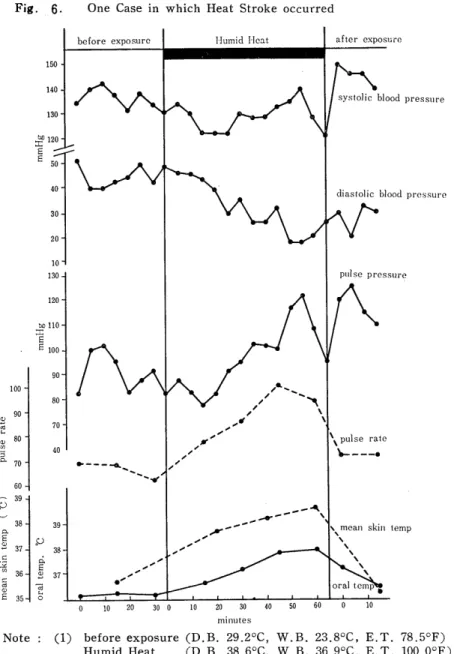
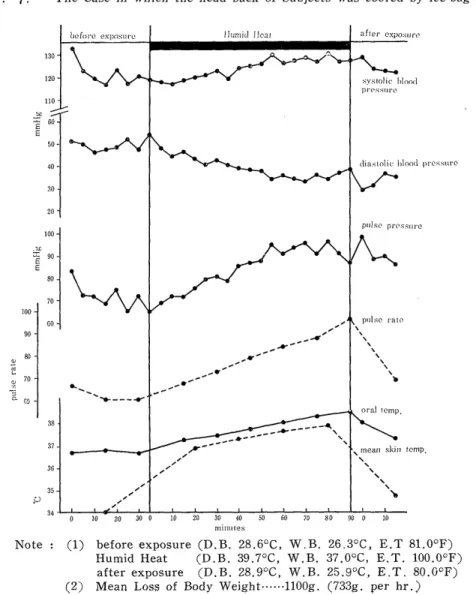
The details of the environmental heat for each exposure were shown in Figures 1-7 in which the experimental data were described.
The measuring items were as follows:
1) The blood pressure was measured by Riva-Rocci sphygno- manometer every 5 minutes. Systolic blood pressure was recorded at the first phase of the Korotkoff sounds. When the diastolic blood pressure, as recorded at the fifth phase of the Korotkoff sounds, fell to zero, it was recorded at the fourth phase.
2) The oral temperature and pulse rate were measured every 15 minutes.
3) The skin temperature was measured on the three spots of the frontal area, occiput and thigh. Then, the mean skin temperature was
calculated by the formula of 1/2{(temp. of occiput) + (temp. of thigh) } ,
introduced by Kurata and Funazu°'.
4) The electrocardiogram was recorded by the standard limbleads before and in the midst of the exposure.
5) The rate of sweating (represented by the loss of body weight) was measured by weighing the men unclothed before and after the exposure.
6) The general clinical appearance and psychic changes were recorded during the exposure.
RESULTS
1) 300-31"C wet bulb temperature (Fig. 1-2)
When the climatic room was kept at 33°C dry bulb (88°F effective temp.), the physiological reactions remained almost unchanged, and the mean loss of body weight was only 144 gm. per hr.
In the case of 43°C dry bulb (93°F effective temp.), the systolic blood pressure remained almost unchanged. But the diastolic blood pressure began to fall slightly after 60 minutes' exposure, and then soon maintained a steady state through the exposure. Therefore, a slight increase in pulse pressure appeared in the latter half of the exposure. The oral temperature, mean skin temperature and pulse rate maintained a steady state, excepting the initial slight rise or increase. The loss of body weight was only 267 gm. per hr.
2) 33'-34'C wet bulb temperature (Fig. 3-v4)
In the case of 35°C dry bulb (93DF effective temp.), the blood pressure remained almost unchanged. The mean loss of body weight was 312 gm. per hr.
The response of blood pressure to heat seemed to be fairly different
from the above results, when the climatic room was heated to 43°C
dry bulb (95°F effective temp.) The systolic blood pressure remained
1964 BLOOD PRESSURE AND HUMID HEAT 3 Fig. 1 . Influence of Humid Heat (W.B. 30-31°C) on Subjects
minutes
Note : (1) before exposure (D.B. 27.2°C, W.B. 25.1°C, E.T. 78.5°F) Humid Heat (D. B 32.9°C, W . B. 30.7°C, E. T . 88.0°F)
after exposure (D.B. 28.4°C, W.B. 25.8°C, E.T. 80,0°F)
(2) Mean Loss of Body Weight ... 288g. (144 g. per hr.) Fig. 2. Influence of Humid Heat (W.B. 30-31°C) on Subject
Note : (1) before exposure (D.B. 28.0°C, W.B. 20.0°C, E.T. 74.0°F) Humid Heat (D.B. 42.4°C, W.B. 31.1°C, E.T. 93.0°F) after exposure (D . B. 28.4°C, W . B. 25.8°C, E. T . 80.0°F)
(2) Loss of Body Weight ... 800g. (267g. per hr.)
Fig. 3. Influence of Humid Heat (W.B. 33-34°C) on Subjects
minutes
Note : (1) before exposure (D.B. 30.2°C, W.B. 23.6°C, E.T. 77.0°F) Humid Heat (D.B. 35.5°C, W.B. 33.6°C, E.T. 93.0°F)
after exposure (D.B. 30.9°C, W.B. 24,3°C, E.T. 80.0°F)
(2) Mean Loss of Body Weight ... 625g. (312g. per hr.) Fig. 4. Influence of Humid Heat (W.B. 33-34°C) on Subject
Minutes