• 検索結果がありません。

“Area Studies in Nursing” from the Perspective of Medical Anthropology -Nursing and Medical Anthropology for interdisciplinary field of study-

N/A
N/A
Protected

Academic year: 2021

シェア "“Area Studies in Nursing” from the Perspective of Medical Anthropology -Nursing and Medical Anthropology for interdisciplinary field of study-"

Copied!
5
0
0

読み込み中.... (全文を見る)

全文

(1)

1. The Situation of “International Nursing”

in Japan The first nursing university in Japan, which was es- tablished in 1952, was part of the department of home economics at Kochi Womenʼs University. Ten more nursing universities opened in the 1960s. Although the number of nursing universities reached a ceiling there- after, a rapid expansion began after 1990. In 2008 there were more than 150 nursing schools in existence.

In the 1990s a new field, “international studies,” was developed and many nursing universities added “in- ternational nursing” to their departments. Recently it has become difficult for newly established universities to get new students because of the declining birthrate and the growing population of elderly people; there- fore, these universities are trying to attract students by offering international studies. Society demands that students today have an international mindset, which means that they should be not only well pre- pared for nursing in Japan, but also internationally active. During this period of globalization, it is natural that nursing in Japan should have ties to international medical practice. However, it is not good to simply say that something is international without careful and

complete preparation. If the object (the person and the surrounding environment) of nursing is to understand the big picture, including the different cultures, areas or regions (nations) beyond the individual patients, I worry that students who receive guidance from teach- ers who only know the world of nursing will be con- fused.

If an “area study” is interpreted in the wider sense for the time being, you can say that it is a “study that researches the social structure, the cultural context, the history, the geography, and the economy etc., of a settled cultural area of a specific region totally from various angles.” You cannot talk about nursing without including the social structure and the cultural context of the object (patient) . Some people might say that this is not a new idea; it has been thought of for some time. Unfortunately nursing in Japan is closed in one respect: we cannot escape from our centrist cultural ideas. We seem to neglect comparisons with other for- eign countries (cultural areas) and do not engage in reflexive, relative thinking about our nursing. So far, we have not gone on the adventure that might over- turn our stereotypes by observing our culture through others.

“Area Studies in Nursing” from the Perspective of Medical Anthropology

-Nursing and Medical Anthropology for interdisciplinary field of study-

Ayumi NOMURA

1

1 Nagasaki University School of Health Sciences, Department of Nursing

Abstract Many of medical anthropologists have researched from only one-side of view of the point.

The people studying medical treatment should not research objects (patients) from only their own perspective; rather, patients should research themselves as their own specialists and observe the situation and their status from a detached point of view. This is a deconstructivist idea for medical treatment and nursing. Patients and people who work in the medical field look at their own environments from the point of view of an anthropologist, and therefore are released from their former passive situations. I want to call them “wild anthropologists.” It is interesting for me that there could be an anthropologist (the medical practitioner) who creates such wild anthropologists, who then disappears as their situations are resolved. I learnt it through the area study (Japan and Sri Lanka) .

Health Science Research 21 (2) : 115-119, 2009

Key Words : medical anthropology, area studies, Sri Lanka, boke-rojin, international nursing Received 20 February 2009

Accepted 21 April 2009

(2)

2. Nursing Science and Medical Anthropology – Interdisciplinary At one time, I proposed to a famous professor at a nursing university that I might research nursing as a medical anthropologist. However, my proposal was rejected by the professor who said: “Only a person who had studied nursing can understand nursing.” The study of nursing in Japan is very isolated from other areas of study; in fact, it can be said to be closed. How- ever, although too much specialization makes a dis- cipline too insular, it is important to study oneʼs own specialty thoroughly as a researcher. The person who cannot escape from the fixed idea of his/her culture cannot necessarily broaden understanding merely by visiting the other culture. It is important to become involved with the other culture and ask yourself what differences there are between the two. As previously mentioned, I think that nursing is an academic study requiring the ability to analyze people and different cultures from various angles, and is an attractive field with many possibilities. We have to accept the fact that nursing borrows from various fields and is a patchwork of different studies. It would be ideal then, if we could acquire knowledge of all disciplines.

I think that there is a limit to developing this abil- ity within the nursing field itself. Nursing as a pro- fession has defined its own areas of specialization and guarded its independence so fiercely that it has been closed, and thus it is difficult to establish a re- search style beyond academic study. I believe nursing should emphasize alternate points of view and estab- lish cross-disciplinary studies. In short, it is important that one should actually go to a region where the ecol- ogy, culture, and society intersect historically in order to understand a different culture in an “area study”

of nursing. In addition, by integrating a single area of expertise with another area while also attempting to unite pure research and applied practices one can come to understand the whole of human society.

Now we have to think about where we stand. It is im- portant that the erroneous idea that only a nursing spe- cialist can understand nursing should be changed. We should also dispute the privileged position of research- ers. Additionally, the distinctions between <those who research> and < those who are researched> should be eliminated in area studies in the future. Our mission as researchers is to ensure that the people who were once the subjects of our studies will now be promoted

to “researchers” in their own right. By relating to each other, and putting aside our theories, we should try to understand the object of study as couched in the real- ity of its surroundings, and acquire the ability to un- derstand context, which includes meaning. The people studying medical treatment should not research ob- jects (patients) from only their own perspective; rath- er, patients should research themselves as their own specialists and observe the situation and their status from a detached point of view. This is a deconstructiv- ist idea for medical treatment and nursing

1,2)

. Patients and people who work in the medical field look at their own environments from the point of view of an anthro- pologist, and therefore are released from their former passive situations. I want to call them “wild anthro- pologists.” It is interesting for me that there could be an anthropologist (the medical practitioner) who cre- ates such wild anthropologists, who then disappears as their situations are resolved. 【Figure2】

3. Relations between “We” and “Others”

There is no longer any “undeveloped region” on the earth (in regard to social anthropology) due to global- ization. However, I have been thinking that assum- ing there were an isolated culture on an island ringed by the sea, it would be ideal to immerse oneself com- pletely in the locale, and to observe the customs there and the relationship between the social structure and sickness from the perspective of medical anthropol- ogy. At one time, I investigated the social structure on an island with a population of 200, including elderly people, in Nagasaki Prefecture where it is rumored that “boke-rojin (aged dementia) does not exist” and the rate of aging (ratio of senior citizens aged 65 or older to the population) is 70 percent

3-6)

. The elderly persons on the island told me that the residents, who first moved there about 500 years ago, were descen- dants of the defeated warriors of Heike, and that only these descendants had been living there since. There was neither a hotel nor any visitors on the island, where people made their living by fishing and farm- ing. When I went there to investigate the island for the first time, I felt the inquisitive stares of the residents.

The islanders accepted my true reasons for being there only after questioning me many times: “Whatʼs your business here?” and “Why did you come to the island?”

Finally, on my third visit to the island, some residents

who had been looking at me from a distance became

concerned about the progress of my investigation, say-

ing: “Have you come again?” and “Have there been any

(3)

good results?” They invited me, the person who kept investigating their island, to supper, asking: “Do you have all the food you need?” They also asked me to participate in the cleaning of the island, which was the established custom. In the two previous investiga- tions, I had focused on doing aural surveys of people about “boke-rojin (aged dementia) , but the research did not go well. However, when I participated in the cleaning work without mentioning my investigation, and was subsequently invited for dinner, I obtained valuable unexpected information. My hosts started saying things like: “The people of this island …”

The investigation of “the island where boke-rojin

(aged dementia) does not exist” comprised the first stage of my study and I next visited Sri Lanka 【Fig- ure1】 . I went to Sri Lanka to investigate the relation- ship between senior citizensʼ PTSD (post-traumatic stress disorder) and dementia in the region stricken by the tsunami caused by the Sumatra coast earthquake in 2004. Even though the scale of the investigation had expanded compared with the previous one in Japan, the method of interacting with the people of the re- gion that I had learned on the “island where boke-rojin

(aged dementia) does not exist” was useful. I spent three weeks without any particular schedule because I wanted to “feel” the personal lifestyles and beliefs of the people of the area directly and leisurely before I

started my real investigation. People here were also concerned about who I was and what I wanted to do.

I was made fun by the grade-schoolers who called,

“Japan!” when I was strolling through the town. More- over, people in the stricken area asked me, “JICA?

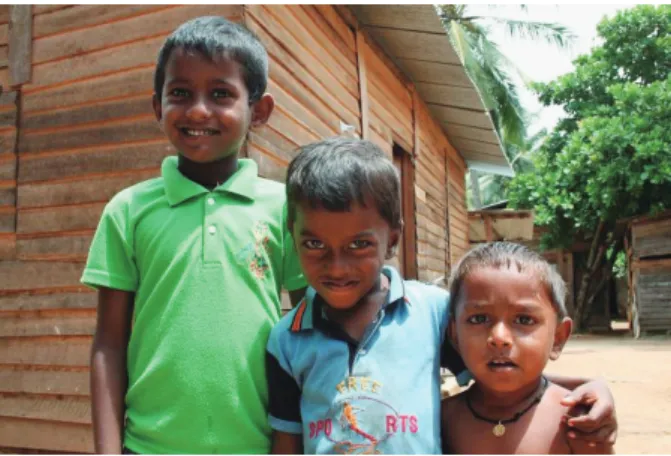
NGO?” and afterwards wanted to know “What can you give us?” Because JICA and NGO groups in Japan had carried out restoration support activities immediately after the tsunami, the word “Japanese” might have given people whose lives had been hard after the disas- ter the image of a “person can do something for us.” In the course of my research I was interested to find that I never got answers to the questions which had been central to my investigation in Japan; rather, the resi- dents of this area were expecting rewards from us by emphasizing their current conditions and the poverty which had resulted from the tsunami. This is because they had the idea that “Japanese = those who support us.” 【Figure3,4】

It is also interesting to note when I spoke to Sri Lankan people, both in and out of the tsunami stricken area, I was asked the following three questions: 1. What is your name? 2. Which religion do you believe in? 3.

Are you single? (In Japan it is not socially acceptable to ask others anything but their name) . When they asked about my religion and I answered that I did not have any special beliefs, the Sri Lankan people looked at each other in disbelief and asked: “You believe in no religion? What on earth do you believe, and how do you lead your life?” The people in Sri Lanka are very reli- gious, and weave their religion into their daily lives.

You cannot marry a person whose religion is different from yours in Sri Lanka. Moreover, there seems to be a tacit rule that a man cannot have special feelings

(deep familiarity) for a woman who has a fiancé.

Figure 1 : Research area in Sri Lanka

Figure 2 : I've been investigating the case. They were

not able to speak English. So I investigated with

Singhalese trying hard.

(4)

Several days later I learned that they were “measur- ing distance” with me through this line of questioning.

I got very good results in the three unscheduled weeks that I spent comfortably in the guesthouse. I had met a man who had come from Malaysia to Sri Lanka on business, and he invited me to dinner several times.

The restaurant in the guesthouse was a very inter- national space and suddenly there were spontaneous conversations between people from four countries, the Malaysian businessman, his two co-workers who were Indian & Sri Lankan, and one Japanese person

(me) . The language we used was English, which was a second language for everyone. We used words that were easy to understand since we were all speaking to others from foreign countries. I became excited by the idea of communicating, of questioning and answer- ing each other, in simple language. The situation of group of people speaking without using their mother tongue sometimes resulted in strange tales (we were all trying to communicate without understanding each otherʼs cultures) . I actually felt at the time that all the stories had been influenced by the speakersʼ “measure”

(a rule – a measure of everything which is a result of the environment and culture where people are born and grow up) . I realized once again how much I had been grasping concepts through my own “measure”

and biased viewpoint.

4. The Meaning of “Meeting Unknown Fields”

 I think that an “area study” is research conducted in a particular region. By region, I mean that you have to put yourself in the place you are researching and expe- rience the subject (object) of your study through your own five senses. It is said that social anthropology is the study of “understanding an object.” Nursing might

be also be similar. To understand the object is to put the researcherʼs body physically in the place where the culture, society, and ecology of the object intersect his- torically, to integrate expertise with another area in a positive way while attempting uniting pure research and applied practice, and in so doing, finally come to understand the whole of human society. Many discov- eries and valuable information can come unexpectedly.

When attempting to expand the frame of understand- ing of an object or a region of study, the question “How do you interpret this?” is more important than simply asking “What has happened?” From my experiences in the islands of Nagasaki and Sri Lanka I have learned that understanding objects in the context or reality of the region where they are, rather than as the subjects of an investigation, asking who we are ourselves, and the ability to understand the context of things we ob- serve, are real pleasures that cannot be experienced without putting yourself in the “place.”

 I would like researchers in nursing to experience this aspect of medical anthropology and take interest in area studies. Expert nurses are good at understand- ing the characteristics of an object (the person and the surrounding environment) . However, most peo- ple focus on specific characteristics without consider- ing the surroundings. If nurses place an emphasis on individuality without considering the environment, diversity in nursing can be lost. What is important in nursing, is generalizing diversity. That is, we should look for natural laws that can be found in common among holistic medical treatments, and acquire the ability by which we can apply and adjust these laws to the people who are here and now. Naturally, it is not enough to do area studies in order to enrich the field of nursing. Nurses to need to acquire the ability to both Figure 3 : Family who encountered damage of

tsunami. Father is a fisherman. But he canʼt work because the boat was broken by the tsunami.

Figure 4 : Children who are playing in temporary

shelter. They all moved to live from the different

location here. But they are good friends.

(5)

reflect on the object, and to negotiate with the object.

This will enable them be become deeply involved in the relationships between themselves and others. Only by expanding its horizons and enlarging its pedagogical framework by asking “How do you interpret this?”

rather than “What has happened?” in an object or a re- gion, can the field of nursing become rich. I expect that in the future, nursing as a discipline will have the pos- sibility of proving metaphysically what has happened in a region where various cultures, history, and societ- ies intersect based on an observation of itself.

Finally, I hope that lectures concerning medical an- thropology will increase now that so many in the nurs- ing field are focused on internationalization.

This paper is a part of a report for Grants-in-Aid for Scientific Research (Basic Research C) “Post-trau- matic Stress Disorder after the Tsunami in Sri Lanka and Related Factors of Dementia” (Problem number 50346938: the research representative: Ayumi Nomura)

Acknowledgment

This research was cooperation with the Prof. Sarath Amarasinghe, Department of Sociology University of Ruhuna, Matara. His support was very valuable in organizing the study and collecting information. I sin- cerely acknowledge the assistance and cooperation of various individuals and institutions who make this re- search possible. I wish to express my gratitude to the academic, non-academic staff and the students, who voluntarily assisted me to collect information and to

analyze the data. My appreciation is also extended to the victimized families who provided with important information despite their extreme hardships.

Reference

1 ) Ayumi NOMURA: Medical and power, about the operation of power through the medium of rhet- oric. Bulletin of Nagasaki University School of Health Sciences, 16 (2) : 39-47, 2003. (in Japanese)

2 ) Ayumi NOMURA: Attempt of anthropology prac- tice in nursing. The Kyushu Anthropological As- sociation, 31: 65-71, 2004. (in Japanese)

3 ) Ayumi NOMURA: The Island where Boke-rojin

(Aged Dementia) does not exist, an essay on the representation of a depopulated and hyper-aged society. Kumamoto University Studies in Social and Cultural Sciences, 2: 99-112, 2004. (in Japa- nese)

4 ) Ayumi NOMURA: Social construction of aging.

Kumamoto Journal of Cultural Anthropology, 3:

81-92, 2004. (in Japanese)

5 ) Ayumi NOMURA: Reciprocal help of the island where Boke-rojin (aged dementia) does not exist.

Kumamoto Journal of Cultural Anthropology, 4:

81-92, 2005. (in Japanese)

6 ) Ayumi NOMURA: Boke-rojin (aged dementia)

does not exist and Sri Lanka that received dam-

age of tsunami, from the medical anthropology to

nursing. Newsletter from Japan Consortium for

Area Studies, 4: 18-20, 2007. (in Japanese)

Figure 1 : Research area in Sri Lanka
Figure 4 : Children who are playing in temporary  shelter. They all moved to live from the different  location here

参照

関連したドキュメント

administrative behaviors and the usefulness of knowledge and skills after completing the Japanese Nursing Association’s certified nursing administration course and 2) to clarify

Keywords: continuous time random walk, Brownian motion, collision time, skew Young tableaux, tandem queue.. AMS 2000 Subject Classification: Primary:

Kilbas; Conditions of the existence of a classical solution of a Cauchy type problem for the diffusion equation with the Riemann-Liouville partial derivative, Differential Equations,

This paper develops a recursion formula for the conditional moments of the area under the absolute value of Brownian bridge given the local time at 0.. The method of power series

modular proof of soundness using U-simulations.. & RIMS, Kyoto U.). Equivalence

Then it follows immediately from a suitable version of “Hensel’s Lemma” [cf., e.g., the argument of [4], Lemma 2.1] that S may be obtained, as the notation suggests, as the m A

Applications of msets in Logic Programming languages is found to over- come “computational inefficiency” inherent in otherwise situation, especially in solving a sweep of

Shi, “The essential norm of a composition operator on the Bloch space in polydiscs,” Chinese Journal of Contemporary Mathematics, vol. Chen, “Weighted composition operators from Fp,