Introduction
Falls are a commonly recognized geriatric syndrome in the Asia-Pacific region,
1and frail older adults have an espe- cially high incidence of falls worldwide.
2It is estimated that one-third of community-dwelling older adults aged ≥65 years fall every year, and serious injuries result from 10% of falls.
3,4Consequently, the sequelae of fracture and reduction in health-related quality of life are serious among frail older adults.
3,5Additionally, economic concern is also serious;
about 7.1 billion US dollars is spent annually on medical and
long-term care costs in Japan.
6Based on this social back- ground, many studies have identified risk factors for falls in older adults.
7,8The etiology of a fall is usually multifactorial, resulting from the interaction between intrinsic (i.e., postural control, muscle strength, joint disease) and extrinsic (i.e., walking surface, high or narrow steps) risk factors.
9It is believed that failure to appropriately change intrinsic human factors to adapt to extrinsic environmental factors may lead to a slip or trip, and eventually, a fall.
10Therefore, various exercise programs have been developed to improve the in- trinsic factors associated with falls, and most of the intrinsic
MS#AMN 07220
Left toe grip strength and lumbar spine/ankle joint disease are associated with falls among frail older women
Takahiro N
ishida1,2, Rieko N
akao2, Mika N
ishihara2, Ryoko K
awasaki3, Sumihisa H
onda21 Sasebo-Yoshii Community Comprehensive Support Center
2 Department of Public Health Nursing, Nagasaki University Graduate School of Biomedical Sciences
3 Department of Clinical Nursing, Oita University of Nursing and Health Sciences
Background: Although toe grip strength has been closely associated with physical performance, the association between toe grip strength and history of falls in older adults remains unclear. The purpose of our study was to investigate the associations between physical function testing, including toe grip strength and falls in the previous 12 months, in community-dwelling frail older women.
Methods: Forty-eight participants aged ≥65 years who were screened by a frailty checklist were included. We compared the faller group (n=18) and non-faller group (n=30) in terms of physical function including toe grip strength, hand grip strength, five-repetition sit-to-stand test, one-leg standing duration with vision, 5-meter walk test, and timed up-and-go test, as well as history of orthopedic disease.
Results: Participants in the faller group had significantly weaker left toe grip strength than those in the non-faller group (p=0.009), whereas the other physical measurements were not found to be significantly different. Regarding orthopedic dis- ease, the faller group had a significantly higher prevalence of lumbar spine and ankle joint disease compared with the non- faller group (p=0.025 and p=0.001, respectively).
Conclusions: Left toe grip strength and lumbar spine/ankle joint disease may be the most important physical function factors for predicting falls in frail older women.
ACTA MEDICA NAGASAKIENSIA 62: 1−6, 2018 Key words: toe grip strength, falls, frail older women
Address correspondence:
Sumihisa Honda, PhD, Department of Public Health Nursing, Nagasaki University Graduate School of Biomedical Sciences, 1-7-1 Sakamoto, Nagasaki 852-8520, JapanE-mail: [email protected], Tel: +81-95-819-7945 Received December 19, 2017; Accepted February 22, 2018
factors for falls have been shown to improve with training in older adults.
4,5In Japan, the aged population is increasing faster than in any other country, and the Ministry of Health, Labour, and Welfare implemented a long-term care insur- ance (LTCI) system in 2000 to provide care for dependent older adults with the support of society as a whole. Indeed, falls and joint disease are leading causes of eligibility for LTCI.
11Given that the intrinsic risk factors for falls are mod- ifiable, early detection and treatments should be central to the preventive care of frail older adults. In 2006, therefore, the LTCI system was revised, and new preventive care services were introduced. The Ministry of Health, Labour, and Welfare has developed a frailty checklist to screen frail adults aged ≥65 years and has promoted community exercise programs to prevent falls among frail older adults.
12-14Recently, several studies have found that toe grip strength (TGS) was closely associated with physical performance among older adults.
10,15Menz et al.
16indicated that foot and ankle characteristics, particularly TGS, are important deter- minants of balance and functional ability in older adults.
However, Uritani et al.
17and Yamashita et al.
15reported that TGS was reduced with aging, especially among adults aged
≥65 years, for women. Although some studies have indicated that TGS was associated with physical function in older adults, few studies have analyzed the direct associations between TGS and fall history. In addition, older adults are reported to be very heterogeneous (e.g., sex differences, range of frail to robust individuals) with multiple patholo- gies such as musculoskeletal disorders (e.g., osteoarthritis, damage to ligaments and nerves).
4,18However, few studies have focused on frail older adults to assess the associations between physical function and fall history. We therefore aimed to investigate the associations between physical function, including TGS and fall history, among community- dwelling frail older women.
Materials and methods Setting and study design
This study was conducted at the Emukae Daycare Center located in the local city of Sasebo, Nagasaki Prefecture, Japan from May 2013 to January 2016. This daycare center provided services for dependent older individuals who were certified for LTCI. Additionally, the daycare center carried out an exercise program to improve physical performance as preventive care for frail older individuals who had not yet been certified for LTCI but had been screened by a frailty checklist.
12A cross-sectional study design was used to inves-
tigate associations between physical function and falls in the previous 12 months.
Participants and procedures
The self-administered frailty checklist
12was mailed to older adults aged ≥65 years. “Frail older adult” was defined by the frailty checklist according to the Ministry of Health, Labour, and Welfare and included simple yes/no questions concerning lifestyle, motor abilities, nutrition, oral func- tions, seclusion, forgetfulness, and emotions. Potentially eligible individuals were invited to confirm eligibility, where a public health nurse involved in this study recorded falls assessments and clinical history. We enrolled 59 participants (48 women, 11 men), and analyzed 48 women in this study.
Written informed consent was obtained from all participants, and the survey was approved by the Ethics Committee of Nagasaki University Graduate School of Biomedical Sci- ences.
Falls assessments
The falls assessments included simple yes/no questions such as “Have you fallen in the past 12 months?” Assess- ments were self-administered by the participants with the guidance of a public health nurse. Participants were divided into a faller group and non-faller group based on the assess- ment. A fall was defined as “unintentionally coming to rest on the ground or at some other lower level, not as a result of a major intrinsic event (e.g., stroke) or overwhelming hazard.”
19Clinical orthopedic history
The public health nurse interviewed the participants about basic attributes such as age, sex, and medical orthopedic history before the exercise program. Orthopedic diseases were divided into groups to include lumbar spine disease (e.g., spinal canal stenosis), hip joint disease (e.g., osteoar- thritis of the hip), knee joint disease (e.g., osteoarthritis of the knee), and ankle joint disease (e.g., sprained ankle). The presence of disease was determined based on information from the participants.
Physical measurement
At baseline, to assess the physical function of the partici-
pants, the following measurements were performed: TGS,
hand grip strength (HGS), five-repetition sit-to-stand (5-rep-
etition STS) test, one-leg standing duration with vision
(OLS), 5-meter walk test (5WT), and timed up-and-go test (TUGT).
Left and right TGSs were measured using a dynamometer (Nisshin Industry Co., Ltd., Saitama, Japan) while the subjects were sitting with their knees flexed at 90 degrees. Two TGS measurements were recorded for each set of toes in an alter- nating fashion. A hand grip dynamometer was used to measure HGS. The maximum grip strength of the dominant hand of each subject was measured while they stood with their arms by their sides. Five-repetition STS testing measured the time taken to complete five repetitions of the sit-to-stand maneuver. All sit-to-stand maneuvers were performed from a chair without arm rests, the seat of which was 45 cm high and 42.5 cm deep. To assess static balance ability, OLS was performed with eyes open, and the participants were asked to stand on the dominant leg while raising the other leg, fixed at the knee, and with hands on their waist. The timing was stopped if the participant could maintain balance in excess of 60 seconds. In conducting the 5WT, participants were asked to walk 5 meters at their normal pace, starting from 3 meters behind the start line. Dynamic balance and mobility were assessed using the TUGT, which measures the time needed to raise from a chair, walk 3 meters at a comfortable and safe pace to reach a cone, turn around the cone, return to the chair, and sit down again. All of the tests were conducted twice, and the better value of the two tests was selected as the representative one. All physical measurements were conducted by a nurse who was adequately trained.
Statistical analysis
Chi-square testing was performed to assess whether char- acteristics such as orthopedic disease were associated with falls in the previous 12 months. The faller and non-faller groups were compared using physical measurements, in- cluding TGS, using the t-test. All statistical analyses were performed using SPSS software, version 23.0 for Windows (IBM, Japan).
Results
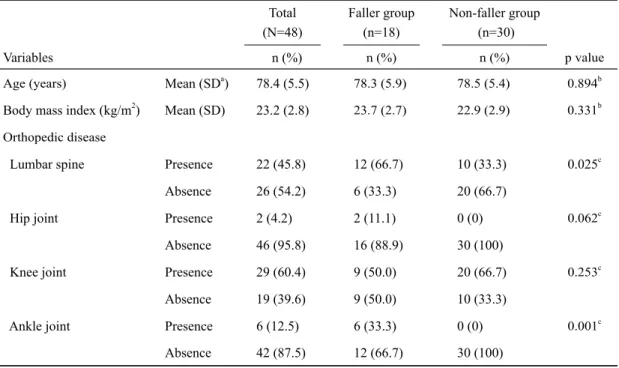
Baseline characteristics of the participants are summa- rized in Table 1. The mean (SD) age of the participants was 78.4 (5.5) years. Of the 48 participants, 18 (37.5%) fell in the previous 12 months. The participants consisted of 29 patients with knee joint disease (60.4%), 22 with lumbar spine dis- ease (45.8%), 6 with ankle joint disease (12.5%), and 2 with hip joint disease (4.2%).
Comparison of the faller group (n=18) and non-faller group (n=30) with regard to basic attributes and orthopedic disease are also shown in Table 1. Falling in the previous 12 months was significantly associated with lumbar spine dis- ease (p=0.025) and ankle joint disease (p=0.001). On the contrary, age and body mass index were not found to be sig- nificantly associated with falls in the previous 12 months.
Regarding physical measurements, the faller group had significantly lower levels of left toe grip strength (mean 2.1 kg) compared with that of the non-faller group (mean 2.7 kg, p=0.009). Other physical measurements, including right toe grip strength, were not significantly different between the faller and non-faller groups (Table 2).
Discussion
In this study, we compared the characteristics of faller and non-faller groups of community-dwelling frail older women and revealed that the faller group had significantly weaker left toe grip strength compared with the non-faller group, and the faller group had a significantly high prevalence of ankle joint and lumbar spine disease. These results suggest that reduced left toe grip strength and the presence of ankle joint/lumbar spine disease increase the risk of falls in frail older women.
Our findings are consistent with Menz et al.
20who con-
ducted a 12-month prospective study among 175 older adults
using the paper grip test and weight-bearing lunge test and
demonstrated that the faller group had much weaker toe
plantar flexion and reduced ankle flexibility compared with
the non-faller group. We measured toe grip strength using a
dynamometer, and our results were similar to those of this
previous study. Measured by the dynamometer, toe grip
strength was generated by collaborative actions of muscles,
such as the flexor halluces brevis, flexor digitorum longus,
and tibialis anterior.
15These muscles are also a key factor for
generation of toe flexor power and ankle plantar/dorsiflex-
ion.
15The toe flexor muscles perform a crucial function in
assisting with propulsive force when walking, and this is
achieved by the contraction of the muscles during the late
stance phase of the gait cycle.
21Fong et al.
10demonstrated
that greater toe grip allows adaptation to a slippery surface
while walking, which was shown by a 30% increased peak
pressure exertion at the hallux compared to non-slippery
conditions. Accordingly, toe grip strength and ankle flexibil-
ity are considered to play an important role in initial postural
sway control as an ankle strategy, resulting in fall preven-
tion.
21-23Interestingly, our results show that left toe grip strength was associated with fall history, but right toe grip strength was not (p=0.663). Murata et al.
24compared a faller group and non-faller group among older adults on toe grip strength using a toe grip dynamometer and found that an increasing sum of both toe grip strengths was independently associated
with preventing falls in the previous 12 months in a logistic regression analysis (odds ratio 0.63). Portegijs et al.
25and Uritani et al.
18proposed that the left and right foot should be assessed separately in older adults due to the possibility of asymmetry in leg strength. In fact, Skelton et al.
26reported that community-dwelling women aged ≥65 years had asym-
Table 1. Characteristics of study participants in faller and non-faller groupsTotal (N=48)
Faller group (n=18)
Non-faller group (n=30)
Variables n (%) n (%) n (%) p value
Age (years) Mean (SDa) 78.4 (5.5) 78.3 (5.9) 78.5 (5.4) 0.894b
Body mass index (kg/m2) Mean (SD) 23.2 (2.8) 23.7 (2.7) 22.9 (2.9) 0.331b Orthopedic disease
Lumbar spine Presence 22 (45.8) 12 (66.7) 10 (33.3) 0.025c
Absence 26 (54.2) 6 (33.3) 20 (66.7)
Hip joint Presence 2 (4.2) 2 (11.1) 0 (0) 0.062c
Absence 46 (95.8) 16 (88.9) 30 (100)
Knee joint Presence 29 (60.4) 9 (50.0) 20 (66.7) 0.253c
Absence 19 (39.6) 9 (50.0) 10 (33.3)
Ankle joint Presence 6 (12.5) 6 (33.3) 0 (0) 0.001c
Absence 42 (87.5) 12 (66.7) 30 (100)
a standard deviation
b t-test
c chi-square test
Table 2. Comparison of physical measurements in faller and non-faller groups Faller group
(n=18)
Non-faller group (n=30)
Measurements Mean (SDa) Mean (SD) p valueb
Right toe grip strength (kg) 2.5 (1.1) 2.7 (0.9) 0.663
Left toe grip strength (kg) 2.1 (0.9) 2.7 (0.8) 0.009
Hand grip strength (kg) 19.4 (3.2) 20.5 (5.2) 0.404
Five-repetition sit-to-stand test (sec) 10.2 (3.3) 9.4 (2.8) 0.398 One-leg standing duration with vision (sec) 11.3 (10.6) 19.3 (27.3) 0.239
5-meter walk test (sec) 4.5 (0.6) 4.4 (1.1) 0.619
Timed up-and-go test (sec) 8.9 (1.4) 8.5 (2.0) 0.490
a standard deviation
b t-test
metrical lower limb strength and power due to previous injuries. Moreover, the previous study also indicated that the greater the asymmetry in leg strength, the greater the fall risk.
26In our study, although left toe grip strength (mean 2.5 kg) was slightly weaker than right toe grip strength (mean 2.6 kg), such asymmetry was not found to be statistically significant using the paired t-test (p=0.226). Our finding that left toe grip strength was associated with fall history may indicate that the faller group was more likely to have sustained an injury of the left leg. Hence, it was suggested that in evaluating toe grip strength among frail older adults, separate left and right assessment was more indicative than the sum of both TGSs in predicting fall incidence over the next 12 months. However, in the present study, we did not separately assess left and right foot joint disease. Therefore, we could not identify a relationship between left/right differ- ences in joint disease and toe grip strength. Moreover, not only a left or right injured foot joint, but also lumbar spine disease might cause unilateral neurological damage, mani- festing as ankle muscle weakness or loss of tactile sensation in the foot.
30Future studies should involve separate assess- ment of left and right hip, knee, ankle, and toe joints.
From the viewpoint of orthopedic disease, ankle joint and lumbar spine disease were associated with falls in the previ- ous 12 months in our study. Shin et al.
27found that left ankle muscle weakness (plantar flexion/inversion) evaluated by manual muscle testing was associated with falls among community-dwelling older adults. Skelton et al.
26revealed that there were no differences in leg strength, such as with quadriceps extension, between fallers and non-fallers, apart from ankle dorsiflexion strength (adjusted by weight) among older adults. Our finding is in line with these previous studies by Shin et al. and Skelton et al., suggesting that ankle joint disease is an important physical function for preventing falls in frail older adults. In the case of deterioration in the ankle joint, forward trunk bending might be used as a compensa- tory hip strategy.
4,28However, in our results, lumbar spine disease, and not hip joint disease, was associated with fall history. Lee et al.
29and Esola et al.
28revealed that the hip joint was relevant to lumbar vertebral mobility. Kyphosis could occur in the presence of lumbar spine disease, such as osteoporosis or lumbar stenosis in older adults.
30,31In such cases, it is thought that the center of gravity is displaced backward, which might result in the loss of postural sway control, which could increase the likelihood of falling.
31In fact, consistent with our results, Muraki et al.
30conducted a cross-sectional survey involving over 1,600 older Japanese subjects and found that women with self-reported lower back pain as well as radiographic evidence of lumbar spon-
dylosis reported a higher incidence of falls over the previous 12 months. We therefore speculate that prevention and reha- bilitation of ankle joint and lumbar spine disease would be useful in preventing falls among frail older adults.
Several limitations of this study should be noted. First, a cross-sectional study design was used. Therefore, causal relationships could not be determined. Second, our results were only obtained from one daycare facility with a small sample size. Also, our study only included women. Accord- ingly, the results of the study cannot be fully generalized to other frail older adults. Third, although multivariate logistic regression analysis was performed on the small sample, an appropriate model was not selected. Fourth, this study might include possible selection bias because eligible individuals voluntarily participated in the exercise program. Finally, confounding factors, including other intrinsic factors (e.g., hallux valgus), and extrinsic factors (e.g., environmental hazards) related to falls may have affected the results. A future large prospective study is required to confirm the associa- tions between incidence of falls and physical function, including toe grip strength, after adjusting for these con- founding factors.
In conclusion, this study demonstrates a direct association between fall history and physical function in frail older women. Left toe grip strength could be the most important intrinsic risk factor associated with falls in frail older women.
Moreover, the presence of ankle joint and lumbar spine disease was also associated with fall history in frail older women. Our findings provide new and important information on fall prevention and rehabilitation of frail older adults. We propose that care prevention programs incorporating toe gripping exercises and appropriate treatment of ankle joint disease and lower back pain would be useful for frail older adults in the strategy for management of fall prevention in the community.
Acknowledgments
We are grateful to all participants for their valuable contri- butions to the study. We also thank Ms. Tomoko Kawasaki from Emukae Daycare Center for her executive support in data collection.
Conflicts of interest
No authors declare any conflicts of interest.
Reference
1. Won CW, Yoo HJ, Yu SH et al. List of geriatric syndromes in the asian- pacific geriatric societies. European Geriatric Medicine 4: 335-33, 2013 2. Fried LP, Tangen CM, Walston J et al. Frailty in older adults: evidence
for a phenotype. J Gerontol A Bio Sci Med Sci 56(3):M146-56, 2001 3. Rinaldi NM, Moraes R. Older adults with history of falls are unable to
perform walking and prehension movements simultaneously. Neuroscience 1;316:249-60, 2016
4. Lelard T, Ahmaidi S. Effects of physical training on age-related balance and postural control. Neurophysiol Clin 45(4-5):357-69, 2015 5. Karinkanta S, Kannus P, Uusi-Rasi K et al. Combined resistance and
balance-jumping exercise reduces older women's injurious falls and fractures: 5-year follow-up study. Age Ageing 44(5):784-9, 2015 6. Hayashi Y. Prevention of falls in the elderly. Japanese Journal of Geriatrics
44:591-594, 2007 (in Japanese).
7. Rubenstein LZ. Falls in older people: epidemiology, risk factors and strategies for prevention. Age Ageing 35 Suppl 2:ii37-ii41, 2006 8. Gopinath B, McMahon CM, Burlutsky G et al. Hearing and vision
impairment and the 5-year incidence of falls in older adults. Age Ageing 45(3):409-14, 2016
9. Almeida ST, Soldera CL, Carli GA et al. Analysis of extrinsic and intrinsic factors that predispose elderly individuals to fall. Rev Assoc Med Bras 58(4):427-33, 2012
10. Fong DT, Mao DW, Li JX et al. Greater toe grip and gentler heel strike are the strategies to adapt to slippery surface. J Biomech 41(4):838-44, 11. Ministry of Health, Labour and Welfare. Cause of Long-term care. 2008 Statistical table,2013. Available at http://www.mhlw.go.jp/toukei/saikin/
hw/k-tyosa/k-tyosa13/dl/06.pdf. Accessed March 1, 2017.
12. Yamada M, Arai H, Sonoda T, et al. Community-based exercise program is cost-effective by preventing care and disability in Japanese frail older adults. J Am Dir Assoc 13(6):507-11, 2012
13. Inokuchi S, Matsusaka N, Hayashi T et al. Feasibility and effectiveness of a nurse-led community exercise programme for prevention of falls among frail elderly people: a multi-centre controlled trial. J Rehabil Med 39(6):479-85, 2007
14. Kato C, Fujita R, Ida K. Participant characteristics and intervention effects of a program to improve the physical function in community- dwelling frail elderly subjects. Japanese Journal of Geriatrics 50:804- 811, 2013 (in Japanese).
15. Yamashita K, Umezawa J, Nomoto Y et al. Evaluation of falling risk by toe-gap force on aged. EMBEC (Praha), 2005
16. Menz HB, Morris ME, Lord SR. Foot and ankle characteristics associated with impaired balance and functional ability in older people.
J Gerontol A Bio Sci Med Sci 60(12):1546-52, 2005
17. Uritani D, Fukumoto T, Matsumoto D et al. Reference values for toe grip strength among Japanese adults aged 20 to 79 years: a cross- sectional study. J Foot Ankle Res 13;7:28, 2014
18. Ng CT, Tan MP. Osteoarthritis and falls in the older person. Age Ageing 42(5):561-6, 2013
19. Tinetti ME, Speechley M, Ginter SF. Risk factors for falls among elderly persons living in the community. N Engl J Med 319(26):1701-7, 1988 20. Menz HB, Morris ME, Lord SR. Foot and ankle risk factors for falls in
older people: a prospective study. J Gerontol A Bio Sci Med Sci 61(8):866-70, 2006
21. Misu S, Doi T, Asai T et al. Association between toe flexor strength and spatiotemporal gait parameters in community-dwelling older people. J Neuroeng Rehabil 8;11:143, 2014
22. Cattagni T, Scaglioni G, Laroche D et al. The involvement of ankle muscles in maintaining balance in the upright posture is higher in elderly fallers. Exp Gerontol 77:38-45, 2016
23. Takatori K, Matsumoto D. Relationships between simple toe elevation angle in the standing position and dynamic balance and fall risk among community-dwelling older adults. PM R 7(10):1059-63, 2015 24. Murata S, Inatani F, Tsuda A et al. Physical and cognitive factors
associated with falls among the elderly with disability at home. The Journal of Japanese Physical Therapy Association 32;2;5: 88-95, 2005 (in Japanese).
25. Portegijs E, Kallinen M, Rantanen T et al. Effects of resistance training on lower-extremity impairments in older people with hip fracture. Arch Phys Med Rehabil 89(9):1667-74, 2008
26. Skelton DA, Kennedy J, Rutherford OM. Explosive power and asymmetry in leg muscle function in frequent fallers and non-fallers aged over 65. Age Ageing 31(2):119-25, 2002
27. Shin KR, Kang Y, Jung D et al. A comparative study on physical function test between faller group and nonfaller group among community- dwelling elderly. Asian Nurs Res 6(1):42-8, 2012
28. Esola MA, McClure PW, Fitzgerald GK et al. Analysis of lumbar spine and hip motion during forward bending in subjects with and without a history of low back pain. Spine 1;21(1):71-8,1996
29. Lee RY, Wong TK. Relationship between the movements of the lumbar spine and hip. Hum Mov Sci 21(4):481-94, 2002
30. Muraki S, Akune T, Oka H et al. Prevalence of falls and the association with knee osteoarthritis and lumbar spondylosis as well as knee and lower back pain in Japanese men and women. Arthritis Care Res 63(10):1425-31, 2011
31. Murata S, Murata J, Tsuda A. Relationship between foot-gripping strength and thoracic spine kyphotic angle in community-dwelling elderly women. Journal of Physical Therapy Science 23(5):601-607, 2008 (in Japanese).