The Theory and Practice of lCags-kyi-sdong-po in the Northern Treasure Branch
of rNying-ma School
Kanako Shinga
of Buddhist Studies Vol. IX, 2017
仙石山仏教学論集
第 9 号(平成 29 年)
The Theory and Practice of lCags-kyi-sdong-po in the Northern Treasure Branch
of rNying-ma School
*Kanako Shinga
1. Introduction
In this paper, I address the issue of the interpretation of Tibetan “lCags-kyi- sdong-po (X(7+k..)” for the meditative techniques described in the Longevity Practice of the Iron-Stalk (3SX(7+k. hereafter, CD).
According to the hagiographico-biographical literature (n%),1 the great
1 Thang-stong fascinated all who knew him, so that six biographies written by his intimates are known so far. These accounts of the adept’s life are largely hagiographical in nature but offering enough data to reconstruct how he had attained the CD practice.
The present article seeks to remain faithful to the six biographies as far as possible.
Among them, my key textual witnesses are:
(1) Ocean of Marvels (.%N5 S), written during 1485−1517 by his direct disciple Shes-rab-dpal-ldan (',(%&j TBRC#P7844).
(2)Jewel Mirror in Which All Is Clear(6(&.%z#+,&.¸ G), completed in 1609 at Ri-bo-che (%+.,) by Lo-chen ’Gyur-med-bde-chen (&.,#I%,,, 1540−1615; TBRC#P644), who inherited Thang-stong’s lineage. Stearns (2007: 9) reasoned that G was ‘essentially an edited and abridged synthesis of’ the earlier five works, which is clearly shown in a variant title of G (Marvels in the Five[Biographies]
Are All Clear(U$+.%6(&). A famous example of this synthesis version
of biography would be 6#N&H+n%R.( (e.g. TBRC#
* To begin with, I extend my profound gratitude to Prof. Florin Deleanu, my supervisor at ICPBS. I should also like to thank my colleague Dr. Corin Golding for his useful suggestions to improve this paper; and Matthew Fisk, for his insightful clarifications of my arguments. My Tibetan teacher, M#..&( deserves special thanks. Needless to say, I alone remain responsible for all mistakes; any shortcomings will be remedied in my ongoing PhD thesis. I shall be most grateful for any criticism, feedback, and queries, which should be addressed to the editor of the SJBS.
adept (K,mahāsiddha) Thang-stong-rgyal-po (c.N&.1361–1485?
TBRC#P2778; hereafter, Thang-stong) was said to have a formidable lifespan of roughly 125 years.2This incredible good fortune had been prophesied by Guru Padmasa bhava (fl. ca. 8c; TBRC#P4956), who predicted that the Guru’s mental emanation (d(u&i.e. Thang-stong) would be born out of compassion for all sentient beings and would attain longevity as a result of his perfection of meditative techniques.3 One of the techniques he employed, according to detailed accounts, is the CD. Through the longevity practice (3S āyu - sādhana; TBRC#T27)4 Thang-stong perfected the attainment of immortality
W2CZ7932), in which the seven biographies of Sa-skya Pa ita Kun-dga'-rgyal-mtshan ((@·+6#N&1182−1251; TBRC#P1056) are covered by Ngor-chen Kun-dga'-bzang-po (.%,6#".1382−1456; TBRC#P1132) and trans- mitted to us. Here I have to remark about the Tibetan shorthands (H.(}+() which are in general well known such as reverse “” for final “−(” (e.g. “X” for
“X(”) shown in the literatures are not all read in this paper.
2 Regarding Thang-stong’s date (birth, age and lifespan), there is not the space here to discuss in depth the multiple and significant differences between hagiographies and histories. Attempting to refer only to G, which specifically says that Thang-stong was born in an Iron Female Ox Year (G_4 18,2:X(.L+&.≈1361), and passed away in the Wood Female Snake Year (G_4 339,18:'+.&&.≈1485) when he was 125 plus the extra months and days of the irregular Tibetan calendar (see G_3 342,1; G_4
339,17: gW>.%+(&.=U#+..'.&+((G&.N,%N
[N,%N⟧G_3;NG_4]!,(gW>.%N#+'+.&&..#y&
,.#23(!+#++). It suggests that he might have lived to be 128 years old. Cf. TD 3252: 1485 [C.E.] (8)[th%|]'+& ...c.N&.#2n%b%&.#+%
c.N&.#(DTC 2352: '+& s+&. ...##!++(K,c.
N&.',(!,((n%+d For more details, see the argument made by the pioneer in this field, Stearns (2007: 11−13; 470n43).
3 G_4 339,3: ?3#+c&( NWx+3#+ 3#2¢.#2W
S( ,(%+d%#I%For details of the prophecies given by the Guru Padmasa bhava, see Shinga (2016).
4 For a sampling of rituals of the3Sin the Tibetan Buddhist Canon, e.g.Āyuḥ- sādhana(P4863 (Anon.):3S#+(). I was of course immediately tempted to compare the3Swith3(TBRC#T473) or.(TBRC#T48) though, in
(#+,) to cultivate life-long devotion to altruistic acts, e.g. building iron suspension bridges over hundreds of rivers.
Belonging to the “mind-sādhana (d(S)” (Thondup, 1986: 120) cycle of the Northern treasure ({,%) branch of the rNying-ma school,5this ritual is highly esoteric. The CD in fact is a hidden treasure teaching practised by Guru Padmasa bhava himself to achieve immortality. The reason Padmasa bhava hid the teaching was primarily practical. According to his prophecies (c), in order to remove obstacles to achieve longevity during the period of the spread of fivefold degeneracy, he concealed the treasure formulated to benefit rGod-kyi-ldem-'phru-can (M.7+j,#y 1337−1408; TBRC#
P5254), the founder of the Byang-gter tradition.6 Then, rGod-kyi-ldem-'phru- can, the upholder of the pure awareness (%+#2vidyādhara) of the longevity practice, gained the power to purify his ordinary body and transform it into a subtle body, which is immortal (3#+%+#2).7
the present state of my knowledge, it would be more reasonable to limit myself to mentioning 3 only as an empowerment (?% abhi eka) of the 3S
5 As for thed(SStearns (2007: 9) argues that: ‘TheIron Treeis the section in the Heart Practice cycle of Gökyi Demtruchen’s treasures for sustaining the essence of life through meditation on Amitābha, Amitāyus, and Hayagrīva’. Including the{,%
for a brief account of five categories of,%cycles (The Eastern/The Southern/The Western/The Northern/The Central gTer-ma Cycles) occurs in various $+(
literature (e.g. #), see Thondup (1986: 115).
6 Dudjom (1991: 780−783) depicts how and what kind of treasure teachings rGod-kyi- ldem-'phru-can discovered from a cave.
7 3%+#2/3#+%+#2 is one of %+#2n!+ the four levels of vidyādhara, cf. TD 2282. Dharmachakra (2006: 191) explains about3%+#2 (knowledge holder with power over longevity): ‘This level of attainment occurs on the path of seeing, where the support present in the supreme state transforms into a clear, vajralike body, while the mind matures into the wisdom of the path of seeing and, as a result, one attains a state of freedom from birth and death’. For%+#2n!+i.e.
(1)n+-%+#2(2)3-° (3)w,-° (4)£K-°, see TD 2685–2686;
Dharmachakra (2006: 184).
The aim of this paper is to inquire into the interpretation of the phrase
“X(7+k..”, as well as the meditative techniques in the literary work of the CD. I argue that it played a key role in Thang-stong’s “Iron-Bridge pathways to enlightenment (X("{Y7+O&)”,8later also known as the “Thang- stong tradition (()” or “Iron-Bridge tradition (X("()”. In the Introduction (1.) I provide a summary of the literature review undertaken for this paper. I explain the context and content of the CD (1-1.) with a focus on the prophecies about CD from both the CD itself and the hagiographies (1-2.).
Following this introductory section, the second chapter (2.) delineates the interpretation of the phrase “X(7+k..” and sequentially discusses the terms
“X(/X(7+—” (2-1.) and the terms “k../—7+k..” (2-2.) with reference to some instances from CD, along with the related longevity practice and also from the hagiographies. Finally, after outlining the two main key factors in the phrase, I propose a concept which exposes the main set of the theory and practice of the “X(7+k..” (2-3.) in CD.
1-1. Brief Bibliographical Remarks about CD
TheLongevity Practice of the Iron-Stalk(3SX(7+k..CD) belongs to the Heart Praxis revelation of the Byang-gter lineage. To the best of my knowledge this sādhanapractice has not yet been critically edited, nor been translated into any European language.9 CD is part of the so-called gTer-ma (,% treasure teaching) literature, said to preserve the words of Guru
8 This claim is already made by Kahlen (1994: 307) as ‘“built philosophy”, physically helping the living ones to trespass rivers and canyons, and spiritually reminding of
“helping to cross ignorance and other obstacles”’. Depending on the hagiographies, the phraseX("{Y7+O&has some variant forms (see Shinga, 2017), but the standard texts follow the term as used here.
9 Nor has it been translated into both classical and modern Chinese or Japanese. The esoteric nature of the text might provide one explanation for its neglect. Including CD, most of the longevity practice that Thang-stong had performed is compiled into very readable volumes such asd(Sf.&H+.(>.%(CD_1);%+,,%5 ,. (CD_2).
Padmasabhava. It is recognisable by the gTer-shad (,%' ), which are sometimes ‘used improperly to mark the subsidiary commentaries and associated rituals as well’ (Gyatso, 1996: 158). As the title of the Opening Chapter (3S X(k.#+,{) shows, thissādhanapractice might be well known with the variant “3SX(7+k.(TBRC#T522)”. “k.” appears only once in the Opening Chapter. Naturally, it seems to be a nominalised form of “k..” so that the variant reading here may not alter the significance and meaning of
“—k..”.10
As Almogi (2005: 37) explains, the Opening Chapter (,{)11 is a Tibetan ‘genre category of lists of contents’. In fact, the ,{ in CD methodically arranges the contents in topical outlines (() that constitute a complex nested hierarchy of threesādhanas, i.e. the Outer, Inner, and Secret (w+(#+S(), extending into eleven sections (.(
W+ see Table 1).12
10A famous example of this nominalisation can be referred to&%+,.(,.into ,.) work done by Tsong-kha-pa ([,5 TBRC#P64).
11“,{” or “,$+” literally means “inscription above a door”, cf. TD 1186;
TBRC#T4CZ2366.
12CD_1 513,3; CD_2 247,3: w+SX(7+k..& w+(#+S(
{,.(W+$.The exact six chapter titles shown both in the CD_1 and
CD_2 slightly differ: (#1) 3SX(k.#+,{ (#2) w+S%+,z
(#3) SX(7+k..(#4) Sµ+ +[+⟧CD_2; $(µ+
+ CD_1] (#5, CD_1 sequences #5 before #4) $(#+h.[,
[$(#+h.[,⟧CD_2;(S#+h.[,CD_1] (#6)3$+#.%&.}+
(
1; #1 w+S%+,z& 1-1; #2 e+W7+^+.$.
1-2; #3 N(k..$.
2; #4 SX(7+k..& 2-1; #5 #.UW7+$&$.
2-2; #6 #+,h.[,#+#}(z$.
3; #7 (S#+h.[,&
3-1; #8 %(&#.7+R.$.
3-2; #9 O,#+Y.$.
3-3; #10 (&.+#{,j,+$.
3-4; #11&(5(%+,%#,$.
Table 1: Topical outlines (() shown in the Opening Chapter (,{)
Amitāyus/
3,
Amitābha/
#.,
In: CD 12 1
In: CP 10 1
In: G 9 1
Table 2: Number of times names are found
In CD, both Amitāyus (passim.: 3, “Limitless Life”) and Amitābha (CD_1 521,6; CD_2 252,4: #., “Limitless Light”) are thought to be the towering deities who are the objects of veneration (?%
¢). The definition for them seems to be quite similar, and thus can easily be confused.13 Indeed, it seems that Guru Padmasa bhava does not clearly distinguish between Amitāyus and Amitābha. Nonetheless, Amitāyus appears throughout the longevity practice, and thus this peculiar doctrine easily extends to him, one of the three deities of long-life (3¢n).14Amitābha seems simply to represent one of the pañca buddhā (%+(U),15 insofar as the
13For a recent full study on the names of Amitābha/Amitāyus, see Nattier (2006; 2007).
14A symbolic interpretation of the three deities of long-life (3¢n), cf. TD 2284:
(1) Amitāyus (3,) (2) White Tārā (R.& %) (3) Vijaya (nN&).
Sa bhogakāya manifests itself in the form of the Nirmā akāya (see Table 2 and also Section 2-1-1. below).
1-2. Prophecies about CD
The gTer-ma literature often has gained its legitimacy by prophesying and performing practices that have been handed down from guru to disciple for many generations to this day. As I have argued elsewhere (Shinga, 2016), theBright Lamp of the Future Prophecy (#.(c(&#+R.,), a bio- graphical prophecy (cn%) traditionally ascribed to Guru Padmasa bhava, which is embedded in the hagiographies of Thang-stong (G), has predicted the future discoverers as ‘this longevity practice (i.e. CD) will be certainly performed by the person who ...’.
One could certainly take these prophecies as ‘the central legi[ti]mating device of the Treasure; it proves, or attempts to prove, that the cycle was not authored by the discoverer but rather was formulated by Padmasambhava in the past’ (Gyatso, 1996: 159). This purports to explain, under his/her16 own predestined revelation, the lives of treasure discoverers (,%c.) consciously or subconsciously designated by the prophecies. The point is that the prophecies have always seen reason and wisdom as to be out of compassion for the suffering beings in a degenerate age.
CD_1 512,2; CD_2 246,2: ThisLongevity Practice of the Iron-Stalk (3S X(7+k..CD) was concealed by nobody other than I (#f), Guru Padmasa bhava, for the merit of the future one who has the aptitude [for cultivating this practice. ...] The secret consort of Guru Padmasa bhava, whose secret name was “Goddess Ca ālī(¢.²+)”, came and wrote the Heart-Sphere of Padmasa bhava (§#|(^++) in the symbolic
15See CD_1 516,4; CD_2 248,5 (the following renders only with a custom format and omits the variant elements):%+(UN&#+V(#+ *4°(¦´1 %ª f©/
*+, µ+ °³ -%.*4
16Note that ‘the great majority of Treasure discoverers were men, as far as we know. One female discoverer was Jo mo sMan mo (thirteenth century)’ see Gyatso (1996: 163n10).
language of the ākinīs. At the waist (<,) of a rocky mountain coiling like poisonous snakes in the Northern Tho-yor Nag-po(.$.%.), [the treasure text] is hidden (,) in a casket of maroon rhinoceros hide. During the spread of fivefold degeneracy, the awareness holder rGod-kyi-ldem-'phru-can, the destined (&() secret yogin, will appear in the East of Ri-bo bKra-bzang.
This treasure (i.e. CD) will be certainly performed by him (i.e. rGod-kyi-ldem- 'phru-can). E-ma-ho! The fortunate son of Guru Padmasa bhava.17
This passage clearly implies that the CD was concealed (!) by Guru Padmasa bhava for the person who would perform the treasure teaching (,%
#+,(%,$+(s.) during the spread of fivefold degeneracy.18 Most probably aimed at maintaining the blessing powers afresh, the gTer-ma literature was written in the symbolic language of the ākinīs, so that it well preserves distinctive features of the “Heart-Sphere (^++)” (Gyatso, 1996: 149) of Padmasa bhava.19
17CD_1 512,2; CD_2 246,2: #f§#|(7+( 3SX(7+k..#+
&(w+#+.e![...]§#|((#+ (¢.²+
[²+⟧2;&+1]{.(##J.#2h$+[h$+⟧2;h#$+1]& §
#|(^++ . {w.(.$.%.#2& }%+e&r(#f#+<, (,R..#2e,[,⟧ 2; 1] !+^+(U.#2e( %+.9
"'%ee %+#2M.7+j,#y[#y⟧2; y1] &((#+n&
#{.%#|,%#+,(%,$+(s.*,).&(§#+(
18For the five defilements (cf. MVy#2335:^+(U#++&pañca-kaṣāyāḥ;五濁名目) of the world, cf. 曇 無 讖 (385–433) 譯 『 菩 薩 地 持 經 (*Bodhisattvabhūmi- sūtra)』T1581.30.928c21−23:所謂五濁。一曰命濁。二曰衆生濁。三曰煩惱濁。四曰 見濁。五曰劫濁。The fast (3^+(*āyuṣkaṣāya;命濁) occurs when the lifespan of human beings becomes limited to a hundred years (928c23−24:謂今世短壽人極壽百歳。
是 名 命 濁). The eidos of the world is quite common to the Buddhist perspective, especially the world in the “end-age (e(#)”. Thondup (1986: 236n122) gives us an intriguing interpretation of thise(#‘The present time of war, disease, famine and emotional struggles might be a golden age for science and technology, but to spiritual eyes it might be the end-age’.
19As for the Eight Pronouncements ( #NS() of Padmasa bhava: (1)'+
[,-^++(2)§-° (3)%d(7+-° (4)e+$.-° (5)x+&(v%-°
Just as predicted, the awareness holder (%+#2 vidyādhara) rGod-kyi- ldem-'phru-can (M.7+j,#y1337−1408) appeared in the East of Ri-bo bKra-bzang (%+.9"), where Thang-stong was bestowed the CD from the Great Anchorite (6q() Don-yod-rgyal-mtshan (.$.N&).20 Withdrawn from the secular society, both the secret yogin ((#+n&#{.%) rGod-kyi-ldem-'phru-can and the religious hermit rGod-kyi-ldem-'phru-can left us few sources that describe their accomplishments. We are left to deduce about what types of transmissions need to be made for the above figures in detail. It may suffice here to say that, according to CD and G, Guru Padmasa bhava intended to bestow this Byang-gter practice to the gTer-stons most certainly through the Mind-mandate Transmission (N). Because he recognised the CD as his Heart-Sphere (§#|(^++). The particular of the authenticity and transmission has been studied by Thondup (1986: 101−110), who devotes considerable attention to gTad-rgya as the Guru recognised the gTer-stons ‘as his own regents and blessed them to tame the beings of the end- age (e(#)’ (Thondup, 1986: 103; 236n121−122). The biographical literature (n%) of Thang-stong supports this point in many places. In fact, G can be based on provenance of the CD, which makes it distinctive and relevant to the purpose of this discussion.
Guru
Padmasa bhava → rGod-kyi-
ldem-'phru-can → Don-yod-
rgyal-mtshan → Thang-stong Table 3: A rough lineage
(6)...#2-° (7)%+#2#+-° (8) #+a,f,(#+-°. ‘Occasionally two more Pronouncements (bka') may be added’, see Dargyay (1979: 31): [9]f,(
V(.#+-° [10]s+f+&^+.#2-° There are various,%scripts known by the ākas and ākinīs of the vajra lands, such as$+ r$+ %$+ j,$+ For more details, see Thondup (1986: 126).
20Don-yod-rgyal-mtshan seems to have played a special role from a very early time in Thang-stong’s life. The Great Anchorite not only attended Thang-stong’s birthday celebration but also gave him the name “Khro-bo-dpal-ldan (E..&j)”, see Shinga (2017).
G_3 48,6; G_4 47,17: When the Great Anchorite Don-yod-rgyal-mtshan was living at the sacred place ((,) of Ri-bo bKra-bzang, in an evening (.), many treasure-owners (,%n() such are Ekajaī[deity]21and others actually came right before the Great Anchorite Hermit (6q(
%+E.) performing the tenth day rituals (3(W).22[They] told [Don-yod- rgyal-mtshan]: ‘The owner of the Dharma (.(.i.e. Thang-stong) is coming to get (&,e$.$.) [the Dharma], so give (t.+) [him]
absolutely everything in the texts ($+,+7(%).’23
G_4 48,2: In the middle of the night, i Rāhula (f.± &) appeared and (|() announced: ‘A noble man [called] “the Great Magician (d,),24the Iron-Bridge Man (X(")” who is a mental emanation (d(7+u&) of the [Teacher of] U iyāna,25is coming smoothly (&,) to
21For Ekajaī (G_3 49,1; G_4 47,19: *, ¯+), MVy#4277 gave ‘Eka-jaī; %&() + 頂 髻 母; 獨 髻 母’, see also BHSGD 152; MW 228 (Ekajaā). Stearns' interpretation of the word provides more detail about the deity: ‘Ekajaī(E ka dza ti) is the main protectress of the Great Perfection teachings and is considered to be an emanation of Samantabhadrī(Kun tu bzang mo). A treasure-owner(gter bdag) is a deity who has been entrusted with a hidden treasure (gter ma)’, see Stearns (2007:
503n396). The Ekajaā/Ekajaī is a ferocious form of Tārā, see Getty (1962: 125):
‘Ekajaā, the blue Tārā, is the most powerful of all the goddesses, for even to listen to her mantra repeated destroys all obstacles, brings good luck and intense religious enjoyment ... [Ekajaā] is one of the most terrifying manifestations in the Mahāyāna pantheon’.
223(W(cf. TD 2287) is the day to commemorate the Guru Padmasa bhava. Thang- stong was said to be born in the same tenth day of the month of miracles (.#y&,.*Mahāprātihārya) in the Iron Female Ox Year (i.e. 1361 C.E.), see
G_4 18,2: X(.L+&..#y&,.#23(W#++'% K.,.
.Z&.%#F(
23G_3 48,6; G_4 47,17: 6q(.$.N&(,%+.9"(
#+>( 3(W[3(W⟧G_3;.(WG_4]#+.&6q(%+E.
#+?ee*, ¯+(.(,%n(.e$.[$.⟧$.(G_3; G_4]
( .(.(&,e$.$.($+,+7(%t.+",%
24Cf. Mi-la-ras-pa (+&%(1052/1040−1135/1123; TBRC#P1853), a famous figure who is affectionately known by the same epithet d,
25Thang-stong as a mental emanation of Guru Padmasa bhava, see Shinga (2016).
this sacred place on the tenth day of next month. [You (Don-yod-rgyal- mtshan),] prepare well (J(&,(.5)!’26
G_3 49,2; G_4 48,5: At about daybreak (.%(7+&), the Great [Teacher of] U iyāna with bright white crystals (',& %H+() surrounded by many ākinīs (##J.) appeared, and said: ‘It's me who hid (,) the Dharma teachings you (Don-yod-rgyal-mtshan) have as treasures. I (Guru Padmasa bhava) am staying (k.) in this land of Tibet for up to () 180 years to support (@.) disciples. Hand over (.) the Dharma treasures to me (my incarnation, i.e. Thang-stong).’ [After telling this to Don-yod-rgyal-mtshan, Padmasa bhava] vanished ($&(..).27
G_3 49,4; G_4 48,9: [Then Don-yod-rgyal-mtshan] told [his] attendants (#.%
n(): ‘The fully ordained monk (,.bhiksu) [with the holy name of]
“brTson-’grus”28is now swiftly (%e) coming here (Ri-bo bKra-bzang) to receive the treasure teachings. He (brTson-’grus = Thang-stong) [will become]
an upholder of the pure awareness of longevity (3#+%+#2) by the excavation (],(() of this treasure (,%) [called]Longevity Practice of the Iron-Stalk(CD). [Thang-stong’s myriad of] followers (z.) as number of stars will gather [before Thang-stong, and they] will offer (#z&#) [him] boundless possessions (&.(s.#$().’29
26G_4 48,2: ,#+G+&f.± &|( ¤Nd(7+u&@,(zd
,X("a+#+3(W&(,#+%&,#{.%$. J(&,(
.5",%|
27G_3 49,2; G_4 48,5:.%(7+&¤N,.[,.⟧G_3;,.G_4]',&
%H+(##J..(>.%{.( D,&$.#+.([.(⟧G_3;
( G_4] n(,%e,%$+ .&#+%&.J(NNW
e&{@.&k. ,%.(n(%&.",%$&(..
28Thang-stong owed his full ordination (S_2 30,1:^,.(upasa pad) to a Sa-skya monastic, i.e. dPal-’byor-shes-rab, “the Master of the Five Scriptures ( #U)” who bestowed upon him thebhik u(,.) name of “brTson-’grus-bzang-po”, see Shinga (2017).
29G_3 49,4; G_4 48,9:,..#K(#+%,%.(n((&%e#{.
%#e .,%#+#+3[3⟧G_3;G_4]SX(7+k..&3#+%+#2 ],((z.>%5(7+J(l( &.(s.#$(#z&#
G_4 48,13: Within the pure conduct of a fully ordained monk, the great adept (Thang-stong) then arrived at the sacred place of Ri-bo bKra-bzang on the tenth day. ‘Great Anchorite (Don-yod-rgyal-mtshan)!’ [Thang-stong] requested ((): ‘Please take into account to completely bestow (D,) upon me the profound Dharma of [both] the scriptures and rediscovered texts ( #,%). To practice the Dharma, I will perform meditation at this sacred place for three years.’30
G_3 49,6; G_4 48,17: [Don-yod-rgyal-mtshan replied to the request from Thang-stong:] ‘Because you (Thang-stong) are the Great [Teacher of]
U iyāna himself ($+%#), [you] probably don’t need to perform meditation.’ [Don-yod-rgyal-mtshan] explained the detail that at 'Am-phu (#v)31in the entire night (m) of the tenth day of last month, pure appearances (#+o) that were a mixture (#f,() of dream and clear light occurred [to Don-yod-rgyal-mtshan. With that, he] said: ‘Certainly (&.() I will offer the owner of the Dharma (Thang-stong) whatever [Dharma] I have.’32
G_3 50,1; G_4 49,1: [Don-yod-rgyal-mtshan] thoroughly bestowed () [Thang-stong] theMagical Web(Q#y&)33and so forth of the [rNying-ma
!,(#.%n(&((.
30G_4 48,13:,(K.,.3(W#++,.+6s.( (,
%+.9"e,( 6q(,.(& #,%H+".($.(.(
!+D, .((&,&(,#+%P.S&.{,&(
((
31'Am-phu (#v) or 'Am-bu (#z)?
32G_3 49,6; G_4 48,17: D,%¤N,.$+%#( P.S.(!+
+#f[+#f⟧G_3;+%G_4]#v[#v⟧G_3;#zG_4]&
V#+3(W#+m+&#.(&#f,(#+#+o|&N(
%((%&$.7+.(.&&.(#z&
33The so-calledMagical Web(Q#y&) is known by various names. As Stearns (2007:
503n400) has clearly pointed out, ‘The text in this case is probablyŚrīguhyagarbha- tattvaviniścaya’ (&(#+^+.,.+n%,( P455; D832). There are also a number of the commentaries in the Tibetan Buddhist Canon, e.g.Gu avatīśrī- mahāmāyā īkā (&Q#y&,.#2#J,&$.j P2495; D1623) by
canonical] scriptures ( #), and the initiations (), the reading transmissions (), and the oral instructions () of the Dharma treasures of the awareness holder rGod-sgro-can.34
2. Interpretation of the Terms “X(” and “k..” 2-1. The Term “X(/X(7+—”
The general notion of the Tibetan term “X(” is widely understood as an iron element (cf. MVy#5983:loha; 銕 ; Das 396: iron), a chemical element with symbol “Fe (Lat. ferrum. CLD 245)”.35 Although by the Buddhist Hybrid Sanskrit (BHS)lohadoesn't seem to be given, MW (908 under the heading of loha) has remarked mainly the metal.36From the Vedic literature, metallic terms are classified, e.g.híraya- (precious metal);áyas- (base metal). Iron is often referred to as the latter owing to its having a higher melting point thanhíraya-
Ratnākaraśānti (ca. 11c; TBRC#P00EGS1016642).
34G_3 50,1; G_4 49,1: ##+Q#y&(.( %+#2M.R.[sic] H+,%
.(7+$.(.(#+ ‘In his twelfth year three vulture feathers grew from the crown of his head’, see Dudjom (1991: 780).
35Other examples from the adjective bases of “X(7+”, e.g. MVy#4943 (X(7+.
ayo-gua;鐡丸); #4981 (X(7+A%(/X(A(A%(aṅkuśagrahaḥ;能弄 鐡鉤,鉤法); #9031 (X(7+%zayaspiṇḍam;鐡筒,鐡圏); #4941 (X(7+'+'&
%+#+(ayaḥ/ayāḥ-śalmalī-vanam; 刀 葉 森 林); #4284 (h.[,X(8vajrāṅkuśī;
金 剛 鐡 鉤, 金 剛 鉤); #9032 (X(śṛ[i?]ṅkhalikam; 鐡 索); #6096 (X(#
nārācaḥ;鐡 箭). MVy has no onomastics associated with “X(”. In the meantime, there are several sources on the example “X(7+” shown in the title of each Tibetan Buddhist Canon, e.g.Āryalohatuṇḍanāmadhāraṇī(P414; D762:#(X(7+Y
!,({#+(). The phrases “X(7+” like the example above seem to be much concerning with the incantation scriptures ((dhāraṇī); or with the ritual of the invocation (S(sādhana), e.g.Vajraśṛṅkhalāsādhana(P4062; D3241:h.[,X(
R.#+S(); or with the ritual commentary onmaala (7+&#.%H+.
maṇḍalavidhi), e.g. Krodharājavajrāśanijvalānāmamaṇḍalavidhi (P3875; D3051:
E..#2N&.h.[,X(#%!,({#+7+&#.%H+. ).
36MW 908: (1) red (metal) (2) made of copper/iron (3) (in later language) iron (either crude or wrought) or steel or gold or any metal (4) a weapon (5) a fish-hook (6) blood (7) the red goat (8) any object or vessel made of iron.
(gold).37
Generally, the primary meaning of “X(” is “iron”, and thence figuratively “robust”.38Nonetheless, it is a catchall term so there exist almost as many adjectival notions as there are contexts in which it is used. In ancient Tibet, the Iron Age spans the period from approximately 900 BCE to 100 BCE (Bellezza, 2014: 78).39 Snellgrove & Richardson (1968: 49–51) reports that Tibetans (in eastern Tibet in particular) possessed their own local traditions of metal work (e.g. arms and weapons) in a still-earlier period.
Thang-stong's hagiographical literature records intriguing stories of how he had successfully built iron suspension bridges over hundreds of rivers (e.g. G_4
37For theáyas- (iron) in contraposition to the híra ya- (gold), cf.ŚB XIV 2,2,54. For more details, see Yamada (2017: 277).
38The English “iron” is usually taken to mean: (1) a metal, the most abundant and useful of those used in the metallic state; very variously employed for tools, implements, machinery, constructions, and in many other applications. (2) In figurative uses, as a type of extreme hardness or strength. (3) An instrument, appliance, tool, utensil, or particular part of one, made of the metal, cf. OED 78−83, which etymologically goes back to the Middle Englishiren, cf. EDEL 308; Goth.aiz; Skt.áyas, cf. ODEE 285;
Ironis probably a Celtic contribution to English, but the borrowing took place in the prehistoric period, before the Germanic dialects separated, and so English shares the word with German (eisen), Dutch (ijzen), Swedish (järn), etc. The prehistoric Celtic form from which these all ultimately came was *īsarnon, which some have linked with Latinaes‘bronze’ and Sanskritisira- ‘strong’. The ancient Indo-European peoples had already split up into groups speaking mutually unintelligible tongues by the time iron came into general use, so there was never any common Indo-European term for it, cf.
BDWO 304;Ironhas been conjectured that the Proto-Germanic *īsarnanwas borrowed from Venetic Illyrian *eisarnonrather than from Proto-CelticIsarno- with its initial shorti-, cf. BDE 544. All resources refer to the etymology of English “iron” here are only available with Sasaki Takayuki (佐 々 木 孝 幸), Lecturer in English, Sophia University.
39Bellezza (2014: 113) offered a succinct survey of the Metal Age in Upper Tibet as it entered relatively late as compared to other ancient civilizations such as those of China or Persia. ‘The introduction of the forging of iron in Upper Tibet may have occurred right on the heels of innovation in copper smelting, but this remains to be proven’.
155,2f). Concerning the production of iron from iron ore, Tibet still had no furnaces ()40at least until the 20th century. The iron used in Thang-stong’s bridges was probably forged by blacksmiths (cf. G_4 166,15: X(7+<z i#+%) at the local level. It may not be fanciful to see his iron- bridges as created by a sustainable manufacturing enterprise that relied on the local production. At least the processes minimised negative environmental impacts while conserving energy and natural resources.41In this regard, I agree wholeheartedly with the suggestions made about the “A-lce-lha-mo (*X,¢.)”
by Stearns (2007: 2; 23). Although Thang-stong is ‘said to have created as entertainment for the people while his iron bridges were being built’, it is worth noticing that the opera performances are ‘not mentioned in any of Tangtong’s biographies’.42
Iron (especially.X() has played a crucial role as a ritual implement (e.g. v%z/v% kīla) as well as in psychiatric medicine throughout the Himalaya.43When we read G, there is certainly nothing to describe a negative
40For cf. MVy#4346: agni-ku a ; 火供竃; TD 1146:
41For the iron-bridge expedition to dPal Ri-bo-che (&%+.,) in 1988, see Kahlen (1994: 306–307). For a detailed metallographic investigation of the iron chains of the Bhutanese suspension bridges by the ETH, Zürich, see Epprecht (1981: 150). The blacksmithing process concerning “loess doll (Jap.高師小僧=Takashi-Kozō); limonite”
will be discussed in my future dissertation. G provides us a number of derivatives as for the term “X(” (I must omit the locorum for lack of space):X(7+".iron chisel;
X(7+&( iron work; X(7+. iron hook; X(% blacksmith;
X(K ironclad boat;X(P.iron gate;X(R.[iron] shackles;X(h% iron tools;X(v%iron spikes;X(.%iron bowl;X((.&powdered coal;X(' ironclad ferry;X(%+fence;+.X(7+&({,(a place where many people were working with iron;,X(flint. In most of the cases iron (X() is referred to as being “precious (%+,X()”.
42This is also discussed by Gyatso (1980: 111; 115n6); Gyatso (1986: 92f); Dollfus (2004:
10). I shall return to his charismatic activities of building bridges below, that will argue the “#x+&(” had facilitated the local people to be involved in discussing their local affairs.
43 Thev%z/v%‘made of iron, or of copper, gold, torquoise, conch-shell, of sandal-
notion on the term “X( (iron)”. It denotes variables, the positive sequence components: a very rich deposit of iron (G_4 140,18:X(7+,%c.(,);
iron is rare in Tibet (141,17:.X( .); precious iron (passim.:%+, X().44
“X(” is also found in place names. For example, Das mentions ‘a place eight miles to the south-east of Tashi-lhunpo in Tsang’ (Das 396); and G provides some proper names such as “X(.%+(Chakpori Hill)”; “&X(
(the sMal-lcags Mountain/Hill)”.45
However it may be, as far as Thang-stong is concerned, “X("(iron bridge(s))” or “X("(Iron-Bridge Man)” are the two most significant uses of “X(”.46 I can here only sketch out the three lines of “X(” from CD
wood and even of leather ((,#+v%z)’ (Nebesky-Wojkowitz, 1975: 18). Trying to apply this variable notion of “X(”, I must offer the Four Tantras (O!+
TBRC#T241) for an instance. The most basic text of Tibetan medicine incorporating Indian, Chinese and Greco-Arab medical systems has explained the inherent qualities of iron as ‘X(7+(+e+@(,&(iron cures hepato-toxicity (+e), ophthalmic disorders (+) and generalised edema (@)’, see GZ 202. Shown in the pt. 2 ('OĀkhyāta), ch. 20 (H+m(cThe Efficacy of Medicinal Substances), this explanation consists of the eight pharmaceutical materials ((). In fact iron is in the Treasure Material (%+.,#+) with the other nine treasures: (1) gold ((,%) (2) silver (T&) (3) copper ("() (4) iron (5) turquoise () (6) pearl ( +) (7) oyster shell (w+() (8) conch shell (e); (9) coral (|) (10) lapis lazuli ( ,). I would like to extend my gratitude to Yasushi Ogawa (小川康) for his helpful remarks on GZ. For the latest article on the Northern School/Tradition ({() of Tibetan medicine in the 15th and 16th centuries in Ngam-ring, see Hofer (2007).
44Other examples from G:X(7+.thick iron needle(s);X(#.%Ufive lumps of iron; X(#+#. this iron is good; X(J hot and/or cold iron;
X(%+.a mountain of iron. The phrases with a verb:X(iforge the iron;
X(5& search for iron; X("#( build the iron bridge.
45For “&X(” Stearns (2007: 516n493) notes that: ‘the Malchak (Smal lcags) is the base of Chakpori (Lcags po ri), the mountain where Tangtong Gyalpo later built a temple and where the Medical College of Lhasa is located’.
46Many of the iron suspension bridges which Thang-stong built over hundreds of rivers are still in use to this day. For such bodhisattvic selflessness done by a monk, as far as I
together with theGlorious Grant of Immortality(#+,&c,%CP) and the hagiography (G). In terms of the longevity practice, CP might be the most well known in Thang-stong’s tradition (c.(/N&,O).47
2-1-1. “Iron-Lotus Petals (X(7+§#)”
The phrase “iron-lotus petals (X(7+§#)” is found in the Chapter of Inner Sādhana of the Iron-Stalk (SX(7+k.. 2; #4).
CD_1 521,5; CD_2 252,3: In the very early morning (.%,(@%,(.
&), [the practitioner] sits in the comfortable seat, all to generate the aspiration to supreme enlightenment. Firstly, [clearly imagine] an iron-lotus seat with eight petals (X(7+§#N) [arisen] from the very condition of emptiness. Above it (the iron-lotus seat), [visualise] yourself (+) as Amitābha with the red body, who sits in the cross-legged posture wearing complete Nirmā akāya vestments. [The Amitābha as being nondual with the practitioner] holds the long-life vase with two hands in meditative equipoise.
know, no Tibetan term denotes. It was most probably because of complete set of precepts (&E+(śīla) thatbhikṣusandbhikṣuṇīsmust follow. From the viewpoint of the precepts, for instance, even in the field of agriculture, swinging iron tools (G_4 167,7: X(h%c.(,K) can be against them because killing soil-dwelling insects should be greatly avoided. More important —— indeed, this is central to this paper —— is Thang-stong's socially mindful personality. So it is well said that ‘he used and developed technology for a “socialist” goal’ (Kahlen, 1994: 307). In 20th century Thailand, the struggle over the precepts consumed much of lives of “development monks (prasong na pattana/pra nak pattana)”. They engage in a wide range of culturally valued activities, see Bobilin (1988); Queen & King (1996); Izumi (2000);
Sakurai (2000).
47At the colophon, CP reads: 3SX("(#+,&c,%eJ(#+&,
. Cf. TBRC#T524 (#+,&c,%3S(c.()); TBRC#T840 (3 a#},&#+,&c,%(N&,O)). Many text versions of the CP (e.g.
3S,O#+,&c,%In: TK, vol. 3, pp. 741−758) have been preserved, see Gyatso (1980: 115n15); Stearns (2007: 477n116). My text (abbreviated as CP) is from the Collection of rNying-masādhanaS(#.#.#2#z"¸(TBRC#W18).
There CP was apparently classified in Amitāyus Group (3,7+>.%).
The limbs of the Excellency (?,i.e. Amitābha) are hard enough like stone (¡#+). [Over] the right and left shoulders, the sun and moon have emerged, [the Amitābha, i.e. the practitioner him/herself] is surrounded by the halo of five lights.48
As I have mentioned earlier (see Section 1-1. above), this reference to Amitābha is unique in the CD insomuch as the figure is depicted in his Nirmā akāya (u&?) manifestation. Being visualised to “wear complete Nirmā akāya vestments (u&?#+{%.(()” probably denotes a value having body manifested in response to the need to teach sentient beings. In the basic doctrine, as one of the fivedhyānibuddhas (see fn. 15), Amitābha has the attributes of Sa bhogakāya, about which, however, there are differences of opinion in the various schools.49
Here in CD, Amitābha is represented in red and in the common cross- legged position (?.%.@+&:(). The colour red attributes to whateveram taof the immortality, which deserves the colour of ruby red (CD_1
522,2; CD_2 252,6:#+,3$+e+( ±%.#2.().
For our purposes it will be sufficient to remember that MW (908) has firstly given “red” under “loha” (see fn. 36).
The practitioner generates the aspiration for enlightenment, visualises him/
herself as Amitābha in complete Nirmā akāya vestments. He/She sits on an iron- lotus seat with eight petals arisen from the very condition of emptiness (c.#+
48CD_1 521,5; CD_2 252,3:.%,([%,(⟧2;%(1]@%,(.& ,#+c&
#e(7 {Y.`(,(@,. .c.#++&( X(7+§
#N[⟧2; c,1],c,+#., ?.%.
@+&:( u&?#+{%.(( w+(!3z#2
?,$&¡[¡⟧2;¡(1]#+ x$($.+#%[#%⟧2;
% 1] ¥(#.U#+N$.&
49CD only mentions Dharmakāya (.(?) twice, where it appears to be identified with the master practitioner, e.g. CD_1 537,2; CD_2 258,3:%(,(.(?%..(to reach a conviction that mycittais none other than Dharmakāya). However, the matter is too complex to be treated in a brief note. I intend to examine it in more detail in a future contribution.
+). The lotus seat (§ ...) denotes the pedestal, where the Guru Padmasa bhava sits.50
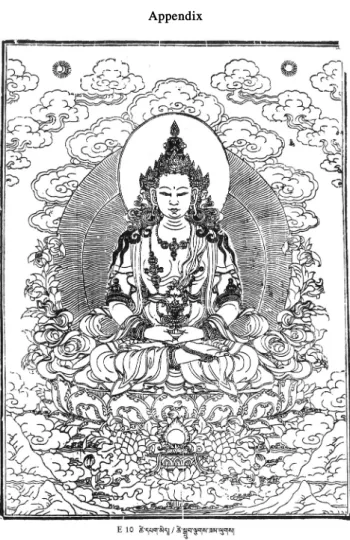
The long-life vase (3z) to be conferred with CP designates the guru () as Amitāyus (3,) to hold the vessel (z).51
CP 192,2: The guru clearly manifests [himself] as Amitāyus. Into the [long-life]
vase in [his] hands, [the degeneracy] would be trapped ((), [and then it (the degeneracy)] would metamorphose to the nectar of immortality (#+,7+
e+).52
As I will argue below (Section 2-1-3.), CP, the longevity practice, is performed by powerful Buddhist and Bon priests (.d.,n() for people whose life expectancy (3.) has been reduced (x.) by negative obstacles. In performing the CP, these priests are able to remove the obstacles by capturing them (l() in rays of light (CP 192,1f).
2-1-2. “Iron-Life Channel (X(7+.)”
The term “life channel (.)” refers literally to the initiand's heart centre, and is also visually represented as such (Millard, 2007: 266). Following the “iron- lotus petals (X(7+§#)” described above, this belongs to the Inner Sādhana of the Iron-Stalk (2; #4). The term is said to be “iron-life channel
50The image is made to appear like this very condition of emptiness in the following way
according to G (G_4 49,12): #+k..&¤N,.f.#2(7+(N
#.##J..(>.%"+( ([Thang-stong looked up to the sky, where he] saw the Great [Teacher of] U iyāna on a lotus pedestal, adorned with forbidding garments, and surrounded by many spiritual heroes and ākinīs.)
51Cf. the figure of “3, 3SX("(”, see Appendix, Fig. 1 from Dagyab (1991: 89) by courtesy of the author, H. H. Dagyab Rinpoche (}$
@(..j',(%%+.,). The artwork provides us with many images of the derivatives of the word “iron”, e.g. “Eisenbehälter mit verschiedenen Krankheiten gefüllt (X(q%o5(7+ (7+() )” see Dagyab (1991: 204).
52CP 192,2:3,e(&#+w+z#+e(#+,7+e+%
I%
(X(7+.)” whose basic character entails the antrum of a live bamboo cylinder (_.).
CD_1 522,2; CD_2 252,6: [The practitioner must] keep visualising from the crown of [his/her] head (s+.#2) to [his/her] secret place (((), an iron-life channel (X(7+.) resembling an upright pillar of bamboo (_.). The bright light of the emptiness prevails inside [the iron-life channel], they are very refined five-coloured lights gleaming. Imagine a conch- shell coloured letter of mantra as a dew-drop outside of the life channel.
From Blissful Pure Land (, Sukhāvatī), invite Jñānasattva ($,',((,(), who resembles oneself (%#f) above in the sky. The longevity nectar (3W) exudes out of the [long-life] vase, [and then] flows into your (the practitioner's) Aperture of Brahma ((zbrahmarandhra).
[Thereby the contemplative (i.e. initiand)] becomes one with the deity who bestowed the initiation (?%¢). From [the longevity] nectar [both of]
the deity and [practitioner's] life channel (.), luminous light brightens and fulfills itself.53
The term “iron-life channel (X(7+.)” is used here to denote ‘the central “psychic-nerve (nā ī)”’ (Kvaerne, 2005: 187).54We are told that it is situated at the heart centre of the practitioner's body.55 Dasgupta starts his
53CD_1 522,2; CD_2 252,6: s+.#2(((% X(7+._.
[_.⟧2;.1] [⟧2;(1]bz%(
[⟧1;+2]c.#.(&¥([¥(⟧2;1].U%(&#.",%#%
.#+w+[⟧2;1]V(7+#~ e."+&bz%( ,(
$,',((,( %#fsf(#&( z#+(3W + ([(⟧2;1]ze( ?%¢{,%,I% ¢.
#+ [#+⟧ 2; 1] e+&(#.#x.((%(j
54For cf. MVy#3991:śirā; 脈; Dharmachakra (2006: 223; 225): channel/energetic channels. While as forz(TD 2212), Dharmachakra (2006: 172) provided us a more specific definition and perspective: ‘The central channel is the main energetic channel in the body, running vertically through its center. Its upper end is located at the cranial aperture on the crown of the head, while its lower end is found in the secret place (the perineum)’.
55I have taken this rendering from Millard (2007: 266): ‘the ‘life channel’ (srog rtsa)
analysis of the plexus (thecakra/the lotus) system with the spinal cord, ‘widely known as theMeruda a, which is taken to be one bone from the bottom of the back up to the medulla oblongata’ (Dasgupta, 1958: 146).56Dasgupta then goes ahead to analyse the nerves with “avadhūtī («+)” (cf. Jäschke 208: e+
aorta?),57‘through which flows the Bodhicitta, and thisAvadhūtikāleads to the Sahaja-bliss’ (Dasgupta, 1958: 155).
It is held “stalk (k.da a)” and “life channel (.)” are connected by means of an intermediary substance, which is supposed to be the connection between the bright wisdom mind itself (i.e. Amitābha) and the practitioner/
initiand. Iron (X() helps the function of making the “stalk/life channel”
robust. Accordingly, we might compare this notion with a corresponding reference to “firmness” in relation to iron in Thang-stong's hagiography.58
Meanwhile, outside of the life channel, a conch-shell coloured syllable of mantra(V(7+#~), which corresponds to “hrī (µ+)”,59 is gleaming like a
situated at the heart centre, is the location of the most important of the five winds in connection with Tibetan psychiatry, the ‘life holding wind’ (srog ’dzin rlung)’.
According to the body part, see also TD 2989 (.): (1).(7+a,eI%#+
(2) #.%#+(7+%I%+.#2{,7+
56TheMeruda ais to be referred toŚrīsampu ikā, ‘where it has been said that in the form of the skeleton-bone the great mountain Sumeru remains in the body’ (Dasgupta, 1958: 147).
57As foravadhūtī, see BHSGD 72: ‘an artery, vein, or canal (nā ī) in the body’. Jäschke (208) mentions . under the heading of `. that ‘in the more developed mysticism the power which meditating saints by dint of long continued practice may acquire of holding back their breath for a great length of time, by which means the air is supposed to be drawn from the%.and=(two veins, v. [i.e. see]) into the z(. e+aorta? [sic]) thus causing a feeling of uncommon warmth, comfort, and lightness inside, and finally even emancipating the body from the laws of gravity, so as to lift it up and hold it freely suspended in the air’ (Here, Tibetan citations have been provided in emended z).
58G_4 315,2: e(e#.N(?#+eX((. +$.
([When the merchants] shot [Thang-stong] many poisonous arrows from [his] front, then [his] front side of body turned to iron and [he] was not injured at all.)
dew-drop ("+&). The seed-syllable “hrī ” means more than the seal of Amitābha. In this regard, Govinda (1983: 230) explains that ‘in the HRĪ we dedicate the totality of our transformed personality (which thus has become the Vajrakāya) to the service of Amitābha’.
The practitioner/initiand invites (sf() Jñānasattva ($,',((,(
[#]). One of the threesattvas set forth in development stage practice ((,(
#,(),60Jñānasattva is ‘visualized in the heart center of the samaya being ... It can involve visualizing a form that resembles the samaya being, ... yet it can also entail meditating on a deity with a form, color, face, and arms that are different than the samaya being, or meditating on a symbolic implement that arises from the seed syllable’ (Dharmachakra, 2006: 219).
For Jñānasattva in this CD, I am following the argument developed by Dharmachakra in assuming that Jñānasattva is indeed visualised as it is similar to oneself (%#f) above in the sky. The wisdom ($,',( jñāna) being ((,(
#sattva) is the deity in its heart centre, thereby the contemplative/initiand becomes one ({,%, abheda) with the deity who bestowed the initiation
(?%¢).
2-1-3. “Iron-Hook (X(8)”
The phrase “iron-hook X(8)” follows the above-mentioned “life channel (.)” located in the same chapter (2; #4).
CD_1 523,1; CD_2 253,4: [From] deep meditative absorption in mantra, luminous rays in the shape of an iron-hook (X(8) [illuminate] all the world
59CD_1 533,1; CD_2 256,2 (#4, see fn. 12):Sµ+[Sµ+⟧2;$(µ+1]
+((. Regarding the seed-syllable “hrī ”, see Govinda (1983: 183f);
Dharmachakra (2006: 112).
60(1) Samaya-sattva (2(,(#); (2) Jñāna-° ($,',(-°); (3) Samādhi-° (+
#2-°), cf. TD 2944:¢@,#+&!+c, 2(,(#¸ $,',((,(
#¸ +#2(,(#(+%e@,#. DTC 2085: 2 (,(# d( %+§#+&$,',((,(#N, ,#+d( %+,
#2(,(#h.[,&(.(w#2&(.$+,(#.
as a vessel and the sentient beings as its content (o.W). [Subsequently,]
compassionate grace (d([,#+{+() of the Buddhas and Bodhisattvas, [the fundamental quality of luminous rays,] would be condensed (l() into [the above-mentioned mantra, i.e.] “... siddhi ((+¬+)”.61
The “iron hook (cf. MVy#4284: h.[,X(8vajra-a kuśī;金 剛 鐵 鉤; 金 剛 鉤)”, too, is significant. It alludes to a tool that illuminates the entire bhājana/sattva-loka (o.W container and its contents).62 Although the luminous rays have a form similar to the robust iron-hook (EWA Bd. 1, p. 47:
a kuśa√añc), the fundamental quality is said to be the compassionate grace of the Buddhas and Bodhisattvas. By deep meditative absorption in mantra, the grace ({+() subsequently would be condensed (l() into the above- mentioned mantra (V( i.e. CD_1 522,5f; CD_2 253,3f: *4¶0 ´1 ...
(+¬+¶0®1) itself.
Hence, through the precept, the practitioner is introduced to a broad Mahāyānic philosophical perspective, which directs attention to the whole receptacle world. According to the CP, the “X((iron)” denotes the robust firmness that primarily relates to the circular mountain range of iron (.%
X(7+%+.*cakravā a) that encircles the universal base (#.!+), according to Buddhist cosmology (Gethin, 1998: 114−119).
CP 192,3: Furthermore ($), the emanating light rays would strike all the realms of cognitive experience ((( sarvadhātu) of the four elements.
[Among the four elements,] the earth element is defined as “all beings hard and solid”. [For instance,]
[1] the universal base (#.!+) of gold wheel ((,%H+(!+ *kāñcana- cakra),
61CD_1 523,1; CD_2 253,4:+#2V(7+#.",%+ X(8bz(o.W
[⟧ 2; 1] ((N({Y(,(#$+ d([,#+{+( [(⟧ 2;
( 1] (+¬+ [(+¬+⟧ 1; (++ 2] l(
62Foro.Wsee TD 1601: (1) w+o.7+#+a,W7+(,((2)o.
s,#+eO#+.(%+(
[2] the axis mundi of Sumeru (%+#+N&.%+%), [3] the seven golden mountains ((,%H+%+e) and
[4] the four continents (L+!+ *caturdvīpa) and the eight subcontinents (L+xN *aṣṭadvīpa)
which abide (() as far as the circular mountain range of iron (X(7+%+. *cakravāḍa) surrounds (.%).63
Empowerment lights emanating from Amitāyus (CP 191,6 ... 193,2) would strike (.) all the realms of cognitive experience of the four elements (#|
!+*catvāri mahābhūtāni). Among the four motifs (earth/wind/water/fire), the earth element (#|() is regarded as particularly significant. This element (( p thivī) is well defined as “all beings hard and solid (!+#(
ka hina)”, and has provided the world to abide as far as the circular mountain range of iron (X(7+%+. *cakravā a) surrounds (.%).64
In the same Mahāyāna hermeneutical theory under consideration here,
“X((iron)” can be defined not only by the quality “robust”, but also by the absolute value of the magnetic. Concerning this attribute, CP refers to “iron- filings (X(w,)” in terms of themantraandsamādhirelated to a ritual of the nectar of immortality (#+,7+e+).
CP 192,1: Owing to zealous conduct of material things,mantraandsamādhi [performed] by powerful Buddhist priests and Bon priests, things which reduce [your] life expectancy (3.) and so forth would be captured all at once ( 7+() by the rays of light. Just as (b%) a magnet captures iron-filings (X(w,) [all at once].65
63CP 192,3: $#.",%#x.(#|!+#+((&. #.!+(,%H+
(!+%+#+N&.%+% (,%H+%+e L+!+L+xN .%X(7+
%+.#2%(#+#|[#|⟧I192,4](#+W!+#((
64The rest of four motifs appears with each definition (CP 193,2: Wm() according to a precise order, see CP 191,6: #|(#+W !+#(192,5:
#|Y#+W!+',% 192,6: #|,#+W#%!+, 193,1:
#|+W$!+$.
According to the CP, we assume the powerful Buddhist priests and Bon priests (.d.,n() are able to capture (l() some of the causes that reduce (x.) our life expectancy (3.) by the zealous conduct (.%
*prayoga) of “material things (()”, “mantra(V()” and “samādhi (+,
#2)”. It is brought out by means of a metaphor. Suppose we compare the situation of a magnet (h.&,) capturing (l() iron-filings (X(w,).
Thus the assumption can be made according to the powerful Buddhist and Bon priests, an intriguing connection. In regard to this phrase, we may observe the practitioners have been primarily rNying-ma-pas and Bon-pos, because
‘these two groups had much overlap in their Treasure activity’ (Gyatso, 1996:
148). Cech (1993) has argued that the powerful Buddhist priests and Bon priests seem to share many features of their ritual environment. ‘The structure of the religious pantheon is the same and the iconographic portrayal of the deities very similar’ (Cech, 1993: 43). Nonetheless, the assumption of a connection between the Buddhist (Vajrayāna) and Bon rituals centred on this longevity practice deserves further study.66
Meanwhile, we find in Thang-stong's hagiography that he himself once provided an understanding of the “iron hook (X(8)” that takes up a more particularly Tantric worldview, as we will see shortly:
65CP 192,1:.d.,n(7+((V(+,#2H+.%&a,(3.
x.&(.(n( #.",%,(h.&,H+(X(w,l(b%7+(l(
66Bon-pos had adopted the policy of imitating Buddhism, especially rNying-ma School so that ‘the beliefs of systematized and adapted Bon are consequently identical with’
(Stein, 1972: 240–241) the school doctrines. Reconstruction of the Bon religion took place with the development of the rNying-ma School, ‘by the discovery of large numbers ofgter-matexts which provided a mechanism for the gradual transformation and reshaping of the Bon religion’ (Samuel, 1993: 322). The gross of important studies (mainly done by A. M. Blondeau in 1970-80’s) of an early example of the ‘cross- pollination’ between the Buddhist and Bon-po treasure traditions are provided in Gyatso (1996: 162n3).