during an English village course
journal or
publication title
The Journal of Kanda University of International Studies
number 30
page range 373‑396
year 2018‑03
URL http://id.nii.ac.jp/1092/00001487/
Learners’ experiences of language anxiety during an English village course
Samuel Morris
Abstract
This mixed methods study investigated language anxiety in 40 high school learners who attended a three-day intensive course at an English village in Japan. Data was obtained through written narratives, interviews, and a modified version of the Foreign Language Classroom Anxiety Scale (Horwitz, Horwitz and Cope, 1986), which was completed pre and post-course. The data revealed that participants’ anxiety levels decreased following their course, with the greatest drops observed in learners with no experience of international travel. Qualitative data revealed four sources of anxiety, the most significant of which was oral presentations. The implications of this study include a tentative endorsement of English villages, as well as practical suggestions to reduce anxiety during English village courses.
Keywords: learner anxiety, affect, English village, narrative frame
It was announced in late 2014 that a government funded English village (EV) would be opened in Tokyo, the latest development designed to foster increased cross-cultural communicative confidence in Japanese learners in advance of the 2020 Olympic games (Osaki, 2015). It is unclear whether Tokyo has been spurred by the large scale adoption of EV facilities in South Korea during the mid-2000s, yet critics may point to the failings of that system in their evaluation of the current proposition in Japan. Krashen (2006, p. 1) in a critical letter to the Taipei Times wrote simply that “we have no idea if (EVs) are really helping children acquire English skills”. Krashen’s arguments for the failing of the EV system were three fold: that EVs are prohibitively expensive, that their limited capacity means they are only able to provide for an insignificant percentage of the learning demographic, and that they have had no formal evaluation through empirical study. These are valid complaints, and given the proposed investment in Tokyo, reinforce the need for a focused and thorough investigation into the potential pedagogic merits of EVs for Japanese learners. The reality remains eleven years after Krashen’s letter that little empirical research has been conducted within the EV context.
There has been some suggestion that English villages may have a role to play in lowering anxiety (Trottier, 2006). Prompted by this claim, the study herein aims to open the dialogue on the affective impact of EVs on learners by considering two issues.
Firstly, by assessing whether a visit to an English village reduces the anxiety levels of
Japanese secondary school learners; and secondly, by unmasking the sources of anxiety
that exist at English villages for English learners.
Literature review
English villages
English villages are defined by their creation of a simulated environment, integrating aspects of western culture and language teaching. Generally they include western architecture and food, and a variety of shops, restaurants and hotel facilities that enable learners to immerse themselves in an English-only atmosphere (Seargeant, 2005). As a result, the purpose of English villages has been suggested to involve “students actually imagining themselves in the role of a fluent speaker in an ‘authentic’ environment”
(McKay, 2011, p. 129).
Over the last 20 years, English villages have become more widely utilised in Asia (e.g. Osaki, 2015; Trottier, 2006; Trottier, 2008). The Korean government have most eagerly adopted the facilities, funding a series of English villages throughout the country to act as a cost-effective alternative to overseas study (Krashen, 2006; Trottier, 2008). Although they continue to be developed, English villages are not all alike, and to date, no study has compared the nuances of different facilities (Morris & Lankshear, 2015).
Literature on English villages has frequently been negative, though not on their
pedagogic value, but on the supposed authenticity of the experiences offered (Krashen,
2006; Seargeant, 2005). That said, Trottier (2006) proposed that English villages may
have a role to play in lowering language anxiety, describing them as “an engaging
alternative source of English immersion which may ultimately increase learner motivation
by helping to break down learner anxiety about English” (p. 278). No studies to date have
however, investigated the impact that English village experiences may have on the
anxiety levels of language learners, reflecting a significant gap in the literature that this
study aims to fill.
Language anxiety
Language anxiety has been described as “quite possibly the affective factor that most pervasively obstructs the learning process” (Arnold & Brown, 1999, p. 8). Consistent with this remark, studies have shown that anxiety has a negative impact on grades and test performance (Aida, 1994; Horwitz, 1986; MacIntyre & Gardner, 1989; MacIntyre
& Gardner, 1994), self-confidence (Gardner & MacIntyre, 1993) and self-esteem (Horwitz, Horwitz, & Cope, 1986; Oxford, 1999) and language anxiety has been associated with negative feelings such as uneasiness (Arnold & Brown, 1999). It is also understood that since learners must communicate with limited linguistic codes, anxiety levels in foreign language classes are higher than in other subjects (Cutrone, 2009;
MacIntyre & Gardner, 1989).
Language anxiety is not a personality trait, but is a situation-specific problem that manifests uniquely during situations of foreign language use (Horwitz et al., 1986).
Horwitz, Horwitz and Cope (1986), described language anxiety as consisting of three distinct performance anxieties: communicative apprehension, which refers to the fear of communicating with people; test anxiety, which refers to the fear of failure in examinations of performance; and fear of negative evaluation, which is a broad and immediate anxiety referring to the fear of negative evaluation from peers. This is a comprehensive and influential model which has seen success in correlating learner anxiety negatively with classroom outcomes (e.g. Aida, 1994; Asano, 2003; Burden, 2004; Goshi, 2005; Horwitz et al., 1986; Matsuda & Gobel, 2004).
Comparative studies have shown the levels and symptoms of anxiety in Japanese and
non-Japanese learners to correlate. Keaten, Kelly and Pribyl (1997) found that the reported
levels of communication apprehension in 1446 Japanese elementary and secondary school
students were similar to American children, and that this apprehension increased steadily
with age. In addition, Williams and Andrade (2008) noted that the physical, emotional, and
verbal symptoms of anxiety in Japanese learners were similar to those found in studies of non-Japanese students: for example, 67% of students suffered from a faster heartbeat, and 42.35% of students claimed that their mind went blank when they were anxious.
Studies in the Japanese context have also supported the conclusion that anxiety is detrimental to language learning. Asano (2003), found a statistically significant link between anxiety and proficiency in 70 freshman university students. Similarly, Matsuda and Gobel (2004) reported that higher levels of language anxiety resulted in weaker class performance among 252 university students. Oya, Manalo and Greenwood (2004) uncovered a link between anxiety and spoken English: the authors tested 73 adult participants during a story-telling activity, and found that those students who experienced anxiety during the task were more likely to make grammatical mistakes. Goshi (2005) suggested that language anxiety was linked to negative feelings about language learning in Japanese university students. Finally a study by Andrade and Williams (2009) into 243 first and second year university students in Japan found that 11% of participants considered themselves “hindered” by anxiety (p. 12). These studies support the conclusion that language anxiety should be minimalised in the language classroom for Japanese learners of English.
Sources of language anxiety
Sources of anxiety are diverse (Oxford, 1999), but can generally be positioned into
situational variables and learner variables (Andrade & Williams, 2009). Situational
variables include such factors as classroom activities, the course level, language testing,
competition and instructor behaviour (Andrade & Williams, 2009; Oxford, 1999), while
learner variables include a learner’s age, ability, gender, beliefs about the target
language, self-esteem and learning style (Andrade & Williams, 2009). Since learners
attend English villages for only short periods, it is likely that situational variables will play a more salient role in learner anxiety during EV courses.
Of the many situational variables, speaking activities produce the most anxiety for language learners, particularly in Japan. In a study by Burden (2004), 59% of Japanese students claimed that they do not feel sure of themselves when they speak in English and 51.2% of participants claimed that they start to panic if they are called upon in class. Similarly, Williams and Andrade (2008), found that anxiety was most commonly associated with those tasks that involved speaking in front of others, such as having to deliver a self-introduction speech at the beginning of a course. One explanation for this speech anxiety in Japan may be the impact of competition. When learners compare themselves to better users of language they tend to have heightened anxiety (Oxford, 1999), and at least two studies have found that Japanese learners are particularly concerned that their peers are more proficient in using English (Andrade & Williams, 2009; Asano, 2003). Another explanation for this speech anxiety is what Cutrone (2009, p. 59) calls the “evaluation paradigm”: the culture of the Japanese school system primarily prepares learners for exams which may ultimately decide their future, and this immense pressure can make learners anxious about spoken mistakes. We can deduce that learners at an English village may well experience anxiety when speaking in and outside of the classroom, and particularly during oral presentations. Speaking forms a significant part of curriculums at English villages, and this suggests that sources of anxiety may be widespread.
Research questions
The literature review above suggests that there is a critical need to investigate the pedagogic viability of English villages, including their affective impact on learners.
Currently no research has been conducted to ascertain the impact that English villages
have on learners’ levels of language anxiety, nor have studies attempted to delineate the sources of anxiety at English villages, a course of action which will enable English villages to better support the affective dimensions of learning.
Consequently, the research questions for this study are as follows:
1. Is there a change in language anxiety levels in learners following a course at an English village in Japan?
2. What sources of anxiety exist at an English village in Japan?
Methodology
Participants
The participants were a single class of 40 students (35F, 5M, aged 15-16) at a national high school in Japan, who attended a course at an English village. The participating class were selected through convenience sampling since the learners were scheduled to attend the English village during the research period, and the English village had an established relationship with the chosen school, which afforded comprehensive access to the participants. Five participants were removed from data analysis due to absenteeism (3 students) and survey incompletion (2 students).
English village course
The participants attended a three day course at an English village in rural Japan. The architecture and landscaping of this particular English village are modelled on an authentic British town, complete with a replica manor house, a pub, several souvenir shops, a tea room, and guest houses. 50% of the staff working in these facilities were non-Japanese English L1 speakers, and transactions generally took place in English.
The participants stayed on site for the duration of their course.
During the course, the participants took ten classes conducted in English. The classes were primarily content based (cooking, drama, international culture etc.) or focused on oral presentations skills. The students gave a group presentation on the final day of the course for which significant preparatory work had been completed prior to the course at the participants’ own school. All teachers were English L1 speakers from a variety of countries, and the students had different teachers for each class.
Instruments, procedure and analysis Research question 1
Participants completed a modified version of the 33-item Foreign Language Classroom Anxiety Scale (FLCAS) (Horwitz et al., 1986) three weeks prior to their course at the English Village, and again six weeks post-course at the participants’ school. This scale was chosen for its previously recorded high internal validity scores (e.g. Aida, 1994;
Asano, 2003; Burden, 2004; Goshi, 2005; Horwitz et al., 1986; Matsuda & Gobel, 2004). A published translation of the original FLCAS was found in Nagahashi (2007) and reverse translated to check for accuracy. Modifications to three items were made by Asano (2003) to suit the Japanese context, and were also included in this study.
The FLCAS is a 5-point Likert scale self-report instrument with items focusing on anxiety-inducing elements of language learning. Examples of items include I keep thinking the other students are better at English than I am (item 7), and I get nervous when I don’t understand every word the English teacher says (item 29). The test provides an anxiety score between 33 and 165, with higher scores indicating greater language anxiety.
The Likert scale scores on the test were coded, with a score of 1 assigned to
“strongly disagree” and 5 to “strongly agree”. Nine negatively worded items were
reverse coded to adhere to the principal that a high score indicated high anxiety (items
2, 5, 8, 11, 14, 18, 22, 28, 32). The data was collated and analysed in SPSS. Cronbach alpha scores were calculated for the pre and post-test and found to be 0.91 and 0.93 respectively, indicating very high internal consistency reliability.
Research Question 2
To answer research question 2, narrative frames were employed, which have been promoted as an efficient way to collect a large amount of information (Barkhuizen &
Wette, 2008). Participants were asked to describe a single anxiety-inducing event they had experienced during their course at the English village. The frame consisted of a series of sentence starters and question prompts that lead participants to write a coherent narrative. The participants were asked to complete their narratives in English on the final day of their course, after their final class. 28 of the received narratives were considered to have been successfully completed, and were subsequently analysed.
In addition to the written narratives, three participants, who self-selected their involvement, were interviewed during their stay at the English village about the incidents of anxiety they had been experiencing. Each semi-structured interview was recorded and lasted approximately 30 minutes. The students’ data were recorded under pseudonyms.
The data obtained from both the narratives and the interviews were analysed iteratively through a content analysis. The data then served a “development function”
(Dornyei, 2007, p. 165): the results were used to create a post-course survey, which
assessed to what degree the experiences described in the qualitative data were
experienced by the sample group as a whole.
Results
Research question 1: Is there a change in language anxiety levels in learners following a course at an English village in Japan?
The mean FLCAS scores for all participants were found to be 93.9 on the pre-test and 86.5 on the post-test, a statistically significant drop of 7.4 points across the research period (p<0.01, two tailed test). The results also indicated that greater FLCAS score drops were observed for those students without previous overseas experience (8.8 points - p<0.01) than for those with previous experience (5.3 points - p>0.05, not statistically significant).
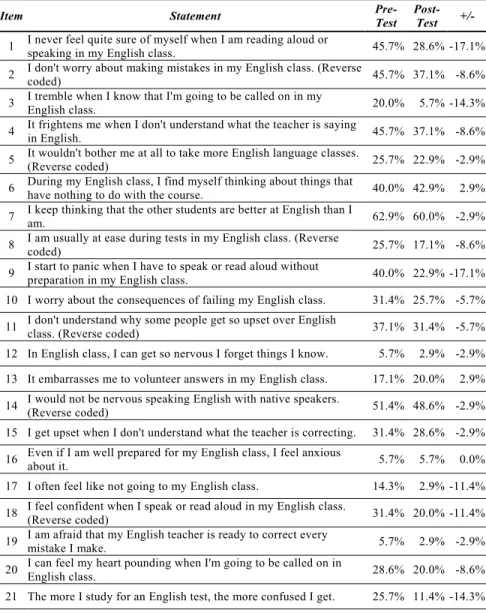
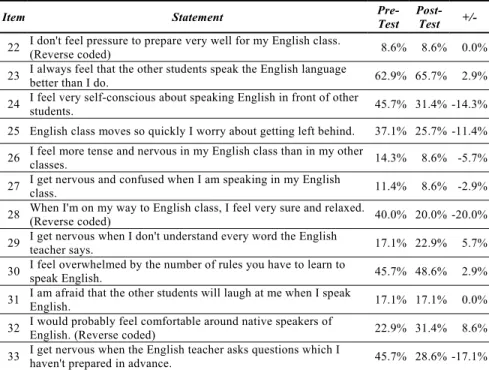
Table 1 shows the percentage of participants who chose to ‘agree’ or ‘strongly agree’ with a given item on the pre and post-tests. That is, the number of students who felt at least some anxiety for the given item. The items of highest agreement were items 7 “I keep thinking that the other students are better at English than I am” and 23 “I always feel that the other students speak the English language better than I do", which were positively agreed with by more than 60% of participants in both pre and post-tests.
While on the pre-test more than 40% of learners agreed with items that pertained to speaking and reading English in front of peers (item 1 “I never feel quite sure of myself when I am reading aloud or speaking in my English class”, item 9 “I start to panic when I have to speak or read aloud without preparation in my English class”, and item 24 “I feel very self conscious about speaking English in front of other students”), these three statements all saw decreases of more than 14% on the post-test.
That is, at least six of the students in the class no longer indicated that they felt anxious speaking in front of the class.
Research question 2: What sources of anxiety exist at an English village in Japan?
Oral presentations
By far the most prevalent source of anxiety uncovered from the narrative and interview data was the learners’ presentations on the final day of their course at the English village (21 of the 28 collected narratives). The most commonly cited reason for this anxiety was that participants were uncomfortable being observed when speaking in front of the class (11 of the 21 narratives):
“Today I presentation speech in front of A group. I’m very nervous because they look at me. So I don’t presentation well.” (Student 8)
“I remembered my presentation. But I forgot to my presentation when stood up in front of everyone.” (Student 40)
Learners were asked to memorise their speeches. The pressure of this task also led to student anxiety which may have affected their performance. The difficulty of memorising a speech was cited as the cause of anxiety in four of the 21 narratives relating to the presentations.
Another factor that appears to affect learners is their own perception of their
English speaking ability. Four of the learners cited this as the reason for their anxiety
when giving their presentation:
Table 1: The percentage of students who indicated agreement with a given FLCAS score item.
Item Statement Pre-
Test Post-
Test +/- 1 I never feel quite sure of myself when I am reading aloud or
speaking in my English class. 45.7% 28.6% -17.1%
2 I don't worry about making mistakes in my English class. (Reverse
coded) 45.7% 37.1% -8.6%
3 I tremble when I know that I'm going to be called on in my
English class. 20.0% 5.7% -14.3%
4 It frightens me when I don't understand what the teacher is saying
in English. 45.7% 37.1% -8.6%
5 It wouldn't bother me at all to take more English language classes.
(Reverse coded) 25.7% 22.9% -2.9%
6 During my English class, I find myself thinking about things that
have nothing to do with the course. 40.0% 42.9% 2.9%
7 I keep thinking that the other students are better at English than I
am. 62.9% 60.0% -2.9%
8 I am usually at ease during tests in my English class. (Reverse
coded) 25.7% 17.1% -8.6%
9 I start to panic when I have to speak or read aloud without
preparation in my English class. 40.0% 22.9% -17.1%
10 I worry about the consequences of failing my English class. 31.4% 25.7% -5.7%
11 I don't understand why some people get so upset over English
class. (Reverse coded) 37.1% 31.4% -5.7%
12 In English class, I can get so nervous I forget things I know. 5.7% 2.9% -2.9%
13 It embarrasses me to volunteer answers in my English class. 17.1% 20.0% 2.9%
14 I would not be nervous speaking English with native speakers.
(Reverse coded) 51.4% 48.6% -2.9%
15 I get upset when I don't understand what the teacher is correcting. 31.4% 28.6% -2.9%
16 Even if I am well prepared for my English class, I feel anxious
about it. 5.7% 5.7% 0.0%
17 I often feel like not going to my English class. 14.3% 2.9% -11.4%
18 I feel confident when I speak or read aloud in my English class.
(Reverse coded) 31.4% 20.0% -11.4%
19 I am afraid that my English teacher is ready to correct every
mistake I make. 5.7% 2.9% -2.9%
20 I can feel my heart pounding when I'm going to be called on in
English class. 28.6% 20.0% -8.6%
21 The more I study for an English test, the more confused I get. 25.7% 11.4% -14.3%
Item Statement Pre- Test
Post- Test +/- 22 I don't feel pressure to prepare very well for my English class.
(Reverse coded) 8.6% 8.6% 0.0%
23 I always feel that the other students speak the English language
better than I do. 62.9% 65.7% 2.9%
24 I feel very self-conscious about speaking English in front of other
students. 45.7% 31.4% -14.3%
25 English class moves so quickly I worry about getting left behind. 37.1% 25.7% -11.4%
26 I feel more tense and nervous in my English class than in my other
classes. 14.3% 8.6% -5.7%
27 I get nervous and confused when I am speaking in my English
class. 11.4% 8.6% -2.9%
28 When I'm on my way to English class, I feel very sure and relaxed.
(Reverse coded) 40.0% 20.0% -20.0%
29 I get nervous when I don't understand every word the English
teacher says. 17.1% 22.9% 5.7%
30 I feel overwhelmed by the number of rules you have to learn to
speak English. 45.7% 48.6% 2.9%
31 I am afraid that the other students will laugh at me when I speak
English. 17.1% 17.1% 0.0%
32 I would probably feel comfortable around native speakers of
English. (Reverse coded) 22.9% 31.4% 8.6%
33 I get nervous when the English teacher asks questions which I
haven't prepared in advance. 45.7% 28.6% -17.1%