( 29 )
Child-friendly grammar teaching in a Japanese elementary school English class
Stan Pederson
(Received September 30, 2020)
This study analyzed grammar teaching in an English lesson delivered to a fifth-grade class in a Japanese elementary school on the topic of number and plural forms. It found that the teacher dealt with this difficult topic by: limiting the material under consideration, by carefully directing student focus through enhanced input and through reference to written forms, and by carefully controlled questioning and confirmation. The lesson was made understandable by using the iconic mode of representation based on examples and patterns, not rules. Controlled practice was used to consolidate learning. Finally, error correction was mostly limited to content, not form, in conformity with the course of study guidelines’ emphasis on developing knowledge and skills to the extent of familiarity and its emphasis on communication.
Key words : Young learners, EFL, grammar, scaffolding
Some years back I was chatting with a principal after having observed an English lesson at elementary school when I commented on how grammar was taught in the lesson. She had not observed the lesson and was rather surprised at my comment saying “We donʼt teach grammar at elementary school.” In a sense, she was correct. Most people think of grammar teaching as explaining specialized terms and constructing sentences using formal rules, which is rightfully frowned upon is primary school teaching. However, if we consider grammar to be the system connecting form to meaning and function, and that learners are actively constructing, testing, and updating their own system of patterns and rules whenever they encounter English, we are always teaching grammar whether we intend to or not.
Our approach may be indirect. We may use classroom English for management, yet students are making connections between form and meaning. Our approach may be implicit, where we make an example of several sentences differing in only one word, thus setting up a paradigm through exemplars for the students to work out rules on their own.
Or, we may go one step further and ask students to look at the examples and to express their thoughts aloud as part of DFODVVHIIRUWWRLGHQWLI\SDWWHUQV$WWKLVSRLQWZHPD\FRQ¿UPWKH“right” solution (explicit teaching) or we may leave the discussion as a work-in-progress with students holding a variety of ideas, or hypotheses, which become the basis for further thinking and testing as they encounter more data through using the language.
Whichever approach is adopted, it should be consciously chosen according to curriculum directives at the national and local level, the nature of the students in terms of cognitive development, and the nature of the language target being addressed.
This paper will deal with a lesson, which introduces the topic of plurals in English. It is analyzed from the SHUVSHFWLYHRIJUDPPDUWHDFKLQJ7KHOHVVRQLVWDXJKWE\RQHPDOH-DSDQHVHHOHPHQWDU\VFKRROWHDFKHUWRKLVRZQ¿IWK grade class.
Literature review
When one reads the literature on grammar teaching, the goals are seldom addressed by authors. The goal is generally XQGHUVWRRGWREHODQJXDJHSUR¿FLHQF\ZLWKHLWKHUDQHPSKDVLVRQDFFXUDF\RURQÀXHQF\7KDWʼs fair enough from a VWULFW6/$SHUVSHFWLYHEXWLQSULPDU\HGXFDWLRQHGXFDWLRQDODLPVUDQJHPRUHEURDGO\DQGWKH\LQÀXHQFHWKHFKRLFHV we make in teaching methods. In Japan the course of study for elementary schools mandates three broad aims to be pursued in all subjects: knowledge and skills, thinking and judgment and attitude and approach to learning. Furthermore, the goals specific to English instruction emphasize speaking and listening over reading and writing and developing familiarity with English sounds and sentence structures over explicit knowledge. In addition, students are to learn
through experience and to develop a positive and active attitude toward further learning (Ministry of Education,
&XOWXUH6SRUWV6FLHQFHDQG7HFKQRORJ\>+HUHDIWHU0(;7@6XFKVSHFL¿FJXLGHOLQHVGRPXFKWRLQIRUPWHDFKHUV about their choices in how to approach grammar.
Teaching Grammar to Young Learners
Form, use (function) and meaning work together to shape oneʼs understanding of grammar. A deficit in one of these areas can be compensated for by knowledge in the other two areas to come up with new propositions about how grammar is constructed (Celce-Murcia & Larsen-Freeman, 1999). According to Skehan (1998) learners need to connect form and function, that is, input must be connected to meaning, and meaning reveals how the words function grammatically.
The starting point for children, according to Pinter (2006) is to participate in meaningful communication. This is best done through the use of unanalyzed chunks. She gives the example of children learning “See you tomorrow”
from the teacherʼVZRUGVDWWKHHQGRIFODVV7KH\PD\¿JXUHRXWWKHURXJKPHDQLQJIURPWKHFRQWH[WEXWWKH\ZLOOQRW know the three words that make up the chunk or what each of them means. Nevertheless, they have established a form- function connection from which they may begin their exploration of meaning. The process will continue in the future as they break the chunk “Seeyoutomorrow”LQWRWKUHHZRUGV7KLVIXUWKHUFODUL¿FDWLRQLQIRUPZLOOOHDGWRQHZLQVLJKWVLQWR meaning, and so on.
Elementary school English classes with their emphasis on learning through experience share much in common with CLT approaches. In the weak version of CLT. activities for communication are based on pre-selected forms and functions. In the strong version of CLT, learnersʼ use of the target language creates opportunities for noticing formal features of language in use (Richards & Rogers, 2001) . In Japanese elementary schools, the course content is clearly set ZLWKVSHFL¿FWDUJHWVIRUVWXG\&/7VWURQJYHUVLRQDQGDVVKRZQLQ3HGHUVRQPDQ\RSSRUWXQLWLHVIRULQFLGHQWDO learning emerge through natural classroom interaction in the process of teaching and management (CLT, weak version).
The messy process by which children enter the three-way puzzle at various points and bootstrap themselves to a more accurate interlanguage requires teachers to adopt an approach based on close observation of teaching and learning and real time reactions and adjustments, in other words, scaffolding (Wood, 1998) is key.
Approaches to teaching grammar are organized by Celce-Murcia (2015) into explicit and implicit streams. The explicit stream is divided between inductive and deductive approaches. Deductive approaches, in particular, present challenges to teaching in elementary school since the understanding and application of abstract rules of logic is a late- stage development and not appropriate to most elementary students.
It should be noted, however, that abstract logical rules is not the only level at which grammar can be taught and understood. Bruner (1960) long ago recognized that the key concepts of any subject can be conveyed to schoolchildren of any age if those concepts are presented in a way for which the child is developmentally ready. Children move from enactive to iconic, and finally, to symbolic representation (Bruner, 1966) any of which can be used to convey fundamental concepts. Thus, the teacher may use a deductive and explicit approach without venturing into symbol- mediated rules.
Ellis (2005) has more detail to offer on both explicit and implicit approaches. Within implicit teaching, he notes a useful distinction between those approaches using enhanced versus non-enhanced input. Input may be advanced by, for example, bold lettering in a text, or slow, clear enunciation to highlight a target form in speech.
After choosing between explicit and implicit approaches, a teacher also needs to decide on the form of practice. Is it to be based on structure as such, that is, carefully delimited controlled practice; or whether it is to be based on using the structure within the context of communication, that is, functional practice. In other words, the form of practice will depend on the teacherʼVFKRLFHEHWZHHQDFFXUDF\DQGÀXHQF\
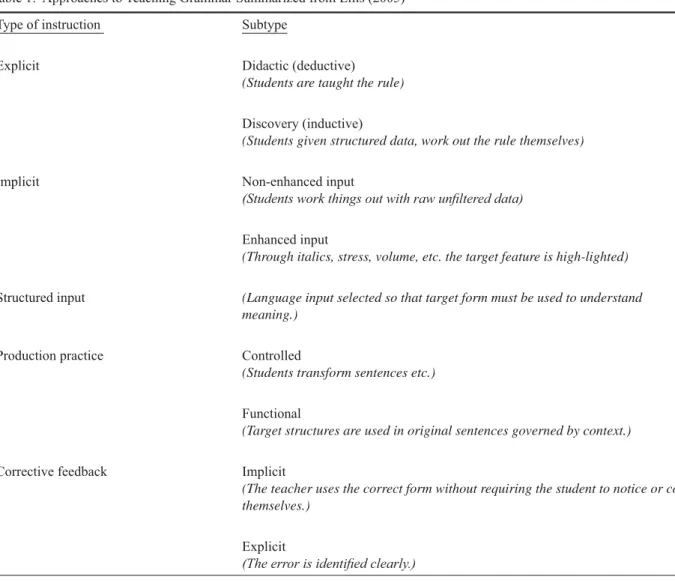
,QWKHFDVHRIÀXHQF\DFWLYLWLHVFRUUHFWLYHIHHGEDFNZRXOGEHDSSURSULDWHZKHUHWKHPHVVDJHLWVHOIIDLOVWRJHW across, thus harming success in communication, whereas an activity promoting accuracy would elicit corrections on IRUP&KRLFHVPLJKWDOVREHPDGHEDVHGRQDIIHFWLYHIDFWRUV'HSHQGLQJRQWKHDJHDQGFRQ¿GHQFHRIVWXGHQWVWHDFKHUV may choose to correct or not, or to correct explicitly or not. Finally, teachers may choose a form of correction based on whether they believe it will have an impact on learning. Ellis (2005)ʼs scheme is summarized in Table 1.
Table 1: Approaches to Teaching Grammar Summarized from Ellis (2005)
Type of instruction Subtype
Explicit Didactic (deductive)
(Students are taught the rule)
Discovery (inductive)
(Students given structured data, work out the rule themselves)
Implicit Non-enhanced input
6WXGHQWVZRUNWKLQJVRXWZLWKUDZXQ¿OWHUHGGDWD
Enhanced input
(Through italics, stress, volume, etc. the target feature is high-lighted)
Structured input (Language input selected so that target form must be used to understand meaning.)
Production practice Controlled
(Students transform sentences etc.)
Functional
(Target structures are used in original sentences governed by context.)
Corrective feedback Implicit
(The teacher uses the correct form without requiring the student to notice or correct themselves.)
Explicit
7KHHUURULVLGHQWL¿HGFOHDUO\
Finally, choices about how to teach grammar will depend on the nature of the target structure or feature. While some linguistic features may present patterns easily recognized by students with little or no assistance, other features of the second language may be invisible without careful structuring of the lesson and explicit guidance from the teacher to induce “noticing” (Schmidt, 1990). Such features include the third person “s” feature of English verbs, a feature with no equivalent in Japanese and with no effect on meaning. Another such feature is the system for pluralizing nouns. This again has no direct equivalent in Japanese. Furthermore, the three different endings /s/, /z/ and /Iz/ and the distinction EHWZHHQFRXQWDEOHDQGXQFRXQWDEOHQRXQVPDNHVLWPXFKPRUHGLI¿FXOWIRUWKHVWXGHQWWRSHUFHLYHSDWWHUQDQGRUJDQL]H information on their own.
Method
The lesson under consideration was videotaped at a large urban school in western Japan. It was fully transcribed by D-DSDQHVH(QJOLVKELOLQJXDODQDWLYHVSHDNHURIWKHORFDO-DSDQHVHGLDOHFW7KHWUDQVFULSWLRQVZHUHFRQ¿UPHGE\WKLV researcher an English/Japanese bilingual. Gestures, pictures and other elements relevant to the communication between the teacher and students were included in the transcription. Each message was coded for: target and source, medium, moves and additional categories as needed. The lesson was not specially recorded for the purposes of this study but was selected from a larger corpus for its clear emphasis on grammatical matters.
The lesson was based on Unit 3 of the prescribed textbook, Letʼs Try 1 (Ministry of Education, Culture, Sports, Science and Technology, 2018), which covers numbers 1-20, plurals, and the question, How many ____s? The instructor is a male, mid-career elementary school teacher with a good knowledge of English.
This paper analyzes the lesson from the perspective of grammar teaching with particular reference to the literature cited above. Data and analysis is mostly presented together for ease of understanding, with a summary and additional comments presented in the discussion.
Results
The main part of the lesson is preceded by a short section on how to answer the question: How are you? This paper treats the main part of the lesson with the content of numbers, plurals and asking and answering questions about how many objects there are. The goal and target sentences have been written on the blackboard and remain present throughout the lesson. An electronic blackboard is at the ready with the dayʼs audio-visual material.
7KHWHDFKHU7$KHUHDIWHU¿UVWVHHVWKDWWKHYRFDEXODU\QHHGHGIRUWKHOHVVRQLVNQRZQDQGUHLQIRUFHG7KLVDVVXUHV that students do not have to use processing capacity recalling new words at the same time as working with the target structures.
He reviews words in the singular form. This base form is the foundation students need in order to recognize that the marked, plural form requires a different sound at the end. See Table 2. Note that TA is asking the question and FRQ¿UPLQJWKHDQVZHUQRQYHUEDOO\KHLVDVVHVVLQJNQRZOHGJHRIYRFDEXODU\QRWLQWURGXFLQJLW
Table 2: Revising Content
Message Source/target Move
(Points at an apple on the screen) TA*, SC SOL
Apple SS, TA RES
(Nods) TA, SC REA
*TA=Teacher A, SC=whole class, SS=a group of students, SOL=solicit, RES=response, REA= reaction
Next, TA points to the picture on the monitor and asks “How many apples?” He speaks the words slowly and clearly including the /z/ sound at the end of apples. After getting an answer from the students, he counts together with WKHFODVVKHFRQ¿UPVWKHDQVZHUWREHFRUUHFWDQGRQFHDJDLQXVHVWKH]VRXQGZKHQKHVD\V“Twelve apples.” The students have had a chance to pick up the sound on their own now. His slow delivery and careful pronunciation of the
¿QDO]VRXQGFRQVWLWXWHHQKDQFHGLQSXW6WXGHQWVKDYHDOVRKDGDFKDQFHWRH[SHULHQFHWKHWDUJHWVWUXFWXUHLQXVHDQGWR fashion a global idea of its meaning. At this point, they have not been taught anything clearly and explicitly about form or meaning.
TA now refers the students to the goal he has written on the board, which they read aloud together. He might have LQWURGXFHGWKHJRDODWWKHVWDUWEXWWKLVZRXOGKDYHGHSULYHGWKHVWXGHQWVRIWKHRSSRUWXQLW\RI¿QGLQJWKHPHDQLQJVDQG SDWWHUQVLQWKHQHZODQJXDJHVDPSOH7KHJRDOVJLYHVWXGHQWVDFOHDUVWDWHPHQWDERXWJOREDOPHDQLQJFRQ¿UPLQJZKDW WKH\KDYHOHDUQHG¿UVWWKURXJKODQJXDJHLQXVH
[Ask and answer questions about number]*
“How many ____s?”
____s
*For purposes of space and readability, Japanese messages are translated and presented in square brackets. All translations are those of the author.
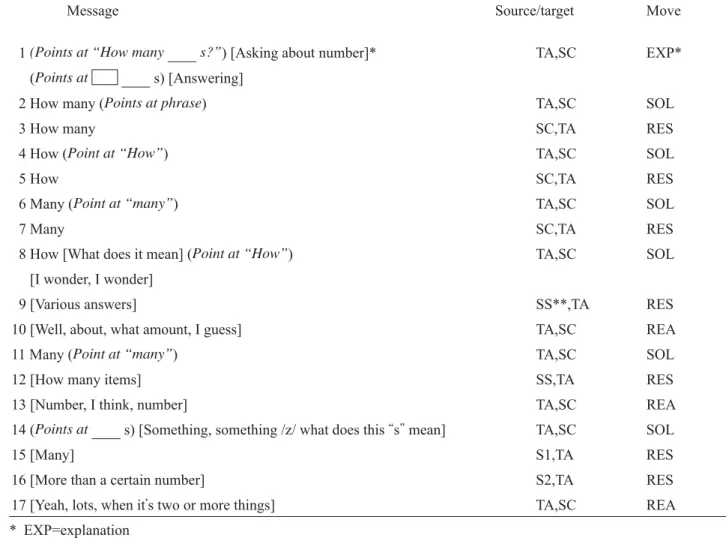
TA then narrows the focus. See Table 3. In message one, he orients the students to the global meaning of each written phrase. In messages two through seven he connects individual spoken words to their written form. The chunks are broken down to the word level and spoken words are anchored to their written form. After form is established, he moves to the studentsʼ guesses about meaning in messages eight to 13. However, he confirms the meaning without
resorting to a one-word direct translation, keeping the studentsʼ curiosity in play.
Now that he has established a foundation of form (spoken and written) and linked it to meaning, he moves into the deeper waters of morphology. While pointing at the “s” he asks “[Something, something /z/ what does this “s” mean]”
LQPHVVDJH2QFHDJDLQKHDVNVWKHVWXGHQWVWRWKLQNEXWWKLVWLPHKHJLYHVDFOHDUFRQ¿UPDWLRQRIWKHULJKWDQVZHU He begins with the /z/ sound, what the children heard, then refers to the written form “s”. The written form makes the feature salient and allows the teacher to focus studentsʼ attention on this small feature.
Table 3: Introducing Content Explicitly
Message Source/target Move
1 (Points at “How many s?”) [Asking about number]* TA,SC EXP*
(Points at s) [Answering]
2 How many (Points at phrase) TA,SC SOL
3 How many SC,TA RES
4 How (Point at “How”) TA,SC SOL
5 How SC,TA RES
6 Many (Point at “many”) TA,SC SOL
7 Many SC,TA RES
8 How [What does it mean] (Point at “How”) TA,SC SOL
[I wonder, I wonder]
9 [Various answers] SS**,TA RES
10 [Well, about, what amount, I guess] TA,SC REA
11 Many (Point at “many”) TA,SC SOL
12 [How many items] SS,TA RES
13 [Number, I think, number] TA,SC REA
14 (Points at s) [Something, something /z/ what does this “s” mean] TA,SC SOL
15 [Many] S1,TA RES
16 [More than a certain number] S2,TA RES
17 [Yeah, lots, when itʼs two or more things] TA,SC REA
* EXP=explanation
**SS=a number of students, S1=student 1
The next step is having the children apply the rule (production practice) and to apply it consistently with selected language (controlled practice). See Table 4.
Table 4: Production Practice
Message Source/target Move
1 [Okay, so when the teacher says one (item) TA,SC EXP
(UDLVHVIRUH¿QJHU) add an s, /z/ please. Alright]
2 Apple TA,SC SOL
3 Apple/zu/ SC,TA RES
4 Melon TA,SC SOL
5 Melon/zu/ SC,TA RES
6 Banana TA,SC SOL
7 Banana/zu/*(laughter) SC,TA RES
8 Baseball TA,SC SOL
9 /zu/ S1,TA RES
Baseball/zu/ (laughter) SC,TA RES
10 (Smiling, shakes hand loosely at the class) [You TA,SC REA
don’t have to put so much stress on /z/ Let’s say it naturally]
. . . **
11 Cat TA,SC SOL
12 Cat/s/ SS1,TA RES
Cat/zu/ SS2,TA RES
13 (Hesitates, looks down at word on electronic blackboard, TA,SC REA taps it with his pen0PFDWV>7KDW¶VGLI¿FXOW@FDWV
* Bold type indicates increased volume and emphasis.
**Similar exchanges have been cut for space.
:KLOHWKHH[DJJHUDWHGHPSKDVLVRQWKH¿QDO]VRXQGVKRZVWKHVWXGHQWVKDYLQJDELWRIPLVFKLHI7$FOHDUO\WDNHV it that way as he scolds them later for it), it also shows that they understand exactly what they have been taught. The enhanced input has resulted in uptake.
They are incorrectly pronouncing /z/ as /zu/ since the Japanese language generally uses consonants together with a vowel. This presents the teacher with a choice about error correction. TA chooses to give the proper pronunciation in his own speech (implicit correction), and allows it to pass without further remark.
He is also, perhaps, honoring the principle of teaching one thing at a time. This interpretation is backed up by his reaction to the complication of the terminal /s/ sound in cats. In message 13, his hesitation shows his surprise at the VXGGHQFKDQJHLQWKH¿QDOVRXQG:KLOHDGGLQJRQHH[FHSWLRQLQRUGHUWRSURYLGHFRQWUDVWVWLPXOXVGLVFULPLQDWLRQLVD time-honored teaching practice, it appears to be outside his plan. He glosses over the exception and continues without introducing the exception to students.
Having assured that his students understand the meaning and the pattern, he wastes no time in recycling this knowledge back into controlled production. He instructs the students to work in pairs, one asking How many ___s? and the other answering according to the pictures in their text book. Students record their answers as they go. He circulates DPRQJWKHVWXGHQWVWRDVVHVVDQGDVVLVWDQ\RQHKDYLQJGLI¿FXOW\
When pairs have finished their work, they go over the answers together. Each answer is checked by playing the digital recording and repeated by the teacher. TA processes student answers only for content, not form. He has PRYHGIURPDQHPSKDVLVRQDFFXUDF\LQIRUPWRDQHPSKDVLVRQÀXHQF\7KH\DUHQRZXVLQJ(QJOLVKQRWVWXG\LQJLW 7KHDQVZHUVDUHRIFRXUVHVLPSOHDQGWKH\ZLOODOZD\VEHULJKW+H¿QLVKHVZLWKSHUIRUPLQJFKDQWVXVLQJWKHWDUJHW sentences.
Table 5: How Grammar Was Taught
Procedure Approach
1 Revise key words in singular form. Create base with examples of unmarked form.
2a Introduce target sentences / target Implicit, enhanced input. Teach morphology slowly and clearly. unanalyzed chunk of language.
2b* Uses target structures in exchanges Implicit, show meaning through use.
with students.
3 State goal as what students can do Explicit, establish function.
with the structure.
4a Ask students to guess meaning of Explicit, inductive.
each word
4b Connect spoken and written form. Anchor speech to writing. Analyze chunk into parts.
5 Point out terminal “s” /z/ and ask Explicit, inductive.
about meaning.
6 Students apply the pattern to selected Production practice, controlled.
samples of language: whole class, pairs.
7a Ask for student answers regarding Focus on meaning.
content only.
7b Right answers repeated with correct Reinforce correct input.
form by teacher and AV materials.
8 Chant using target structures. Production practice, controlled.
9 Ask students about well-known content Informal assessment without reference
and enjoyment to knowledge of target structure and grammar.
*Letters a and b are used when procedures occur at the same time.
7KH¿QDOVWHSRIWKHFODVVLVWRFRQGXFWDVLPSOHDVVHVVPHQW7KHWHDFKHUDSRORJL]HVIRUQRWKDYLQJWLPHWRXVH reflection sheets, and instead poses questions with students raising their hands. He asks if they can express their FRQGLWLRQ+RZGR\RXIHHO"DWRSLFWKDWRFFXSLHGWKH¿UVWSDUWRIWKHOHVVRQ+HDVNVLIWKH\FDQFRXQWIURPRQHWR +HDVNVLIWKH\ZHUHDEOHWRJUHHWWKHLUIULHQGVKHDUWLO\$QG¿QDOO\KHDVNVZKHWKHUWKH\ZHUHDEOHWRHQMR\WKHFODVV 7KHVSHFL¿FJRDOVRIEHLQJDEOHWRDVNDQGDQVZHUTXHVWLRQVXVLQJ“How many” has been left out, nor is the addition of the /z/ sound to indicate plurals in English addressed. The procedure and approaches are summarized in Table 5.
Discussion
In terms of grammar teaching technique, when the teacher introduces new language, he takes an implicit approach, allowing students to experience the sounds without any stated focus. Similarly, he presents meaning through use with no immediate follow up on meaning. Thus, all students have at least this one opportunity to make of their experience what they may. The teacher does, however, give them enhanced input, speaking slowly and clearly to increase the likelihood RIQRWLFLQJYDULRXVOLQJXLVWLFIHDWXUHVVXFKDVWKHVHSDUDWLRQEHWZHHQZRUGVDQGWKH¿QDOSKRQHPHLQSOXUDOIRUPV After this, however, the teacher tends to use explicit techniques. He may focus on a word then ask students to speculate on the meaning as in procedure 4a (See Table 5); or he may focus on a form and ask students to induce its IXQFWLRQDVLQSURFHGXUH,QHDFKFDVHKHFRQ¿UPVWKHDQVZHUKLPVHOI+HGRHVQRWIROORZXSE\DVNLQJIRUVXSSRUW nor does he promote discussion. The teacher engages in careful scaffolding of learning, providing focus, encouraging WKLQNLQJDQGFRQ¿UPLQJFRUUHFWQHVV
His use of written text to support the teaching of pluralization is of particular note. He starts with an unanalyzed sample of speech. This is connected to the matching sentence. The sentence is next split into words and finally the
terminal /z/ is matched with the written “s.” Although the students cannot read, they have been provided a visual anchor for the plural variation in the context of a sentence and a word. It is an easy step from there to impart the unspoken understanding that the /z//“s” is connected to a thing, and only when there is more than one thing.
As in the example above, and throughout the lesson, the teacher limits exposure primarily to the iconic mode of presentation. Students are generally processing examples and following patterns. No rule is ever stated in abstract, symbolic form.
While the teacher takes great pains to impart a precise understanding of the correct form, he does not engage in explicit error correction. In terms of production practice as well, there is controlled practice with the whole class, in pairs and whole class practice again with a chant. Nonetheless, these sections are not particularly long or drill-like. In other words, he stops at the level of familiarityDVUHFRPPHQGHGLQWKHRI¿FLDOFRXUVHRIVWXG\DQGGRHVQRWJRWKHH[WUD VWHSWRLPSDUWLQJNQRZOHGJHDQGVNLOOVDVVXFK7KLVLVUHÀHFWHGLQWKH¿QDODVVHVVPHQWZKLFKLQFOXGHVQRWHVWLQJDQG ZKLFKDVNVQRTXHVWLRQVDERXWWKHWDUJHWRIVWXG\LGHQWL¿HGDWWKHVWDUWRIWKHOHVVRQ4XHVWLRQVDERXWNQRZOHGJHDUH OLPLWHGWRZHOONQRZQDQGSUHYLRXVO\VWXGLHGWRSLFV4XHVWLRQVDERXWDIIHFWLYHPDWWHUVVXFKDVZKHWKHUWKH\ZHUHDEOH to “heartily” greet their friends and whether they enjoyed the lesson enjoy equal status.
As mentioned at the outset, whenever we have an English class, we are teaching grammar, so it is important to be aware of how our grammar teaching conforms to the goals of the elementary school course of study, whether it is being taught in a developmentally appropriate way, and whether it is the right approach for the structure or feature EHLQJWUHDWHG7KHOHVVRQDERYHSURYLGHVD¿QHH[DPSOHRIKRZGLVFUHHWJUDPPDUSRLQWVWKRVHWKDWUHTXLUHV\VWHPDWLF presentation and scaffolding, might be implemented in a child-friendly way while satisfying the aims of the course of study to improve thinking and judgment, to teach through experience and to develop familiarity with English sounds and structures.
Acknowledgement
7KLVVWXG\ZDVPDGHSRVVLEOHE\WKHVXSSRUWRID-DSDQ6RFLHW\IRUWKH3URPRWLRQRI6FLHQFH*UDQWLQDLGIRU6FLHQWL¿F Research grant. Grant number(C)16K02967
References
Bruner, J. (1960). The process of education. Cambridge, MA: Harvard University Press.
Bruner, J. S. (1966). Toward a theory of instruction. Cambridge: Harvard University Press.
Celce-Murcia, M., Larsen-Freeman, D. (1999). The grammar book: An ESL/EFL teacherʼs course (2nd ed.). Boston, MA: Heinle & Heinle.
Celce-Murcia, M. (2015). An overview of teaching grammar in ELT. In M. Cristison & D. Christian & P. Duff & N. Spada (Eds.), 7HDFKLQJDQGOHDUQLQJ(QJOLVKJUDPPDU5HVHDUFK¿QGLQJVDQGIXWXUHGLUHFWLRQV1HZ<RUN1<5RXWOHGJH
Ellis, R. (2005). Instructed second language acquisition: A literature review. Wellington, New Zealand: New Zealand Ministry of Education.
KWWSZZZHGXFDWLRQFRXQWVJRYWQ]BBGDWDDVVHWVSGIB¿OHLQVWUXFWHGVHFRQGODQJXDJHSGI
Ministry of Education, Culture, Sports, Science and Technology. (2017a). Shogako gakushushido yo ryo (Heisei 29 nen hokushi) kaisetsu: Gaikokugo katsudo, Gaikokugo hen [Elementary school study curriculum guidelines (Heisei year 29 bulletin) commentary: Foreign language activities, Foreign language section]. Author.
KWWSZZZPH[WJRMSFRPSRQHQWDBPHQXHGXFDWLRQPLFURBGHWDLOBBLFV)LOHVD¿HOG¿OHBBSGI
Pederson, S. (2020). Target language use and support for comprehension by Japanese primary teachers in English classes: A quantitative perspective. Asian EFL Journal Quarterly, 24(2), 83-98.
KWWSVZZZDVLDQHÀMRXUQDOFRPPDLQMRXUQDOVPDLQMRXUQDOYROXPHLVVXHPDUFK Pinter, A. (2006). Teaching young language learners. Oxford: Oxford University Press.
Richards, J., Rogers, T. (2001). Approaches and methods in language teaching (Second edition). Cambridge, U.K.: Cambridge University Press.
Skehan, P. (1998). A cognitive approach to language learning. Oxford: Oxford University Press.
Schmidt, R. W. (1990). The role of consciousness in second language learning. Applied Linguisitics, 11(2), 129-158.
Wood, D. (1998). How children think and learn (2nd edition). Malden, MA: Blackwell Publishing Ltd.