• 検索結果がありません。

Extension function of proximal interphalangeal joint of middle finger exerted by 2nd and 3

N/A
N/A
Protected

Academic year: 2021

シェア "Extension function of proximal interphalangeal joint of middle finger exerted by 2nd and 3"

Copied!
11
0
0

読み込み中.... (全文を見る)

全文

(1)

Extension function of proximal interphalangeal joint of middle finger exerted by 2 nd and 3 rd dorsal interosseous muscles

Shota Matsuzawa

1

, Mineo Oyama

1

, Masahiro Odagiri

1

, Hiroaki Koizumi

1

, Yuichi Nakamura

2

, Aoi Tazawa

1

, Eigo Ikeno

1

, Chihiro Fujime

1

1

Graduate school of Health and Welfare, Niigata University of Health and Welfare, Niigata, Japan

2

Niigata hand surgery foundation, Niigata, Japan

Keywords: dorsal interosseous muscle, extension function, electrical stimulation, EMG Received: 2 December 2019 / Accepted: 19 February 2020

Abstract

This study aimed to clarify the contribution of the dorsal interosseus (DI) muscles to proximal interphalangeal (PIP) joint extension function.

Six healthy males were included in the study. PIP joint extension angle and torque were measured upon electrical stimulation of the 2 nd and 3 rd DI muscles; furthermore, an electromyogram of both muscles during active maximum PIP joint exten- sion was obtained. Six positions were measured between metacarpophalangeal (MP) joint flexion of 80° and hyperextension (MPH) of 20° (MP80, MP60, MP40, MP20, MP0, and MPH20).

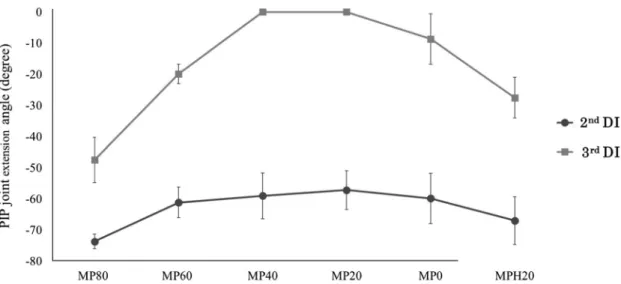
The average PIP joint extension angle upon electrical stimulation of the 2 nd DI muscle was al- most constant within -60° to -70° regardless of MP joint position. Although it was 0° for MP40 and MP20 upon stimulation of the 3 rd DI muscle, it was around -30° and -50° for MPH20 and MP80, respectively (p < 0.01). PIP joint extension torque was measured at MP40 and MP20, where full extension was possible, and 0.03 Nm at MP40 and 0.05 Nm at MP20. Muscular activity during finger extension motion by the maximum effort was approximately 30% of the maximum activity at MP40 and approximately 70% at MP80

and MPH20 as a peak value for both muscles (p <

0.01).

This study revealed that the 3 rd DI muscle gov- erns PIP joint extension function; its degree of ef- fect is influenced by MP joint position. Moreover, muscular activity in PIP joint extension motion fluctuates with MP joint position, and the muscles are activated at positions where PIP joint exten- sion is not efficiently obtained. This increased ac- tivity is caused by suppression of MP joint exten- sion, which increases the PIP joint extension function via the extensor digitorum muscles.

Introduction

Extension motions of the fingers are performed smoothly by cooperative activity of the finger ex- tension mechanism formed of the extensor digito- rum (ED) muscle, interosseous muscles, and lum- brical muscles. Above all, the interosseous and lumbrical muscles, the main components of the intrinsic muscles, extend the proximal interpha- langeal (PIP) joints and suppress hyperextension of the metacarpophalangeal (MP) joints of the ED muscle, increasing PIP joint extension function.

Since the interosseous muscles have greater phys- iological cross-sections than those of the lumbri-

Corresponding author: Shota Matsuzawa

Niigata hand surgery foundation, 997, Suwayama, Seiro, Kitakanbaragun, Niigata 957-0117, Japan

TEL/FAX: +81-25-427-0003, E-mail: [email protected]

(2)

cal muscles in particular [1], their role is greater than that of the lumbrical muscles; the authors presume that they are important muscles for the finger extension motion.

The interosseous muscles, consisting of four dorsal interosseous (DI) muscles and three palmar interosseous muscles, insert at the lateral band, interosseous hood, and proximal phalanx base, while the ratios of the insertion sections differ among them. For example, the main fiber of DI muscles involved in the middle finger inserts at the proximal phalanx base for the 2 nd DI muscle and the lateral band for the 3 rd DI muscle, while the PIP joint extension function of the 2 nd DI, which is mainly attached to the proximal phalanx base, is low [2]. However, since an anatomical study revealed the presence of fibers inserted at the lateral band in the 2 nd DI muscle [3], it may be involved in the PIP joint extension function to some extent. Nevertheless, few studies have in- vestigated the extension function of each DI mus- cle; therefore, their details have not been elucidat- ed.

Studies that investigated the PIP joint extension function of the interosseous muscles include an anatomical study using cadavers [4], a study on motion electromyography (EMG) [5], and a study using electrical stimulation [6]. However, in the above anatomical study, joint motion was artifi- cially caused by pulling of the muscle tendon;

therefore, the actual motion generated by muscle contraction in vivo was not reproduced. More- over, in the motion EMG study, the volume of muscular activity did not necessarily reflect range of motion.

In the study of electrical stimulation, the origi- nal function of the interosseous muscle can be in- vestigated by independent contracting of the in- terosseous muscle in vivo. However, muscle contraction by electrical stimulation is caused by constant stimulation of the peripheral nerves and does not necessarily reflect the function in vivo because it does not reflect the descending output

from the central nervous system. Therefore, to in- vestigate the DI muscle’s PIP joint extension function, it is necessary to confirm the original PIP joint extension function by electrical stimula- tion of the DI muscle and actually confirm the muscle activity using voluntary movements. In addition, few studies using electrical stimulation have focused on the PIP joint extension force and extension angles due to differences in MP joint position [6].

In this study, we hypothesized that there is a difference in the PIP joint extension function be- tween the 2 nd and 3 rd DI muscles due to differenc- es in the structures of the insertions; and these polyarticular muscles affected the PIP joint exten- sion function according to the MP joint position.

Therefore, the PIP joint extension function of the middle finger was investigated at different MP joint positions by contracting the 2 nd and 3 rd DI muscles using electrical stimulation. In addition, to confirm the PIP joint extension function of DI muscles in vivo, a motion electromyographic study was also performed.

Materials and Methods 1. Subject

Six normal adults without a medical history of neuromuscular or orthopedic diseases were in- cluded in this study. All were male; mean partici- pant age was 31 years (SD 5.9). All were right- handed. The study was approved by the Ethics Committee of Niigata University of Health and Welfare (Approval No: 17341-120816). The sub- jects received a written explanation about the study’s purpose and method, and each provided written consent prior to participating.

2. Measurement of PIP joint extension angle and torque when the DI muscle is electrically stimu- lated

1) Electrical stimulation

PIP joint extension angle and torque were mea-

sured under the condition of electrical stimulation

(3)

of the 2 nd and 3 rd DI muscles of the subjects’ right hands. Since the DI muscle can provide more sta- ble electrical stimulation than the palmar interos- seous muscle by surface stimulation, the 2 nd DI and 3 rd DI muscles that constitute the middle fin- ger extension mechanism were used as the target muscles. An electrostimulator (MEB-5500, Neuro Pack Σ; Nihon Kohden, Japan) provided the elec- trical stimulation using 10-mm plate electrodes (EP-20; Unique Medical, Japan). The electrodes were placed 2 cm apart at the dorsal part of the DI muscles, which most strongly induce the flex- ion movement of the MP joint of the middle fin- ger and the extension movement of the PIP joint by electrical stimulation. To avoid the influence of the stimulus site differences among MP joint positions, electrode positions were adjusted so that the maximum MP joint flexion force was ex- erted for each MP joint position. In addition, during electrical stimulation of the DI muscles, palpation and visual examination confirmed that the non-stimulated DI muscles did not contract.

The stimulation pulse width of the electrical stim- ulation, stimulation frequency, and stimulation time were 200 μsec, 20 Hz, and 3 sec, respective- ly, and the stimulus intensity was set to the supra- maximal stimulus. The supramaximal stimulus

was 1.1 times the strength at which the maximum MP joint flexion was exerted for each MP joint position. The maximum flexion force was con- firmed using the digital force gauge (RZ-100; Ai- koh Engineering, Japan). Electrical stimulation was provided five times under each condition for the separate measurements of PIP joint extension angle and torque. Before electrical stimulation, the patient was placed in a relaxed resting posi- tion immediately after active flexion, and the val- ues of the electric goniometer and digital force gauge confirmed that no voluntary movement had occurred. The stimulation was delivered in a ran- dom order for each condition, and the subjects were given a 1-min break after each electrical stimulation to avoid fatigue. An immobilizing brace made of plastic was used to maintain MP joint and wrist positions during the electrical stimulation (Figure 1).

2) Measurement of PIP joint extension angle Electrical stimulation was provided separately for the 2 nd and 3 rd DI muscles during the measure- ment of PIP joint extension angle. PIP joint ex- tension angle caused by the contraction of each muscle was measured by the electric goniometer for fingers (R-360-C finger; Tiger Medical Instru- ments, Japan). The measurements were performed

Figure 1. Measurement of PIP joint extension angle and torque.

PIP joint extension angle (a) and extension torque (b) when the 2

nd

and 3

rd

DI muscles were electri-

cally stimulated. An electric goniometer for fingers was used to measure PIP joint extension angle,

while a digital transducer was used to measure extension torque. The sensor of the digital transducer

was set vertically on the dorsal part of the middle phalanx 2.5 cm away from the PIP joint. DI, dorsal

interosseous; PIP, proximal interphalangeal.

(4)

in the forearm pronation position and wrist joint intermediary position. Flexed positions of 80°, 60°, 40°, 20°, and 0° and hyperextended positions of 20° at 0° of adduction and abduction were used; thus, a total of six positions were employed for MP joint. Electric goniometer signals were A/

D-converted at a sampling frequency of 1 kHz and recorded on a personal computer; these sig- nals were processed with a band-pass filter at 20–

500 Hz.

3) Measurement of PIP joint extension torque PIP joint extension force was measured with the forearm and wrist in the pronation and inter- mediary positions the same as the PIP joint exten- sion angle. In the MP joint position, the extension force cannot be measured in a position in which the PIP joint cannot be fully extended. Therefore, MP20 and MP40 were employed, in which full PIP joint extension was possible by electrical stimulation of the 3 rd DI muscle. The PIP joint was flexed at 10°. Electrical stimulation was pro- vided to the 2 nd and 3 rd DI muscles simultaneously to balance MP joint adduction and abduction. For measurement of extension force, the digital force gauge mentioned before was set vertically on the dorsal part of the middle phalanx 2.5 cm away from the PIP joint. The acquired extension force signals were A/D-converted at a sampling fre- quency of 1 kHz and recorded on a personal com- puter; these signals were processed with a band- pass filter at 20–500 Hz. After that, extension torque was obtained by multiplying it by 0.025 as an external moment arm.

3. Measurement of muscular activity at PIP joint extension movement

The EMG was derived from the 2 nd and 3 rd DI muscles of the right hand, with bipolar pasting wire electrodes made of stainless wire 0.05 mm in diameter coated with rigid urethane (TN204- 123; Unique Medical, Tokyo, Japan). The mea- surements were performed with the forearm in pronation and wrist joint in the intermediary and

flexed positions of 80°, 60°, 40°, 20°, and 0° and a hyperextended position of 20°; thus, a total six positions were employed for the MP joint, same as measurements of PIP joint extension angle in- duced by electrical stimulation. The motion task was the active maximum extension of the PIP and distal interphalangeal (DIP) joints of the middle finger. The subjects were instructed to extend only the PIP and DIP joints of their middle finger in the immobilizing brace; furthermore, they were instructed not to consciously move the MP joint and other fingers. Moreover, to normalize the EMG obtained by each motion, EMG during the active maximum flexion movement of the MP joint at 60° flexed position was also measured.

The MP joint flexion angle was set at 60° since preliminary experiments confirmed that muscle activity was greatest at the MP joint flexion of 60°. The duration of muscle contraction for each motion task was approximately 3 sec; each task was performed three times. EMG signals derived from the wire electrodes were A/D-converted with the sampling frequency of 2 kHz and record- ed on a personal computer. A data acquisition and analysis system (PowerLab 8/35; AD Instruments, Australia) was used for the above processing. The recorded EMG signals were processed with a band-pass filter at 20–1000 Hz.

4. Data analysis and statistics

For PIP joint extension torque and angle, aver- age values among the subjects for every MP joint position were obtained by calculating the average values of five measurements for each subject. For the electromyography (EMG) analysis, all wave signals in 1-sec intervals from the 3-sec EMG signals were rectified and an integrated EMG (IEMG) was calculated. Data acquisition and analysis system software (LabChart 8; AD Instru- ments, Australia) was used for the data analysis.

The calculated IEMG values were normalized

with the IEMG values of active maximum flexion

movement of the MP joint as a standard (normal-

(5)

ized IEMG [NIEMG]), and the average NIEMG values of three measurements were calculated for each subject. Next, the average NIEMG values among subjects for every MP joint position were calculated.

For statistical processing, prior to the test, the Shapiro-Wilk test was used to confirm that each variable followed a normal distribution. The sub- jects’ average PIP joint extension torque values were compared for MP joint position using the paired t-test. Moreover, regarding PIP joint exten- sion angle and NIEMG, subjects’ average values were compared with muscle and MP joint posi- tion as factors by the two-way repeated measures analysis of variance. As a retrospective test, the factors of muscle and the MP joint position were analyzed using the paired t-test and Turkey’s mul- tiple comparison test, respectively, with the sig- nificance level < 5% for both. SPSS Statistics ver.

18 (SPSS Japan Inc, an IBM company, Japan) was used for the above processing.

Results

1. PIP joint extension angle and torque upon elec- trical stimulation of DI muscles

The range of the electric stimulus intensity in this study was 16.1–18.7mA (SD 0.4 – 0.9). The

main effect of muscle and MP joint position on PIP joint extension angle of by electrical stimula- tion was significant (muscle: F (1,5) = 197.9, p <

0.01, η 2 = 0.76; MP joint position: F (5,25) = 108.0, p < 0.01, η 2 = 0.18). In addition, interac- tion was seen between muscle and MP joint posi- tion, while significant differences were seen in changing patterns of extension angle accompa- nied by differences in MP joint position between the 2 nd and 3 rd DI muscles (F (5,25) = 21.7, p <

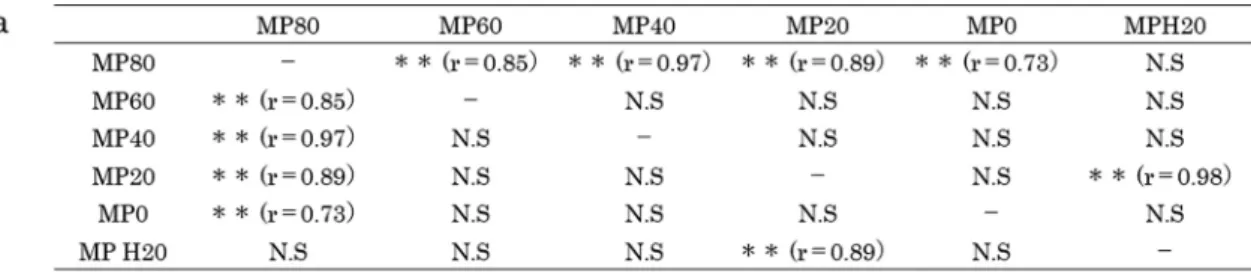
0.01, η 2 = 0.05). Mean PIP joint extension angle due to contraction of the 2 nd DI muscle were -73.7° (SD 2.3), -61.2° (SD 4.9), -59.8° (SD 7.4), -57.2° (SD 6.2), -59.8° (SD 8.1), and -67.0° (SD 7.7) for MP80, MP60, MP40, MP20, MP0, and MPH20, respectively. Multiple comparisons of MP joint positions revealed no differences among MP0, MP20, MP40, and MP60; full extension was impossible at any position. The extension an- gles of MPH20 and MP80 presented more signifi- cant decreases than those of other positions, while extension motion rarely occurred at MP80 in par- ticular (p < 0.01) (Figure 2, Table 1a). Mean PIP joint extension angles due to contraction of the 3 rd DI muscle were -47.5° (SD 7.2), -19.8° (SD 3.1), 0° (SD 0), 0° (SD 0), -8.7° (SD 8.1), and -27.5°

(SD 6.5) for MP80, MP60, MP40, MP20, MP0,

Figure 2. PIP joint extension angle during electrical stimulation of the 2

nd

and 3

rd

DI muscles.

(6)

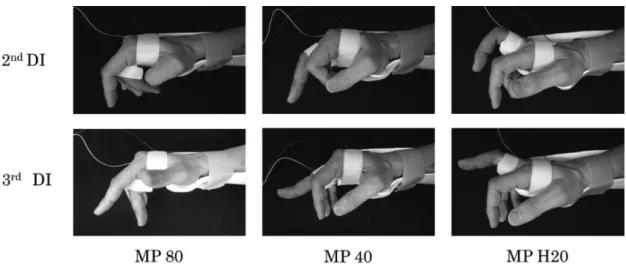
and MPH20, respectively. Comparison with the 2 nd DI muscle revealed a significantly higher PIP joint extension angle in the 3 rd DI muscle for ei- ther position (p < 0.01) (Figure 2, Table 2). Mul- tiple comparisons among MP joint positions pre- sented full extension at MP20 and MP40; on the other hand, it presented significantly greater de- creases for MPH20 and MP80 than those for oth- er positions (p < 0.01) (Figure 2, Table 1b). Fig- ure 3 shows PIP joint extension under electrical stimulation of the DI muscles of the representa- tive subject. PIP joint extension torque with elec-

trical stimulation to the 2 nd and 3 rd DI muscles was 0.05 Nm and 0.03 Nm for MP20 and MP40, respectively. Extension torque presented signifi- cantly greater values for MP20 (t (5) = 7.74, p <

0.01, r = 0.96) (Figure 4).

2. Muscular activity of PIP joint extension motion NIEMG during the maximal extension move- ment of the PIP and DIP joints had no main effect on the muscles but a significant main effect on MP joint position (muscle: F (1,5) = 0.85, p = 0.85, η 2 = 0.76; MP joint position: F (5,25) = 75.8, p < 0.01, η 2 = 0.92). In addition, no interac- tion was seen between muscle and MP joint posi- tion, and changing patterns of NIEMG accompa- nied by changes in MP joint position were similar in the 2 nd and 3 rd DI muscles (F (5,25) = 0.18, p = 0.97). Average NIEMG values of the 2 nd DI mus- cle were 68.4% (SD 13.0), 44.7% (SD 16.0), 27.1% (SD 5.3), 38.3% (SD 13.7), 54.2% (SD 12.3), and 65.9% (SD 10.7) for MP80, MP60, MP40, MP20, MP0, and MPH20, respectively.

Mean NIEMG values of the 3 rd DI muscle were Table 1. Multiple comparisons of PIP extension angle among MP joint positions (2

nd

DI muscle

[a], 3

rd

DI muscle [b]).

Turkey’s multiple comparison test; **: p < 0.01, *: p < 0.05, N.S: not significant. the effect size is shown in parentheses.

Table 2. Comparisons of PIP extension angle

between the 2

nd

DI muscle and 3

rd

DI muscles for each MP joint.

(7)

70.3% (SD 8.8), 48.2% (SD 5.3), 30.4% (SD 10.5), 44.2% (SD 7.0), 58.3% (SD 5.1), and 71.4% (SD 4.5), respectively. Multiple compari- sons of NIEMG among MP joint positions re-

vealed that it was approximately 70%, the high- est, at MPH20 and MP80 for both muscles and approximately 30%, the minimum, at MP40 (p <

0.01) (Figure 5, Table 3).

Figure 3. PIP joint extension angle during electrical stimulation of the 2

nd

and 3

rd

DI muscles (repre- sentative example).

Upon electrical stimulation of the 2

nd

DI muscle, full extension of the PIP joint was not seen at either MP joint position (upper). Upon electrical stimulation of the 3

rd

DI muscle, full extension was seen at MP40 but not at MP80 or MP20 (lower). In this representative example, the electric goniometer and force gauge were removed to increase visibility. 2

nd

DI muscle, second dorsal interosseous muscle;

3

rd

DI muscle, third dorsal interosseous muscle; MP80, MP joint at 80° flexed position; MP40, MP joint at 40° flexed position; MPH20, MP joint at 20° hyperextended position; PIP, proximal interpha- langeal.

Figure 4. PIP joint extension torque during electrical stimulation of the 2

nd

and 3

rd

DI muscles.

(8)

Discussion

1. PIP joint extension angle and torque under electrical stimulation of DI muscles

In this study, the authors investigated the influ- ence of MP joint position on PIP joint extension

function of the DI muscles. As a result, the PIP joint minimally extended when the 2 nd DI muscle was stimulated, but the PIP joint could complete- ly extend when the 3 rd DI muscle was stimulated.

However, the extension function was greatly af- Table 3. Multiple comparisons of NIEMG among MP joint positions (2

nd

DI muscle [a], 3

rd

DI

muscle [b]).

Turkey’s multiple comparison test; **: p < 0.01, *: p < 0.05, N.S: not significant. the effect size is shown in parentheses.

Figure 5. NIEMG of the 2

nd

DI and 3

rd

DI muscles during maximal extension movement of the

PIP and DIP joints.

(9)

fected by MP joint position, and the function de- creased when the MP joint was hyperextended and in the strong flexed position.

Although the presence of lateral band fibers in- volved in the extension function of the PIP joint was anatomically confirmed in the 2 nd DI muscle, only a slight extension movement occurred during the maximum electrical stimulation in this study.

These results suggested the presence of only a few transition fibers or that their structures were weak and they were not capable of transmitting power that could sufficiently extend the PIP joint.

Regarding the result that PIP joint extension function of the 3 rd DI muscle differed among MP joint positions, the cause differed between MP joint hyperextension and a strong flexed position.

Factors related to MP joint hyperextension in- cluded an increased resistance due to tension of the palmar tissue such as the finger flexor muscles against extension force of the 3 rd DI muscle for the PIP joint [4] or limited muscle contraction amplitude beyond a certain DI muscle by fixing of the MP joint in the hyperextended position; we suppose that the latter is the major cause. For the latter cause, we presume that fibers causing strong flexion action of the MP joint run on the palmar side of the axis of flexion-extension of the MP joint on the 3 rd DI muscle and inserts in the proxi- mal phalanx base; most of the tension from the 3 rd DI muscle was conveyed by these fibers, which limited the muscle contraction amplitude at the hyperextension position and, therefore, limited the tension transmitted to the fibers shifting to the lateral band. Conventionally, it was believed that the PIP joint extension function would increase as a result of DI muscle extension for the MP joint extension position [4,6]. However, this theory is denied by the above theory. With increased MP joint flexion, a shortened 3 rd DI muscle length and decreased tension with an increased MP joint flexion angle were considered factors contributing to the decreased extension function. Other factors included the assumption that, with an increased

MP joint flexion angle, the traction force caused by contraction of 3 rd DI was transmitted only to the MP joint flexion and little tension was trans- mitted to the lateral band fibers [4].

Full PIP joint extension was achieved at MP20 and MP40; its factors included the fact that the contractive force was effectively transmitted to the lateral band directionally without contraction of the 3 rd DI muscle being blocked at these posi- tions, while the optimal length of the 3 rd DI mus- cle was maintained. Moreover, judging from the result of this study that PIP extension torque in- creased more at MP20 than at MP40, since the extension moment arm of a PIP joint was not var- ied by MP joint position, MP20 is a position that allows more effective transmission of contractive force of the 3 rd DI muscle to the lateral band and maintains the optimal length of the 3 rd DI muscle.

2. Muscular activity of PIP joint extension motion High activity was seen for both the 2 nd and 3 rd DI muscles during MP joint hyperextension and high flexion; the lowest activity was seen at MP40. This result opposes PIP joint extension function with electrically stimulated 3 rd DI mus- cle, indicating that DI muscles are active when PIP joint extension is insufficient. We presume that this activity increases PIP joint extension function via the ED muscle. In other words, when the 3 rd DI muscle was electrically stimulated, full PIP joint extension could not be achieved in the more flexed and hyperextended MP joint posi- tions; therefore, PIP joint extension at these posi- tions may be performed mainly by the ED. There- fore, DI muscles prevent MP joint extension caused by ED and increases the PIP joint exten- sion function.

3. Clinical application of study results

The data presented in this study can be refer-

enced in cases in which reconstruction of the cen-

tral slip or resection of lateral band cannot be

avoided. It is recommended that the 3 rd DI mus-

(10)

cle, which has a strong PIP joint extension force, be selected for reconstruction of the central slip [7,8] versus the 2 nd DI muscle for resection of the lateral band. Moreover, for postoperative therapy in cases of proximal phalanx fracture or extensor tendon injury of the proximal phalanx, PIP joint extension at MP40 is recommended to improve gliding performance to prevent adhesion of the lateral band and training at MP20, at which the extension force is further increased, for improv- ing gliding performance in cases of adhesion of the lateral band.

4. Study limitations

This study has several limitations. First, the lumbrical muscle on the palmar side of the 2 nd DI muscle or the adjacent interosseous muscles might have been inadvertently stimulated. How- ever, since PIP joint extension motion was stimu- lated only a little under the electrical stimulation of the 2 nd DI muscle, we presume that its influ- ence was not significant. Thus, it will be neces- sary to stimulate it with wire electrodes or needle electrodes in the future. Moreover, although we investigated the extension function of the middle finger in this study, there exist individual differ- ences in the insertion of the 2 nd DI muscle [2,3];

as other fingers have interosseous muscles, the presents result may not be applicable to all fin- gers. To further investigate the function of the in- terosseous muscles on PIP joint extension, it will be necessary to increase the number of subjects and investigate the functions of other interosseous muscles.

Conclusion

This study investigated the PIP joint extension function of the 2 nd and 3 rd DI muscles for the pur- pose of clarifying the kinematic characteristics of DI muscles. As a result, we confirmed that the 2 nd DI muscle does not have a PIP joint extension function, whereas the 3 rd DI muscle does. More- over, the PIP joint extension function of the 3 rd DI

muscle was influenced by MP joint position. DI muscle activity during PIP joint extension varied among MP joint positions for both muscles and was high at those positions at which PIP joint ex- tension was not efficiently achieved. The authors considered that this increased activity suppresses MP joint extension and that the ED muscle in- creases PIP joint extension function.

Acknowledgments

We thank Dr. T. Nara and Dr. T. Soma for help- ful comments on the manuscript. This work was supported by a Grant-in-Aid for Scientific Re- search of Graduate Students of Niigata University of Health and Welfare, Grant Number H24F05.

We would like to thank Editage (www.editage.

com) for English language editing.

Conflicts of Interest

There are no companies having COI relation- ship with the authors that need be disclosed.

References

1. Wang K, McGlinn EP, Chung KC. A biome- chanical and evolutionary perspective on the function of the lumbrical muscle. J Hand Surg Am. 2014; 39: 149-155.

2. Zancolii EA. Strucutal and dynamic bases of hand surgery. 2nd ed. Philadelphia: Lippin- cott; 1979; 244-254.

3. Eladoumikdachi F, Valkov PL, Thomas J, et al. Anatomy of the intrinsic hand muscles re- visited: Part I. Interossei. Plast Reconstr Surg. 2002; 110: 1211-1224.

4. Valentin P: The interossei and the lumbricals.

In: Tubiana R editor. The hand vol. I. 1st ed.

Philadelphia: W.B.Saunders company; 1981;

244-254.

5. Long C, Brown ME. Electromyographic ki- nesiology of the hand, moving the long fin- ger. J Bone Joint Surg Am. 1964; 46: 1683- 1703.

6. Lauer RT, Kilgore KL, Peckham PH. The

(11)

function of the finger intrinsic muscles in re- sponse to electrical stimulation. IEEE Trans Rehabil Eng.1999; 7: 19-26.

7. Matev I. Transposition of the lateral slips of the aponeurosis in treatment of long-standing boutonière deformity of the fingers. Br J Plast Surg. 1964; 17: 281-286.

8. Snow JW. A method for reconstruction of the central slip of the extensor tendon of a finger.

Plast Reconstr Surg. 1976; 57: 455-459.

Figure 1. Measurement of PIP joint extension angle and torque.
Figure 2. PIP joint extension angle during electrical stimulation of the 2 nd  and 3 rd  DI muscles.
Table 2. Comparisons of PIP extension angle  between the 2 nd  DI muscle and 3 rd DI muscles for each MP joint.
Figure 3. PIP joint extension angle during electrical stimulation of the 2 nd  and 3 rd  DI muscles (repre- (repre-sentative example).
+2

参照

関連したドキュメント

We give an application of the second extension of the Thas-Walker construction and exhibit a 4-parameter family F of explicit examples of spreads of PG(3, R ) with

Given an extension of untyped λ-calculus, what semantic property of the extension validates the call-by-value

In this case, the extension from a local solution u to a solution in an arbitrary interval [0, T ] is carried out by keeping control of the norm ku(T )k sN with the use of

Particularly, this paper deals with a certain two-variable generalization of these rings and an extension of the theory of descent monomials and P-Partitions to a broader class

As an application, in Section 5 we will use the former mirror coupling to give a unifying proof of Chavel’s conjecture on the domain monotonicity of the Neumann heat kernel for

We present combinatorial proofs of several non-commutative extensions, and find a β-extension that is both a generalization of Sylvester’s identity and the β-extension of the

The direct inspiration of this work is the recent work of Broughan and Barnett [5], who have demonstrated many properties of PIPs, giving bounds on the n-th PIP, a PIP counting

Here we only present and prove an Orlicz norm version of the inequality (1.5) [and of its extension to the power weight case see, e.g., (2.6) with/3 1 + Zp and give an example of