Implementation of Computer Network Education on a Manufacturing Course for High School
Students using a Remote Monitoring System with Linux Microcomputer Operation for Use in
Defense against Natural Disasters
著者 SHIBATA Kouji, HANADA Kazuma
著者別名 柴田 幸司, 花田 一磨
journal or
publication title
The Bulletin of Hachinohe Institute of Technology
volume 35
page range 47‑54
year 2016‑03‑31
URL http://id.nii.ac.jp/1078/00003558/
Implementation of Computer Network Education on a Manufacturing Course for High School Students using a Remote Monitoring System
with Linux Microcomputer Operation for Use in Defense against Natural Disasters
Kouji S
HIBATA†and Kazuma H
ANADA††A
BSTRACTA previous paper by the author reported on the development of an ultra-small, low-power, economical sensor information remote monitoring system featuring low operational cost and stable operability in disaster conditions. The system incorporates a Linux microcomputer and a USB-connected mobile broadband modem to enable 4G cellular network connection combination, and can be operated with a private IP address via an embedded VPN program for easy negotiation of NAT and firewall protection.
Studies by the author have also shown that camera images and information on temperature/humidity from sensor-remote locations can be securely acquired through a web browser using a smart device by connecting a commercially available and economical USB web camera and a temperature/humidity sensor to the system. Against such a background, this paper reports on the operational procedure for the system and information imparted during a training course on its construction and setup. The three-day course was run for sophomores at Aomori Prefectural Sambongi High School using facilities of the Hachinohe Institute of Technology with the aim of applying the related outcomes to network education on campus.
These outcomes can be implemented in mass teaching of advanced configuration technology for computer networks and server programs to university students via their own digital devices. Such educational programs enable hands-on learning on campus because the system is created with inexpensive devices.
Keywords: Internet, VPN, cellular network, remote monitoring, IoT, M2M, Raspberry Pi, computer network education
1. Introduction
Systems for the collection of sensor information from remote locations can today be easily made at relatively low cost thanks to the popularization of mobile Internet connection services, whereas conventional systems require a costly dedicated line
1). The recent rapid proliferation of cellular networks along with the associated increasing trend of data transmission speeds has also enabled the
transmission of large volumes of data online from mobile units. As a result, a wealth of information (such as camera data from sensor-connected devices) from mobile objects can be acquired with an Internet connection
2). In addition, such communication systems with microcomputer- operated sensor devices can directly exchange information via a LAN or a public network such as the Internet. Their use is expected to expand into a wide range of applications, not only for sensor networks in factories and homes but also in agriculture, fishery, transportation, healthcare and tourism. The technology is also attracting increasing attention for use in M2M (machine-to-machine) application and for IoT (Internet of Things) usage.
平成28年1月8日受付
† 工学部電気電子システム学科・准教授
†† 工学部電気電子システム学科・講師
八戸工業大学紀要 第 35巻
Against this background, the author’s research group developed an extremely compact and inexpensive remote monitoring system that transmits information via the Internet. The system combines a Linux microcomputer with an embedded VPN program and various USB- connected sensors. It allows simple acquisition of camera and temperature/humidity data at low operational cost with the assignment of a dynamic private IP address by an Internet service provider thanks to a firewall and a NAT (network address translation)-traversing VPN program installed on the microcomputer
3). The use of ARM cores for the system cuts related costs drastically by boosting volume efficiency based on the capacity for embedding on commercial smartphones, tablet PCs and similar. The multi-tasking Linux operating system was chosen for its efficient use of storage capacity, its high processing speed, its lower CPU load and its FOSS (Free and Open Source Software) status. This technological combination enables cost-effective sensor network system creation in multiple programming languages, and allows free addition of various types of sensors via USB or I2C interfaces. The wide range of potential applications demonstrates the system’s high versatility. The author constructed a sensor network system based on a VPN that can be operated with a private IP address dynamically assigned to the IoT terminal without static from the Internet service provider. It is proposed as a solution that allows stable, non-stop prolonged operation and uninterrupted communication between the IoT terminal and another server. This performance is based on the system’s capacity for instantaneous switching among fixed-line, Wi-Fi and cellular phone network connections if any of these paths is interrupted in a disaster situation or similar. As part of engineering education, it is important for today’s digital natives to learn the techniques required for network-based construction and configuration of sensor network systems.
There is also a need to provide practical training in order to arouse interest in engineering among college-bound high school students.
Against this background, the author provided technical intern training in engineering using the premises and
facilities of the Hachinohe Institute of Technology (HIT).
The training took place over a period of three days from September 5 to 7, 2014, and was attended by students of Aomori Prefecture’s Sambongi High School. At the sessions, the author delivered lectures on the construction of the remote-sensor information and its ability to function even if a disaster causes access line disconnection. This paper reports on these educational activities.
2. Details of practical training
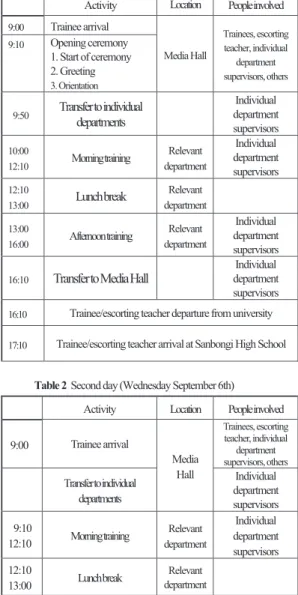
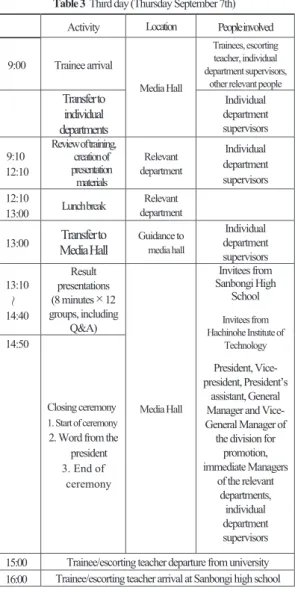
Outlines of the practical training are shown in Table 1 to Table 3. The author was given time slots on three days to provide engineering instruction to two Sanbongi High School sophomore students as a part of studies on the Manufacturing course on the campus. This included the time taken to meet the students at the training venue (HIT’s Media Hall) and to take them back to their school, and the time taken for trainers to escort the attendees to the training centers of individual HIT departments. The schedule also included time for presentations on the last day so that the students could report on the results of their experience.
Accordingly, most of the first two days was allotted to network device construction and configuration with the schedule outlined below. This allowed the training to be conducted in line with the requests of the client and within the framework shown in Table 1 to Table 3. During this time, the students were also trained on expressions and editing in C programming language to support the retrieval of information from sensor devices on a terminal, and also learned HTML for the online publication of such information. After the configuration training, efforts were made to arouse the trainees’ interest in engineering by teaching them how to configure VPN settings on their own smartphones and to receive sensor information via their subscription cellular networks. Finally, instruction was given on how to create PowerPoint slides and present the fruits of the trainees’ learning on the final day. The schedules for the three days of lectures are outlined below.
First day
Microcomputer installation of Linux, OS update, basic
network configuration, installation of HTTP server and PHP programming language interpreter, setting of wireless LAN
Second day
Installation and setting of VPN/motion capture/Munin software, compilation and installation of software for collection of temperature/humidity sensor information, rewriting and placement of HTML/PHP file (index.php) Third day
Collection of camera images and temperature/humidity data from a microcomputer via a VPN and trainees’ own smartphones, creation of PowerPoint slides for presentation of results, presentation practice
The creation of a P2P communication system for Internet-based transmission and collection of huge volumes of web camera/sensor data using a microcomputer requires considerable amounts of knowledge, skill and practical application, including OS installation on a microcomputer and a PC. Knowledge of how to install software such as an HTTP server, use and edit PHP language, and locate HTML/PHP files for information provision is also needed, as is the ability to edit, compile and install a program for sensor data collection.
Finally, knowledge of how to configure network equipment, terminals and Internet links is also needed. An educational program for hands-on computer network learning that incorporates these skills requires accurate and extensive configuration of a microcomputer, network equipment and client terminals to ensure that all elements interact properly. Accordingly, a fourth-grade student was recruited from HIT’s Department of Electrical Systems to assist with essential network configuration as part of graduation work activity. The assistant provided support for various types of work in the training, including preparation and the provision of training itself. Over the three days of the training, the students were successfully taught how to build computer networks within a given period of time from precise equipment configuration to retrieval of information via their own phones. This success
is owed to the strong support of HIT students and the operating manual (discussed below).
Table 1 First day (Tuesday September 5th) Activity Location People involved 9:00 Trainee arrival
Media Hall
Trainees, escorting teacher, individual department supervisors, others
9:10 Opening ceremony
1. Start of ceremony 2. Greeting 3. Orientation 9:50 Transfer to individual
departments
Individual department supervisors 10:00
12:10 Morning training Relevant
department
Individual department supervisors 12:10
13:00 Lunch break department Relevant 13:00
16:00 Afternoon training Relevant
department
Individual department supervisors
16:10 Transfer to Media Hall Individual
department supervisors 16:10 Trainee/escorting teacher departure from university 17:10 Trainee/escorting teacher arrival at Sanbongi High School
Table 2 Second day (Wednesday September 6th) Activity Location People involved 9:00 Trainee arrival
Media Hall
Trainees, escorting teacher, individual department supervisors, others Transfer to individual
departments
Individual department supervisors 9:10
12:10 Morning training Relevant department
Individual department supervisors 12:10
13:00 Lunch break department Relevant 13:00
16:00 Afternoon training Relevant department
Individual department supervisors 16:10 Transfer to Media Hall Individual department supervisors 16:10 Trainee/escorting teacher departure from university 17:10 Trainee/escorting teacher arrival at Sanbongi high school
八戸工業大学紀要 第 35巻
Table 3 Third day (Thursday September 7th) Activity Location People involved
9:00 Trainee arrival
Media Hall
Trainees, escorting teacher, individual department supervisors,
other relevant people Transfer to
individual departments
Individual department supervisors 9:10
12:10
Review of training, creation of presentation
materials
Relevant department
Individual department supervisors 12:10
13:00 Lunch break departmentRelevant 13:00 Transfer to
Media Hall Guidance to media hall
Individual department supervisors 13:10
~14:40
Result presentations (8 minutes
×
12groups, including Q&A)
Media Hall
Invitees from Sanbongi High
School Invitees from Hachinohe Institute of
Technology President, Vice- president, President’s
assistant, General Manager and Vice- General Manager of
the division for promotion, immediate Managers
of the relevant departments, individual department supervisors 14:50
Closing ceremony 1. Start of ceremony 2. Word from the president 3. End of
ceremony
15:00 Trainee/escorting teacher departure from university 16:00 Trainee/escorting teacher arrival at Sanbongi high school
3. Efficiency measures implemented for the training Collection of camera and temperature/humidity data from equipment and sensors in remote locations via a cellular network with point-to-point (P2P) connection using the trainees’ own smartphones required extensive software installation and configuration. The training also required significant configuration for various types of computer network equipment as well as for the microcomputer and the terminal device for sensor data retrieval. As a result, the provision of instruction on computer network creation to the trainees, who had no knowledge of the subject, was an
enormous burden for the trainer. To help mitigate this burden, a command input manual for all equipment was created before the training to allow instruction to be provided within the hours available and improve the efficiency of the sessions. Figure 1 shows an excerpt from the manual, which covers the initial network creation required after OS installation on the microcomputer, wireless LAN adapter setting, OS updating, installation of certain basic programs and device drivers, installation and setting of the VPN program, installation of the HTTP server and PHP program, HTML/PHP file editing and placement, and editing, compilation and installation of the program for camera and temperature/humidity data collection. The resulting improved procedure enabled the trainees to effectively and routinely compete these significant and cumbersome tasks and to grasp the operation principle.
①「sudo nano /etc/network/interfaces」
②「face eth0 inet dhcp」
③「static」
④「address 192.168.11.20」
⑤「netmask 255.255.255.0」
⑥「gateway 192.168.11.1」
⑦「ctrl+o」
⑧「ctrl+x」
⑨「sudo reboot」
⑩「ping 192.168.11.20」
⑪「sudo apt-get update」
⑫「sudo apt-get upgrade」
⑬「sudo apt-get install apache2」
⑭「y」
⑮「sudo apt-get install php5」
⑯「y」
⑰「sudo reboot」
⑱「sudo nano /var/www/index.html」
⑲「sudo lsusb」
Figure. 1 Command input for equipment setting included in the manual
This instruction also provided opportunities for the
trainees and students at the university to interact, as most
actual judgment during the teaching was entrusted to the
lecture assistants.
4. Proposed system
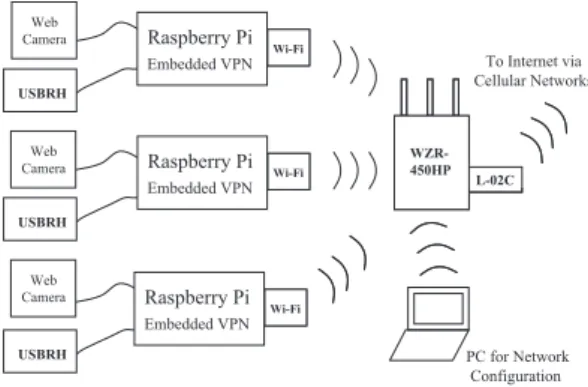
The computer network system created in the training is shown Figure 2. It consists of a microcomputer running on Linux, a router for connection to the Internet, a USB- based mobile broadband modem for LTE network connection, and various peripherals such as a temperature/humidity sensors and a web camera. The Raspberry Pi
4)model originally developed for educational purposes was chosen for the Linux microcomputer due to its cost-effectiveness. An L-02C modem (LG Electronics) was also chosen to allow interfacing with the microcomputer using a USB Internet connection via the 4G cellular network of Japanese provider NTT Docomo, and a standard USB web camera was used to import camera images to the microcomputer. A USBRH-FG USB-connected temperature and humidity sensor combination module (Strawberry Linux) was additionally chosen. In the proposed system, point-to-point (P2P) connection between the Linux microcomputer with a data communication unit for remote information acquisition and the client terminal is secured using VPN software embedded into the Raspberry Pi. In addition, the Linux microcomputer (which is also used as the HTTP server) maintains a constant server-to-terminal connection via the VPN, easily negotiating NAT and firewall protection with a private IP address assigned dynamically to the computer without static from the Internet service provider. This combination of technology significantly reduces the cost of the Internet connection required for secure point-to-point transmission of data from a remote server in many different locations to a terminal via a cellular network. The instructors taught the attendees a connection technique using the proposed computer network system from the terminal device on the Internet via VPN to certain information remote monitoring systems for sensors in different locations that were connected to a wireless router.
The trainees were also instructed on correction of data from sensors in remote locations based on connection to the microcomputer. Work for training on the above was implemented as follows:
1. Installation of Linux OS on a Raspberry Pi 2. Setting of LAN conditions (IP address, gateway,
DNS)
3. Setting of a wireless LAN adaptor connected to the Raspberry Pi
4. Installation and setting of the VPN program 5. Setting of the firewall (connection admission
control for ports 22, 80)
6. Installation of the web (HTTP) server and PHP software
7. Installation of Motion software for the web camera 8. Editing, compilation, installation and assignment to
the OS of the program for collection of environmental sensor information
9. Rewriting of the HTML file (index.php)
10. Installation of Munin software and writing of a script to display environmental data
11. Setting of access router for Internet access via cellular networks
For the system, a Buffalo WLI-UC-GNM unit was chosen as a wireless LAN adapter for physical connection to the Raspberry Pi, and a Buffalo WZR-450HP wireless LAN router was chosen for radio connection. A dynamic private IP address was also assigned to the Linux microcomputer from the wireless LAN router using DHCP to enhance scalability for connection to another variety of access lines under these set-up conditions.
CameraWeb
USBRH
Wi-Fi Wi-Fi
Raspberry Pi Embedded VPN
PC for Network Configuration USBRH
USBRH
To Internet via Cellular Networks
L-02C WZR-450HP L-02C WZR-450HP Wi-Fi
Wi-Fi
Raspberry Pi Embedded VPN
Wi-Fi Wi-Fi
Raspberry Pi Embedded VPN Web
Camera
Web Camera
Figure2 Configuration for VPN connection via Wi-Fi and cellular networks
The proposed system’s VPN connection is achieved
using an application called Hamachi (LogMeIn), which
enables the operation of a variety of servers using a private
八戸工業大学紀要 第 35巻
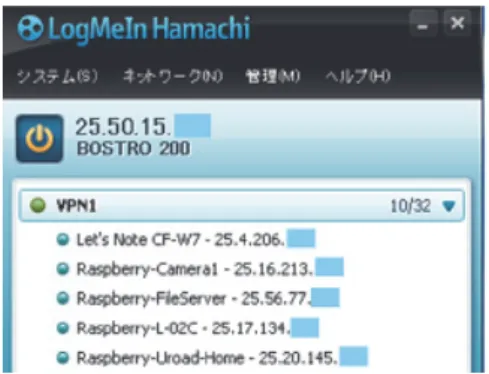
IP address and allows easy VPN construction across NAT and firewall barriers to reduce operational costs. A dedicated program to link the microcomputer as the server and the PC as the terminal is also needed to operate the VPN. Figure 3 shows the state of remote server connection between the microcomputer and a Windows XP PC after the completion of steps 1 – 11 above. The results show a number of Raspberry Pi connections to the wireless LAN router over the radio on the VPN constructed using Hamachi.
Figure 3 Connection of individual computers using Hamachi
Next, Apache2 was installed for the website to allow the microcomputer to work as an HTTP server, and PHP5 was installed on the system to allow the display of temperature/humidity data via a web browser. The motion- capture program allowing web camera usage was adopted from Motion software, whose installation allows long- distance monitoring based on web camera images via a web browser. A program adopted to collect temperature/humidity data from a sensor module (USBRH-FG) using Pi was also generated. To achieve this, the source file of a program edited in C language to work for a CPU with different architecture was first adapted to work on Pi. Next, an executable file was generated using the make command for the Pi’s Debian OS. Finally, a function to display temperature/humidity data from the sensor was mounted using this command for the Linux OS.
The index.php file code was also edited as shown in Figure 4. The /var/www directory was then located to enable retrieval of sensor data using a mobile terminal device from a server via a web browser. Figure 5 shows
the display of remote information in a Firefox browser for the web server located on site on a Windows XP PC via VPN after the completion of steps 1 – 11 above. Camera and temperature/humidity data are shown on the screen.
<!DOCTYPE html>
<html lang="ja">
<head>
<meta http-equiv="Content-type" content="text/html;charset=UTF-8">
<title> Temperature and Humidity in the Laboratory </title>
</head>
<body>
<font size="7">
Temperature Humidity
<br>
<?php
echo exec('/usr/local/bin/usbrh');
?>
<br>
<a href="http://25.42.***.***:8081"><img class="motion"
src="http://25.42.***.***:8081"/></a>
<br>
</font>
Figure 4 Content of the edited index.php file
Figure 5 Details of camera image and temperature/humidity information provided via a Web browser
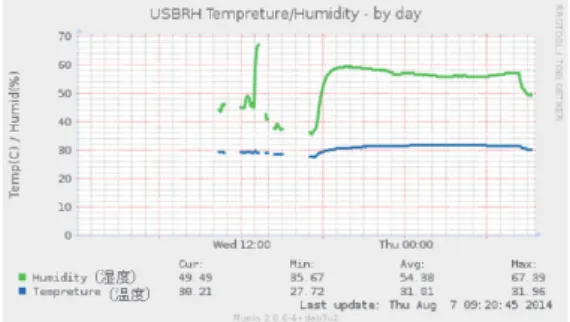
During the training, Munin software was also installed on
the Raspberry Pi to enable monitoring of the server’s
operational status, and a script was written to import
environment information. Temporal changes in
temperature and humidity were also monitored and
recoded via the Internet. Figure 6 shows the results of
monitoring performed using the microcomputers set up
and located by the trainees to determine temporal
variations in temperature and humidity. The results show
that longitudinal sensor information was obtained
continuously over a period of two days, thereby indicating
the stability of the proposed system. Based on these results,
the trainees made the following observations:
1. From around 18:00 on August 6th, the temperature increased from 28 to 31°C and humidity increased from 35 to 67% after the air conditioning in the lecture room was turned off at home time.
2. From around 8:00 on August 7
th, the temperature decreased from 31 to 30°C and humidity decreased from 58 to 50% when the air conditioning in the lecture room was turned on at the start of the day.
The trainees thus gained an insight into the natural phenomena of temperature/humidity changes.
Figure 6 Two-day temporal variations in temperature/humidity
5. Training outcomes
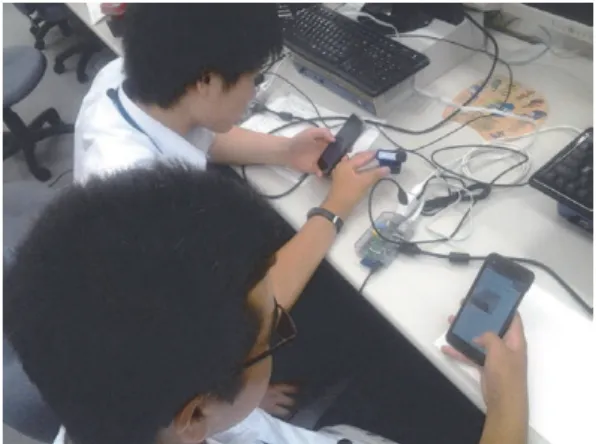
Figure 7 to Figure 9 show scenes from the three days of training, and help to illustrate the supporting roles played by assistants from the university. Figure 9 shows the trainees using the VPN function on their own smartphones to collect sensor information via a cellular network.
Camera images and temperature/humidity data were successfully obtained from a remote location by setting the VPN function for individual terminals despite the use of different operating systems (Android and iOS on an Android smart phone and an iPhone, respectively). In this way, the trainees were able to experience collecting sensor information using a system created on their own cell phones. Guidance on creating MS PowerPoint slides to present the training outcomes was also provided, and the students gave eight-minute collaborative presentations on
what they had learned.
The successful completion of such an intensive course with so much content is attributable to:
1. The dedicated support of HIT student assistants 2. The prior creation of an installation manual for routine
work in the construction of the proposed system The following feedback on the course was received from the trainees:
1. We learned that our own electronic devices could be programmed with code that we edited on a PC during the course.
2. We learned that everyday items have complex structures.
3. We learned that equipment may appear simple, but its manufacture is not.
This feedback will be used to improve computer network education using the proposed remote monitoring system.
Figure 7 Microcomputer/network equipment set-up
Figure 8 Remote monitoring system installation on campus
八戸工業大学紀要 第 35巻
Figure 9 Trainees collect information using their own smartphones.
6. Conclusion
The author previously developed an ultra-small and cost- effective remote monitoring system that enables the acquisition of images from a USB-connected web camera and information on temperature/humidity using a microcomputer running on Linux. The proposed system can also be used to acquire information from remote locations using a smart device with always-on point-to- point (P2P) connection between an HTTP/FTP server and a terminal device. This is done via cellular networks and the Internet at low operational cost thanks to the embedding of a VPN program in the microcomputer. The system incorporates the Linux OS for various control operations using the microcomputer, which increases the potential for expansion and application. As a result, its use is expected in areas such as the Internet of Things (IoT) and machine-to-machine (M2M) engagement. The proposed system is highly promising as an extremely versatile tool for training future engineers and developers of computer networks and embedded systems. Crucially, it can be set up anywhere and provides an uninterrupted connection for remote monitoring. Always-on broadband Internet access can be provided via cellular networks, even in mountainous areas and at sea, at ultra-low operational
cost by connecting a USB mobile broadband modem to the microcomputer directly and applying control as necessary. The system can be considered applicable to education on information, communication and computer network systems because it is created with inexpensive devices.
This paper has proposed a remote monitoring system for application to education on computer network construction.
During the study, three days of training on the construction of the system were provided to high school students using HIT facilities. The practical method of hands-on education was adopted with the use of HIT students as assistants and the creation of a tutorial manual. The course’s guidance on creating PowerPoint slides and its presentation practice session also helped to build the students’ social skills. As a result, trainee feedback was positive.
In the near future, an educational curriculum will need to be developed and implemented for mass teaching of advanced computer network configuration technology to around 50 HIT students as part of their regular courses.
This will involve the provision of microcomputers to all these students when they start at the university.
References
1) Kouji Shibata et al.., “A Remote Monitoring and Control System for Sensor Information Based on a Stand-Alone VPN over a Mobile Telephone Network,” bulletin of the Hachinohe Institute of Technology, 31, pp. 115 – 120, 2012-3 (In Japanese).
2) Kouji Shibata et al ., “A Remote Monitoring System for High-Speed Sensor Information Based on a Stand-Alone VPN over a WiMAX Network,” bulletin of the Hachinohe Institute of Technology, 32, pp.
129 – 134, 2013-3 (In Japanese).
3) Kouji Shibata et al.., “Development of an Ultra-small Sensor Information Remote Monitoring System with an Embedded VPN and Linux Microcomputer Operation,” Proc. of the 5th International Conference on Engineering and Applied Sciences, ICEAS 2015, ICEAS-3318 pp. 169 – 179, Sapporo, Japan, 2015-7.
4) Raspberry Pi website: http://www.raspberrypi.org/