おける女性の政治活動の活性化について‑
著者 相内 眞子, 幅崎 麻紀子
雑誌名 人間福祉研究
巻 14
ページ 1‑15
発行年 2011
URL http://id.nii.ac.jp/1136/00000274/
Why Are Nepali Women Politically Active After the Civil War?
Masako AIUCHI Makiko HABAZAKI
北翔大学!人間福祉研究" 第14号 2011年
Women and Election in Nepal:
Why Are Nepali Women Politically Active After the Civil War?
Masako AIUCHI, Hokusho University Makiko HABAZAKI, Yamagata University
About JAWS and the Signifi- cance of this Paper
Women and Politics or Gender Poli- tics has been one of the most significant fields in political science in the United States since the APSA (American Political Science Association) created a permanent panel of the Women and Politics in its annual academic meeting in the mid!80s.
The major interest of the Women and Politics shared by many researchers is political underrepresentation of women in the United States. Causes have been re- peatedly investigated, and various theories have been established. As more and more women scholars entered the political sci- ence, Women and Politics thrived, and the theme of political underrepresentation of women became the center piece of the researches.
The issue of political underrepresenta- tion of women attracts many female re- searchers of political science from over- seas, and the shared academic interest has made possible the development of com- parative studies on women and politics.
The birth of the JAWS ( Japan!America Womens Symposium) in 2000 was one of the fruits of the cooperative efforts by
both American and Japanese researchers.
The year 2010 was the tenth anniversary of the JAWSs creation, and the founders of both countries gathered in Washington, DC. in August to participate the APSA annual meeting and the pre!APSA events to present their papers.
The theme of the meeting in 2010 was the Women and the Election, and almost all the papers presented there were about American or Japanese womens political development in nation!wide elections in re- cent years. This paper, which deals with Nepali womens political participation, stood among them. The significance of this paper is that the interest in political un- derrepresentation of women in another country beside US and Japan is shared by Japanese and American researchers. The efforts for comparative studies bore a fruit of globally shared interest in womens par- ity in electoral politics.
About Nepal
Nepal is a country of diverse culture, peoples located in the Himalayas. It has over 100 castes which are called Jatis, and ethnic groups speak their own languages.
Nepal is also famous for the world highest
mountain Everest as well as the birth place of Buddha. Furthermore it is known as one of the Least Developed Countries (LDCs) and known as the Hindu Kingdom.
In 2006, however, a decade!long civil war waged by the Communist Party of Nepal (Maoist) ended the Monarchical Dynasty, and culminated to the establishment of a federal democratic republic on May 28, 2008. After the war ended in November 2006, people elected representatives for the Constituent Assembly to make a new democratic country. They worked hard for peace!building and institutionalized democ- racy.
The process for democracy in Nepal has attracted attention in the world while the peace building process is not completed, because the share of seats in parliament held by women is 33 percents which is the highest ratio in Asian countries. Nepal- ese women seem to get equal right for policy!making.
However, both the gender!related devel- opment index (GDI) and the gender em- powerment measure (GEM) reveal inequal- ity of gender in Nepal. The value of Ne- pals GDI is 0.545, which is 98.6% of its HDI (Human Development Index ) . Nepal has been placed 112th out of the 155 coun- tries with GDI values.
In terms of GEM value, Nepal ranks as 83rd 1. Their adult literacy rates are 38.44% of women and 69.67% of men, re- spectively. 19.33% of women participate in local election, and 20.78% of women have professional jobs. A ratio of estimated fe- male to male earned income is 0.3752. The data shows serious disparity of gender in political, economic and social realms.3
Furthermore, glancing at the situation of their life in Hindu Society which is major- ity of Nepal, women face gender discrimi- nation in domestic sphere as well as pub- lic sphere. In the past, female participation in the parliament was tragically low. Nev-
Materials for this paper were collected in March 2004 from interviews with members of the CA in cooperation with the Unified Communist Party of Nepal (Maoists) and the Nepali Congress and the Working Women Journalists.
Open!ended interviews were conducted with four female CA members individually. A questionnaire was prepared as a face sheet which mainly asked questions about life his- tory and process to CA. I wish to thank Jayapuri, Tara, Amrita, Usha who talked me own life histories, Sangeta who gave me a great deal of political information, and Lok who help me to understand interviews precisely. I am also very thankful to Prof. Masako Aiuchi who included me as a member of the research project, that is Womens participa- tion to politics after civil war: dispute and conversion of gender, a case study of Nepal.
This research was supported by JSPA Grants!in!Aid for Scientific Research (2008!2010).
1 Japan is ranked 57th in the world.
2 The data of GDI and GEM are in 2008.
3 UNDP Website http://hdr.undp.org/en/statistics/
ertheless, women succeeded in holding one!third of the total 601 seats of the new Constituent Assembly in April 2008.
So why did women get one!third share of seats in parliament ? How do women participate not only in local but in national level policy!making bodies?
This paper takes up the womens par- ticipation in the Constituent Assembly and discusses some factors that led women to secure one!third of the total seats in the parliament, focusing on democratic move- ment, Maoist insurgency, and the repre- sentatives life histories. It may give some clues for progressing gender empower- ment in Asian countries including Japan.
1.Democratization in the 90s, Civil War, and Process to the Constituent Assembly
Numerous parties exist in Nepal now since people got a right of making political parties. Until democracy in 1990 all admin- istrative stratifications from local to na- tional level had been made up of Panchayat government policies, which was a partyless political system since 1960 s.
While the rule of the Rana dynasty came to an end in 1950, the new regime suppressed democratic trends. After Nepal government banned political parties by the 1962 constitution, only a few parties existed in underground. Until 1990 the Panchayat governance had been under the rule of Royal family substantially.
The long!standing poverty and peoples
discontent raised demand for democracy and the movement culminated to the par- tyless Panchayat goverment in 1990. The multi!party system was adopted with a new 1990 constitution of Nepal.
They set up a multiparty parliament af- ter the first parliamentary election in 1991.
There were three parliamentary elections in 1991, 1994 and 1999. The Nepali Con- gress (NC) won in the first election. In the second election, once the Communist Party of Nepal (Unified Marxist!Leninist) (CPN (UML)) was chosen as a leading party in 1994, they formed a coalition government with other parties. As a result of the 1999 election, the Nepali Congress Party won a majority government again.
Unchanging male domination to women
Even though the dominant party turned, the power stratum dominated by high caste and rich ethnic society was not changed. That is, men in Brahman / Chhetri castes continued dominating women as well as many other ethnic so- cieties. Most seats were occupied by them in the three elections.
On the other hand, during Panchayat Era, gender!based discrimination was widespread in Nepali society. Whatever was their caste, ethnicity, or regional affili- ation, it affected all Nepali women. A patri- archal notion was implanted not only in domestic sphere but also in public, political sphere. Both young and old women prac-
ticed their way of life according to the Hindu!Patriarchal norm cord. They were taught that women before marriage should be obedient to their father, and obedient to their husband after marriage.
Furthermore, women had no legal inheri- tance right to their parents property ex- cept dowry (bride wealth), and had rare chance to go to secondary school. So that, participating in politics was extremely dif- ficult.
According to Nepal Human Develop- ment Report 2009 by UNDP, women lag behind men because of at least six factors:
1. disparities in education, 2. limitations on the rights of women to own and inherit property, 3. poor health, especially in the realm of reproductive health, 4. low access to labour markets, employment and pro- ductive assets, 5. gender!based violence and 6. lack of fair representation in deci- sion making5.
Women have reservation seats for na- tional parliament since the Democracy. Ac- cording to the 1990 constitution, at least 5 percent of parliament members were supposed to be women6. Yet in the gen- eral elections of 1991, only eight female candidates could win the House seats out
of 205 members7. The ratio of womens participation for the House was only 3.90 percent. In the National Council of 60 members, three women were introduced by using both the methods of nomination and election. The womens ratio in the Na- tional Council was narrowly 5 percent.
In the 1999 election, 12 women in the House and 9 women in the Council won the seats. Only one woman member be- came a Minister of Women and Social Welfare, out of 32 Ministers. Furthermore, almost all female members of the parlia- ment belong to high caste families.
With many disparities evident among ethnic peoples and castes, and between ru- ral and urban, rich and poor, men and women, people raised their complaints, and this may have led to the Maoist insur- gency.
Maoist insurgency
The Communist Party of Nepal (Maoist) launched a civil war on 13thFebruary, 1996. They called it the Peoples War. It was a conflict between government forces and Maoist, which lasted from 1996 until 2006. It ended with a Comprehensive Peace Accord on 21st November, 2006.
4 There are so many descriptions about the dominated women. (see Benett 1983, Gray 1990)
5 UNDP 2009 Nepal Human Development Report 2009, pp.18!19
6 Gellner, D. and Hachhethu, K.2008 Introduction in Geellner and Hacchethu eds. Local Democracy in South Asia: Microprocesses of Democratization in Nepal and its Neighbors SAGE Publications.
7 1,345 stood as candidates for the Lower House including 79 female candidates.
Now Nepal is building peace under the monitoring of the United Nations Mission in Nepal.
More than 13,347 people had been killed by the end of 2006, and 50,356 people had been displaced by the end of 2004, with 200,000 people internally displaced in Nepal8. Finally, the Maoists gave up rebel- lion and joined forces of mainstream politi- cal parties. They consented to participate in multi!party democracy joining peoples movement to abolish Kindom. King Gy- anendra restored the civilian government in April 2006, and agreed to reinstate the National Parliament following peoples movement to democracy ( Janaandolan ) with violent strikes. GP Koirala, a leader of Nepali Congress became a Prime Minis- ter. The government promised to hold an election for Constituent Assembly by June 2007, and lastly the election was held on 10th April, 2008 after postponed two times.
The first meeting of the Constituent As- sembly was held on 28thMay, 2008 and it decided to abolish Kingdom and pro- claimed Nepal a republic as stated in the Interim Constitution of 2007.
2. The Election for the Con- stituent Assembly (CA)
People voted electing representatives to a constituent assembly to make a new constitution. More than sixty percent of
the voters took part in the election. The electoral system for the CA election adopts mixed plural system, which consists of both 240 seats from the First!Past!the! Post (FPTP), and 335 seats from the Pro- portional Representation (PR), with 26 rec- ommended nominees from various sections of society by the Council of Ministers (see Table 1). To adopt the plural system is mentioned in the Interim Constitution of 2007.
There are 240 geographic areas for elect- ing one member from each constituency for the FPTP system. On the other hand, 335 members were elected under the PR from the whole Nepal as a single electoral constituency. Each voter had two ballots at a polling place, one to vote for the FPTP, the other for the PR (see Picture 1).
Eight political parties won seats in the Constitutional Assembly from the FPTP, and twenty!four political parties got seats from the PR. The Unified CPN (Maoist) se- cured the largest number of seats, with 120 members from the FPTP and 100 from the PR. However, the Maoist chose forming a coalition government as they oc- cupied only 39.6 percent in the Assembly.
The Maoist leader Prachanda (Pushpa Ka- mal Dahal) was elected as the first Prime Minister of the Federal Democratic Repub- lic of Nepal on August 15, 2008,
8 OCHA (Office for the Coordination of Humanitarian Affairs) Nepal. 2008. Internally Dis- placed Persons (IDPs): Current Status. OCHA Nepal. [http://www. internaldisplacement.org /8025708 F 004 CE 90 B/ ].
Picture 1: A brochure of the CA election made by Nepal Government Source: http://www.election.gov.np/EN/voterinfo/flipchart
Table 1 Result of the CA election
FPTP PR Nominees Total
1 Unified CPN(Maoist) 120 100 10 230
2 Nepali Congress(NC) 37 73 5 115
3 CPN (UML: Unified Marxist!Leninist) 33 70 5 108
4 Madhesi Peoples Rights Forum 29 22 2 53
5 Tarai!Madhes Loktantrik Party 9 11 1 21
6 Sadbhawana Party(Mahato) 4 5 1 10
7 Janamorcha Nepal 2 5 ! 7
8 Nepal Workers and Peasants Party 2 2 1 5
9 Rastriya Janamorcha 1 3 ! 4
10Rastriya Prajatantra Party 0 4 ! 4
11CPN(ML) 0 8 1 9
12CPN(United) 0 5 ! 5
13Rastriya Prajatantra Party Nepal 0 4 ! 4
14Rastriya Janashakti Party 0 3 ! 3
15Rastriya Janamukti Party 0 2 ! 2
16CPN(Unified) 0 2 ! 2
17Nepal Sadbhawana Party(Anandi Devi) 0 2 ! 2
18Nepali Janta Dal 0 2 ! 2
Others 1 12 13
Independents 2 ! ! 2
Total 240 335 26 601
CPN means Communist Party of Nepal.
Source:Election Comission,Nepal [http://www.election.gov.np/reports/CAResults/]
3. Women in the Constituent Assembly ( CA )
The election for the assembly attracted attention from international communities.
Not only UN but many countries including US, EU and Japan dispatched Election Ob- servation Missions to Nepal.
Furthermore, the result of election was a focus from gender point of view in poli- tics.
The share of seats in parliament held by women is about one!third which is the highest ratio in Asian countries.
One hundred and eighty women leaders (30.0%) were elected out of 601 seats and 6 women out of 26 seats were nominated by the Cabinet. Whilst the elected womens ratio was only 12.5 percent in
the FPTP, and 43.6 percent of women were chosen from the PR. As a result, Ne- pal stands on the 14 th position globally to send the women leaders to the legislature parliament (see Table 2).
The political parties guaranteed the in- clusive quota from different caste, ethnic groups, backward district and women fol- lowing the Interim Constitution, which states quota system of the Constituent As- sembly, that is the political parties shall have to ensure proportional representation of women, Dalit, oppressed tribes / indige- nous tribes, backwards, Madhesi and other groups, in accordance as provided for in the law.··· in case of women there should be at least one third of total representa- tion obtained by adding the number of
9 Comparing to India, although India has quota system in political area, it has been prac- ticed not in Lok Sabha (the lower house of parliament in India) chosen by direct election but in Municipality and Local Panchayat (an elective village council in India).
Table2 Number of Elected Women in CA
Party Name FPTP PR Nominated Total %of Women Unified Communist Party of Nepal
(Maoists) 24 52 2 78 33.9%
Nepali Congress(NC) 2 36 1 39 33.9%
CPN(UML) 1 35 1 37 34.3%
Madhesi People's Rights Forum 2 9 0 11 20.8%
Tarai!Madhes Loktantrik Party 1 2 0 3 14.3%
Sadbhawana Party(Mahato) 0 2 0 2 20.0%
Janamorcha Nepal 0 0 0 0 0.0%
Nepal Workers and Peasants Party 0 0 0 0 0.0%
Rastriya Janamorcha 0 0 0 0 0.0%
Rastriya Prajatantra Party 0 2 0 2 50.0%
Communist Party of Nepal(M.L.) 0 4 0 4 44.4%
Communist Party of Nepal(United) 0 2 0 2 40.0%
Others 0 2 0 2 !
Total 30 146 4 180 30.0%
Soure:Nepal Constituent Assembly Portal 〔http://www.nepalcaportal.org/EN/ca!members/〕
candidature···to the proportional representa- tion, in Article 63 of the Constitution9. Most parties fulfilled the quota system ex- cept a few parties.
Therefore, Nepali women have made sig- nificant strides in policy barriers and im- proved participation through getting se- cure allocation of the CA seats to women.
That is, adopting the affirmative action women succeeded in holding one!third of the total 601 seats of the new Constituent Assembly.
However, some questions have remained about the CA seats ratio of women. Why have women been able to reserve one! third share of seats in parliament practi- cally? No matter how reservation seats for women was mentioned above in the former Constitution, political parties did not carry out the regulation in 2001. Fur- thermore, the quota proportion was only 5 percent in the last decade. Why did po- litical parties provide one!third share in
the parliament for women?
One reason is that they were politically aware of international consensus of gen- der. They only followed recommendation of the International Institute for Democ- racy and Electoral Assistance10 Even though it aimed at political benefits, the quota system was pointed out effective- ness11. However, the reason bringing the 33 percent quota system into the CA was not only those political intentions but was womens efforts and experience.
4. Life Histories of Women in the Constituent Assembly
Some keys to work out a puzzle are in each womans experience and life histories.
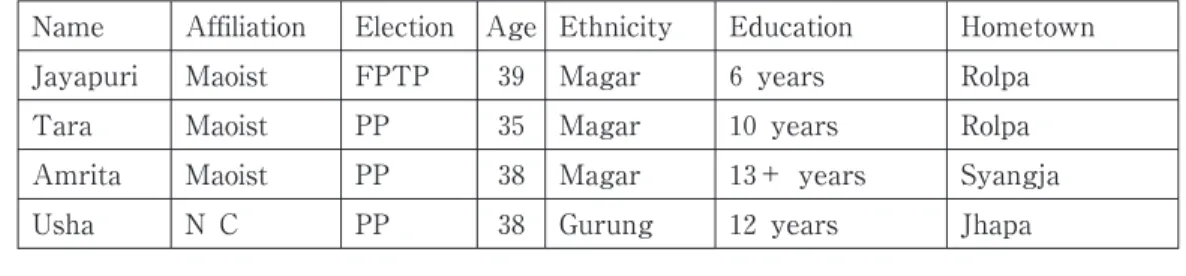
All of women being interviewed are in their 30 s and belong to the ethnic commu- nity located in rural area12. They dont have higher education or wealthy family background. One woman graduated only elementary school and others graduated secondary education (See Table 4).
10 IDEA has Quota Project for Women. See website 〔http://www.quotaproject.org/〕
11 UNICEF 2006 The State of the Worlds Children 2007〔http://www.unicef.org/sowc 07 /docs/sowc 07.pdf〕
12 Each interview carried out at a Maoist Office, Parliament Hall, and took approximately one and half hour per person with Nepali language, all being tape recorded after getting permission from the interviewees.
Table 4 Attribution of interviewees
Name Affiliation Election Age Ethnicity Education Hometown Jayapuri Maoist FPTP 39 Magar 6 years Rolpa Tara Maoist PP 35 Magar 10 years Rolpa Amrita Maoist PP 38 Magar 13+ years Syangja Usha N C PP 38 Gurung 12 years Jhapa
There are some reasons to be able to become a CA member. They dont have any resources to join politics, which are high education, economic background, and political network. Furthermore, they do not belong to Brahman!Chetri society oc- cupied by political leaders but to ethnic society. However, they became CA mem- bers through practicing long efforts for about 20 years. They started joining politi- cal parties at local village and climbed to the National level step by step.
Moreover, they have common experi- ence, interest, feelings and motivations to join politics. That is discrimination. They have experienced being discriminated against, based on ethnic, rural, poor back- ground, and especially being women.
Amrita said that, I have wondered why people discriminate against the poor, eth- nic people and women since schooldays.
The boys teased me about my Mongolian face. I didnt know why they teased at that time. Girls from the Aryan were not teased. I had unpleasant experience not only in rural area but in Pokhara, the sec- ond biggest city in Nepal. Furthermore school teachers taught us the Magar peo- ple were strong, boorish and too honest.
There were many discriminatory descrip- tions on textbooks in school days. There were some sexually harassing descriptions, too. That is; young boys call Magar girls little Magarni despitefully. I understand education encourage discrimination.
Jayapuri said when I went to cities, I felt being looked down as a rustic. Some school teachers despised us and used rough language.
All of them have conflicting opinions to- wards distinction of people by money.
Tara wondered why people have been di- vided into poor and rich. Jayapuri also said I was very poor. I had to earn money to go to school. I had to walk for 9 days bringing heavy crops as a porter to earn small rupees to pay school fee. As my village is in remote area, it took 9!10 days for round trip for a near bazaar.
During this trip I slept and ate food on the way. Nevertheless it was hard work, I could get only 14 rupees bringing about 50 kg.
Not only in society but also in their own families, they faced educational discrimina- tion on gender. People in villages sup- posed daughters did not need to go either to school or to hospital. There were only two girls in my school. However my mother gave me education. I began to go to school when I was twelve years old.
She grew up in her poor family without education and delivered twelve children including me. Although she was poor, she sent me to school. Sometimes people ac- cused her of sending daughters to school.
But she had not bow to social notion, Jayapuri said.
Experiences and feelings in childhood must have made them have interest in
politics and go to the political parties.
Commonly they practiced social work in early school days. Usha said her history in her schooldays. I used to support for so- cial justice. When I saw someone looked down, I felt strong anger towards the meanness. Regardless of my own safety I tried to resolve the issue even if I was lit- tle. I was 12!13 years old when I began working as a social mediator in a village.
When fire occurred I used to help the vic- tims as a volunteer. When quarrels and scuffles occurred I used to intervene to make reconciliation. Therefore my mother had been trembled for the safety of mine.
This interference in the society may be sign to become a politician when thinking now.
Before joining the political party, she or- ganized a voluntary association to prevent youth from using drugs in Kakarvitta, south!eastern Nepal near border with In- dia. In those days youths drag addiction was a serious problem. Accordingly she discussed what to do to stop using drugs with her fellows, and she arranged Night Chess Club where youth play chess!game taking some tea. Many young people stopped crossing border to India because they can spend their time playing chess in the club. The club is still now there.
Amrita also worked as a volunteer in a Magar ethnic school in her village.
Fleeing from restricted social norm
They are ordinary women in remote ar- eas. Women in Nepal were taught being moderate, holding own opinion in mind, and that consciousness of shame is high virtue for women.
Tara confessed me that she used to flee away from her house because of her shame when some guests visited. Not only Tara but many of them were ashamed to stand in front of people, to give speech, and even to take meals.
However, their feeling of shame disap- peared little by little while acting in par- ties. As Amrita thought people whom she faced were fellows in her group, she could sweep away her shame. They also were educated how to speak as politicians and practiced training to sweep away tradi- tional womens norm. In other words, they had to change their minds and behaviors to practice political action. During the peo- ples war (Maoist insurgency), they had to walk, fight, sleep, work, eat, and do every- thing with male fellows.
Influence of Civil War
All of them weve involved in the civil war. Although Jayapuri and Amrita be- longed to administrative section in the Maoist without fighting, they were living next to the death. Tara participated as a commander and she was detained in a jail in India for being a Maoist for two years.
Usha also was arrested and detained in a jail for objecting activities to Monarchy.
Their experience in the civil war showed male political leaders womens ability to become a political leader as well as womens earnest mind to democracy13. According to Ushas analysis, the reason why she became a CA member is that her achievement spreading democracy from the border with India had been rec-
ognized by her party. Hence she is sure to have been selected as a candidate for the PP.
They spent long time and process to be- come a CA member. They began political action at a small local lever, and they climbed a ladder to the CA. They showed positive proof being able to become politi- cal leader with great effort. Therefore, it took a long process to reach a CA mem- bership for 23 years on average (see Table4).
13 The Maoist published a small book collected female leaders voice. (see Mahila Dhwani) Table5 Womens long process to CA
Name Personal history affiliated sub!groups in Party Jayapuri Total period of enrollment in the party:27 years
1.a member of Youth organization in Maoist 2.a member of women committee in Maoist 3.a member of central committee
4.CA members
Tara Total period of enrollment in the party:20 years
1.a member of student organization in Maoist for one year 2.a member of village women committee in Maoist for one year 3.a president of village women committee in Maoist for one year 4.a member of regional committee in Maoist for one year 5.a president of regional committee in Maoist for two years 6.a member of district committee in Maoist for one year
7.a president of district women committee in Maoist for three years 8.a member of central committee
9.CA member
Amrita Total period of enrollment in the party:22 years 1.a member of student union in Maoist
2.a member of Nepal National Independent Student Union 3.a member of central committee
4.CA member
Usha Total period of enrollment in the party:23 years 1.a member of Youth club in Congress
2.a member of Jhapa district Tarun Dal in Congress(the youth wing of Nepali Congress Party)
3.a member of center committee 4.CA member
Source: Interviews with CA women
5. Did Women Accomplish Gender Equality in Politics?
Women in Nepal obtain one!third seats in the CA being empowered by laws to practice equal legal rights showing their experience and ability to Nepal society.
Now they look like getting gender equal- ity. Is that true?
Certainly they get quota seats in the CA. However, glancing over the Govern- ment, there are only a few women in the Cabinet. In the Prachanda Cabinet from Aug 2008!May 2009 founded by the Mao- ist, three women took posts of the Minis- ter. The following Madhav Kumar Nepal Cabinet founded by the UML installed only two women as a Minister of Foreign Affairs and a Defence Minister. The for- mer is Sujata Koirala from NC, a daughter of the ex!prime minister, and the latter is Bidyhya Devi Bhandari from UML. The number of women in the Cabinet now in- cluding state ministers and assistant minis- ter are 5 out of 43. Not only in the Cabi- net but in the Political parties, there are a few women in central committees.
Therefore increasing women in the Cabi- net and the political parties is important problem to resolve gender imbalance.
Furthermore chance of being elected is different on gender. Probability of getting seats in the CA is very low for women except the Maoist and the Madeshi Forum women (Table 6). Women had disadvan- tages from the first step of the CA elec-
tion in every party. Leaders did neither put on many women candidates for the FPTP. What was worse they might be provided difficult electoral districts for get- ting seats.
Women politicians are not satisfied with the quota in political, administrative, gov- ernmental, judicial, educational and other fields. They need to get more proportion in every field. They think the gender dis- crimination sill exists and is a deep!rooted social problem. All of them insisted that women should obtain at least a half of the CA seats, considering the proportion of men and women in the population.
Women need specific supports for get- ting socio!political power. Although women have equal legal rights for inheritance from parents, marital age, citizenship, and so on, those rights are only on the paper.
Most of ordinary people do not practice the new regulations actually.
Usha told me Changing socio!cultural custom is difficult, because people have practiced them for long time. We need drastic change to reform the gendered tradition, and those are duties of the new government. Firstly the Nation has to be reconstructed. We continue our political gender equality movement.
6. Conclusion
It is clear from what has been described on this paper that there are some reasons
participating in politics for women, and that there is a long process for them to come from local political bodies to the cen- tralized authority such as Parliament.
Women have showed their activity and proved to be able to become political lead- ers for 20 years and more. A cue must be the civil war demanding democracy against Monarchy. It is no more than one opportunity to appeal their political ability.
They have continued to build up their ca- pability of making democracy, building peace, abolishing poverty and putting an end to gender discrimination.
Certainly women in Nepal have accom- plished the one!third quota in the Parlia- ment with their great efforts. However, it is not a close but merely a step to get gender equality. They leave a lot of home- work to accomplish gender equality in politics.
Nepali womens experience will contrib- ute to promoting gender equality in poli- tics for women in other Asian societies.
References
All Nepal Womens Association ( Revolu- tionary) Central Committee.
Table 6 Number of elected/defeated candidates
PARTY WISE RESULT of FPTP Candidate
Total Elected
Party Name Female Male Female Male Total
1 Unified Communist Party of Nepal
(Maoists) 43 197 240 24 96 120
2 Nepali Congress(NC) 26 214 240 2 35 37
3 CPN(UML) 27 212 239 1 32 33
4 Madhesi People's Rights Forum 3 100 103 2 27 29
5 Tarai!Madhes Loktantrik Party 4 90 94 1 8 9
6 Sadbhawana Party(Mahato) 4 83 87 0 4 4
7 Janamorcha Nepal 28 175 203 0 2 2
8 Nepal Workers and Peasants Party 27 71 98 0 2 2
9 Rastriya Janamorcha 15 107 122 0 1 1
10 Rastriya Prajatantra Party 22 210 232 0 0 0
11 Communist Party of Nepal(M.L.) 11 105 116 0 0 0
12 Communist Party of Nepal(United) 6 49 55 0 0 0
13 Rastriya Prajatantra Party Nepal 8 196 204 0 0 0
14 Rastriya Janshakti Party 14 184 198 0 0 0
15 Rastriya Janamukti Party 8 76 84 0 0 0
16 Communist Party of Nepal
(Unified) 10 126 136 0 0 0
17 Nepal Sadhvawana Party
(Anandidevi) 13 91 104 0 0 0
18 Rastriya Janata Dal 0 8 8 0 0 0
Others 58 509 567 0 1 1
Independents 42 774 816 0 2 2
Total 369 3577 3946 30 210 240
Source:Nepal Constituent Assembly Portal
2007 Mahila Dwani (Womens Voice) Bennett, L.
1983. Dangerous Wives and Sacred Sisters: Social and Symbolic Roles of High!Caste Women in Nepal NY: Co- lumbia University Press.
Election Commission Nepal
2008 Sambidhan sabha Sadasya Nir- vachan (CA Member Election) 2064 Gellner, D. and Hachhethu, K.
2008 Introduction in Geellner and Hacchethu eds. Local Democracy in South Asia: Microprocesses of Democ- ratization in Nepal and its Neighbors SAGE Publications.
Gray J.N.
1990 (1982). Chetri Women in Domes- tic Groups and Rituals in M. Allen &
S.N. Mukherjee (eds.), Women in India and Nepal, pp.211!41. New Delhi: Ster- ling Publishers.
OCHA (Office for the Coordination of Hu- manitarian Affairs) Nepal.
2008 Internally Displaced Persons (IDPs): Current Status. OCHA Nepal.
UNDP
2009 Nepal Human Development Re- port 2009 UNDP Nepal
UNICEF
2006 The State of the Worlds Chil- dren 2007 UNICEF
ネパールにおける女性と選挙
―内戦後のネパールにおける女性の政治活動の活性化について―
相内 眞子 幅崎麻紀子
抄 録
小論は、ネパールを事例に、内戦を、既存のジェンダー構造を転換し、女性の政治参画を生 み出す転換点として捉え、これまで政治と遠い世界に生きてきた女性たちを政治運動に駆り立 てた要因について、その理由を女性議員のライフヒストリーをもとに探るものである。
ネパールは、内戦を経て王政を廃止し、民主制の共和国として再建された。クォータ制を採 用した選挙制度の下、国会における女性議員比率はアジア諸国で最も高い。女性の政治的地位 の大きな変化はどのようにもたらされたものなのか、あるいは「ジェンダー平等」は遂行され たといえるのか。本研究は、ネパールの政治史を概観し、次に内戦後の政憲議会議員として選 出された女性に密着し、政治活動を展開するに至った経緯、政治活動を可能にした資源、政治 活動による生活の変化、そして、女性たちにとっての内戦と政治活動の結びつき等について聞 き取り調査を実施し、その結果を論述したものである。
女性たちは、内戦やローカル社会での様々な活動を経て、現在、国会議員に上り詰めたこと、
政治活動を行う現在においてもなお、ジェンダーに基づく差別の存在を感じていること、そし て、それを改善するために、政党の壁を越えた女性政治家のグループを構築していることがわ かった。
本研究は、平成22年度科学研究費補助金・基盤研究(C)による共同研究であり、2010年8 月に開催されたAPSA/JAWS研究会(アメリカ・ワシントン市)にて報告された論文を 改訂したものである。
キーワード:ネパール、女性の政治参画、クォータ制