The 7th National Survey of the Sexual Behavior of Japanese Youths
その他のタイトル 日本の若者の性情報のニーズ : 第7回青少年の性行 動全国調査に基づいて
著者 大倉 韻, 守 如子, 羽渕 一代
journal or
publication title
関西大学社会学部紀要
volume 50
number 2
page range 11‑32
year 2019‑03‑31
URL http://hdl.handle.net/10112/16922
Sexual Information Needs of Japanese Youths:
The 7
thNational Survey of the Sexual Behavior of Japanese Youths
Hibiki OKURA・Naoko MORI・Ichiyo HABUCHI
日本の若者の性情報のニーズ
~第 7 回青少年の性行動全国調査に基づいて~
大倉 韻・守 如子・羽渕 一代
抄 録
本稿は、2011年に行われた第 7 回青少年の性行動全国調査(JASE)のデータに基づき、日本の若者の性 行動の現状を明らかにすることを目的としている。この調査は、7640人から回答を得ており、若者が性的 関心をもたなくなってきたのはなぜかといった問題に焦点をあててきた。本稿は、この調査の項目のうち から、「あなたがいま、性について知りたいことは何ですか」という質問に着目して分析を行った。分析か ら得られた第一の結果は、性情報のニーズは、性別と学校段階によって、いくつかのタイプに分けること ができるという点である。第二の結果は、性情報のニーズは、「性行為と妊娠」「性的な悩み」「性病」「恋 愛」という 4 つのカテゴリーに収斂していくプロセスとみることができるという点である。特に、日本の 若者にとって、「セックス(性交)」は、恋愛としてよりもむしろ妊娠に関わるものとして意識されている ということ、その一方で性交によって生じる別種のリスクである「性感染症」や「エイズ」のリスクは性 交とは独立したものとして意識されていることが明らかになった。また、第三に、性的関心が性情報ニー ズと正の相関がみられたことから、性的関心が性情報ニーズに強い影響を与えていることが明らかになった。
キーワード:性情報、若者、性行動
Abstract
This study examines the sexual behavior of Japanese youths. Using quantitative data gathered from the 7,640 respondents to the 7th National Survey of the Sexual Behavior of Japanese Youths, it explores why sexual interest is declining in Japan. The main question of our study posed is “What would you like to know about sexuality?” Our analysis provides the following results. First, Japanese youths need several types of sexual information, varying in accordance with gender and school level. Second, sexual information needs to address four factors: (1) sexual intercourse and pregnancy, (2) the anguish of sexuality, (3) sexual diseases, and (4) romantic love. We think it important to note that Japanese youths consider sexual intercourse to be strongly related to pregnancy but not to romantic love. Additionally, Japanese youths do not seem to link sexual intercourse to the risk of contracting an STD. Third, sexual interest was correlated with the need for sexual information.
Keywords: Sexual information, Japanese youths, sexual behavior
1. Introduction
In Japan, the lack of interest in love and sex among youths has been attracting attention. This is foregrounded by the well-known issue of the country’s declining birth rate. It has often been argued that the cause of this decline was compounded by persistent gender inequality in the workplace and the hesitation on the part of couples to start families, owing to economic reasons (Ochiai 2004, Yamada 2007, Matsuda 2013).
In the mass media, this situation had also been attributed to the rise of the “herbivorous boy” (“Sousyokukei danshi”), which became a buzzword in the late 2000s and which referred to males who were passive in matters of love and sex (Morioka 2008).
Although a direct causality between the rise of the “herbivorous boy” and the declining birth rate remains to be determined, it is indisputable that the proportion of young people who are passive in matters of love and sex has increased. According to the National Survey of Sexuality among Young People, which has been conducted every 6 years since 1974 by the Japanese Association for Sex Education (JASE), of which we are members, the number of youths who do not show any interest in sexual matters increased more rapidly than the number of those who do. Hayashi (2013)
analyzed the data and demonstrated that this polarization became more accentuated with every decade. The author also found that the age at which people started being interested in sex increased as well.
Why is sexual interest declining in Japan? The main question this study asked respondents was: “What would you like to know about sexuality?” We focused on the latter information needs to understand what subtends the apparent lack of sexual interest of young Japanese individuals.
Research on the information needs of young people regarding their sexual education
is currently gaining ground. However, the subject was largely ignored in the past. In
Japan, some people and groups, especially politicians and the religious right, object to
proactive sexual education because they believe that providing information about sex
encourages young people to engage in sexual activity. On the other hand, advocates for
sexual education often approach it largely from a theoretical viewpoint. Neither the
proponents nor the deterrents of sexual education adequately grasp the information
needs of young people. To reevaluate sexual education in schools, it is first necessary to understand students’ needs for information. For older respondents, Daneback et al.
(2012) conducted a mass survey of Swedish people aged 18 to 65 to identify those who used the Internet to seek information about sexual issues and to examine the reasons for using the Internet for this purpose. They found that the three most commonly cited reasons for using the Internet to seek information about sexuality were “to get to know my body”, “to learn about how to have sex”, and “because of curiosity about sex”. The most common reason in the youngest age group (18–24 years) was “to get to know my body”. The authors demonstrated that the need for sexual education continued even into adulthood.
There are two important prior studies that have examined the information needs of youths regarding sex-related matters. Tanton et al. (2015) assessed the progress of meeting young people’s sexual education needs in Britain. They examined the then- current situation and the changes over the previous 20 years in sources of information on sexual matters and unmet information needs. They evaluated the latter by asking,
“Looking back to the time you first felt ready to have some sexual experiences yourself, is there anything on this list that you now feel you ought to have known more about?” The authors stated that most men and women felt they ought to have known more, especially about topics related to reducing the potential health risks of sexual activity (e.g., the rubric “STDs”) and psychosexual issues (“sexual feelings, emotions, relationships”). According to the authors’ analysis, the respondents’
information needs varied little by gender. The only difference was that women were more likely than men to have wanted to know about “contraception/birth control” and
“how to say no”. The other study, by Iketani (1993), examined the need for sexual
education among the younger generation in Japan to reevaluate sexual education as a
whole. According to the survey, the most common “thing to want to know” among
elementary school upper-grade boys was “how boys’ bodies developed”; while the two
most common “things to want to know” among elementary school upper-grade girls
were “how a baby is born” and “how girls’ bodies developed”. With the development of
secondary sexual characteristics, primary-school children were likely to be interested in
their own bodies. However, the two most commonly cited “things to want to know” by
junior high school students were “the difference between men’s and women’s mindsets”
and “how to interact with boy/girlfriends”. Thus, the study showed that information needs about sexuality varied according to school level.
Drawing on the foregoing two precedents, our paper examines the information needs of Japanese youths regarding sex-related matters and explores how these needs vary by gender, school level, and other factors.
2. Methods and Procedure
The JASE conducted surveys in 1974, 1981, 1987, 1993, 1999, 2005, and 2011. All samples were randomly selected from eligible classes in junior high schools, senior high schools, and universities in Japan using stratified probability sampling. For this study we mainly used the data collected in 2011 (7640 respondents).
Measures and Variables
We assessed seven general areas: sexual experiments and behavior; sexual norms and awareness; sexual damage; sex education, knowledge and information; friendship; family relationships; and media usage.
These categories were further subdivided as follows:
1) Sexual experiments and behavior:
Sexual interests
Sexual information needs Dating
Kissing Intercourse Masturbation
2) Sexual norms and awareness:
Image of sexuality in general
Gender role consciousness
Sexual norms (about intercourse without love, prostitution)
3) Sexual damage:
Sexual harassment Date rape
4) Sex education, knowledge, and information:
Sex education Sexual interests Information resources Sexual knowledge
5) Friendship:
Number
6) Family relationships Image
Cohabitation
Parental employment
7) Media usage:
Mobile media usage SNS usage
Pornographic sites Game sites
Results
We have tabulated the results as follows:
1: Sexual interest
Table 1 presents the frequency of sexual interest by gender and school level. Male
students expressed a greater sexual interest than female students, and older students
were more interested in sexuality than younger ones. Specifically, 95.1% of male university students reported having sexual interests but only 71.5% of female university students did. In some contexts, a number of young Japanese males seemed to be asexual — the so-called “herbivorous men”. However, according to the data, females appeared more “herbivorous” than males in Japan.
Table 1. Sexual interest Total Junior high
male Junior high
female High school
male High school
female University/
college male University/
college female
Has sexual interests 58.2% 41.2% 33.0% 73.5% 44.5% 95.1% 71.5%
No answer 2.5% 2.2% 2.0% 2.3% 4.0% 0.5% 3.1%
N 7682 1271 1233 1006 1572 1036 1564
Table 2 shows changes in sexual interest between 1981 and 2011 and indicates that the proportion of young people reporting an interest in sexual matters declined
(Hayashi, 2013). Table 3 shows changes in sexual interest in the following demographic cohorts: 1963–68, 1969–74, 1975–80, 1981–86, 1987–92, and 1993–99
(Hayashi, 2013). Approximately 80% of male students born between 1963 and 1968, and between 1981 and 1986, reported being interested in sexual matters by 14 years of age, but this rate declined in those born between 1987 and 1992, and this tendency became more marked in those born between 1993 and 1999. Indeed, in this sample,
Table 2. Sexual interest by school level (1981–2011)
1981 1987 1993 1999 2005 2011
Total 87.9 69.4 70.6 74.3 61.0 58.2
Junior high male – 52.5 53.9 59.2 44.9 41.2
High school male 92.8 89.6 89.9 90.5 78.5 73.5
Junior college male – – – 100.0 – –
University/college male 98.2 95.9 96.7 99.4 93.8 95.1
Junior high female – 45.5 48.6 49.2 37.1 33.0
High school female 75.0 71.4 70.5 76.9 54.8 44.5
Junior college female 87.6 83.4 88.0 84.8 – –
University/college female 90.4 85.7 87.8 91.1 87.0 71.5
No answer 3.2 5.6 5.1 2.7 3.6 2.5
N 4,989 8,681 4,944 5,492 5,437 7,682
Hayashi (2013) analysed all data.
interest in sex seemed to decline according to become young cohorts. Furthermore, only 70.3% of females born between 1987 and 1992 reported being interested in sexuality by 20 years of age, and less than half of those born between 1993 and 1999 reported sexual interest by the age of 18. The age at which Japanese girls and young women became interested in sexual matters increased as a function of time.
Table 3. Age at first sexual interest by cohort Cumulative experience proportion of sexual interest
Birth cohort
Age 1963–68 1969–74 1975–80 1981–86 1987–92 1993–99
Male
10 13.1 9.9 14.1 13.9 11.4 8.6
12 44.1 37.1 40.5 43.5 33.6 26.9
14 85.4 72.7 76.9 76.5 65.4 54.2
16 94.6 85.8 91.4 89.5 80.1 67.8
18 95.4 87.6 93.3 91.4 84.2 68.9
20 96.2 – – – 86.7 –
N 2,004 3,103 2,444 2,552 2,954 2,279
Female
10 5.6 4.4 9.2 9.0 7.6 6.3
12 23.0 25.6 31.0 30.2 21.7 17.0
14 57.3 54.4 55.3 55.2 40.7 33.7
16 77.1 70.7 73.7 73.2 56.5 44.7
18 84.2 77.8 80.5 83.2 65.0 48.4
20 85.5 85.2 82.7 87.1 70.3 –
N 1,985 3,051 2,243 2,511 3,240 2,780
Hayashi (2013) analysed all data.
2: Sexual information needs
In terms of areas in which additional information was needed, 24.6% of the youths cited “romantic love”, 20.5% mentioned “the differences between men’s and women’s mindsets”, and 15.2% wanted to know about “sexual minorities”. The need for sexual information about romantic love was the most frequently cited topic among junior high and high school students, whereas university students were more likely to cite “the differences between men’s and women’s mindsets”. Older students wanted to know about “methods of contraception”, “HIV/AIDS”, “STDs”, “the differences between men’
s and women’s mindsets”, and “sexual minorities”.
There was also a gender effect on sexual information needs. Specifically, older male
students wanted to know more about the “mechanics of pregnancy” than did younger male students, whereas older female students were less interested in this than were younger female students.
Table 4. Sexual information needs Total Junior high
male Junior high
female High school
male High school
female University/
college male University/
college female
01. How a baby is born 7.1% 5.4% 9.1% 7.8% 6.6% 8.1% 6.0%
02. Sexual intercourse 14.0% 15.1% 15.6% 16.8% 10.0% 15.5% 13.0%
03. Birth control 10.7% 6.5% 12.1% 9.2% 10.2% 10.8% 14.4%
04. (Induced) abortion 8.2% 5.3% 9.4% 6.0% 7.5% 9.6% 10.8%
05. Masturbation 8.8% 10.0% 13.5% 7.9% 7.2% 5.5% 8.5%
06. HIV/AIDS 12.7% 9.0% 9.9% 11.9% 9.9% 17.7% 17.9%
07. STD 14.3% 9.3% 11.7% 11.7% 11.7% 18.3% 21.6%
08. The difference between men
and women’s mentality 20.5% 11.7% 15.1% 17.5% 19.9% 25.1% 31.3%
09. Romantic love 24.6% 18.4% 27.7% 24.0% 23.6% 24.0% 28.6%
10. Gender equality 8.7% 6.9% 7.8% 7.9% 4.8% 11.4% 13.6%
11. Sexual harassment, sexual
abuse 7.7% 5.8% 9.0% 5.1% 6.2% 9.2% 10.3%
12. Consultation for sexual
problems / anxiety 8.5% 4.9% 7.4% 5.1% 9.8% 8.1% 13.1%
13. Sexual minority 15.2% 7.0% 14.3% 8.3% 18.0% 14.8% 24.2%
14. Others 1.4% 0.8% 0.6% 2.3% 1.9% 2.3% 0.8%
15. Nothing to want to know 42.8% 61.9% 46.0% 50.8% 39.7% 37.4% 27.2%
N 7682 1195 1196 974 1538 1016 1539
3. Effects of developmental stage
The previous section on the perceived need for information about sexual matters showed that information needs differed depending on gender and school level. In this section, we used a factor analysis of gender and school level to examine the context in which this need for information emerged. This analysis was based on responses to the question: “What would you like to know about sex? Please circle any that apply to you”. After excluding “Other” and “Nothing” responses, we used the results of a principal factor analysis (promax rotation) to obtain the pattern matrix shown Table 5.1. Factor loadings > 0.2 are indicated in bold.
Within the whole sample (Table 5.1), the aspects included in the “sexual intercourse and pregnancy” factor were “sex”, “masturbation”, “contraceptive methods”,
“pregnancy”, and “abortion”. The rubrics included in “the anguish of sexuality” factor
were “issues of sexual violence and harassment”, “sexual minorities (e.g., homosexuals and those with gender identity disorder)”, “issues of gender equality”, and “counselling for sexual anxiety and problems”. The aspects included in the “sexual diseases” factor were “venereal diseases such as chlamydia and gonorrhoea”, and “HIV/AIDS”; lastly, those in the “romantic love” factor were “love” and “the difference between men’s and women’s mindsets”.
In general, given the lack of overlap between the factors above, male junior high students (Table 5.2) appear to have only vague information about sex. We can assume that the vague “unease about sex” factor emerged because most of the options were not familiar to junior high school students. The second factor was “love and sex”, which included “sex”, “masturbation”, and “love”; the third was “male–female relationships”, which is consistent with the comparatively large number of responses related to gender differences.
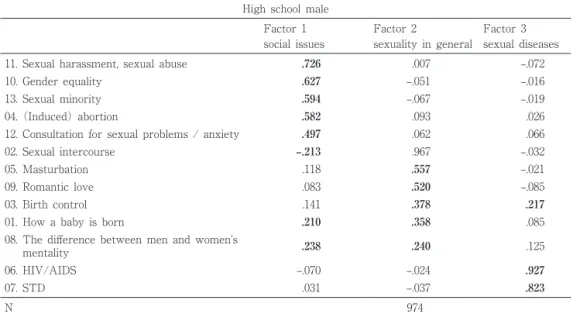
Among male high school students (Table 5.3), the first and third most common factors were the same as in the analysis of the total sample: “the anguish of sexuality”
and “sexual diseases”. The second factor was “sexual relations in general”, which incorporated responses related to “romantic love”, “sex”, and “pregnancy”. The inclusion of “romantic love” and “sex” in the same factor among male junior high and high school students differs from the results obtained from students in other grades and from females. Male university students showed a stable factor structure that was the same as that of the overall analysis.
The factor structure for female junior high school students (Table 5.4) was inconsistent with that for male junior high school students, suggesting gaps in the sexual knowledge of the respondents. The first factor, “sexual risks,” included items that related to personal risks and risk managements arising from sex, such as contraception, pregnancy, abortion, and venereal diseases; the second factor,
“intercourse”, included many aspects focused on “sex” and “masturbation”. The third factor, “romantic love”, contained items related to love. Similar to the first factor, the fourth factor included many elements that dealt with the “negatives” of sex, but, as these dealt with larger-scale social problems, this factor was called “social issues”.
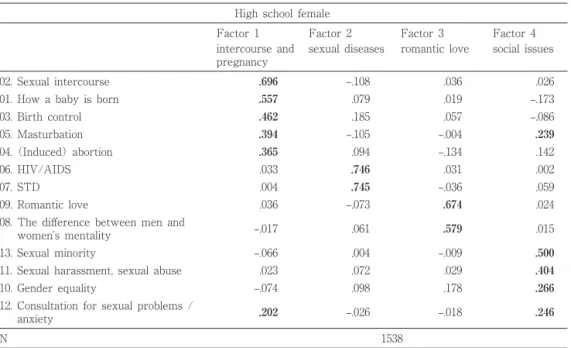
The factor structure for female high school students (Table 5.5) was essentially
identical to that of the overall sample. However, it differed from that of high school males, reflecting the fact that females mature sexually earlier. It should be noted that
“masturbation” was included within the “social issues” factor. As explored in detail in the next section, females view masturbation as undesirable or as an act that should be shunned, and this leads junior high and high school female students to think that engaging in masturbation is a “problem”.
Female university students showed the same stable factor structure as their male counterparts, and therefore also similar to the overall analysis.
Although not a paired sample, if we suppose that the results at each school levels reflect the children’s development, we can see this as a process in which “vague unease about sex” and “vague expectations for sex” crystallize as students mature, eventually converging in the four categories of “intercourse and pregnancy”, “the anguish of sexuality”, “sexual diseases”, and “romantic love”.
Table 5.1 Factor structure of sexual information needs (promax rotation)
Total
Factor 1 Factor 2 Factor 3 Factor 4
sexual intercourse
and pregnancy the anguish of
sexuality sexual diseases romantic love
02. Sexual intercourse .793 –.121 –.085 .096
05. Masturbation .532 .078 –.053 –.015
03. Birth control .511 .032 .157 –.043
01. How a baby is born .458 .021 .055 .031
04. (Induced) abortion .308 .253 .127 –.121
11. Sexual harassment, sexual abuse .078 .585 –.060 .002
13. Sexual minority –.036 .522 .000 –.020
10. Gender equality –.107 .506 –.026 .167
12. Consultation for sexual problems /
anxiety .116 .430 .027 –.022
07. Sexually transmitted desease (STD) –.028 .005 .786 –.001
06. HIV/AIDS .029 –.048 .754 .047
09. Romantic love .141 –.035 –.047 .654
08. The difference between men and
women’s mentality –.082 .098 .094 .625
N 7458
Factor loadings > 0.2 are indicated in bold.
Table 5.2 Factor structure of sexual information needs (junior high male)
Junior high male
Factor 1 Factor 2 Factor 3
sexual anxiety love/sexual conduct men and women
04. (Induced) abortion .749 –.023 –.005
13. Sexual minority .717 –.049 –.031
12. Consultation for sexual problems / anxiety .706 –.093 .043
07. STD .676 .032 –.114
03. Birth control .659 .130 –.044
11. Sexual harassment, sexual abuse .497 .091 .120
06. HIV/AIDS .458 .064 .071
01. How a baby is born .299 .145 .275
02. Sexual intercourse –.077 1.030 –.019
05. Masturbation .286 .471 –.033
08. The difference between men and women’s
mentality –.084 –.050 .865
09. Romantic love –.051 .305 .459
10. Gender equality .333 –.127 .388
N 1195
Factor loadings > 0.2 are indicated in bold.
Table 5.3 Factor structure of sexual information needs (high school male)
High school male
Factor 1 Factor 2 Factor 3
social issues sexuality in general sexual diseases
11. Sexual harassment, sexual abuse .726 .007 –.072
10. Gender equality .627 –.051 –.016
13. Sexual minority .594 –.067 –.019
04. (Induced) abortion .582 .093 .026
12. Consultation for sexual problems / anxiety .497 .062 .066
02. Sexual intercourse –.213 .967 –.032
05. Masturbation .118 .557 –.021
09. Romantic love .083 .520 –.085
03. Birth control .141 .378 .217
01. How a baby is born .210 .358 .085
08. The difference between men and women’s
mentality .238 .240 .125
06. HIV/AIDS –.070 –.024 .927
07. STD .031 –.037 .823
N 974
Factor loadings > 0.2 are indicated in bold.
Table 5.4 Factor structure of sexual information needs (junior high female)
Junior high female
Factor 1 Factor 2 Factor 3 Factor 4
sexual risks intercourse romantic love social issues
03. Birth control .621 .208 –.052 –.107
07. STD .592 –.156 –.073 .197
04. (Induced) abortion .582 .032 –.050 .029
06. HIV/AIDS .398 –.105 .076 .210
01. How a baby is born .294 .118 .268 –.146
02. Sexual intercourse –.023 .915 .032 .001
05. Masturbation –.012 .452 –.042 .256
08. The difference between men and
women’s mentality –.064 –.091 .734 .080
09. Romantic love –.054 .123 .611 –.032
13. Sexual minority –.028 .172 –.089 .655
12. Consultation for sexual problems /
anxiety .202 .051 .119 .304
11. Sexual harassment, sexual abuse .120 .211 .090 .271
10. Gender equality .090 –.106 .195 .214
N 1196
Factor loadings > 0.2 are indicated in bold.
Table 5.5 Factor structure of sexual information needs (high school female)
High school female
Factor 1 Factor 2 Factor 3 Factor 4
intercourse and
pregnancy sexual diseases romantic love social issues
02. Sexual intercourse .696 –.108 .036 .026
01. How a baby is born .557 .079 .019 –.173
03. Birth control .462 .185 .057 –.086
05. Masturbation .394 –.105 –.004 .239
04. (Induced) abortion .365 .094 –.134 .142
06. HIV/AIDS .033 .746 .031 .002
07. STD .004 .745 –.036 .059
09. Romantic love .036 –.073 .674 .024
08. The difference between men and
women’s mentality –.017 .061 .579 .015
13. Sexual minority –.066 .004 –.009 .500
11. Sexual harassment, sexual abuse .023 .072 .029 .404
10. Gender equality –.074 .098 .178 .266
12. Consultation for sexual problems /
anxiety .202 –.026 –.018 .246
N 1538
Factor loadings > 0.2 are indicated in bold.
4. Role of the need for information on sex
This section describes a logistic regression analysis performed on the relationship between sexual behavior and the need for information about sex. Age and interest in sex, engagement in masturbation, dating, kissing history, and experience with sexual intercourse were treated as independent variables (converted to dummy values). The following responses to “Things you would like to know about sex” were treated as dependent variables: “1. Mechanics of Pregnancy” through to “13. Sexual minorities”.
Because a major gender difference in the need for information about sex was observed in previous analyses, this analysis was undertaken separately for males and females.
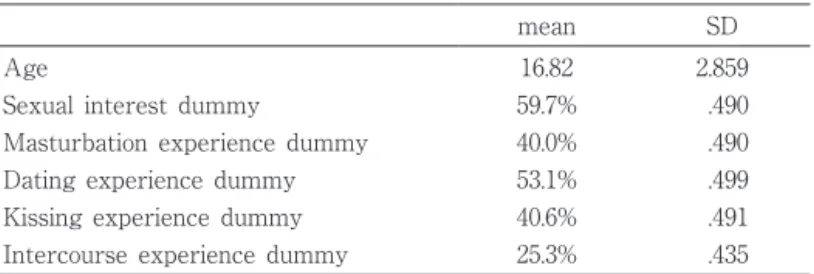
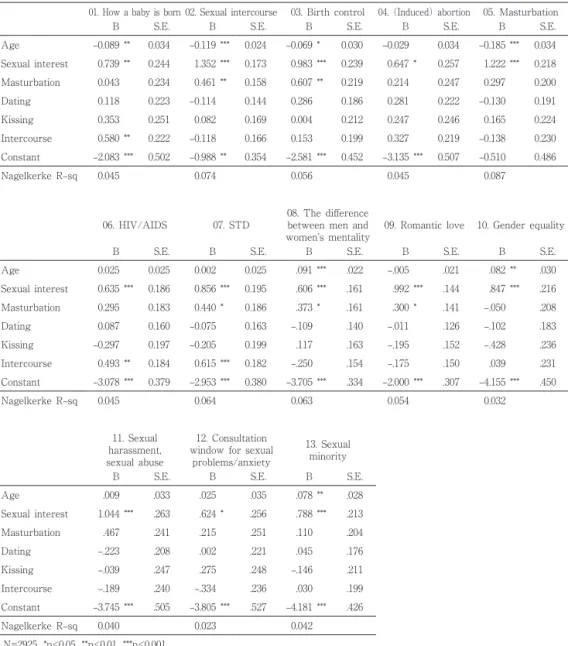
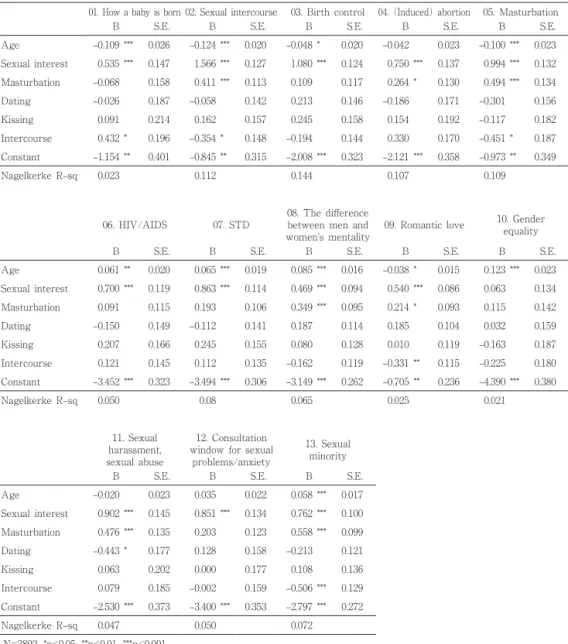
The details for each factor (as well as the average age at which each sexual experience occurred) are shown in Table 6, whereas the results of the logistic regression analysis are shown in Tables 7 and 8.
After confirming the average age at which each sexual experience first occurred, following Nagata’s (2013) “Courting Sequence”, this section also considered sex as a series of experiences that progress from “sexual awareness → masturbation → dating
→ kissing → sex”.
Table 6. Descriptive statistics for each factor
mean SD
Age 16.82 2.859
Sexual interest dummy 59.7% .490
Masturbation experience dummy 40.0% .490
Dating experience dummy 53.1% .499
Kissing experience dummy 40.6% .491
Intercourse experience dummy 25.3% .435
Table 7. Odds ratios from the logistic regression of information needs for male 01. How a baby is born 02. Sexual intercourse 03. Birth control 04. (Induced) abortion 05. Masturbation
B S.E. B S.E. B S.E. B S.E. B S.E.
Age –0.089 ** 0.034 –0.119 *** 0.024 –0.069 * 0.030 –0.029 0.034 –0.185 *** 0.034 Sexual interest 0.739 ** 0.244 1.352 *** 0.173 0.983 *** 0.239 0.647 * 0.257 1.222 *** 0.218
Masturbation 0.043 0.234 0.461 ** 0.158 0.607 ** 0.219 0.214 0.247 0.297 0.200
Dating 0.118 0.223 –0.114 0.144 0.286 0.186 0.281 0.222 –0.130 0.191
Kissing 0.353 0.251 0.082 0.169 0.004 0.212 0.247 0.246 0.165 0.224
Intercourse 0.580 ** 0.222 –0.118 0.166 0.153 0.199 0.327 0.219 –0.138 0.230
Constant –2.083 *** 0.502 –0.988 ** 0.354 –2.581 *** 0.452 –3.135 *** 0.507 –0.510 0.486
Nagelkerke R–sq 0.045 0.074 0.056 0.045 0.087
06. HIV/AIDS 07. STD 08. The difference between men and
women’s mentality 09. Romantic love 10. Gender equality
B S.E. B S.E. B S.E. B S.E. B S.E.
Age 0.025 0.025 0.002 0.025 .091 *** .022 –.005 .021 .082 ** .030
Sexual interest 0.635 *** 0.186 0.856 *** 0.195 .606 *** .161 .992 *** .144 .847 *** .216
Masturbation 0.295 0.183 0.440 * 0.186 .373 * .161 .300 * .141 –.050 .208
Dating 0.087 0.160 –0.075 0.163 –.109 .140 –.011 .126 –.102 .183
Kissing –0.297 0.197 –0.205 0.199 .117 .163 –.195 .152 –.428 .236
Intercourse 0.493 ** 0.184 0.615 *** 0.182 –.250 .154 –.175 .150 .039 .231
Constant –3.078 *** 0.379 –2.953 *** 0.380 –3.705 *** .334 –2.000 *** .307 –4.155 *** .450
Nagelkerke R–sq 0.045 0.064 0.063 0.054 0.032
11. Sexual harassment, sexual abuse
12. Consultation window for sexual
problems/anxiety
13. Sexual minority
B S.E. B S.E. B S.E.
Age .009 .033 .025 .035 .078 ** .028
Sexual interest 1.044 *** .263 .624 * .256 .788 *** .213
Masturbation .467 .241 .215 .251 .110 .204
Dating –.223 .208 .002 .221 .045 .176
Kissing –.039 .247 .275 .248 –.146 .211
Intercourse –.189 .240 –.334 .236 .030 .199
Constant –3.745 *** .505 –3.805 *** .527 –4.181 *** .426
Nagelkerke R–sq 0.040 0.023 0.042
N=2925, *p<0.05, **p<0.01, ***p<0.001.
Table 8. Odds ratios from the logistic regression of information needs for female 01. How a baby is born 02. Sexual intercourse 03. Birth control 04. (Induced) abortion 05. Masturbation
B S.E. B S.E. B S.E. B S.E. B S.E.
Age –0.109 *** 0.026 –0.124 *** 0.020 –0.048 * 0.020 –0.042 0.023 –0.100 *** 0.023 Sexual interest 0.535 *** 0.147 1.566 *** 0.127 1.080 *** 0.124 0.750 *** 0.137 0.994 *** 0.132 Masturbation –0.068 0.158 0.411 *** 0.113 0.109 0.117 0.264 * 0.130 0.494 *** 0.134
Dating –0.026 0.187 –0.058 0.142 0.213 0.146 –0.186 0.171 –0.301 0.156
Kissing 0.091 0.214 0.162 0.157 0.245 0.158 0.154 0.192 –0.117 0.182
Intercourse 0.432 * 0.196 –0.354 * 0.148 –0.194 0.144 0.330 0.170 –0.451 * 0.187
Constant –1.154 ** 0.401 –0.845 ** 0.315 –2.008 *** 0.323 –2.121 *** 0.358 –0.973 ** 0.349
Nagelkerke R–sq 0.023 0.112 0.144 0.107 0.109
06. HIV/AIDS 07. STD 08. The difference between men and
women’s mentality 09. Romantic love 10. Gender equality
B S.E. B S.E. B S.E. B S.E. B S.E.
Age 0.061 ** 0.020 0.065 *** 0.019 0.085 *** 0.016 –0.038 * 0.015 0.123 *** 0.023 Sexual interest 0.700 *** 0.119 0.863 *** 0.114 0.469 *** 0.094 0.540 *** 0.086 0.063 0.134
Masturbation 0.091 0.115 0.193 0.106 0.349 *** 0.095 0.214 * 0.093 0.115 0.142
Dating –0.150 0.149 –0.112 0.141 0.187 0.114 0.185 0.104 0.032 0.159
Kissing 0.207 0.166 0.245 0.155 0.080 0.128 0.010 0.119 –0.163 0.187
Intercourse 0.121 0.145 0.112 0.135 –0.162 0.119 –0.331 ** 0.115 –0.225 0.180
Constant –3.452 *** 0.323 –3.494 *** 0.306 –3.149 *** 0.262 –0.705 ** 0.236 –4.390 *** 0.380
Nagelkerke R–sq 0.050 0.08 0.065 0.025 0.021
11. Sexual harassment, sexual abuse
12. Consultation window for sexual
problems/anxiety
13. Sexual minority
B S.E. B S.E. B S.E.
Age –0.020 0.023 0.035 0.022 0.058 *** 0.017
Sexual interest 0.902 *** 0.145 0.851 *** 0.134 0.762 *** 0.100 Masturbation 0.476 *** 0.135 0.203 0.123 0.558 *** 0.099
Dating –0.443 * 0.177 0.128 0.158 –0.213 0.121
Kissing 0.063 0.202 0.000 0.177 0.108 0.136
Intercourse 0.079 0.185 –0.002 0.159 –0.506 *** 0.129 Constant –2.530 *** 0.373 –3.400 *** 0.353 –2.797 *** 0.272
Nagelkerke R–sq 0.047 0.050 0.072
N=3892, *p<0.05, **p<0.01, ***p<0.001.
The responses obtained from male students confirmed that “sexual interest” was positively correlated with all rubrics, whereas age was negatively correlated with the items included in “sexual intercourse and pregnancy”. The responses obtained from female students showed the same tendency. The data also confirmed that age was positively correlated with several other rubrics and that some information needs were influenced by sexual experiences.
Age was negatively associated with “pregnancy”, “sexual intercourse”, “birth control”,
“abortion”, and “masturbation”. This shows that the need for information on sexual intercourse and pregnancy arose soon after an interest in sex had developed, and that this need decreased in proportion to the amount of information gained. The positive association for “gender equality” and “sexual minorities” reflects that awareness of these as social issues increased as children matured. An additional positive association was found for “venereal diseases” and “AIDS” among females, reflecting a process by which females become aware of sexual risks as they mature, regardless of sexual experience; this contrasts with the attitudes of males towards STDs, which we will examine below.
In terms of experimenting with sex, sexual interest was positively correlated with all dependent variables, although it was statistically insignificant for “gender equality”
among females, which suggests that sexual interest develops first and subsequently gives rise to the need for specific information.
With regard to masturbation, among males, masturbating was associated with an increased need for information about “romantic love” and “sexual intercourse” and, thus, simultaneously gave rise to a need for information on “abortion”, “STDs”, and “the difference between men’s and women’s mindsets”. Although, as with males, masturbation by females increased their need for information about “romantic love”,
“sexual intercourse”, and “the difference between men’s and women’s mindsets”, it also
increased their need for information on “abortion” rather than birth control, and
increased their concern with “sexual violence”and “sexual minorities”. However, the
relationship between female masturbation and the need for information is likely a
spurious correlation
1).
There was no apparent influence of dating or kissing on information needs among either males or females (although going on a date markedly reduced females’ needs for information on “sexual harassment and violence”), but having sex increased the need for information on “pregnancy”, “venereal diseases”, and “AIDS” among males. It also increased the need for information on “pregnancy” among females. Having sex also reduced the need for information on “masturbation”, “romantic love” and “sexual minorities” among females. This shows that having sex dramatically altered the information needs of females, in particular.
5. Discussion
5.1 Relationship between sex and love
According to the factor analysis of data from male university students and all females,
“sex” and “romantic love” were included in different factors. Additionally, sex was incorporated in the “sexual intercourse and pregnancy” factor, along with issues such as birth control and abortion, among male university students and female junior high and high school students. This suggests that sex is strongly associated with pregnancy rather than with romantic love
2). Male junior high and high school students considered sexual intercourse as “something having to do with sexual love”, involving romantic love. For female junior high school students, sex constituted its own domain, unrelated
1) It appears that, among females, rather than increasing the need for information, masturbation reflects a more positive attitude towards sex as a whole. Responses to the question “Have you masturbated?” reflected a clear gender difference, with 91.1% of male university students answering either “Yes, in the last month” or
“Yes, but not in the last month”, versus only 36.2% of female university students selecting these options.
Mori (2013) divided female high school and university students into four groups based on whether they had had sex and whether they masturbated and analyzed the attitude of each group towards sex. The study found that the groups who masturbated (“had sex and masturbated” and “did not have sex but masturbated”) possessed a wealth of information on sex and had a positive image of it. Thus, it is possible to conclude that women who masturbate have the greatest need for information on sex as a whole. It seems reasonable to assume that the relationship between female sex and masturbation is spurious and “that women generally interested in sex will masturbate and gather information on sex”.
2) This does not, of course, mean that love and sex are considered to be entirely unrelated, and the correlation between “love” and “sex and pregnancy” was not low: 0.412 overall, 0.352 for female junior high students, 0.378 for female high school students, 0.399 for male university students, and 0.325 for female university students.
to pregnancy, but it came to be connected to rather pregnancy than sexual love as they progress through school.
Takahashi (2013) has underscored the trend towards “accentuating the risks of sex” among adolescents. For the author, the recent liberalization of sexual mores has promoted self-determination with regard to sexual activity, which has resulted in some young people not receiving accurate information (particularly from their friends) and, thus, thinking of sex as a risk (accentuating the risks of sex for the individual). The connection shown in the above results between intercourse and pregnancy should probably be regarded as one manifestation of this risk awareness.
It is, of course, important to be aware of the risks of pregnancy when engaging in sex, but an excessive preoccupation with this can lead to total suppression of sexual activity. Ishikawa (2006) has argued that, because of an idealist notion of romantic love, young Japanese people today appear to aim for “pure love” and have come to share an idea that “it is natural for love to lead to sex”. If sex and love are obviously linked, then an excessive awareness of the risks of pregnancy through sex could naturally result in limitations on sexual activity as a whole.
The notion has often been vehiculated that the growing number of unmarried people in Japan put off marriage or avoid interacting with boy/girlfriends because they fear the poverty attendant to a ‘shotgun’ marriage (Ushikubo 2015). This study suggests that students share with single people of average marriageable the same uneasiness about sex.
5.2 Relationship between sex and STDs
The previous section addressed the strong connection between sex and pregnancy, but another set of risks that were independent of sexual intercourse — “venereal diseases”
and “AIDS” — exerted an effect on both males and females from high school on. This
suggests that, for the young, STDs are not considered to have a direct connection to
their own sexual activity. The correlations between the “STDs” and “love” factors were
0.182 overall, 0.172 for high school females, 0.199 for university males, and even 0.009
for university females, showing a far lower correlation coefficient in comparison with
other factor correlations.
Although more than 15% of both male and female university students required information on “venereal diseases” and “AIDS”, the fact that there was no relationship observed between their own anticipated sexual activity and the need for information suggests that, for these students, STDs were seen as “important but with no connection to myself or my partner”. While Section 4 indicated the positive association between male sexual activity and the need for information on STDs, this could also be interpreted as a lack of awareness regarding the connection of STDs to themselves until they have actually had sex.
5.3 Effects of sexual activity on females’ needs for information
The logistic regression analysis showed that sexual interest, masturbation (among males), and experience with sex affected the need for information on sex; however, these data also showed that having had sex reduced the need for information of various types among females. It seems that this reflected the anxiety felt by female students with regard to sexual activity. That is, it reflected a psychological dynamic whereby, prior to having sex, females experienced a great deal of anxiety and difficulty with regard to sexual intercourse and their own sexual identity. This manifested in the need for, and pursuit of, information as if they were steeling themselves for sex.
However, once they had had sex, these anxieties and difficulties disappeared or were alleviated, and their need for information decreased. This is an interpretation that fits with sexual intercourse often being described as “not that big a deal” after the first time.
This survey did not consider the “intensity” of the need for information or “whether essential information was being obtained”; it examined whether knowledge about sex was accurate based on the answers to six questions
3). The average number of correct
3) The six questions were: “Extra-vaginal ejaculation (the withdrawal method) is a reliable means of contraception”; “Ovulation occurs only during menstruation”; “If excess semen builds up, it is bad for the body”; “If you don’t seek treatment for STDs, like chlamydia and gonorrhea, you may become infertile
(unable to have children)”; “In Japan, over the last decade, the number of people newly infected with HIV and AIDS has continued to decrease”; and “Oral contraceptives (low-dose birth control pills) are particularly effective as a form of contraception”. The following response options were offered: “Correct / Incorrect / Don’t know / Don’t understand the question”. For the analysis, the answers were coded as “correct” or
“other”. Due to restrictions imposed by the participating schools, these questions were not asked of junior
answers was 2.48 for males who had not had sex, and 2.62 for females who had not had sex, with females being more accurate (p<0.05, t-test). Among those who had had sex, it was 3.10 for males and 3.31 for females. This implies that females were more informed about sex than males prior to engaging in sexual intercourse.
However, this decrease in the need for information does not guarantee the accuracy of the extant information. Indeed, the reduced desire for information after having had sexual intercourse is not necessarily the same as having accurate information. That the average number of correct answers to these relatively easy questions about sex was only just above three for the group that had actually exposed themselves to the risks of STDs and pregnancy suggests that there is cause for concern.
Conclusions
Overall, our data indicate the following: 1) that Japanese youths need different types of sexual information according to gender and school level; 2) that sexual information needs to address the following four factors: “sexual intercourse and pregnancy”, “the anguish of sexuality”, “sexual diseases”, and “romantic love”; 3) that Japanese youths feel that sexual intercourse is strongly related to pregnancy but not to romantic love;
and 4) that Japanese youths do not feel sexual intercourse is related to their risk of contracting an STD; and, regarding the relationship to sexual behavior, 5) that sexual interests were related to sexual information needs. Indeed, sexual interests did affect sexual information needs.
The proportion of Japanese young people interested in sexual matters is decreasing, apparently because of their awareness of the risk of pregnancy. According to our data, they felt that “sexual intercourse means pregnancy” for girls, rendering the avoidance of sexual matters inevitable and indicating that sexual information needs differ by gender and that interest in sexual matters is decreasing more in females than in males.
We understand why Japanese youths would avoid the “risk” of sexuality given their belief that it leads to the “risk” of pregnancy.
high school students; thus, data were obtained only from high school and university students.
References
Daneback, Kristian. Mansson, Sven-Axel. Ross, Michael W. and Markham, Christine M., 2012. “The Internet as a Source of Information about Sexuality.” SEX EDUCATION-SEXUALITY SOCIETY AND LEARNING, 12–5: 583–598.
Hayashi, Yusuke. 2013. “Seishonen no seikoudou no teinenreika bunkyokuka to sei ni taisuru aratana taido (Engaging in sexual behavior at a younger age than in the past, polarization, new attitudes toward sex).” pp.25–41 in Wakamono no sei hakusho: dai7kai seisyounen no sei-koudou zenkoku tyousa houkoku (A White Paper about the Sexuality of Youths: The Report of the 7th National Survey of the Sexual Behavior of Japanese Youths), edited by JASE. Tokyo: Shogakkan.
Ikeya, Hisao. 2003. Sekushuariti to Seikyouiku (Sexuality and Sexual Education). Tokyo: Aoki Shuppan.
Ishikawa, Yukari. 2007. “Zhouhou-gen no chigai ga motarasu sei-isiki no jendaa-sa (Gender differences of sexual awareness based on the source of information),” pp.81–100 in Wakamono no sei hakusho:
dai6kai seisyounen no sei-koudou zenkoku tyousa houkoku (A White Paper about the Sexuality of Youths: The Report of the 6th National Survey of the Sexual Behavior of Japanese Youths), edited by JASE. Tokyo: Shogakkan.
Matsuda, Shigeki. 2013. Shoshika-ron (A Theory about the Decline in Birth Rate). Tokyo: Keisou Shobou.
Mori, Naoko. 2013. “Jii-keiken niyoru zyoshi-gakusei no bunka (Differentiation of Girls Based on Experiencing Masturbation),” pp.161–176 in Wakamono no sei hakusho: dai7kai seisyounen no sei-koudou zenkoku tyousa houkoku (A White Paper about the Sexuality of Youths: The Report of the 7th National Survey of the Sexual Behavior of Japanese Youths), edited by JASE. Tokyo:
Shogakkan.
Morioka, Masahiro. 2008. Soushokukei danshi no ren-ai-gaku (A Study on the Love of Herbivorous Boys). Tokyo: Media Factory.
Nagata, Natsuki. 2013. “Seishounen ni miru kappuru kankei no inishiatibu to kihan ishiki (Initiatives and Normative Consciousness of Couples Relationships in Japanese Youths),” pp.101–120 in Wakamono no sei hakusho: dai7kai seisyounen no sei-koudou zenkoku tyousa houkoku (A White Paper about the Sexuality of Youths: The Report of the 7th National Survey of the Sexual Behavior of Japanese Youths), edited by JASE. Tokyo: Shogakkan.
Ochiai, Emiko. 2004. 21seiki Kazoku he (Toward the Families of the 21st Century) third edition. Tokyo:
Yuhikaku.
Takahashi, Masahito. 2013. “Yokubou no zidai kara risuku no zidai he (From the Age of Desire to the Age of Risk),” pp.43–61 in Wakamono no sei hakusho: dai7kai seisyounen no sei-koudou zenkoku tyousa houkoku (A White Paper about Sexuality of Youths: The Report of the 7th National Survey of the Sexual Behavior of Japanese Youths), edited by JASE. Tokyo: Shogakkan.
Tanton, Clare, Jones, Kyle, G; Macdowall, Wendy, Clifton, Soazig, Mitchell, Kirstin R., Datta, Jessica, Lewis, Ruth, Field, Nigel, Sonnenberg, Pam and Stevens, Amy. 2015. Patterns and Trends in Sources of Information about Sex among Young People in Britain: Evidence from Three National Surveys of Sexual Attitudes and Lifestyles, BMJ OPEN 5–3.
Ushikubo, Megumi. 2015. Ren-ai shinai wakamonotati (Youths Without Romantic Love). Tokyo:
Discover21.
Yamada, Masahiro. 2007. Shoshi syakai Nihon (Decline in the Birth Rate of Japan). Tokyo: Iwanami
shinsho.
―2018.10.19受稿―