
• 検索結果がありません。

福島県立医科大学 学術機関リポジトリ

N/A
N/A
Protected

Academic year: 2021

シェア "福島県立医科大学 学術機関リポジトリ"

Copied!
8
0
0

読み込み中.... (全文を見る)

全文

(1)

Fukushima Medical University

福島県立医科大学 学術機関リポジトリ

This document is downloaded at: 2021-11-07T23:40:35Z

Title Effects of daily alcohol intake on glomerular filtration rate over three years

Author(s) Sato, Yu; Yoshihisa, Akiomi; Maki, Takumi; Takeishi, Yasuchika

Citation Fukushima Journal of Medical Science. 67(1): 1-7

Issue Date 2021

URL http://ir.fmu.ac.jp/dspace/handle/123456789/1378

Rights © 2021 The Fukushima Society of Medical Science. This article is licensed under a Creative Commons [Attribution- NonCommercial-ShareAlike 4.0 International] license.

DOI 10.5387/fms.2020-20

Text Version publisher

(2)

Vol. 67, No. 1, 2021

[Original article]

Effects of daily alcohol intake on glomerular filtration rate over three years

Yu Sato 1)2) , Akiomi Yoshihisa 2) , Takumi Maki 1) and Yasuchika Takeishi 2)

1)

Department of Internal Medicine, Fukushima Prefectural Miyashita Hospital, Onuma County, Japan,

2)
Department of Cardiovascular Medicine, Fukushima Medical University, Fukushima, Japan (Received September 8, 2020, accepted December 8, 2020)

Abstract

Background : The association between daily alcohol intake and changes in renal function in the Japanese general population is not well established.

Methods : We analyzed data from 150 residents who underwent specific health checkups held in Mishima Town in 2016 and 2019. We divided participants on the basis of alcohol consumption : residents with daily alcohol intake of < 20 g/day (the none

-

to

-

low group, n = 104, 69.3%) ; those with daily alcohol intake of ≥ 20 but < 40 g/day (the intermediate group, n = 30, 20.0%) ; and those with daily alcohol intake of ≥ 40 g/day (the high group, n = 16, 10.7%). We compared baseline characteristics. The primary endpoint was a decrease in estimated glomerular filtration rate (eGFR), defined as the decrease in eGFR greater than the median decrease over three years.

Results : The three

-

year changes in eGFR were +0.3 (−4.8, +3.0), −2.3 (−5.1, +1.2), and −4.9 (−8.2, −2.9) mL/min/1.73 m

2

in the none

-

to

-

low, intermediate, and high groups, respectively (P = 0.007). In the multivariate logistic regression analysis, a high amount of alcohol intake was inde- pendently associated with a decrease in eGFR, with adjusted odds ratio of 11.418 (95% confidence interval 1.554

-

83.879, P = 0.017).

Conclusion : A high average daily alcohol intake is associated with a decrease in eGFR.

Key words : glomerular filtration rate, renal function, specific health checkup, general population, alcohol

Introduction

Renal function is a strong predictor of high mor- tality not only in patients with heart failure

1)

, but also in the general population

2)

. All

-

cause and car- diovascular mortality increase with a reduction of estimated glomerular filtration rate (eGFR) below 75 mL/min/1.73 m

2

in the general population

2)

.  However, baseline renal function is unmodifiable, and it is crucial to predict and prevent deterioration in renal function

3)

.

Specific health checkups are useful to detect residents who are at a high risk of cardiovascular disease, and are a good opportunity to provide life- style interventions

4)

. However, the usefulness of specific health checkups for predicting deterioration

in renal function has not been fully examined, espe- cially in the general population with normal renal function. Regarding modifiability, alcohol consump- tion is a target for lifestyle intervention

5-8)

. How- ever, the association between daily alcohol intake and change in renal function has not been fully ex- amined, particularly among Japanese. Thus, to clarify these issues in a general population with nor- mal renal function, we carried out a cross

-

sequential and longitudinal observational study of specific health checkup results in collaboration with local government authorities involved in the administra- tion of Japan’s universal healthcare system.

Corresponding author : Akiomi Yoshihisa, MD, PhD. E

-

mail : [email protected]

©2021 The Fukushima Society of Medical Science. This article is licensed under a Creative Commons [Attribu- tion

-

NonCommercial

-

ShareAlike 4.0 International] license.

https://creativecommons.org/licenses/by

-

nc

-

sa/4.0/

1

(3)

2 Y. Sato et al.

Methods

Subjects and protocol

This was a cross

-

sequential and longitudinal observational study of specific health checkups held in Mishima Town in Onuma County, Fukushima Pre- fecture, Japan. Residents aged 40

-

74 years old were eligible for the checkups. A study flowchart is shown in the Figure. We collected all the results of National Health Insurance beneficiaries who un- derwent specific health checkups both in 2016 and 2019 (n = 187). Residents who lacked data on eGFR (n = 3) and those with eGFR of < 60 mL/

min/1.73 m

2

in 2016 (n = 34) were excluded. Fi- nally, a total of 150 residents (70 male, 46.7% ; me- dian age 67.0 years old) were included in the study. 

We divided participants on the basis of alcohol con- sumption : residents with daily alcohol intake of

< 20 g/day (the none

-

to

-

low group, n = 104, 69.3%) ; those with daily alcohol intake of ≥ 20 but

< 40 g/day (the intermediate group, n = 30, 20.0%) ; and those with daily alcohol intake of ≥ 40 g/day (the high group, n = 16, 10.7%). This study complied with the Declaration of Helsinki and the statement of STROBE (Strengthening the Reporting of Obser- vational studies in Epidemiology)

9,10)

. In addition, since the participants’ information was anonymized and de

-

identified at the Mishima Town Office prior to analysis, written informed consent was not re- quired or obtained from each resident, but opt

-

out methods were explained in public reports of the cur- rent study

11)

. The study was publicized by posting a summary of the protocol on the website of Fuku- shima Prefectural Miyashita Hospital, at Mishima Town Office, and in Mishima Town’s public relations magazine, where a notice clearly informed all resi- dents of their right to refuse enrollment. The study protocol was approved by the research ethics committee of Fukushima Prefectural Miyashita Hos- pital (No. 20190001) and registered under the Japa- nese UMIN Clinical Trials Registration (UMIN 000036620).

We compared baseline (2016) demographic data, social history, past medical history, and the results of blood and urine tests among the three groups. In- formation about social history and past medical his- tory was obtained from a standardized questionnaire. 

Regarding alcohol intake, participants were asked

“How much do you drink per day, when converted to volume of sake?” with four response options (1, < 180 mL ; 2, ≥ 180 but < 360 mL ; 3, ≥ 360 but < 540 mL ; 4, ≥ 540 mL) and a conversion table “180 mL

of sake is equivalent to 500 mL of beer, 110 mL of shochu, 60 mL of whiskey (a double), and 240 mL of wine.” In the present study, 180 mL of sake was defined as containing 20 g of alcohol. Blood and urine tests were performed in a fasting state. The modified Modification of Diet in Renal Disease equa- tion was used to calculate eGFR : eGFR (mL/min/

1.73 m

2

) = 194 * serum creatinine

(−1.094)

* age

(−0.287)

* 0.739 (if female)

12)

. The rate of annual eGFR de- cline in the general Japanese population has been re- ported to be 0.36 mL/min/1.73 m

2

, but this rate is af- fected by the coexisting diseases and baseline eGFR

13)

.  In this study, we set the primary outcome as a de- crease in eGFR greater than the median decrease in this study population. The median three

-

year change in eGFR of the whole study population was

−1.4 mL/min/1.73 m

2

. Thus, change in eGFR over three years below −1.4 mL/min/1.73 m

2

was defined as a decrease in eGFR.

Statistical analysis

Continuous variables were presented as median (25th percentile, 75th percentile) and categorical variables were expressed as counts and percentages. 

The Jonckheere

-

Terpstra trend test and the Co- chran

-

Armitage trend test were used for the com- parisons of continuous and categorical variables, re- spectively. To avoid the problem of multiple comparisons, P values of the pairwise comparisons of groups after the Jonckheere

-

Terpstra trend test were adjusted by the Bonferroni correction. The impact of alcohol intake on a decrease in eGFR was assessed using logistic regression analysis. Odds ratios were then adjusted for age and sex, and fur- ther adjusted for established factors associated with deterioration in eGFR, namely age, sex, body mass index, current smoking, hypertension, diabetes mel- litus, dyslipidemia, estimated glomerular filtration rate, and urine albumin

-

to

-

creatinine ratio

13-15)

. P values of < 0.05 were considered statistically signifi- cant for all analyses. The Cochran

-

Armitage trend test was performed using EZR (Saitama Medical Center, Jichi Medical University, Saitama, Japan) which is a graphical user interface for R (The R Foundation for Statistical Computing, Vienna, Aus- tria)

16)

and all other analyses were performed using SPSS ver. 26 (IBM, Armonk, NY, USA).

Results

In the current study, 16 of the 150 residents

(10.7%) belonged to the high group (Figure). Base-

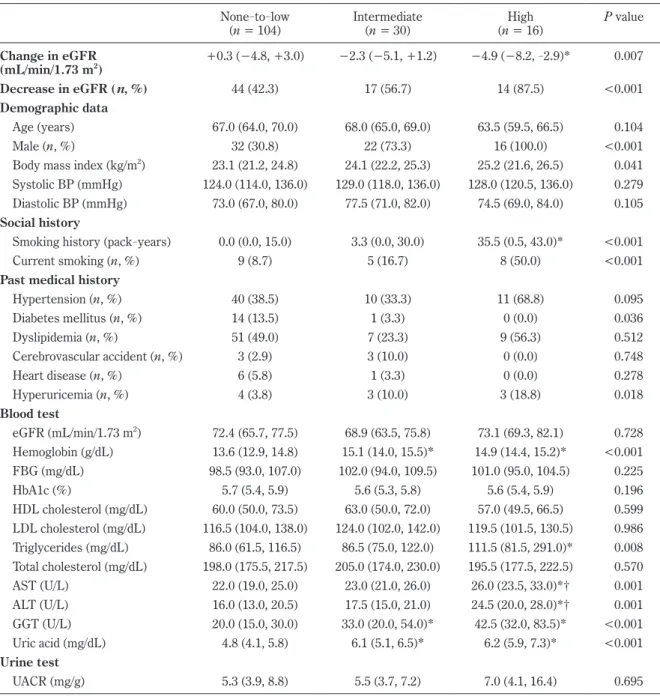
line characteristics are shown in Table 1. The

(4)

three

-

year changes in eGFR were +0.3 (−4.8, +3.0), −2.3 (−5.1, +1.2), and −4.9 (−8.2, −2.9) mL/min/1.73 m

2

in the none

-

to

-

low, intermediate, and high groups, respectively (P = 0.007). There was no trend in age among groups, but the percent- age of males increased with alcohol consumption (none

-

to

-

low, 67.0 years, 30.8% male ; intermediate 68.0 years, 73.3% male ; high, 63.5 years, 100.0%

male, P < 0.001). Regarding social history and past medical history, there were significant trends in cur- rent smoking, diabetes mellitus, and hyperuricemia. 

Blood tests revealed that there was no trend in lev- els of baseline eGFR among the groups (P = 0.728) while there were significant trends from the none

-

to

-

low group to the high group in levels of liver en- zymes. As to urine tests, there was no statistical trend in urine albumin

-

to

-

creatinine ratio.

The results of logistic regression analysis are summarized in Table 2. In the unadjusted model, a high amount of alcohol intake was associated with a decrease in eGFR compared to a low none

-

to

-

low amount as reference (odds ratio 9.545, 95% confi- dence interval 2.063

-

44.163, P = 0.004). After ad- justment for pre

-

specified confounding factors, a high amount of alcohol intake was independently as- sociated with a decrease in eGFR with adjusted odds ratio of 11.418 (95% confidence interval 1.554

-

83.879, P = 0.017).

Discussion

In this cross

-

sequential and longitudinal obser- vational study, we found that a high amount of alco- hol intake was significantly associated with a de- crease in eGFR. The strength of this study was that we obtained data from specific health checkups available through a system of universal healthcare, so our results can be extrapolated to the general

population with normal renal function. This study is of importance not only for daily clinical practice, but also for public policy, because we found that po- tential deterioration in eGFR can be estimated by specific health checkups.

The association between alcohol intake and

prognosis remains controversial. Historically, a

small amount of alcohol intake was considered to

contribute to the reduction of all

-

cause mortality in

the general population

17,18)

. However, this J

-

curve

phenomenon disappears after adjustment for bias

and study characteristics

19)

. A recent systematic

analysis revealed that zero alcohol intake minimizes

the overall risk to health

20)

. Alcohol intake increas-

es the risk of chronic diseases including cancer, de-

pression, alcohol use disorders, hypertension, and

cirrhosis

5,21-23)

. On the other hand, the impact of al-

cohol consumption on renal function is still contro-

versial. A large cohort study of female nurses re-

ported that the amount of alcohol intake was not

associated with later renal dysfunction

24)

, while a

retrospective case

-

control study reported an associ-

ation between alcohol consumption and end

-

stage

renal disease

25)

. According to a recent meta

-

analy-

sis, alcohol consumption was inversely associated

with risk for developing CKD

26)

. However, there

have been some studies that showed competing re-

sults

27,28)

. A large community

-

based observational

study in Japan, in which intermediate and high

amounts of alcohol consumption were not distin-

guished, reported that an alcohol intake of more than

20 g/day had a neutral impact on later development

of CKD

29)

. The present study also focused on a

Japanese general population, namely, participants

with normal renal function who were eligible for

specific health checkups. Our results suggest that

a high amount of alcohol consumption (40 g/day or

more) is associated with a decrease in eGFR. The

Figure. Study subject flowchart

(5)

4 Y. Sato et al.

discrepancy of the impact of alcohol consumption on renal function remains controversial. Drinking habits are influenced by cultural and genetic back- grounds over the world

30,31)

. Although polyphenols show anti

-

atherosclerotic effects, amounts of poly- phenols differs according to the types of beverages (wine, beer, etc.)

32)

. As to genetic background, an allele of rs671 in aldehyde dehydrogenase 2 (ALDH2), a functional variant involved in alcohol metabolism, is specifically prevalent among East Asian popula- tions

33,34)

. A meta

-

analysis of genome

-

wide associ-

ation studies for kidney function

-

related traits rev- eled that some loci including ALDH2 are associated with kidney function

35)

. Thus, the impact of alcohol intake should be further elucidated, taking account of the type of beverages and characteristics of the study population. In addition, according to a large

-

scale Mendelian randomization analysis, an allele of rs1229984 in alcohol dehydrogenase 1B (ADH1B), a genetic variant associated with none or minimal al- cohol intake, expresses a cardiovascular

-

protective profile

36)

.

Table 1. Baseline characteristics (n = 150).

None

-

to

-

low

(n = 104) Intermediate

(n = 30) High

(n = 16) P value

Change in eGFR

(mL/min/1.73 m

2

) +0.3 (−4.8, +3.0) −2.3 (−5.1, +1.2) −4.9 (−8.2,

-

2.9)* 0.007

Decrease in eGFR (n, %) 44 (42.3) 17 (56.7) 14 (87.5) <0.001

Demographic data

Age (years) 67.0 (64.0, 70.0) 68.0 (65.0, 69.0) 63.5 (59.5, 66.5) 0.104

Male (n, %) 32 (30.8) 22 (73.3) 16 (100.0) <0.001

Body mass index (kg/m

2

) 23.1 (21.2, 24.8) 24.1 (22.2, 25.3) 25.2 (21.6, 26.5) 0.041 Systolic BP (mmHg) 124.0 (114.0, 136.0) 129.0 (118.0, 136.0) 128.0 (120.5, 136.0) 0.279 Diastolic BP (mmHg) 73.0 (67.0, 80.0) 77.5 (71.0, 82.0) 74.5 (69.0, 84.0) 0.105 Social history

Smoking history (pack

-

years) 0.0 (0.0, 15.0) 3.3 (0.0, 30.0) 35.5 (0.5, 43.0)* <0.001

Current smoking (n, %) 9 (8.7) 5 (16.7) 8 (50.0) <0.001

Past medical history

Hypertension (n, %) 40 (38.5) 10 (33.3) 11 (68.8) 0.095

Diabetes mellitus (n, %) 14 (13.5) 1 (3.3) 0 (0.0) 0.036

Dyslipidemia (n, %) 51 (49.0) 7 (23.3) 9 (56.3) 0.512

Cerebrovascular accident (n, %) 3 (2.9) 3 (10.0) 0 (0.0) 0.748

Heart disease (n, %) 6 (5.8) 1 (3.3) 0 (0.0) 0.278

Hyperuricemia (n, %) 4 (3.8) 3 (10.0) 3 (18.8) 0.018

Blood test

eGFR (mL/min/1.73 m

2

) 72.4 (65.7, 77.5) 68.9 (63.5, 75.8) 73.1 (69.3, 82.1) 0.728 Hemoglobin (g/dL) 13.6 (12.9, 14.8) 15.1 (14.0, 15.5)* 14.9 (14.4, 15.2)* <0.001 FBG (mg/dL) 98.5 (93.0, 107.0) 102.0 (94.0, 109.5) 101.0 (95.0, 104.5) 0.225

HbA1c (%) 5.7 (5.4, 5.9) 5.6 (5.3, 5.8) 5.6 (5.4, 5.9) 0.196

HDL cholesterol (mg/dL) 60.0 (50.0, 73.5) 63.0 (50.0, 72.0) 57.0 (49.5, 66.5) 0.599 LDL cholesterol (mg/dL) 116.5 (104.0, 138.0) 124.0 (102.0, 142.0) 119.5 (101.5, 130.5) 0.986 Triglycerides (mg/dL) 86.0 (61.5, 116.5) 86.5 (75.0, 122.0) 111.5 (81.5, 291.0)* 0.008 Total cholesterol (mg/dL) 198.0 (175.5, 217.5) 205.0 (174.0, 230.0) 195.5 (177.5, 222.5) 0.570

AST (U/L) 22.0 (19.0, 25.0) 23.0 (21.0, 26.0) 26.0 (23.5, 33.0)*† 0.001

ALT (U/L) 16.0 (13.0, 20.5) 17.5 (15.0, 21.0) 24.5 (20.0, 28.0)*† 0.001

GGT (U/L) 20.0 (15.0, 30.0) 33.0 (20.0, 54.0)* 42.5 (32.0, 83.5)* <0.001 Uric acid (mg/dL) 4.8 (4.1, 5.8) 6.1 (5.1, 6.5)* 6.2 (5.9, 7.3)* <0.001 Urine test

UACR (mg/g) 5.3 (3.9, 8.8) 5.5 (3.7, 7.2) 7.0 (4.1, 16.4) 0.695

eGFR, estimated glomerular filtration rate ; BP, blood pressure ; FBG, fasting blood glucose ; HbA1c, hemoglobin A1c ; HDL, high density lipoprotein ; LDL, low density lipoprotein ; AST, aspartate transaminase ; ALT, alanine transaminase ; GGT, γ

-

glutamyltransferase ; UACR, urine albumin

-

to

-

creatinine ratio.

*adjusted P < 0.05 vs. none

-

to

-

low and † adjusted P < 0.05 vs. intermediate after the Bonferroni correction.

(6)

Since the current study was based on specific health checkups performed in a single town, the number of participants was relatively small. Thus, our results should be considered preliminary, and further studies or meta

-

analyses are necessary to confirm our findings. The amount of alcohol intake in 2016 was self

-

reported and changes in alcohol in- take over the three years were not considered. In addition, taking into account the situations in which one typically drinks alcohol, the salt and protein from snacks consumed while drinking may have had an effect on the participants’ renal function. How- ever, these data were not available in the database used for our study.

In conclusion, a high amount of alcohol intake is associated with a decrease in eGFR in a Japanese cohort with normal renal function.

Acknowledgments

The authors thank Mr. Masaru Morita, Mr. Hi- toshi Nihei, Ms. Miyoko Yokokura, and Ms. Kaori Nihei from the Mishima Town Office for manage- ment of the specific health checkups and data collec- tion.

Conflict of interest disclosure

None.

Financial support

This work was supported by the Medical Re- search Grant for Fukushima Prefectural Hospitals (grant number : none).

References

1. Damman K, Valente MA, Voors AA, O’Connor CM, van Veldhuisen DJ, Hillege HL. Renal impair- ment, worsening renal function, and outcome in patients with heart failure : an updated meta

-

anal- ysis. Eur Heart J, 35(7) : 455

-

469, 2014.

2. Chronic Kidney Disease Prognosis Consortium. 

Association of estimated glomerular filtration rate and albuminuria with all

-

cause and cardiovascular mortality in general population cohorts : a collab- orative meta

-

analysis. Lancet, 375(9731) : 2073

-

2081, 2010.

3. Sato Y, Yoshihisa A, Oikawa M, et al. Prognostic Impact of Worsening Renal Function in Hospital- ized Heart Failure Patients With Preserved Ejec- tion Fraction : A Report From the JASPER Regis- try. J Card Fail, 25(8) : 631

-

642, 2019.

4. Nakao YM, Miyamoto Y, Ueshima K, et al. Effec- tiveness of nationwide screening and lifestyle in- tervention for abdominal obesity and cardiometa- bolic risks in Japan : The metabolic syndrome and comprehensive lifestyle intervention study on na- tionwide database in Japan (MetS ACTION

-

J study). PLoS One, 13(1) : e0190862, 2018.

5. Gudenkauf FJ, Thrift AP. Preventable Causes of Cancer in Texas by Race/Ethnicity : Alcohol Con- sumption’s Contribution to the Incidence of Eight Major Cancer Types. Alcohol, 2019.

6. Rice P. Plus ca change, plus c’est la meme chose : a Review of Recent Alcohol Policy Developments in Europe. Alcohol Alcohol, 54(2) : 123

-

127, 2019.

7. Lundin A, Hallgren M, Danielsson AK. Screening in Primary Care for Alcohol Use Compared With Smoking, Diet, and Physical Activity : A Repeated Population Survey in Sweden. J Stud Alcohol Drugs, 80(1) : 109

-

113, 2019.

8. Nemtsov A, Neufeld M, Rehm J. Are Trends in Table 2. Logistic regression analysis for decreased estimated glomerular filtration rate

(75 events / 150 participants).

Alcohol intake Odds ratio 95% confidence interval P value Unadjusted model

Intermediate (vs. none

-

to

-

low)

High (vs. none

-

to

-

low) 1.783

9.545 0.785

-

4.050

2.063

-

44.163 0.167

0.004 Adjusted model 1

Intermediate (vs. none

-

to

-

low)

High (vs. none

-

to

-

low) 1.682

8.274 0.699

-

4.048

1.583

-

43.250 0.246

0.012 Adjusted model 2

Intermediate (vs. none

-

to

-

low)

High (vs. none

-

to

-

low) 1.972

11.418 0.741

-

5.248

1.554

-

83.879 0.174

0.017 Adjusted model 1 : adjusted for age and sex.

Adjusted model 2 : adjusted for age, sex, body mass index, current smoking, hypertension,

diabetes mellitus, dyslipidemia, estimated glomerular filtration rate, and urine albumin

-

to

-

creatinine ratio.

(7)

6 Y. Sato et al.

Alcohol Consumption and Cause

-

Specific Mortality in Russia Between 1990 and 2017 the Result of Al- cohol Policy Measures? J Stud Alcohol Drugs, 80(5) : 489

-

498, 2019.

9. Rickham PP. Human Experimentation. Code of Ethics of the World Medical Association. Declara- tion of Helsinki. Br Med J, 2(5402) : 177, 1964.

10. von Elm E, Altman DG, Egger M, et al. Strength- ening the Reporting of Observational Studies in Epidemiology (STROBE) statement : guidelines for reporting observational studies. BMJ, 335 (7624) : 806

-

808, 2007.

11. Clark AM, Findlay IN. Attaining adequate con- sent for the use of electronic patient records : an opt

-

out strategy to reconcile individuals’ rights and public benefit. Public Health, 119(11) : 1003

-

1010, 2005.

12. Matsuo S, Imai E, Horio M, et al. Revised equa- tions for estimated GFR from serum creatinine in Japan. Am J Kidney Dis, 53(6) : 982

-

992, 2009.

13. Imai E, Horio M, Yamagata K, et al. Slower de- cline of glomerular filtration rate in the Japanese general population : a longitudinal 10

-

year follow

-

up study. Hypertens Res, 31(3) : 433

-

441, 2008.

14. Stevens PE, Levin A, Kidney Disease : Improving Global Outcomes Chronic Kidney Disease Guide- line Development Work Group M. Evaluation and management of chronic kidney disease : synopsis of the kidney disease : improving global outcomes 2012 clinical practice guideline. Ann Intern Med, 158(11) : 825

-

830, 2013.

15. Lee SJ, Lee HJ, Oh HJ, et al. Metabolic syndrome status over 2 years predicts incident chronic kid- ney disease in mid

-

life adults : a 10

-

year prospec- tive cohort study. Sci Rep, 8(1) : 12237, 2018.

16. Kanda Y. Investigation of the freely available easy

-

to

-

use software ‘EZR’ for medical statistics. 

Bone Marrow Transplant, 48(3) : 452

-

458, 2013.

17. Holman CD, English DR, Milne E, Winter MG. 

Meta

-

analysis of alcohol and all

-

cause mortality : a validation of NHMRC recommendations. Med J Aust, 164(3) : 141

-

145, 1996.

18. Lin Y, Kikuchi S, Tamakoshi A, et al. Alcohol con- sumption and mortality among middle

-

aged and el- derly Japanese men and women. Ann Epidemiol, 15(8) : 590

-

597, 2005.

19. Stockwell T, Zhao J, Panwar S, Roemer A, Naimi T, Chikritzhs T. Do “Moderate” Drinkers Have Re- duced Mortality Risk? A Systematic Review and Meta

-

Analysis of Alcohol Consumption and All

-

Cause Mortality. J Stud Alcohol Drugs, 77(2) : 185

-

198, 2016.

20. GBD 2016 Alcohol Collaborators. Alcohol use and burden for 195 countries and territories, 1990

-

2016 : a systematic analysis for the Global Burden of Disease Study 2016. Lancet, 392(10152) :

1015

-

1035, 2018.

21. Rehm J, Room R, Graham K, Monteiro M, Gmel G, Sempos CT. The relationship of average volume of alcohol consumption and patterns of drinking to burden of disease : an overview. Addiction, 98(9) : 1209

-

1228, 2003.

22. Morales Quintero LA, Moral Jimenez MV, Rojas Solis JL, Bringas Molleda C, Soto Chilaca A, Rodri- guez Diaz FJ. Psychometric properties of the Al- cohol Use Disorder Identification Test (AUDIT) in adolescents and young adults from Southern Mexi- co. Alcohol, 81 : 39

-

46, 2019.

23. Pignon B, Sescousse G, Amad A, et al. Alcohol Use Disorder Is Differently Associated With Psy- chotic Symptoms According To Underlying Psychi- atric Disorders : A General Population Study. Al- cohol Alcohol, 2019.

24. Knight EL, Stampfer MJ, Rimm EB, Hankinson SE, Curhan GC. Moderate alcohol intake and re- nal function decline in women : a prospective study. Nephrol Dial Transplant, 18(8) : 1549

-

1554, 2003.

25. Perneger TV, Whelton PK, Puddey IB, Klag MJ. 

Risk of end

-

stage renal disease associated with al- cohol consumption. Am J Epidemiol, 150(12) : 1275

-

1281, 1999.

26. Cheungpasitporn W, Thongprayoon C, Kittanamon- gkolchai W, et al. High alcohol consumption and the risk of renal damage : a systematic review and meta

-

analysis. QJM, 108(7) : 539

-

548, 2015.

27. Shankar A, Klein R, Klein BE. The association among smoking, heavy drinking, and chronic kid- ney disease. Am J Epidemiol, 164(3) : 263

-

271, 2006.

28. Thakkinstian A, Ingsathit A, Chaiprasert A, et al. 

A simplified clinical prediction score of chronic kid- ney disease : a cross

-

sectional

-

survey study. 

BMC Nephrol, 12 : 45, 2011.

29. Yamagata K, Ishida K, Sairenchi T, et al. Risk fac- tors for chronic kidney disease in a community

-

based population : a 10

-

year follow

-

up study. 

Kidney Int, 71(2) : 159

-

166, 2007.

30. Braker AB, Soellner R. Alcohol drinking cultures of European adolescents. Eur J Public Health, 26(4) : 581

-

586, 2016.

31. Tolstrup JS, Nordestgaard BG, Rasmussen S, Tyb- jaerg

-

Hansen A, Gronbaek M. Alcoholism and al- cohol drinking habits predicted from alcohol dehy- drogenase genes. Pharmacogenomics J, 8(3) : 220

-

227, 2008.

32. Arranz S, Chiva

-

Blanch G, Valderas

-

Martinez P, Medina

-

Remon A, Lamuela

-

Raventos RM, Es- truch R. Wine, beer, alcohol and polyphenols on cardiovascular disease and cancer. Nutrients, 4(7) : 759

-

781, 2012.

33. Takeshita T, Mao XQ, Morimoto K. The contribu-

(8)

tion of polymorphism in the alcohol dehydrogenase beta subunit to alcohol sensitivity in a Japanese population. Hum Genet, 97(4) : 409

-

413, 1996.

34. Crabb DW, Edenberg HJ, Bosron WF, Li TK. Gen- otypes for aldehyde dehydrogenase deficiency and alcohol sensitivity. The inactive ALDH2(2) allele is dominant. J Clin Invest, 83(1) : 314

-

316, 1989.

35. Okada Y, Sim X, Go MJ, et al. Meta

-

analysis iden-

tifies multiple loci associated with kidney function

-

related traits in east Asian populations. Nat Gen- et, 44(8) : 904

-

909, 2012.

36. Holmes MV, Dale CE, Zuccolo L, et al. Associa-

tion between alcohol and cardiovascular disease :

Mendelian randomisation analysis based on indi-

vidual participant data. BMJ, 349 : g4164, 2014.

Table 1.  Baseline characteristics (n = 150).

参照

関連したドキュメント

This year, the world mathematical community recalls the memory of Abraham Robinson (1918–1984), an outstanding scientist whose contributions to delta-wing theory and model theory

Proof of Lemma 4.2 We shall use T to denote the once-punctured torus obtained by removing the cone point of T (n).. In order to construct covers of T , we require the techniques

Keywords: continuous time random walk, Brownian motion, collision time, skew Young tableaux, tandem queue.. AMS 2000 Subject Classification: Primary:

This paper presents an investigation into the mechanics of this specific problem and develops an analytical approach that accounts for the effects of geometrical and material data on

While conducting an experiment regarding fetal move- ments as a result of Pulsed Wave Doppler (PWD) ultrasound, [8] we encountered the severe artifacts in the acquired image2.

Wro ´nski’s construction replaced by phase semantic completion. ASubL3, Crakow 06/11/06

In the present paper, we show that, under the same hypothesis on the diameter of the tree, the group is an HNN extension with finitely presented base group, and hence that the

• Informal discussion meetings shall be held with Nippon Kaiji Kyokai (NK) to exchange information and opinions regarding classification, both domestic and international affairs