73 73
Introduction
The difficulties faced by Japanese EFL learners in their acquisition of a second language need constant repeating to remind educators and learners themselves of the difficulties that exist in learning a foreign language (English in this case). Much has been made of the quality of English education in Japanese public schools, and the efforts to correct perceived weaknesses, which it is assumed, can be achieved through teacher-training, foreign language teachers, or increased assignments.
However, realistic goals have to be achieved that acknowledge cultural and linguistic differences that contribute to the difficulty in acquisition of a second language. Rather than comparing intranational TOEIC scores among students at varying stages of language learning, more attention needs to address the underlying causes and contributing factors to Japanese EFL perceived weaknesses.
Language distance
Language distance refers to the ‘structural closeness of languages’ (Crystal, 1987, p. 371) or the similarity
shared by different language systems. Quantative assessment has attempted to measure languages which share more features (lexically, typologically, phonologically, etc) from those which exhibit dissimilarity. However, it has proved controversial due to the number of variables involved, but also quantifying the numerous aspects which make up languages into quantitive, comparable form.
Although intuitively Western European languages seem ‘closer’ to English (than say Japanese) proving measurements of this closeness is problemtaic.
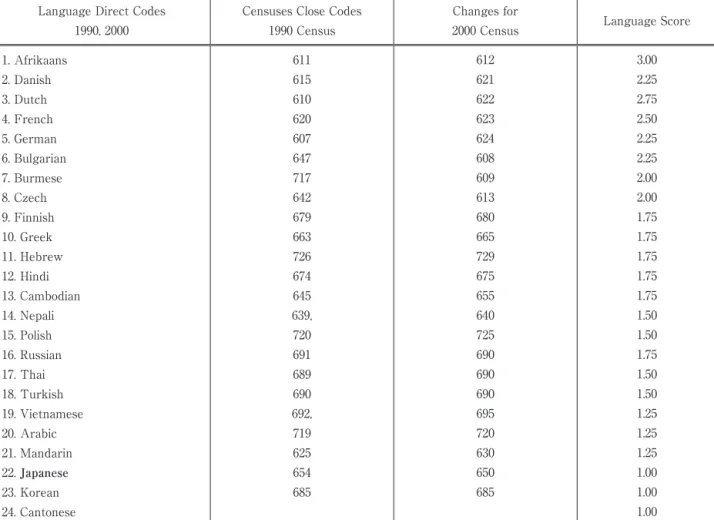
Langaue trees offer a diagramaitc form of language relationships and allow linguistics to trace the evoloution of languages. The potential to quantify the relationship offers the chance to anticipate diffulties for learners due to language dissimilarity or L1 intereference. In an attempt to triangulate language scores Hart-Gonzalez and Lindemann (1993) compare the language scores for different nationalities after the completion of foreign language training. The scores (see Table 1 below) can assist in the evaluation, and diagnostic analyses in understanding the determinants of English language proficiency among EFL learners of English.
Although criticized as crude and unreliable, they
English Linguistics: Difficulties in English for Japanese EFL Learners
『英語学概論:日本人にとって英語が難しい理由』
BURROWS, Christian Department of Educational Administration Faculty of Education for Future Generations 次世代教育学部学級経営学科 C. バロウズ
Keywords:English linguistics, communication problems, L1 influence on language
Abstract:This paper presents a summary of several of the major difficulties Japanese EFL
learners face when learning English a second language. In particular, the influence of the L1 on L2
language learning is highlighted. Particular reference is made to language distance phonological,
and lexical problematicity and the resulting effects on linguistic performance. It is recognized
that although the teaching environment and the quality of teaching are often criticized as inferior,
no acknowledgement is made of the real difficulties which exist in second language learning for
Japanese learners.
74 74
offer a cursory insight into manifested difficulties from learners from varying countries. More accurate assessment is required to reveal the underlying causes and influenceas to validate the findings, but as an oversight the data provides an interesting insight into differences in language systems.
The range is from a low score (harder to learn) of 1.00 for Japanese to a high score (easier to learn) of 3.00 for Afrikaans, Norwegian and Swedish. Japanese being the most distant, followed by Mandarin; then French and then Afrikaans, Norwegian and Swedish as the least distant. As the majority of the top- ten countires are European it is claimed that EFL learners from these countries would be expected to show quicker development due to language simmilarites than learners form Japan or Korea.
Segmental aspects: Phonologically related
Pronunciation difficulties can occur through the phonological transfer of sounds from the L1 into the L2. Well discussed variances between Japanese and English relate to the difficulty of pronunciation of phonological sounds which may not exist in either language.
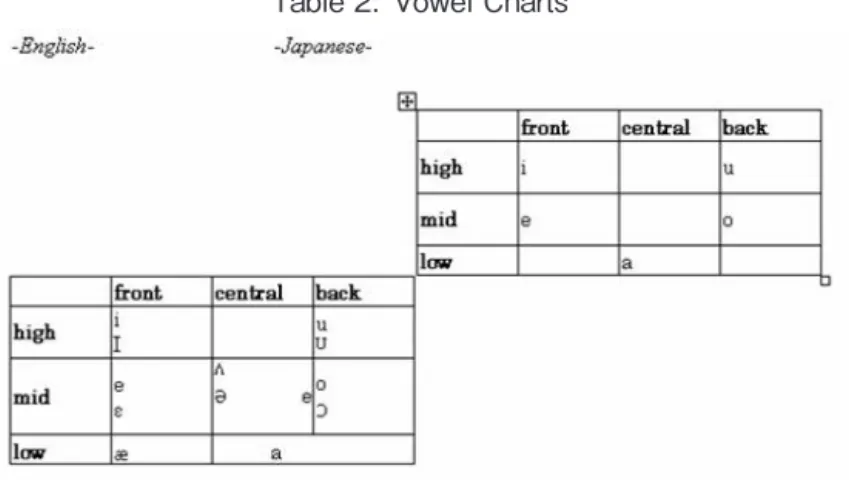
Vowels: The Japanese vowel system includes only five vowels (compared to 15 for English including dipthongs). Difficulty producing English vowels that do not exist in a Japanese vowel system unused to vowel distinctions made by the change of tongue positioning between the five front and five back vowels of English (only two distinctions exist for Japanese vowels). Additionally, the English central vowels are not represented in the Japanese system which results in difficulty in distinguishing “hut”,
Table 1: Index of Difficulty of Learning a Foreign Language (Language Scores) and Codes for Languages Reported in the U.S. Census
Language Direct Codes 1990, 2000
Censuses Close Codes 1990 Census
Changes for
2000 Census Language Score
1. Afrikaans 2. Danish 3. Dutch 4. French 5. German 6. Bulgarian 7. Burmese 8. Czech 9. Finnish 10. Greek 11. Hebrew 12. Hindi 13. Cambodian 14. Nepali 15. Polish 16. Russian 17. Thai 18. Turkish 19. Vietnamese 20. Arabic 21. Mandarin 22. Japanese 23. Korean 24. Cantonese
611 615 610 620 607 647 717 642 679 663 726 674 645 639, 720 691 689 690 692, 719 625 654 685
612 621 622 623 624 608 609 613 680 665 729 675 655 640 725 690 690 690 695 720 630 650 685
3.00 2.25 2.75 2.50 2.25 2.25 2.00 2.00 1.75 1.75 1.75 1.75 1.75 1.50 1.50 1.75 1.50 1.50 1.25 1.25 1.25 1.00 1.00 1.00
Note: Language Codes in this table are from 1990 United States Census of Population and Housing, Technical Documentation and from 2000 United States Census of Population and Housing, Technical Documentation.
75 75
“hat”, and “hot”.
The numerical difference is compounded by the way vowels are pronounced differently in English. A distinction between lax and tense vowels is made according to how much muscle tension or movement in the mouth is involved in producing vowels (Ladefoged, 1982). English vowels requiring additional muscle application (tense) contrast from those which can be produced with minimal tension (lax). The combination of unfamiliar mouth contortions in addition to unfamiliar sounds compound to present difficulty for Japanese learners of English.
Consonants: Noticeable differences also exist in consonantal distributions, with English also containing more consonants than Japanese. A more prevelant distinction lies in the unique distribution patterns of consonants in both languages with English a wider, more diverse range which includes consonant clusters. For example, the lack of a Japanese /v/ sound means the voiced bilabial stop /b/ for /v/ is substituted in its place. This can result in confusion when words such as ‘very’ are
pronounced. This problem also extends to the /r/ and /l/ difference and resulting words which prove difficult to pronounce. Word clusters result in the insertion of vowel sounds (vowel epenthesis) between the consonants resulting in the ‘Katakana pronunciation’ which can affect many beginners of English. For example, the ‘str’ consonant cluster would become ‘sutora’ resulting in /sUtOraberry/ to conform to the Japanese open syllable pattern (CV- CV).
The absence of a particular sound results in the substitution of that sound from the learner’s L1 sysem. In the case of /r/ or /l/ the consonant is unavailable in Japanese so is substituted with the liquid sound similar to both English /r/ and /l/, but which does not exactly correspond to either of the English liquids and are often pronounced in- between the sound of the English /r/ and /l/. The interchangeable of the usage results in common difficulty which results in native speakers of English having difficulty in distinguishing between, for example, a Japanese learner’s pronunciation of ‘rice’
and ‘lice’. Another problem that comes from the lack of particular consonants in Japanese but which exist in English is the pronunciation of labiodental Table 2: Vowel Charts
Table 3: Classification of consonants according to place and manner of articulation -Japanese-
76 76