137 137
論 文
The Benefits of Cultural Attraction in Learning Japanese History:
The Perceptions Among Undergraduate Students
日本への興味及び日本史を学ぶ際の利点の認識を下支えする大学生の 文化的魅力の理解の影響
スティーブン オーコナー Stephen O’CONNOR IPU New Zealand
Abstract:As a result of the declining interest in history as a subject to study, academics think that students can lack specific life skills. However, in order to make the study of history relevant and motivating for students, interest can be engaged through cultural objects of a country under study. This cultural attraction of its popular culture has been appropriated by Japan through its soft power influence. This study looks to investigate to what extent has Japan’s popular culture played in nurturing peoples’ interest in the country and its history and the perception of benefits of studying history. The study found that these cultural interests were the major reasons to study history, as well as affording the students the skill acquisition to interpret the past, make links with the present and then connect with recommendations for the future.
要旨:歴史学に興味が薄れていることを背景に,いくらかの研究者らは学生の具体的なライフスキル の欠如が見られると論じている。しかし,学生にとって歴史学が身近なものかつ興味深いものとする ために,特定の国の文化的側面を通じて考えることができる。日本のソフトパワーの影響力を通じ,
ポップカルチャーといった文化的魅力が充てられてきた。本研究では日本の歴史学に対する興味が ポップカルチャーによってどの程度の役割を果たしたのか分析する。本研究では,学生の文化的側面 への興味が歴史学を学び,過去を理解し,現在とのつながりを確認し,将来への提案を示すための重 要な要因となっていることが確認できた。
Keywords: History education, Study of history, Soft Power, Cultural attraction, Japanese history, Japanese culture
Introduction
Primarily, the Language and Culture Japanese faculty at IPU NZ has a focus on the acquisition of Japanese as a foreign language. However, in order to develop knowledge of Japanese culture and society, non-language courses can also be taken. In the first year of study at the institution, students have the option of taking Modern Japanese History as a first year elective paper. Throughout the years, there has always been a steady stream of students opting to study Japanese History at the institution as part of their degree. However, there are growing concerns amongst academia that the study of history has been relegated to the fringe of higher education
(Berg, 2019) and that students are abdicating taking the subject. This has led to studies investigating the nature and purpose of the study of history in the initial years in high schools around the world in order to understand why the subject wasn’t seen as worth pursuing with history as a choice of subject, some way behind other school subjects (Ostler, 2009; Wilschut, 2015). An international study in 1994 across European countries found that young people considered learning history had little relevance or use for them (Angvik & Von Borries, 1997). Also, those students that did take the subject had difficulty explaining why they took history (Barton & Levstik, 2011; Harris & Reynolds, 2014). As a result of these pessimistic results, some recommendations have been
suggested. Research by Haydn and Harris (2010) indicated that teachers should be spending increased time helping students to understand the purpose and benefits of studying history. Their study showed that when teachers made explicit the purpose of history, then students could see the relevance.
Academics think, as a result of a declining interest in history as a subject of study, that students are lacking in-depth thinking skills to navigate some of the problems prevalent in society (Wineburg, 2018). In order to placate this, academics have been vocal in the benefits the study of history can afford us. A substantial amount of literature on the topic advocates the usefulness of history for providing understanding of the past to inform the present (Gray, 2005; Teaford, 1973). Bentley (2007) outlines the impact of studying history and the opportunity it provides to make the person wise and enabled to make good judgements, making better life choices.
However, studies have outlined the disparity between the academic literature and with what is actually offered in the classroom, as students seem unable to use knowledge of the past to orientate the present and future (Foster, Ashby & Lee, 2008;
Shreiner, 2014). One of the reasons this could be is the curriculum tended to have the past events studied independently, rather than in their relevance to contemporary society (Haydn & Harris, 2010).
Overall, what all of these examples suggest is that there seems to be a significant gap at the grassroots level in the middle and more especially, high school sector in ways of how history can be made relevant to students as a subject to study, so that the past, present and future connections within the subject can be made.
This thinking of the connection of the past and present and that there is interdependence between them is important in history and is known as historical consciousness (Berg, 2019). It is relevant because it is the ability to be able to interpret the past, make links with the present and then connect with recommendations for the future. It is the understanding that human culture exists in time and that its development is an ongoing process. Within this, the learning of history of other cultures enables
history students to reflect on them, perhaps in relation to their own.
Conceptual Framework
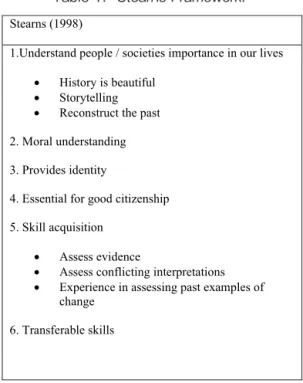
History had been the staple of Higher Education courses and in 1998 the American Historical Association (AHA) commissioned historian Peter Stearn to outline its usefulness in a framework. As outlined below in table 1, there are a number of key factors he felt was important for the overall purpose of studying history. First and foremost, was the understanding of people and culture in order to better comprehend how we should run our own lives. Mirroring this understanding was a study by McNeil (1985) who believed that there needed to be a critical reflection of the past, as these are patterns that help inform the future. This imbued a sense of being aware of the differences and improbabilities that are a part of our society. Also, the framework addressed the notion that a trained student in history will also have a number of skills that can be applied in everyday life. Glassie (1994) in his research alluded to this in finding that history could teach lessons in life, citizenship and individual development.
overall purpose of studying history. First and foremost, was the understanding of people and culture in order to better comprehend how we should run our own lives. Mirroring this understanding was a study by McNeil (1985) who believed that there needed to be a critical reflection of the past, as these are patterns that help inform the future. This imbued a sense of being aware of the differences and improbabilities that are a part of our society. Also, the framework addressed the notion that a trained student in history will also have a number of skills that can be applied in everyday life. Glassie (1994) in his research alluded to this in finding that history could teach lessons in life, citizenship and individual development.
Table 1. Stearns Framework.
Stearns (1998)
1.Understand people / societies importance in our lives
History is beautiful
Storytelling
Reconstruct the past 2. Moral understanding 3. Provides identity
4. Essential for good citizenship 5. Skill acquisition
Assess evidence
Assess conflicting interpretations
Experience in assessing past examples of change
6. Transferable skills
Source: Adapted from Stearns, 1998, n.p.g.
In a study by Berg (2019), that looked at university undergraduate student beliefs on the implications of studying history that applied the framework by Stearn, found students could use history as a tool to enable them to make purposeful decisions based on past events and leading into the future. However, he noticed the barriers to good teaching were the passivity of the programs and curriculum in the school system. His recommendation was to conduct a comparative international study using the framework within a national context, looking at student attitudes and beliefs about history. This is what my study has attempted to do and
Source: Adapted from Stearns, 1998, n.p.g.
Table 1.Stearns Framework.
138 138
In a study by Berg (2019), that looked at university undergraduate student beliefs on the implications of studying history that applied the framework by Stearn, found students could use history as a tool to enable them to make purposeful decisions based on past events and leading into the future. However, he noticed the barriers to good teaching were the passivity of the programs and curriculum in the school system. His recommendation was to conduct a comparative international study using the framework within a national context, looking at student attitudes and beliefs about history. This is what my study has attempted to do and needless to say, this framework provides the impetus to analyze the impacts of cultural attraction of Japanese culture and to help justify the rationale to study Japanese history.
Soft Power and Japan
In the realm of international politics, soft power takes the antitheses of the age-old concept of hard-power and coercion between nations and replaces it with the ability to influence others through co-optness.
This term of soft power was coined by Peter Nye in the late 1980s and has since become popular in the political sphere. Vuving (2009) sees it as synonymous with further non-military power that co-exists with both cultural and economic power. Popular in the 1990s, Nye (2008) attests that countries can affect others through the power of enticement and attraction. Countries can do this through its resources of culture, values and policies. This is important, as rather than coerce another country through threats, a country’s resources prove attractive and people will be tempted naturally as they can relate to the promoted values of the culture.
Prior to the 1980s, Japan didn’t have such an appealing influence on other countries. During the early twentieth century Japan had pursued an ambitious and aggressive course of expansion which remained as an obstacle to better relations with its international neighbors (Henshall, 2012). However, alongside increased economic power, wealth and a more dynamic living standard during the latter half of the century, Japan began to grow its cultural
influence (McGray, 2009) and increase its reach of cultural power globally. In 2018, Japan had managed to push itself into the top five index of soft power 30 in the world (Soft Power 30, 2018) and this was an accumulation of a wealth of culture and innovation through anime, J-Pop, manga, cuisine, electronics, automobiles, art, literature, design and architecture.
According to Iwabuchi (2002) these cultural products help to show Japanese cultural inventiveness and pique interest. Yu, Takata and Dryland’s (2012) study on the impact of Japanese popular culture in Hong Kong found the popularity of these cultural products have had a significant impact on the millennial children. In order to capitalize on this popularity, the Japanese government has appropriated a cultural diplomacy through its manga (comics) and anime (animated cartoons) investing a ‘Cool Japan’ strategy.
Although there has been research that has indicated the positive influence on the learning of the Japanese language around the world, there have been very few studies that have examined the effects of this cultural attraction on students’ interest in studying Japanese history. Therefore, this current study looks to investigate the perceptions of Japan’s soft power has played in nurturing peoples’ interest in the country and its history and the perception of benefits of studying history.
Methods
Over the first semester of 2020, within the Modern Japan history class at IPU New Zealand, 13 students completed a questionnaire. All participants were undergraduates at IPU and aged between 17 and 23 years old, with seven males and six females. There was a mixture of New Zealand born students and also those that identified as international students.
Those other countries that were represented consisted of Vietnam, Indonesia and Samoa. Over half the students in the class had designated Japanese Language as their major. The questionnaire incorporated a qualitative design to explore the experiences and perspectives. Initial questions collected background data and the remaining questions were semi-structured and open ended, 139 139
exploring their opinions on the study of history and then subsequently their interest in Japanese culture in order to gain a more meaningful response. This included:
11. What aspects of Japanese culture interest you?
12. Why did these aspects interest you?
13. Did the cultural aspects motivate you to want to learn Japanese history?
14. In what way?
Results and discussion
Employing a descriptive statistical analysis of the responses from the students, it was found that for the most part, in the initial considerations of history as a topic of study, they followed a more traditional conception in correlating the subject as mostly
“historical facts,” “chronology of dates and events,”
“reading” and “essay questions on unfamiliar topics.”
Although, all of the respondents mentioned that when they thought of history they considered it as a discipline that could focus on “finding the truth.”
This is in keeping with Berg’s (2019) research of student perceptions of studying history, who also found these traditional notions imbued, and in an earlier study, (Berg & Christou, 2017) touched on the causes of this, it being barriers to good teaching and motivated learners through traditional methods of rote memorization and learning of facts, as two examples. Similarly, Stearn’s (1998) concepts in his framework of ‘storytelling’ or ‘history as beautiful’
were not touched on either within this context of history as a topic of study. However, an interesting comment by a single student corroborated Gray (2005) and Teafords (1973) assessment that the lessons from history’s past can be appropriated to better inform the present. The questionnaire also explored the reasons for taking history and these were consistent amongst the participants. All of the answers corresponded with the literature in how students placed importance on (Berg, 2019;
Andress, 1997; & Stricker, 1992) exploring our past, learning from past experiences and the fact that history can help us understand the world we live in.
Interestingly, this included insights to other cultures
and also exercising critical thinking skills.
The overlying benefits for students learning history included an overwhelming majority mentioning analytical skills development, a foundation built for history related careers, diverse professional opportunities and the ability to apply historical insight to business success. In part, the skills development fits with Stearn’s framework of number 5 and having the skills acquisition in having the ability to assess both evidence and conflicting interpretations. Additionally, the participants were adamant of future career and business opportunities the study of history could afford which is in keeping with Stearn’s number 6 of transferable skills.
Also, Stearn’s framework draws on the concept of fostering citizenship and one student recounted how she could recover from a past trauma because of an increased understanding of the Japanese culture through the history class. This shows that at least some of the students are seeing a connection between studying history and citizenship which can lead to personal growth, a finding Berg (2019) assents is supported by the research literature.
Cultural Attraction
As language is linked to culture and the majority of students in the history class at IPU New Zealand have, or are studying the Japanese language, it can be inferred that the motivation for learning the language is because of Japanese culture and the cultural products, as found in a previous study (Iwabuchi, 2002). This research confirmed that most of the participants agreed that these cultural interests were also the reasons to want to learn Japanese history. The students listed the range of years of interest in Japanese culture from 3 to 19 years and the most popular aspects being manga, anime, food, fashion and also films. In response to why did these aspects interest them, the answers were varied. Some mentioned siblings that introduced them to these cultural products, others identified the more-deeper and nuanced art and storytelling of manga compared with western counterparts, while still others were interested as a byproduct of
the video gaming they were involved in. Regarding motivation for wanting to learn Japanese history, the students were adamant the culture was the defining reason for doing so and that this was a direct result of the cultural neutral product such as manga and anime, as well as the non-neutral products; TV programs. Linking both history and culture, one student regarded historical anime as motivating.
The final question in the questionnaire asked the students the value of studying Japanese history for their studies, personal life and for their future. The first question offered a variety of answers. Students mentioned they were Japanese language majors and took the paper as an elective choice. They also stated it gave them a better understanding of other cultures and the chance to indulge in an in depth course of history; something they had not been able to do while in high school. For the second question, and the value for their personal lives, the students touched upon the positive effects on behavior if they are aware about Japan, before they live there. Interestingly, the value of Japanese history made for a foundation for deeper understanding of the culture and could allow them to be more open minded, as well as enabling them to discuss with others the topic of Japanese history. For the last question in gauging what value does Japanese history hold for their future, the participants mostly related their responses to career prospects after study and for the most part in Japan.
They mentioned that they would like in the future to live and work in Japan and so it gave them a better understanding of the people and customs in order to do that. Also, one student expressed an interest of being a history teacher. The results from these questions confirmed a previous study by Yu, Takata and Dryland (2012) who found that the initial interest from Japanese pop culture was the catalyst for learning the language and culture.
Conclusion
In summary, this paper has initially looked at the relevant factors as to why history has become an outlier amongst other more popular subjects for study in high schools. Stearns (1998) framework about
why history should be studied was implemented.
Overall, students studying history as a first year paper at university found it useful for reflecting on past lessons and providing the path for future recommendations. This is in keeping with Berg’s (2019) study. A potential barrier was identified with students revealing the more traditional methods of imparting the study of history in high schools still being in place. There should be more reflection on the pedagogical methods of conveying the knowledge, and especially so now within the digital technology world and how these can be appropriated to their best advantage in the history classroom. The students could understand the importance of the historical context of people and societies as outlined from Stearn’s framework. This present study also collaborated Stearn’s framework of the student’s knowledge of transferable skills and the acquisition of specific skills through the learning of history.
Japan’s nurturing of its soft power image through its popular culture has had an indelible effect on millennials. The study found that this was a strong reason for students to have an interest initially in Japanese culture, which then encouraged them to take up the study of its language and then the pathway for greater knowledge of Japan’s history.
Indeed, if there was more of an alignment within high schools of the pedagogy of history teaching, enabling students to see how the past can inform our present and future, building on their own personal interests through pop culture, then students once they enter university would be more inclined, motivated and be better able to gain important learning and life skills through the study of history. In the words of William Faulkner, “The past is not dead. In fact, it’s not even past.”
References
Andress, D. (1997). Beyond irony and relativism: What is postmodern history for? Rethinking History, 1(3), 311-326.
Angvik, M., & Von Borries, B. (1997). Youth and history: A comparative European survey on historical consciousness and political attitudes
141 141
among adolescents. Hamburg, Germany: Körber Stiftung.
Barton, K. C., & Levstik, L. S. (2011). Doing history:
Investigating with children in elementary and middle schools. New York, NY: Routledge.
Bentley, J. H. (Oct. 2007). Why study world history?
World History Connected, 5(1), Retrieved from http://worldhistoryconnected.press.uillinois.
edu/5.1/bentley.html
Berg, C. W. (2019). Why study history? An examination of undergraduate students’ notions and perceptions about history. Historical Encounters, 6(1), 54-71.
Foster, S., Ashby, R., & Lee, P. (2008). Usable historical pasts: A study of students’ frameworks of the past:
Full research report ESRC end of award report.
RES-000-22-1676. Swindon, United Kingdom: ESRC.
Glassie, H. (1994). The practice and purpose of history. The Journal of American History, 81(3), 961-968. Retrieved from https://www.jstor.org/
stable/2081435
Gray, P. W. (March, 2005). Why study military history? Defence Studies, 5(1), 151-164. doi:
10.1080/14702430500097408
Haydn, T., & Harris, R. (2010). Pupil perspectives on the purposes and benefits of studying history in high school: a view from the UK. Journal of Curriculum Studies: National History and Beyond- Part Two, 42(2), 241-261. https://doi.org/10.1080/
00220270903403189
Harris, R., & Reynolds, R. (2014). The history curriculum and its personal connection to students from minority ethnic backgrounds. Journal of Curriculum Studies, 46, 464-486.
Henshall, K. G. (2012) A history of Japan: From Stone Age to superpower. Basingstoke: Palgrave Macmillan.
Iwabuchi, K. (2002). Recentering globalization: Popular culture and Japanese transnationalism. Duke University Press.
McGray, D. (2002). Japan’s gross national cool.
(Globalization at Work). Foreign Policy.
McNeill, W. H. (1985). Why study history? American Historical Association. Retrieved from
http://www.historians.org/about-aha-and-
membership/aha-history-andarchives/archives/
why-
Nye Jr, J. S. (2008). Public diplomacy and soft power.
The annals of the American academy of political and social science, 616(1), 94-109.
Shreiner, T. L. (2014). Using historical knowledge to reason about contemporary political issues: An expert-novice study. Cognition and Instruction, 32(4), 313-352.
Stearns, P. N. (1998). Why study history? American Historical Association. Retrieved from
http://www.historians.org/about-aha-and- membership/aha-history-andarchives/archives/why- Stricker, F. (May, 1992). Why history? Thinking about
the uses of the past. The History Teacher, 25(3), 293-312.
Teaford, J. (1973). “Why Study History?” The Social Studies, 64(4), 164-169.
The Soft Power 30. (2018). A global ranking of soft power 2018. Retrieved from
https://softpower30.com/wp-content/uploads/
2018/07/The-Soft-Power-30-Report-2018.pdf
Vuving, A. (2009) How Soft Power Works. Paper presented at American Political Science Association Annual Meeting, Toronto, 3rd September.
Wilschut, A. (2015). Testing frame of reference knowledge in national examinations: Report on an experiment in the Netherlands. In A. Chapman &
A. Wilschut (Eds). Joined-up history: New directions in History Education Research. 85-115. Charlotte, NC: Information Age.
Yu, X., Takata, K., & Dryland, E. (2012). Cultural attraction,‘soft power’ and proximity: the popularity of Japanese language in Hong Kong since the 1980s. Journal of Cultural Geography, 29(3), 315-336.